All posts by admin

The Onondagas and the Movies, Part III

In the 1992 movie “The Last of the Mohicans,” filmmaker Michael Mann found inspiration in the famous but dreadful novel by James Fenimore Cooper.  As did the folks who made “The Iroquois Trail,” forty years before, Mann and his crew took what they wanted from the source material in an effort to construct an adventurous story that spoke to a large white audience.  The film one one hand sheds some light on the broad cultural influence of the Onondaga Nation and Americans’ changing attitudes toward Native American peoples in the late 1980s and early 1990s.  It also demonstrates how limited that change really was.

In Mann’s “Mohicans,” as in Cooper’s novel, native people are either noble or ignoble, all uniquely in touch with their surroundings and with nature, but all tragic, all doomed. They appear, they do things, but clearly they will all disappear. Cooper’s novel and Mann’s film both reflect long-held notions of the “Vanishing American.” In the original novel, Natty Bumppo, or Hawkeye, along with his companions Chingachgook and Uncas escort the daughters of the British colonel Munro, Alice and Cora, through the war-scarred wilderness as they avoid the vengeful Huron Magua.  Cora, the daughter of Munro and an African slave, draws the attention of both Uncas and Magua, but Alice, whose name means “Light,” does not.  Cora, darker of skin and hair, is pursued by Cooper’s “dusky” characters, and makes statements more sympathetic to native peoples than do other characters in the novel.  She dies in a Huron attack, but Alice does not.

Mann did not address Cora’s race, and it is hair-haired Alice who draws the attention of the Indians in his version of the story. In Manning’s hands, “Mohicans” is a love story, with Cora and Hawkeye (renamed in this film Nathaniel Poe because, well, Natty Bumppo is a stupid name) occupying center stage. Alice, rather than fall into savage hands, flings herself over a cliff and dies.

“Last of the Mohicans” came out during my third year of graduate school in 1992. It was the sort of film that grad students in Early American history loved to criticize and laugh at.  Indeed, I always remembered the film most for its famous goofs and careless film-maker’s blunders.  The English leave Fort William Henry after its surrender to the French: Where will they go? Why they will march towards the two large buses visible in the shot.  How will they get there? The director with the blue baseball cap and the bullhorn will tell them where to go.  Danger awaits, however, as Magua’s warriors prepare to spring the trap, the right-handed warriors on one side, the left on the other.

Mann’s film appeared two years after Kevin Costner’s “Dances With Wolves” set a new standard for Native American involvement in movies about native peoples.  It also appeared a month before the 500th anniversary of Columbus’s “discovery” of America. The Columbian Quincentenary provoked scholars and activists alike to look once again at the catastrophic consequences of European discovery.  Popular books like Kirkpatrick Sale’s The Conquest of Paradise and David Stannard’s American Holocaust appeared, as well as special editions of scholarly journals like the William and Mary Quarterly examining the legacies of the “Columbian Encounter.” Publishers produced books for young readers providing more sympathetic treatment of native subjects.

Americans’ attitudes toward native peoples had changed, it seemed, and manifestations of this appeared all over: from the growing interest among early American historians in Native American history, for instance, to a large number of films and documentaries. Anthropologists and historians began to tell each other, even if they did not always act on their own advice, that they ought to talk to the Native American descendants of those about whom they wrote and whose histories and cultures they researched.  In 1987, under the influence of a small group of scholars in Native American Studies, the United States Senate passed a resolution acknowledging Native American contributions to American democracy, even if historians roundly criticized the “Iroquois Influence” thesis. There seemed to be an increasing amount of interest in native peoples.

Filmmakers like Michael Mann were of course not immune to these changes.  For his film to succeed, he needed the support and participation of native peoples.  Otherwise, it would be viewed as neither authentic nor acceptable.

Mann shot the film in North Carolina, a far-cry from the story’s setting in northern New York, largely on land surrounding the opulent Biltmore estate. Large numbers of Cherokees served as extras. Mann brought in actors from across Native America.  And because Onondaga remained in many ways a “Capital City” in Native America, and its leaders spoke with such authority on so many issues, Mann sought their advice and their assistance. According to a story that appeared in the Syracuse Post-Standard on August 15, 1992, “more than a dozen Onondagas, including two chiefs and a clan mother, appear in this Hollywood version of Jame Fenimore Cooper’s tale of the upstate frontier.”  Thadodaho Leon Shenandoah appeared in the film, as did Clan Mother Alice Papineau.  Dennis Banks, the great American Indian Movement leader who spent time as a fugitive at Onondaga, also appeared in the film.  The shooting took place over several weeks.  Onondagas received eighty dollars a day, plus room, board, and transportation.  It was tiring.  When the shooting ended, “sound technicians returned to Onondaga to tape voices of Indian men and women and the laughter of children.” Leon Shenandoah told the paper that “the movie’s waterfall sounds echo the falls that spill over Hemlock Creek on the reservation.”  Yet despite the hard work, those Onondagas involved in the movie looked forward to seeing the finished product.

“All the more wonder, then,” the Post-Standard reported six weeks later, “why 20th Century Fox paid little attention to upstate New York and its Iroquois nations when debuting ‘The Last of the Mohicans” in Syracuse. The film’s producers invited nearly 400 people to a special screening at the Fayetteville Mall but only fifteen were Onondagas, “most of whom scored tickets late in the day.”  According to the story, “Lynn LaRocca, the Syracuse representative of several Hollywood studios, including 20th Century Fox, said the studio sought a low-key opening but did not ignore the movie’s upstate ties.” LaRocca told reporters that she mailed complementary tickets to Leon Shenandoah, but he “was out of town and unable to pick them up at an off-reservation post office box.”  Though some were able to get their hands on tickets, most in the community would have to wait to see the movie and pay the price of admission.

Those Onondagas who did see the film at its premiere had positive things to say.  Vincent Johnson “praised the film’s insightful depiction of Colonial America, one that showed Indians and early colonists sharing similar problems with the European powers.”  He told the reporter that “It’s nice to see Real Native Americans in a movie.”

Michael Mann and the film’s producers needed Indians in the film.  They needed cooperation and assistance for reasons tied solely to the movie’s bottom line.  But they really did not want any interference or trouble.  Show up.  Do what we ask you to do.  Let us make our movie.  Collect your paychecks and then disappear.  The inattention the producers paid to the Onondagas at the movie’s premier shows clearly the limits of their respect.  They liked Indians best when they allowed them to create a fictionalized representation of the American past, a movie that became even more than Cooper’s novel, a story of white people falling in love.

A long time ago I used to assign Fergus Bordewich’s Killing the White Man’s Indian to students in my Native American survey course.  It was the first book we read.  Bordewich argued that both native peoples and white people embraced certain standards and definitions of who Indians were and what they ought to be that were extremely limiting.  One part of this was to cast native peoples as part of the past.  Mann and his crew wanted native peoples to play parts in his film, to accept their role in the story he wanted to tell quietly and without complaint.  In this sense, Mann was not unlike many, many historians who have done the same thing.  Indians existed, in Turner’s language, at the “outer edge of the wave,” and the “meeting point of savagery and civilization.” If they showed up anywhere else, in any other manner, they were a problem that could be cast aside, ignored, forgotten.
The Onondagas and the Movies, Part II: John Big Tree

On July 7, 1967, Chief John Big Tree died on the Onondaga Reservation.  Born Isaac Johnny John, perhaps in 1877 in Michigan, the Seneca actor appeared in nearly five dozen movies between 1915 and 1950.  He played a scout in “Stagecoach” along side a young John Wayne in 1939, and with Henry Fonda in “Drums Along the Mohawk,” and, again with John Wayne, in “She Wore a Yellow Ribbon.”  That was 1949, his second-to-last film. He played Chief Pony That Walks.

After his retirement from the movies, Big Tree settled at Onondaga, where he stayed near the center of the community’s life.  According to a story about the upcoming Green Corn Dance hosted by the nation in 1951, an event that was open to the public and well-promoted in the Syracuse newspapers, the Post-Standard noted that “Chief Bigtree, motion picture actor, and is wife, Cynthia, will appear” along with Mrs. Bigtree’s “famous green corn soup and ghost bread.”  Two years later, along with Percy Smoke, Nelson Schenendoah, Jimmy Noland, and others, Big Tree joined with Onondagas at the Syracuse Boys’ Club’s Camp Zerbe to “relate Indian lore and demonstrate tribal dances.”

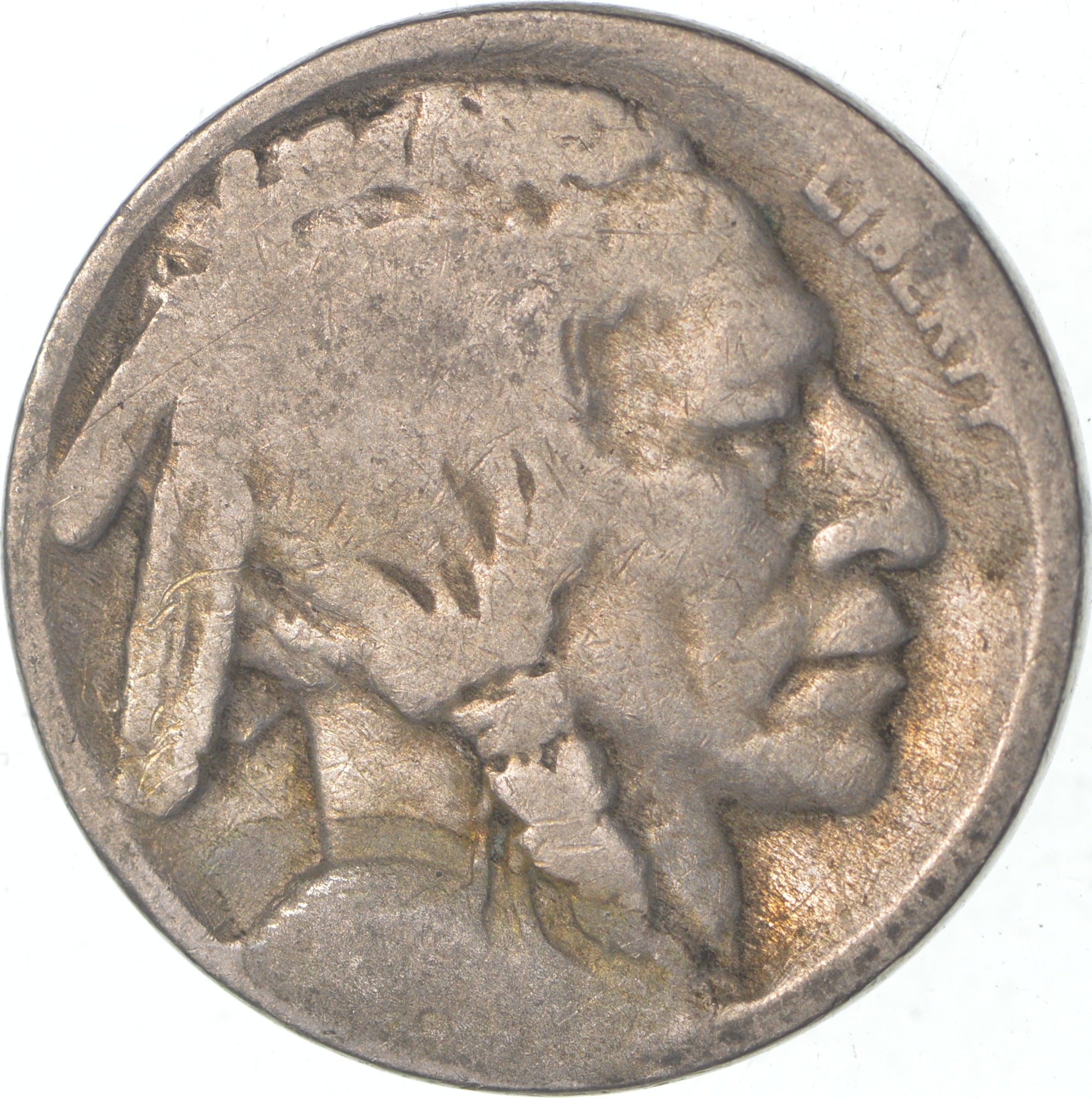
In 1964, Big Tree appeared on the cover of Esquire magazine in a pose that looked back to what he seemed to consider his most famous role.  Big Tree claimed that James Earle Fraser used him as one of his models when he sculpted the image for the “Indian Head” or “Buffalo” nickel, which circulated from 1913 to 1938.  Big Tree claimed as well to have posed for Fraser’s most famous sculpture, “The End of the Trail.”

Fraser denied this.  In a letter he wrote to Calvin Coolidge’s Commissioner of Indian Affairs in the summer of 1931, he wrote that “the Indian head on the Buffalo Nickel is not a direct portrait of any particular Indian, but was made from several portrait busts.”  It was, in a sense, a composite image.  Fraser wrote that he “used three different Indian heads.” The name of one of them, perhaps Big Tree, he said he could not remember.  The other two included “Irontail, the best Indian head I can remember; the other was Two Moons.” Some thought that the third Indian was not Big Tree but Two Guns Whitecalf, but Fraser was certain this was not the case.  Fraser was not always precise in his recollection.

Nonetheless, John Big Tree made many appearances as the “Indian on the nickel,” and when he died in 1967 the reports identified him as the model for Fraser’s image.  Big Tree, the wire-service story in the Syracuse Post Standard noted, was best “known for his acting and for his likeness on the Indian head nickel.”

As I’ve indicated in previous posts, my research right not consists of reading lots of newspaper articles about the Onondagas. I have quite literally thousands still to read through.  John Big Tree, obviously, is a very tiny part of the much larger story I intend to tell.  At a period when Onondagas appeared at the Indian Village at the New York State Fair in Plains Indian dress, an effort to assert their identity as native peoples as they fought state efforts to tax their lands, as they contended with polluters on the reservation, and began to assert that wampum belts and other items housed in the New York State Museum were part of their cultural patrimony, John Big Tree was a former celebrity whose presence appealed to his audience’s nostalgia.  That’s revealing.  White people in the state carried powerful assumptions about who native peoples were and who they ought to be.  More than anything, they tended to view native peoples, and their culture and their language and their ways of living, as part of the past.  If any number of white people had their way and any number of points in their history, I tell my students, the Onondagas would have been gone. In a sense, they had to appear in a certain manner–that of the Plains Indian–in order for white people to see them, to consider them authentic.  At the time John Big Tree died in 1967, that was beginning to change.  And the magnitude of that change will be most visible when we get to our next film next week.

The Onondagas and the Movies, Part I: “The Iroquois Trail”

One of the things about doing newspaper research, I find, is how easily it can lead to distraction.  I am at a point in my research where I am still formulating questions, where I still have so much to learn.  I am not looking for any one thing.  Rather, I am trying to collect as much information as I can about the Onondagas and their history.  In this sense, nothing I find is irrelevant, and everything I read might be significant, even if I do not know now what I might eventually do with that information.

In 1950, Bernard and Edward Small produced a film called “The Iroquois Trail.”  To generate publicity, the producers staged a screening in Syracuse, the “hometown of Hiawatha,” they said. I would never have known about this film had I not read the Syracuse papers looking for information about the Onondagas.

So armed with Wi-Fi, Youtube, and an hour-and-a-half workout at the gym, I watched “The Iroquois Trail.”  It was bad.  Like, “what was wrong with these people?” bad.

Based loosely upon James Fenimore Cooper’s The Last of the Mohicans,” a novel I loathe from the very pit of my soul, “The Iroquois Trail” contains elements that Cooper’s readers would have recognized as kinda-sorta similar to the novel.  Instead of Natty Bumpo, the film focuses upon Nat Cutler.  Played by George Montgomery, Cutler is a fast-talking, witty frontiersman with a stupid, coonskin cap, a desire to avenge his murdered kid brother, and a determination to prevent the British from marching into a military blunder.  Instead of Chingachgook, Cutler’s sidekick is the redundantly-named “Chief Sagamore,” loyal and committed until the end.  Ogana, their nemesis, serves the same function as did Magua in Cooper’s novel, a malevolent double-crosser who hates the English and lusts after “Yankee scalps and a white woman for his tepee,” thus preserving Cooper’s interest in transgressive interracial sex.  And everyone contends for the British fort commander’s daughter.  The struggle between France and Great Britain for control of the Hudson-Champlain waterway during the Great War for Empire serves as the setting.  But less than a distillation of Cooper, “The Iroquois Trail” seems more like a summary written by a school kid who did not understand the original.

It is difficult to know where to start in listing the problems with the film.  The producers filmed it around Big Bear Lake, and any Californian would recognize that at the outset.  Northern New York does not look like that. Only a few Indian actors appeared in the film and, save for Monte Blue, who played Sagamore and claimed some Native American descent on his father’s side, only in small and uncredited parts.  Ogana, the villain, was played by Sheldon Leonard, a Jewish-American actor from New York City best known for playing tough guys and for a small role in “It’s a Wonderful Life.” The Indian-speak of the native characters is grating, the deployment of Native American stereotypes so heavy-handed. The dialogue is terrible, the characters’ motivations muddled, and the entire production lazy.  I was relieved that it was not nearly as long as I expected.

The film itself was entirely predictable, completely uninteresting, poorly acted, unevenly paced, and carelessly written.  Still, its promotion in Syracuse did interest me.  The Strand Theatre teamed up with Boy Scouts of America to promote the film and public safety.  “Traffic signal standards will be posted with caution signs keyed to the city’s historic locale on the old Iroquois trail, which crossed the state from Albany to Niagara,” the Syracuse Post-Standard reported on 12 July 1950.  When the film finally premiered later that month, the young audience was “constantly vocal in tribute to the red-blooded adventure story,” and “in a hissing mood against Ogana, the proud Huron chief (well-played by shaved-head Sheldon Leonard) who used every deceit known, playing France against English and colonials.”  The audience, the Post-Standard reporter indicated, was “delighted” by the movie.

And in all of this–a film set in New York during the Great War for Empire, a publicity campaign that capitalized on the city’s ties to the history of the Haudenosaunee–no mention was made of the actual Onondagas, whose reservation boundary was just a few minutes away from the theater.  It was during these years that Iroquois people gathered at the New York State Fair grounds in Syracuse at the Indian Village dressed in Plains Indians clothing because white people needed to see that in order to recognize them as authentic.  Movies like “The Iroquois Trail” taught audiences that native peoples were part of the past, that they were either noble or ignoble, but in all cases part of the past.  The filmmakers and the promoters appropriated a story and a piece of history and marketed it as relevant to the history of people who lived in Central New York.  But they felt no need to visit real native peoples, to speak with them, and learn their histories.  There is no word in the paper if any Onondagas traveled in to town to catch the movie before it disappeared.

Strand Theatre


The Coward John White

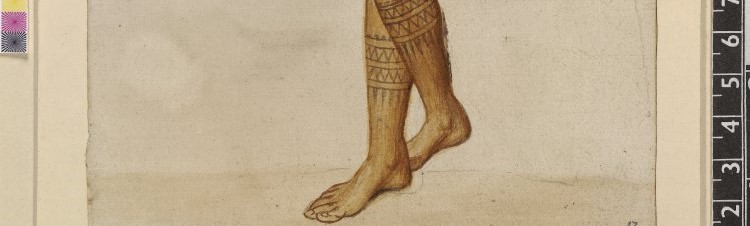
The failed governor of a failed colonial enterprise, sent packing from what would soon become the fabled “Lost Colony” of Roanoke, and a pretend aristocrat whose patron procured for him a bargain-basement coat-of-arms, John White was also an “important” and “renowned” artist whose “vivid” and “lifelike” images included an Algonquian woman he depicted with two right feet.  Nearly everything John White touched turned to shit.

White did not lack for experience, we are told. He likely sailed aboard one of Martin Frobisher’s voyages in search of mineral wealth and a northwest passage in the 1570s.  He accompanied the reconnaissance voyage Sir Walter Ralegh sent to “Virginia” in 1584 and, the next year, returned aboard the much larger expedition sent to establish a base along the coast of today’s North Carolina.  He was among those men who, that summer, explored the coast to the south of Roanoke Island where he completed several paintings of the Algonquian peoples of the region and towns in which they lived, before he returned home with Sir Richard Grenville in the fall of 1585. He may have traveled more widely in the summer of 1585 to gather the information necessary to make his large map of the Outer Banks and Eastern North America. In 1587 Ralegh decided to try again, and for reasons that remain inexplicable still, he appointed White governor of what he hoped would become the “Cittie of Ralegh.”  White returned home from the colony a few weeks after arriving, and would not make back until 1590.  It was then that he discovered that the colony he claimed to have governed had disappeared.  Five voyages to America, but he spent more time aboard ships coming and going than he actually did on American shores.

It is easy, I suppose, to view White as a pathetic figure.  He brought his family to England’s paltry new world outpost. Circumstances forced him to return to England, and to struggle for several years to return to America.  He never succeeded in reuniting with his daughter, her husband, and their daughter Virginia, the first English child born in America.  How painful this must have been for him, to not know what had happened to his child and grandchild.

It is understandable.  It must have been agonizing for White. I can imagine his pain easily. But I keep tripping over my belief, based upon reading and re-reading the surviving records, that every time John White was faced with an important choice, he made the wrong one.

Every document that sheds light on the planning for the 1587 colony, for instance, shows that Ralegh charged White with establishing his “Cittie” on the Chesapeake Bay.  Relations with the Indians there the previous year offered promise.  An English party spent some time there in 1585 and 1586.  They found the deep water anchorage, abundant food, and peaceful Indians far more welcoming than the Algonquians in the vicinity of Roanoke, who would soon chase the colonists out of America.

Before heading to the Chesapeake, White wanted to check in on the men Richard Grenville had left at Roanoke the year before, shortly after the harried colonists evacuated.  He may as well have intended to install Manteo, the Indian from Croatoan who had stuck with the colonists since 1585, as a sort of feudal “Lorde of Roanoac” to govern the region in Ralegh’s name. So they were going to check in on Grenville’s colonists, install Manteo in his new post, and then carry on northward towards the Chesapeake.  Simple enough.  But that did not happen, and White’s explanation why makes little sense.

White and his men clambered aboard the pinnace, a smaller ship capable of safely crossing the Outer Banks.  “Simon Ferdinando,” the expedition’s pilot, told the sailors aboard to drop White’s party at Roanoke, “saying that the Summer was farre spent.”  It was the 22nd of July and, White suggested, Ferdinando wanted to get on with the more lucrative business of chasing Spanish prizes.

Which makes no sense at all, for Ferdinando did not leave until the last week of August, more than a month later. White spent much of his account whining about Ferdinando, blaming him for everything and for nothing, and the charges simply do not add up.  One of the ships that made up the 1587 voyage separated from the other two in some rough weather: White blamed Ferdinando for this, accusing him of trying to abandon one of the ships. At another point, Ferdinando was not certain of his latitude, and at another he thought he could find food in the Caribbean but his supplier could not be found.  Understandable, perhaps, but White blamed Ferdinando for these events, too.  The colonists ate poisonous fruit, manchineel apples, and to wash that down drank nasty, stagnant water, and fell ill.  Ferdinado remained aboard the flagship. Still, White blamed Ferdinando, even though it was he who allowed the colonists to drink “stinking water of the pond,” and who failed to keep the colonists safe while on land.  Later, the flagship nearly ran aground near Cape Fear, and again White blamed Ferdinando. And the decision to settle on Roanoke, despite instructions to go elsewhere? White blamed that on Ferdinando, too, but the only logical explanation for White and his colonists ending up on Roanoke was that he decided to settle in this somewhat familiar setting, rather than move to the Chesapeake where he had no first hand experience.

It was a bad choice.  Grenville’s  men were very clearly dead: White reported that his men found the skeleton of one of them. Very clearly they had been killed by Indians. Within a couple of days, those same Indians killed George Howe, one of White’s closest advisers.  White attempted to carry on some diplomacy and figure out how the Indians felt about his colonists, which somehow still seemed a mystery to him.  The Croatoans, always friendly, at first feared the English and lined up for battle before Manteo assuaged their fears.  They lectured the English about indiscriminate attacks the year before. They begged the English not to steal their food.  White decided that this was a good time to ask them for favors, and told them to carry messages to the neighboring Indian villages, indicating that the English “would willingly receive them againe, and that all unfriendly dealings past on both parts, should be utterly forgiven and forgotten.”  This reflected nothing more than White’s utterly clueless understanding of the situation in which he had placed the colonists–in the midst of large numbers of Algonquians who had no interest in accepting English friendship. He was in no position to “receive” anyone.

Could White make it worse?  Yes.  After waiting a week, and receiving no response from the Indians, White decided to attack “the remnant of Wingina his men, which were left alive, who dwelt at Dasamonquepeuk,” across the sound from Roanoke.  It was they, he believed, who had killed George Howe and wiped out Grenville’s party.  White led a party across the sound, surrounded some Indians in the dark at Dasemonquepeuk, and launched his assault. As White put it himself, “we hoped to acquite their evill doing towards us, but,” he said,  “we were deceived, for those Savages were our friends, and were come from Croatoan to gather the corne & fruit of that place, because they understood our enemies were fled immediatly after they had slaine George Howe.”  They killed the wrong Indians.  They killed friendly Indians, or at least he least hostile of the Algonquians in the region.  The colony was now in dire straits, with no friends, and little provision.

Over the next several days, the English baptized Manteo, and White’s daughter gave birth to Virginia Dare.  The colonists needed provisions, and White could not find any volunteers to go home to lobby for more. The colonists told White to go himself.  He whined. He feared that during his absence, “his stuffe and goods might be both spoiled, & most of them pilfered away.”  White refused to go. He feared that the people he led would rifle through his stuff.   The next day, the 23rd of August, more of the colonists, “as well women and men,” once again told White to leave.  Please. Really, just go. Don’t worry. We will be fine.  We will be better off without you.  They wanted him to leave.  They knew who they were dealing with.  They promised to sign a bond not to steal White’s crap, as if they really wanted his books and his armor.  He must have found it difficult o leave his daughter and granddaughter behind, but that is not the argument he made.  With a promise not to steal any of his stuff in hand, White departed for England on the 27th.

It was a hellish journey home. White survived, but many of the sailors did not.  He tried again to sail for America the next year, that of the Armada, but the ship he was aboard was mauled by a French corsair. In the battle for control of the ship, White was shot in the ass, an injury that does not seem to have embarrassed him at all.  By the time he finally made it back to Roanoke in 1590, he could determine only that the colonists were no longer on the island, and that the trunks containing his stuff had been dug up by Indians, broken open, and their contents ruined.  So much for that bond.  White seemed to know where the colonists were, though the location is not clear from his account.  In any case, White was a man who nobody listened to.  He could not persuade the mariners  to devote the time to seek out the colonists, and White returned, once again, to England, his voyage entirely without effect.

The Sins You Forget Can Never Be Forgiven

And the sins you forget, you may commit again.

Are there historical sins that can never be forgiven? Are their historical crimes so great that the guilt can never be washed away?

Last week a story appeared in the New York Times  announcing that the “Holocaust is Fading from Memory.” Many adults, according to a recent survey, “lack basic knowledge of what happened—and this lack of knowledge is more pronounced among millennials, whom the survey defined as people ages 18 to 34.” 41% of Americans, as well as 66% of millennials, had never heard of Auschwitz. And, as Matthew Rozsa pointed out in Salon, it’s not just a Holocaust problem.  Americans of all ages just do not know their history well at all.

I am not willing to fault the young people for that.  Our education system, presided over by the overly-credentialed but unwise and unimaginative adherents of a testing regime, who celebrate STEM fields, who equate positive outcomes with “employability,” and who consistently challenge the relevance and even the necessity of training in the liberal arts and humanities, have done us all a huge disservice.  We know little of where we have been, who we hurt, how we hurt them, who benefited, and how the processes of history have unfolded.  We don’t know what we have done, how, and to whom.  And it seems unlikely that without that knowledge we will ever be able to stop.

There are just a few weeks left in the semester.  At the end of my Indian Law and Public Policy course in a few weeks we will discuss apologies for the historic treatment of America’s peoples.  And in my course on the Early Republic, which I am teaching for the first time in twenty years, we have reached that point in the semester where I am discussing Antebellum slavery and the slave regime in the south.  I like to ask students about apologies for slavery, too, given the horrible brutality of the entire system.

I have been at this a long time, and I can anticipate the answers.  Apologies bring complications.  Lawsuits, for instance.  Or all the exceptions.  My ancestors were not even here back then, and so on.  As a nation, and as individuals, I encounter many people who do not like to second-guess, who are willing to say that the past is in the past and it is time to move on.

But if Americans do not know those histories—of dispossession and colonization in the first instance and enslavement and white supremacy in the second—and if they do not understand the chains binding the past to the present, the likelihood of them understanding what they might apologize for is remote at best. Why do something when you lack the knowledge to understand the problems that exist?

We like villains, for instance. We like to place blame.  Doesn’t take much thought at all. Andrew Jackson was a real bastard, we might point out. But we might also suggest that he was hardly the only person to call for “Indian Removal.”  And he was hardly the only person to benefit.  Those of us who live on what was once native land should know that well. We do not, generally speaking, but we should. To many Americans the injustice that made them who they are remains invisible. I have met many people who sense that there is something off-putting and creepy about President Trump’s fixation with Andrew Jackson, but to ask them to explain why is another matter entirely.

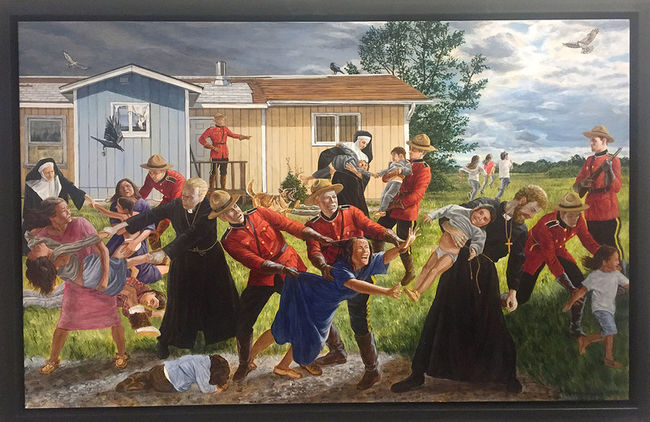
I have been listening to the “Finding Cleo” podcast produced by CBC Radio.  It is a searing story of the legacies of Canada’s brutal decision to carry away 150,000 First Nations children into boarding schools, foster care institutions, and adoptions, in order to assimilate them.  The podcast follows the victimized siblings of one small girl who also fell victim to Canada’s “Sixties Scoop.”  Today is the product of many yesterdays, of many decisions, policies, and actions, the consequences of which whipsaw through time, spreading wreckage as they go.  If your students watch the “The 13th,” they will recognize that slavery is hardly part of the past, that the injustices upon which the South’s “Peculiar Institution” rested are still very much with us.  Incarceration Nation.  Prison reform has received more attention than in the recent past, but the racial disparities in American prison populations quite simply is not a source of concern to many Americans.  We watch our duly elected buffoon preside over the country, and bounce from crisis to crisis, while his trampy kids and corrupt appointees run a smash and grab ring. Important problems, the legacies of our nation’s sins, remain unaddressed, because too many people do not care, and too many people know too little to care.

The Allure of the Archives, and the Accompanying Responsibility

I recently finished reading Arlette Farge’s The Allure of the Archives. It’s a beautiful little book, written originally in French, translated into English by Thomas Scott-Railton.

Farge’s journey into the archives brought her into contact with the denizens of 18th century Paris, ordinary men and women who entered the historical record only because they found themselves dragged before authorities as accusers and victims, witnesses or perpetrators. They came to advocate for their cause, to protect or recover their property, to seek redress, or vengeance, or, at times, to save their lives.  Farge describes the people of Paris, but her experiences in the archives and the lessons she drew from the people she encountered there—men and women who appear fleetingly and incompletely in the judicial records–are wise and wonderful enough to be useful to all students of the past, whatever field they study.  I can imagine using Farge’s book the next time I teach the freshman writing seminar.

The allure of the archives, Farge writes, “is rooted in these encounters with the silhouettes of the past, be they faltering or sublime.  There is an obscure beauty in so many existences, barely illuminated by words, in confrontations with each other, imprisoned by their own devices as much as they were undone by their era.”

Farge describes the rituals and mechanics of archival work, and she describes archival etiquette, at least for an era before digital cameras became commonplace. But the book’s beauty lies in its account of Farge’s interactions with the archives’ inhabitants, the ordinary French men and women who show up in bits and pieces in the surviving records.  “The incompleteness of the archive,” she writes, paradoxically “coexists right alongside the abundance of documents.”  Tell me about it.  Historians write down quotations from these documents, and “the proper usage of documents is similar to the inlaying of precious stones: a quotations only truly takes on meaning and significance if it fills a role that nothing else could.”  Historical scholarship is a discipline and a craft and, for Farge, it is a reflective process.  Those working in the archives must remain conscious of what they are doing, and the consequences that may result from their carelessness.  We hold these forgotten lives in our hands. That is a privilege that comes with great responsibility.

History is never the simple repetition of archival content, but a pulling away from it, in which we never stop asking how and why these words came to wash ashore on the manuscript page. One must put the archive aside for a while, in order to better think on one’s own terms, and later draw everything together. If you have a taste for the archives, you feel a need for these alternating tasks of exclusion and reintegration of documents and writing, as you add your own style to the thoughts that emerge.

Still, so many people you meet in the archives, so many stories.  “What can be done with these countless individuals, their tenuous plans, their many disjointed movements?” She likens these images to silhouettes on a wall or the shifting images one sees when gazing into a kaleidoscope, dynamic always, appearing and then disappearing, passing quickly out of your field of view before you get a clear sense of what you are looking at.

I get it. My colleagues who write about Native American history will sympathize.  In so many archives, in so many collections of documents, in parish registers, burial records, transcripts of diplomatic encounters, bits of correspondence scattered here and there, receipts, school records, and even newspapers, thousands of lives, thousands of individuals, will appear fleetingly, saying little or nothing at all, words recorded by people with limited understanding of the peoples whose stories they tell.

These lives are difficult to reconstruct, I know, as I work through the many thousands of pages of documents I have collected to write my Onondaga book. It is difficult and demanding work.  We work to recover larger pictures from scattered or broken fragments. But as I look small, I look large, too.  We wrestle with the challenge of understanding the relationship between these individuals and the larger societal forms to which they belonged as native peoples.

It is easy to write the history of native peoples as objects acted upon by non-native actors.  Writing that sort of history, however, privileges the forces of colonialism and the voices speaking in behalf of that process.

Farge has given me a lot to think about as I continue to read my sources and work on my history of the Onondaga Nation.

The Onondagas, as a community, experienced warfare, disease, and dispossession.  They endured efforts to break up their reservation, to individualize them and destroy their national identity, and to transform them into something else.  They confronted the State of New York’s efforts to extend its laws over their lands and the decisions of nearby business interests that destroyed Onondaga Creek.  Telling these stories requires detailed examination of the many thousands of pages of documents and an enormous amount of reading, but the work itself is not particularly difficult.  The views of white policy makers and power brokers are uncovered with relative ease.  The challenging part is reconstructing the lives of the thousands of individuals who cross the pages in the sources I read, and who interacted with these larger forces.

History: It’s the study of continuity and change, measured across time and space, in peoples, institutions and cultures.  To tell these stories of continuity and change, to give them real meaning, requires a close examination of the small pieces, the individual pebbles on the beach.  Boarding schools were terrible, we are told, instruments of cultural-genocide marching under the guise of benevolence.  Richard Henry Pratt founded the Carlisle School, and I read his propaganda and his reports, all the paper detritus of his campaign to “kill the Indian and save the man.”  The best he could see in the thousands of young Native Americans who came to Carlisle was that they might be formed into something else. Pratt’s words are difficult to read, knowing that his blundering arrogance shattered so many lives and caused so much grief.

But I also need to look at the young men and women who clearly wanted to go to Carlisle because it offered them an opportunity to acquire a trade, to improve themselves.  The records exist.  We can see the Carlisle students who ran away from their “outing system” placements because they were homesick or were needed at home or because they hated their overseers, or fell in love with a fellow student working at a place not far away.  It requires telling the stories of those Onondagas who missed the school once they left, who pestered the school’s administrators to send them copies of the student newspaper, and who attended Carlisle games when the team was close enough for them to make the trip.  We must consider of the stories of those who were sent home because they were sick or rebellious or because they drank too much.  It requires placing one set of difficult readings against another and against yet another still, cobbling the pieces together into some sort of sensible whole.

Sometimes, the people who appear in these records have children and grandchildren still living.  As historians, drawn in by the allure of the archives, we are voyeurs and witnesses, and we will uncover stories that if shared carelessly can produce grief and pain and sadness. If we view our trips into the archive like a raid or a treasure hunt–and I will admit to feeling this way during my 5:00am drives down the Thruway from Rochester to Albany–we risk becoming exploitative, engaging in a sort of colonial enterprise.  These documents are not ours, and the stories we fashion from the lives we see in bits and pieces do not belong to us alone.  As we share these stories, and shape our careers as historians on the backs of the people about whom we write, we must remember our obligations, and the seriousness of our enterprise.

Many of my friends are historians, and many of us, I believe, identify closely with the work that we do and the subjects that we teach.  It is part of what makes us what and who we are.  We think about our work a lot, maybe too much for those with whom we share our lives.  We can obsess and lose sleep as we think about the questions that can only be answered by a sojourn in the archives. We must be honest: as historians, we are nothing without these stories.  Arlette Farge’s book reminded me of these obligations, and the deep and alluring connections that exist between the people we write about and the stories we tell, what we do and how we see ourselves.


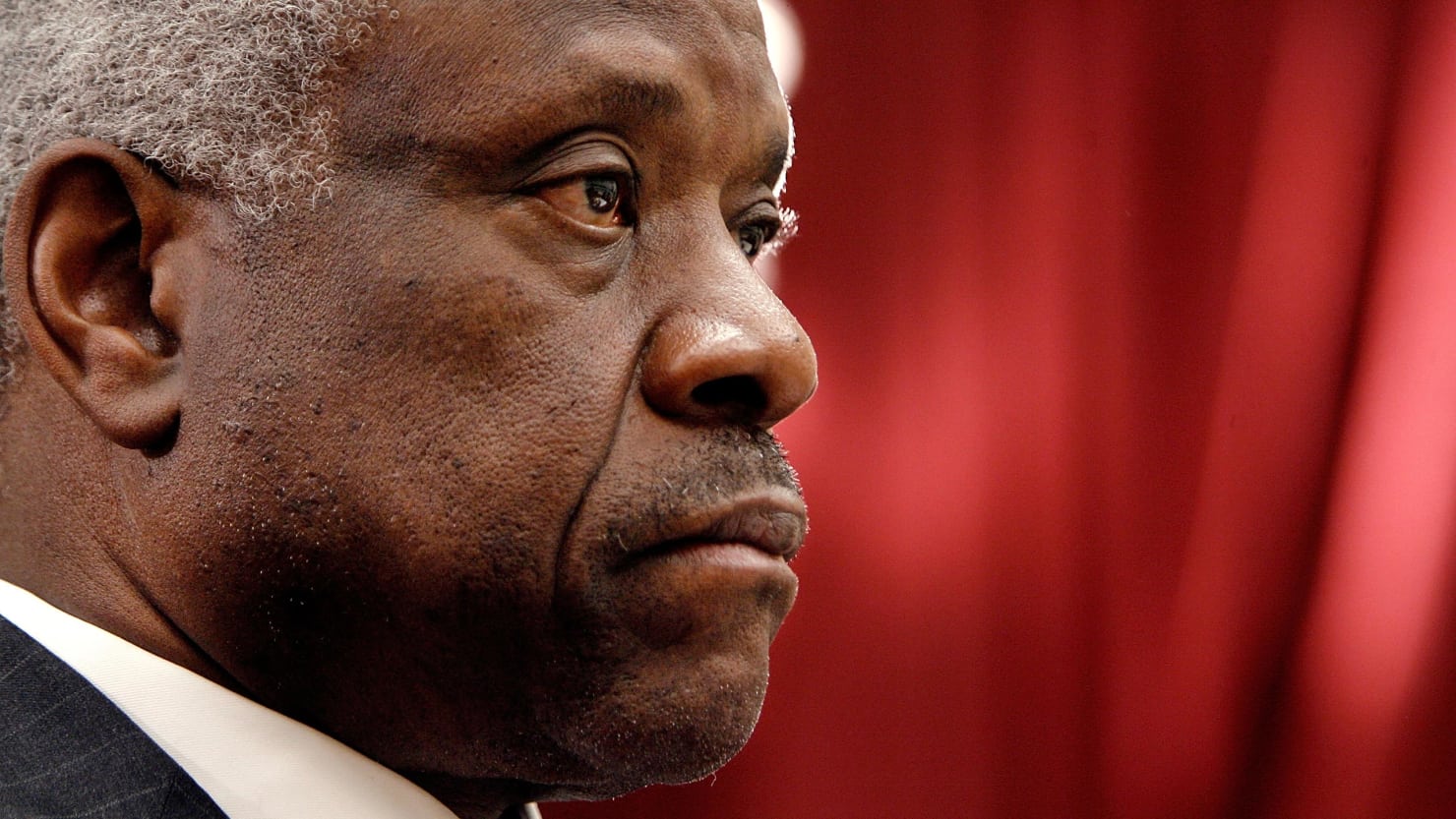
Clarence Thomas is Right. And Wrong. Mostly Wrong. But, Still…..

I tell my students to give Justice Clarence Thomas a chance. It is a difficult thing to do, because to me so many of his views are so loathsome. For my students, it is a bit different.  If they have heard anything about him at all, it’s that Justice Thomas is the quiet one, and not in the George Harrison sort of way, but in the “I got nothing to say” sort of way.  They know he is one of the most conservative justices on the Court. Though their knowledge about him is vague and imprecise, I have seen students roll their eyes when I mention his name.

“You don’t get to do that,” I tell my students.  We are historians, scholars, practitioners of an academic discipline.  We do not get to call names or roll our eyes.  Just as I am bothered by those on the right who dismiss the sort of work I do as “politically correct,” and who illegitimately avoid arguments that make them uncomfortable, we must not reject an argument because we have heard things about the person making the argument. We must take seriously the ideas and beliefs of those with whom, politically or ideologically, we might be predisposed to disagree, even when it is difficult to do so.  We consider their arguments.  Then we respond.

And Justice Thomas has said some interesting things about the Supreme Court’s long and tangled history with native nations.  One need not accept everything he says to recognize that Justice Thomas has raised some troubling and provocative questions.

For example, there is his concurring opinion in the 2004 case of US v. Lara. The Lara case, which I have students in my Indian law class read, tested the constitutionality of congressional legislation that offered a remedy–the so-called “Duro Fix–for problems raised in an earlier case called Duro v. Reina (1990).

In 1978, in the Oliphant decision, the Court had held that Indian tribes lacked the ability to prosecute non-Indians who committed crimes on tribal land, because the exercise of this power was somehow inconsistent with their status as “domestic dependent nations.” (The Court never clearly explained why).  Duro extended that prohibition to non-member Indians, who in the Court’s view stood in relation to tribal governments in exactly the same position as a non-Indian.  Both decisions delivered significant blows to a native nation’s ability to preserve law and order on its own lands.

Recognizing that Duro created a significant problem, Congress reacted and gave tribes the power to prosecute non-member Indians, and in Lara Justice Thomas concurred in an opinion recognizing the constitutionality of the legislation.  Still, Thomas was troubled by the “premises and logic of our tribal sovereignty cases.”

Thomas felt that the court had not attempted to remove the important tensions between two assumptions that struck him as contradictory.  “First, Congress (rather than some other part of the Federal Government) can regulate virtually every aspect of the tribes without rendering tribal sovereignty a nullity.” It did so, however, at the same time that it maintained that “the Indian tribes retain inherent sovereignty to enforce their criminal laws against their own members.”

Thomas could not accept the Court’s assertion “that the Constitution grants Congress plenary power to calibrate the ‘metes and bounds of tribal sovereignty.'” He had read the Constitution, of course, and in it, he wrote, “I cannot locate such congressional authority in the Treaty Clause. . . or the Indian Commerce Clause,” which gave to Congress in Article I, Section 8, the right to regulate “commerce” with the Indian tribes.

Furthermore, Thomas questioned the constitutionality of the 1871 enactment through which Congress put an end to treaty-making, because “the making of treaties, after all, is the one mechanism that the Constitution clearly provides for the Federal Government to interact with sovereigns other than the States.”

Thomas reviewed the Lara reasoning, and that used by the Court in its antecedents: Oiliphant, US v. Wheeler (1978), and Duro.  He was skeptical.  In his conclusion, Thomas wrote,

The Court should admit that it has failed in its quest to find a source of congressional power to adjust tribal sovereignty. Such an acknowledgment might allow the Court to argue the logically antecedent question whether Congress (as opposed to the President) has that power.  A cogent answer would serve as the foundation for the analysis of sovereignty issues posed by this case. We might find that the Federal Government cannot regulate the tribes through ordinary domestic legislation and simultaneously maintain that the tribes are sovereigns in any meaningful sense.

In Adoptive Couple v. Baby Girl (2013), Thomas again considered the constitutional basis for plenary power, this time in a case involving the 1978 Indian Child Welfare Act.  “Although the Court has said,” he wrote, “that the central function of the Indian Commerce Clause is to provide Congress with plenary power to legislate in the field of Indian affairs,” neither the text nor the original understandings of the Clause “supports Congress’ claim to ‘plenary’ power.”  The contested adoption proceedings at the heart of the Baby Girl case involved neither commerce nor tribes, and Thomas believed that “there is simply no basis for Congress’ assertion of authority over such proceedings.”

Three years later, in the case of US v. Bryant, Thomas once again returned to these questions. Congress’s “purported plenary power over Indian tribes,” he wrote, rests on shaky foundations.  “No enumerated power–not Congress’ power to ‘regulate commerce…with Indian tribes,’ not the Senate’s role in approving treaties, nor anything else, gives Congress such sweeping authority.”  Thomas found the origins of this claim to power in the 1886 Kagama decision, which upheld the constitutionality of the previous year’s Major Crimes Act.  Native American weakness, in that case, justified the extension of federal power.  The government’s power, the Kagama court wrote, “over these remnants of a race once powerful, now weak and diminished in numbers, is necessary to their protection… It must exist in that government, because it has never existed anywhere else.” That seemed like a claim to power that was not supported by the Constitution and it was time, in Thomas’s view, to review these decisions.

And in an 2017 dissent in a case involving the Secretary of the Interior’s decision to take 13,000 acres of Oneida land in New York into trust, Thomas again criticized the Court’s Indian Commerce Clause rulings.  Allowing the federal government to take land within a state into trust on behalf of an Indian tribe, Thomas argued, could not be supported by any language in the Constitution, and it would have shocked the “Founding Fathers” to “find such a power lurking in a clause they understood to give Congress the limited authority to ‘regulate trade with Indian tribes living beyond state boundaries.”

If Congress had no legitimate constitutional authority to legislate for Indians (in this case, the legislation in question was the 1934 Indian Reorganization Act), and no acceptable justification for its claim to plenary power, Thomas believed that power must exist in some other entity.  For Thomas, it seemed to be with the states, a power reserved to them by the Constitution.   And that logic, if acted upon, would be toxic and destructive.  Leaving Indian tribes at the mercy of state governments would eliminate the nation-to-nation relationship between the United States and native nations, and produce a full negation of American Indian tribal sovereignty. One could write a history of Indians in the United States focusing on the attempt of state governments to extend their authority into Indian country.


There is a lot of legal scholarship out there on the Supreme Court’s rulings on the scope or limits of the Indian Commerce Clause, and I have by no means read it all.  Matthew L. M. Fletcher and Gregory Ablavsky have both written recently about the Indian Commerce clause, and they both flatly reject Thomas’s conclusions.  They believe that his interpretation of the Indian Commerce Clause is too narrow, too literal, and that Congress did have the power to enact protective pieces of legislation like the Indian Reorganization Act, or the Indian Child Welfare Act, or to take Indian lands within a state into trust.  There is a long thread of decisions they argue, where Congress protected Native nations from the encroaching power of the several states.  They have a point, I suppose.

I have only sampled some this scholarship, and I have a lot more to read.  But I am not sure Ablavsky, for instance, is absolutely right.  And what if Thomas is right?  At least in part?  A little bit?

In other words, what if the Constitution does not give Congress plenary power over Indian affairs?  Article I, Section 8 of the Constitution says that “Congress shall have the power to regulate Commerce with foreign nations and among the several states, and with the Indian tribes.”  Ablavsky notes that the Founding Fathers used the word “intercourse” far more often than they did the word “commerce,” and that this word has a wider range of meanings.  There is a lot of truth to that.  The first federal Congress, in order to flesh out the sparse language of the Constitution, enacted in the summer of 1790 the first of a series of “Indian Trade and Intercourse Acts.”  But look at the legislation.  The Indian Trade and Intercourse Act regulated those instances where native peoples and newcomers came into contact by limiting the actions of non-Indians: Americans could not trade with Indians without a license, for instance, and purchases of Indian land could be effected only by the national government.  In the Indian Trade and Intercourse Act, Congress asserted no power to regulate the internal affairs of any native nation.

Maybe plenary power is a lie, a fiction, or a fraud.  Maybe Thomas is right, in that the Court, over many years, has just sort of made stuff up to suit its purposes.

I have many friends who spend a great deal of time decrying the so-called “Doctrine of Discovery,” the notion that somehow the Europeans’ discovery of America gave them title to land on this continent.  Many of them are calling for a repeal of the doctrine, and for its repudiation by the churches who originally espoused it.   Is the notion of “plenary power” any less a fiction?  Can it be justified in any way from the sparse language in the Constitution which, Justice Thomas has asserted consistently throughout his career (whatever you think of him), truly matters?  Justice Thomas has pointed out that the Court’s Indian Commerce Clause rulings are built on a fiction, that they stand without justification in the Constitution’s language.  Perhaps, rather than placing that power in the hands of state governments, as Justice Thomas seems to suggest, it more accurately could be asserted that the Constitution recognized native nations as separate polities, over which it exercised no control and no authority, save for an authority superior to the states to regulate interactions between these native nations and the American people.  Congress, rather than the states, could regulate commerce and intercourse by regulating the activities of American citizens, but it could claim no power to do anything within and over native nations themselves, because no such power is stated in the Constitution.  If the Doctrine of Discovery is a racist sham, as its critics assert, then perhaps the Congressional plenary power doctrine is a falsehood, too, a misinterpretation of framers’ intent and a complete fiction that the United States ought to address if it wants honor its endorsement several years ago of the UNDRIP.  And if it is a fiction, we are left with one conclusion about the federal government’s claim to exercise absolute authority in the realm of Indian affairs:  that its claim to plenary power rests on nothing more, at the end of the day, than brute force.  Colonialism is alive and well.

Onondaga, 1918: A Declaration of War, and Other Stories

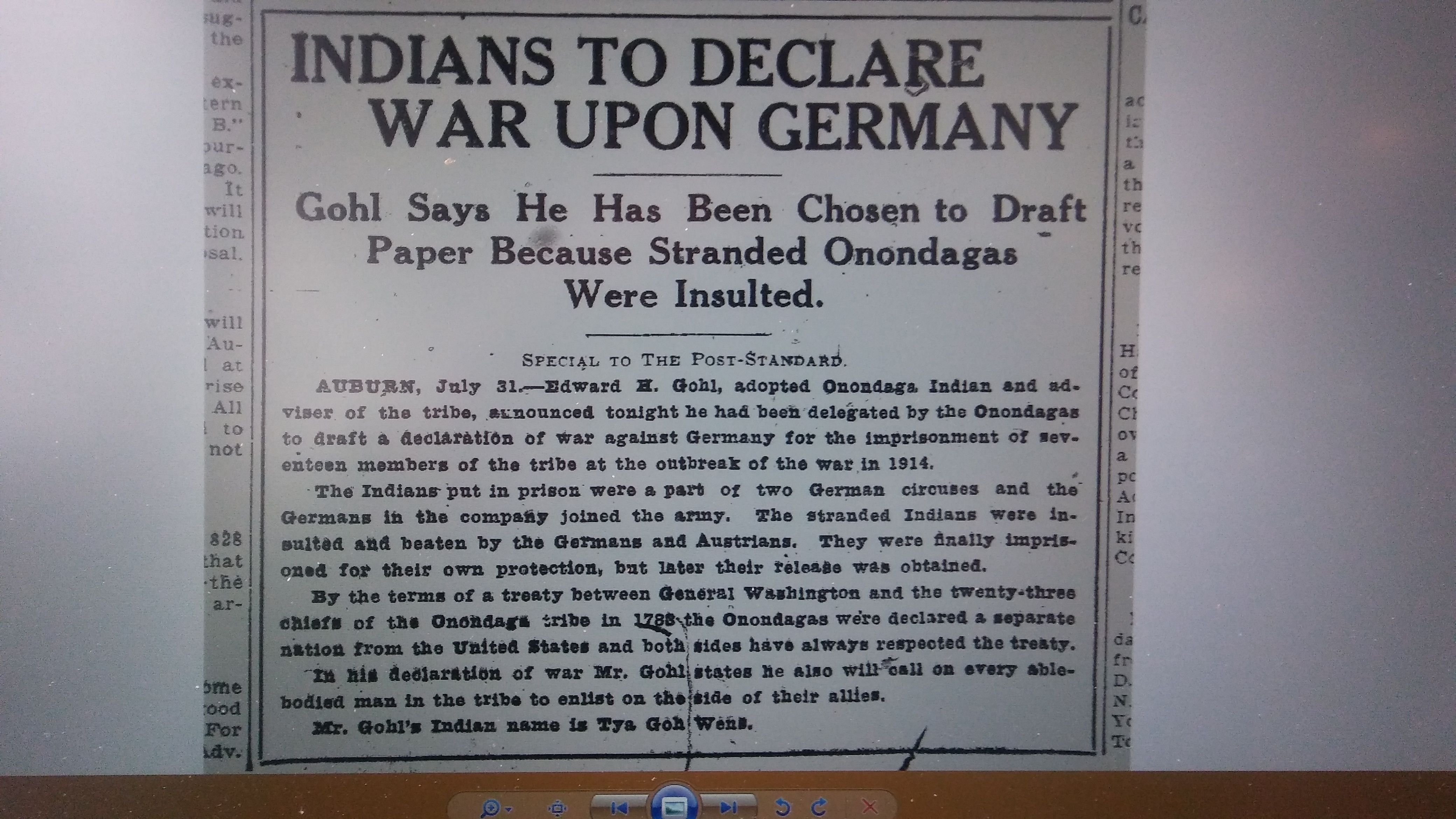
In August of 1918, the following news story appeared in the Syracuse Post-Standard.   Under the headline, “Indians to Declare War Upon Germany,” and a smaller title indicating that “Gohl Says He Has Been Chosen to Draft Paper Because Stranded Onondagas Were Insulted” we learn something of an adopted Onondaga, a group of imprisoned circus performers, and inexplicably angry Germans and Austrians.

“Edward M. Gohl, adopted Onondaga Indian and adviser of the tribe, announced tonight he had been delegated by the Onondagas to draft a declaration of war against Germany for the imprisonment of seventeen members at the outbreak of the war in 1914.

The Indians put in prison were a part of two German circuses and the Germans in the company joined the army. The stranded Indians were insulted and beaten by the Germans and Austrians.  They were finally imprisoned for their own protection, but later their release was obtained.

By the terms of a treaty between General Washington and the twenty-three chiefs of the Onondaga tribe in 1788 the Onondagas were declared a separate nation from the United States and both sides have always respected the treaty.

In his declaration of war Mr. Gohl states he also will call on every able-bodied man in the tribe to enlist on the side of their allies. 

Mr. Gohl’s Indian name is Tya Goh Wens.

There is, to say the least, a lot going on here, more than meets the eye. Though the Onondagas negotiated a treaty in 1788, it was with the State of New York and not George Washington, and there was little in the agreement that was worthy of respect. Gohl shows up frequently in the press as a representative for the Onondagas, though there is much about the relationship that I do not yet understand. And the passive voice: “their release was obtained,” but by whom, how, and when?  Documents like these, so suggestive yet so frustrating, I like to give to my students on those rare occasions when I teach my department’s required course in historic research methods, or when I teach a freshman writing seminar that I sometimes call “Life Stories.”  Stories like these, it seems to me, open a world of questions, a series of trails to follow that all are utterly enticing.


I’ve been working on my history of Onondaga as a place and a native nation for almost a decade now and I have still a couple of more years of research before I will be able to set pencil to paper and begin my writing process.  So many documents, and so much material, I still have to look at.  There are still a number of archives to visit and a large amount of evidence to collect and consider.  And so many of these small pieces of information, these bits of stories, raise questions that demand answers. They tug at me. They present alluring side trails that seem so worthy of investigation.  Down these by-ways and detours and secret paths we can find the human stories that, when they are told well, bring history to life.  Even when the answers are not certain, and the conclusions drawn are far from definitive.

In the summer of 1914, sixteen Indians from the Onondaga Reservation just south of Syracuse New York made their way to Europe to perform with a German circus company.  After they arrived in Berlin, they split into two groups.  One headed eastward toward Russia, the other south towards Italy.  Nobody at Onondaga had heard from them in several weeks the Post-Standard reported in August of 1914, and their friends at home were worried.  It was August, and the Great War had begun.

I have much still to learn about these sixteen Onondagas and their experiences overseas.  I do not know as of yet the name of this particular circus, how these Onondagas were recruited to join it, and what their lives were like once they returned home. I do not know how the sixteen Onondagas in 1914 became seventeen three years later.  I know little about what they saw in Europe, or how their journeys affected them.  I do not know where they performed, what they did, and what those audiences expected from them. I know that not all historical questions have answers.  We who write about the past are often left with only our ability to imagine, and that is just fine.

I know the names of the sixteen Indians from Onondaga, of course.  It seems likely to me that Jerry Homer, one of the Onondaga Jeremiah Homer Student Information Cardperformers, was the Onondaga Jeremiah Homer who, ten years before, had arrived at the Carlisle Indian School. He was one of five Homer children to attend Carlisle.  According to the school’s records, he was ten years old when he arrived. He was a tiny, tiny kid, just three-and-a quarter feet tall. He weighed only fifty pounds.  He may have arrived malnourished, though his older sister, who died young, was also reported to have had a very slight build.

The Carlisle School sent questionnaires to former students. They liked to know what their alums had done with their lives.  The students’ answers allow small glimpses into the lives of ordinary native peoples who lived late in the nineteenth and early in the twentieth centuries.  Jeremiah Homer did not say much in his response.  In 1911 he reported that he was living on the Onondaga Nation territory and that he wished that the school would send him copies of the Carlisle Arrow, the school’s newspaper.  He indicated as well that he was now married to Mary Cornelius, an Oneida woman whose family lived at Onondaga.

Mary Cornelius did not attend Carlisle, but she was enrolled for two years at the state’s Thomas Indian School from 1907 until 1909.  One of the sixteen Indians from Onondaga who went to Europe, and who was later imprisoned, was Mary Cornelius. Jerry met Mary, I would guess, sometime after they returned to Onondaga from their time at boarding school. Both were home by 1909. They were married by 1911, Jerry indicated, and the otherwise unnamed “Baby Cornelius” mentioned in the story must have been their child.

Mary Cornelius became an important figure in the twentieth-century history of the Oneidas.  You can read a profile here.  Jerry Homer is tougher to figure out. Mary and Jerry do not appear to have lived together upon their return to the reservation, and Jerry or Jeremiah Homer disappears from the reservation census records by 1920.   I wish I knew more about what happened to him, but at this point, that is as far as the trail leads. By-ways and detours.  Some times you wander down a path, only to realize the need to return to the main trail. The resources to answer the questions I have about this family, about their experience in Europe–they are not at my disposal right now.  I will have to travel, hit the archives once again, to finish telling this small story.

I am confident that I will be able to find the evidence that will help me flesh out these stories. Perhaps some of you reading this now know more than I and, if so, I hope you will share with me what you know.  If the evidence exists, I will find it.  It might take time.  Many paths I follow–that any historian follows–invariably lead to dead ends.

So why bother?  Is there something in this, as one of my professors used to ask, of more than mere antiquarian interest? I am writing a book looking at one small piece of land, and the people who lived there, over a span of more than six centuries.  Given the vastness of that story, why give so much time and thought to two individuals about whom it is possible, at the end of the day, to know very little?

It is fun, for one thing.  It is hard sometimes for my students to appreciate this. They have a lot to carry, and we compel them when we assign research projects to come up with something meaningful to say in a short, fifteen-week semester.  They do not have the time to wander down back alleys and by-ways in search of interesting stories.  I think that is something about which we need to be more aware.  I have no deadline on this project.  A lot of us do the work we do, which so often we do alone and in isolation, because it is so immensely satisfying.  we pour hours into our projects, into our attempts to find answers to the questions that bother us. Our work does not always result in publication.  But the work, for many of us, is its own reward.

But more than that, telling the stories of people like Jerry/Jeremiah Homer and Mary Cornelius allows us to paint a more accurate picture of the communities about which we write.  Being Onondaga, or being an Oneida living at Onondaga, or being Native American generally, meant so many different things to so many different people.  White lawmakers in New York State, federal officials, Christian missionaries, local law enforcement–they all had their own views of who Indians were and what they might become. And native peoples themselves always defied and complicated these necessarily limited understandings and racist stereotypes. Writing the history of a place like Onondaga, then, means looking not only at the policy makers and the nation’s faction-tattered leaders but the lacrosse players who tested themselves against Ivy League teams, or the members of the “American Indian Concert Band,” formerly known as the “Onondaga Indian Concert Band,” which was led by David Russell Hill and claimed to be the “only professional Indian band known to both hemispheres”; or the bricklayer who learned his craft so well at Carlisle and whose future seemed bright, only to come crashing down in the face of racism and discrimination when he went to Syracuse seeking work; and circus performers who went to Europe on an eight-month contract.  These native peoples went to Europe.  They were swept up in forces beyond their control.  They were incarcerated briefly, apparently for their own protection, and they returned home.  As America’s entry into the Great War approached, debates occurred over whether native peoples, who as yet were not citizens of the United States, could be drafted.  The Onondagas’ declaration, justified by the base treatment their friends and families had experienced a couple of years before, quieted the issue for a time, until 1940, when it would surface once again.


Biographies of great men and women fill my bookshelves, life histories of people who did great things.  They fought wars, won elections, discovered one thing, or destroyed another.  The lives of famous people are linked to the events that they shaped, and that in turn shaped us.  There is a place for books like these.  You read them and I read them.  We all have a list of them that we really like.

But think of your own life.  What are the events that made you who and what you are? Have you done things, or had things happen to you, after which nothing ever could be the same?  I ask my students this question each semester when I want them to consider the meaning of history. Always they ask for clarification.  They want to know if I am interested in some public event, something “historical,” or something personal.  I do not give them any guidance, for I want them to consider what constitutes a historical event.  They will struggle with this because they are young and they have not lived through a lot.  They might mention the attacks on 9-11, though all of them now are young enough that they  can have no memory of that terrible day. Some will say the election of Barack Obama, which most of them think they remember.  I will listen to them as they compare their lists.  But I come back to my question.

What are the events that made you who and what you are?

Was it a marriage? A divorce? A birth or a death or a relocation? A breakup? A particularly cruel thing said someone said to you or a particularly empowering statement of support?  What events in their life left an impression, or a scar?

In writing a history that covers hundreds of years and focuses on a relatively small piece of what has become upstate New York, it is easy to lose sight of individual stories, and to focus on the forest much more than the trees. But it is in the small stories, the brief snapshots of ordinary lives, where we can find answers to some of the most important questions about our shared histories, and our shared humanity, across space and across time.


Teaching on Native Ground

Last Friday, the 9th of March, 2018, was Teachers’ Day at Geneseo, an event my colleagues in the History Department have held for the past several years.  We invite teachers from public schools to come to campus.  They attend a workshop in American history and another in World History.  In the past, we have had a keynote address held at lunchtime, but this year, my colleagues decided to do something different: a roundtable discussion on ways to involve high school students in local history projects that will broaden their understanding of the themes and topics they are expected to learn in school. I spoke briefly about Native American history.  This is a polished-up version of my remarks.


I do not have a specific project to speak about. I would rather suggest a general change in focus, and in our way of thinking, about the teaching of Native American history in New York schools.

In some ways, I believe, the manner in which Native American history is taught in public schools in New York continues a colonial project that began in 1492.  That may sound dramatic, but that is what I believe.  I base that on reading the Common Core guidelines for New York State, and as I have watched five children wend their way through New York public schools.

You—well, all of us really—we teach at public schools that stand on what had been native ground, on lands acquired in behalf of the people of the great state of New York by elite land barons and state government officials who viewed Indians as obstacles and barriers to progress and brakes on their considerable economic ambitions.  Those Indians one way or another would have been completely eradicated and erased if New York’s Founding Fathers had their way. They would be gone.  They would have been either removed, or assimilated, or driven to extinction, and certainly dispossessed.

The students you send to me do not know this history at all.  They know nothing of these stories.  They may know something about Cherokee Removal but absolutely nothing about the removal of, say, the Senecas from the valley as a result of military invasion, epidemic disease, or an 1826 real estate transaction that did not conform at all to the requirements of United States law.

They might know that the Iroquois once lived here, that they lived in longhouses, and that they relied upon the “Three Sisters” for their sustenance, but not that they are still here, fiercely protective of their status as autonomous native peoples, as members of native nations.  They might have been told something about how the Iroquois shaped the Constitution or American democratic thought but not that the Iroquois influence thesis has been thoroughly discredited and never really persuaded any historians in the first place, while they know nothing about how Haudenosaunee peoples actually played a role of incredible significance in shaping the history of this state and region.

They might know that Andrew Jackson is a SOB, but they will not have reflected upon how nearly ALL Americans were complicit in and benefited from the historical processes with which he is associated but which began long before he was born and continued after he died.  Indeed, they will not have thought about how they continue to benefit from “Indian Removal,” a terrible euphemism that should be retired.  Because New York, it is important to point out, became the “Empire State” in large part because of a systematic and determined program of Indian dispossession.

Look, we are historians.  We tell stories about the past.  At the end of the day, these stories are fundamental to what we call history.  It seems to me that we could be choosing better stories.  We all can do better.

So here’s something to think about. This semester for the first time I had my students keep journals.  I urged them to read beyond what I had assigned, to share with me their thoughts about the current events they were expected to keep up on in the United States and Canada, and even to say those things that they were too reluctant or did not get an opportunity to say in class. Of the nearly 40 students in my Indian Law and Public Policy course, a large majority of them expressed their amazement that they had not been taught any sort of meaningful Native American history at earlier points in their careers as learners, especially about the Native American history of the region in which they live.  The sense I got from reading these journals was that they felt cheated.

And this is unfortunate, because this region has an extraordinarily rich Native American history that is easily accessible, and that can be critically engaged with relative ease. It is inscribed on the land in terms of the place names, the streams and lakes and rivers that flow through this region where people lived, the easily-recovered lines of European invasion that cut through Wayne, Monroe, and Livingston Counties.  Chenussio, Geneseo; Canawaugus, Avon.  These were important towns, centers of Seneca power whose history is largely invisible to our students. And it doesn’t have to be that way.

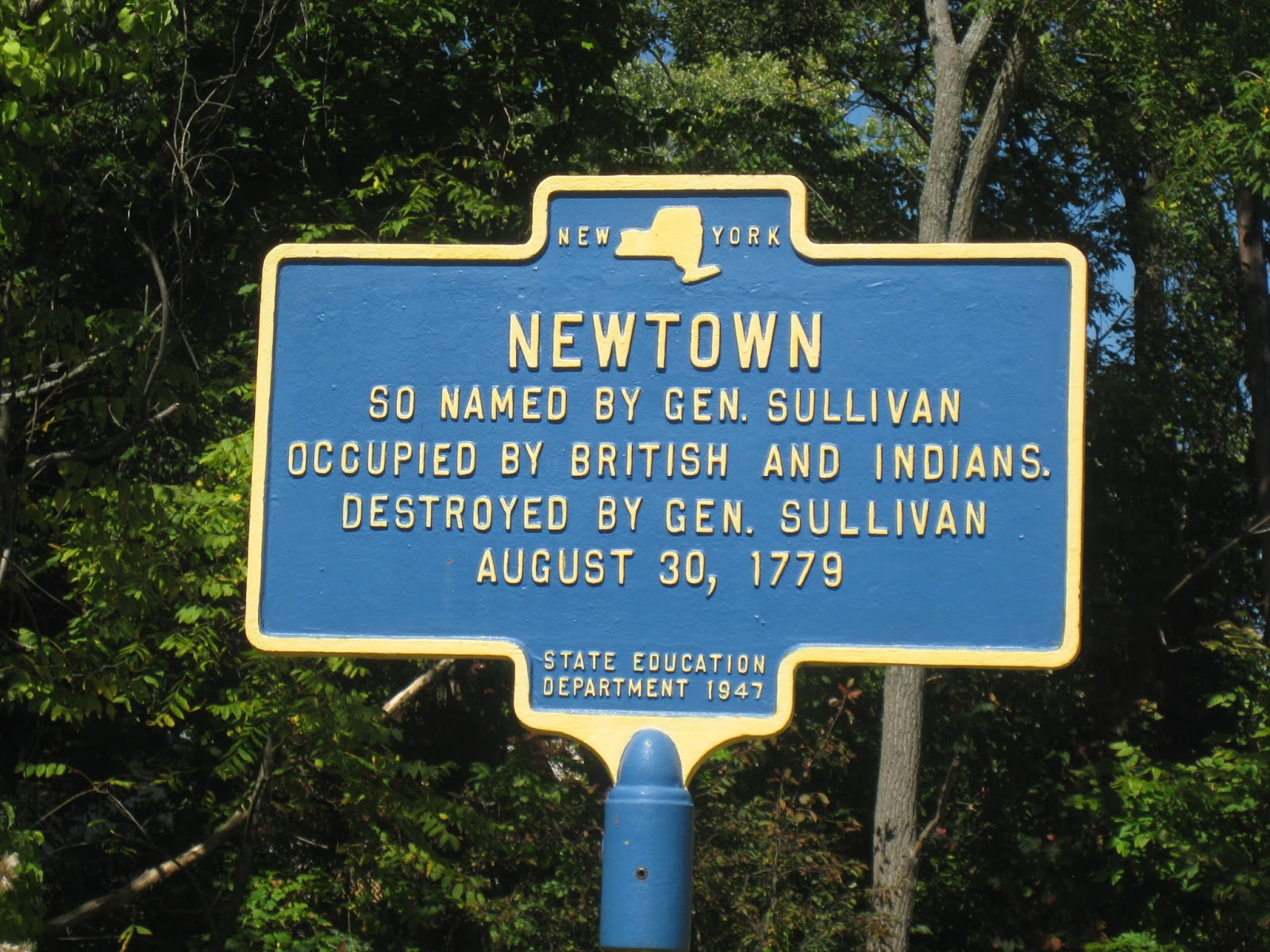
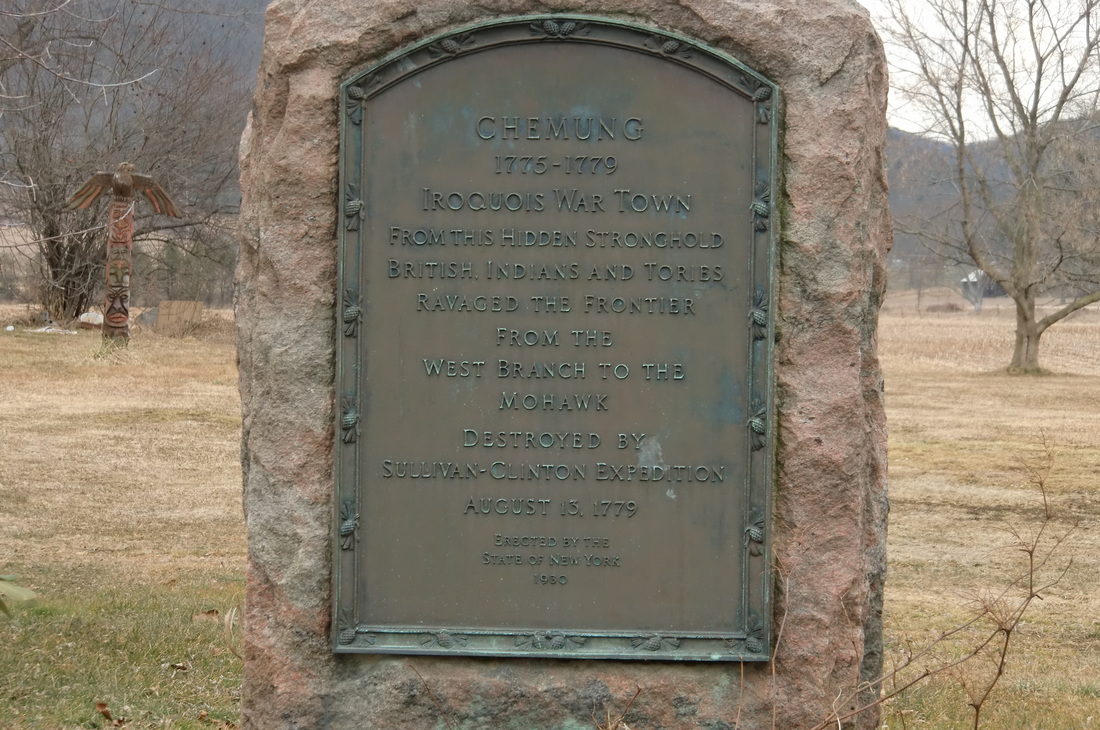
Image result for new york state historical markers indians         Wherever your school is located, you likely are near a badly biased state historical marker, full of loaded language, displaying common, stereotyped views of native peoples.  Your students can research these sites, or the events that took place there, and revise them.
When my students ask, “Why weren’t we taught this in school,” I see a powerful teachable moment.  Why indeed? Why do students in New York State learn about Cherokee Removal and not about Haudenosaunee dispossession and the diaspora that made the “settlement” of this unsettled, post-revolutionary state possible?  Do those people who assemble the standards against which your performance is measured actually not know these stories themselves, and so bequeath to students a limited view of this region’s history?

There is an opportunity here to talk about the power to make history, to determine what is and what is not considered part of the American past, and I think local stories are one way to engage students in that past.  If you ask your students to reflect upon why they are not taught these stories, what will happen?  Maybe, just maybe, we have some discomfort in talking about our past, and the considerable benefits non-native New Yorkers have received from this state’s very long and continuing history of colonialism.

Incarceration Rates for Native Americans

Many of my students have seen The 13th, the scathing documentary that looks at the close relationship between racism and violence in modern America.  Not only does the United States, with 5% of the world’s population, incarcerate nearly a quarter of the people on earth who live their lives behind bars, but it does so in a manner where African Americans are are disproportionately represented in the prison population.  Racism is alive and well in this Incarceration Nation.

I spend a lot of time thinking about the prison system.  My good friend runs a blog detailing her experiences as the wife of an inmate incarcerated under New York’s inhumane Rockefeller drug laws.  And many of our students read Heather Thompson’s book on Attica last fall.  Professor Thompson was on campus, as were a number of people who had been involved in the Attica uprising and its aftermath. A student in my Indian Law class asked about incarceration rates for Native Americans.  I had always assumed that Native Americans, in states with large Native American populations, were over-represented in those state prison populations.

There is information on jails in Indian Country here. It is a broad, national picture.  For the Native American population incarcerated in “local jails,” which are defined as “confinement facilities administered by local or regional law enforcement agencies and private facilities operated under contract to such agencies. They exclude jails administered by federal, state prison, or tribal authorities,” you can read more here. For the federal prison system, an overview can be found here.

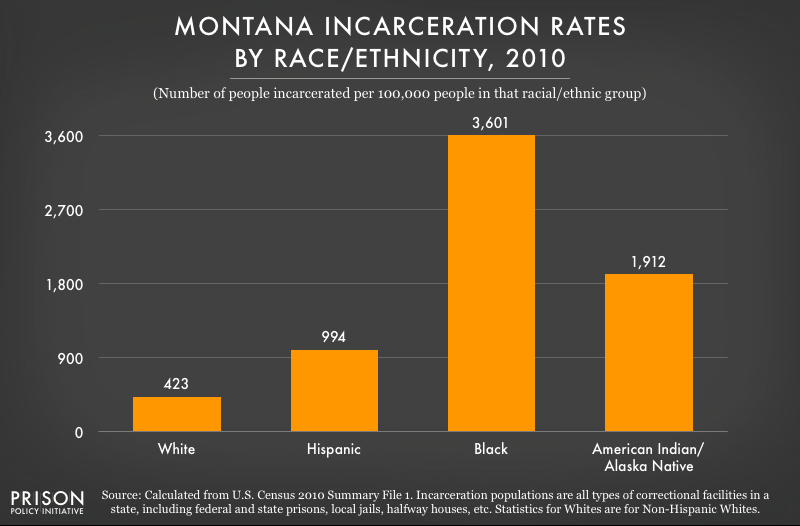
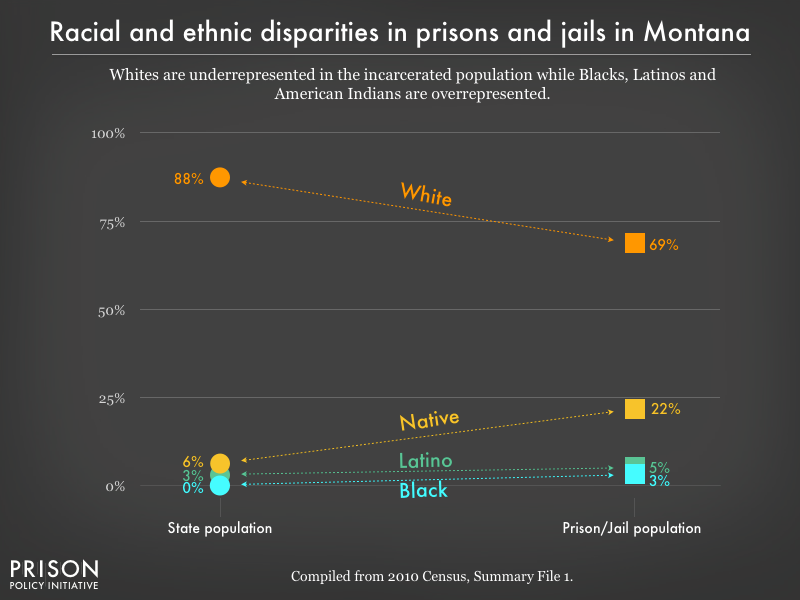
In Montana, where I lived and taught for four years. Native Americans were significantly over-represented in the states prison population. The Prison Policy Initiative has assembled a really helpful website that allowed me to increase my understanding of this important issue.


2010 graph showing incarceration rates per 100,000 people of various racial and ethnic groups in Montana


racial and ethnic disparities between the prison/jail and general population in MT as of 2010

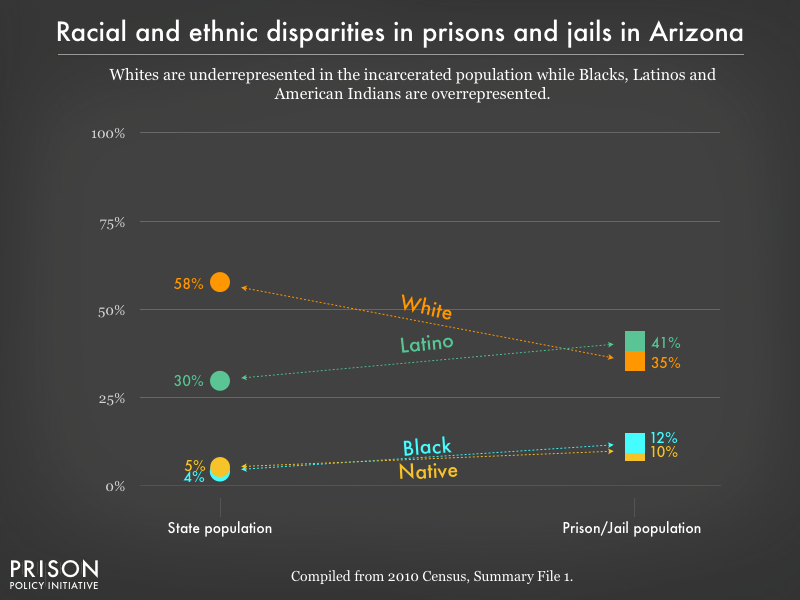
For Arizona, a state with a large Native American population, the figures are a bit less stark than they are for Montana.


racial and ethnic disparities between the prison/jail and general population in AZ as of 2010


For other states with large Native American populations, here is a run down on the figures:

State                                          Percentage of Population           Percentage of Incarcerated Population

New Mexico                                               9%                                                           11%

South Dakota                                            9%                                                            29%

North Dakota                                            5%                                                            29%

Utah                                                            1%                                                             4%

Washington                                              2%                                                              5%

Oklahoma                                                 7%                                                              8%

Alaska                                                        15%                                                          38%

Minnesota                                                 1%                                                             8%

For other states, you can see the reports here, including tables on the number of people in each racial demographic per 100,000 in population by clicking here.