All posts by admin

Local History Matters. Now, More Than Ever

Under state law, New York requires every municipality to have an official historian. When you do the math, that comes out to one historian for each of the five boroughs of New York City, 12 Community Historians in Manhattan, 62 city historians, 932 town historians, and 544 village historians.  Add to that the 62 county historians, the scores of small historical societies, and the dozens of small archives, collections, and history museums, and you have the foundation for a vibrant local history community.

            Some of these local historians are more active than others. Some have more resources at their disposal. A huge percentage of them serve as volunteers. Many of them are retirees, doing work they love with great enthusiasm in the name of preserving their community’s past.  To varying degrees, they coordinate their efforts, and meet together to discuss common interests and concerns, like the meeting of the Government Appointed Historians of Western New York (GAHWNY) I attended last fall. It is a hodge-podge, with a thousand moving parts, but the work they do is exciting and important.

            And largely separate from the work we do as academic historians.  That reality has become increasingly clear to me over the course of this past year, as I began to survey the public history landscape in New York State. It is a shame.  The academic history community has largely ignored local historians.  And as I began to meet local historians, and talk with them, it struck me that we in the academy could be doing so much more, and that we had overlooked an extraordinarily valuable community of historians doing extraordinarily valuable work.

Why not, then, form a partnership between local historians and my college that could benefit us all—students at our college interested in history or museum studies, the public history community, and those in the general public with an interest in history?  Why not form a center to encourage interest in state history at the local level?  That’s what we are trying to do at Geneseo—a Center for Local and Municipal History– and our first steps will take place on February 16th.

            Encouraging a partnership between our college and the local history community will certainly benefit our students.  Teaching is not an attractive career path for all of our students, and the withered state of the academic job market makes it difficult for us to encourage even the most talented to pursue graduate training in history.  Our students find work in a host of fields, and I believe firmly that history students emerge from our college with the skills to prosper in a variety of fields. 

Still, history itself, as a discipline, is changing.  Museum studies is a dynamic and creative field.  The broad expanse of the “digital humanities” is bringing innovation to historical research, publishing, archival work, and public education.  Thanks to the creative teaching of my colleague Yvonne Seale (@YvonneSeale) and other members of the Geneseo community, our students have the opportunity to learn these versatile digital skills.  Our students, I believe, can provide important assistance to resource-starved local and municipal historians.  Our students will benefit from the opportunity to deploy their skills in a real-world setting and local historians will benefit from the assistance our students can offer.

But there is more to it than that.

The New York State K-12 Social Studies Framework places no emphasis on local history. As a result, too many New Yorkers know too little about the history of the communities in which they live.  I suspect that this problem is not unique to New York State. The American Association of Colleges and Universities, which in part has funded our local history initiative, argues that “in this turbulent and dynamic century, our nation’s diverse democracy and interdependent global community require a more informed, engaged, and socially responsible citizenry.” This sort of civic engagement and civic learning, I would argue, can occur in a more meaningful manner when our friends and neighbors know who and what and where they are in terms of connection to a certain location in place and time.  How did we get here? Why is our community the way it is? What is the source of the challenges we face as members of communities?  How can we confront those challenges effectively, and what have we tried before.  These questions are fundamentally historical.

If you read the news, and follow developments across the political spectrum, you will note that many Americans, regardless of their political affiliation, or whether they live in the inner city, the suburbs or in rural New York, feel disconnected, like outcasts. Rootlessness. When we teach people about their own history, their own place, we teach them, at least in part, that their stories matter. It may not be enough for us any longer merely to remember the past.  We can and should do more. We can connect people who feel disconnected when we present them with the evidence that they have a role in their community’s story, that they are themselves forces in history.

Local historians are already doing much of this important work.  They will do it with or without the support of the academic history community. Just before Christmas, I met with Larry Naukam, formerly with the Rochester Public Library, and a gentleman with a mastery of the work being done by local historians and archivists in upstate New York.  We met at the Starbucks in Brighton, at Twelve Corners, not far from my house.  There, Larry showed me all sorts of fantastic work.  He showed me, for instance, the digitized church and cemetery records on the Rochester Genealogical Society webpage. Then the Rochester Churches Indexing Project (RCIP), started some time ago by individual researchers affiliated with the RGS. The Cayuga Heights History Project contains a wealth of information on Ithaca, New York, as does the History Forge.  Amie Alden, the County Historian in Livingston County, where SUNY-Geneseo is located, has valuable information on her department’s website, including records relating to Civil War deserters and wills and other archival sources. Historians in Wayne have assembled a useful collection of materials on historic sites in that county. Small museums, like that belonging to the Walworth Historical Society, posts records and resources. Somehow, I had missed the Digital Public Library of America, which houses many millions of images from across the country, many with a local focus. The New York Heritage Digital Collections page is also worth your time. The Fulton NY Post Cards website is a crazy scene and clunky to use, but it includes millions of pages of digitized New York newspapers. 

All this from one conversation, in one hour, in one coffee shop.  There is so much material available to reconstruct local histories.  These records allow those of us who study the past to tell the stories of the ordinary people who spent their lives in the communities we now call home.  Geneseo students, I hope, will join in our efforts to recover, preserve, and present the documents containing these stories to the public, and to convince our friends and neighbors that this effort is worthwhile. In these collections we find people who appear nowhere else in the historical record.  They appear fleetingly and incompletely in these documents.  But tracking them down, as Arlette Farge put it, is part of the “allure of the archives,” those “encounters with the silhouettes of the past,” which possess “an obscure beauty in so many existences, barely illuminated by words.” So many people appear in these archives, and the stories of so many places.  “What,” Farge asks, “can be done with these countless individuals, their tenuous plans, their many disjointed movemnts?”  Farge likened what she found to the shifting images one sees when gazing into a kaleidoscope, dynamic always, appearing and disappearing, passing quickly out of your field of view sometimes before you get a clear sense of what you are looking at.

We at Geneseo want to talk about these stories, and enlist our students in the effort. Our first step is going to be a gathering on campus on February 16th, to discuss what can be done to forge a strong and viable partnership between different stakeholders and students.  I expect nearly 60 people to attend our meeting, including New York State Historian Devin Lander and Professor Taylor Stoermer, who teaches in the Museum Studies program at Johns Hopkins.  Prior to joining the Museum Studies faculty, Dr. Stoermer was Instructor of Public History at Harvard University, Director of Historic Huguenot Street (a National Historic Landmark District in New York), Chief Historian of Colonial Williamsburg, Invited Research Scholar at Brown University. He has held Fellowships at Yale University, the Huntington Library, the International Center for Jefferson Studies at Monticello, and the Virginia Historical Society. He is an alumnus of Johns Hopkins, the Tulane University School of Law, Harvard, and the University of Virginia, where he earned his Ph.D. in History, specializing in colonial Virginia and the American Revolution. Dr. Stoermer is also the author of Colonial Williamsburg: The Official Guide (2014) and Public History: A Field Guide (Forthcoming, 2019).

 I am looking forward to a lively discussion from which I hope to learn a great deal. Then, during the first summer session in May, I will teach a course at Geneseo called “Local History Workshop.”  Students who enroll in the course will work in tandem with a local historian or historical society on projects that engage the public.  If the course is popular, I will add it to my regular rotation.  If these steps succeed, we will begin to raise money for the establishment of a center on campus.  1500 Local Historians, and none of the SUNY campuses devotes much attention to them.  We at Geneseo hope to lead the way. The local historians with whom I have spoken are enthusiastic.  They need the help.  I expect we will find students willing and ready to join in the effort.  If you are interested in joining us, please feel free to drop me a line.  Local history matters, now more than ever.

Everything is Beautiful

I have completed all of my grading for the fall semester, made it through the stress and hustle of the holidays.  Some time to reflect, before the next semester begins in a couple of weeks.  The final essays written by students in my Western Humanities course inspired me. We can read so many laments about “kids these days,” so many ill-informed condemnations of “campus climate.”  God knows, there is a lot to worry about in this world, but these kids are all right.

            I have written about Geneseo’s Western Humanities requirement on this blog before.  In my version of the course, the students begin by reading three works from Ancient Greece: Antigone, Thucydides, and Plato’s Republic.  They then read Cicero’s Republic and Virgil’s Aeneid.  After the Greeks and Romans, we move into the Judeo-Christian tradition: Genesis, much of Exodus, the first and most of the second book of Samuel, a good chunk of Isaiah, the Gospel of Matthew, Paul’s Letter to the Romans, and the passion narratives in the other three gospels. We spend the next three meetings on the first nine books of Augustine’s Confessions. Followed by Aquinas’s Treatise on Law, More’s Utopia, and Shakespeare’s Hamlet.  It is a heavy reading load for a single semester.  We wrap up with three short readings: Martin Luther King’s “Letter from a Birmingham Jail,” Jack Gilbert’s poem “A Brief for the Defense,” and Roger Rosenblatt’s 2016 essay for The Atlantic called “The World is a Thriving Slaughterhouse.”

            If you read this blog, you will know my affection for Rosenblatt’s essay.  Going through an attic full of photographs, notes, and clippings documenting his long career as a war correspondent in some of the late 20th century’s most brutal combat zones, Rosenblatt told the story of the people he met—in Israel, Palestine, the Sudan, Cambodia, Rwanda.  He closed the essay with the story of Khu:     

Here are notes on a conversation with Khu, a 15-year-old boy who fled Vietnam to Hong Kong after the war. His parents are dead. He had nothing in Vietnam, so one night he jumped aboard a boat in Haiphong, headed up the South China Sea to Hong Kong. After some time, the people on the boat ran out of food. The captain, or “boat master,” assigned one man to knock Khu unconscious with a hammer and another to cut his throat, so the others could eat him. When the crew members saw the tears on Khu’s face, they let him live. But the next day, the adults killed the man with the hammer and cut up his body. “Everyone was issued a piece of meat, about two fingers wide.” Khu holds up a hand to indicate the size of the portion. He says he understands their actions. They were starving. Would you do the same?, I ask him. No, he says, I would not kill in order to live.

It is evening, and Khu and the translator are sitting with me, looking over the dazzling Hong Kong harbor. We watch the junks move among the little islands. The mountain of the city rises like a Christmas tree. I ask Khu what he’s thinking about. The lights, he says. They are beautiful. And the boats. I ask what he thinks about the boats. He says they are also beautiful. What else is beautiful?, I ask him. He says everything is beautiful.

I asked the students to write an essay reflecting on Khu’s last statement, drawing as they did so upon any four of the pieces we read over the course of the semester. 

            Because to me and to them, I know, it does not always seem beautiful. The suffering in Syria or Yemen or Afghanistan, or the violent persecution of minorities on a global scale, or the callousness shown to the millions of people displaced around the world, so many of whom flee victimization only to become victims once again. Two children, fleeing the hell on earth that is their homeland, died in the custody of American law enforcement.

            The students acknowledged this suffering. I encouraged them to follow the news, and many did so. They wrote movingly about these global injustices, placing this ugliness in the context of their understanding of Plato’s forms, or the call in Testaments Old and New to extend grace, compassion, and kindness to those on the margins, and Augustine’s urgent determination to find an explanation for the reality of evil that did not leave him wrecked and wretched.  They used Sophocles and Aquinas to make the case that a higher law exists—somewhere—against which the deeds of even the most confident despot will be measured. And Hamlet: in that grief-shattered young man, aware fully of the rottenness surrounding him, the students drew the lesson that as long as you are alive, you might find the chance to look past the despair, a lesson Hamlet himself could not learn. They understood well, as Ethan Hawke’s character in the film “First Reformed” put it, that balancing despair and hope is a struggle at the center of the human condition, even if Hawke’s character succumbed to that despair as well.

            So many of the students went beyond the news, the world at large, to write about their own moments of darkness.  They wrote with feeling, and I am grateful to them for sharing their stories with me. They were so personal, and so certain am I that they have not shared these stories widely on campus, that I do not feel that I can share them here in any detailed manner.  They wrote of the trauma and pain they carry, for example, from their parents’ acrimonious divorce. They wrote of their first encounters with death: of high school classmates to accidents, overdose, or homicide; of the adults in their lives, to cancer, accident, and suicide.  They wrote of people who died young, and their loss left these kids with their first taste of grief.  They identified with Augustine, who saw in his own struggles with grief a sign that he was not well, that his heart was unquiet.  They chronicled their struggles with breathtaking frankness. They spoke of their own mistakes, and the hard lessons they have learned.  They understood their own shortcomings, the steps they need to take in places to make themselves whole. 

            Spend four months talking with these students. Read their writing.  If you had the chance to do so, you would worry less about the future generation.  The students, at their best, wrote essays in which they examined big questions: the experience of evil, the suffering in the world and in their own lives, their place in a cosmos that at times seems close to shattering.  They looked out at the world, took its measure to the best of their ability, and they saw the beauty in it all.  They were not naïve, to my mind. They understood that there is so much injustice, so much that is so seriously screwed up.  But if they did not have a ready solution for the problems they so clearly could see—problems that great thinkers have thought about for millennia—most of them believed firmly that it did not have to be that way. 

            I find the Humanities course a challenge to teach. I was not around long ago when my colleagues assembled the original reading list, a menu from which faculty are allowed to make selections in a number of categories.  We have some freedom to substitute and innovate, but at the end, we have a long list of books that discuss all sorts of things. Finding unifying themes, I found difficult when I first taught the course.  After eight years of teaching it, the themes are more apparent.  Have no fear, I tell the students.  If there is one thing the books that they read share it is this: an awareness of the need to be not afraid, to be willing to ask difficult questions, to demand evidence, to express their dissent.  As we watch a political system presided over by the Travesty-in-Chief, aided and abetted by the tens of millions of Americans who still support him, and political leaders who know better but refuse to speak up, that courage is more necessary than ever.

            These students expressed, each in their own way, their optimism that their generation was up to the task.  They expressed their openness to the possibility that the world does not need to be the way it is.  They agreed with Khu.  That faith, in a country where somehow that smash-and-grab operation that is the Trump Administration managed to come to power, buoys me and, I suspect, many of those of us who teach. 

Here’s to hoping 2019 is better than 2018. I wish you peace in the new year.

When my daughter texted me last night to tell me there was an Active Shooter on her campus…

…it provided me with a new perspective on our nation’s unique and unending history of mass violence.  When the murders at a bar in Thousand Oaks took place just a couple of days earlier, at the other end of the county where I grew up, in a part of the world I know very well, it hit home as well.  A couple of weeks ago, an armed man was headed for the school where my wife teaches.  They went on lockdown and lockout.  He wanted to murder his children.  The police stopped him a couple of blocks away.

No shooter menaced the Loyola Marymount University Campus.  It was a false alarm.  Still, the students must have been frightened.  I immediately texted her back.  And called, but realized that was probably a mistake.  What if she was hiding and her phone vibrated or rang and that gave her away. She was in a safe location, and let me know that, but still, I told her to stay there until she saw someone with a badge telling her it was safe to exit.  I felt fear.  And anger.

One of the young people who died in Thousand Oaks had survived the slaughter in Las Vegas. Think about that.  According to one report I read, nearly a dozen of the young people in that bar attended the concert in Las Vegas when a one-man army opened fire, killing nearly five dozen people and wounding more than 400.

Dana Loesch, the NRA spokesperson and future denizen of the Eighth Circle of Hell, has already pointed out that my home state has tough gun laws.  That did not prevent the shootings so, she suggested, legislation and regulation are not the answer.  What a deeply cynical and self-serving argument.  You might want to regulate us, she says.  You may want your representatives to enact a law attacking 2nd Amendment rights.  But you can’t win.  Your laws will not do any good.  You are powerless to stop this.  You would be better off agitating for better mental health care, because the guy who shot up the bar in Thousand Oaks suffered from PTSD, even though there are many people who suffer the after-effects of trauma who could not hurt a fly.  The problem is not us, she said, and it is not the guns. It is always something else: the video games, the violent culture, the sick society, the heavy metal music.  You are better off buying a gun of your own, to protect you from, you know, the criminals, and the Mexicans and the Terrorists and the crazies.  The NRA is a trade group, after all. Your fear is good for their bottom line.

But there is something that can be done.  We all saw the marches that took place across the country earlier this year, after another one-man army equipped with highly efficient killing machines entered a school in Florida and added to the nation’s growing tally of slaughtered children.  I joined one of those marches.  And I will do so again.  I continue to write op-eds when and where the opportunity presents.  Maybe I will teach a course on the history of guns in America.  As historians, I believe strongly that my colleagues and I should bring our critical and research skills to bear on matters of public importance.  The election results suggest that, in places, there is growing energy behind this movement.  We need to keep the pressure on our elected leaders to act. We need change, and we need it fast.

30,000 people die each year from bullet wounds, whether those are the result of accident, suicide, or murder. That is more than three people an hour, every hour, of every day.  That does not count the many thousands more who are wounded, their bodies mangled and lacerated by devices designed only to destroy human life.  Maybe those who embrace their right to own killing machines should learn more of the experiences of those who are wounded, their lives altered permanently by a bullet.  And then there are many more threatened with these weapons, who live in fear because an abusive spouse or parent or friend has weapons.  Finally, there are those of us who, as this epidemic widens, whipsaws, and afflicts more families, live in fear that in some way we, or those we love,  might be next.  Guns end conversation. They end debate.  The create a climate of fear.  Guns are inconsistent with freedom, whatever the death-dealers at the National Rifle Association tell you, because they force us to live in fear.  They menace. They threaten, they frighten, and they kill.  They were invented only to kill.  We need a community with more compassion.  We need to choose to live our lives free from fear.  And we need to rid our communities of the killing machines that are too readily available to too many people, even in states with the toughest of gun regulations.

The Black Heart of the Republic

The other day we began to read of explosive devices arriving at the homes and offices of prominent Democratic politicians. The unknown bomber targeted two former presidents, a former Vice-President, a former Secretary of State, a former Attorney-General and a number of Democratic members of Congress.  It was the largest attempted assassination of American political leaders in many decades.

The President and his supporters, meanwhile, denounce their critics as a “mob,” view any press coverage that does not fawn over their leader as “fake news,” and characterize any criticism or questioning as “hostile.” Meanwhile, they practice a politics of marginalization: they stir up their almost entirely white base against the LGBTQ community, refugees, and the victims of sexual assault. They construct and nourish the false-equivalency that the actions of “Antifa”—yelling at public officials, hounding them out of restaurants, and in one instance tossing the Senate Majority Leader’s lunch—are somehow equal to the much greater violence of the Proud Boys, or the White Supremacists (“Fine People,” our President said) who murdered a woman in Charlottesville, or those who call for the imprisonment of their opponents, the silencing of dissent, restrictions on a free press, or violence.  They lock frightened refugee children in cages apart from their parents. They do all that they can to suppress the votes of people of color in North Dakota and Georgia.


Many of the President’s supporters loudly and proudly describe themselves as Christians.  His support among self-described Evangelicals remains high and unwavering. I keep coming back to that.  Too many people are choosing fear over compassion, a fear that rests at the black heart of the American republic.


Nearly every semester at Geneseo, I teach the early portion of the college’s Western Humanities course, a “Great Books” course of the sort that many Conservatives used to appreciate, back when conservatives appreciated books and the universities where they were taught.  At one time, we required students to take both halves of the course, which together carried them from the Ancient Greeks to the very recent past.  Declining resources and changing academic fashion have combined to make that approach no longer sustainable, but we still do require that all students complete at least one of the two courses.

In my section, we spend about four weeks, one-quarter of the course, working our way through the Bible.  The students read Genesis and a chunk of Exodus. They read from the two books of Samuel and from Isaiah.  From the New Testament the students read the Gospel of Matthew, portions of the other Gospels, and Paul’s letter to the Romans.

I am not a religious person, in the sense of belonging formally to any organization, but I am a reader and a thinker who wrestles with the questions these texts raise.


“WWJD.”  I have seen that on those little rubber wristbands that people sometimes where.  “What Would Jesus Do?”  I look at our current politics, and our current leader, and see as the greatest threat to our republic not just apathy, not just ignorance about the theory and practice of American constitutionalism, but a stunning lack of empathy and compassion.

We live a politics based on hatred and resentment and fear.  No false equivalency narrative here.  I‘ve asked my students to write essays based upon their reading of the Bible.  I asked them to think about any political or social issue that they feel is important, that has raised questions that we struggle still to answer.  What does the Bible say about that problem?

The students will write about the environment.  They will discuss empty consumerism, acquisitiveness, excessive ambition.  But most of all, they write of the Bible’s call to believers to practice compassion at a level that is so radical as it is viewed as completely impractical today.  But that imperative to show kindness to the stranger, to love not just your neighbor but your enemy, to seek out injustice and correct oppression, to free ourselves from our attachment to our material wealth and to love all, unconditionally—this has always been difficult, and it has always been impractical.

In March of 2017 I went to hear Gregory Boyle speak at a nearby college.  He is the Jesuit priest who founded Homeboy Industries in Los Angeles. I’ve admired him for a long time, and it was an honor to shake his hand. Father Boyle spoke of a world of compassion.  It was frightening, he said, to enter that world: a world where we stand with those who are demonized, in hopes that the demonizing is brought to an end; with those who suffer, so they will not suffer alone; with those who are despised and excluded, so that they know that they are welcome.  It was, he said, a world with no “us” and no “them.” Only “us.”

So, again, “WWJD”?  What would our politics look like were we to practice the compassion the Bible asks believers to show to everyone, regardless of who and what they are?  I sense that we would not demonize those in the “caravans,” refugees from homelands where they do not feel safe, and dreamers yearning to breathe free and provide for their families. We would not warn of this approaching army, and attempt to convince our based that they are an invading army, a horde that our armed forces must stop. We would listen to and honor the victims, and not reward the perpetrators of violence against women.  And children.  Our leader would not try to exclude and divide and nourish the worst demons in our nature.  He would not wink at violence, endorse through action and inaction white supremacy and anti-Semitism, and he would stop preying upon the poor.

He is banking, I expect, on the possibility that we who are not in that growing circle of the despised will not show empathy or compassion.  That we will be too busy, to wedded to the small computers we carry with us everywhere we go, from bathroom to bedroom and beyond.  That we will not care, and that we will become convinced that we will lose if someone from the circle of the despised is elevated.  Or that fearing retribution or criticism, we will stay silent. Judging by the events of yesterday, and the stuff I saw appearing on the Internet Machine, many of the President’s supporters do not believe that an extremist sent bombs to a few prominent Democrats, or that this is anything other than a Democratic plot, somehow, to make the President look bad.  Perhaps they are not aware of how bad all of this looks already.

So we must speak up.  We historians, who know the past, and have seen these sorts of alarming practices before, should engage ourselves in countering this violence, these lies, and the lack of empathy and compassion.  We who take these stands will receive criticism. Some will receive threats.  So we should think of that text that so many of Donald Trump’s supporters hold sacred.  In so many ways, across so many pages, it urges us to compassion, and to “be not afraid.”


A Death in the Family

On October 7, 1968, Billy Van Tassel died in the Long An Province of South Vietnam.  His unit operated near Tan Tru, an area characterized by hard fighting and heavy casualties. He was from Scarsdale, New York, and was two months shy of his twenty-first birthday.  He was my second cousin, though I never knew him.  He died fifty years ago today.

Because I am a historian, I tend to think a lot about the past. It’s an obvious statement, I suppose. History, I tell my students, is the study of continuity and change, measured across time and space, in peoples, institutions, and cultures.  I try to teach my students to understand the significance of the past, to understand past events, and why they mattered.  I try to persuade them to see the connections between events, even when at first they are not apparent.  Sometimes those connections are incredibly difficult to find, but real nonetheless.

And there were many significant events in 1968.  “Identify and give the significance of the Tet Offensive,” my friends and colleagues might ask.  It began in January, a series of coordinated North Vietnamese attacks that made clear that the American government’s reports and bulletins about progress in the war were at best rosily optimistic, and at worst brazen lies.  Or the assassination of Martin Luther King in April of that year, or Bobby Kennedy in Los Angeles two months later.  Identify and give the significance of the Democratic National Convention, where Chicago policemen serving that city’s autocratic mayor bludgeoned anti-war protestors in the streets at the end of the summer.

Billy was one dead soldier, one of more than 16,500 American service members who died during that terrible year, one of the 57,000 Americans who died in all during the Vietnam War.  Against that backdrop, his life may not amount to much. Many families suffered.

So what is it that makes an event significant? Does it have to change the world, disrupt the established order of things, ring in a new era, or carry some measurable consequence?  I sometimes ask my students to identify the most significant historical events in their lives.  They ask for clarification but I encourage them to do their best.   They will mention the attacks on 9-11, though they are too young to remember them. They might mention the election of Barack Obama, though some of them are young enough that they do not remember that historic night either.  They are so young.  They will come up with a range of answers: Sandy Hook, Pope Francis, the tsunami in Japan, the Black Lives Matter and #MeToo movements, Donald Trump.  I listen. Then I ask them again to tell me about the most important event in their lives. What events made you who you are?  I suggest to them some possibilities: a first kiss or a first broken heart; the birth of a sibling, a marriage, or a death in the family, an act of cruelty or an act of kindness.  Were there events in your life, I ask them, things that you experienced, after which nothing ever was the same?  Billy Van Tassel’s death, I think, was one of those events.


I am trying to learn what I can about Billy Van Tassel.  He was born in 1947.  The Long An Province,  where he fought, was a region where the Saigon government and the Communists vied for the control and allegiance of the local populace.  If Jeffrey Race is right in his book War Comes to Long An: Revolutionary Conflict in a Vietnamese Province, that struggle already was over as early as 1965, when Billy was still a student at Fordham Prep, still running track, still studying Latin and Greek, still editing the school newspaper and the senior yearbook.  He graduated in 1965. I have no idea what he did between then and his enlistment in 1968.  His tour began on the Fourth of July, three days after the official beginning of the “Counteroffensive Phase V Campaign.”  He served in B Company, 2nd Battalion, 60th Infantry Regiment, in the 9th Infantry Division of the United States Army.  He joined his fellow soldiers in fighting to recover territory lost earlier that year during the Tet Offensive.  American forces came in, hard and heavy, and then the South Vietnamese arrived and began rooting out communist fighters.  In Race’s view, the strategy could not succeed.  They were separating fish from water, the American commanders said, removing the communist fighters from the towns and villages of South Vietnam.  But the violence they deployed in this counteroffensive was too extreme, too indiscriminate, and it may actually have increased the number of militants.

I know nothing of Billy’s experience in Vietnam. He wrote letters home to his mother. I would like to see those letters someday. He asked her to send him magazines about cars, I am told.  He was really into cars. I know nothing about the men with whom he served, the battles in which they fought, the horrors they may have experienced, though I hope to learn more.  I have found a directory of men who served in the 2nd Battalion during the war, and from that I can piece together a list of names of men who fought in B Company, Billy’s unit. To track those men down, I suspect, will take a lot of detective work, running down a lot of leads.  I have found photographs online taken by men who fought with B Company in 1968, but I did not see Billy in any of them, though all I know of his appearance comes from his yearbook photo.  War, and the passage of time since someone snapped that senior yearbook photo, might have changed his appearance. I believe there is a lot I still can learn about his brief time overseas, but I am not certain of the strength of the connections he forged while overseas. He died three months after he arrived in Vietnam, “small arms fire” given as the cause of his death.  Three months. The semesters at the school where I teach are longer than that.  He was a sergeant, promoted posthumously, so maybe he did really well in basic training, or gained a promotion on the battlefield.  I wish I knew. There are people out there who know, but I do not know who they are.

Billy Van Tassel volunteered. He was not drafted.  That is what the family says. That blows my mind. He went to Vietnam in 1968, well after things seem to have turned south. He arrived in Vietnam as the anti-war movement at home grew in strength, and after that opposition caused President Johnson to decide against seeking reelection.  He arrived in Vietnam after many officials in the Department of Defense had concluded, if we are to believe the Pentagon Papers, that the war could not be won.  He volunteered, turning down scholarship offers to Fordham University and Boston College.  Despite his family’s pleas that he attend college, he decided to enlist.

Everyone I spoke with thought that a number of factors went into his decision. “He felt it was a just war at the time,” one of his cousins told me, and he wanted to serve his country. He wanted to do his part. He may have wanted to impress his father, who had served in World War II.

William Van Tassel, Sr., served with the 774th Bomber squadron, 463 Bombardment Group, in the 15th Air Force in North Africa and Italy. The elder Van Tassel entered the service late in 1942. He was thirty-eight years old.  He went to Utah for some training, according to his discharge papers, and then to the Mediterranean theatre.  The 463rd was a heavy bomber group, flying B-17 “Flying Fortress” planes.

Billy’s dad was classified as an Air Operations Specialist 791, which meant that his job required that he assist

“in the administration of the Army Air Force Operations Office. Supervise or assist in the preparation and maintenance of individual flight records and related reports, preparation of operating orders authorizing flight missions, check lists for periodic instrument tests, and aircraft damage and accident reports, and issuance of flying clothing and personal equipment to aircraft personnel and passengers.”

He also would have supervised or assisted

“in the dispatching of air planes by preparing flight routes and logs of position reports of outgoing or incoming aircraft, obtaining clearances and information as to weather conditions and communication with other stations regarding flights from station and course of transient aircraft.”

This means that it is not likely that he served on board an aircraft.  I am trying to learn more, but a letter from the director of the National Personnel Records Center to my uncle’s congressman indicated that his service records were housed “in the area that suffered the most damage” in a fire that took place at the St. Louis facility in July of 1973.  “The fire destroyed the major portion of records of Army military personnel for the period from 1912 through 1959, and records of Air Force personnel with surnames Hubbard through Z for the period 1947 through 1963.” Much of what I might have found out there, as a result, is gone, burned up.  Even if he were not in combat, maybe seeing so many younger men leave and not return over the course of the two years he spent there had an effect.  Casualty rates for bomber crews were high.  Everyone agrees that the war changed him, that he was never the same again. He had “combat fatigue.”  The kids used to joke that he was not always with it, that he was a “dead head.”  Before the war he was “outgoing and personable,” but afterwards, he stopped speaking.  He sat at family gatherings, content to hold a baby on his lap, but largely uncommunicative other than that. Family members believe he suffered from what today we might call Post-Traumatic Stress Disorder.

He worked with my grandfather selling tires after the war.  A lot of people worked for my grandfather.  When my grandfather moved his family to California, William found work cleaning up the courts at a tennis club. His wife Cecelia, my grandfather’s sister, worked as a secretary in the Manhattanville College library. Sometimes they needed help making ends meet. I am told she was friends with Jean Harris, who later was convicted of the murder of Dr. Tarnower, of Scarsdale Diet fame, and may even have visited her in prison.

A damaged man returned from a horrific war, whose son signed up for an unpopular war, and fought there for three months before somebody shot him.  The family’s suffering continued.  Billy’s sister, Mary Ann, died four years later. She ran a stop sign in Newburgh, New York, right in front of the town hall.  It was a sunny afternoon in January of 1973.  She hit another car, and her vehicle flipped.  The Newburgh newspaper has a photograph of people trying to save her, but you can see the resignation in their faces.  There was nothing they could do.  Her neck was broken, and she died twenty minutes after the accident.


People seem to expect a lot from historians, when they pay attention to historians at all.  They have questions, and they want answers. Sometimes they want reassurance, for us to tell them the course they are following, as nations or as individuals, is right or justified.  But some questions have no answers.  Or, perhaps, there are questions that historians cannot answer in their role as historians.  That uncertainty can be unsettling for some, when the past can provide no path forward and the past, itself, cannot be known.  How much can we really know about what happened before us? We learn the facts, and collect what strikes us as relevant.  We gather the evidence.  We know where to look.  But those interior worlds—why did the person we are studying do this or do that? Why did that person make one choice before another? What were they thinking, and what did they feel?  Were they happy, sad, fearful, or full of regrets? And what and how does it matter anyways?


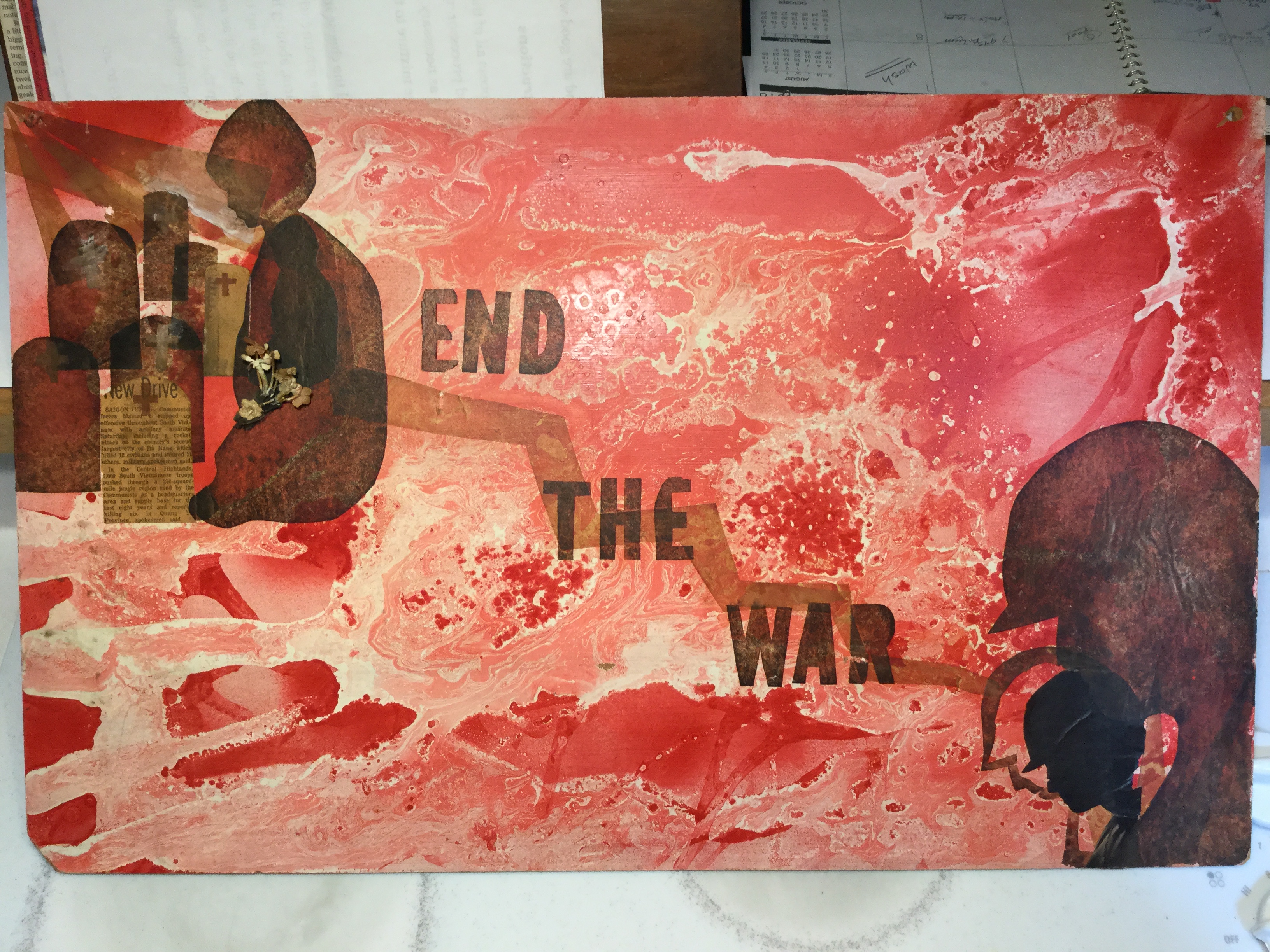
There used to be a poster that hung in the garage of the house where I grew up.  My sister remembers it, too.  My mom made it when we both were kids.  Red and white paint, smeared violently together, with the silhouettes of soldiers and gravestones, and in black block letters across the top, “End The War.”

My dad did not know what happened to it.  He thought that maybe he had tossed it. Then we asked my mom.  No, she remembered. They still had it.  They dug around in the closet of what once had been my sister’s room and they found it.

It has been at least three decades since I last saw that picture, but with the exception of some dried flowers on one of the dark tombstones, it was exactly as I remembered it. It left an impression.  I have always wondered why.


The death of Billy Van Tassel made my mother angry.  She had opposed the war before Billy’s death, but had not involved herself in protest or anything like that. My sister and I were young.  We grew up in a house where I was never allowed to play with guns.  That, too, my mom said, was a product of Billy’s death.  My own visceral hatred of America’s gun culture? It could have more proximate origins, of course, but the seeds might have been planted long ago.

So many questions. Some I cannot yet bring myself to put on paper.  Uncomfortable questions, and certain uncertainties.  Historians, I suspect, understand this.  We tend to accept the messiness of the past, the inconsistencies we cannot explain, the questions we cannot answer, the riddles for which we lack the last clue.  Aware completely that there always will be questions we cannot answer, onward we go anyways, searching for answers.  Until we can’t any longer.

Military service records for Vietnam veterans are open to immediate family—fathers and mothers and siblings and children.  Billy Van Tassel has no one.  His father and mother died long ago.  His sister is gone.  The National Archives will open his records seventy-five years after his death, a quarter of a century from now. So I talk to those with whom I can speak.  I gather what I can find.  But there is much I can never know.

Billy’s death must have been a shattering event. And like shattered glass, the cracks spread outward. For some they cut deep and left scars.  For the rest of us things were different to be sure, but it is sometimes difficult to see how, and to measure the weight of this event across the span of half a century.

History—the real history of our everyday lives—works like that. We are the things that we remember. We are the things that we forget.  We need to be honest about this. We are the product of facts and tales, truths and fables, the things that we know to be real and stories that we take on faith alone.  Perhaps we do so foolishly, or because of needs or inclinations long buried or barely recognized.  We are what we know and, truth be told, what we can never know.

We head nevertheless into the libraries or the archives.  We search about on the internet. Burdened with questions, we head out tired but relentless, searching for answers that may not exist.

A Note to Students, on the Confirmation of Brett Kavanaugh

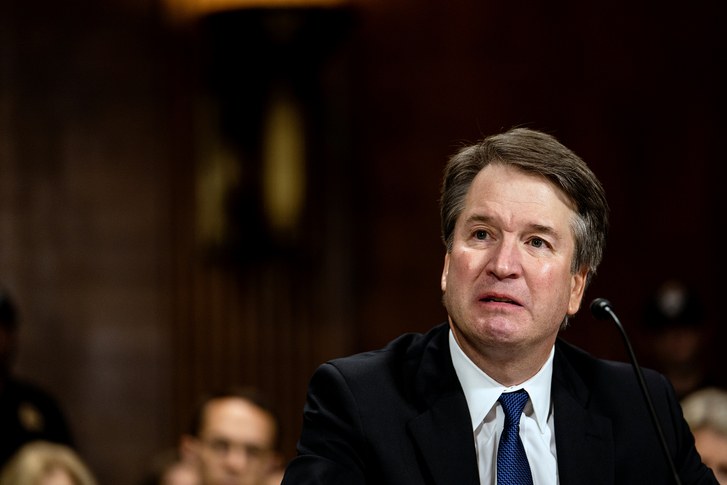
I write these words early on a Saturday morning.  Sometime later today, I expect that the Senate will vote to confirm Judge Brett Kavanaugh to the United States Supreme Court.  Republican leadership in the Senate corrupted the nation’s institutions to force through a justice who stands credibly accused of sexual assault, and who appears to have perjured himself in his testimony before the Senate.  Democratic Senators never managed to view all the documents on Kavanaugh’s career, including his time in the White House, or to obtain answers about Kavanuagh’s curious financial dealings.  A political operative who worked to bring down the presidency of Bill Clinton over that president’s sexual “misconduct,” Kavanaugh’s accusers never had the opportunity to present their case to the committee.  It likely would not have mattered. They crammed Kavanaugh through, the ends apparently justifying any means.  In our class discussions, many of you thought this process was grotesque. Don’t give up.  Fight on.

A long time ago I served as an expert witness in a federal land claims case.  I worked for a non-profit law firm representing the Tonawanda Seneca Nation. They asserted that the State of New York had purchased from them Grand Island, a large island in the Niagara River, in violation of the Federal Indian Trade and Intercourse Act, and as such, that the transaction was null and void.  I will not go into the details, but one of the many historical questions in the case involved whether the federal government had ever returned land to an Indian tribe that earlier had been acquired by a state.  Attorneys for the state of New York, the defendant in this case, said that the federal government had no right to do so and that no such return of land had ever happened.  I wrote reports highlighting two instances where the national government had done just that. In the 1785 Treaty of Hopewell, the United States returned to the Cherokees lands purchased from them by the upstart and outlaw “State of Franklin.”  Five years later, at the Treaty of New York, the United States returned land to the Creeks purchased from them by the state of Georgia in a number of coercive treaties.  And at Canadaigua, in 1794, the United States returned land to the Senecas that included the islands in the Niagara River.

I wrote my report, spent a day in deposition.  Other experts testified on the Tonawandas’ behalf.  It did not matter.  The federal district court in western New York dismissed the case before it ever went to trial. I was upset.  I told my friend, one of the attorneys in the case, that I felt like I was playing tennis against an opponent who could raise and lower the nets at will, and widen and narrow the lines while the ball was in the air.  It was unfair.  I felt like there was no way we could win.  She said, and I have always appreciated this, that you still have to do the work, and that you still have to fight, because otherwise the injustice is uncontested and rewarded.

Those of you who have protested against Kavanaugh have been described as a mob by the Republican leadership and their allies in the Right-Wing media.  In the callousness with which Dr. Ford’s story has been dismissed, I know that many of you feel as well that your stories do not matter.  In the cynical manipulation of the political system by Leader McConnell and the rest of the Republican leadership, you might feel that there is not much that is democratic about this government at all, that we are led by men old and white who do not care about people like you.  You might think the system is so corrupt that it is beyond redemption, or that because 63 million Americans voted for this travesty that all hope is lost.

But you need to resist.  You need to question each of their assumptions, each of their spurious claims. Engage them fervently in dialogue and discussion. You need to make your voices heard.  They will try to denigrate you and dismiss you.  They will call you “Snowflakes” and “Feminazis” and propagandists of “Political Correctness” and part of a mob.  Keep at it. Your protest is patriotic, your expressions of your dismay important exercises of citizenship. They are working to achieve a revolution, a new America with little government regulation, unfettered corporate power, restrictions on who can vote when and where, and a truncated democracy.

And they will not stop.  I expect that many of you see that now.  They will not stop.

THEY WILL NEVER STOP.

Until you stop them.

Election day is less than a month away.

Town Destroyer in Paradise: How George Washington Ended up Just Outside Handsome Lake’s Heaven

I recently read Colin Calloway’s book on The Indian World of George Washington, and that got me thinking about two very different depictions of our nation’s first President.  I write about the Senecas, with whom these particular depictions originate, in Native America. In the late 1790s, the great Seneca prophet Handsome Lake experienced a series of visions that became the basis of the Gaiwiio, the good news of peace and power, the “old time” religion still practiced by many Haudenosaunee Iroquois traditionalists in New York State and Canada.   This was a critical moment in Seneca history, and the emergence of this gospel, and Handsome Lake’s message, was one of enormous significance, bringing hope and an explanation for their historical experience to Haudenosaunee peoples.  As related in the 1850s to the early anthropologist Lewis Henry Morgan by the Tonawanda Seneca Jemmy Johnson, George Washington “stood preeminent above all of the white men” because “of his justice and benevolence to the Indians.”  Johnson told Morgan that the Senecas believed “that the Great Spirit had received” Washington “into a celestial residence upon the plains of heaven, the only white man whose noble deeds had entitled him to this heavenly favor.”  The only one. Not in paradise, but just outside. Washington resided there, silent and content.  “No word ever passes his lips. Dressed in his uniform, and in a state of perfect felicity, he is destined to remain through eternity in the solitary enjoyment of the celestial residence prepared for him by the Great Spirit.”

It is quite an image, and one difficult to reconcile with the man known by many Indians as the “Town Destroyer,”  a name originally claimed by his great-grandfather for the fighting he did along the Potomac frontier in the 1670s, and which our Washington appears to have appropriated and used when it served his purposes.  From his birth to his death, Washington lived in a world carved out of Indian land.  Washington spent nearly his entire career thinking about and fighting against native peoples, engaging them in diplomacy, and laying plans and conceiving of policies to acquire Indian lands for himself, for his fellow investors, and, later, for his nation. Indeed, Washington was instrumental in the dispossession of native peoples. The country he played so fundamental a role in founding rose on lands lost by native peoples.

During the colonial period, during the era of the Revolution, during the Confederation and under the new Constitution, Americans could disagree intensely over the conduct of Indian policy. This long-running debate, however, for white Americans was always over means, not ends.  The debate boiled down to defining the nature of the Indians’ defeat.

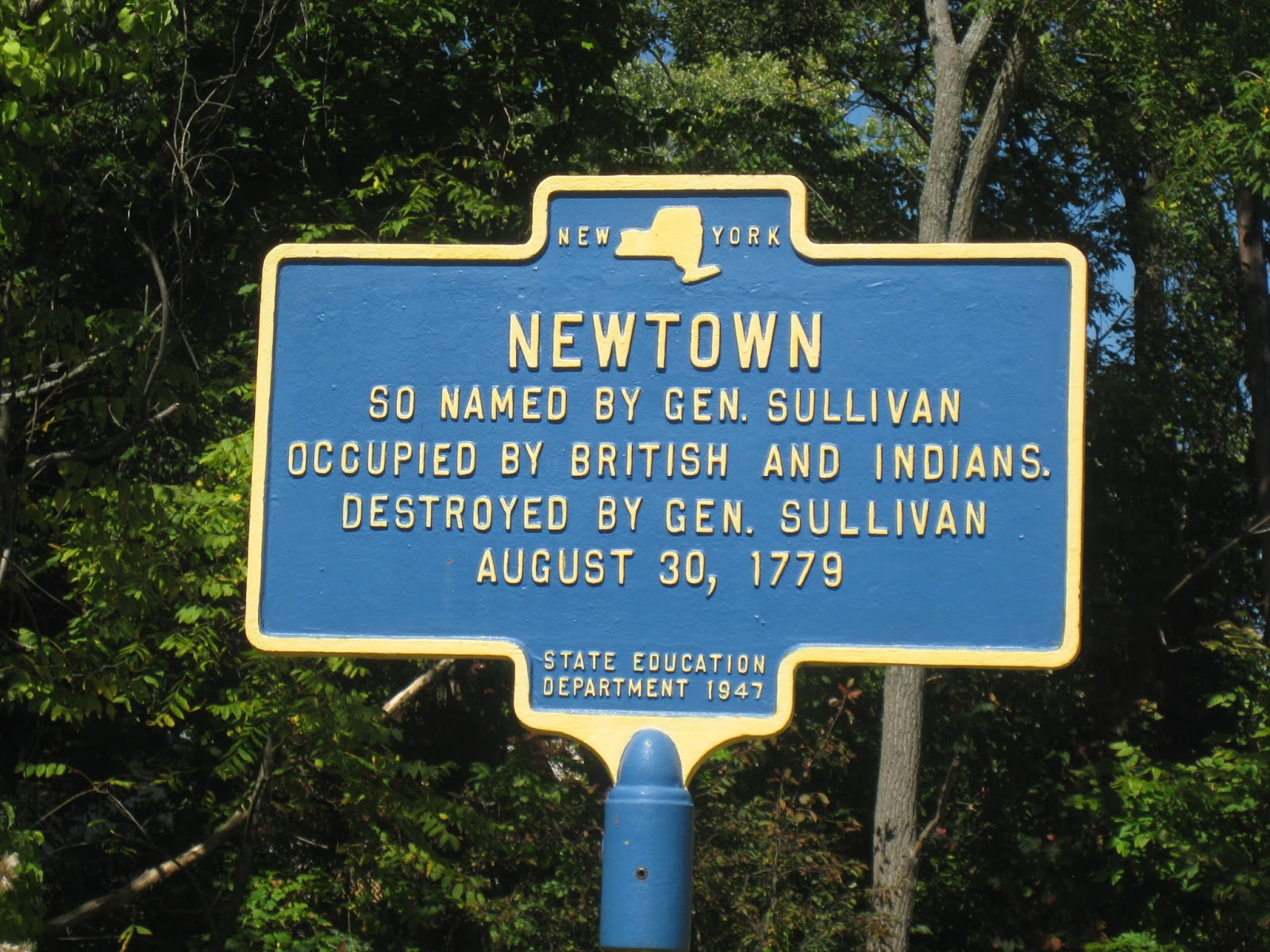
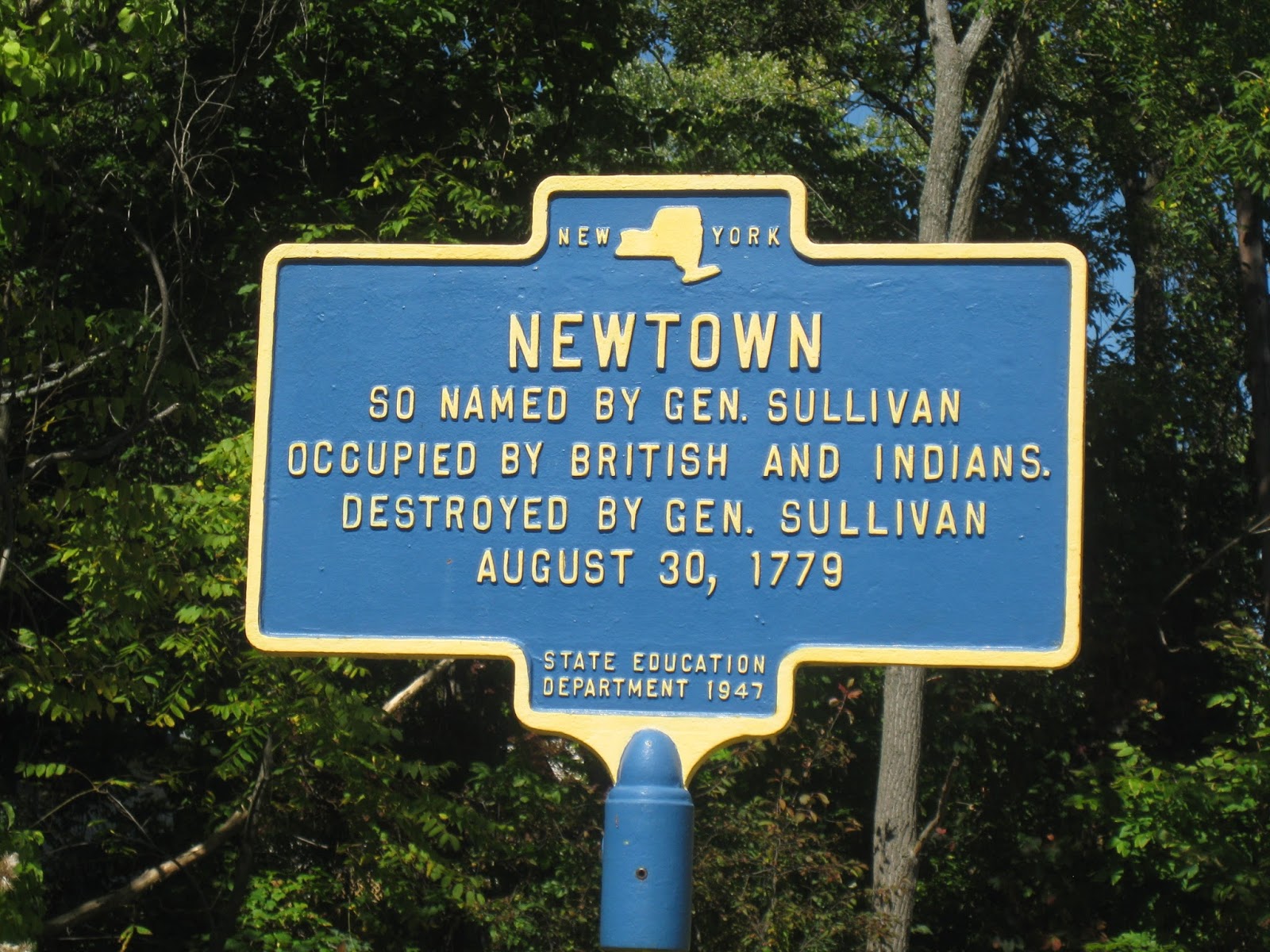
Washington’s treatment of Native America makes clear that the answer would involve violence. During the Revolution, Washington ordered invasions of the Iroquois that resulted, if we choose to believe Haudenosaunee voices, in the rape and murder of Onondaga non-combatants by New York militiamen following Colonel Goose Van Schaick. It resulted in what can justly be called war crimes against Senecas and Cayugas as well the destruction of their crops and orchards, and dozens of towns in 1779 as part of the infamous Sullivan campaign.  Washington hoped that Sullivan’s men would “distract and terrify” the Indians and, in Washington’s own words, “extirpate them from the Country.”  Sullivan’s soldiers drank a toast promising, among other things, “civilization or death to all American savages.”
As my kids sometimes say, “That’s pretty racist.”  Not a pretty picture at all.  So how did this guy end up outside the Senecas’ heaven, close to, but not quite inside, paradise?

To best answer that question, I suggest that we flip the narrative, and try to look at these important events in American history as native peoples might have experienced them. As I point out in Native America, we can start with the words we use.

Words like ‘Indian,” for example, or phrases like “Native American,” of course are flawed.  They obscure more than they reveal, and they would have meant little to peoples whose names for themselves often translated as “people” or “the real people,” or “the real human beings.”  But the problem with words goes even deeper than this.  Too many historians, for too long, have relied upon flawed dichotomies: there was a “pre-contact” or “prehistoric” period that came before “contact” and before the arrival of Europeans ushered in the “historic” era.  Native peoples obviously had long histories on this continent before Europeans arrived. They interacted and exchanged with and fought against native neighbors near and far, and these contacts bred a host of cultural practices that pertained to their “contact” with others.  They did not simply drop these aboriginal practices when Europeans arrived.

Language can be difficult, and words tricky things.

Colonists “settle” but Indians do not: they are depicted nomads who wander and roam when they in places were more fixed and tied to place than the newcomers.  Europeans plant crops, but Indians do not, according to conventional wisdom; colonists serve as soldiers while native peoples fight as warriors. Language can emphasize difference, and an emphasis of difference can be misleading, for example, because it might make violence seem inevitable, or reinforce racial and racist stereotypes.  In reality, the differences between natives and newcomers at the outset might not have been as great as our flawed language leads us to believe. Both, for example, relied upon an agriculture centered upon corn to stay alive. Both supplemented their agricultural produce with sources of protein they acquired systematically.  Native peoples, for instance, managed forests, burned underbrush, and generated new growth that attracted game that hunters could more easily harvest.  Newcomers, meanwhile, turned their livestock loose and allowed it to forage and fend for itself.  When the settlers got hungry, they went out into the woods to hunt down their nearly feral cattle and hogs.

Some more words.  The “Founding Fathers,” the patriots, and white settlers who encroached on native peoples’ lands, Indians saw not as freedom fighters but as “perfidious cruel rebels” and, tellingly, as “white savages.” They referred to them not as champions of liberty but as “Butchers,” and “Killers,” and “Madmen.” They called them “Big Knives” or “Long Knives,” names that chillingly reflected the violence with which they were associated.  Native Americans in this part of the country in the eighteenth and nineteenth centuries feared that Americans acted with genocidal intent, and they said it again and again and again. One solution to the Indian question, for some white settlers, you see, was extermination, and groups of white Americans expressed that desire and acted on it in ways that confirmed the nightmares of native peoples.  You can think of the murder and mutilation of children carried out by the Paxton Boys late in 1763, acts of horrific violence that have brought my students to the edge of tears.  Children murdered by white vigilantes armed with tomahawks.

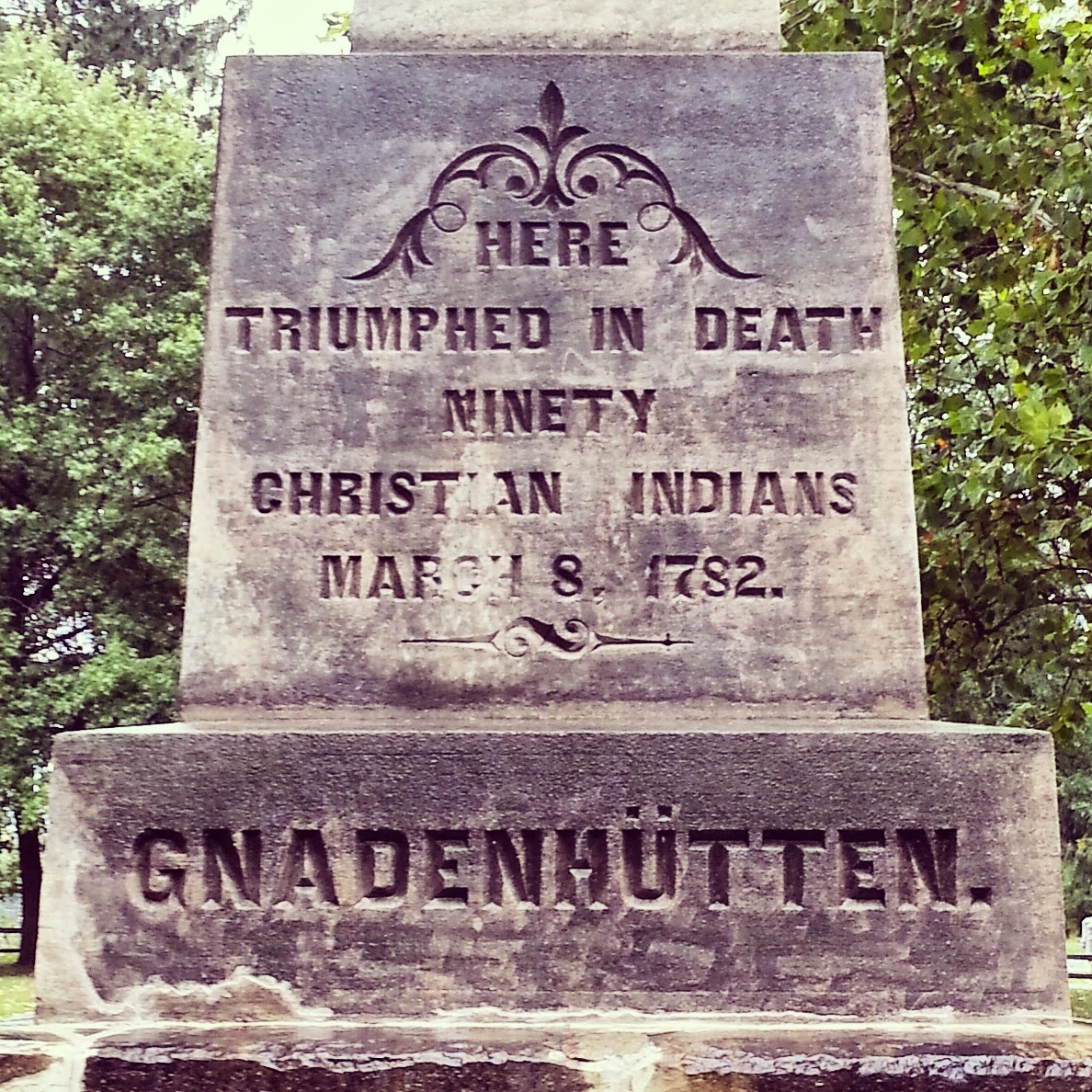
Or the massacre at Gnaddenhutten, 1782.  Gnaddenhutten– “The Houses of Mercy.” That’s what that name means.  No mercy there for the Christian Indians who lived and prayed and worked there. The soldiers from Pennsylvania surrounded the Christian Indians at Gnaddenhutten.  They had them at their mercy.  So they held a vote on whether or not to kill the one hundred Christian Indians they had taken captive.  This was, for many native peoples, what American democracy looked like.  I have written about the massacre at Gnaddenhutten on this website.   It is a devastating history. One could write a history of Native Americans that uses the violence meted out on native children as the vehicle driving the narrative, from the earliest period to the present.
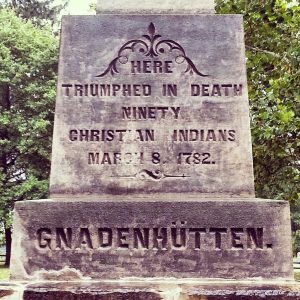
I tell my students about these violent episodes.  These events allow us to mess around with words.  Murder at Gnadenhutten becomes an expression of democracy. Frontier settlers become savages.  I try to decenter things, to upset expectations.  And I think we need to do this if we are to understand why so many native peoples so forcefully and effectively resisted the newly independent United States. And, also, how the Senecas,–the victims of a brutal invasion ordered by Washington and by acts of vigilante justice for decades thereafter– might pass a silent George Washington, the man who ordered the burning of their towns and forced them to flee their homeland, on their way into heaven.

After the war, after he resigned his commission, Washington’s advice was sought out and given on Indian affairs.  In a letter he wrote to James Duane of New York in the fall of 1783, he called for effective and meaningful oversight of the settlement of the western territories.  He always had distrusted squatters, and feared the unregulated expansion of white settlement. He wanted peace and order on the frontier, to acquire land without conflict. “To suffer a wide extended Country to be over run with Land Jobbers, Speculators, and Monopolisers or even scatter’d settlers,” he wrote “is pregnant of disputes with the Savages, and among ourselves, the evils of which are easier, to be conceived than described.”  Native peoples, he asserted, had sided with Great Britain against the American states and all good advice.  A “less generous people” than we, he said, would drive them out.  Recognizing that this would involve a renewal of conflict with native nations that had been battered but not defeated during the war, Washington suggested that the Indians be told that the past will be forgotten. The United States, however, whether they liked it or not would “establish a boundary line between them and us beyond which  we will endeavor to restrain our people from hunting, or settling, and within which they shall not come, but for the purpose of Trading, Treating, or other business unexceptionable in its nature.”  Indians would give up lands in the process, to the United States or to the states with the best claim to those lands.  The sale of Indian lands allowed states to pay their soldiers.  The sale of Indian lands allowed New York to abstain from taxing its citizens before the War of 1812. Indian dispossession made New York the empire state.

But the result of these Confederation policies was chaos.  The Articles of Confederation, the new nation’s first constitution, established a limited government in which the states retained all rights they had not explicitly granted to the national government.  In Article IX of the Articles, which listed Congressional powers, the states granted the national government the “sole and exclusive right and power” of “regulating the trade and managing all affairs with the Indians, not members of any of the States, provided that the legislative right of any State within its own limits be not infringed or violated.” Who might these Indians be? New York? Virginia? North Carolina? Georgia?  This crazy ambiguity allowed aggressive states like North Carolina, Georgia, and New York, and even entities like the upstart “State of Franklin,” to conduct their own Indian policies, negotiate their own treaties, and extract their own land cessions, at times in defiance of Congress and, in the case of Georgia, at the point of a gun.  Land speculators, squatters, cattle rustlers, timber cutters, state politicians, congressional commissioners, and Indian killers—they all assaulted the Native American estate.  And Congress itself, in the treaties it convened with Indian nations it claimed to have defeated, operated on a “conquest theory,” asserting that because the Indians had aligned themselves with Great Britain, and Britain had lost, so too had the Indians.  Native peoples seethed with resentment at the treatment they received from national and state officials during the Confederation, as congressional commissioners cast aside long-established protocols for conducting diplomacy, and thumped Indian leaders in the chest demanding cessions.

This could not stand, for these native nations maintained the capacity to resist.  Washington certainly supported efforts to replace the Articles of Confederation with a more powerful central government based on the imperial model.  He agreed with the Virginians who saw the faults in the Articles.  Like James Madison. In his white paper laying out the “Vices of the Political System of the United States,” Madison placed as number two on his list “encroachments by the States on Federal authority,” and he gave as an example “the wars and treaties of Georgia with the Indians,” state aggressions against the powerful Creeks that threatened the entire Southern frontier. Washington frequently expressed a similar complaint.

The new constitution of 1787 eliminated the ambiguity of the Articles of Confederation. In Article I, Section 8, we the people granted to Congress power “to regulate Commerce with Foreign Nations, and among the several States, and with the Indian tribes.” That’s it. That is all it says.

To flesh out that spare language, Congress in 1790 passed the first of several Indian trade and Intercourse Acts. (The first was enacted in 1790, the last in 1834).  The law, which reflected perfectly the views of Washington and his secretary of War Henry Knox about the conduct of Indian policy, provided rules governing those instances when native peoples and newcomers came into contact.  Legal land sales required the oversight of an appointed federal commissioner and the subsequent ratification of the transaction by the Senate.  Trade without a license obtained from federal agents was prohibited.

It is important to say a few words about this important piece of legislation, the nation’s first Indian law. Washington, in a letter written to the Senecas in December of 1790, saw the new law as a watershed.  The Iroquois had indeed lost much to the State of New York during the Confederation years but now, he wrote, “the case is entirely altered—the general government only has the power to treat with the Indian nations, and any treaty formed and held without its authority will not be binding.”  The Trade and Intercourse Act would provide “security for the remainder of your lands.” The United States, he continued, “will never consent to your being defrauded,” “will protect you in all your just rights,” and “considers itself bound to protect you in all the lands” you still possess.  Washington never claimed any power over the internal workings of native nations.  Nor did the Constitution grant to the national government any powers over the internal workings of native nations.  Sovereign native nations were a force Washington and his contemporaries recognized.

Washington needed a peaceful and orderly frontier, but the government he commanded was a tiny thing.  The total number of non-uniformed employees of that national government in 1801, the first year for which we have good figures, was less than three thousand, and the vast majority of these worked in customs or other revenue-related functions, or the postal service.  The number of federal officials in all of New York working in Indian affairs, for instance, could be counted on one hand.  The government and its agents, then, could do little to curb encroachment, or prevent theft, or timber cutting or cattle rustling, by white people in Indian country.  Even if the will was there—and that is a matter that is debatable—the institutional apparatus was not.

The states continued to purchase Indian lands.  Settlers continued to encroach.  Conflict erupted in Georgia, the Carolinas, and in the Ohio Country, where growing numbers of militant native peoples came together in a spirited resistance against American expansion.  This territorial and physical aggression unquestionably frustrated Washington, but aware fully that power claimed but not exercised was power lost, he largely held his tongue. Controlling state governments was one thing; controlling the violence of settlers still another.  Thirteen Senecas, to cite one example from some of my own work, were murdered by white frontiersmen between 1784 and 1790 and probably another half-dozen more in the couple of years that followed that.  Native peoples found their life, liberty, and property in jeopardy.  For them, these were times that tried men’s souls.

And here’s the thing.  These grievances were significant, and Washington understood this.  He mentioned them in his annual messages to Congress.  He worked to negotiate treaties to resolve them, always looking for additional cessions of land.  Indians in the so-called Northwest Territory shared many of these grievances.  So while the government hoped to extract cessions and purchase the land upon which settlers settled and squatters squatted, native peoples increasingly committed themselves to protecting their homelands by force.  So they were ready when, in September of 1790, General Josiah Harmar led a force of 1450 regular soldiers and Kentucky militiamen out against the native towns along the Wabash and Maumee rivers in what today is the state of Indiana. Native peoples from many nations—Shawnees, Miamis, Ottawas, Potawatomis, Weas, and Kickapoos—ambushed Harmar’s force along the Maumee and killed 180 of his men. The defeated American force returned home by the end of October.

The defeat of Harmar’s invasion emboldened those native peoples willing to resist American forces, and swelled their ranks. Potawatomis and Shawnees, along with Delawares and Miamis, attacked a settlement called Dunlap’s Station just north of Cincinnati in January of 1791, while Potawatomis joined with Ottawas and Chippewas to attack targets elsewhere along the Ohio. By the spring, land speculators in the Ohio country complained that they found it difficult to recruit prospective settlers. “The Indians kill people so frequently,” they wrote, “that none dare stir into the woods to view the country.”

Native peoples had their own fears, of course. When Kentucky militiamen attacked a cluster of villages in northern Indiana where Potawatomis and many other native peoples lived, they threatened them with extermination. If native peoples refused to make peace, Brigadier General Charles Scott said, “your warriors will be slaughtered, your towns and villages ransacked and destroyed, your wives and children carried into captivity.” Many of those who lived in the Ohio country saw in the United States, whatever its claims to desire peace, a truly existential threat, the menace of genocide.

Meanwhile, Congress had already laid plans for another military invasion to take place in 1791. Arthur St. Clair, whose chief qualification was his seniority, led American forces into the Miami River Valley in September. Most of his soldiers were militiamen, poorly trained and poorly supplied. Before dawn on November 4, a force that consisted of Potawatomis, Shawnees, and large numbers of others—Ottawas, Chippewas, Wyandots, Mingos, Delawares, Miamis, and a few Chickamauga Cherokees—attacked St. Clair’s much larger force. The soldiers panicked and ran. Over 640 soldiers were killed or captured or unaccounted for. Another 250 were wounded. Fewer than 500 men made it to safety unharmed. They killed only a small number of Indians in the largest defeat ever suffered by American military forces at the hands of native warriors. Twenty percent of the American military had been wiped out in one day.

By 1792, native peoples from many nations had gathered at a site called the Glaize, near today’s Defiance, Ohio. There they reflected upon the meaning of their victories over the American forces. Native peoples with grievances against the Americans settled there, and their numbers included Potawatomis, Shawnees, Delawares, Miamis, Sacs, Foxes, Ottawas, Hurons, Munsees, Conoys, Mingos, and Cherokees and Creeks. The presence of the southern nations showed that the diplomatic connections between militants north and south remained strong. American agents feared that the powerful and well-armed Creeks and Chickamaugas would join with the Shawnees and other northerners to attack American settlements. The Indians gathered at the Glaize, according to the Shawnee leader Painted Pole, would unite to resist further invasions. The inability of the American government to control its vicious backcountry settlers, and its own rapacious desire for Indian land, had unified its many enemies into a powerful native force.

With the British still occupying forts on American soil, and imperial officials brazenly discussing the policy of creating a neutral Indian barrier state north of the Ohio River, with native peoples hostile towards the United States insulating Britain’s holdings from American expansion, the situation was dire indeed.  It is stunning.  Britain hoped to snap off that part of the United States north of the Ohio River to create a neutral Indian barrier state.  If powerful groups like the Senecas, with the potential to receive easily British arms and ammunition from Fort Niagara joined with the victorious northwesterners, the entire frontier could be set ablaze.  Washington ordered another invasion of the Ohio Country.   Late in the summer of 1794, American general Anthony Wayne led his force of 3000 soldiers toward the Maumee Valley. There, on August 20, he defeated the confederated tribes at the Battle of Fallen Timbers. Although casualties were roughly the same on each side, the Americans took the field, and razed the Indian towns. The fleeing warriors headed toward the British post at Fort Miami. British agents had remained active in the Northwest since the close of the Revolution, and they had armed and encouraged the natives’ resistance to American expansion. Now, however, they kept closed the gates to their forts and refused to fire upon the pursuing Americans. Once again, the British abandoned their native allies and demonstrated, if the point still required demonstration, that native peoples in the Old Northwest needed the British more than the British needed them.

They now had no choice but to make peace with the United States. A year after the battle, at Greenville, the Potawatomis, Shawnees, Delawares, Ottawas, Chippewas, Miamis, Weas, Kickapoos, Piankashaws, and Kaskaskias agreed to a peace that “shall be perpetual … between the United States and Indian tribes.” They paid as the price of that peace a massive cession of lands to the United States. The confederated tribes gave up tracts of land in Indiana and Illinois, and, more significantly, all of southern and eastern Ohio.

The Treaty of Greenville revealed the sort of changes that the President and the Secretary of War hoped to bring to their defeated enemies.  Each of the nations signing the treaty would receive an annuity, a yearly payment of money and other items the tribe could use to supply its wants. If the tribes should “desire that a part of their annuity should be furnished in domestic animals, implements of husbandry, and other utensils convenient for them, and in compensation to useful artificers who may reside with or near them, and be employed for their benefit,” they need only to inform the federal agent stationed nearby and “the same shall at the subsequent annual deliveries be furnished accordingly.” The United States would thus see to the civilization of the Indians, by transforming them from wandering hunters into settled farmers on the American model. Because farming required less land than the hunt, the thinking went, more land soon would be opened for white settlement and expansion. To make this argument, of course, required the Americans who wrote the treaties, like Wayne, and those who ratified and proclaimed them, like the members of Senate and the president, ignore the vast Indian cornfields that American forces destroyed, or the herds of cattle and swine that even now native peoples relied upon for food. To save the Indians, Americans would civilize them, and civilization required that they live upon less land. Americans took native land in the name of helping native peoples become civilized. Taking, as one historian put it, became giving.

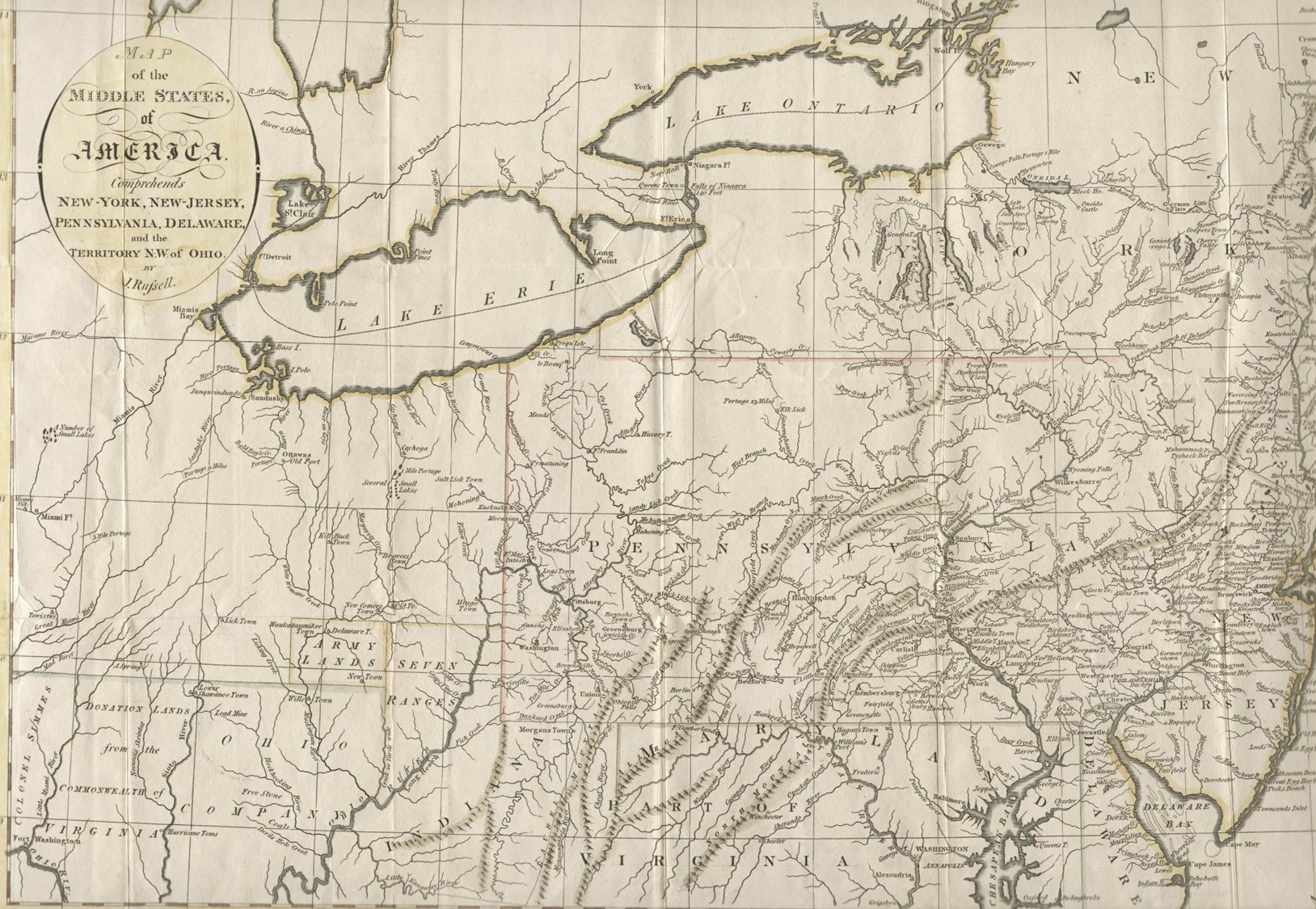
There were still the problems in Iroquoia that caused Senecas to contemplate joining the Indians to their west.  Their disaffection was real, the threat they posed to the United States significant. As Anthony Wayne invaded the Maumee valley, the American commissioner Timothy Pickering met with the Six Nations at Canandaigua in western New York. He hoped to resolve long-standing difficulties with the Senecas. Their lands formed the central issue at the council. Through the Treaty of Canandaigua, signed on November 11, 1794, Pickering and the Senecas redefined the boundaries of the Seneca estate. The new western boundary of their lands ran “along the river Niagara to Lake Erie.” This gave to the Senecas access to the river and the islands and access to British Canada to their west, a freedom, they hoped, that gave them an outlet and the opportunity to avoid the fate of other encircled Indian tribes. The Senecas did not wish to become “mere makers of baskets and brooms.” This was an important concession. The ability to move through space, to interact with Haudenosaunee communities distant from them, was of immense importance to Iroquois peoples. Pickering also agreed to pay to the Senecas “a quantity of goods to the value of ten thousand dollars,” and, further, that “with a view to promote the future welfare of the Six Nations,” an annuity of $4500.

As with the treaty negotiated eight months later at Greenville, the United States sought to civilize the Six Nations and transform them into farmers on an American model. To the Senecas, however, the 1794 Treaty of Canandaigua recognized their sovereignty.  This is why it is so critical. It is why they honor Washington still and commemorate the treaty every year.  Pickering, on the president’s behalf, pledged that the United States would never claim the Senecas’ lands, “nor disturb the Seneka nation, or any of the Six Nations, or their Indian friends residing thereon and united with them, in the free use and enjoyment thereof.”  The Free Use and Enjoyment of their lands: it is a critical phrase. They could, they hoped, live upon their lands without the interference of outside authorities, and with the protection of the United States against unlawful intrusion. The treaty, the Senecas believed, recognized their right to exist upon their ancestral lands as a nation free from outside interference.  It recognized their nationhood.

1794, by any standard, was a momentous year in the history of the Early Republic.  There’s the Whiskey Rebellion, and the foreign policy problems occasioned by war between France and Great Britain.  And Indian affairs. That year, Washington said that he had hoped to oversee the orderly expansion of American settlement while pursuing a policy “calculated to advance the happiness of the Indians and to attach them firmly to the United States.” He wanted peace, and to see to the “civilization” of native peoples. To this end, congress enacted and he signed the Trade and Intercourse Acts, designed to ensure order along the frontier and peace in relations between native peoples and the citizens of the young republic. He abandoned the conquest theory advanced by the Continental Congress in the immediate aftermath of the Revolution for a system based on treaties that, he hoped, would regulate American expansion while guaranteeing native nations the lands that they did not cede—at least until the next treaty council.

Yet Washington that same year lamented “the insufficiency of the existing provisions of the laws toward the effectual cultivation of peace with our Indian neighbors.” By 1796, the final year of his presidency, Washington still hoped to restrain “the commission of outrages upon the Indians,” but he feared that “scarcely anything short of a Chinese wall, or a line of troops, will restrain Land jobbers, and the encroachment of settlers upon the Indian territory.”

A Chinese Wall was out of the question.

The policies advanced by Henry Knox and he failed to achieve their cardinal goals for a number of reasons. Many native peoples, of course, already considered themselves civilized, and saw little attractive in the arrogant assumption that they must abandon their culture in order to survive. Others dressed like their white neighbors, bore Anglo-American style names, and lived in American-style housing. Many of them spoke English. They may even have listened to missionaries who worked to save their souls. Many already were members of Christian congregations. But they borrowed selectively, took what they wanted, and they lived on the margins of American society in communities of their own making. Though they incorporated substantial amounts of Anglo-American material culture into their lives, they remained quietly indifferent to what many Americans felt they had to offer native peoples.

Those native peoples who did work with the Americans—the leaders who, hoping to avoid the horrors of wars they feared they could not win, or the continuing loss of their lands—signed treaties guaranteeing them all that remained until they were ready to sell. They may have attended to the missionaries, accepted agricultural implements and livestock, and tried to make changes in their ways of living because they believed that doing so offered the best chance for their people to survive. But making these changes raised all sorts of challenges.

The frontier, we must remember was a violent and at times a frightening place. Many settlers living on war-ravaged frontiers simply could not trust their Indian neighbors, no matter how small a sliver of their original lands they retained. Settlers in the Ohio country, for example, experienced the horrors of warfare just as did Indians. Some of them witnessed the death of friends and neighbors in Indian attacks. More of them heard horrifying stories of Indian attack. These settlers had occasion to fear Indians and they found in their fears justification for horrible acts of terror. They could, as did those Ohio country settlers in 1782, conclude that the singing of psalms by Christian Indians at the Moravian mission at Gnadenhutten was not the expression of praise for a peaceful and loving God, but the ranting and boasts of savages who had wet their hands in the settlers’ blood.

These acts of violence, along with the failure of the young republic to control its land-hungry settlers, and the continued suffering in many native communities, gave encouragement to those leaders who called for an armed resistance against the Americans. By 1794, much of this resistance had collapsed, and native peoples paid an enormous price for it. Warfare, and the resulting dislocation, devastated native communities. The Cherokees surrendered over 20,000 square miles of their territory. The Six Nations, combined, lost much more, and the population of both nations declined significantly between 1776 and 1794. The birth of the new republic, an “empire for liberty” in Jefferson’s view, proved catastrophic for many native peoples.  Washington always wanted to dispossess Indians, to acquire their lands. He hoped to do so peacefully, through treaties, with a minimum of cost and violence. Unlike, say, Jefferson, who wrote at length about native peoples, he never gave much thought to their history and culture. Native peoples were, for him, an obstacle, and a problem to be solved.  A creature of empire, his solutions were imperial, even if his was an imperialism tempered by his limited control over his countrymen, and a recognition of the power, and the nationhood, or native peoples.  Some of these natives succeeded against long odds in remaining upon their lands.  That was the case with the Senecas and the Tuscaroras I visited yesterday, who in their casino enterprises, their tribal businesses, in their programs for cultural preservation, continue to assert their untrammeled right to the “free use and enjoyment of their lands” as their departed relatives move past Washington, who signed the treaty that recognized their enduring nationhood, on their way into paradise.

 

“Civilization Or Death To All American Savages”: On the “Commemoration” of Sullivan-Clinton, 1779

“Civilization or Death to all American savages!”  That was one of a number of toasts offered by the officers who accompanied James Sullivan’s invasion of Iroquoia during the American Revolutionary War.  Planned and plotted by George Washington himself, the “Sullivan Campaign” burned dozens of Haudenosaunee towns, destroyed crops, orchards and fields, and forced the Iroquois to flee from their homelands toward the British post at Niagara.  There they suffered and died in large numbers during one of the worst winters on record.  In a letter to Lafayette, Washington expressed his hope that the expedition would eliminate the considerable threat hostile Iroquois posed to the rebel movement, “distract and terrify” them, and “extirpate them from the Country.”

I tell the story of the Sullivan Campaign in Native America.  You can also read a rather dry, nuts-and-bolts military history that focuses exclusively on the American side in Joseph Fischer’s A Well-Executed Failure.  Most recently, Colin Calloway in his fine examination of The Indian World of George Washington covers the expedition in all its brutality, from Van Schaick’s rape and murder of Onondaga women, to the atrocities committed by Sullivan’s men.  And it is not just academic historians with an interest in the story.  The Empire State Society of the Sons of the American Revolution, with financial backing from the William J. Pomeroy Foundation, has introduced its “Sullivan-Clinton Campaign of 1779 Historic Marker Grant Program.”  The ESSSAR ( try saying that without sounding like Kaa) invites you or your organization “to help commemorate the 250th anniversary of the Revolutionary War Sullivan-Clinton Campaign of 1779 by erecting a specially designed Historical Marker.”  The Pomeroy Foundation “will provide full funding for the marker, pole, and shipping.” Installation is up to you.

If you want to submit a proposal for a historical marker, your time is running out.  The deadline is September 14th.  You can fill out the form here.

The website includes a small sample marker you might use as a template.  “Chugnut,” the sample reads, “Native American village near mouth of Big Choconut Creek destroyed by General Enoch Poor, August 18, 1779, Sullivan-Clinton Campaign.”

If this marker is an indication of things to come, it looks like this will be a history uninformed by the important recent scholarship on native peoples, focusing mostly on what Continental soldiers and officers did with little attention to destroyed towns and and shattered lives, the uprooting of a people and their transformation into refugees, and the atrocities committed against non-combatants.  Chugnut is there, but then it is not.  No sense of what it was before, or what became of the people who lived there.  No sense that the rise of New York as the Empire State could not have occurred without war and violence, and without a systematic campaign of dispossession carried out by the state against the Haudenosaunee.

The ESSSAR campaign information came to me during the summer. To some extent, I am still catching up with some of that email.  I do not have time, regrettably, to submit a proposal for signs.  That is my fault.  I would very much like to send a large number of suggestions. I get that I am too late.

But I hope the sponsors of this project will seek out Haudenosaunee voices and solicit their suggestions for marking the path carved by Sullivan’s men, and measuring the destruction it wrought.  The Sullivan Campaign was designed expressly to eliminate the Iroquois as a force in the western reaches of what came to be New York State.  The Americans wanted to erase their towns, destroy their food supplies, force them from their country, and drive them to starvation over the winter outside of Fort Niagara.  You might call this an invasion.  You might say this was war.  But you could also call it ethnic cleansing.  Or genocide.

There is that tired cliché: The winners write history.  Might makes write.  Well, yes, they do, but it is usually not very good and it is almost always incomplete.  If you have used Native America, or if you have managed to keep abreast of the massive literature in Native American Studies written by anthropologist, archaeologists, and historians, you will note that there are a wealth of sources that can be used to reconstruct native experiences during the Revolution. You can ignore them if you want when you commemorate acts of war, but we historians have a name for that, and we will judge you harshly if you do so.  We will judge you in the same way we judge those who continue to defend the racist monuments celebrating the Confederacy erected after the Civil War. Like them, you will be encouraging a history of erasure, one that conceals the misdeeds of the past, and obscures the sufferings of those who became the victims of history.  Good historians remember and understand that what some people choose to “commemorate,” others are compelled to mourn.

Easy A

Over the break, while sitting in the airport in Las Vegas, I took a few minutes to read Gary Landerman’s essay in the Chronicle of Higher Education, “Why I’m Easy: On Giving Lots of A’s.”

Landerman correctly notes that many of our students experience enormous amounts of stress in college.  Grades, he correctly argues, wield enormous influence in determining the sorts of opportunities a graduate will enjoy.  Part of Landerman’s plan, then, “is to try to show love and empathy rather than contempt and derision, as some of my colleagues do.  Hell, students already have enough stress and uncertainty in their lives, as they adjust to living on their own, making new friends, feeding themselves, and taking crazy-making courses” in other fields.

Landerman seems to teach a significant number of general education courses on a variety of topics in his field of Religious Studies.  Some of these courses are quite large, enrolling more than two hundred students.  Landerman wants the content in these courses “to go down easily and smoothly, to be both entertaining and effortless—a nice break from their other courses, which are sober, regimented, and demanding.”

There are some obvious counter-arguments.  Not all required courses for majors are “crazy-making,” “sober,” and “demanding.”  A professor can maintain high standards in courses covering difficult subject matter in a manner that is not contemptuous and derisive.  I have many colleagues who show a great deal of empathy and love to their students while forcing them to work their way through challenging assignments.  If you have taught for as long as I have, you will learn that it is not uncommon for students to love professors who made them work their asses off.  And Landerman, it seems to me, seems to underestimate just how “stimulating” and “entertaining” the demanding courses that majors take can be.

There was a time when concerns such as these would have led me to dismiss Landerman’s essay entirely, to be so annoyed by his claim that he can get away with what he does because he is tenured that I would completely tune him out.  The students he sees seem more fragile, less able to handle hardship and adversity than those I have known, and far less willing to tackle difficult work.

Landerman teaches large classes, he tells us.  In a class with two hundred students, it is obviously impossible to engage every student in discussions. It is difficult to develop assessments for classes that large that measure the students’ grasp of abstract concepts.  Landerman, indeed, tells us that his exams are easy, and multiple choice.  He does not have to spend a lot of time grading, and jokes that only idiots struggle to receive an A or a B in his classes.

Still, Landerman raises an issue about which I do not hear enough discussion.  “Why,” Landerman asks, “should I assign a grade to an effort at human growth?”  Setting aside the obvious answer that in efforts at human growth, some students work harder and are more successful improving themselves than others, maybe it would be better to ask different questions: what do I want students to get out of my classes, and what is the relationship between the grades I give and actual learning?

I have a colleague, for example, who assigns her students a handful of short papers, ten or so, over the course of the semester.  This she does in lieu of exams.  The paper assignments require students to confront weighty topics.  It is demanding work.  And students must complete all the papers.  So, let’s say, a student completes nine of the ten essays, and earns an “A” on each paper.  Some situation, however, whether a family emergency, an illness, a breakup, or a simple mistake in keeping track of assignments and due dates, keeps the student from turning in the tenth paper.  That student would fail my colleague’s course.

Where is the justice in that?  The policy strikes me as punitive and pedantic. There is no relationship between that student’s failing grade and what she learned over the course of the semester.

I understand that some professors believe students should be “responsible.”  Good training for the real world, they say.  They want to teach students that deadlines matter.  Most of their students, I believe, understand that perfectly well from high school, and if you know a historian who has never missed a deadline, I hope you will introduce me to that sparkly unicorn.  We may not be the people best suited to provide lessons on the subject, “Deadlines Matter.”

This is an extreme example, but there have been many occasions where I have wondered about the relationship between an assignment, the grade, and student learning.  I know that I have made mistakes, and that I have given assignments that did not necessarily measure well the student’s learning.  I still feel like there is a lot I can learn. As a result, I have become more flexible, and that flexibility has led me to be more lenient in my grading. I still require a lot of work but, like Professor Landerman, I have become a generous grader.

Like him, I want my students to think about complex issues.  I want them to engage with important and challenging ideas.  Students in my classes have written essays of such grace, beauty, and intelligence that they have moved me to tears.  Other students write with not nearly that much ease. They struggle to express themselves. They come into my class less well-prepared, or with fewer academic or educational resources than their “Straight A” classmates, but they may have travelled father to get there.  They may have learned more.  They may have been more affected by what they read or, I hope,  by what we talked about in class, than students who perform better in terms of standard measures of student learning and achievement.  Like Professor Landerman, I want to help in a small way to expand these kids’ horizons. I feel fortunate that I can remember how easy it is to be turned on by something I learned in class, that I remember how an idea can change your life.

Just this morning, at the opening convocation at Loyola Marymount University, I listened to the faculty member chosen to address the students and their parents say that at LMU, “Faculty don’t give students’ grades; at LMU, students earn their grades.”  The line received a good deal of applause, but it struck me as completely inane.  This speaker had given a talk that, it seemed to me, revealed a contemptuous attitude toward her students.  You need an alarm clock to succeed, she said, because you do not want to oversleep.  Do your homework. Read the syllabus.  Give me a break.  I hate statements like these that so underestimate students.  As for the grading part of her speech, she seemed to remove her own biases and beliefs and values from the equation.  The students do the work. I decide what they have earned.  But of course she is giving grades, and if she is not careful and conscious and thoughtful, she may enter scores and marks that reflect more what she expected from the students than what they actually learned.  As the parent of a freshman sitting in that audience, I found that a chilling and depressing thought.

We Need To Get Woody Guthrie Right, Now More Than Ever

Every couple of months I read on Twitter another denunciation from someone in the Native American/Indigenous Studies community of Woody Guthrie’s famous song, “This Land is Your Land.” It’s a “obvs hella-colonial” song, the critique goes, because Guthrie’s claim that the entire continent “from California, to the New York Island” belonged to you and me ignored the original Native American owners of North America.  As such, Guthrie erased the reality of Native Americans’ antecedent claims to the continent and, in effect, whitewashed the long history of American Indian dispossession in the United States.

As scholars we need to counter the colonialist project of erasing native peoples and their histories from the land, but this critique of Guthrie is facile at best. Those who teach and write about Native American history, those of us who have worked with these communities in their present-day struggles to regain control of their ancestral lands, have bigger problems than a 75-year-old folk song.

Here are the full lyrics to the song:

This land is your land This land is my land
From California to the New York island;
From the red wood forest to the Gulf Stream waters
This land was made for you and Me.

As I was walking that ribbon of highway,
I saw above me that endless skyway:
I saw below me that golden valley:
This land was made for you and me.

I’ve roamed and rambled and I followed my footsteps
To the sparkling sands of her diamond deserts;
And all around me a voice was sounding:
This land was made for you and me.

When the sun came shining, and I was strolling,
And the wheat fields waving and the dust clouds rolling,
As the fog was lifting a voice was chanting:
This land was made for you and me.

As I went walking I saw a sign there
And on the sign it said “No Trespassing.”
But on the other side it didn’t say nothing,
That side was made for you and me.

In the shadow of the steeple I saw my people,
By the relief office I seen my people;
As they stood there hungry, I stood there asking
Is this land made for you and me?

Nobody living can ever stop me,
As I go walking that freedom highway;
Nobody living can ever make me turn back
This land was made for you and me.

Guthrie wrote the song after hearing Irving Berlin’s “God Bless America,” a patriotic anthem that borders on the jingoistic.  (If you want a song that celebrates an “America: Love It or Leave It” ethos, this ought to be your target). Guthrie wrote during a period in American history when the economy had failed catastrophically, where millions of people were out of work, and federal efforts to provide relief, recovery, and reform, as radical as they were for the time, did not fundamentally challenge the basic structures of American capitalism.

Guthrie stood against the injustices in American society, the exploitation of labor, the impoverishment of hard-working, ordinary people  He stood against the selfish rich, those who gamed a system already rigged in their favor.  This was protest music of the first order.

So, yeah, you can hate Guthrie’s lyrics if you want, but as scholars we have an obligation to read deeply, honestly, and thoroughly.  Unlike, say, Fox News, we are not allowed as scholars to take words out of context, not if we are to claim that we are hard-working, honest, and open-minded in our approach to the past.  And as citizens, we could use more voices like Guthrie’s, willing to denounce the injustices of a system that seems to spiral farther and farther away from its expressed highest ideals every day.