
All posts by admin

Manifesto

We are historians.

No document is sacred. We are impatient with slogans, patriotic hymns, dogmas, ideas held but unexamined and unchallenged.

There is no text that cannot be analyzed, no claim that can not be challenged. Your comforting myths will find no succor here.  There is no assertion we will not check, no argument we will not dissect, no matter we will take on faith.

We will question you. You will feel like it is getting hot in here.  You will sweat.

We respect only the discipline of history–the craft we have learned and refined, the diligence and the thoroughness and the honesty and the hard work that goes into answering questions about the past in a systematic manner.

It is not a science, but it is a discipline, a way of thinking, doing, and being.

We take it all very seriously.

We will make you uncomfortable.

We will be, in your view, assholes and inquisitors, for we will demand of you your evidence. You would rather we study STEM. You see less value in the liberal arts and humanities in direct proportion to the pressure you feel we put upon you to think critically, to reason soundly and honestly.  We will expect you to be able to explain how your reasoning follows from your premises and, assuredly, we will ask you for proof. Maybe you will convince us.  Maybe not.  We will know what you have said before. We will ask you questions you have not considered. We will ask you why you did not consider our questions, and we may feel, as you might, that you are not asking the right questions at all, that they are not good questions that you are asking.

We will ask you what you have read, and why this and not that and what you think about this other thing. We will ask you how you know what you claim to know. If you have nothing to say, we might think that you have more work to do, or that you have not been fully honest, with yourself or us, about your own prejudices and biases.  We will think that you are more interested in advancing an agenda, in scoring political points, than in the truth.

And so we will judge you, and your work. We will judge what you say and what you write, though we will usually be polite. And we will judge you harshly when you mouth platitudes and talking point that you know to be half-truths, and when you attempt to wriggle away from the harsh reality you helped concoct, by saying “it’s not time.” We will listen to you, the mouthpieces of the NRA, and the craven politicians who do their bidding, and the fringes of the media where such dark ideas dwell.Image result for anti-gun art

And when you call us “politically correct,” or view us as part of a menacing “Left,” or as “Libtards”; when you mock us for being “woke” or fragile “snowflakes,” or “European socialists,” we will conclude that you are ill-informed, ignorant, or a coward and a wilful liar.  Or that you have nothing much to say at all. That all your Hannity vanity and wreckless Bannon is nothing but air.  We have a name for that sort of conduct, and we will use it to describe you.

We students of the liberal arts and humanities do not always agree. Sometimes we argue and sometimes feelings get hurt.  Criticism stings. But the give-and-take, the dialogue and debate, it is what we love.  It drew us into this world, this life’s work.

We listen and we learn. We re-write our lectures and redesign our courses, when we uncover something new. When a new interpretation, a “revisionist” work arrives, we consider it.  We think it over.  We take notes. We think some more. We stay up on our fields.  We devour new scholarship. We are honest, and we work hard.  We work longer hours than you will expect. We have high standards. We do not fear these at all. We agonize about what we write and teach, and we strive, imperfectly, to get things right. We spend a lot of time alone, reading, thinking, researching, writing. No, we will not carry weapons.

We hold ourselves to high standards. But we will hold you to high standards, too. And though we are quick to smell a rat, and good at detecting lies, and we are willing to dig like terriers for answers, we are patient and we will listen to you. And we listen closely.

It has been a bad couple of days.  I say that as a historian and as a human being.

There is a novel I love.

I have not read it in a long time. I may have lost my copy. I gave it away to someone but I cannot remember who that was, or I lost it on one of my many moves. It is called Waterland, and the author was Graeme Swift. The main character was a history teacher named Tom Crick. He taught his students about the French Revolution, about the history of Europe. But Tom Crick’s life was falling apart, personally and professionally.

And one day, challenged by a frightened student, a boy who could not see the point in studying the past when the future looked so bleak, and who asked his teacher why should we bother studying history, Crick provided his answer.

Why, Crick said, is the question that makes us human, and the word that blares in the historian’s ear like a siren in the night.  Why? If only…But why?

I think about that novel a lot.  History. And regret.  They go together.

Like gunshots and grief.

So, again, why?

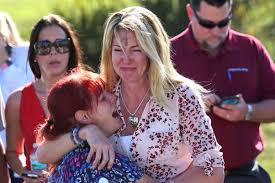
Why did this screwed-up kid with a screwed-up life do this screwed-up thing in Florida the other day. I rarely watch the news anymore, but I watched a lot after I heard that yet another school shooting was underway.  These stories hit me hard. I wrote some words for the local paper, and have thought a lot about this story of this screwed-up thing. I listened to the Republicans talk about it.  One of them said that he did it because he was a screwed-up kid with a screwed-up life, which does not help me.  It is circular.  And I have known other screwed-up  kids with screwed-up lives who could not hurt a fly. Maybe the society is sick, as one person said, or it’s because of I-pads, somehow, or because of violent video games, or too many guns in the movies.  Maybe it happened because we have removed God from the schools and because there are, one said, homosexuals everywhere.  This kid had no parents. Maybe it is a product of bad parenting. Or the cops.  Maybe it happened because the cops chickened out and would not go into that school that had become a charnel house, one fueled by the easy availability of weapons of war.

Or maybe it is because when a bad, screwed-up person is determined to do a bad, screwed-up thing, there is really nothing you can do to stop them. I heard one political leader say that. And that is fatalism.  It is not an explanation. It is an abdication.
Shoddy reasoning.  Fallacious reasoning.  I have heard a lot of it.  I have read it in some of the nasty notes I have received after my editorial appeared in the paper. But people like me? We are patient.  We are teachers. And we will reason with you and engage with you. We can take the heat.  How about the guns, we will ask you.  Maybe it happened because it is so easy to obtain weapons here, and to use them while the nation’s leader stirs up unthinking anger and undiscerning resentment.

Why did this happen? It is a historical question, you see, because asking it forces us to ask why it happens in this country so frequently.  It has become a uniquely American thing: like women’s basketball and the mass incarceration of people of color, it is one of those things in which America leads the world. (MAGA!)

We who think, read, reason, and we who are moved by the suffering, we will point out that there is plenty that might be done to reduce the likelihood of events like this from repeating again, and again, and again. And we, who think, read, and reason, and who feel the weight of the past, and who demand evidence, will call you out when you repeat the talking points handed out by the terrorist death cult that claims your allegiance as you race towards the Eighth Circle of Hell. And when your evidence is cherry-picked, fabricated, and is the sort of complete and utter bullshit that seemingly excuses the slaughter of children as the price of freedom, we will denounce you for your amorality and your cowardice and your utter and absolute evil.

Because thirty thousand people die every year from gunshot wounds, whether from suicide, homicide, or accident.  Many thousands more have their bodies torn, lacerated, chewed up and spit out by these weapons that have one purpose and one purpose only: to kill. How many more crimes are committed with these weapons, or people threatened and frightened? It boggles the mind.

You can stop this. You can do something or you can remain complicit. If you choose to do nothing, the blood is on your hands. We will say that, out loud and to your face.

We will remember you and we will be among those who judge you.  And we judge harshly.

A sick society?  No. There is sickness, but there is also good. I know you saw those kids in Florida.  They are coming to Washington. Marching.  None of you,  I expect, will have the stones to come out and meet them. You will try to co-opt the movement, but we are angry.  And, as historians, we can tell you that if you ignore evil for too long, it will explode. And those who rise up against the evil, they become history’s heroes.
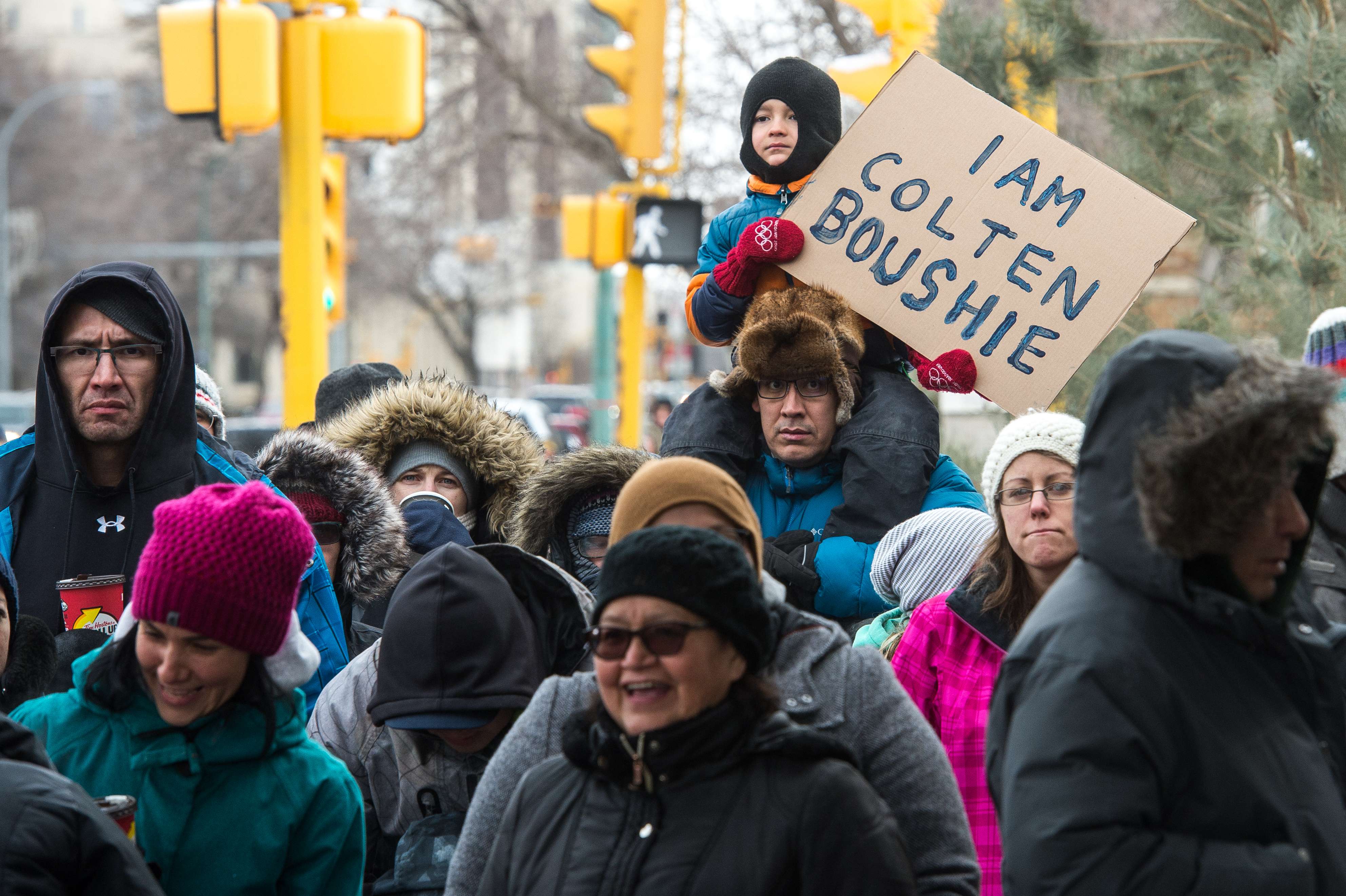
A Lament for Colten Boushie

Late last Friday night the jury delivered its verdict in the trial of Gerald Stanley, the Saskatchewan farmer accused of murdering a young Cree man named Colten Boushie. Stanley shot Boushie in the head at close range and killed him. The all-white jury could have found Stanley guilty of murder in the second degree or manslaughter.  Instead they acquitted him entirely.

It is not entirely clear what happened on Stanley’s farm that afternoon late in the summer of 2016, other than that there was an altercation involving Stanley, his son, and his wife with the four young people who drove onto the property, a cattle farm on Canada’s Plains.

Boushie and his friends had been drinking, that is for sure. One of them got out of the car and climbed aboard an ATV parked on Stanley’s farm, and tried to start it.  One of them tried to get into a gold pickup truck that belonged to one of Stanley’s neighbors.  He was a part-time mechanic and the truck needed some work. Stanley saw the car approaching and he watched them mess around with the truck and the ATV. He said he was afraid of the intruders, Indians, the other.

Nobody denies that Stanley went inside, grabbed a gun, loaded it with bullets, and, after a tussle, shot Colten Boushie in the head. Stanley said the gun misfired, that his finger was not on the trigger. Firearms experts disagreed. The gun was working properly, and could not have been fired without the trigger being pulled.

I am not a lawyer, and so I do not know all the legal ins-and outs of this case. It is plain to see that the witnesses were not entirely reliable, that both Stanley and Boushie’s companions changed elements of their stories over time. Based on the heavy press coverage in Canada, it seems that there is no way that a jury could have reached absolute certainty about what happened on the Stanley farm with one set of exceptions: Boushie and his friends entered Stanley’s property; they messed around with some of his stuff; Stanley went to get his gun; he fired that weapon three times, and one of those bullets struck Boushie, killing him.

Canadians have spoken much in recent years about “reconciliation,” about coming to terms with the atrocities the country and its provinces have committed upon native peoples. Prime Minister Trudeau has played a leading role in this effort. But when Niigaan Sinclair, a Professor of Native Studies in Manitoba, said that the verdict in the Stanley case was “unbelievable yet believable,” he got to the heart of the issue. Yes, Trudeau sent his warm thoughts and best wishes, his sympathies and his concerns, to Boushie’s family. But how does he expect First Nations peoples to take that seriously after the acquittal of Stanley? What is the point of talking about reconciliation and recovery and hope for a future informed by a thoughtful consideration of the atrocities and violence of the past, when the atrocious behavior and the violence continues?

It is a fair question for policy-makers in the United States, too, who have shown little willingness to talk about this nation’s colonial past.

When unmatched with real action and real results, “reconciliation” seems to involve white people asking native peoples to let them off the hook for the crimes of their ancestors. After this weekend especially, I cannot see any reason for them to do so.  “Reconciliation” can’t just be, “It’s awful what we did to you, and let’s move on.” Rather, it must include, “it’s awful what we still are doing, and let’s talk about what needs to be done to make it stop.”

“Unbelievable, yet believable.”  I get it.  Those who watched the trial hoped for justice in the case of Colten Boushie, but it was a forlorn hope.  It’s a sad but brutal fact: there is little evidence to support any belief that courts will get things right, that they will treat native peoples with justice and humanity.  Rotten to the core.  Ask those who grieve for Jason Pero, or John T. Williams,  or Romeo Wesley or Zachary Bearheels.  Colten Boushie is Canada’s Trayvon Martin, and Gerald Stanley its George Zimmerman.

I have made the case in the past, and it is an unpopular one here, that those of us non-natives who own homes in New York State are the beneficiaries of a systematic program of Indian dispossession.  What Indians lost, white New Yorkers gained. Some are more guilty than others, but we are all complicit.

Sherman Alexie published a poem last week, on nearly the same day that Gerald Stanley’s trial commenced. “Hymn,” he called it, a call to love everything and for the radical hope that accepts as truth that we can feel and act on that love.


So let me ask demanding questions: Will you be

Eyes for the blind? Will you become the feet


For the wounded? Will you protect the poor?

Will you welcome the lost to your shore?


Will you battle the blood thieves

And rescue the powerless from their teeth?


Who will you be? Who will I become

As we gather in this terrible kingdom?


My friends, I’m not quite sure what I should do.

I’m as angry and afraid and disillusioned as you.


But I do know this: I will resist hate. I will resist.

I will stand and sing my love. I will use my fist


To drum and drum my love. I will write and read poems

That offer warmth and shelter of any good home.


I will sing for people who might not sing for me.

I will sing for people who are not my family.


Colten Boushie was the victim of a crime that had its origins long ago. It is historic. The criminals, and all their accomplices in and out of all the years, they remain at large, untroubled, unworried, guilty, and free.

Patterned Acts of Violence

Brooke Crews butchered Savanna Greywind.  Crews wanted a baby, and her young neighbor was eight months pregnant.  On the night of 17 August last year she lured Greywind into her home. While Savanna was still alive, and passing in and out of consciousness, she cut the child from her womb. When Crews’ boyfriend arrived, she presented him with the baby.  “This is our baby,” she reportedly said. “This is our family.” Together, they cleaned up the blood. Together they disposed of Savanna’s clothing. And, together, they wrapped her body in plastic sheeting and dumped of it in the river, where kayakers found it sometime later.

JUST OVER A YEAR BEFORE Savanna Greywind’s murder, another twenty-two year old, Colten Boushie, set out from his reserve west of Saskatoon. The car Colten and his friends were riding in got a flat tire, and the guys pulled into the farm of Gerald Stanley.  Boushie and his friends had been drinking.  They may have committed some petty thefts, though the testimony is confused.  Young guys, engaging in mischief.  Committing some minor crimes.  (If you were ever a young adult, you probably have done this sort of stuff, too). But, here, at Stanley’s place, they seem to have wanted nothing more than help fixing a flat tire.  What happened next is a matter of dispute. Stanley said that the 70-year-old handgun he wielded in order to scare the young men off misfired. Others that he carried out an act of vigilante justice against a group of young men he feared had come to rob him.  And others still believed that Stanley was an Indian-hating westerner from the Canadian Plains.  Whichever, the case, Colten Boushie, who was seated in the vehicle’s front seat, died from a gunshot wound to the head.  The bullet was fired by Stanley, from his old gun.

Last week, Savanna Greywind’s killer was sentenced to life in prison without the possibility of parole. Stanley’s trial for the murder of Colten Boushie began last week. Both stories struck me as so evocative of the long and troubled history that I teach.  Both stories scream with the echoes of the past.

The news is increasingly filled with stories of missing and murdered indigenous women and children.  In response to Greywind’s murder, North Dakota Senator Heidi Heitkamp has introduced “Savanna’s Law,” which will “help address crisis of missing and murdered Native American women.”  Specifically, the act would

  • Improve tribal access to certain federal crime information databases. The bill would update the data fields to be more relevant to Native Americans, and mandate that the Attorney General consult with Tribes on how to further improve these databases and their access to them. The Attorney General would then submit a report to Congress on how the U.S. Department of Justice plans to implement the suggestions and resolve the outstanding barriers Tribes face in acquiring full access to these databases.
  • Require the Attorney General, the Department of the Interior, and the Department of Health and Human Services to solicit recommendations from Tribes on improved access to local, regional, state, and federal crime information databases and criminal justice information systems during the annual consultations mandated under the Violence Against Women Act.
  • Create standardized protocols for responding to cases of missing and murdered Native Americans. These protocols would take place in consultation with Tribes, which would include guidance on inter-jurisdictional cooperation among tribal, federal, state, and local law enforcement.
  • Require an annual report to Congress with data. The report would include statistics on missing and murdered Native women, since there is little data on this problem and there isn’t a central location for keeping that information. The report would also include recommendations on how to improve data collection.

I wish Heitkamp well. I hope her legislation passes, and I hope it helps.  It mainly aims at attempting to improve information about a problem that all acknowledge is poorly understood.  That is a good thing, but it seems to me it is at best a half-measure. So much more than information is needed.

Heitkamp’s proposed piece of legislation addresses nonetheless deep and systemic problems that cut to the core of the Native American experience in North America.  Native American women have always been objects of white violence.  Long ago, for instance,  George Percy told the story of how he ordered the Queen of Paspahegh stabbed to death after his men had earlier entertained themselves by throwing her children from the boat and shooting out their brains in the water.  Edward Moseley, that mercenary who sold his services to the Puritan Saints during King Philip’s War, boasted about how he unleashed his war dogs on an Algonquian captive his men had taken.  The dogs, Moseley noted, tore her to shreds. The mutilation of women’s bodies by American soldiers at Sand Creek: that, too, is part of a long, long story.  Sexual violence rests at the core of this history and it continues: along the Canadian Highway of Tears and, if the spotty records are correct, on reservations across America.  And in Fargo.

Brooke Crews stole Savanna Greywind’s baby.  There is a long history of white clergymen, government officials, military officers, and bumbling do-gooders who have scooped up Native American children.  Canada, much more than the United States, has started a discussion of the legacy of residential schools and the problems that continue to plague them. European colonizers and their colonial heirs long have collected the orphans whose parents they killed, sold them into slavery, bound them into servitude, and still, today, distribute them to white families in some states through broken and racist foster care systems.

Colten Boushie’s story, too, has so many ties to a vicious and violent past, for white people, throughout the history of this continent, have murdered native people. That reality runs through every book I have written, including Native America: Arthur Peach, the killer of a Narragansett messenger, Northern Neck racists who murdered Susquehannocks; Pennsylvania Frontiersmen who murdered Senecas with impunity, leading Federalist Timothy Pickering to lament that, for most white people living in close contact with native peoples, killing an Indian was no crime at all. Read the annual reports of the Commissioner of Indian Affairs:  they are full of complaints from federal policy makers who felt powerless to stop the violence meted out on Indians by the white frontier population.  It was frontier whites, American officials understood so well, who were responsible for frontier violence.  Indians were usually victims.

You cannot miss this in the documents. It is all there. It is always there.  And still it goes on.  The police treated Boushie’s body with a callousness they would not use for white crime victims. And the police, when they came to Boushie’s house to tell his mother and father that their son had died, searched the house.  They came in with guns drawn. They treated Mrs. Boushie with disrespect and cruelty.  If the Boushies’ account is accurate, the Canadian police behaved like racist thugs.  It is a heart-breaking tale that should shame police officials in Saskatchewan.


GREYWIND’S MURDER has provoked discussion and legislation in the halls of Congress to address a problem that native peoples have talked about for generations, but that Congress is only now starting to act upon.  Boushie’s murder has caused deep-seated racial tensions to surface and has brought into the open, his grieving friends and families say, the sorts of racism and violence First Nations people face every day.  The trial is receiving heavy coverage in Canada, where Boushie is being described as the “Rodney King of Canada.”  Maybe something good will come from airing out these issues.  That is what some hopeful people say.  I am doubtful, because this violence has gone on forever.  The headlines in the newspapers point out that the case has caused racial fears to increase, and that white people, one story said, are fearful of retribution. White people are worried.  Fear of the other.  Fear of the marginalized. Fear of the neighbors whose ancestral homelands you now occupy. I heard the expression of that fear when I lived in Montana: from my landlord, a feisty old woman who would not rent to Crows because, she said, if you let one in, soon you would have the whole tribe; from my students who, in unguarded moments, embraced baldly racist stereotypes; to the angry ranchers who extracted their livelihood from what had once been Crow land, and who refused to place themselves voluntarily under the authority of tribal officials. I hear it in small-town New York, too, where one can still see the faded “Upstate Citizens for Equality” sign along the sides of roads throughout the Finger Lakes.

We are historians.  Many of us have heard the old line, that if we do not learn from the past we will repeat our mistakes.  We study continuity and change, measured across time and space, in peoples, institutions and cultures.  And, in Native American history, it is the continuities that stand out: with a Secretary of the Interior who views anything he cannot kill as something he might drill, and who views nothing as sacred save for his own conservative evangelicalism; with violence continuing across the continent; with a hostile legal system assaulting native nationhood; and with a Chief Executive whose infantile racism makes clear what many of us have long argued: this is a deeply racist country, and many of us continue to benefit from that systemic injustice.  We have numerous examples of how difficult it will be to achieve meaningful change.  That is realistic, not pessimistic.

My students are shocked when they read about stories like those of Savanna Greywind and Colten Boushie, and even more so when I take the time to place them in the context of a much larger, and much more violent, history than they have ever been taught. They seem empowered, some of them, and determined to “do something.”  Others, they sense that the obstacles are formidable. And so on we go, teaching and writing, fighting against the dark belief that things will not get better. We choose the stories we want to tell.  We must remember that.

The Lewis Henry Morgan School in Rochester New York

If you study the Iroquois, you have come across the work of the pioneering anthropologist Lewis Henry Morgan.  He published in the middle of the nineteenth century The League of the Ho-dé-no-sau-nee or Iroquois.  It is an important book. Though many of Morgan’s findings have been rejected, there is no doubting the significance of the work.  His ties to the Parker family at Tonawanda gained him extraordinary access at a period when many Americans still anticipated that the Iroquois, like other Native American peoples, would disappear.

Morgan’s Rochester ties are deep.  He lived in town, left his papers to the University of Rochester, and for years his grave in Mount Hope Cemetery became a pilgrimage site for Iroquois leaders and activists.  In this picture, taken in 1920, Oneida Elsie Elm sings a funeral dirge at his grave site. George Decker, the Rochester attorney who represented the Oneidas, and who helped in the attempt to take Levi General’s (Deskaheh) complaints about Canada’s treatment of Haudenosaunee at Grand River before the League of Nations in Geneva, stands farthest to her left.  The Seneca Arthur Parker, another force in Haudenosaunee anthropology with whom we must contend, stands to her left.  The Oneida William Rockwell and the Mohawk Louis Bruce are also pictured.  The University of Rochester is hosting events to commemorate the bicentennial of Morgan’s birth, and has recently launched what I expect will become a fantastic digital humanities project focused on Morgan’s life and career, and its significance. You can take a look at the website here.  It looks fantastic.

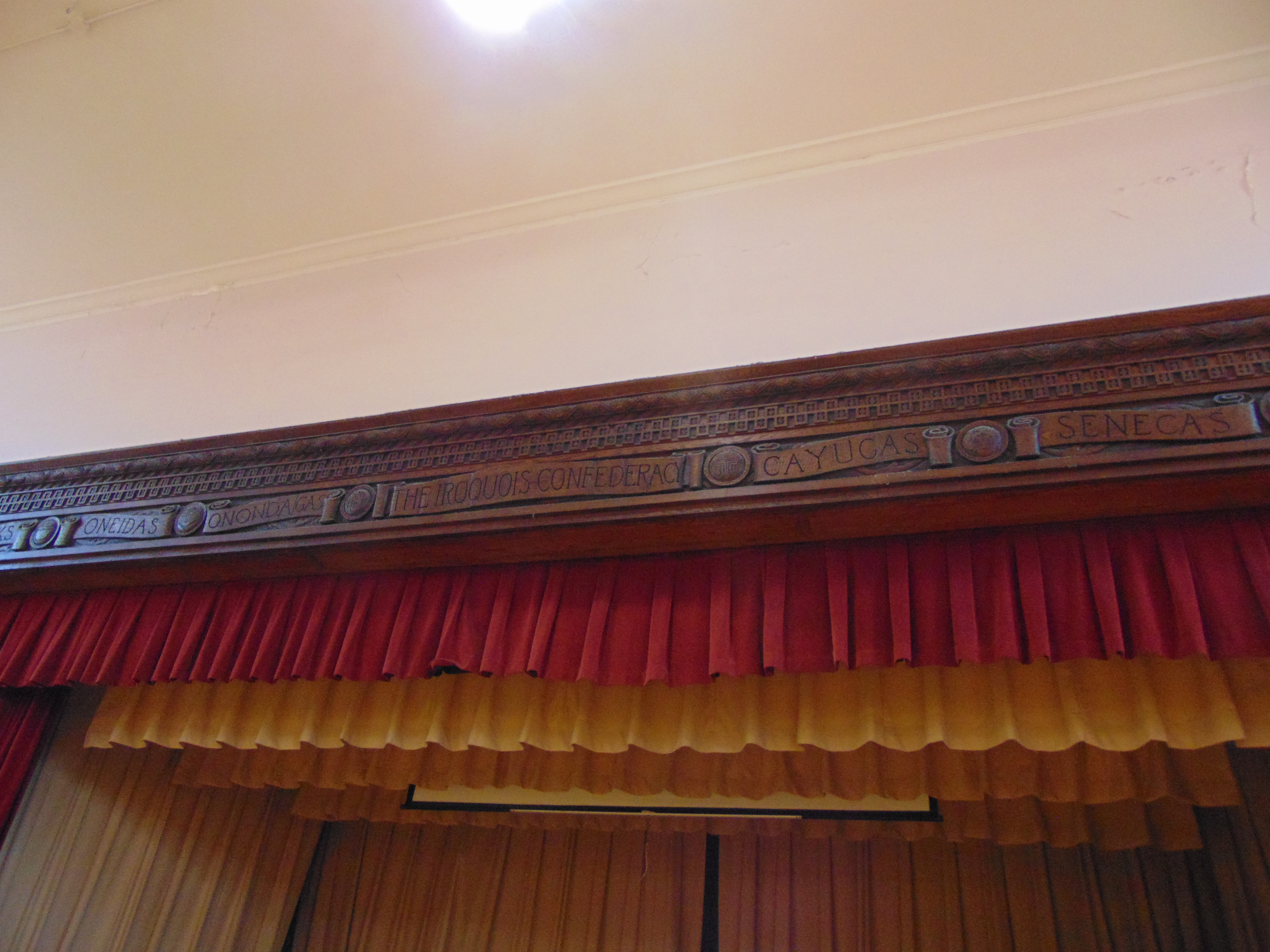
A couple of weeks ago, I was chatting with Robert Foster, Professor of Anthropology of UR and the director of the Morgan project. He indicated that there had once been a school in the Rochester City School District named after Morgan.  Bob had heard that the school’s auditorium was decorated with Haudenosaunee themes, though he had not yet seen them himself.

I did some poking around.  It took only a minute to find out that the school had been recommissioned as a charter school, Number 10, the Dr. Walter Cooper Academy School.  A couple of phone calls, and thanks to a welcoming staff, I was able to take some pictures of the auditorium.

My students have no sense of how much the WPA did, and how much government can do.


The woodwork above the stage includes the names of the Six Nations.  The placement of the Mohawks far to the left and Senecas and Tuscaroras to the right makes sense when one appreciates that I was facing South when I took this picture. The vertical posts are fashioned to look like trees, with beavers at the bottom of each. Morgan wrote a study called The Beaver and His Works.   Running along the top above the names of the Six Nations is woodwork, I assume, designed to look like wampum.

According to Ivan, the custodian who allowed me access to the building, the auditorium is scheduled to be remodeled.  The stage will remain, and the room will be transformed into the school library. The plans at this stage include a replica longhouse to be built into the library design.

Everywhere one goes, you see see evidence of erasure.  Non-native Americans, in my experience, are uncomfortable talking about the violence of the past, the totality of that dispossession.  Native peoples, when they are considered in public schools, are cast as part of the past.  The images and motifs present in the old Lewis Henry Morgan school auditorium do that as well.  But they also provide an opportunity to talk about that history, and I was pleased to see that the Walter Cooper Academy plans on keeping them as they move forward with renovations.  The school staff with whom I spoke were proud of the room.  I could tell that when I visited.

The University of Rochester will be hosting events over the course of this year.  You can find out more about those events here.


In Indian Country, the Police Are Not Your Friends

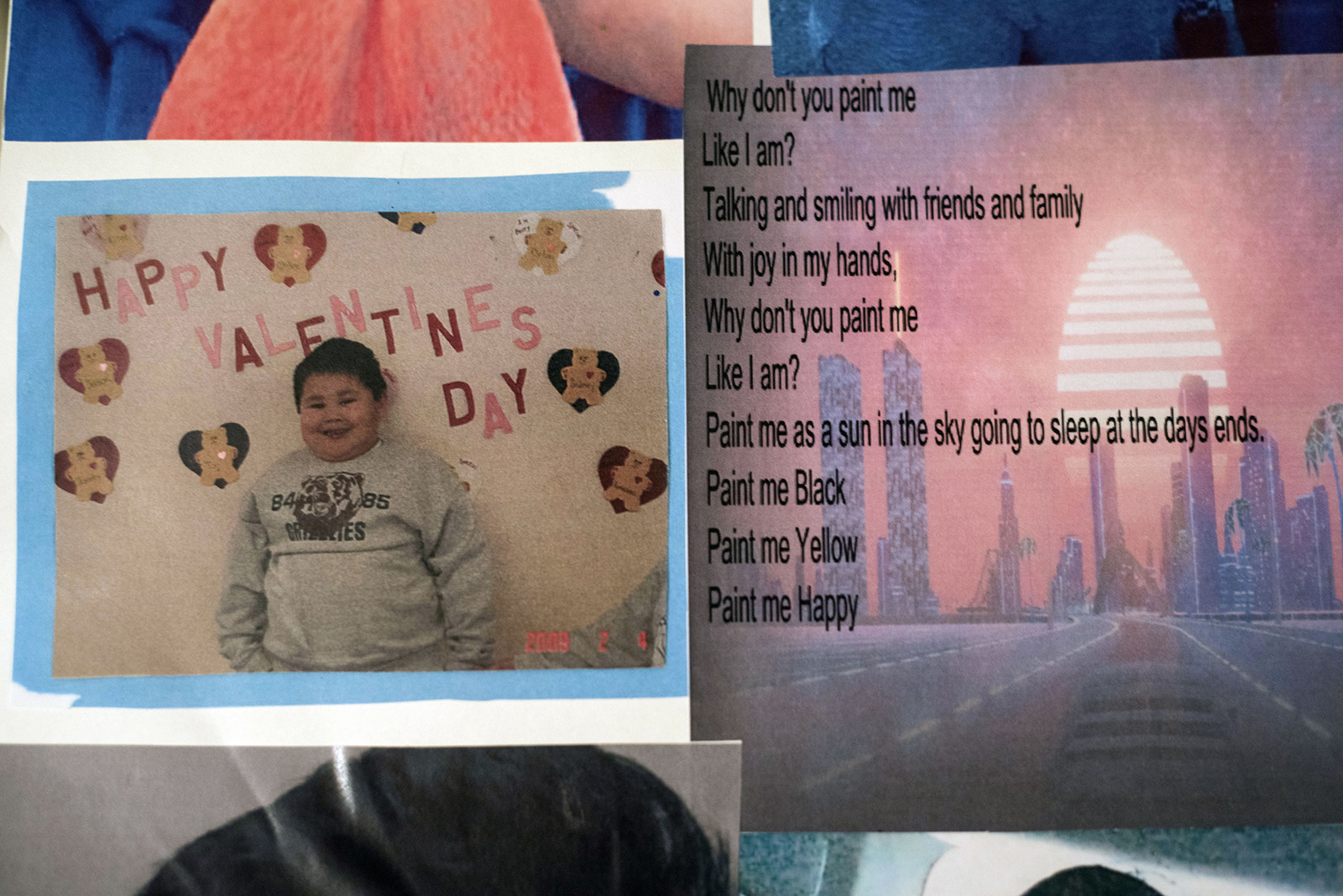
A deeply disheartening story appeared in Buzzfeed looking at relations between native peoples and local law enforcement on Wisconsin’s Bad River Reservation.  It was here, last year, where a sheriff’s deputy shot to death 14-year old Jason Pero.  And it is here, according to members of the Bad River community who spoke to Buzzfeed’s John Stanton, where rape, harassment, and racism are all experienced by members of the community at the hands of white law enforcement.  Pictures and a poem written by Jason Pero. Jason, 14, was shot and killed by Ashland County Sheriff’s Deputy Brock Mrdjenovich on Nov. 8, 2017.

Stanton presents to his readers figures that you are familiar with if you have been reading my blog.  According to the CDC, Stanton writes, “Native Americans are more likely to be killed during an interaction with law enforcement than any other racial group. In 2017, at least 31 indigenous people died as a result of an encounter with law enforcement. In 2016, the number was 29.”

And, he continues,

On a per-capita basis, Native Americans are 12% more likely to be killed by law enforcement officers than black Americans — and three times more likely than white Americans.

If you live on one of the dozens of reservations across the country in which local, white police forces from nearby border towns have jurisdiction, the chances that you’ll end up in jail are high. In Ashland County, for instance, Native Americans make up 11% of the population but account for 44% of the inmates in the county jail, according to data collected by the Vera Institute of Justice, a nonprofit criminal justice research and reform group.

It is an impressive piece, and Stanton has done much more work than most journalists writing about Indian country.  He looked at census data, showing the relative poverty of Bad River, and relatively high rates of unemployment.  He looks at the community’s history. “You don’t have to look far back for examples of racial tensions boiling over here,” he writes.

During the Wisconsin Walleye War between 1988 and 1991, white protesters hurled racial epithets and sometimes eggs and rocks at Ojibwe tribal members spear fishing for walleye, a tradition protected under treaties between the US government and the tribe. Although the violence eventually ended after a federal judge upheld the Ojibwe right to spear fish, distrust and bitterness between the two communities remained.

According to one member of the community, things at Bad River are not as bad as they were back in the 1970s and 1980s.  Whites and Indians are “inextricably linked” in Ashland County, with native peoples and their white neighbors coexisting “in an uneasy truce of convenience and routine.” The tribe’s casino is a major engine in the local economy, especially during the summer months. The system seems to work for white people as long as the members of the Bad River community stay quiet.  But with evidence of rape, and the murder of Jason Pero by a deputy sheriff, people are speaking out.  Sandra Gokee, a family relation of Jason’s and a teacher at the Ashland Middle School, was suspended for an angry Facebook post in which she lamented the murder of Jason by a deputy sheriff.  According to her superintendent, Gokee created racial tensions in the school and made the children of white police officers feel unsafe.

We are no longer in the 1970s and 1980s, but in the short time Our New Nero has been in office, racial tensions have increased.  The small progress made over decades has been threatened.

Stanton’s fantastic article will give students a sense of the amount of racism existing in communities where native people and white people live in close contact, the ability of law enforcement to prey upon Indians with few consequences, and the complexities of law enforcement created by Public Law 280 back in the 1950s.  But more than any of that, he highlights the pain caused by the murder of yet another child, by yet another law enforcement officer, in yet another incident where deadly force was hardly necessary.

On Montana, Foster Care, and Reservation Basketball

A couple of news stories centered on Montana caught my attention this past week.  The Missoulian ran a series of well-reported stories on the state’s foster care system, Addicted and Expecting: How Montana’s Lack of Resources Impacts Mothers and their Children.  Montana, a state that is struggling like many others with the opioid crisis, has become the “child removal capital of the United States.” This at a time when research on best practices suggests that adequately funded and accessible drug treatment programs for troubled parents produces better outcomes than placing their children in a foster care system characterized by neglect, abuse, and poor conditions.

The history of state foster care systems and Native American children is a distressing one, and the problems continue, most notoriously in South Dakota. Steven Pevar, whose ACLU handbook I use in my American Indian Law course, has written extensively about the problem. In Native America, I write about this history, and the events that led to the passage of the Indian Child Welfare Act in 1978. It is a subject that catches the attention of my students, and I have written on this blog about continued assaults from the political right on the ICWA. Image result for montana indian reservations

The Missoulian devoted one article in the series to conditions on reservations where drug treatment programs are in especially short supply. The figures presented by Lucy Tompkins, who reported this piece for the paper, are staggering.  In Browning, way up in the northwestern corner of the state on the Blackfeet Indian Reservation, “44 percent of pregnant women tested positive for opioid use, according to a 2017 health assessment by the Blackfeet Tribal Health Department and Boston Medical Center.” (The full report is available here).

Furthermore, in Montana’s Lake County, which includes part of the Flathead Indian Reservation, almost half of the infants born “were at risk for neonatal abstinence syndrome, the medical term for a dangerous set of withdrawal symptoms in drug-dependent infants including tremors, convulsions, and high-pitched crying.” Add to this that far fewer Native American women receive pre-natal care during the first trimester of their pregnancies than non-native women, and you have the ingredients for significant crisis in Montana’s native communities.

It is easy to provide students with facts and figures illustrating economic, social, and health disparities in native and non-native communities. One must be careful about doing this in order to avoid the sort of “sympathy porn” produced by “journalists” like Dianne Sawyer a couple of years back. (The reservation students’ response to Sawyer’s piece is fantastically effective: If you have not seen it, you can watch it here).  It is always worth mentioning to our students what native nations and native peoples are doing on their own to construct solutions to the challenges they face and, indeed, that the problems reservations face may be different in degree but not necessarily in kind from those facing many small towns and rural areas in the United States.

The Washington Post ran a story that offers a moving depiction of reservation life that avoids the cliches and stereotypes and pitfalls into which Dianne Sawyer blissfully stumbled. It’s a profile of Mya Fourstar, a talented fifteen-year-old basketball player at Frazer on the Fort Peck Reservation in the northeastern part of the state. Fourstar wants to play college basketball, either Division I at Gonzaga or somewhere else, but it’s tough both on and off the court.  It is a story students will appreciate, I believe, as they confront their own challenges.

Reservation basketball in Montana is huge. I learned that during the four years I lived in Billings. It was covered on the local television news, and in the pages of the Billings Gazette.  It was an exciting, run-and-gun style of basketball, with some incredibly talented players. But it was difficult to recruit these kids to play in college. “They won’t leave home,” I remember a guy in the athletics department at the college where I taught saying.  Given the treatment native students faced on my campus, I did not find this surprising at all, though I was then only beginning to grasp the complexity of the challenges these young people faced.

Reservation basketball offers a revealing and, for students, an interesting way to teach about conditions on reservations in the United States, a way to humanize a story that too often is phrased in generalities and statistics that provide by their nature a limited perspective. There is a wealth of material out there for students to read, watch, and think about. There is this CNN story about basketball on the Fort Belknap Reservation, for instance, and you will find many more if you look; news stories like this and this and this and this and this and this, from the now defunct Indian Country Today Media Network, that capture something of the strong feelings reservation basketball can generate; blog posts like this that describe the importance of reservation basketball and others that provide fascinating historical background.  And, of course, there is Larry Colton’s book on Crow basketball.

There are, I suppose, as many ways to teach non-Indian students about life in Indian country as there are college professors teaching the subject.  What we have to do as instructors, in addition to imparting knowledge and information, is break down and dismantle the stereotypes and uncritical assumptions that serve as the lenses our students look through as they read and write and learn about Indians.  There is plenty of bad news out there, and so many of the images to which students are exposed highlight themes of suffering, tragedy, and inevitability.   It is worth talking about how limited most discussion of Native American issues actually is.  Reservation basketball, like lacrosse in Haudenosaunee communities in New York and Canada, allows a window into a world that is not nearly as remote as our students are led to believe.

On Reparations and Reconciliation

Students of Native American History could benefit from paying attention to the debate that took place earlier this week between Cornel West and Ta-Nehesi Coates.  Coates wrote We Were Eight Years in Power and West reviewed that book in The Guardian.  Since then, Coates has deleted his Twitter account after a lengthy exchange.

I like Coates’ work, a lot, though I have yet to read his most recent book.  His article on white supremacy and the rise of Donald Trump was outstanding, and his essay making the case for reparations for slavery has sparked debates ever since it appeared in The Atlantic several years ago.  West, however, was unimpressed, and he criticized how Coates “fetishizes white supremacy,” has a “preoccupation with white acceptance,” and an uncritical “allegiance to Obama” who, West believed, let black people down.  “It is clear,” West said of Coates, that his “narrow racial tribalism and myopic political neoliberalism has no place for keeping track of Wall Street greed, US Imperial crimes, or black elite indifference to poverty.” Why, for example, West suggested, should we talk about paying reparations to the descendants of African slaves if the unjust power structures that both fuel and feed off of racism and poverty remain in place and stronger than ever?

Across the country in recent years, Americans have slowly and haltingly begun to pay more attention to the legacies of slavery.  The ugly conservative defense of Confederate monuments can be seen in part as the racists’ reaction to this salutary revisiting of the nation’s past.  Exciting scholarship continues to be produced exploring the centrality of slave-holding to the rise of the American republic. Colleges and universities, like Brown and Georgetown and Yale, for instance, as a result of what scholars have learned, have begun to examine critically the importance of slavery in the development of their own institutions, and have tried to set things right.  Protestors, young people mostly, have put their bodies on the line to demonstrate to complacent white Americans that “Black Lives Matter.”  But look around you, and you will see it: racism is stronger than ever and the rich grow richer and consume an ever-growing piece of the pie.

The past can weigh you down and hold you back. It can sap your strength.   Think of people you know.  The traumas they have experienced, and the grief and the sadness and the pain they have felt can leave them maimed, scarred, paralyzed, injured.  These traumas can become a powerful and important part of their identity, as they see themselves as a victim or a survivor or both.  Personal stories and personal histories: our pasts can affect us.  What is true for individuals can be true as well for the larger community.  Without an accounting the pain remains, the injuries do not heal, and the excuses, justifications, distortions and lies remain unchallenged.

Over the course of the past semester, I have written on this blog about how in a growing number of municipalities and on an increasing number of college campuses commemoration of “Indigenous Peoples’ Day” has either replaced or been appended to celebrations of Columbus Day.  On my own campus, a resolution to this effect passed the College Senate unanimously. I have written about efforts in Canada to present the “truth” of what happened in the nation’s residential schools in an effort to find “reconciliation” with Canada’s aboriginal peoples.

There are limits, of course.  At the end of the day it costs white people nothing, save for some hurt feelings on the part of conservative snowflakes, to acknowledge Indigenous Peoples’ Day, or to rid themselves of a racist sports team mascot or logo. Nothing at all. And, still, it is a slog, every step of the way. Progress, at times, is depressingly slow, the opposition determined.  On my own campus, efforts to fly the Haudenosaunee flag on the college flagpole have been defeated by a policy of SUNY leaders in Albany mandating that only the US, the state, the college flag fly. We are located in Geneseo, New York, a town that obviously bears the name of the Seneca village that preceded it on this site.  Events of significance, like the Big Tree Treaty of 1797, were supposedly negotiated on the campus grounds. Other significant events–the Sullivan-Clinton campaign marched through town in 1779–occurred nearby.  And, of course, there is the people’s history. Long before there was a white settlement at Geneseo, and a Livingston County, long before Continental soldiers burned Iroquois towns and crops in the field and began coveting those lands, the Chenussio Senecas were important actors impossible to miss in the historical record.  We are an institution that is part of a state that could not exist in the way it exists without a systematic campaign of Iroquois dispossession.  But despite uniform support on my campus, SUNY will not allow our gesture to a shared history and our acknowledgment that the Senecas’ loss was the state’s gain.

So let’s talk truth and let’s talk reconciliation.  And let’s do so with an acceptance of the fact that native peoples might stop us and ask, “yes, but upon whose terms?”  Talk, after all, our long, shared history shows is exceedingly cheap. Canada and the United States, and their respective provinces and states, and counties, cities and towns, stand on lands that once belonged to native peoples.  Sometimes these lands were acquired by white people through means that were illegal and unjust even by the self-justifying standards of the “settler state.”  The fact of enduring colonialism is painfully evident.  How productive can discussions of reconciliation be without addressing the fundamental reality that settler states rose on native peoples’ land, and that their growth and gain was necessarily native peoples’ loss?  How can we fruitfully talk about “reconciliation” when the institutional mechanics of “settler colonialism” remain so thoroughly intact? To get my students to think about these issues I often assign the work of Haudenosaunee scholars like Taiaiake Alfred and Audra Simpson, but there are many other solid people discussing these issues.

West, in a sense, saw Coates tinkering around the edges, offering a powerful critique of white supremacy without a program to tackle fundamental structures of inequality.  Whatever one feels about West or Coates, it is a useful debate.  I often have students who tell me they “want to do something,” and I admire them for that.   I ask them what they have in mind.  We talk. They start as reformers, and it can take them time to grasp the larger forces that benefit from and hold in place structural inequality.  Similar debates are going on in Native American communities, and we who teach and write in this field need to bring more attention to them.  There is plenty of “sympathy” that I hear for what some people still describe as the “plight” of native peoples.  Doing something to counter the structural features of “settler colonialism” is another matter indeed, but one that we as scholars and teachers have an obligation to address.

Treaty Day, 11/11

Today is Treaty Day in Canandaigua, New York. An annual commemoration of the treaty the Six Nations of the Iroquois signed with the United States in 1794 is held there each year, with a parade from the Canandaigua Primary School to the County Court House lawn at 130, and a commemoration ceremony at 200.  For the rest of the day, there are vendors and displays and speakers at the primary school.  The school site itself is significant because a large number of the 1600 Indians who attended the treaty council between September and November in 1794 camped on land that ultimately became the school’s play fields.

Two years ago I published a book about the Treaty of Canandaigua.  The United States negotiated about 370 treaties with a large number of American Indian nations. These diplomatic agreements do various things. Some of them established peace after periods of warfare. They granted to the United States control over the internal affairs of tribes.  They allowed the government to further its variety of “Civilization” programs, from the provision of spinning wheels and livestock to early moves towards allotment, and they were the instrument through which the land that made up Native America became part of the United States. Some of these treaties were fraudulent. There is no doubt about that.  Some of them were deceptive, and others coerced. Many were, in short, instruments of colonial control. Canandaigua, I argued, was different.

After the Revolution, the United States dictated a treaty of conquest to the small number of Six Nations people who gathered in November of 1784 at Fort Stanwix.  The United States negotiated similarly coercive treaties with the southeastern nations at Hopewell and with the Ohio Valley tribes at Fort McIntosh.  At Stanwix, American treaty commissioners dispensed with the long-recognized protocols of Iroquois diplomacy, thumped the gathered Indians on the chest, and explained to them what the new American empire would look like. The Iroquois were expected to release prisoners and provide hostages as a measure of their good faith. And they were required to give up all of their lands west of a line drawn four miles east of the Niagara River, a move designed to contain the Six Nations within the State of New York and cut them off from the British posts at Oswego and Niagara, and their kin who had resettled at Grand River in Ontario. The treaty did nothing to address some significant grievances that were felt particularly by the Senecas, the largest and westernmost of the Iroquois nations in New York. The Senecas complained of white encroachments on their land.  The complained about murders, 13 of them by white frontiersmen between 1784 and 1790, and an uncertain number more afterwards. And they complained on limitations on their ability to move: the lack of access to the Niagara River, and the claim asserted by Pennsylvania to the so-called “Erie Triangle,’ that tag of land you pass through in the Keystone State when you follow Interstate 90 from, say, Buffalo to Cleveland.

These grievances were significant. And the native peoples in the so-called Northwest Territory shared many of them–encroachment, violence, and so on. To deal with the threat posed by the confederated Northwestern nations–Shawnees, Delawares, and many others–President Washington sent out an American army led by Josiah Harmar to teach them that the soldiers of the United States numbered like the trees in the woods, the stars in the sky.  The Americans were defeated handily, “thrown on their backs.” Harmar lost one hundred men and five hundred horses.  The Northwestern confederates attacked American settlements in Kentucky, Virginia, western Pennsylvania, and their allies did damage in the Carolinas and Georgia as well, They pushed back American settlement. Another army went out under the command of Arthur St. Clair.  Its story is told by Colin Calloway in The Victory with No Name. They marched out into the Ohio country. On the 4th of November in 1791, the Northwestern confederates attacked them.  Of St. Clair’s 1400 men, 910 were killed or wounded.  St. Clair lost 1200 muskets, lots of artillery, his horses.  Twenty percent of the entire armed forces of the United States was wiped out in one day.

Could it get worse? Yes.  The British still held their forts at Oswego, Niagara, and Detroit on the margins of an Iroquoia that had remained under siege since the Revolution.  Settlers were terrified.  The British looked at these Indian victories and began to discuss among themselves the possibility of carving out a neutral Indian Barrier State, with its southern boundary running along the Ohio River.  What would happen if the powerful and aggrieved Six Nations joined with the Northwestern confederates? The entire frontier would be exposed, and native warriors posed an existential threat to the United States.

So what to do? Seneca diplomats and American officials both recognized that they could address the challenges they faced through negotiation and diplomacy better than through warfare.  The Senecas had learned well what American soldiers could do to their homeland from the Sullivan Campaign of 1779.  Iroquois diplomats traveled widely, risking their lives, some of them dying, in an effort to avoid war and protect their communities.

Timothy Pickering, the emissary appointed by Washington, met with the Senecas at Tioga in the fall of 1790, in the wake of the Pine Creek murders, a crime for which the one person tried was acquitted. Pickering learned from this that no jury would convict a white man for murdering Indians.  Native lives did not matter, he lamented.

Meanwhile, other Seneca leaders were meeting with American officials in Philadelphia, a meeting in which George Washington pledged to protect the Iroquois from any additional land grabs by the State of New York.  And in the fall of 1791, Pickering met with a larger group of Senecas at Newtown Point, to establish friendship and alliance.

The United States needed the Six Nations. Pickering understood that better than any of his American policy-making peers.  The Six Nations served as American eyes and ears in the west, for instance.  The British continued to work with Indians in the region, including the Senecas, from their posts at Detroit and Niagara. And the State of New York, despite Washington’s promises, continually offered fresh sources of grievance through fraudulent and illegal land sales.  In my current book project on the Onondagas I spend a lot of time on the 1788 and 1793 purchases. 

To resolve these crises, the United States called a council to meet at Canandaigua, which was far enough away from Niagara, Pickering hoped, to keep the British from interfering.  That was the hope. 1600 Haudenosaunee showed up at Canandaigua in the fall. They brought with them many grievances.  Encroachment on their lands must stop.  Murders must stop. And their land issues: access to the Niagara River and the claim to the Erie Triangle.

Now here’s the thing.  Before the treaty council commenced at Canandaigua, the northwestern Indians had been defeated at the Battle of Fallen Timbers. The defeated Indians fled toward a British post, and there they found no shelter or assistance.  From this Pickering knew, then, that there was no immediate threat that the Senecas would join with the Northwestern confederates because they had been defeated.  And there was no longer any immediate threat that the British would get involved or that their dreams of a neutral Indian Barrier State could come to fruition because, when push came to shove, they kept their gates closed to their allies.

But Pickering negotiated anyways. It is a big part of the story I tell in Peacemakers.  A treaty of seven articles, some of which very clearly served the United States.  Peace and friendship, of course, but also the fourth article, which stated that the Six Nations would never claim any additional lands in the United States. The Six Nations, Iroquoia, would never grow again.  The United States secured the right to cut military roads through Seneca country, and the right to bring its “civilization” program to the Six Nations.

So what did the Six Nations get?  They got, for a time, the return of their lands along the Niagara River. More importantly, they were guaranteed the right o the “free use and enjoyment of their lands.”  The phrase is used three times in the brief treaty.  The United States recognized this right and did so unambiguously.  Native peoples could do what they wanted on their own lands, free from the interference of any outside authority.  They were sovereign nations.

Of course, the legacy of Canandaigua is mixed.  New York, in violation of federal law, continued to buy land, particularly from the Oneidas, Onondagas, and Cayugas, who were completely dispossessed by 1795.  Private interests, with the support of the United States, started carving parcels from Iroquoia.   At Big Tree, in 1797, three years after Canandaigua, the Senecas parted with nearly all of their lands, save for eleven small reservations. I have written about that transaction here. And in more recent years the expansion of the St. Lawrence Seaway, the Moses Parkway and the Niagara Power Authority, and, of course, Kinzua Dam, the subject of Scott Sackett and Paul Lamont’s fantastic new documentary. Much of what was secured at Canandaigua has been lost.

So what are we left with? The treaty exists. That is a fact.  That phrase, “free use and enjoyment,” is an important touchstone for Haudenosaunee people who face continual threats to their autonomy and independence, their sovereignty and the integrity of their economic enterprises through taxation and state interference.

There is a sticker that is sometimes seen in Indian Country. “Honor Indian Treaties,” it says.  Yet so many Indian treaties are little more than real estate transactions where American commissioners dictated cessions to militarily defeated people and asserted control over their communities. Treaties were too often instruments of colonial control, licenses for empire and subjugation. Canandaigua was different.  At the time the treaty was negotiated in 1794, Haudenosaunee people still retained the capacity, should they choose to align themselves with the Northwestern confederates, to pose a grave threat to white American settlement.  And they used that power, and their own considerable diplomatic skill, to secure the return for a time of a key parcel of land. More importantly–and this is what is commemorated every year at Canandaigua on Treaty Day, though they acknowledge the losses, the celebrate the recognition and confirmation of their right to the “Free Use and Enjoyment of their Lands.” We are native nations, the Haudenosaunee people gathered at Canandaigua assert, and we are still here.

Historians and the Problem of Evil

Elzbieta Plackowska, forty-five years old, was convicted late in September for murdering her seven-year old son Justin and a five-year old girl, Olivia Dworakowski, who she was babysitting.  The crime occurred more than five years ago, on 30 October 2012. After telling the children to get down on their knees to pray, she started after them with a pair of kitchen knives. She stabbed Justin more than one hundred times, then slashed his throat. Olivia she stabbed more than fifty times. Her throat was cut as well. She also stabbed to death two dogs that were in the apartment. It was a horrifying crime, and I find it difficult to comprehend the terrifying last moments in the lives of those two children.

For the past several years, I have told the students in my Humanities course this harrowing tale. I do so as part of our discussion of Augustine’s Confessions. I spend three days discussing The Confessions. One of the many topics Augustine wrestled with was the problem of evil.  The Manicheans, with whom Augustine spent a lot of time, had one explanation for the existence of evil but this answer left Augustine dissatisfied and unmoved.

In his attempts to understand the nature of God and the relationship between an all-powerful and good God and the existence of evil, Augustine concluded that the farther away from God something was, the more disordered it became, and more scattered and fleeting.  The notion was Platonic. Heaven is close to God, human souls and minds are a step farther away, and bodies, the world of flesh and materiality, farther away still.  This conceptualization allowed Augustine to deal with the problem of evil in a way that made sense to him.  Evil, he wrote, “is nothing  but the diminishment of good to the point where nothing at all is left.”

I want the students to think about this.  I ask them for their definitions of evil. They usually answer with cases, as in “Stalin was evil,” or the latest mass shooter is evil.  I wonder whether they think Augustine’s definition is helpful. Does it help them comprehend the acts of which they speak.  Does his definition work for them? The brutality of the twentieth century, in the closing years of which these students were born: what of that? Does Augustine’s explanation of evil allow us to understand Hitler, Rwanda, Pol Pot, and Jeffrey Dahmer?

So I ask them about Elzbieta Plackowska.  I tell them her story.  Is she evil? Does Augustine’s explanation provide us with what we need to make sense of so senseless an act of violence?

The story often stuns the students.  I can see that reaction very clearly and very powerfully. Certainly they did not see this story coming. So many of them are young and sensitive and some of them are overpowered by it.  There is usually some silence before anybody speaks. Invariably someone mumbles out something quietly about insanity and, indeed, I point out that Plackowska’s attorneys attempted an insanity defense.  I try to let the conversation go. Do we call “insane” what people in an earlier time might have called “evil”? Is the institutional and diagnostic apparatus of psychology, applied to the criminal justice system, just an attempt to explain the inexplicable, to make sense of the senselessness of nightmarish violence?

I do not know enough about the history of psychology to answer that question, but I do want the students to think about the issues Augustine–and Elzbieta Plackowska’s knee-buckling acts of violence–present.

I always have loved Norman Maclean’s Young Men and Fire, but I disagree to some extent with his criticism of historians and the very discipline of history.  We historians, he suggested, are reluctant to go to the edge, and go beyond the strict confines of “what happened” and “who” and “why” and “where.”  We pull back from the big, existential questions. In the case of Maclean, we do not attempt to get inside the heads of the impetuous young men who died fighting the Mann Gulch Fire in Montana in 1949. In his attempt to uncover and imagine their dying thoughts, Maclean believed, one might find meaning and wisdom. He did, and the result is an absolutely beautiful meditation on fire and the meaning of life.

Historians, however, do more of this than Maclean believed. I think here of Martha Hodes’ gorgeous The Sea Captain’s Wife and Rachel Hope Cleves’ Charity and Sylvia, both of which are books that sit on my shelf close to Maclean’s. In my own work, I wrestled with some of this in my book on Roanoke, The Head in Edward Nugent’s Hand, and in my attempts to understand how it was that a Mohawk missionary to the Oneidas decided one day to begin claiming that he was the long lost child of Marie Antoinette and Louis XVI.

But if you look at history as it’s taught to young people, there is abundant evidence to support Maclean’s critique. Filling in blanks, bubbling in scan-tron forms, clicking on one of a number of choices–and, indeed, the way that history is presented in all-too-many textbooks–it leaves students with the sense that history really is little more than a series of events and facts to be mastered and remembered.

And I do find when my students in history courses work on their research projects, sometimes they pull back from the suffering, the evil that may exist at the heart of their story.  When I encounter these students, I urge them to read parts of James Merrell’s Into the American Woods, the most beautifully and powerfully written piece of serious scholarship in my field that I have read in a great many years. His treatment of massacre of the peaceful, but suspected, Christian Indians by the “Paxton Boys” late in 1763 informed what I wrote about this event in Native America. I did not want my readers to think that “this thing happened and it was really, really bad,” but rather to understand what it was like, not just to be there, but to have been a participant in the event, a victim, or a perpetrator.  Merrell does this so well. It is a wise, but very dark book.

Next week, in my Native American history survey course, I will discuss with my students “Indian Affairs in the Civil War Years.”  The title for that day’s meeting, I admit, needs some work.  The students will read a chunk of Native America, a handful of documents on federal Indian policy from the annual report of the Commissioner of Indian Affairs, and documents on the Dakota War in Minnesota in 1862 and the Sand Creek Massacre in southern Colorado in November of 1864.  I spend most of the hour on Sand Creek. I place on a Powerpoint slide an excerpt from a letter written by Silas Soule, a soldier in Colonel Chivington’s force, who refused to obey his commanding officer’s order to kill all the Indians at Sand Creek.  In a letter to his family written a short time after the slaughter, Soule wrote:

“The massacre lasted six or eight hours, and a good many Indians escaped.  I tell you Ned it was hard to see little children on their knees have their brains beat out by men professing to be civilized.  One squaw was wounded and a fellow took a hatchet to finish her,  she held her arms up to defend her, and he cut one arm off, and held the other with one hand and dashed the hatchet through her brain.  One squaw with her two children, were on their knees begging for their lives of a dozen soldiers, within ten feet of them all, firing –when one succeeded in hitting the squaw in the thigh, when she took a knife and cut the throats of both children, and then killed herself.  One old squaw hung herself in the lodge –there was not enough room for her to hang and she held up her knees and choked herself to death.  Some tried to escape on the Prairie, but most of them were run down by horsemen.  I saw two Indians hold one of another’s hands, chased until they were exhausted, when they kneeled down, and clasped each other around the neck and were both shot together.  They were all scalped, and as high as half a dozen taken from one head.  They were all horribly mutilated.  One woman was cut open and a child taken out of her, and scalped.

  White Antelope, War Bonnet and a number of others had Ears and Privates cut off.  Squaw’s snatches were cut out for trophies.  You would think it impossible for white men to butcher and mutilate human beings as they did there, but every word I have told you is the truth, which they do not deny.  It was almost impossible to save any of them.”

Apparently there is a movie about Soule.  Who knew? If you have seen it, I would love to hear your thoughts. Soule is an attractive hero, a compelling character. He testified against his fellow soldiers and his commander. He was murdered shortly thereafter in Denver.  Nobody was ever tried for the crime, and his murder went unpunished.

Shocking stuff, to be sure. Sometimes students will shake their heads, dismayed or disgusted or disturbed by Soule’s words. But I urge them to go further. Into the woods.  Why did this event happen in this way? Why did these horrible deeds occur? Most accounts of Sand Creek,with the exception of Ari Kelman’s masterful A Misplaced Massacre,  will describe how the Cheyenne and Arapaho at Sand Creek were no threat, were attempting to comply with orders and were caught completely unaware.  Chivington was a bad guy and he was roundly criticized in the east afterwards.  But what about the rest of his men, those who took trophies, and cut up bodies, and murdered those who begged to be spared? Why did these Colorado soldiers make this choice? And what of the crowds at the Denver Opera House, who cheered when scalps taken from the slain were presented to them during intermission?

They were racist, no doubt.   The students have no difficulty in drawing that conclusion.  But there are racists everywhere, I tell them.  You might know some, I say.  But they do not always pull out their guns and shoot babies in the face. They do not castrate the dead, carrying off their prizes as tobacco pouches, or mutilate the bodies of the women they killed. How did these men get there? How does anyone get there? War, Thucydides once said, “is a violent teacher.”  What lessons do acts like these leave us with?

The value of our endeavors as historians, the worth of the historical enterprise, might be measured by how well we can explain these brutal realities, and draw out their dark lessons.  We who write about and study the history of native peoples, we need to go to the black heart of the frontier experience, of colonialism, and injustice.  We must do more than decry how awful these events were.  We must teach them, and reach as far into the darkness as we can to understand them, and help others to do so as well.

So, Elzbieta Plackowska.  The officers who responded to the crime scene were shattered by what they saw.  Many of them needed counseling.  How could she have done this? She claimed at first that she was attacked by a black man, that it was a home invasion.  She said as well that the children were possessed, that they took the shape of demons, or that she lost control of herself.  There was evidence as well that she resented her husband, a long-haul truck driver, that she was deeply alone and wanted to hurt him in the worst way that she could imagine.  If that is what motivated her, then I suspect she succeeded.  But lots of husbands and wives resent their spouses, and they don’t all do this.  In the end, I do not know what was going through Elzbieta Plackowska’s mind when she picked up those knives, but I do know that labeling this act as evil, or insane, or deranged or whatever word you want to use, doesn’t help me get closer to finding the meaning of this event, and learning its dark lessons about who and what we are.

Why Dennis Banks Matters

Dennis Banks, one of the most important leaders of the American Indian Movement, or AIM, died last week.  Banks was eighty years old.

The  obituary that appeared in the New York Times, written by Robert McFadden, covered the key points in Banks’ long career, but it has justly been maligned for its resort to stereotype in describing Banks’ appearance (“high cheekbones,” “raven-haired,” “dark, piercing eyes”); its over-emphasis on Banks’ considerable legal troubles without describing the harassment and persecution AIM faced from federal, state, local, and, at times, tribal police officials; and a nasty, judgmental tone when it came to Banks’ family life and large number of children.

If you follow the conversation on Twitter about the Times obituary, you will see that some of these critiques are sensible, others a bit off-base.  Many of the critics suggested that the obituary dishonored Banks by pointing out his criminal troubles and the confrontational and sometimes violent nature of AIM activism.

My own objection to the obituary is a bit different, for it seems to me that McFadden badly misunderstood the goals and the significance of the American Indian Movement and Banks’ role in it.

We should be clear. AIM has, to too great an extent, monopolized discussions of American Indian activism in the second half of the twentieth century.  This is a failing of the historians, and not AIM itself. Native American “activism,” a term that has been used uncritically, at the local and reservation level, and often occurring away from the gaze of national media, long predated AIM.  Still, McFadden questioned the significance of AIM’s activism and, in so doing, much of Banks’ life work.  Banks, he said, brought some attention to Indian causes, but he “achieved few real improvements in the daily lives of millions of Native Americans living on reservations and in major cities” and who continue to “lag behind most fellow citizens in jobs, housing, and education.” He never slayed the dragon.

I am not quite sure what McFadden expected, and what he might have defined as meaningful change or “real improvements.”  His language, which I am willing to believe was unintentional, still struck me as a snide dismissal of AIM and of American reform in general.  If problems still exist after the reformers’ careers have ended, McFadden seems to suggest that it was all for naught.

Of course AIM made outrageous demands that never were going to be fulfilled.  Of course their actions, at time, generated opposition among certain members of the communities in which they worked.  At times, by any standard, AIM members behaved badly.  It would be foolish to expect native peoples to speak with one voice, for factionalism and disagreement are facts of Native American life.  And it would be foolish as well to expect one organization, no matter how charismatic its leaders, to wipe out the enormous injustices and inequalities native peoples faced.

Banks plays a significant role in my present book project, a history of the Onondaga Nation.  After jumping bail in South Dakota, Banks found shelter in California. Jerry Brown, the state’s once and future Democratic governor, refused to honor demands that he be extradited.  But when the Republican George Deukmejian became governor of the Golden State, Banks made his way to New York, where he found “sanctuary” on the the lands of the Onondaga Nation.  He stayed there for much of 1983 and 1984.  The decision of the chiefs and clanmothers at Onondaga to grant Banks sanctuary was part of the Onondagas’ assertion of nationhood that made it, in many ways, the center of discussions about Native American Nationhood in the last quarter of the twentieth century.

Banks missed out on a lot during his sanctuary, was homesick, and at times struggled to keep busy on the small nation territory.  He organized running clubs, took a job, but the evidence in Syracuse newspapers and other sources suggest that not all Onondagas were happy with his residence on the nation territory.  I have much left to learn about Banks’ time on the Onondaga Nation, but it seems that all these things factored into his decision to leave. He surrendered to authorities in the fall of 1984.

McFadden, in an obituary rife with cliches that focused on dysfunction, violence, and alcoholism in Native American communities, could not see the significance of AIM’s work.  He did not understand the toll persecution and legal harassment took on the movement, nor the barriers against which it operated. Nor did he acknowledge how the activism of the 1960s and 1970s, from the Fish-Ins and Alcatraz, to the Trail of Broken Treaties and the occupation of the Bureau of Indian Affairs headquarters in Washington, to the stand-off at Wounded Knee in 1973, and hundreds of other acts of defiance and protest in Native American communities small and large, made American policy makers who previously had hoped to “terminate” Native Americans reconsider their positions.  You can see the shifts in policy beginning under President Johnson, accelerating under Richard Nixon who, despite that whole Watergate thing, was a pretty good president for native peoples.   And it culminated in the significant legislation of 1978, which I discuss in the final chapter of Native America, one of the most important and creative periods in law-making in all of Native American history. Of course Banks and his allies and associates left much work undone, and of course there were significant limitations in what solutions federal authorities were willing to consider, but without the efforts of thousands of native peoples, on their own, in AIM, or in other Native American rights organizations, none of this significant legislation would have been enacted.

Nobody summarized the significance of this activism better than Paul Chaat Smith, whose Everything You Know About Indians is Wrong, is a wonderful introduction to this important subject.  Speaking of this period in Native American history, from Alcatraz to Wounded Knee, Smith wrote that

“It is our people at our looniest, bravest, most singular and wonderful best, and moving beyond words even to those of us who resist cheap sentiment and heroic constructions of complicated and flawed movements.  Yet there it is, over and over again: Indians who objectively have little or nothing in common choosing to join people they often don’t even know who are engaged in projects as bizarre as laying claim to a dead prison on an island that is mostly rock, or picking up a gun to take sides in the Byzantine political struggles of the famously argumentative Sioux.”

McFadden said that Dennis Banks and his partner in so many AIM campaigns, the late Russell Means, were the best known Native Americans since Sitting Bull and Crazy Horse.  Maybe so, but Americans seem to know little about Sitting Bull and almost nothing about Crazy Horse except for their names.   Banks’s influence is a significant one, and all one has to do is search the archives of the New York Times to see that.  It is disappointing that McFadden’s obituary is such a disappointing last word on so significant a life.