All posts by admin

My Imposter Story: Some Thoughts on Ralph Ketcham

A couple of weeks ago I attended a memorial service for one of my graduate school professors, Ralph Ketcham, who had died last spring.  A great and productive scholar and teacher, active up until the end.  A lot to admire.

I wanted to finish Ralph’s final book, Public Spirited Citizenship: Leadership and Good Government in the United States, before I wrote more about my experience with him.  As in so much of Ralph’s scholarship, James Madison’s political writings, and Madison’s quest for a “republican remedy for the diseases most incident to republican government,” weighs heavily on this book.  But Ralph covers much more ground than that, from Plato to Cicero, to Erasmus and Swift and Pope and Jefferson and, of course, Publius. Ralph said that the authors of the Federalist spoke enough with one voice that they should be considered as one, even if I never quite believed that.

Ralph lamented in this final book the loss of public spirited-ness, a common theme in the works of the political writers he spent his career studying. He lamented how the factionalism which Madison sought to control had broken the republic into a menagerie of competing “interest” and “identity” groups, each pursuing their own tribal interest.  This tribalism placed, and places, little value on far-sighted leadership and, importantly, it asks little of citizens other than that they register to vote for this cause or another, and that they mobilize and join with others of like mind and devotion to the same cause to protect their partial interests.  The notion of a public good had shriveled in the heat of this factional competition, stoked by leaders who looked only to their next election.

I had not seen Ralph in the several years before he died, and I wonder how hopeful he was for the future. Not after the electoral college placed in the Oval Office a corrupt and unlettered brute free of the tiniest ounce of public-spiritedness and bearing nothing more than a narcissistic devotion to his own reputation, image, and desiccated sense of honor.  If one wanted evidence that “the people” had failed, that the system had not worked, the election of a man so clearly devoid of all but the most minimal qualifications for the office and whose fitness for the job has been openly questioned by members of his own party, seemed abundant proof.  Trump’s election seemed to make the case that perhaps the “citizens” are not up to the fulfilling the vital duties of citizenship.

“What is needed to attain good self-government, then,” Ralph writes in the closing pages of Public-Spirited Citizenship, “is broad and deep, as well as clear and simple.”  What we need are “citizens and leaders who are in some degree knowledgeable, wise and public-spirited.” Easier said than done, perhaps.  But Ralph expressed faith that the citizens of this republic were equipped or could be equipped once again to develop the “habits of the heart–that give them not only such perception of the public good but a passion to seek it in the polity.”

Such a growth and development is an essential part of the change needed in the ‘bewildering and disconcerting,’ even dysfunctional, group pressure and conflict-of-interest politics now dominant in the United States. The potentially present moral and emotional qualities of human beings, of citizens, though, need earnest, careful, widespread nurture and teaching to fulfill a genuinely public-spirited citizenship. That, in fact, is a crucial part of overcoming the present political culture to achieve one closer, again, to that of the Athenian Oath: ‘We will strive increasingly to quicken the public’s sense of civic duty; thus in all these ways we will transmit this city, not only not less, but greater and more beautiful than it has been transmitted to us.”

When I went back to Syracuse for Ralph’s service, I spent some time in the University Archives. I am working on a book on the history of the Onondaga Nation, and one of the university’s early chancellors was at the center of a number of unsuccessful efforts to break up the Onondaga reservation and allot its lands to individual Indians.  I spent some time there, then ate at one of the few places that remained on Marshall Street from when I was a student there more than twenty five years ago, and then walked up to Maxwell Hall, where I saw in the lobby the statue of George Washington, framed by the Oath of the Athenian City State. I went to Ralph’s service at Hendricks Chapel, listened to the stories Ralph’s colleagues and former students told, and what I heard there informed how I taught Cicero when I got back to Geneseo the next day.  I felt very fortunate to have known Ralph, and to have had him as a teacher.  A lot of good memories.

And I remembered very clearly that I owed Ralph a lot.  When I got to Syracuse in 1990, with a generous fellowship, I had imposter syndrome. Big Time.  I had the Maxwell School’s most prestigious fellowship, and at my first class every class meeting at Syracuse, in Ralph’s class–man, some of those people were so smart.  It was a history of early American political thought and it drew students from the history department but also from philosophy, political science, public administration, and cultural foundations of education.  I found these other students intimidatingly bright, so well-spoken, so confident.  But the class was too large for good discussions, Ralph thought, so he broke it into two groups, and I went with the historians.  I was doing all right here, I guess, but not well enough to know that I was going to make it in graduate school.

Our first paper assignment involved analyzing the works of a number of Puritan writers, some in England like William Ames and the Lord Saye and Sele, and others in America like Roger Williams.  John Winthrop factored largely in my paper, and I still use bits of what I wrote when I teach the early history of New England. I cannot recall all of the works we read, but I remember benefiting greatly from working through them.  I did the paper, my first in graduate school at Syracuse, and waited apprehensively for the result. Professor Ketcham, if I remember it right, said that both halves of the class would meet as one, a committee of the whole, at his house a short distance from campus that evening. Something had gone wrong, or bothered him about the papers. I cannot remember if this was a conclusion I drew myself, or one that emerged from the usual worried scuttlebutt that ran through the graduate students’ hangout, a bar on the South Campus called the Inn Complete.

Professor Ketcham let us have it–gently, but unmistakably so. He mentioned that history or political science of whichever field we were serving our apprenticeships in was, at the end of the day, about writing. He might have said something about stories, but I am not sure. He certainly mentioned the importance of clarity and style as essential ingredients in a persuasive and effective paper. I wish I still had my marked up copy of that paper, but it did not manage to make the trip during one of my many moves since I left Syracuse in 1994.

Ralph told us all this, and then he began reading.  He said that he wanted to provide an example of an effectively written paper. He began to read mine.

I knew that I still did not feel very accomplished, or as if I had just beaten the world.  Self-doubt would continue to plague me, as I suspect it does many students of history.  But I did feel like I imagine a baseball player feels like after he hits a groundball single in his first at bat. No great accomplishment by itself. Need to keep working, and keep improving.  But, still, I can do this.

Graduate school in many ways for my cohort of students seemed to generate lots of feelings of inadequacy, of self-doubt, of imposter syndrome.  We worried if we would ever find academic jobs, though nearly all of those who finished were lucky enough to do so.  I am not sure how typical my program was. At the time, there were some very, very fine historians at Syracuse. One of my classmates, who came to Syracuse via an Ivy League undergraduate program, quipped that Syracuse’s history department had an inferiority complex that we all paid for with a very heavy workload. It came up between beers, wings, and fries at the Inn Complete. I actually liked my time in school, self-doubt aside, and liked doing the reading.

No big deal.  The paper was read. I got a good grade.  But I was grateful for that. It helped me through a trying first year at Syracuse.  I was a Southern Californian who had never seen snow fall before in my life, and here I was living three thousand miles away in a city known for its foul weather.  For that first class I have always been grateful to Ralph. He was always interested in my work. I know, from our interactions over my four years on campus, and from the times I saw him when I went back, that Ralph thought highly of me and my work.  His support was one small piece of the puzzle of how I managed to succeed as a graduate student and an academic historian in my own right.

I will be teaching the History of the Early Republic in the spring.  I have not taught it since my last year at MSU-Billings, which was twenty years ago.  I have always had a fondness for the field–originally I went to Syracuse to study that period.  Other things came up along the way and I followed a different path, but I moved back into the field when I researched and wrote my books on Canandaigua and on Eleazer Williams. I have started working through the broader scholarship again, refreshing my memory, making note of what is new.  I revisited Ralph’s edition of Madison’s notes from the Constitutional Convention, which he paired with a nice selection of Anti-Federalist writings.  I looked again at his Presidents Above Party and his massive and authoritative biography of James Madison.  If if were not so huge I would consider using it class.

We who succeed in this field are the products of a lot of hard work to be sure, but also of the efforts of those with whom we study. My interpretations of this or that were framed during discussions and debates in reading seminars and my teaching style, I am sure, though it has changed much over the years, still bears traces of Ralph and the other folks who I watched teach, and from whom I learned so much.


Some More Thoughts on Why We Need Indigenous Peoples’ Day

Canadian Prime Minister Justin Trudeau is set to apologize for the damage done by residential schools for First Nations children in Newfoundland and Labrador.  He will do so on November 24.  Like many apologies, I suppose, it is not enough to erase the trauma suffered by so many First Nations families. In the end, however, there are limits as to what can be done to address the crimes and the mistakes of the past. Acknowledging, apologizing, and a pledge to learn and never let it happen again: it is incomplete, but much, much better than nothing.

I am inclined to be charitable towards Trudeau, and those Canadians committed to pursuing truth and reconciliation.  My own country, after all, has shown a disturbing and consistent unwillingness to examine much of its history critically, and this tendency has been even more pronounced than usual in the response to the important dialogues surrounding police violence against people of color and the efforts to remove racist Confederate monuments.

Earlier this week I appeared on a local public radio call-in show called “Connections,” hosted by Evan Dawson, on WXXI Rochester. (The audio is here). I was on the show to talk about Native America but also to discuss the growing movement on college campuses and in municipalities across the country to recognize Indigenous Peoples’ Day every year on the second Monday in October. Peter Jemison, from the Ganondagan State Historic Site, joined me on the program.

This movement, as I pointed out in an earlier post, is viewed as an affront by many Italian-Americans whose ancestors suffered discrimination when they immigrated to this country.  There may be grounds for compromise here, as Father James Martin pointed out earlier this week. “If we abolish #ColumbusDay in favor of #IndigenousPeoplesDay,” he tweeted, “we still need a day to honor Italian-Americans, who were once marginalized. I’d suggest a new name for #ColumbusDay and a new day for #IndigenousPeoplesDay.”  Maybe there is something to be said for this, a compromise.

But the political right has not couched their opposition to Indigenous Peoples’ Day in these terms,and they have shown little interest in compromise or discussion.  Bob Lonsberry, for instance, a long-time conservative radio personality in Rochester, tweeted out last Monday that “other than the birth, death, & resurrection of Jesus, the discovery of the Americas by Columbus was the most important event in human history.” There are a lot of obvious problems with this argument, but this sort of sentiment has been widely embraced on the political right.  Matt Walsh, a columnist for The Blaze who tweets @MattWalshBlog, told his many followers to not “let anyone tell you it’s wrong to celebrate the great men who built our civilization.”  Kurt Schlichter, another pundit aggressively active on Twitter, said that “the European conquest of the Americas was history’s greatest achievement.”  The Daily Wire posted an incredibly racist and offensive video, since removed from their site with apologies from the editor, depicting the Americas in 1491 as a land of savagery, cannibalism, and superstition that was refined and civilized by Christopher Columbus.

And the President, our Bronze Creon, proclaimed that

“the permanent arrival of Europeans to the Americas was a transformative event that undeniably and fundamentally changed the course of human history and set the stage for the development of our great Nation. Therefore, on Columbus Day, we honor the skilled navigator and man of faith, whose courageous feat brought together continents and has inspired countless others to pursue their dreams and convictions — even in the face of extreme doubt and tremendous adversity.”

Not one mention of native peoples.  We are witnessing a reaction against the very notion that native peoples have a place in this story that is worth remembering and retelling.

Indeed, assertions such as these, like all assertions based upon shoddy historical reasoning, I find deeply troubling for a number of reasons.  First, they completely deny the enormous human consequences of European imperialism and colonialism in the Americas. Millions of people died as a direct result of colonization.  The avarice, bigotry, and violence of these explorers is so apparent in the documentary record that to ignore it or deny it requires a positive act of will. The most conservative critics of Indigenous Peoples’ Day show a deep lack of sensitivity to the sufferings of native peoples, to say the least, and a willingness to consign the historical experience of millions of people like them to the dustbin of history.

Like a guy named Bruce, who was the first caller on Evan Dawson’s show.  Native peoples, Bruce suggested, were savage and violent, their lives poor, nasty, brutish, and short.  Although Europeans did some “bad things” here and there, it was all in the name of progress.  Indians should stop bitching and moaning, Bruce implied.  After all, he could lose his property at any time should the government exercise its power of eminent domain, he said, so in that sense he was just like the Indians.  Join the club, he said.  No, Bruce.  No.  White dudes who have the luxury of listening to NPR in the middle of the day, I am willing to wager, generally do not suffer dispossession at the hands of the government.  And certainly not in the systematic and continent-wide scale experienced by America’s native peoples.

Second, these assertions celebrate what many scholars and activists now call settler colonialism, the legacies of which are still felt in very real ways by native peoples. Settler colonialism encourages the erasure, the dismissal, of native peoples and their concerns from the realm of rational discourse.  The country was not being used, these conservatives argue, and only Europeans with their refinement, religion, and culture made it better.  It is racist in its dismissal of both the inherent beauty of so many indigenous cultures and the blood-drenched history of Europe for centuries before Columbus sailed out into the ocean blue. Life in fifteenth century Europe was no walk in the park.

Commemorating Indigenous Peoples’ Day–and this is a point that so many of these right-wing pundits do not see–does not belittle or demean the western tradition.  What it does do is allow us to pay attention to the experience of those native peoples whose losses were Europeans’ gain, and who have endured and survived through five centuries of discrimination, dispossession, and slaughter. If, after all, any number of people in our nation’s history had had their way, native peoples would be gone: They would have been wiped out by warfare and epidemic and chronic disease; or they would have been “removed” to make way for the “settlers” who championed the rise of Andrew Jackson in the first few decades of the nineteenth century; or confined on tiny reservations until the missionaries and teachers and government farmers wiped away any trace of their identity as native peoples; or assimilated into the American body politic; or “terminated” in the middle decades of the twentieth century, with the reality of their native nations erased by congressional statute.  Indians were supposed to disappear. If any number of people had their way, Native American people would not be here to call for an Indigenous Peoples’ Day.

Finally, the reaction to Indigenous Peoples’ Day coming from the political right reflects the increasingly oft-expressed anger of white males at nearly any expression of grievance by people of color.  Protestors who assert that “Black Lives Matter, and who complain about the alacrity with which militarized police deploy violence against African Americans is dismissed as violence; the protests of principled men like Colin Kaepernick and other African-American NFL players is regarded as an assault on the flag, and a demonstration of a lack of patriotism, with no discussion whatsoever of the issues that generated those protests. Suggestions that racist Confederate monuments be removed or revised is treated as an assault on white identity and southern heritage; and native peoples, meanwhile, are told to get over it.  The crimes you “allegedly” suffered took place long ago, and therefore the problems occurring in your communities are entirely your fault.  We had nothing to do with that.

I have been teaching and writing about Native American history for a long time, more than thirty years. Every day when I talk with my very good students, I realize that I still have so much to learn.  Every time I read new scholarship, I realize that there are so many more stories out there that we should tell.  I will be a student of this subject forever.

But one thing is so very clear to me, and the tweets I mentioned above are the evidence: Racism towards Native Americans is a real thing.  The inequalities experienced by native communities are significant. If you have followed the posts on this blog at all, or the stories I share on my Twitter account, you will see this plain as day.  The statistics do not lie.  New York, where I have lived for all but five of the last twenty-seven years, became the Empire State, as Laurence Hauptman has so ably shown, through a systematic program of Iroquois dispossession. You could not have one without the other.

The transactions through which New York acquired Iroquois land happened a long time ago, but these were transactions that violated federal laws the United States lacked the power and perhaps the willingness to enforce.  The Supreme Court has held that these transactions occurred so long ago that nothing can be done to right these wrongs, but that does not mean that the rights retained by native peoples should be ignored, or their history dismissed.

New York’s native peoples have seen, through a long history, their homelands invaded.  They experienced waves of epidemic disease.  They faced dispossession, and then the effort to “remove” them to new homes in Arkansas, or Wisconsin, or the Indian Territory, and then to re-educate their children, and disable their governments.  Disease, warfare, dispossession, diaspora: the injuries occurred a long time ago, but their legacies remain.  And when native peoples and their allies suggest that we commemorate that history on a special day, one associated with the author of a genocidal process against native peoples, their arguments are dismissed.

Look at the ground underneath your feet.  If you live in western New York where I live, in towns called Irondequoit, or Nunda, or Geneseo, or Tonawanda, think about the processes of dispossession that made New York state what it is.  If you believe that laws matter, that the Constitution matters, that the pledges in a treaty that guarantees to the Six Nations the right to “the free use and employment of their lands” matters, then drop the whining about Indigenous Peoples’ Day. It is not a good look.  It makes you  sound like a racist buffoon.


A Plea for Justice on Indigenous Peoples’ Day

In Native American history, there are lots of guilty parties, but Christopher Columbus is guiltier than most. There is absolutely nothing edifying in this story of avarice, violence, and religious bigotry, save for the native peoples who at times and places survived the carnage. The continued celebration of Columbus Day does a historical injustice to the native peoples of two continents and the Caribbean.

The Columbus Day holiday found its origins in the Italian-American community. Columbus, quite likely from Genoa, sailed in the service of Ferdinand and Isabella, the authors of the Spanish Reconquista, and in 1492 he “discovered” America. He was, his advocates claim, an Italian and an American hero. The holiday in his honor asserted that Italians were Americans, too.

But the Columbus Day holiday has been under siege for some time. He discovered nothing, of course, for the “New World” he stumbled across in search of the riches of Cathay was already occupied by millions of people. The 500th anniversary of Columbus’s voyages in 1992 reawakened interest in the explorer and his actions in the New World, and that attention did not cast Columbus in a good light.  Recently, a growing number of colleges and municipalities across the country have recognized Indigenous Peoples’ Day, to be held on the federal Columbus Day holiday.  An Italian-American friend of mine asked me the other night why any one of the other 364 days of the year could not be chosen for Indigenous Peoples Day.  In his view, the movement to obtain recognition for Indigenous Peoples’ Day generated conflict where none was needed, and caused offense to Italian-Americans.  While I understand his argument, the commemoration of Indigenous Peoples Day is something I support.  As we point out in Native America, the Columbus Day holiday “many native peoples view as a day for mourning the victims of an American holocaust and 500 years of genocide.”

The Columbian Encounter, so-called, is the beginning of a horror story for the native peoples of the Americas, North, South, and Central, as well as the indigenous population of the Caribbean, who were quickly destroyed as autonomous peoples by the Spanish newcomers.  Columbus, his supporters might argue, gets too much of the blame.  He did nothing to native peoples in North America because he never set foot on the North American continent.  This much is true, but Columbus has become, and perhaps always has been, a symbol standing in for the “fundamental violence of discovery,” as I class it in the second chapter of Native America.

Long ago I taught at a one-day NEH gathering on the Blackfeet Reservation way up in northwestern Montana.  The subject was children’s literature that treated in different ways the history of America’s native peoples.  One of the books was Michael Dorris’s Morning Girl (1992).  The story followed Morning Girl and her brother Star Boy, indigenous children playing and exploring in the “Pre-Columbian” Caribbean.  It is a story that is wise and gentle. But at its close, it takes a darker turn.  Morning Girl swims out to see a strange sight approaching the beach.

Dorris ends the story with a lengthy excerpt from Columbus’s journal:

In order that they would be friendly to us — because I recognized that they were people who would be better freed and converted to our Holy Faith by love than by force — to some of them I gave red caps, and glass beads which they put on their chests, and many other things of small value, in which they took so much pleasure and became so much our friends that it was a marvel. Later they came swimming to the ships’ launches where we were and brought us parrots and cotton thread in balls and javelins and many other things, and they traded them to us for other things which we gave them, such as small glass beads and bells. In sum, they took everything and gave of what they had very willingly. But it seemed to me that they were a people very poor in everything. All of them go around as naked as their mothers bore them; and the women also, although I did not see more than one quite young girl. And all those that I saw were young people, for none did I see of more than 30 years of age. They are very well formed, with handsome bodies and good faces. Their hair coarse — almost like the tail of a horse-and short. They wear their hair down over their eyebrows except for a little in the back which they wear long and never cut. Some of them paint themselves with black, and they are of the color of the Canarians, neither black nor white; and some of them paint themselves with white, and some of them with red, and some of them with whatever they find. And some of them paint their faces, and some of them the whole body, and some of them only the eyes, and some of them only the nose. They do not carry arms nor are they acquainted with them, because I showed them swords and they took them by the edge and through ignorance cut themselves. They have no iron.

Their javelins are shafts without iron and some of them have at the end a fish tooth…. All of them alike are of good-sized stature and carry themselves well. I saw some who had marks of wounds on their bodies and I made signs to them asking what they were; and they showed me how people from other islands nearby came there and tried to take them, and how they defended themselves; and I believed and believe that — they come here from tierrafirme to take them captive. They should be good and intelligent servants, for I see that they say very quickly everything that is said to them; and I believe that they would become Christians very easily, for it seemed to me that they had no religion. Our Lord pleasing, at the time of my departure I will take six of them from here to Your Highnesses in order that they may learn to speak…

Morning Girl, then, is the story of that child who Columbus  saw as his men approached landfall in October of 1492, and whose gentleness and innocence led the wayward Admiral to conclude that her people would make good servants.

We spent quite a bit of time that morning discussing Dorris’s book.  The teachers from Blackfeet felt very differently about the book than did some of the non-native teachers.  The Blackfeet teachers all agreed that if they were to use Morning Girl in class, they would cut out that last piece.  They would have physically removed the last page from the book.  Too painful, and too traumatic for the children who might read it, they thought.  In Fourteen-Hundred and Ninety-Two, Columbus sailed the ocean blue…and contemplated how indigenous children might make good slaves.

I do not agree with altering books in this manner, nor in insulating children from the more horrifying parts of our shared history, but I understood their concerns.  We spend some time on Columbus in Native America. We have to. Between the first and second editions, one of the many books I read as I worked on revising the text was Andres Resendez’s excellent The Other Slavery which, among other things, described in detail the centrality of slavery in Columbus’s enterprise.  Columbus carried slaves back to Spain on each of his voyages, and promised the Crown “as many slaves as Their Majesties orders to make.”

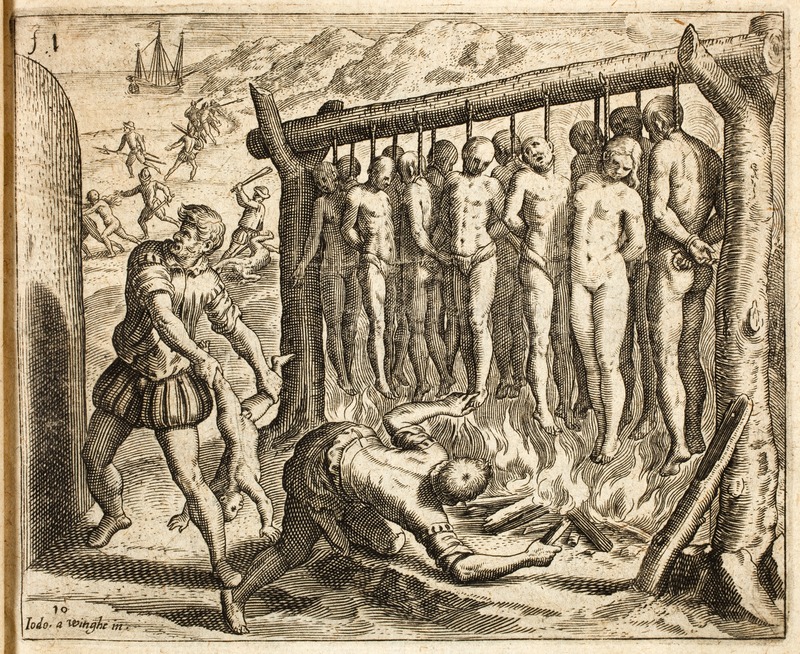
If you read excerpts from Bartolome De Las Casas’s Devastation of the Indies–and if you are a student in a Native American history course treating this period you likely will–you can read about the sheer brutality of the Spanish conquistadors who followed Columbus.  Las Casas provides a first-hand account of the first modern genocide: Spanish ships able to sail homeward without need of navigational instruments because all they needed to do was follow the trail of floating corpses, enslaved Indians who died on the Atlantic crossing. Las Casas described how Spanish colonists could buy human flesh for their dogs, and how Spanish war dogs tore native peoples literally limb from limb.  Las Casas described the competition between conquistadors to see who could run through the most Indians with one thrust of the pike, and how Spaniards burned native peoples in groups of thirteen in honor of Jesus and the apostles, and bashed their children’s heads in by swinging them against the rocks, as in the Flemish (and Protestant) engraving to the left.  And all this brutality, all the subjugation that occurred under the aegis of the Spanish encomienda system, exacerbated the consequences of epidemic diseases, which in places killed off 80% of the population. Brutality made native peoples less able to resist the onslaught of disease. Millions died.

But here’s the thing, and I hope you will see it if you read Native America.  We can focus on victimization and cruelty.  God knows, Columbus and his successors were violent and brutal and victimized many.  But to focus on victimization alone does a deep disservice to the history of native peoples.

In Native America, we tell the story of the first European explorers who came to North America from the Indians’ perspective: What native peoples saw when they looked at these newcomers, their strategic calculations, how they fit the Europeans into their conceptual universe.  If you look at the story of the French explorer Jacques Cartier, who sailed into the St. Lawrence River in the 1530s, or his Spanish contemporary Coronado who wandered throughout the American southwest, or Soto’s violent exercise in futility in the Southeast, or the Juan Pardo expedition, or Cabrillo’s ineffectual reconnaissance of the California coast, or even the Roanoke voyages of 1584-1590, you cannot help but see one consistent theme. It is so obvious in the surviving documents. What is clear in every account is the utter dependence of the newcomers upon the native peoples who cautiously welcomed them into their communities, cultivated them as military allies and trading partners, enlisted them in their struggles with their neighbors, and contemplated transforming them into kin.  When the newcomers wore out their welcomes in North America, their enterprises were doomed, their situation worse than desperate.  These European explorers discovered what they believe they discovered only because native peoples allowed them to do so.  And the effects of the visits by these European sojourners were remarkably short-lived, the consequences fleeting.  Even with De Soto, who many scholars long had blamed for spreading epidemic disease into the continent’s interior (a mistake I made in the first edition), we now know from the work of historians like Paul Kelton and anthropologists like Robbie Etheridge that his disastrous expedition had little long-term effect.  The wasting plagues came in the seventeenth century, a product of an Anglo-American trade in Native American slaves, the scope of which was vast and mind-boggling.

Columbus Day found its origins in discrimination against Italian-American immigrants. We were here from the beginning, Italian-Americans said, and we have as great a claim to this continent as any other group.  The holiday has seldom encouraged any significant and honest discussion of the consequences of the Columbian Encounter, a process which was, as historian Alfred Crosby showed a long time ago, much bigger than Christopher Columbus.  It is time for the bad history and the myth associated with this day to go away, and if recognizing Indigenous Peoples’ Day helps I am all for it.  Let’s talk about Columbus, to be sure, and the European invasion of America, but let’s do so with our eyes firmly upon those native peoples whose losses were Europeans’ gain, and who have endured and survived through five centuries of discrimination, dispossession, and slaughter.

We Are Teachers

Many years ago I served on a search committee for a position in the history of American Foreign Policy. For many reasons it was an odd search, and we ultimately did not succeed in hiring anyone for the opening.  We interviewed one candidate over the phone, with an exceptional record of publication, and a strong, Ivy League academic pedigree. He was doing a post-doc at some thinktank somewhere and, when asked about teaching said that, yes, he did enjoy it, and that it was for him a “nice break in the day.”  He would not have been a good fit for us. I teach in a department, and at a college, with a great number of very fine teachers, where teaching is Job One, and where we take great pride in the accomplishments of our undergraduates.

Don’t Be This Guy

I have served on many search committees since that time. It consistently strikes me how poorly served are many job candidates who come from elite research institutions.  The letters of recommendation, even when they are signed and printed on letter-head, are so long, with detailed and esoteric discussions of the significance of a candidate’s research.  In my view, they contain more detail than is necessary and, all too often, say little about teaching beyond expressing the belief that the candidate, based upon their personality, might be good at it.

Do not get me wrong. Research is important.  It makes you a better historian and, when done with eyes open, it makes for better teaching. It

…or this guy

forces you to remain engaged with the scholarship and to keep abreast of the developments in your field. Even at a college like ours, it is something that you are required to do in order to achieve tenure and promotion.

And even at a school like mine, with its heavy teaching load and limited travel funds, it is my view something that you are ethically bound to do. Were I to resign my position, and if my college was able to scare up the money to replace me and conduct a tenure-track search for a historian in Early American or Native American history, I would expect that at least a hundred people would apply for the job.  Many of these people would be fantastically qualified. Many of them would have published much more by the time they went out on the job market than my peers and I did back in the middle of the 1990s.

But, let’s face it, many of them will never land tenure-track teaching positions.  Because colleges increasingly rely on adjuncts to carry the weight of their college’s teaching obligations, or because public systems are strapped for cash and positions are not necessarily replaced, many of these outstanding young historians will never get the chance to do what I have done.  It is an unjust system, and no meritocracy.  Those of us with good jobs need to appreciate how privileged we are. We need to publish, and if we cannot, we should get the hell out of the way for those who can.  We cannot justly take up space.  Other people, were they so fortunate, would produce high quality work and in quantity if they could.  Many of them will never get that chance.

Many of those who apply for position after position and never find secure academic employment would make fantastic college teachers as well.  So those of us fortunate enough to have jobs have the obligation to put our best efforts forward, to realize that we speak to more students on any given teaching day than will likely ever read an article we publish or listen to a paper we give at this or that conference. We should realize that we can devastate a student with an unkind word or with criticism that is indelicate or overly harsh.

We should recognize as well that with words of confidence and encouragement we can change a young person’s life.  A student will remember us, and what we have said, perhaps long after we have forgotten that student’s name.  And to have that sort of positive impact as a teacher requires great effort and commitment and consciousness.  I once had a colleague when I taught in Montana who told me during my campus visit that being a college professor was “the best part-time job in the world.” He published shit, a bibliography here, a stupid article there.  He taught unimaginatively–presidents and scantrons in American history.  To do well requires an enormous amount of energy and sensitivity.  Teaching is the most important thing we do.

I have had many great teachers as colleagues.  Bill Cook, my medievalist colleague who retired a few years back, and who was adored by generations of students, told me that he reminded himself that every student he taught was the most important person in somebody’s life, and that they were entitled to the utmost courtesy, care, and respect.  His office for many years was across from mine, and I was always impressed by how much time he took with students, how much interest he showed in them.  It was a good lesson for me.

I had this student who took a couple of my classes–my Native American survey course and my course in American Indian Law. She wrote one of the finest research projects I had ever read. Her short papers were brilliantly insightful. They were well-researched and extremely well-written. They were theoretically sophisticated.  She was not a history major, but was the best student in each of the classes she took.  As she prepared to leave campus, having completed her last semester, she stopped by my office. She thanked me for the semester. I told her that I have been at this teaching thing a while.  I told her that I had a good idea of what it takes to succeed in graduate school and academia, and I told her that I am highly selective in who I recommend for graduate school–it is a tough job market, after all, and to succeed you need to be a hard worker, talented, and imaginative.  I told her that I did not know what her plans were after school but that I had every confidence that she could succeed in any endeavor she chose to pursue, and that I would be delighted to write a letter of recommendation for her.  She was visibly moved by this.

A couple of weeks later, I was talking to a colleague in her home department. I was sharing how talented I thought this student was, and thanked my colleague for sending her over to my department.  He said that she was a C student, that she did not seem that interested or motivated.  Damn.  That transcript.  Those grades.  Wouldn’t work for graduate school.  It was a conversation that left me deeply disappointed, and I feel it still, a couple of years later.  Was she really uninterested, or was he uninspired or ill-advised?  I wish I had the chance to meet this student earlier in her Geneseo career.  I have a feeling that I may have been the only professor she had who really let her know how exceptional and talented she was.

We teach. Sometimes, we get lucky, and we meet students who have such breath-taking talent that we learn more from them than they from us.  Sometimes students disappoint us, frustrate us, inspire us, and make us proud.  Sometimes they do not live up to what we believe is their potential.  But once in a while, you will change their life for the better, and, once in a while, they will make yours much better, too.

The Treaty of Big Tree–Let’s Follow the Money

The anniversary of the “Treaty of Big Tree,” signed on the 15th of September in 1797, is approaching. According to a New York State historical marker, the agreement was negotiated on land that now provides parking for students who attend the college where I teach.  It is a big deal in Geneseo. It is the one, big, historical event that occurred within the town’s bounds.

One thing that I think a lot of non-historians do not realize is the amount of research we do that never sees the light of day. Although we require our students quite often to come up with some meaningful sort of research project during the short fifteen weeks of a semester, we spend plenty of time following interesting questions that lead to dead ends.  It happens all the time. We are curious. We ask questions and, sometimes, despite our best efforts, we cannot find an answer.

A couple of years back I was asked to do some research for the Seneca Nation of Indians about the history of the annuities that often were attached to the agreements they entered into with New York State and the United States.  In exchange for their lands, Senecas would receive an annual payment.

I often see this bumper sticker in and around Indian Country.  The Indian Country Today Media Network, now apparently on hiatus, spoke frequently of broken treaties.  But some treaties, it must be remembered, were little more than real estate transactions in which white people obtained a title to Indian lands in return for very little at all.

I have always done research on Big Tree, but I had never bothered to look at whether the United States had fulfilled its part of the bargain. Certainly it acquired a lot of land. But did it pay to the Senecas what they were owed?  I travel with footnotes.

I tell the story of the treaty at Big Tree in Native America.  It is an important moment in the history of the Senecas.  Robert Morris had acquired from earlier land speculators a right of preemption, or first purchase, to all the Seneca lands in New York state. He sold this right to the Holland Land Company in December of 1792.[1]  A well-financed syndicate of Dutch merchants and bankers, the Holland Land Company was much better equipped than Morris to oversee the actual opening up of the Seneca homeland to white invasion and settlement—a massive undertaking that involved administering an enormous territory, and absorbing the costs associated with surveying, building roads, and laying out towns.[2]  Before they would pay, however, the Holland investors insisted that Morris extinguish the Senecas’ title to the lands in question.

What did that mean? It meant holding a treaty, and negotiating with the Senecas.  In 1797 Morris began laying plans for a council.  Because Morris was ill and because he feared prosecution for debt should he leave his home in Philadelphia, his son Thomas traveled to Big Tree on the Genesee River to conduct the treaty. (The treaty was held, according to a New York State historical marker, near one of the parking lots on my campus).  The story of this sordid council, involving the use of alcohol at the treaty ground and the bribing of important Seneca leaders, has been told many times before. My treatment in Native America is inspired by the great books written by Anthony F. C. Wallace and Laurence Hauptman, which are required reading for those who wish to understand the Iroquois.[3]

Morris obeyed the letter, if not the spirit, of the federal Indian Trade and Intercourse Law, the statute which governed relations between natives and non-natives.  The law required that for a purchase of Indian lands to be legally valid, the purchase must be overseen by the United States, and the resulting agreement must be approved by the United States Senate.  Morris requested and obtained the appointment of a federal agent, and the Senate did ratify the agreement. And at Big Tree, on the campus where I offer my courses in Iroquois history, the Senecas parted with all of their land, that huge region from the Genesee River westward to the Great Lakes and the Niagara River, save for 200,000 acres distributed across eleven reservations.  In exchange for this massive cession, Morris agreed to pay “the sum of one hundred thousand dollars, to be by the said Robert Morris vested in the stock of the bank of the United States, and held in the name of the President of the United States, for the use and behoof of the said nation of Indians.”  The Senecas would receive as a payment, each year, the interest earned on this investment.[4] 

So let’s follow that money, as far as the sources allow.  That was easier said than done.  I am no accountant.

In March of 1798 the United States used the $100,000 it had received from Robert Morris to purchase 205 shares in stock of the Bank of the United States “to be held in trust” for the Senecas “by the President of the United States.”  The dividends on this investment averaged slightly more than seven thousand dollars a year, though some of the revenues that would otherwise have been delivered to the Senecas were withheld to purchase additional stock: 9 shares in 1804 at a cost of $5328.00, an additional share in 1806 for $522.00, and five more shares in 1807 for a sum of $2580.00.  With the exception of this combined amount of 8430 dollars, the increase produced by the Big Tree investment was delivered to the Senecas by federal agents.  The dividend, paid twice a year, amounted to a minimum of sixteen dollars per share between 1798 and 1802, or $3280 every six months.[5]

The Bank of the United States, part of Alexander Hamilton’s (Stop singing, please) ambitious but controversial program for developing the new nation’s economy, had received a twenty-year charter from Congress in 1791.  When the Bank ceased its operations in 1811, the stock was liquidated, producing a sum of $95,040. (This sum was less than the $100,000 initially invested owing to shifts in the value of the stock).  The War Department credited $1980.00 of this sum to fund its Indian appropriations account, while investing the remaining $93,060.00 in 6% stocks in the name of the President of the United States, to be held in trust for the Seneca Indians.

The Senecas watched closely these funds, and saw the annual dividend as essential to their survival.  They said this, in writing, time and again.  A large group of “Seneca chiefs” told Secretary of War William Eustis in 1811, after the expiration of the Bank’s charter, that “we are told the field where our Money was planted is become barren.”  What they hell, they seemed to be saying. This concerned the Senecas, the chiefs said, because “our money has heretofore been of great service to us.  It has helpt us to support our old People, and our Women and Children.”  The Senecas sought assurance that the Big Tree fund—the result of their leaders’ difficult decision to transform their lands in western New York into an annual payment—would continue to be paid.  “Brother,” the chiefs wrote to Eustis, “we do not understand your ways of doing business,” and “this think is heavy on our minds.”  The Senecas wanted to continue “to hold our White Brethren of the United States by the hand, but this weight is heavy. We hope,” they concluded, that “you will remove it.”[6]

I am fairly certain that these Seneca chiefs understood more than they let on.  Signed by a large number of prominent Seneca leaders, the “Talk of the Seneca Chiefs” must have occasioned some alarm in the War Department.  With war with Great Britain looming, the chiefs suggested that if the United States did not uphold its part of the bargain and see to the continued payment of the dividends, they might then cease “to hold our White Brethren of the United States by the hand,” and instead embrace those other white brethren, who stood poised on the opposite side of the Niagara River and Lake Ontario, with whom they had aligned during American Revolution. Don’t mess with us. You need us to help secure the Niagara frontier.

The interest earned on the investment after 1811 produced only $5618 per year, but owing to the importance of the Senecas as allies while the United States muddled through its conflict with England, the sum of $6000 was paid to them from the general funds of the Indian department.  This fund, in turn, was credited with the dividend produced by the stock.  This arrangement continued until 1826 when the 6% stock was liquidated, producing $93,602.67, which the War Department invested in 3% stock.  The dividends, falling well short of the $6000 to which the Senecas had grown accustomed, posed a problem for the administration of John Quincy Adams.  To pay the usual $6000 would draw down the fund and perhaps force the sale of the stock from which the dividends derived.  In any case, the government would be expending more than the interest on the investment.  President Adams determined nonetheless “that the government would continue to pay” the Senecas six thousand dollars annually, “taking upon itself the protection of the fund.”  The United States, Adams believed, “was bound in good faith to do so.”[7]

Adams was willing to spend federal funds to uphold the honor of the United States.  His successor, Andrew Jackson, clearly did not share this view.  Commissioner of Indian Affairs Thomas McKenney disliked the idea of paying the $6000.00 when “the sum remitted” was “greater than the interest received on the Stock.”  Anticipating the new president’s views, McKenney decided to offer to the Senecas in 1829 nothing more than the divided, a sum of less than three thousand dollars by 1829.[8]

This unilateral decision angered the Senecas.  An elderly Cornplanter, writing from Kinzua, appealed to President Jackson.  The Senecas, Cornplanter wrote, had been well satisfied with the annual dividend of $6000, but now the news from Washington “fills our minds with concern that we cannot get our Money nor be informed why we should not receive [it] as in former years.”[9]  Writing less than three weeks after Congress enacted the Indian Removal Bill, surely Cornplanter recognized that he had directed his appeal to an ardent expansionist who coveted Indian land and wanted all eastern Indians relocated to new lands in the west. The Big Tree payment, Cornplanter continued, “was but a little but it enabled us to purchase Salt & some Blanketts and that would be a great help to those who are active & till their land.”  The Senecas could not accept anything less than the 6% to which they were accustomed.[10]

The President did not believe that any law existed which authorized him to pay to the Senecas a sum greater than the value produced by the stock.  Sticking to his rigid and self-serving code of constitutional interpretation, Jackson punted the question to Congress, which in the 1830s did things.  The resulting bill, introduced in the House of Representatives, would provide the Senecas with a permanent annuity of $6000, while whatever proceeds emerged from the stock would be credited to the United States.

Senator John Forsyth of Georgia, a determined advocate of the ethnic cleansing his state carried out against the Cherokees and the Creeks, opposed any measure that went beyond the strict language of the Big Tree treaty.  Nothing in that agreement, he believed, obligated the United States to pay to the Senecas 6% forever.  Paying the $6000 he said,


had already cost the Government a very considerable amount  over and above the product of the stock, and now the question arises, are we bound to do more, after doing all we have already gratuitously performed?  But it is said the Indians have been given to understand that the full amount of six thousand dollars should be paid to them. Who gave them to understand this? Who had a right to do so? And yet it was on such loose declarations that the whole merits of this claim seemed to rest.  It is contended that the Government is bound to realize to these Indians any expectations they may have been induced to entertain.  It is true, it is said that the late President of the United States [Adams], when the subject was before him, had given them these assurances. This, however, did not establish the justice of the demand.  He could see no sort of obligation on the part of the Government to pay them more than the amount produced by their stock.[11]

Forsyth’s argument failed to persuade a critical number of his colleagues, which is surprising given how they felt about Indians, and the bill became law in February of 1831.  Thereafter, the law read,

the proceeds of the sum of one hundred thousand dollars, being the amount placed in the hands of the President of the United States, in trust, for the Seneca tribe of Indians, situated in the State of New York, be hereafter passed to the credit of the Indian appropriation fund; and that the Secretary of War be authorized to receive, and pay over to the Seneca tribe of Indians, the sum of six thousand dollars annually, in the way and manner as heretofore practiced.

A subsequent act, signed into law in December of 1831, paid to the Senecas $2914.40, “that being the balance due on the annuity payable to said Indians for the year one thousand eight hundred and twenty-nine.”[12]

Congress did on a number of subsequent occasions revisit the Big Tree annuity.  An act passed in June of 1846 provided that “certain stocks, etc. held in trust for the Senecas should be cancelled and the funds deposited in the Treasury at 5 percent interest and the interest paid to the Senecas annually.”[13]  Fifty-three years later, in March of 1909, Congress directed the Secretary of the Treasury to place on the books of the Treasury Department “to the credit of the Seneca Indians of New York, the sum of $118,050, such sum to bear interest at 5 percent until withdrawn for the Indians, being the value of stocks held in trust for the Indians and taken by the United States and cancelled under the authority of the act of June 27, 1846.”  Congress authorized the Treasury Secretary in 1909 to place on the books of the treasury department $118,050, “such sum to bear interest at 5 percent until withdrawn for the Indians, being the value of stocks held in trust for the Indians and taken by the United States and cancelled under the authority” of the 1846 act.  This sum, Congress decided, the Treasury secretary would pay  “per capita to the members of the tribe entitled thereto.”[14]

I am not sure what happened as we carry the story through the rest of the nineteenth century and into and through the twentieth. The records of congressional appropriations show that the Congress continued to appropriate the $6000 dollars each year to pay its obligations under the Big Tree treaty.  Seneca Nation records, however, suggest that these payments were not received until relatively recently. I still have work to do to be able to sort this out.

But here is the thing. Honor Indian Treaties.  But a lot of them were not honorable at all, and the terms of many of them were never written with Indians’ interests in mind. Students in my Native American Survey course has just finished reading Thomas King’s The Inconvenient Indian, which says so much in such a breezy manner.  “Treaties,” King wrote, “were not vehicles for protecting land or even sharing land.” Rather, “they were vehicles for acquiring land.  Almost without fail, throughout the history of North America, every time Indians signed at reaty with Whites, Indians lost land.”

So let’s think about what we mean when we call upon the United States to honor its treaties. Certainly the government should keep its word. Certainly in the realm of Indian affairs it has behaved despicably and irresponsibly. Certainly treaties have been broken many times, with often devastating consequences. But, in many instances, native communities would have been better off if these treaties had never been negotiated, never signed, never ratified, and never proclaimed by the president.  So many of them were coerced, or fraudulent, or exploitative.  The colonization of this continent, and the dispossession of native peoples, to a great extent was achieved through the instrument of treaties.


[1] Charles E. Brooks, Frontier Settlement and the Market Revolution: The Holland Land Purchase, (Ithaca: Cornell University Press, 1996), 13-14.

[2] Wallace, Death and Rebirth of the Seneca, 179-180.  The Holland Land Company Papers are located at the State University of New York, College at Fredonia.

[3] Wallace, Death and Rebirth of the Seneca, 179-183; Taylor, Divided Ground, 313-316; Laurence M. Hauptman, Conspiracy of Interests: Iroquois Dispossession and the Rise of New York State, (Syracuse: Syracuse University Press, 1997), 91-92; Norman B. Wilkinson, “Robert Morris and the Treaty of Big Tree,” Mississippi Valley Historical Review, 40 (September 1953), 257-278.

[4] Kappler, comp., Treaties, 1028.

[5] LR OSW IA, 1: 0188.

[6] Talk of the Seneca Chiefs, 9 October 1811, LR OSW IA, 1: 714.

[7] Nourse Report, 18 March 1829, LR OIA-Seneca, Roll 808.

[8] McKenney to Secretary of War John H. Eaton, 17 March 1829, Ibid.

[9] John O’Bail (Cornplanter) to Andrew Jackson, 2 August 1830, Ibid.

[10] Ibid.

[11] Gales and Seaton’s Register of Debates in Congress, 3 February 1831, p. 79.

[12] Available at the Library of Congress “Century of Lawmaking” website.

[13] “Compilation of Material Relating to the Indians of the United States, etc., by Subcommittee on Indian Affairs of the Committee of Public Lands, House of Representatives, Pursuant to H. Res. 66, 81st Congress, 2d. Sess., 13 June 1950, Serial No. 30,” in Paul G. Reilly Collection, Buffalo State College, Box 37, p. 12.

[14] Ibid., 13.

Creative Destruction: Or, Let’s Bash Some Monuments

It’s what we do, at least metaphorically. For historians, the destruction of monuments can be a good thing, a visceral and often-times important act of revision. It is an opportunity to replace dated and damaging interpretations of the past with more complicated, nuanced, and correct stories. We do not necessarily need to destroy Confederate statues to do this, but certainly we can reinterpret them, knock them down a few pegs, and re-write the stories that these racist monuments to white supremacy attempt to tell. Stick them in a museum, if you want, but let’s not pretend these are sacred sites.

There was a news story I caught at the end of last week.  Among the many vicious clowns and tiki-torch bearing, racist weenies in Charlottesville, was Mr. Jerrod Kuhn, a graduate of Honeoye Falls-Lima High School. It’s about ten miles from where I live. Kuhn was photographed marching with the white supremacists while they chanted “Jews Will Not Replace Us,” “Blood and Soil,” and “White Lives Matter.”  Kuhn said, however, that he was neither a Nazi nor a white-supremacist.  Rather, he was a “moderate Republican”(!) marching to protest efforts to eliminate statues and monuments commemorating the Confederacy and the cause for which it stood–White Supremacy.  When some of Kuhn’s anti-fascist neighbors saw his picture with the marchers, they publicized this bit of news, arguing that local residents should know that there is a Nazi in town.  And Kuhn cried foul. He was afraid. Some of his neighbors were being mean to him.  Boo-Freakin-Hoo. If you dance with the devil, people are going to think you are a sinner, and the monuments Kuhn marched to protect and which commemorated the Confederacy were erected not immediately after the Civil War, but several decades later, at the beginning of the Jim Crow era.  It is an interpretation of the Civil War that has endured, in the face of all the evidence, for far too long. If taking down statues which lionize slave-owners who were willing to kill US Soldiers in order to hang on to their human property and the system of white supremacy that lay at the bedrock of southern society is what’s at stake, then let them fall.

I have thought a lot about Charlottesville.  I have thought about the President’s support for the so-called “Alt-Right” movement.  As I mentioned in a post last week, I really do not care what the President says: systems of white supremacy are deeply ingrained. Trump has emboldened the Nazis and the Troglodytes, but those people have been living under rocks quite contentedly for generations, surfacing periodically. Even though Steve Bannon has lumbered away from the White House, and Donald Trump is saying whatever the hell it is that he occasionally says, white supremacy will endure. It is institutional, and it is part of what we are as a nation.

I have thought, however, about what all of this might mean to those of us who teach and study Native American history, a field in which we might not discuss white supremacy enough.

After I moved to Montana in 1994, one of my first trips was to visit the Little Bighorn Battlefield site, about an hour or so away from Billings.  In the small visitor’s center stood a iron plaque, about a yard square, that had been placed at the battlefield by Native American activists in the summer of 1988.  It read,

In honor of our Indian Patriots who fought and defeated the U.S. calvary. In order to save our women and children from mass-murder. In doing so, preserving rights to our Homelands, Treaties and Sovereignty. 6/25/1988 G. Magpie, Cheyenne.

You can read about the history of this plaque here.  It was a protest.  An attempt to replace one monument with another, a somber remembrance of the men Custer led to their deaths in June of 1876 with a monument commemorating the efforts of the Lakota warriors who fought to protect their homelands, even if the battle took place in Crow Country. Some viewed the plaque as an act of vandalism.  But it forced a conversation. Custer was no hero.  His men fought to eliminate Lakota people, to take their homelands, and the mineral wealth that lie beneath it.  The native peoples who fought them were not obstacles to progress.  But that is how they were depicted.

The protest mattered. It gained attention.  It forced a conversation, a reconsideration.  The National Park Service responded.  When a permanent monument was erected at the battlefield site in 2003, the native peoples who participated in that protest, who defied the rangers and cemented their iron plaque over the list of Custer’s dead cavalrymen, came as invited guests.

History is not merely a collection of facts.  You can see, for instance, how Custer has been depicted over the years.  Walt Whitman described him as a Christ-like figure, one who sacrificed himself in the name of western civilization and the conquest of the American West.

From far Dakota’s canyons,
  Lands of the wild ravine, the dusky Sioux, the lonesome stretch, the
      silence,
  Haply to-day a mournful wall, haply a trumpet-note for heroes.

  The battle-bulletin,
  The Indian ambuscade, the craft, the fatal environment,
  The cavalry companies fighting to the last in sternest heroism,
  In the midst of their little circle, with their slaughter’d horses
      for breastworks,
  The fall of Custer and all his officers and men.

  Continues yet the old, old legend of our race,
  The loftiest of life upheld by death,
  The ancient banner perfectly maintain’d,
  O lesson opportune, O how I welcome thee!

  As sitting in dark days,
  Lone, sulky, through the time’s thick murk looking in vain for
      light, for hope,
  From unsuspected parts a fierce and momentary proof,
  (The sun there at the centre though conceal’d,
  Electric life forever at the centre,)
  Breaks forth a lightning flash.

  Thou of the tawny flowing hair in battle,
  I erewhile saw, with erect head, pressing ever in front, bearing a
      bright sword in thy hand,
  Now ending well in death the splendid fever of thy deeds,
  (I bring no dirge for it or thee, I bring a glad triumphal sonnet,)
  Desperate and glorious, aye in defeat most desperate, most glorious,
  After thy many battles in which never yielding up a gun or a color,
  Leaving behind thee a memory sweet to soldiers,
  Thou yieldest up thyself.

A century later, Richard Mulligan portrayed Custer in “Little Big Man” as an unhinged madman, a preening martinet, in love with his own reflection, and lusting for Indian blood.  He spouted lines that would have sounded familiar to a movie audience exhausted and angry about the Vietnam War. He represented all the foolishness, the arrogance, and the stupidity that led the United States into an imperial war it could not win.  Custer, Westmoreland, light at the end of the tunnel, we must always advance.  It was a stunning revision of Custer’s carefully cultivated image.

Interpretations change.  Monuments are not history. They are interpretations of history.  And as such, they are not sacred.  They are open to challenge, to question.  And if the claims they make are wrong or over-simplified or pernicious–Custer was heroic, or the South fought for “States’ Rights,” for example– than they ought to be replaced, revised, rewritten.  My point is that we historians, when we do our jobs well, destroy monuments ALL. THE. TIME.  We ask tough questions.  We challenge long-cherished assumptions.  We are not precious, and we should hold nothing sacred but a determination to work the sources thoroughly and honestly in order to get the story right.

And then there is the story of Juan de Oñate’s foot.  A statue of the Spanish Conquistador, considered a “Founding Father” of New Mexico, stood in the town of Alcalde.  In January of 1998, as the 400th anniversary of his arrival in New Mexico approached, protestors armed with a chainsaw cut the right foot off the statue.  For them, this conquistador was no hero. They were, in effect, writing an alternative version of the Oñate story, commemorating the violent Spaniard’s brutal order to cut the right foot off of two dozen Acoma Pueblo prisoners who had resisted his advance.  I wrote about this event in Native America. The sculptor repaired the statue, but the missing foot never was returned.

We can call this act vandalism, or the destruction of public property, the sort of stuff that Vice-President Mike Pence has said he deplores.  It was those things, but it also was an act of reinterpretation, of historical revision. Douglas Seefeldt made this point in a paper entitled “Oñate’s Foot: Histories, Landscapes, and Contested Memories in the Southwest,” published in Across the Continent: Jefferson, Lewis and Clark, and the Making of America, published by the University of Virginia Press in 2005. Seefeldt edited this volume, along with Jeffrey L. Hantman and Peter Onuf. While some might excuse Oñate’s violence, and celebrate his founding of the Spanish province that became the state of New Mexico, and his bringing the cattle industry to what became the American Southwest, the people who removed the foot from the statue reminded New Mexicans of another side to the story, and demonstrated that history consists of many narratives and many voices.  Not all these voices are heard.  Not all of them are listened to.  And sometimes, to register, to move the debate, dramatic acts are necessary.

I like this poem that tells the story of the removal of Oñate’s foot, and the subsequent celebration of another, larger, statue of the conquistador erected near El Paso:

“The Right Foot of Juan De Oñate”By Martín Espada

On the road to Taos, in the town of Alcalde, the bronze statue
of Juan de Oñate, the conquistador, kept vigil from his horse.
Late one night a chainsaw sliced off his right foot, stuttering
through the ball of his ankle, as Oñate’s spirit scratched
and howled like a dog trapped within the bronze body.
Four centuries ago, after his cannon fire burst to burn hundreds
of bodies and blacken the adobe walls of the Acoma Pueblo,
Oñate wheeled on his startled horse and spoke the decree:
all Acoma males above the age of twenty-five would be punished
by amputation of the right foot. Spanish knives sawed through ankles;
Spanish hands tossed feet into piles like fish at the marketplace.
There was prayer and wailing in a language Oñate did not speak.
Now, at the airport in El Paso, across from Juárez,
another bronze statue of Oñate rises on a horse frozen in fury.
The city fathers smash champagne bottles across the horse’s legs
to christen the statue, and Oñate’s spirit remembers the chainsaw
carving through the ball of his ankle. The Acoma Pueblo still stands.
Thousands of brown feet walk across the border, the desert
of Chihuaha, the shallow places of the Río Grande, the bridges
from Juárez to El Paso. Oñate keeps watch, high on horseback
above the Río Grande, the law of the conquistador rolled
in his hand, helpless as a man with an amputated foot,
spirit scratching and howling like a dog within the bronze body.

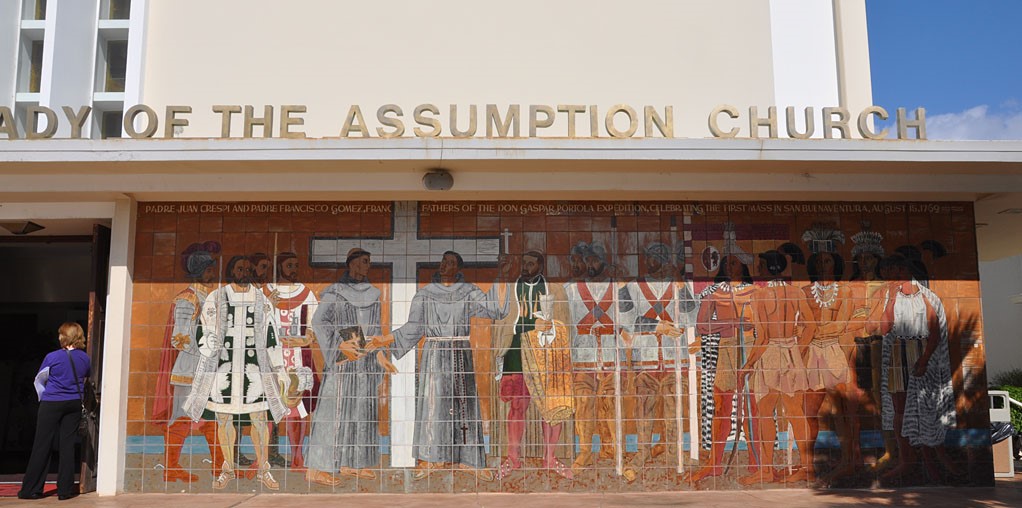
Interpretations of Native American history are everywhere, and I often encourage students to seek them out, to engage them in a debate, to interrogate their biases and assumptions.  Good comes from this.  Every day from first through sixth grade I saw this mural on the wall of Our Lady of Assumption Church in Ventura, where I grew up and went to elementary school.  It presents a rosy picture of the arrival of the Spanish priests at Mission San Buenaventura, one not at all consistent with how scholars see that encounter today.  Nobody has suggested removing this mural to my knowledge, but it stands testament to an interpretation highly favorable to the Catholic Church.

We write history; we do not create monuments. Our purpose is not civic education or instilling patriotism. As I have said before, history is the study of continuity and change, measured across time and space in peoples, institutions, and cultures.  That requires asking tough questions, researching relentlessly, and presenting answers that are sometimes painful to hear.  And too much of the history that has been included on these Confederate monuments and monuments to conquistadors and conquerors is, quite simply, bad history.

In two weeks the town of Geneseo, where my college is located, will be commemorating the 1797 “Treaty of Big Tree.” It is a big deal in town. As a guest of the college, you might stay in the Big Tree Inn.  Dining halls on campus are named after Mary Jemison, who knew much about the treaty, and Red Jacket, who got screaming drunk before he signed it.  For those who do not want to drink where students drink, the tavern at the Big Tree is one of a small handful of choices along Geneseo’s short main street.  If you want to take in the sights, you can go to the Livingston County Historical Society, spitting distance from the campus, and see what its curators claim is an actual piece of the “Big Tree,” under which the treaty was negotiated.  And according to a historical marker located in a campus parking lot, this treaty was significant.  The sign reads, “Treaty Of Big Tree:  Site Of Memorable Treaty Releasing Seneca Title To 3,600,000 Acres Of Land September 15, 1797.”

Releasing title.  3. 6 million acres.  Wow.  This treaty was an alcohol-soaked affair in which Thomas Morris, the non-bankrupt son of the bankrupt financier of the American Revolution and not-too-successful land speculator Robert Morris, employed bribery and alcohol to obtain signatures to a grotesquely corrupt real estate transaction. The Senecas, who had little choice, signed over the right to nearly all of the land in New York State west of the Genesee River save for eleven reservations. Over time, those reservations were whittled down to four, and then two, and now three.  In return for this massive cession, and the bribes he agreed to pay several Seneca leaders, Thomas Morris invested $100,000 dollars in stock of the Bank of the United States, the interest of which was paid to the Senecas most years thereafter.  Some years the amount came to nearly six thousand dollars; other years it was half that.  Why did this happen?  Stuart Banner answers tough questions like this in his excellent How the Indians Lost Their Land, a book I use in my Indian Law course.  The territory was massive; the Senecas’ population small.  The speculators and the settlers were coming.  Better to sell now, get something, and preserve a few key locations than walk away empty-handed. Dispossession.  Land loss. The removal from homes and homelands.  That story is given short-shrift in the celebratory histories of Geneseo and Livingston County. Signs like this one, as the Haudenosaunee scholar Rick Hill has argued, should be re-written.   Rick put together a pamphlet some years ago in which he wrote brief retorts to these ethnocentric markers that seemingly justify the dispossession of Haudenosaunee people and the resulting Iroquois diaspora.

So to those of you who marched in Charlottesville, or sympathize with them, let me make this clear: when we historians suggest that your markers and monuments ought to come down, we are not trying to steal your history and heritage.  History belongs to no one and your heritage, well, good luck with that.  You are on your own. We are suggesting that the interpretation of the past that you cling to, rather, is not only incorrect and oversimplified, but in some cases pernicious and a justification for past evils and continuing historical crimes. We hope we can reason with you, and persuade you with evidence to see things our way.   We are educators, after all, who have spent our adult lives studying history.  We know some stuff. (Some of the other people complaining about you? Yeah, they think you’re racist assholes, and some of them want to beat you up, but I don’t speak for them).  Facts, evidence, explanation: That is the world of the historian.  Myth, fantasy, and ideological comfort food–that is where the monument boosters stand.  Our goals are different. Yours are about justifying your views of the past.  Ours?  We like to think that we are speaking and writing about the truth.

And here’s a challenge for those of you who do not like what we say.  I tell my students this every semester. Ask us for the evidence.  I promise you, we will do the same.  We will support our claims with evidence, and ask that you do, too. If you hear something that you do not believe, ask us for the proof.   That is fair. I tell my students, it is entirely fair for them to ask their history professors not only, “What is the evidence for this claim?” but, also, “So What? Why does this story matter?” No historian worth his or her salt will be threatened by that question.  We can take it.  Can you?


On Charlottesville, and Our National Character

In what ways does the white supremacist violence in Charlottesville matter?

In the past two weeks I have listened to the Attorney General of the United States announce his determination to investigate discrimination on college campuses against…..wait for it….white people.  This move was endorsed by a President who has called Mexicans “rapists” and “animals,” and who has in as many words endorsed police brutality against African Americans and other people of color.  A sheriff’s deputy in Oklahoma, meanwhile, who gunned down an African American man who was walking away from her with his hands raised was rehired by another law enforcement agency.  And Friday night, and again on Saturday in Charlottesville, white supremacists marched in an American city, on an American college campus founded by Thomas Jefferson.  That flawed hypocrite whose moral cowardice was so great, who fathered children with his slave mistress while owning many other African Americans, who denounced native peoples as savages and spent much of his presidency trying to dispossess them, proclaimed his support for the premise that “all men are created equal.”

Saturday morning I sold a broken down flat-screen TV to a scrap-dealer.  Found a dude on Craig’s List who bought and sold dead flat-screens, and who included in his rapid-fire text messages a reference to Paul’s first letter to the Corinthians.  He showed up. Never shook my hand. Never made eye-contact, and never acknowledged my wife who also was standing outside.  He had on an Infowars T-Shirt.  “Ideas are bulletproof,” it read, with the letters imposed over an image of the Constitution. And the stickers on the back window of his truck?  A gun, pointed right at me, with the caption “Not This Truck;”  a  “F–k Cuomo” sticker, with the “f” and the “k” fashioned from the outlines of assault rifles; and a seal for some sort of militia group to which he pledged allegiance (I wish I could remember exactly what it said).

I sold a broken down television, in other words, to a guy who loudly proclaimed his embrace of Christianity in every text he sent, while at the same time announcing to all whose path he crossed that he not only would use violence to protect his personal property, but that he expected somebody to try to take it.  What a dark, frightened, and violent way to look at the world.

These views, expressed on my driveway by a frightened but well-armed scrap-dealer/militia member, or acted upon by the vicious nerds, gun fetishists, racists and thugs in Charlottesville, and described as moral equivalents to the views held by those who believe in justice, equality, and that black lives do matter by our babbling President, are of course nothing new in American history.  We have seen this before.  Too many times over too many years.  Nearly all of us who study this nation’s history for a living, I suspect, were shocked, angered and dismayed, but we were not surprised.  Sick and tired, but not surprised. The racists and white supremacists appeared in Charlottesville, but they had never, every, really gone away.

And that is a lesson, I believe, that must now inform my courses in Native American History even more than they have done in the past.  Hatred and fear of a racialized other.  It runs through the colonial period of American history. You cannot miss it if you look at the sources: from the treatment of native peoples by a frontier population intent on extracting a livelihood from ground seized from native peoples, to the slave owners, and the the lawmakers and legislators and founding fathers who regulated and policed the expropriation of native peoples’ lands and African peoples’ labor.   As I make my way slowly through Robert Parkinson’s magisterial The Common Cause, the best book I have seen on the American Revolution in some time, it is abundantly clear how important a fostered hatred of warlike native peoples and rebellious African slaves was to give shape to the “common cause” for which American patriots fought during the Revolutionary war.  Racism was there at the outset, fundamental to the formation of American national identity.  There have been, of course, many courageous people who have spoken out against this blight at the heart of the nation–some of them were mowed own by a white supremacist’s car on Saturday–and this heroic tradition is important.  But to deny the centrality of its opposite–racial antipathy–is to fail to examine closely the entire content of our nation’s character.

Three times more Africans migrated to the English American colonies than white people between 1630 and 1780.  Slavery was fundamental to the settlement and growth of the Anglo-American empire.  That dynamic and expansive process of enslavement, as historians like Brett Rushforth, Alan Gallay, Linford Fisher, Christina Snyder and many others have recently shown, ensnared many native peoples, too.  Slavery was central.  So was the systematic and organized dispossession of native peoples. I have tried to write about all of this in the second edition of Native America.

“This was all in the past,” you might say.  That is what Attorney General Jeff Sessions seems to think.  The President, too, ever-ready with insult and slur, has proven himself time and again incapable of denouncing the white supremacists who believe strongly that he endorses their views.  This all is heartbreaking, you might say.  You might say that what we are seeing in Charlottesville is inconsistent with who we are as a nation.  You may respond to the news  by tweeting out a message of hope or inspiration under the hashtag #thisisnotus.  That is naive.  Dispossession. Discrimination.  Police forces, armed and militarized to the hilt, locked and loaded to protect the lives, liberties, and property of white people from what  they perceive as the threat posed by people of color, slay African Americans and Native Americans largely without fear of the consequences.

I have seen an increasing number of “Police Lives Matter” flags in the Rochester area, and “Blue Line” American flags.  I see on the news stories about how a Canandaigua woman quickly sold out of the shirts and signs she printed proclaiming that “I Support the Police,” or something like that. It’s a tough job. I get that. If you cannot do it without fearing or discriminating or murdering people of color, please for the sake of humanity do something else.

Is it worse than it has been in the past? We have talked about this as a family. We live in a small suburb of Rochester, a faculty ghetto of sorts where most residents like to think of themselves as tolerant and open to diversity.  My wife, whose skin is dark, is pulled over frequently by our local police; in nineteen years living here, I have never been pulled over.  It has been bad in the past.  There is no denying that.  But it is bad now, and it is getting worse even in the short time since the last election.  For too many white Americans, black lives do not matter.   Native lives, for too many of them, matter not at all. Too many white people view programs like affirmative action, intended to address past systematic injustices, as a threat.  And the people who hold these views? They know the president has their back.

I would like to think that we historians can make a difference, however small, by discussing this history in our classes. I do not see how one can understand American history in its complexity without doing so.  Few people read our work, I know.  But if we are to be effective educators, we must reach out.  We must have faith in the power of knowledge and reason and dialogue and debate.  We must write and teach with the urgency that comes from knowing that our words matter.  And in African-American History, or Native American history, we have the opportunity to explore the structural inequalities and profound injustices that have always rested at the core of this nation’s story.  We must be straight with our students.  Most of my colleagues are already doing this, but the urgency for doing this is growing. Cast away the comforting myths.  It is not our job to instill love of country, patriotism or civics.  We must counter this argument every chance we get. Leave that to the hacks and the partisans, the liars and the myth-makers and the members of the PTA.  We must defend what we do. We must be honest.  Look the evil in the eye.  Expose it to the light of day.  Name the evil, and show our students where it has manifested itself in the past, and the many forms it can take, the contortions and distortions it demands and justifies.  We will take some heat in doing this.  The dingbats and the right-wingers and some of the most conservative evangelicals and others will say that we are not doing our jobs, that we must stick to the facts.   And we cannot take these foolish charges sitting down. We must challenge those who denounce what we are doing with the meaningless and stupid epithet, “politically correct.” Debate these people.  Call them out, politely, professionally, but persistently. Only by standing tall can we help to inspire in our students the courage to speak out, to ask tough questions, and demand reasoned and relevant answers.  Only by doing so can we, in some small way, encourage them to confront and to resist the rottenness that has plagued this nation for far too long.

Intellectual Courage

I gave the following keynote address to the annual meeting of NYSACAC, the New York state organization for high school and college admissions counselors, which took place at SUNY-Geneseo earlier this month. In some ways, it encapsulates what I tell my students each semester on the first day of class in my Humanities class.


I am delighted to be here, and to join those who have welcomed you here to our beautiful campus.  Geneseo, as a place, shows up in the historical documents long before Rochester existed, long before Monroe or Livingston counties, long before there was much of anything European established in what became the broader upstate region. It lays in the heart of the ancestral homeland of the Senecas, the keepers of the western door of the Haudenosaunee, the Iroquois Longhouse.

Seneca soldiers and diplomats who lived in this Genesee valley played a role in the history of two empires, the French and the English, in the Iroquois League and Confederacy, and in the history of the native confederations that threatened the existence of the British Empire in America and then the young United States in the 1790s. They continued to live in this valley, at least some of them, even after Major-General John Sullivan led Continental forces through the Finger Lakes in 1779, burning crops and villages, and scorching the earth, as he went.  They were here in the 1790s and into the 1800s, before they moved to Allegany and Cattaraugus and Grand River in Canada.
Stories from the past.  I could tell you more: about Mary Jemison, the white woman of the Genesee.  She lived for a time as a captive, and adoptee, a refugee, and a Seneca homesteader down the road in what became Letchworth State Park, where you can see a statue of her and a replica cabin.  There are some documents with her mark on them in the county courthouse at the end of Main Street, where she deeded Seneca lands she claimed to white men associated with the Ogden Land Company, among whom numbered one of Geneseo’s founding fathers.  Her Seneca sons, who died violently, two of the three at the hands of their brothers, victims of the alcohol that could cut jagged holes in the fabric of Native American life.  There are New York State historical markers all over this county.  Biased, to be sure, but all telling historical stories about this part of New York State.

For nearly two decades, I have told stories like these to students at this school.  I have taught a lot of students over the years, and told a lot of stories. I am a historian.  That’s what we do.  I am interested in the past, and its connections to the present.  How things came to be.  Continuity and Change measured across time and space in peoples, institutions and cultures.  But all of that is just a way of saying that I am a guy that makes my living by asking questions.  And I love the questions—the search for evidence, the complexity and the lack sometimes of definitive answers, and the stories—the stories are at the heart of all that we historians do as teachers and writers.

I imagine that in your line of work you have stories that you can tell, too, stories of young people who have all sorts of challenges in front of them, or who survive trauma and neglect, some who have succeeded wildly and some who have broken your hearts.  I am sure you have stories of kids who are coming to you before they leave home to go to school, or to work, or into the service, or off to some experience—a gap year or a slack year or an adventure–and who want to begin writing their own stories for themselves, and perhaps by themselves, for the very first time.  These are stories, too, of continuity and change, of how things came to be, of being and becoming. Some of these young people are becoming competent and capable. Or they may be developing generosity and compassion, and some of them might be frightened and uncertain, sometimes for reasons that go deep into theirs and their family’s past, layers upon layers of stories you may have to disentangle if you want to understand them, where they are coming from, and where they hope to go. Some of them do not know what their story is going to look like, or how to begin writing it.

Like you, I have seen students who fall into all of these categories, students who, whatever they are feeling, can do so much to make this world—our world—a better place.

I can also imagine, and only imagine, the time constraints that you, and our colleagues who are out there in the classroom, work under in an era of increasing demands and declining resources. My teacher friends do so much, with so little, so often for people outside the building who have little understanding of what a good job actually looks like, who measure success in ways so foreign to the lived experience of you and your students.  And so it is with some trepidation that I propose to you today, if we are truly “dedicated to serving students as they explore options and make choices about pursuing postsecondary education” as Article I, Section 1 of your association’s by-laws read, that there is more that we can and should do for these young people who are so important to all of our futures.

My oldest daughter is one of these young people, She is at this point in her life where she interacts with her counselor a bit in high school, and talks with an occasional admissions representative.  She has entered this period that is so rich with opportunity and potential but also fraught with vulnerability. She is finishing up her junior year in high school. She has visited colleges and will visit some more and has begun to think when her way-too-busy schedule permits about what she might like to do with the rest of her life.  She has received all sorts of advice on what sort of story she might write, and she has received a lot of advice on how to navigate the college admissions process.  She has been plopped down in front of computers to navigate Naviance and see what her next step might look like. Programs to get her thinking about how to begin her story.

And based upon what I have seen as a parent and a professor, it seems to me that there is one area that is so essential to success in a college classroom, and especially at a liberal arts college like this one, that does not get talked about at high school enough: the importance of cultivating and encouraging intellectual fearlessness; to develop in young people the courage not to shy away from those things that seem to them–to all of us—to be extremely difficult. To master basic skills, of course. To be honest, curious, inquisitive, and relentless to be sure, but most of all, in terms of the questions they ask, the evidence they consider, the ideas they engage with, and the theses they advance, to be as fearless as they can be.  Now, on campuses like this, in this country, in this global community, more than ever.

Geneseo, as I have said, is still a liberal arts college. It’s a phrase that gets thrown around a lot.  We integrate the liberal arts into the curriculum whatever a student’s major. We here at Geneseo wear that label, a liberal arts college, proudly, and many of us still hope our students will, too.

But that is a difficult—an increasingly difficult—thing for them to do. I imagine that some of the students you advise have heard the jokes about liberal arts and humanities majors.  They have worried parents who fear that their kids will not be able to take care of themselves without a “marketable” degree. Some of your students, before they arrive on campus, will already have been asked, “What are you going to do with that degree?”  Sometimes those questions can come from innocent curiosity, like, really, what are you going to do with that degree. But these questions can also come with a barbed tip, too, in the sense that the liberal arts and humanities are thought by some people out there to have limited value because, unlike the STEM fields and business and “the Art of the Deal,” the liberal arts are too often thought of as adding little of value.

The governor of Florida, for instance, a few years ago, argued that we do not need more anthropologists.  Another Floridian, a United States Senator, during his brief, quixotic run for the presidency said that we need “more plumbers and less philosophers.”  The Lieutenant Governor of Kentucky told students at Eastern Kentucky University that they should not bother studying history, and that since they attended a public college, funded by taxpayers—people who work—that they should do something useful to the Commonwealth.   Why should the state subsidize the study of French literature, the governor of that state asked.  What value does it add for Kentuckians?  Even in the SUNY system we have seen a diminishment in the perceived importance of the liberal arts, social sciences, and humanities.

And all of this is too bad, for I would argue that the study of these fields adds a lot, because they give us the cultural capital necessary to participate in a democratic society in a meaningful and constructive way.  But thinking in terms of nuances, complexities, ambiguities, shades of grey; being one of the people who embraces the big questions, pursues the answers over the long haul, who appreciates the value of open debate and discussion, who endeavors to find truth, and digs like a terrier for answers—people like that can find these times we live in rough sledding. People who ask fundamental questions about why things are the way that they are and how they ought to be—they can be perceived as threatening to those in power, which is why we see this assault on institutions like the National Endowment for the Arts and the NEH, which fund in a variety of ways arts and humanities projects that explore issues that cut to the marrow of the human condition.

Our students now live in a world that you and I have helped to create for them where too many people confuse their feelings and their fears for facts, where being smart and engaged and critical and willing to ask questions can make one an object of scorn.  They live in a world as well where complexity is so often dismissed, where big and difficult answers to the big questions are avoided, that asking these sorts of questions can take a certain amount of courage.

Let me give you an example. The former talk show host Bill O’Reilly used to have a segment on his shows where he sent a correspondent out to do “on the street” interviews where his goal was to expose the ignorance of the liberals he so often criticized on his show. One time the correspondent ran into a highly knowledgeable young guy, college-aged, who was more than willing to engage in a reasoned and informed debate and before he could get to his second sentence, Boom! “Nerd Alert!” flashed on the screen, as if being knowledgeable about public affairs and the world in which we live is a bad thing, something to make fun of.

Many Americans live in a world where they simply do not invest their time and energy to ask questions, stay informed. When we have a President who lies baldly to the press, and a press that is more concerned with ratings and clicks than in pursuing difficult stories, that is interested in fad and outrage and that has the attention span of a 2-year-old, we arrive at that dire point where the use of “alternative facts” can really be a thing that we can talk about with straight faces.  We, collectively, the mature adults in the room, have modeled some very, very, poor behavior.  We reason sloppily or lazily; we are dishonest, or cynical; we are cowards and grotesquely ill-informed.  For instance:

  • A sitting congressman told an audience that the theory of evolution and the Big Bang were “lies straight out of the pit of hell.”
  • The chairman of a Senate environmental panel brought a snowball into that august chamber as proof that climate change is a hoax.
  • When only 36% can find North Korea on a map, and that remaining majority is far more likely to favor military action against a nuclear power led by a deranged mad man;
  • And when almost one in three Americans could not identify President Obama’s vice president, who was there for the entire eight years of his presidency,
  • We have come pretty close to bottoming out.

Think about this: Americans, according to a recent survey, are more likely to be able to identify any two members of the Simpson family than any one of the five freedoms protected by the First Amendment to the United States Constitution, rights that now, as they have been at many points in the past, are under assault. (I known, you think Homer, Marge, Bart, Lisa, and Maggie, but maybe not quite as readily of press, religion, speech, petition and assembly).  22% of Americans can name all five members of the Simpson family, while only one in one thousand could name all five first amendment freedoms.

We are complacent in the face of inequality and injustice.  As the searing documentary “The 13th” pointed out, the United States has 5% of the world’s population, but 25% of the people who live their lives behind bars, and we are working hard to increase that percentage, if we are to believe the current United States Attorney General.  But think about that: One out of every four persons who is incarcerated ON EARTH  is imprisoned in the land of the free, and the home of the brave, though that freedom and that bravery is, at times, quite hard to find. People of color are imprisoned at rates far out of proportion to their share of the general population.

OXFAM reported in January of 2017 that 8 men, the wealthiest in the world, own as much as the poorest half of the world’s population.  8 men own as much wealth as the poorest 50%, 3.6 BILLION PEOPLE.  The wealth of these eight men grew by half a trillion dollars over the course of the preceding five years, while the wealth of the poorest 50% fell by 1 trillion. At the height of his fame, Michael Jordan was paid more than all the factory workers in all of Nike’s factories combined.

We have seen gun-craziness, racism, rising antisemitism, fear.  You know it is all there, and you can, I imagine, think of additional examples.  Violence.  White supremacists marching in New Orleans and Charlottesville to protect monuments explicitly commemorating white supremacy. The election of an incurious and juvenile president who has, at various times,

  • insisted that freedom of the press—part of that pesky first amendment—does not allow the press to criticize him;
  • that torture, specifically prohibited by American laws, should be brought back;
  • that we should wall ourselves off from the rest of the world;
  • claimed that women are objects who can be grabbed and groped at his pleasure; and that the norms and values and responsibilities of civil society and basic ethics simply do not apply to his family and favorites.
  • I cannot keep up with it all—every time I thought I was done writing this address, another bit of news…And here is the point:

Rational, reasoned, and just public policy is difficult if not impossible without an informed, engaged, and rationally-thinking public willing to ask tough questions, to engage.

Fear.  Many Americans live in fear: of immigrants and Islamist extremists–but a plastic surgeon botching your operation is more likely to kill you in the United States than a terrorist. Peanuts kill more Americans than terrorists, as John Oliver pointed out.  Yet we are told to be fearful.  And many of us do as we are told. People around the globe and in this country—some of them, anyways—seem to have more confidence in fear and anger and hate than in their opposites. With malice towards many, and charity for few; with little interest in heeding the call of the Old Testament prophets to care for the widows and comfort the fatherless, the weakest members of society, and to seek out injustice and correct oppression.

Our students are coming of age in this moment where a lot of really old issues—race and inequality and class and gender and violence and justice, are resurfacing in complicated and anguishing ways.  The problems are out there.  But to name them and to ask, “What can we do?” and to gather the information to solve them, that can be tough.  And so many of these problems we face are rooted, in part, in a rejection of critical thought, in an embrace of the irrational, and a society with these problems can fall prey to demagogues with their simplistic answers, and will find it difficult to display emotional maturity, and will be prone to violence.

What are we going to do about all of this?  I don’t know. But maybe if we are to make America great again, or as great as it might be, it might be the young people who you help send to a school like this one, who get a solid grounding in the liberal arts, whatever their majors, who will best see that “injustice anywhere” just may be a threat to justice everywhere.  And that if it is “an inescapable network of mutuality, tied in a single garment of destiny, that binds us, one to another,” as Martin Luther King once wrote, that these kids, these young men and women, may be among those best suited to do something about it.   So those of us at a school like this, we who think and reason; we, the people who read the footnotes–we can deploy that wisdom that not only makes our lives richer but makes the world a better place—–only if we have the courage to act, and to use it.

All of us, you and I, we need to do a better job with the young people we advise and teach.

After all, we live in and have helped to create a world where—when we stand up in the face of the problems before us and ask, “Why?” and when we insist on a reasoned and relevant response to that simple question—it’s like an act of subversion, and subversive acts, even the smallest ones, require a degree of courage, of fearlessness.

It can beat your down, if you let it. I see it occasionally on this campus.  Despair. Hopelessness.  Cynicism.  Especially cynicism. I worry that it can beat down the young people with whom we work, if we do not do a better job in equipping them to be intellectually fearless. Again, look at the spectacle of public life that we are in the process of bequeathing to this generation. We might forgive them for an easy slide into a deep cynicism, but we must emphasize that cynicism is an intellectually lazy position, a colossal cop out or a reflection of a feeling of powerlessness.

But these young people do have power.

It can take courage to trust and to respect and to appreciate, as well as to care and to love, and to accept the validity of ideas presented by those with whom we would be predisposed to think we might disagree.  To never underestimate others, to take people seriously, whoever that person happens to be, to accept the possibility that those with whom we disagree might have a point and, indeed, to admit that we might be wrong.  To appear vulnerable in the face of those who despise us.  It is not an easy thing for us, and it is not an easy thing for our students.  It takes courage, and a willingness—a true commitment—to approaching everything and everyone with a readiness to see goodness and to be surprised.

It is so easy, and at a level perfectly understandable, to feel like the challenges we all face are too big and it is possible, I think, that we all feel at times like we are not enough to make a difference—that we need to be wealthier or have more expertise or access or a stronger prescription or whatever.  But what if the students we worked with used their skills and their thoughts and their reason and acted as if they were exactly what was needed? If we all knew we could work to close the gap between the way things are and the way things ought to be, even a little bit, would we have the courage to act? Would we really do it?

A long time ago I had a great history professor.  His name was Albie Burke.  He died about five years ago. And even though I left Cal State Long Beach where he taught in the late 1980s, I still got back to campus every other year or so to have lunch with him and to catch up, to talk about the Supreme Court, constitutionalism, politics, and all sorts of other things. We were both historians who sort of wanted to be lawyers.  I can remember feeling nervous and unprepared before having to present some of my work in seminar, my thesis project on two really big Supreme Court cases in the field of American Indian law.  And believe me, I was stressed out. We would meet in his very Spartan office, and he always made really incisive eye contact when you were speaking to him.  Bright, bright, blue eyes. He would listen very quietly, never interrupting.  Very comfortable with silences.  And then when you finished, spilling out your guts, telling him how you were not ready, he would pause for a few beats and then say:  “You will never be prepared. You still got to do it.”  He’d smile just a little bit as he said that. It was a tough lesson for some of his students, I think, but his point was that you can spend all your time worrying and fretting and fearing and preparing and not doing.  Fear can keep you from doing what needs to be done, in public life, and in terms of what you want for your own lives.  His daughter told a similar story at his memorial service about many conversations she had had with him just like that.  It is so easy to talk yourself out of pursuing your dreams, of tackling the challenges that may lie in front of you, and that lie in front of all of us.

It is this spirit that we must teach and nurture and cultivate.

How do we get there? Not by rubrics and grades and tests.  Not by slapping labels on kids without making clear to them that at the end of the day they will have to decide whether that label will serve as an explanation for their failures or an obstacle, however burdensome and unfair, that they will have to overcome if they are to succeed.

I know that I have a lot to learn still. I learn a lot from my students.  Maybe I do not know much at all.  But I do know this: Students do not become better people, or more courageous citizens, through exams and grading.  Students do not learn from many forms of assessment.  The tests and the grades we assign do nothing to make them better people. And yet we do this still. The non-profit ETS brings in over 1.6 billion dollars a year.

And when grades or test scores are used to as great an extent as they are at present to determine opportunity—to open doors for some students and close doors for others—they can have the effect of reinforcing inequalities and systematic injustices that have stood for far too long.

The grades your colleagues give, and the grades I give, and the subjects that many of us teach, may in fact matter less for the scores and the content that we are mandated to cover than for what we give to our students to help them to learn to think, and reason, and ask tough questions.  Students will remember how we made them feel, if we made them feel, more than any of the subject matter we teach them. I am willing to bet that if you take a minute, and think back to the time you spent in class, in high school or in college, and what you remember from those classes, that you might agree with me.  I hope so.

Maybe we can be the types of teachers who worry less about grades and missed deadlines, who will believe their excuses, and give out more “A’s.” I am walking proof, after all, that there is little relationship between high school and even undergraduate achievement and later academic success.   And nobody—NOBODY—will convince me that a sixteen or a seventeen or an eighteen-year old should have doors shut because they were not inspired or equipped by their overworked and underpaid teacher to complete their assignments, or able to place their rote work and assignments ahead of whatever crisis, great or small, was dominating their life.  Grades and test scores, to too great an extent, measure the dutiful but not the beautiful parts of our students.

Students.  I have used that word a number of times in this talk, but it is important to remember that we are talking here about young people—people like us years ago– with potential and with dreams who are still learning where their talents lie.  And we need those dreamers.  Stargazers.  That’s what Plato called them.

Here’s what a student of mine wrote for her Humanities final just a month ago. Humanities is a course that we used to really value here, and that used to make Geneseo special and unique.  I gave the students an essay by Roger Rosenblatt that appeared last fall in The Atlantic in which he reflected on his long career as a war correspondent, and the seemingly limitless capacity of people for inhumanity and barbarism.  It is powerful, heartbreakingly beautiful essay. The assignment, in the end, asked students to write about human nature, justice, and the problem of evil, as the contemplated this article, and works by Sophocles, Plato, Thucydides, Augustine, More, the Bible, Shakespeare, and some others I am not remembering.  “The question remains,” this very talented student wrote, “how do we account for all of the hatred, violence, and injustice that we witness? What words do we use to describe it? How can we possibly rationalize it and make sense of it? Where do we find its opposite in the world, and how do we eagerly point at that, so as to say, ‘See, this is also us. This is also me.’

“In a world and a human history overwhelmed by hatred, violence, and injustice, what counters it, I argue, is love, compassion, faith, and the courage to rise above it.”

Maybe we should refuse the rubric, and ignore the scores.  Look for the beautiful.  This rising generation of students is already better than us in important ways—their open-mindedness, their tolerance, their acceptance of difference. I really believe that. Encourage courage. We have a lot of influence.  Or at least we have the potential to be highly influential:  a cruel or an uncaring word from us, for example, even when cast off thoughtlessly or uncritically, or because we are stressed out or too busy, can do so much damage, while a kind word, a single note of encouragement, can do something that these students will remember for the rest of their lives, something that can help them write a beautiful life story.

So let’s do better.  Let’s encourage fearlessness, even where we have failed to demonstrate it ourselves.  I feel that I have the best job in the world. Really. There is nothing else that I can imagine doing because, like you, I get to spend my time talking to young people, many of whom are optimistic, who are neither jaded nor cynical but see the world as one with so much potential. And it is, for those with the courage to act.  How cool is that?

And each and every day, I have the opportunity, if I choose to truly be present, to truly listen, to be awed by their achievements, humbled by the obstacles they have overcome to get to this college, inspired by their creative thinking, pushed by their challenging questions, and amazed by the alacrity with which so many of them seek out injustice, attempt to correct oppression, and in thousands of small ways show the vital courage to make the world—our world—a better place.

I have enjoyed this opportunity to speak to you.  I thank you for listening, for giving me some of your time, and I hope that you enjoy and benefit from your time here at Geneseo, at this conference, and at this beautiful campus.
 

The Loving Decision and the Concealed History of Virginia’s Native Peoples

Yesterday was the anniversary of the Pulse nightclub massacre that took place a year ago in Orlando, the largest mass shooting in recent US History.  It was also the fiftieth anniversary of the Supreme Court’s decision in Loving v. Virginia, the case which struck down laws that prohibited marriage across the color line.

You may have seen the beautifully quiet and restrained telling of this story in last year’s Oscar-nominated film that starred Ruth Negga as Mildred Loving and Joel Edgerton as her devoted husband Richard.  The film avoided grandiose speeches, courtroom melodrama, and focused instead on the struggle of a couple, white and black, to hold things together in the Jim Crow south.

There was more to the story, however, for Mildred Loving always claimed that she was Native American, a descendant of Virginia’s native peoples.  This story is told in Sally Jacobs’  piece that appeared on WGBH. You might find Jacobs’ story useful in your classes.

[UPDATE: And you might find it useful for more than just the story.  Arica Coleman, mentioned below, wrote a fantastic book on this subject, and she has accused Jacobs of plagiarizing her work.  You should read Coleman’s criticism here and in the comments section which follows Jacobs’ piece.  Professor Coleman presents a powerful case, and we need to hear Jacobs’ response. MLO]

Mark Loving, Mildred’s grandson, contacted the Virginia Department of Historical Resources because he objected to the description of his grandmother on a state historical marker as “a woman of African-American and Virginia Indian descent.” So said Jacobs in her piece for WGBH. Mark Loving objected to the suggestion that Mildred Loving was anything other than a Native American woman.  “I know during those time that there were only two colors,” he said in an interview from last November, “but she was Native American.  Both her parents were Native American.  Mildred herself insisted in 2004 that she had no black relatives, according to Arica Coleman, who interviewed her for the fantastic book she wrote on mixed-race marriage.

Race is never simple, and Virginia’s history is a messy one.  In 1924, for instance, the Virginia legislature passed its “Racial Integrity Act” which defined white people as having “no trace whatever of any blood other than Caucasian.” The act included the so-called “Pocahontas exception,” stating that “persons who have one-sixteenth or less of the blood of the American Indian and have no other non-Caucasic blood shall be deemed white persons.”  Many Virginians, blissfully unaware that some of Pocahontas’s descendants had sired children with slaves, attempted to tie themselves firmly to Virginia’s romantic past by claiming descent from Pocahontas. Their interests had to be protected. Anyone who was not white, under the provisions of the law, was “colored.”

I take some time with laws like these in my classes in order to explain to them how nonsensical and ridiculous all of this is at a fundamental level.  Race is a construction, an invented category. The blood that flowed through one’s veins did nothing to effect culture and belief and values and behavior.  Still, Virginians enforced the Racial Integrity Act with a vengeance, and the Commonwealth’s first registrar of the Bureau of Vital Statistics, Walter Ashby Plecker, was a true believer.  “Let us turn a deaf ear,” he wrote revealingly in 1925, “to those who would interpret Christian brotherhood as racial equality.”  Virginia Indians, he believed, were not real Indians: they had been mongrelized, mixed with peoples of African descent, and as such he ordered his employees to alter the birth certificates of Indian children.  This was erasure, an attempt at extermination carried out with pens and paper. The certificates now would read “colored.”  Plecker claimed that he had science on his side—the same “eugenics” that later fueled the Nazi holocaust—but he admitted to close friends that he routinely changed racial designations from Indian to colored without any evidence.

Plecker’s racist crusade made it difficult for many native peoples in Virginia to prove that they were Indians.  The vital records upon which such a designation relied, after all, had been altered.  Native peoples in Virginia asserted a third racial identity in a biracial society.  They did not attend black schools because they felt no necessity to accept Plecker’s logic.  Many wanted access to the better facilities available to white Virginians.  Some of those who could pass as white did so, but many of Wahunsonacock’s descendants struggled in the face of this racist legal code.

During the Second World War, Commissioner of Indian Affairs John Collier complained about Plecker’s strict enforcement of Virginia’s racist legal code but Plecker was convinced that thousands of “mulattoes” in Virginia “are striving to pass over into the white race by the Indian route.” Plecker determined to keep the races pure, and the lines between them distinct.  When a draft board in Richmond ordered three Rappahannock men to report to an induction station for African American soldiers in Maryland, they refused. Authorities in Virginia prosecuted the men and sentenced them to six months in prison.  The government allowed Chickahominy soldiers to serve in white units only after the tribe demonstrated its own racism toward African Americans:  Chickahominies who married black people faced expulsion from the community; they tried to keep African American farmers away from the reservation, and prohibited black doctors and preachers from visiting their communities.  Most of the Virginia Indians who served did so in white units, but not without an enormous struggle.

There were solid historical reasons for Mildred Loving’s family to claim to be Indians.  But people on the margins intermarried throughout the South.  They always did, and racial identity could be fluid on the marchlands of the empires and the colonial state.

As Jacobs shows, in Virginia, along Passing Road, where the Lovings lived and loved, there is today debate about Mildred Loving’s identity.  Who she is still is debated.  In an attempt to navigate these troubled waters, Jacobs reported, “the state of Virginia rewrote its highway marker to describe the Lovings simply as an interracial couple and removed all mention of her being either African-American or Native-American. But that didn’t quell the controversy.”

In the face of local opposition, the state last week moved the location of the highway marker away from a roadside several miles from the Lovings’ gravesite. It’s now to be near the former Virginia Court of Appeals in Richmond, where the Loving case was once heard, over an hour’s drive away. Despite the controversy, Virginia Governor Terry McAuliffe is set on Monday to dedicate the marker, which has been in storage for over a year.

That some of your students likely will have some familiarity with the recent film version of the Lovings’ story, and the recent salutary discussion across the country of how love must trump hatred, bigotry and racism, it might be useful to discuss this important case in Native American history classes.  And if not the Lovings’ story, there are similar cases throughout the American South, and throughout Native America.


Apologies

This Friday is Sorry Day in Australia.  Though it has antecedents in aboriginal protest and commemoration, Sorry Day has taken place every May 26 since 1998.  It followed in its current form from a May 1997 report by the Australian Human Rights and Equal Opportunity Commission called Bringing them Home, which acknowledged that “Indigenous children have been forcibly separated from their families and communities since the very first days of the European occupation of Australia.”  That report was tabled twenty years ago this year.  Children in Australia’s boarding schools experienced physical and sexual abuse. They received little education of value. The Australian government admits that now.

In February of 2008, then-Prime Minister Kevin Rudd issued a formal apology. You can watch his powerful statement here.  He spoke of the brutality of Australia’s historic treatment of its indigenous neighbors.

Until we fully confront that truth, there will always be a shadow hanging over us and our future as a fully united and fully reconciled people.

It is time to reconcile. It is time to recognise the injustices of the past. It is time to say sorry. It is time to move forward together.

To the stolen generations, I say the following: as Prime Minister of Australia, I am sorry.

On behalf of the government of Australia, I am sorry.

On behalf of the parliament of Australia, I am sorry.

I offer you this apology without qualification.

We apologise for the hurt, the pain and suffering that we, the parliament, have caused you by the laws that previous parliaments have enacted.

We apologise for the indignity, the degradation and the humiliation these laws embodied.

We offer this apology to the mothers, the fathers, the brothers, the sisters, the families and the communities whose lives were ripped apart by the actions of successive governments under successive parliaments.

In making this apology, I would also like to speak personally to the members of the stolen generations and their families: to those here today, so many of you; to those listening across the nation – from Yuendumu, in the central west of the Northern Territory, to Yabara, in North Queensland, and to Pitjantjatjara in South Australia.

I know that, in offering this apology on behalf of the government and the parliament, there is nothing I can say today that can take away the pain you have suffered personally.

Whatever words I speak today, I cannot undo that.

Words alone are not that powerful; grief is a very personal thing.

I ask those non-indigenous Australians listening today who may not fully understand why what we are doing is so important to imagine for a moment that this had happened to you.

I say to honourable members here present: imagine if this had happened to us. Imagine the crippling effect. Imagine how hard it would be to forgive.

My proposal is this: if the apology we extend today is accepted in the spirit of reconciliation, in which it is offered, we can today resolve together that there be a new beginning for Australia.

And it is to such a new beginning that I believe the nation is now calling us.

Australians are a passionate lot. We are also a very practical lot.

For us, symbolism is important but, unless the great symbolism of reconciliation is accompanied by an even greater substance, it is little more than a clanging gong.

It is not sentiment that makes history; it is our actions that make history.

Rudd’s statement, which is worth reading in its entirety, goes far beyond anything the United States has considered. There is in this country a substantial number of people who do not like to hear about the negative parts of US history.  I have heard this sentiment a lot over the years, and it takes different forms: discussion of the negative parts of American history is unpatriotic, or demoralizing, or depressing; telling these stories might come at the expense of telling more positive and uplifting stories that could bring young people to respect and revere American institutions; or, occasionally, telling the stories of those individuals and groups who have fallen by the wayside or who suffered as a result of American progress somehow diminishes the dominant narrative and those white people who populate and benefit from it.  These reactionary forces are powerful.  Those who bring these stories up can expect to be criticized severely, to have their integrity and their objectivity as scholars questioned, or to be dismissed with that empty-headed epithet that their work is “politically correct.”  I saw this first hand when I taught in Montana at the beginning of my career in the 1990s.  Speaking out on these issues, it turned out, nearly cost me my job.

Sorry Day in Australia is a limited response.   It does not go as far as the guys in the Australian rock band Midnight Oil wanted to go when they called upon their fans, in “Beds are Burning,” to return the land to its original owners.

Sorry Day does not pretend to fix every problem. But it does open up a discussion, a day when the government of Australia encourages its citizens to reflect upon what it has done, even in the relatively recent past, to Aboriginal Australians. That is more than the United States has done.

Canada, too, despite continuing problems with First Nations youth in provincial institutions, despite the large numbers of missing indigenous women, and the deep structural problems that gave rise to the Idle No More movement, has undertaken efforts to talk about its painful past.  I have mentioned on this blog the National Centre for Truth and Reconciliation housed in Manitoba: it is a marvelous project that might equip Canadians to tell the story of Canada’s residential schools, the young people taken by law and by the authorities from their families to be educated, and the consequences and legacies of these wrong-headed and evil policies.

In the United States, in places, there are efforts to begin an accounting for the nation’s past misdeeds. Confederate memorials are coming down, a long-over due policy beautifully defended by New Orleans mayor Mitch Landrieu.  Some buildings, on some college campuses, named after racist and cruel figures from the American past, are being renamed, though not without controversy.  Some universities with ties to the slave trade, like Brown and Georgetown, have undertaken programs to atone for their sins.

But when it comes to native peoples, we are way behind Canada and Australia.  Small gestures, no doubt, are taking place: some members of some religious congregations have pushed their churches to renounce the so-called “doctrine of discovery,” a symbolic gesture that in the end would cost these churches little.  More real, perhaps, was the recent decision by the Society of Jesus to return land given to it by the United States on the Rosebud Reservation to the community. But a larger accounting has not occurred.

And without such an accounting, young people can only with great difficulty arrive at an understanding of the moral complexities of their nation’s past.  We need more than an apology, couched in legalese, that nobody knows about. I have mentioned the congressional apology on this blog. You can read it here, and see how truly deficient a document it is.  It is as if a Senate staffer went through an American history textbook, found the points where bad things happened to native peoples, and cobbled them together into a tepid and half-baked statement of regret.  We are sorry, but want it understood that nothing in this apology opens us up to suit.

The resources to write and teach this history are out there, and contrary to what you might have been taught, native voices are not hard to find in the historical record.  In the Agency records housed at the National Archives, for instance, hundreds and hundreds of reels of microfilm, each containing hundreds of pages of documents, allow committed researchers to reconstruct the government’s systematic programs to incarcerate native peoples on reservations, Christianize and civilize them, and take their land, all in the name of “Progress.”  Scattered around the country in state, local, and organizational archives are the historical documents that reveal the herculean efforts of native peoples to survive these policies. In these records are the stories of native peoples who lived their lives under this oppressive regime.  Their stories are worth talking about.  Obviously if I did not believe this very strongly I never would have written Native America.  We need to know these stories, for without comprehending the damage done we can hardly understand that for which we apologize.

On the last day of class in my Native American survey course, I talk about apologizing for the past.  I mention the periodic calls for an apology for slavery, or the efforts of the Reagan administration to accept responsibility on behalf of the American people for the policy of “internment” during the Second World War. I ask, “What about native peoples?” Does the United States owe native peoples an apology? I play them a video of Rudd’s apology and I might have them look at the American apology resolution.  Are these actions adequate? If not, what more might be done? Has so much historical damage been done that nothing can set things right?

You can imagine the student responses.  We (they readily identify themselves with the government still) will get sued, or when will it end, they ask.  They worry of an ill-defined slippery slope.  I had nothing to do with it, some might say, for my family came to the United States long after all of this history had occurred.

I try not to say too much. I try to let the conversation evolve.  If there is a lag, I mention some of the stories I have told them over the course of the semester.  I do not talk about the larger processes of dispossession or colonialism, but smaller stories, about individuals and local groups.  Don’t these stories cause you to feel sorrow? Regret?

We do not apologize well, I tell them.  I will mention whatever celebrity is in the news who said something that he or she regretted, followed by a “I’m sorry if anyone was offended.”  No, I will point out.  It would have been better for this person to have said, “I’m sorry that my words hurt you.”  And if the government does not owe native peoples an apology, I ask the students, “Do you?”

It is time for us to pull these records together.  The National Archives does a lot.  Archivists across the country do great work, and digitization projects are underway all over the place. But these institutions need resources (Yes, I know about the Trump administration’s draconian budget proposal).  Let’s start compiling the material to tell this story comprehensively.  It is time for an accounting. Look, as I mentioned in an earlier post, at the ground beneath your feet. It does not diminish us in any way to admit that non-Indian citizens of the United States have prospered because their ancestors made native peoples suffer. It is the truth.  We need to confront it.