All posts by admin

Remembering the Boarding and Residential Schools–Gord Downie’s “The Secret Path”

One of my very good former students told me about “The Secret Path,” a multimedia project produced by Gord Downie, the lead singer of the Canadian rock band The Tragically Hip in the fall of 2016.  An animated film, a musical album, a graphic novel, The Secret Path tells the story of Chanie Wenjack.  Twelve years old when he fled from the Cecilia Jeffrey Indian Residential School, Chanie wanted to return to his family at Ogoki Post, four hundred miles away.  He did not know how long a journey he had, and he never made it home. He died from exposure, exhaustion, and hunger along the tracks that he thought would lead him to his family in October of 1966.  Just a kid.

The Secret Path is a simple but searing portrait of the experience of children in Canada’s residential schools.  From the late nineteenth century into the 1980s (Cecilia Jeffrey closed in 1974), Downie wrote,

“All of those Governments, and all of those Churches, for all of those years, misused themselves. They hurt many children. They broke up many families. They erased entire communities. It will take seven generations to fix this. Seven. Seven is not arbitrary. This is far from over. Things up north have never been harder. Canada is not Canada. We are not the country we think we are. “

Children at Cecilia Jeffrey were subjected to medical “experimentation and treatment of ear disease” in the 1950s,  government documents later revealed.  Children suffered, emotionally and physically.   Their families did, too, and a lot of people knew about it.  If you are interested in this history, or the parallel history of boarding schools in the United States, you should watch the film, listen to Downie’s music, and learn from the panel discussion treating the painful legacy of these institutions, filled with children taken by law from their parents aboard “Trains of Tears” which transported them hundreds of miles from their homes.  Between 20,000 and 50,000 children were sent to residential schools in Canada.  As in other parts of the history of native peoples, the numbers can stagger, become too abstract. What Downie does so well is force us to look at the entire broken and horrible process from the perspective of one child.

There is a large literature on the history of American Indian boarding schools. The bibliography will guide you to some of the books I like. The best treatment of the famous Carlisle Indian School in Pennsylvania remains the unpublished dissertation written by Genevieve Bell, “Telling Stories out of School: Remembering the Carlisle Indian Industrial School, 1879-1918,” (Ph.D diss., Stanford University, 1998).  You will likely have to get it through your college library’s interlibrary loan.

Bell showed that we have not told the story of the American boarding schools as effectively as we might, that the important insights from this vast scholarship have not trickled down to high school and college American history textbooks.  For one thing, we have allowed Richard Henry Pratt, the founder of Carlisle, to shape too much of the narrative.  Pratt liked to boast that he would “kill the Indian and save the man.” He liked to produce before-and-after pictures, showing “savage” children from the western wilds and the same children, cleaned up and with their hair cut, in the military uniforms worn by Carlisle students.  Pratt wanted his supporters to believe that he was “civilizing”

Sylvester Long’s Report Card, before he became Buffalo Child Long Lance

wild Indians.

The reality was more complex, a point Bell makes convincingly. The most numerous children at Carlisle came from native communities in the east–Oneidas, for instance, or eastern Cherokee.  These children  spoke English and already were familiar with agricultural work on a white American model.  Many of them already were Christian.  They studied Latin and Trigonometry. Many of them wrote English beautifully.

But the institutions still were cruel.  Institutions in general where “the other” was corrected, improved, educated, reformed, rehabilitated, or detained, were routinely brutal.  Children died at these schools, far from home, some without knowing how much their parents and siblings missed them, without knowing how much they were loved.

I took this picture on a very rainy day nearly a decade ago in the graveyard that still stands on the site of the former Carlisle Indian School.  I was inspired to visit the site one day while I was in the area after reading Calvin Luther Martin’s The Way of the Human Being, which I mentioned in my previous post.  In that book’s closing pages, Martin and his wife visited the graveyard at Carlisle.  Having left his teaching job at Rutgers, and having spent some time teaching the real people in Alaska, Martin looked at the columns and rows of tombstones as if they were the seats in a classroom.  He presented to them, in a sense, his last lecture.

“I took my position at the front of the class and looked around, professor for the last time. Before me, attentive students in silent formation. The last class at the Carlisle Indian Industrial School.  They died before becoming blacksmiths and carpenters, shoemakers and tinsmiths, tailors, printers, harnessmakers, plumbers, bricklayers, or laundresses, cooks, and seamstresses. But they were already real people, I thought, as I fought back my anger–people who understood the way of the human being in this place. I was a man, a historian, standing before a cemetery created by blundering good will.

I paused and reconsidered. I had to leave them with something more satisfying than my bitterness. . . I apologized to these kids. I apologized not as an angry historian but simply as a sorrowful human being. What else can one possibly be, standing in a graveyard? I called some by name as I did so. I told them we were traveling west, and I invited any lingering spirits to come along. All I heard were the cars, though sometimes, more powerfully, the wind.”

The United States, several years ago, apologized for its historic treatment of native peoples.  You probably missed it. The apology received little attention.  Largely the work of then-Senator Sam Brownback, a Kansas Republican, the resolution included the formal “Whereas” statements that appear so often in Senate documents: Indians had been treated badly, they had been dispossessed, and, “Whereas the United States government condemned the traditions, beliefs, and customs of Native Peoples, and endeavored to assimilate them by such policies as the redistribution of land under the General Allotment Act of 1887, and the forcible removal of Native children from their families to faraway boarding schools where their Native practices and languages were degraded and forbidden,” the United States apologized “to all Native Peoples for the many instances of violence, maltreatment and neglect inflicted on Native Peoples by citizens of the United States.”  Nonetheless, “nothing in this joint resolution,” the Senators agreed, “authorizes or supports any claim against the United States.”

It was an empty, cynical, and shallow gesture.  We do not talk about the boarding schools, and other painful parts of our history, frankly enough.  We do not learn from this history.  The government boarding schools are gone, but there are still a few run by church and other organizations, like St. Labre in Montana.  Their approach is different than those used in an earlier period but, still, it is important to remember how recent this history is. The Thomas Indian School on the Cattaraugus reservation in western New York remained open into the 1950s.  It is not unusual to speak of and, in New York State, to meet boarding school “survivors.”

Canada is doing more than the United States to talk about its troubled past.  Still, problems remain. Just a couple of days ago, APTN ran a story with the headline “Ontario Government Has No Idea How Many First Nations Kids it Puts in Group Homes.”  Three teenage girls had died in these schools in less than six months, one in a fire, two by suicide.  If American officials and Canadian officials would have had their way in the not-so-distant past, nobody would be discussing the fate of Indian children, for the schools would have succeeded in assimilating native children into the Canadian or American mainstream.  According to Ry Moran, the director of the Canadian National Centre for Truth and Reconciliation at the University of Manitoba, these schools “tried to end indigenous peoples.  They tried to end cultures.”  Speaking at a panel discussion available on The Secret Path website, Moran noted that “the railways were used in this country to establish Canada, but they also were used to transport kids,” many thousands of them, who were forcibly taken from their families.  It’s a story, Moran argues, that still too few Canadians know.  (The National Centre for Truth and Reconciliation is creating an archive, an amazing but troubling archive of arrogance, cultural imperialism, and ethnocentrism: You can check it out right here).

Americans, too, do not know these stories well enough.  Colonialism.  It is a force.  It produces comforting myths that blind Americans to the truth.  “It could not have been as bad as we might have heard.” I have heard that from audiences where I have spoken.  We do not like to confront the legacy of our past cruelties.  More powerful work like that produced by Downie may force more of us to do so.
On The Way of the Human Being

Yesterday one of my very good students told me that he was driving through New York’s Finger Lakes region, not all that far from my campus.  He was enjoying a nice spring day, noticing the signs remaining from the heyday of the Anti-Indian group Upstate Citizens For Equality, and listening to one of the blowhards on right-wing radio.  Slim pickings, sometimes, in the Finger Lakes.  Whoever it was that he listened to argued that Native Americans need to move on and “Get Over It.” Stop whining and stop complaining. The injustices they suffered occurred a long time ago.

It is the end of the semester here at Geneseo.  All of us, I suspect, students and faculty alike, are limping into finals week.  The weather is turning nice, the flowers are blooming. It is difficult sometimes for students to focus on schoolwork. I get this.  The last reading I give to the students in my American Indian Law and Public Policy course is Harold Napoleon’s essay, Yuuyaraq: The Way of the Human Being.  It is, in places, a beautiful book, but a small number of my students were pretty hard on it. Disappointingly so.

Napoleon, a Yup’ik, wrote his essay in the late 1980s from a penitentiary in Alaska.  During a state of intoxication that he cannot remember, he killed his child. Napoleon wondered in Yuuyaraq not only how his story ended in prison–college-educated and capable, he had served his community by holding a number of leadership positions–but the larger story of what had happened to his people.

Yuuyaraq was, for Napoleon, a beautiful way of living. Indeed, his essay directly inspired the historian Calvin Luther Martin‘s beautiful but flawed meditation on the experience of native peoples in a book he wrote, also entitled The Way of the Human Being.    The human beings lived in a world in which they interacted with a range of spiritual forces, malevolent and otherwise, and a host of human and other-than-human beings. Ritual allowed this world to work.  Hunters made requests; hunters treated the animals they pursued with courtesy and so long as the animals were accorded the proper respect, no misfortune could befall the people. (Gregory Evans Dowd twenty-some years ago did a wonderful job of showing how these beliefs informed native peoples’ conduct and understanding of the cosmos in the first chapter of A Spirited Resistance, a book I sill assign in my classes).

Look at the primary sources.  Look at the extant accounts.  You cannot miss it. Napoleon discusses the primary sources. Following upon his work and that of a host of scholars and writers, Native American and non-native, I attempted to present this world of ritual and spiritual power in the opening chapter of Native America.  It is a world where native peoples paid close attention to ritual in order to deflect the wrath of malevolent forces whose ire could spell ruin for indigenous farmers, hunters, and warriors.

You also cannot miss when you look at these accounts how fragile all of this was.  Epidemic diseases tore gaping, jagged holes in the fabric of native community life.  For Napoleon’s people, the experience was a relatively recent one.  He writes of what his elders called the “Great Death,” which struck Alaska Native communities at the very beginning of the twentieth century.  60% of the people, the real human beings, died.

Wreckage. That is what Napoleon describes, and it is a painful read.  Other native peoples, whether recorded in white sources or in their own writings, have described the resulting chaos and pain in similar terms.  I think here of David Silverman’s searing portrait of Christian Indians in central New York who, when their white neighbors celebrated their independence from Great Britain and acted on their voracious appetites for Indian land, became convinced that they were a people cursed by God to suffer for all of eternity.  Or spelatch, the term Skokomish artist Bruce-subiyay Miller used to describe the world of change that came to his people after the arrival of Europeans.  The Skokomish “fell into disarray,” Miller wrote, his ancestors’ experience akin to that of “a shipwreck where everyone was trying to find something to cling to, to save their lives.”  As with Napoleon’s people, many turned to alcohol.  Some tried to assimilate, or turned to Christianity.  All of them struggled, for they found that “the things that they venerated, that gave them their vital life force and their strength for survival, suddenly were condemned as evil.”

A small number of my students, four out of the thirty in the class, thought that Napoleon was blaming the victims, but they badly misread his work.  The epidemic produced wreckage that most of us, mercifully, can only struggle to imagine.  The epidemics destroyed Yuuyaraq.  The survivors, Napoleon said, with their traditions , their customs, their networks of kin, and their very way of comprehending the cosmos destroyed, began to listen to missionaries who described their culture as sinful and demonic, their ways of living wicked.  Napoleon clearly did not blame the converts.  They were trying to get by, to make sense of a horrifying new world.  He described his people as victims of something very much like Post-Traumatic Stress Disorder, as victims of “cultural genocide” and a historical process that he described as “evil.”

When I teach Napoleon, I think often of the long poem that runs through Leslie Marmon Silko’s masterful novel Ceremony, which in its manner conveys something very powerful about the historical processes described in Yuuyaraq.  If you have not read it, you must. Though a work of fiction, Ceremony can work well in a history class. If you are a student, you can learn much from Silko about the horrifying new world the arrival of Europeans created for native peoples.

In the novel, Silko’s witches begin to duel, and conjure a horrifying vision.


Long time ago

in the beginning

there were no white people in the world

there was nothing European.

And this world might have gone on like that

except for one thing:

Witchery.

Silko’s witches told the story of the arrival of white people on American shores.  It was a horror story, for these newcomers

grow away from the earth.

Then they grow away from the sun

then they grow away from the plants and animals.

They see no life.

When they look

they see only objects.

The world is a dead things for them,

the trees and rivers are not alive.

The deer and bear are objects

They see no life.

They fear

They fear the world

They destroy what they fear

The fear themselves.

The white people would bring a New World to native peoples. The newcomers, Silko’s witches warned,

will kill the things they fear

all the animals

the people will starve…

They will fear what they find

They will fear the people

They will kill what they fear

Entire villages will be wiped out

They will slaughter whole tribes.

There were survivors, but they struggled with the horrifying consequences of this witchery.  Napoleon told his story, after all, from a prison full of Alaska Native who suffered from what one recent report labeled “Intergenerational Trauma.”  Martin, who taught at a penitentiary during a portion of the time he spent in Alaska, met men and women who found themselves incarcerated after committing horrible acts they could not remember.  They were struggling to carry the burden imposed by a legacy of unresolved grief.

Napoleon proposed solutions. He was not an expert, he claimed, nor a wise man.  But he had seen a lot and experienced a lot.  Talking circles, to open up, to restore shattered bonds, to heal.  It is hard to disagree with what he suggests. He was a humble man, and he has continued to struggle to meet the challenges communities like his face since he was granted parole.

Still, the problems remain.  In Canada, too, as the enduring epidemic of suicide in Nunavut attests.

Trauma.  An absence of well-being. Communities still struggle.  Get over it, they are told.  These are the words of white critics who are racist and stupid, and they can be dismissed as such.  But what to do?  In the United States, much of the talk about Native American communities focuses on economic development, sovereignty, self-determination.  Like justice, democracy and pizza, everyone is for these things, but what, really, do they mean?  And with the measure of self-determination and sovereignty determined by the governing structures of the settler state, or decided, as Roger Echo-Hawk put it in his too-long book of several years ago, in “The Courts of the Conqueror”?  How much can the governments of settler states do? What are they willing to do?  How much can their experts achieve?

Napoleon argued that communities needed to solve their own problems, to forcefully advocate for themselves to pursue changes in government policy but also to deal with the grief and heal.  In Wasase, Taiaiake Alfred, (who my students read as well) laments the limitations imposed by leaders who all-too-often act just like white politicians, administering the programs and policies put in place by the settler state.

Alfred, Napoleon, Martin–they are describing communities in the midst of complicated problems, and if we do not force our students to confront them we do a disservice to them as historians. Grief is a force in Native American history.  Read a bit, and you will find it hard to miss.

I know my students sometimes are asked why they are studying this or that field in the liberal arts.  What good is that? I’m willing to bet that if you are a student, you have heard it, too.  Maybe on our post-truth, alternative-fact world, history is not worth much to many of our leaders, but if we keep our eyes and our hearts open, and read with discipline, energy and compassion, we can arrive across the distance of time and geographic space at something close to understanding.  And that is no small thing.


Hey, Teacher, Leave Those Kids Alone!

We’ve come to that point in the semester where I begin to see on Twitter and on Facebook and elsewhere “bloopers,” students’ answers to questions on their midterms or finals that are so wrong that their professors or teachers find them funny.

I would urge you to think twice before you post things like this, for those student bloopers may reflect more poorly on you as a teacher than it does upon the young people enrolled in your courses.

When I began my teaching career back in the mid-1990s, my first tenure-track job, I shared space in a department with two former “Jeopardy” champions  Our offices were small, and a packed in closely along a strip of contorted hallway on the eighth floor of the college’s Liberal Arts building. I could overhear the conversations in other offices. And I can remember one of those Jeopardy champions meeting with a student during office hours to review for an upcoming test.

“Abraham Lincoln’s first vice-president was?” I can remember him asking.

Dead silence.  Nothing.  The poor student did not have a clue.

“Hannibal Hamlin,” my colleague said.

“Oh.”

And so it went. And nowhere, in any of this, did the most important question of all appear: Who cares? So what? Why should I, some kid enrolled in a general education course I have to take to complete my requirements, care about Hannibal Hamlin? In what ways did he, or his vice-presidency, matter?  My colleagues tested students on how well they could memorize facts that, by themselves, meant little, and mattered less.

There was in that department as well a Missouri Synod Lutheran Pastor, who divided his time between his church and the department, and who used to brag that being a college professor was “the best part-time job in the world.”  He gave his students multiple choice exams, with one of the choices a joke, a crazy answer that he liked to think was funny.  He liked to share his exams with me.  He thought they were funny in the way that people who do not know how to tell jokes think things are funny.  When his students chose, for example, “D: A Heavy-Metal band” as an answer to the question, “What was the Black Death?” he would laugh at their lack of knowledge.  He couldn’t believe, he said, that the students would fallen for this and he would shake his head in dismay at their ignorance. “Kids these days,” he may as well have said.

No, I thought.  You have it all wrong. Both of my colleagues had it wrong.  It was possible, it seemed to me, that students do not know who Hannibal Hamlin is because you did not convince them that this individual mattered, that he lived a life that they ought to know something about.  Or that the lectures and the notes and the memorization of facts, or the mammoth textbook you assigned, sucked all the life out of a subject that is so inherently interesting when taught with passion, planning, and attention.  Or, perhaps, they may have chosen to identify the Black Death as a metal band because you failed to convey to them the significance of this event.  You may not have interested them in the topic. The students may not have cared about what you told them.  That is sad.  They may not have cared about you.

I cannot criticize students for this.  I encourage my students, as they read the books I assign, or listen to our discussions, to ask themselves and to ask me, “So What?”  If I cannot handle that challenge, then I am not fit for this line of work.

I have been teaching a long time.  I have worked with some truly wonderful colleagues, committed, dedicated, and creative teachers.  But there are those who quiz their students, to keep them honest, to give them an incentive to do the reading that these instructors believe they would not otherwise do.  Others offer exams that serve no purpose other than to demonstrate what students do not know or, perhaps, what the instructor failed to teach them.

I hated exams when I was a student. It was not because I did not want to work.  I loved history.  Even before I declared it as my major. I loved the work in the library, and the reading, and the discussions.  I can remember the first primary source from the library’s special collections that I held in my hands, a pamphlet written by the interesting Pennsylvania loyalist Joseph Galloway. It is important for those of us who teach to remember what drew us to this field in the first place. Every historian I know is a voracious reader. Yet I know of no historian who reads for enjoyment a textbook.   But I prepared for the exams. They caused me stress.  I memorized what I was expected to memorize.  I saw students who knew the material as well as I did at a conceptual level choke, or have a bad day.  And I know that I never learned a single thing taking an in-class examination.

Instead of trying to find out, in effect, what our students do not know, it might be better to assess them in a way that allows them to show what they do know, and to demonstrate how thoughtful and creative and worth listening to that they actually are. One of the greatest parts of this job is the opportunity it provides me to be inspired by and learn from my students’ insights.

In my nineteen years at Geneseo, I have never given an in-class exam.  I have never used a scan-tron form or a blue-book. I give students take home projects, short papers, really, and give them a week or more to work on them.  Some of the questions that will be appearing soon on the Resources page of this website are ones I ask my students in the Native American survey course. In my humanities course, in which the students read works from Antigone to Hamlet, I pose for them big questions.  Recently, for instance, I asked the students to reflect on Roger Rosenblatt’s essay that appeared in the Atlantic last year, an essay I have remarked upon for this blog in the past. It is a harrowing depiction of the capacity of human beings for evil and violence, but also about the possibility that beauty, and love, might survive even our darkest moments.

The strongest essays show me students who are thinking deeply, wrestling with huge questions, and who are striving to understand the great works that they have read.  I can see from the essays that the students took the assignment seriously, and I can see not only that the books I assigned mattered, but how they mattered. I think back to the best of these answers often. I think of the non-traditional student, a bit older than his classmates, coming back to make another try at college after spending time with the Army in Iraq. I have mentioned him in this blog before.  I could see him working through his wartime experiences as he wrestled not only Rosenblatt’s observations, but with Thucydides’ admonition that “war is a violent teacher” and the call in the Gospels not only to love our neighbors, but our enemies as well. Or the student, a volunteer in a hospice, now on her third or fourth major, fighting her own demons as she wrote an essay that moved me to tears.  Or the guy from some part of Francophone Africa, arrived in nearby Rochester through one of the refugee resettlement programs, who described the slaughter of his own family as he struggled to understand what was worth fighting for, dying for, and perhaps killing for.   And the kids with the more comfortable or conventional backgrounds, who are turned on by a text, whether Augustine’s own struggles to define who he was as a young man, or Antigone’s decision to resist an unjust law, or Cicero’s command that the man of virtue must serve the commonwealth, even when that service offered the frightening prospect of criticism or condemnation.

My point is that I learn a lot from these essays, and I am a guy who still has much to learn.  I rethink my own beliefs and assumptions about the texts I assign based on what my students write. I reconsider how I teach them. I see in them things I had not seen before.  I learn.

If this is not your experience, and if you are one of those professors out there who likes to post student bloopers on Facebook or Twitter, or even if your default position is one where you assume that the kids know little and care less, I would urge you take a good, long, look in the mirror. I love history.  If you are bothering to read this, there is a good chance you do, too. Many of our students have been taught by over-worked and underpaid teachers, racing to cover as much material as their states require for their students to be able to pass whatever standardized test awaits them at the end of the year.  I have watched my own kids as they take their high school history classes.  Watching them work through their assignments–the busy work and regurgitation and memorization–I would not blame them for a second if they did not like history as a subject.  In my mind, it is not at all unreasonable for these students to expect us to sell them on the significance of what we do, on why it all matters. We should not shy away from this challenge. And if you are concerned by your students’ shaky grasp of the facts, or bothered that they do not know things “that every informed citizen should know,” you might be asking the wrong questions. Before you laugh, consider what you are doing.  Facts are important, but they are only the most basic building blocks of history, and they have little value without creativity, interpretation, and imagination.

And here’s a final point.  When you laugh at student bloopers, you come off as smug, arrogant, and a bit of a prick. I doubt you would laugh about that student’s answer with that student sitting right in front of you.  Teaching matters. It is hard work. It takes great effort to do it well.  The failure of your students might be, at least in part, a failing on your part as a teacher.

On the Notorious RBG and Sherrill

Many of my friends have a great deal of affection for United States Supreme Court Justice Ruth Bader Ginsburg.  My own enthusiasm for the “Notorious RBG,” however, is tempered by a consideration of the 8-1 opinion she wrote in the case of Sherrill v. Oneida Indian Nation in 2005.  Today is the anniversary of that momentous decision.

The Oneida Indian Nation had purchased on the free market lands within the small city of Sherrill, New York, in 1997 and 1998.  The lands in question were once part of the Oneidas’ 300,000 acre reservation. The State of New York had acquired the lands  early in the nineteenth century in a series transactions that clearly violated the terms of the Federal Indian Trade and Intercourse Acts, which stated that purchases of Indian land without a federal commissioner present and without subsequent ratification by the Senate were null and void and of no effect.

With cash from their gaming operations, the Oneidas purchased some of these lands back.  They considered the lands as part of their original reservation, and, exercising their rights as a sovereign nation, they refused to pay taxes to the City of Sherrill.  The town began foreclosure proceedings against the Oneidas.  The federal district court, and then the circuit court, ruled in the Oneidas’ favor.  These rulings, indeed, were entirely unsurprising.  But then came the Supreme Court, and the Notorious RBG.

Writing for the 8-1 majority, she shot the Oneidas down.  “Given the longstanding non-Indian character of the area and its inhabitants, the regulatory authority constantly exercised by New York State and its counties and towns, and the Oneidas’ long delay in seeking judicial relief against parties other than the United States, we hold that the tribe cannot unilaterally revive its ancient sovereignty, in whole or in part, over the parcels at issue.”

Wow.

Too much time had passed since the original wrong, Ginsburg wrote.  Any remedy now, after the passage of time, would be too disruptive.  It would not be fair to the non-Indian land owners in the region who bought their land, she suggested, in good faith.  Thus the Court must prevent “the Tribe from rekindling the embers of sovereignty that long ago grew cold.”

The Oneidas, it is true, own less than 2% of the land in the contested area and make up less than 1% of its population.  Because courts were closed to the Oneidas until 1974, they could not pursue their claims against parties other than the United States.  And the State of New York had exercised regulatory and legislative authority over the entire area even though its authority for doing so was murky at best.  The book by the Syracuse attorney George Shattuck, who helped get the Oneidas’ land claim cases into the court system, and the Syracuse University dissertation by Philip Geier do a nice job of telling much of this story.

I have strong feelings about the Sherrill decision.  We have to deal with the case.  It is law, and it has had consequences. We have to confront it.

Ginsburg’s opinion was based upon a long and flawed history. Much has been made about her decision to draw upon the so-called “discovery doctrine” and Chief Justice John Marshall’s opinion in the 1823 Johnson v. McIntosh case.  There is in this a legal and ideological critique of Ginsburg’s ruling that has some heft, though not as much as some people think.  I would rather challenge this ruling for its willful ignorance of the region’s history.  Upstate New York, and specifically the Oneidas’ aboriginal homeland, she wrote, now had few Indians who owned little land.  Of course.  But this was the result of a historical process through which New York became the Empire State, part of a systematic program of Iroquois dispossession.  The loss of Indian lands in New York State and the advance of white settlement was not the playing out of God’s manifest destiny. It was a crime against the laws of the United States.  The region lost its Native American character because of the actions of the state of New York.

Once an Indian tribe lost its lands, even if those lands were obtained illegally in a manner that violated federal law, and even when the tribe reacquired those lands from willing sellers on the open market, Ginsburg and her colleagues on the Court held that there was no longer any remedy open to the Indians.  The only way to revive sovereignty over lost lands was to have Congress take those lands into trust. The very existence of the Oneida Indian Nation was not enough to do this.  Tribal sovereignty, the Court implied, was a quaint and antiquated notion not worthy of its consideration. The passage of time had made history irrelevant. Let that one sink in for a minute.

And keep in mind, at issue in Sherrill was not an Indian nation’s exercise of criminal jurisdiction over non-Indians.  The tribes had lost that power in 1978.  Nor were we taking about the efforts of a native community to regulate or tax the activities of non-Indians on Indian lands. That, too, the Supreme Court had held was out of bounds.  No. In Sherrill, the issue was whether the Oneida Indian Nation would pay taxes to the City of Sherrill on lands the Nation owned, that stood within the bounds of its historic reservation, and that they originally had lost through illegal transactions.  Where is the disruption?  The Oneidas were dispossessing nobody.  They were imposing their authority over no one.  They were merely buying back lands that had been illegally acquired from them two centuries before.  And Ginsburg thought this was too disruptive.  That it was not fair.  The Oneidas sought not redress for waves of epidemic disease, or the military invasions of their homeland, or dispossession, or diaspora, but merely the chance to purchase the land and rebuild their nation.

Ginsburg accepted the premise that New York had acquired these lands in a manner that violated the law.  She refused to allow any remedy.  And with lower courts applying her ruling even more broadly to dismiss all Iroquois land claims, Ginsburg essentially validated illegal acts and excused the state’s misdeeds.

Ginsburg has written some helpful and valuable opinions in my view, but not in this case.  The Supreme Court is not a promising arena for native peoples to look to for the resolution of their claims.  And Sherrill, it was among the worst. It was a cowardly and cynical decision. Yeah, Justice Ginsburg seemed to say, your lands were taken from you illegally.  But even if the law says those sales are of no effect, there is nothing we can do for you now. It would not be fair.  Not to the white people who make up the majority of the population in the claim area.  History, and the law, are written by the winners.  You are out of luck.

We Cannot Forget What We Do Not Remember

I have told  myself that I would not write about Donald Trump, but the guy is the gift that keeps on giving, if by gifts one means a series of outrages that forebode some national or global calamity.

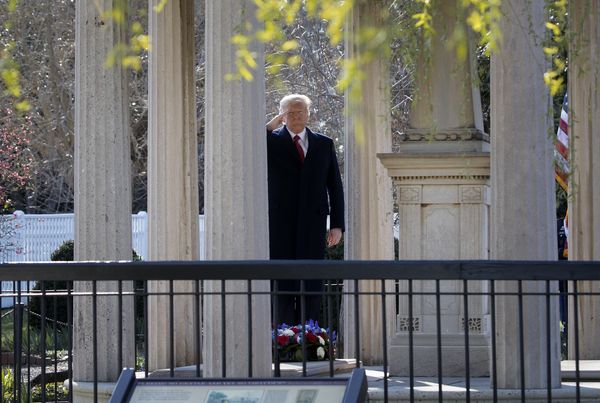
This week, on the Ides of March, our Bronze Creon visited the grave of Old Hickory, Andrew Jackson, the seventh president of the United States. Trump’s affection for Jackson is clear–a portrait of Jackson hangs in the Oval Office and, in a tweet, our current president thanked #POTUS7 for his service to the country.  New Orleans? The slaughter of Creeks at Horseshoe Bend?  Perhaps.  Or was it Jackson’s distaste for the 1st Amendment in the form of his support for the congressional “Gag Rule,” or restricting abolitionist materials from the US Mail?  Did Trump like Jackson’s desire to go medieval on the Nullifiers in South Carolina? Maybe it was because Trump embraced the  myth that Jackson was an outsider, the people’s candidate, a kindred spirit of sorts, even if based on a flawed historical analogy.  Or the ruinous Bank War? Or Jackson’s brutal embrace of majority rule whatever the consequences?

For students of the Native American past, Andrew Jackson is identified with the policy of “Indian Removal.”  (God, I hate that euphemism.)  More than any of his predecessors, Jackson advocated removal as national policy toward native peoples.  His supporters included many southerners and westerners who wanted Indian land.  He called for removal in his first annual message.  He signed the Indian Removal Bill into law in 1830.  He argued that removal was not mandatory, but that native peoples who remained upon their lands must subject themselves to the laws of the states in which these lands were located. Those states offered no protection for the persons and property of native peoples. Earlier in his career, Jackson negotiated massive land cessions with southeastern Indian nations, and he appointed during his presidency the commissioners who used all means fair and foul to obtain signatures on removal treaties. During his presidency, thousands of native peoples left their homes in the east for new homes in the west.  There is no doubt that thousands of native peoples died as a direct result of the policies pursued by Andrew Jackson.

Our Bronze Creon told one interviewer that though he is very busy doing tremendous things to make America great again, he did find some time to begin reading a book about Andrew Jackson.  I doubt that he learned much.  The same day that Trump visited Jackson’s grave, a federal court in Hawaii struck down the president’s second attempt to ban Muslim immigrants from a handful of countries.  Mike Huckabee, the Le Fou of GOP politics, said that like Jackson when confronted by a Court that challenged a fundamental assumption of his Indian policy, Trump should resist the judicial branch of the federal government.   Huckabee became, in effect, the first person in the 21st century to see Jackson’s dismissal of the Court’s authority as admirable, and created the impression that this is a presidency run by men who have little knowledge of this nation’s past and less regard for the historic sufferings of its people of color.

I have written about all of this before. Jackson is a bad guy.  He ruled by anger.  He shot people in duels. He menaced his enemies.  He held grudges with such ferocity that he makes Nixon seem chill. He trashed the economy, and seems not to have understood banking. We should not shed a tear that he is slated for removal from the twenty-dollar bill.  He is rightly associated with America’s long history of ethnic-cleansing.

But here’s an unpopular point.  Removing Jackson from our currency, or denouncing him as the author of a genocide against Native Americans, does not absolve any of us of the sins of our nation.  Removal is a fact of life in Native American history. It began before Jackson took office, and continued long afterwards.  (If you have not seen it, take a look at Claudio Saunt’s interactive map illustrating Native American land loss). I teach, for instance, at a college called Geneseo.  I routinely drive through or visit places called Canandaigua or Irondequoit, and pass by on the highway places called Onondaga and Canajoharie and Nunda and Cohocton. The place names remain, after the people were removed, or consolidated on reservations in remote corners of New York state.  A half dozen archaeological sites, all previously Seneca towns, are within a half-hour’s drive of where I sit. I walk along the old path of the Erie Canal, that symbol of New York’s rise as the Empire State that could not have been constructed without Iroquois dispossession. Both its original path and its current path pass by within a half mile of my house.  In other words, look at the ground beneath your feet.  It was once Native American land, and if you live in the east, like me, you likely have benefited from the relocations and removes that turned native peoples into refugees and exiles.

A more astute politician, not to mention a more sensitive human being, might have acknowledged the costs of Jackson’s policies–policies that were popular at the time, and from which millions of non-Indian Americans continue to reap the benefits.  A more historically aware President might have talked about the complexities of the past. But that is not Donald Trump’s style.  He is not a deep thinker.  A man who recently congratulated the long-dead Frederick Douglass for the good work he is doing, Trump has shown no signs that he has any interest in or knowledge of America’s troubled past.  And that is especially the case when it comes to the victims of American history.

Yeah, About that Issue of What is Fair and What is Unfair

A number of disgruntled readers of my piece on Donald Trump have reached out to me with angry emails.  My essay appeared in the Syracuse newspapers a week or so ago.

One reader raised an argument with which may of us who teach Native American history are familiar, and with which we must contend.  Referring to the Oneidas of New York, who operate a lucrative casino and resort complex a short distance from Syracuse and just off the New York State Thruway, this reader asserted that “the ‘sovereign nation’ concept is obsolete and unfair to taxpaying citizens.”

“Last time I checked,” he continued, “most Oneida Indians live within the borders of the US, the County of Madison and the town of Vernon, They drive their cars on public highways, are protected by our military, so on and so on, just like me.”

Oneidas did everything this writer did, he argued, “except pay taxes.”  Asserting that Indians have unfair advantages, he declared that “it’s time to level the playing field.”

If you teach Native American history, you have likely encountered these sentiments before.  If you are a student in a Native American history class, it is a safe bet that some of your classmates share these views.  They are not uncommon.  I heard them when I lived in Montana.  They were for many years the lifeblood of the anti-Indian sovereignty group Upstate Citizens for Equality, which opposed Indian gaming and other commercial operations in New York state and Indian land claims.  Some of their signs still dot the roads coursing through New York’s Finger Lakes region.

We could, I suppose, dismiss these views as anti-Indian racism.  That, in my view, would be a mistake.  We need to engage.  We need to educate, and tackle views such as these head on. Our students, after all, learn nothing about concepts like tribal sovereignty and the place of native peoples in the American constitutional system and, at best, little about Native American history. At times, views like these are expressed with such vehemence that we might feel as if we are casting our pearls before swine, but I believe that these are teachable moments. And I would argue that we let these opportunities pass us by at considerable cost.

When I face views such as these, I try to concede a few points. In other words, if one sets aside the entire historical experience of the native community in question–which historians are always reluctant to do–it might seem that native peoples have certain “advantages.”  But these so-called advantages are often misunderstood, or based upon fallacies, or a lack of information about the constitution and American Indian history.

Sometimes I find this stuff difficult to explain.  Sometimes I think the people who write to me really do not want to hear a history lesson, or an explanation for how things came to be.

So I begin with the fact that native peoples belong to polities that predate the United States.  Under American constitutionalism, native nations retain by virtue of their inherent sovereignty the right to govern most of their own affairs, on their own lands, so long as they have not explicitly lost those rights by virtue of an act of Congress or a treaty, or implicitly because the practice in question is somehow inconsistent with their status as domestic dependent nations.  I will point out that to a great extent they have lost criminal and civil jurisdiction over non-native peoples who own land on their reservations, but that they retain considerable power still.  I point out that over the course of the last forty years the Supreme Court has weakened significantly the powers of tribal governments.

So much for the Constitution.  I also point out that the notion that “Indians pay no taxes” is an oversimplification.  Native Americans pay federal taxes, even when that income is earned entirely on a reservation. States and localities do not have the constitutional right to tax economic activity by native peoples on Indian land.  (The most useful discussion of this issue appears in Chapter 10 of Stephen L. Pevar’s The Rights of Indians and Tribes, (4th ed., 2012)).  I am willing to concede that this might pose a competitive disadvantage to non-native businesses located in the vicinity of Indian reservations, but that this is not simply a product of “special treatment” or an “uneven playing field,” but because of the language of the Constitution which places Indian affairs under the control of the federal government.  I point out that in a number of instances, Congress has allowed states to exercise its authority in Indian country.  This is the case in New York State.

I have been at this a long time. Racism towards Native Americans is a real thing.  The inequalities experienced by native communities are significant.  The statistics do not lie.  New York became the Empire State, as Laurence Hauptman has so ably shown, through a systematic program of Iroquois dispossession. You could not have one without the other.

The transactions through which New York acquired Iroquois land happened a long time ago, but these were transactions that violated federal laws the United States lacked the power and perhaps the willingness to enforce.  The Supreme Court has held that these transactions occurred so long ago that nothing can be done to right these wrongs, but that does not mean that the rights retained by native peoples should be ignored.

New York’s native peoples have seen, through a long history, their homelands invaded.  They experienced waves of epidemic disease.  They faced dispossession, and then the effort to “remove” them to new homes in Arkansas, or Wisconsin, or the Indian Territory, and then to re-educate their children, and disable their governments.  Disease, warfare, dispossession, diaspora: the injuries occurred a long time ago, but their legacies remain.  And now, when a community like the Oneidas manage to bring a measure of prosperity to their homelands, after the withering trauma of history, there are those non-Indians who cry out, “Wait! This isn’t fair!”

Give me a break.  Look at the ground underneath your feet.  If you believe that laws matter, that the Constitution matters, that the pledges in a treaty that guarantees to the Six Nations the right to “the free use and employment of their lands” matters, then drop the whining about what is or is not unfair. Please.  I was writing about something else, a president’s name-calling that I considered racist.  Stop sniveling about fairness.  It is not a good look.  It makes you sound racist.


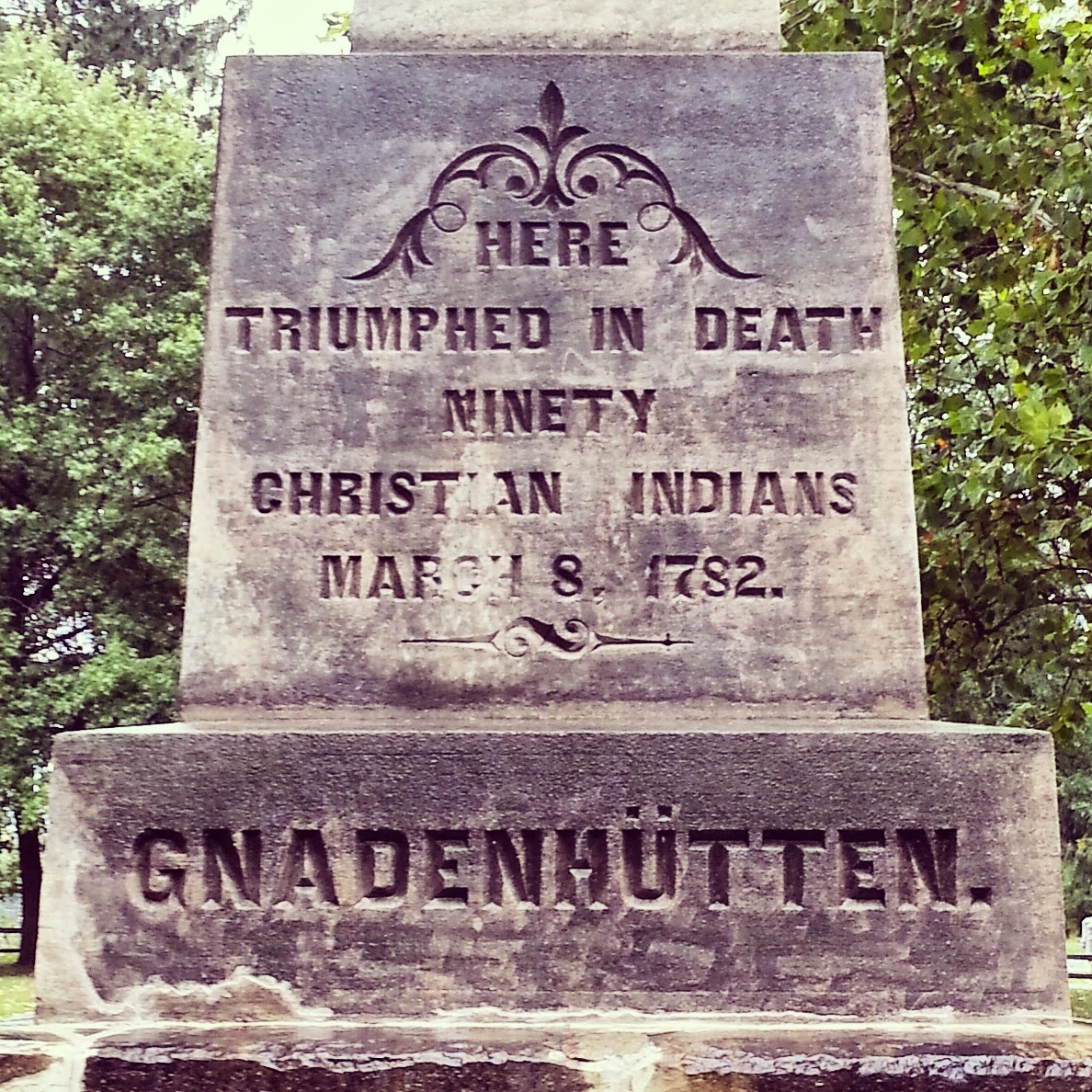
Thinking of Gnadenhutten, 8 March 1782

I have thought a lot lately about the old charge that University faculty are all left-wingers who distort the minds of the tender children enrolled in their courses.   I have never believed this.  When I took my first job in Montana, my colleagues in the history department included a Missouri Synod Lutheran pastor who despised liberals and loved Rush Limbaugh, an Iraqi Seventh-Day Adventist who worried that African Americans would move to Billings because it was easier there to commit crimes, and an expert on lynching who saw nothing objectionable in the infamous Willie Horton ad run by the George HW Bush campaign against Michael Dukakis.  I was surrounded by historians on the political right.

More recently, a local radio show asked if my college would send a representative to discuss whether or not we were concerned about a lack of ideological diversity on campus, and just days before that, the recently installed Secretary of Education warned her audience at the Conservative Political Action Conference that “the faculty, from adjunct professors to deans, tell you want to do, what to say, and more ominously, what to think.”  I wrote about that here, yesterday.

I have little patience for charges such as these.  One thing I like to do as a historian when confronted with questions like these is to ask those who believe that left-wingers have taken over the academy how the teaching of a given subject might change if I were farther to the right or the left than I am at present.  Let’s talk about the history. Support your reasoning.  Explain to me how the political affiliation of, say, a history professor, affects the way he or she teaches a given subject.  We can talk about slavery, or the American Revolution, or I might ask them about events like the massacre at Gnadenhutten, which occurred on this date in 1782.

Because if we are to understand Native American history in all its complexity, I believe that we must confront the lacerating violence of events like Gnadenhutten. We must do so whether we are on the Right or the Left or in the middle.  I would contend that an honest rendering of this event would not differ widely on the basis of who taught it.

The frontier, we must remember, was a violent and at times a frightening place. No historian would dispute that, no matter what their politics, unless they chose to ignore the evidence completely. Many Anglo-American settlers living on war-ravaged frontiers simply could not trust their Indian neighbors. Settlers in the Ohio country, for example, experienced the horrors of warfare just as did Indians. Some of them witnessed the death of friends and neighbors in Indian attacks. More of them heard horrifying stories of Indian attack. These settlers had occasion to fear Indians. They acted, with violence and decision, to save themselves.  But settlers found in their fears justification for horrible acts of terror. They could, as did Ohio country settlers in 1782, conclude that the singing of psalms by Christian Indians at the Moravian mission at Gnadenhutten was not the pious expression of praise to the One God but the ranting and boasts of savages who had wet their hands in the settlers’ blood.

Native peoples had their own fears, of course. When Kentucky militiamen attacked a cluster of villages in northern Indiana where Potawatomis and many other native peoples lived, they threatened them with extermination. If native peoples refused to make peace, Brigadier General Charles Scott said, “your warriors will be slaughtered, your towns and villages ransacked and destroyed, your wives and children carried into captivity.”  Read Jeffrey Ostler’s excellent piece in the William and Mary Quarterly from 2015.   Indians feared genocidal violence from white Americans, and you cannot miss the expressions of that genocidal intent in the writings and statements of American officials. Words and deeds combined, a frightening mix. Many native peoples who lived in the Ohio country saw in the United States and its citizens, whatever its claims to desire peace, an existential threat to their existence. Gnadenhutten.  The soldiers from Pennsylvania held a vote on whether or not to kill the 100 Christian Indians they had taken captive. This was, for native peoples, American democracy at work.   As the Christians sang the last hymns they would sing, savage militiamen began to murder them, thirty men, three dozen women, and thirty-two children in all. Kids.  Almost three dozen.

I tell my students about these violent episodes.  I mess around with the words.  Murder becomes an expression of democracy.  Frontier settlers become savages.  I try to decenter things, upset expectations.  I want the students to think about events like these, so formative in my own thinking about the meaning of Native American History.

If you are a student, you will have to decide how to make sense of this stuff.  We can talk about it or not.  We can ignore it if we want to.  Maybe that dude in Texas, who I saw on a local television station when I lived down there defending that state’s crazy history curriculum, and who believed that a bad day in the United States was better than a good day anywhere else, would choose to dismiss Gnadenhutten as an exception.  More likely he would not have us talk about it at all. But Gnadenhutten cuts to the core of the American frontier experience, and we cannot confront that history without paying it heed.  Left, Right, or Center.


Oliphant v. Suquamish: Forty Years Ago Today


Today is the anniversary of the Supreme Court ruling in  Oliphant v. Suquamish, a case that involved a native community along the Salish Sea, a white interloper, and the evisceration of the power of native peoples to govern and preserve order in their communities.  The Court issued its ruling on this date in 1978.

When I revised Native America and completed the second edition, I wanted to include more discussion of the role played by the American judiciary in defining and limiting that slippery concept we call sovereignty, and to look closely at the practices of an activist court applied to  Native American tribal governments

I talk a lot about the law and the courts.  I like to have students in my American Indian law course begin at the beginning, or one of a number of possible beginnings, by reading the United States Constitution.  Indians are mentioned twice in that august document.  There is a reference to “Indians not taxed” as being excluded from the tally of population required to calculate representation.  And then there is Article I, Section 8, spelling out the powers of Congress.  Among the long list of things that the legislative branch can do is “regulate commerce with foreign nations, and among the several states, and with the Indian tribes.”

Commerce.  What does it mean?  The students in my class ponder that question.  They read the Indian Trade and Intercourse Act of 1790. Like a number of pieces of legislation enacted by the first federal congress, the Trade and Intercourse Act elaborated upon the sparse language in the constitution.  Under the Trade and Intercourse Act, trade was licensed and regulated.  Land purchases from Indians not overseen and approved by the United States government were declared invalid.  Congress claimed the power to regulate those instances when native peoples and American citizens interacted with each other.  Importantly,  Congress claimed no authority over the internal affairs of American Indian nations.

Native nations were autonomous nations.   But that autonomy gradually was defined away. Chief Justice John Marshall, in 1831 and 1832, defined native polities as “domestic dependent nations.”  They could not carry on diplomacy with powers outside of the United States, nor sell their lands to any party but the United States, but they were immune to any state interference.  The State of Georgia’s prosecution of an American missionary resident in the Cherokee Nation was thus deemed unconstitutional, even if Andrew Jackson refused to enforce the decision.

But a series of decisions beginning in the last quarter of the nineteenth century chipped away at the autonomy of native nations even farther. Congress could extend its criminal jurisdiction over Indian country because the very weakness of the Indians, caused by the actions of the American government, demanded protection.  If the relationship of native peoples to the United States resembled, as Chief Justice Marshall had said, that of a ward to its guardian, in the 1886 Kagama decision the Court held that the government had the power to legislate for those communities, to protect them by making native peoples subject to federal criminal jurisdiction for certain “Major Crimes.”

The rule that emerged over time, and through the law, came to be known by legal scholars as explicit divestiture.  Native American nations could do essentially whatever they wanted unless they had been explicitly forbidden from doing so by a treaty or an act of congress, both of which were the “supreme law of the land” according to the Constitution.

And this is where Oliphant comes in.  The facts of Oliphant, according to Judith Royster,  are straightforward. “Mark David Oliphant and his co-defendant were on the Port Madison Reservation during the Suquamish Tribe’s annual celebration. Tribal police arrested both men in separate incidents. Oliphant was charged with assaulting a tribal officer and resisting arrest. The other man was charged with reckless endangerment and injury to tribal property after he led tribal police on a high-speed chase that ended when he crashed into a tribal police car. Both men sought a writ of habeas corpus in federal district court. The district court denied the petitions, the Ninth Circuit affirmed in Oliphant’s case, and the Supreme Court took the cases on review.”

Oliphant asserted that because he was not a member of the Suquamish tribe, and despite his residence on their land, that tribal authorities lacked the authority to prosecute him.  The Supreme Court agreed.  In a devastating ruling, Justice William Rehnquist held that

an examination of our earlier precedents satisfies us that, even ignoring treaty  provisions and congressional policy, Indians do not have criminal jurisdiction over non-Indians absent affirmative delegation of such power by Congress.

Without citing any evidence, Rehnquist concluded that “by acknowledging their dependence on the United States, in the Treaty of Point Elliott, the Suquamish were, in all probability, recognizing that the United States would arrest and try non-Indian intruders who came within their Reservation.”  The treaty does not explicitly say that, nor did the Suquamish specifically give up that power, but Rehnquist did not seem to care.

Oliphant, in essence, produced a new principle for measuring the powers of tribal governments to police their communities.  Adding to the doctrine of explicit divestiture came Rehnquist’s elaboration: the doctrine of implicit divestiture.  Native nations could do anything they wanted, unless explicitly prohibited by the terms of a treaty or an act of Congress or, now, if the power in question were somehow inconsistent with their status as domestic dependent nations.  Defining what was and was not inconsistent with this status was murky at best.

It was, over the course of one hundred and forty years, quite a slide.  The Supreme Court in Oliphant cited little law. It did not cite the constitution.  It simply stated that the exercise of criminal jurisdiction over a non-member in this case was inconsistent with their status as a domestic dependent nation. And the consequences—of Oliphant and the doctrine of implicit divestiture, were significant. It limited significantly the ability of Native American nations to preserve order on their lands, and to police the activities of non-members within their boundaries.  The decision was, according to Royster, “a morass of bad reasoning,” and a ruling that affirmed that the Supreme Court, rather than the military or missionaries, was now the locus of imperial power over native nations in the United States.

Donald Trump’s Pocahontas Problem

It is difficult to keep up with the sheer quantity of daily news generated by the new administration, but I wrote the following piece after Donald Trump, once again, referred to his principal critic, Senator Elizabeth Warren of Massachusetts, as Pocahontas.  The day after this news broke, I asked my students what they thought of it.  These are bright kids, engaged, and they believed quite strongly that Trump’s behavior was inappropriate, and juvenile.  Many of them volunteered that this sort of name-calling was racist.  When I asked them why, however, I felt that they struggled to provide an answer. They knew it was wrong, but had difficulty pin-pointing why.  This essay summarizes my explanation.


While Massachusetts Senator Elizabeth Warren’s claims to Native American identity certainly can be called into question, President Trump’s choice to deride her as “Pocahontas,” during the campaign and in a meeting  with Democratic lawmakers, goes too far.  Warren said she learned of her Cherokee ancestry through “family stories,” but she has not produced any evidence.  Still, Al Franken, Warren’s colleague in the Senate and a member of the Indian Affairs Committee, called Trump’s actions racist. He’s right. Here’s why.

            Trump’s recent name-calling is of a piece with his testimony before Congress in 1993, when he cast aspersions on the Connecticut tribes who then were opening up casinos that could compete with his own. “They don’t look like Indians to me,” Trump said.

            For President Trump, it seems, Native American identity can be determined by a quick glance.  He looked for certain characteristics and did not see them in the Pequots, or in Senator Warren. Centuries of intermarriage, enslavement, and the complex, messy, and tangled history of native peoples mattered in his determination not a bit.  For him, native peoples were individuals with certain easily distinguished racial features, and not members of political entities that possessed an inherent but limited sovereignty that predated the creation of the United States.

            But here’s the thing. Too many Americans share Trump’s views about who Indians are and what they ought to be.  Too many Americans view Indians as part of the past.  Think about the most commonly held stereotypes about Native Americans:  What images enter your mind? Ask your friends what they think. Chances are a lot of those images come from the past.

            And when we speak of Native Americans as being part of the past, we are aiding in an ongoing colonial project which erases native peoples in the present.  And if they are viewed as part of the past, or inauthentic, it becomes easier to dismiss the legitimacy of Native Americans, as individuals and as members of semi-sovereign nations, as being out of time and place and, as a consequence, irrelevant.  It becomes easier to ignore the very real problems of inequality and injustice in Indian Country; it becomes permissible to cheer for a football team with a racist name; or to silently assent to a President’s decision to authorize a pipeline through lands that a Native American community deems sacred. It also makes it possible to call into question the sovereign right of native nations to develop their economies, protect their lands, and against immense odds preserve their cultures.   When the President casts Indians as part of the past, he makes it more difficult for many Americans to recognize the importance of native peoples’ calls for justice today.

The Winters Doctrine and Dakota Access

After class a couple of weeks ago, one of my students asked me why the Winters decision had not played a larger role in the Water Protectors’ efforts to defeat the Dakota Access Pipeline. The students had read Winters v. US (1908) and they had been following closely developments at Standing Rock in their current events reading.

I have been teaching college history for a long time, but I am still reminded quite often how much there is that I do not know. My very best students frequently drive me back to the piles of books in my office, or to the library, or to the wonderful world of resources available online.  Sometimes their questions force me to ask my friends—historians, anthropologists, and, in this instance, lawyers—for guidance.  I learn a lot through teaching.  It is why I am so happy and feel myself so fortunate to be at Geneseo.

Winters, as Charles Carvell noted in an extremely useful article that appeared in the North Dakota Law Review, is quite simply a phenomenal ruling. “It occurred at a time,” Carvell writes, “when Indians wars were not distant memories and when federal Indian policy was      not to promote or even protect Indian interests but to break apart tribal communities and assimilate Indians into white society.” This was, Carvell continues, the era of Allotment, and of boarding schools—a full court press against native peoples and their cultures.   “The decision occurred at a time when the disappearance of ‘the Indian’ and Indian tribes was thought to be at hand.  It was issued a few years after Lone Wolf v. Hitchcock,” the 1903 decision that recognized the plenary power of Congress over Indian affairs and the ability of Congress, unilaterally and regardless of context, to abrogate an Indian treaty.  Winters was litigated as settlers crossed the Plains in droves. Still, “despite the milieu in which it was litigated, the Winters decision protected tribal interests.”

How did it do that? The Court held that when Congress established an Indian reservation, it established as well a right to the water necessary for that reservation to achieve its purposes.  Since one of the stated goals of the reservation policy involved leading native peoples towards what the federal government and many reformers considered a civilized way of life—and in this instance the native peoples in question were the Gros Ventre and Assiniboine communities residing near the Milk River on the Fort Belknap Reservation—that meant guaranteeing them the water they needed to undertake stock-raising and agriculture.  Thus the Winters Doctrine. Settlers upriver had diverted waters from the Milk River and this, the Court held, was unlawful.

So at the very time that Congress was seeking to dispossess native peoples and eradicate their culture, the Court, in this quirky case, recognized that these reservations had a claim to water superior to that of the settlers who coveted this vital resource.

Water is essential on the plains.  As the Water Protectors have asserted, “water is life,” and in their view, the Dakota Access Pipeline jeopardized waters flowing through the reservation.  As early as 1976, according to Carvell, the Standing Rock Sioux Tribe asserted that it controlled water and other natural resources on its reservation. The Standing Rock Sioux that year began demanding that all users of water obtain the approval of the tribal government.

And the Standing Rock Sioux have not only stated that they have control over their waters, but they have acted on their words. “They have developed on-reservation water resources, and reject any notion that in doing so they are subject to state regulatory authority. They have developed,” Carvell continues, “irrigation projects and water for domestic, municipal, and government purposes.”

Standing Rock, in other words, has asserted that its reservation was established as a permanent homeland and, as a result, that it “is entitled to use all water necessary to make itself economically self-sufficient, and because what is necessary to ensure self-sufficiency is never stated the tribe’s water right is ‘inherently unquantifiable.’” The scope of their claim is immense, extending to “the full spectrum of uses necessary to the ‘arts of civilization.’”

It is not difficult to imagine that an oil spill or a pipeline break upriver would threaten these water resources. Pipelines break. They leak. Oil spills.  It has happened in the vicinity of the Dakota Access in recent months. It is obvious that these accidents would threaten tribal water resources.  But North Dakota is unique in terms of western water law. The amount of water to which tribes in North Dakota are entitled has never been quantified, and as a result, one might argue that the Winters doctrine has, strictly speaking, never been applied to Standing Rock and other reservations in the state.

The efforts of the Water Protectors and their lawyers to obtain restraining orders to prevent the completion of the Dakota Access pipeline did not address these issues.  Nor have treaty guarantees and other matters received a full airing in court.  Needless to say, if the Dakota Access Pipeline is completed, and it is beginning to look like that is what is going to happen, many of the most pressing historical and legal question will not have received a full hearing.  And that, along with President Trump’s determination to undermine the Environmental Impact review, makes this episode even more disappointing and unfortunate than it otherwise might have been.