Several years ago my daughter texted me to tell me there was an active shooter on her college campus. I wrote about the experience on this blog.
I immediately texted her back. And called, but realized that was probably a mistake. What if she were hiding and her phone vibrated or rang and that gave her away. She was in a safe location, and let me know that, but still, I told her to stay there until she saw someone with a badge telling her it was safe to exit.
No shooter menaced the Loyola Marymount University Campus. It was a false alarm. But the experience left me rattled. I was terrified. And angry. I was so angry that evening that I could not speak.
I have listened to politicians speak in the aftermath of the slaughter at a Buffalo supermarket and an elementary school in Uvalde, Texas, and that anger has resurfaced again. Republicans, and a few feckless Democrats, have suggested that tougher gun laws are not the answer. You may want your representatives to enact legislation to regulate the use of weapons in the United States, they say. You may want your representatives to enact a law “attacking the 2nd Amendment.” But you won’t win. From Ted Cruz to Lauren Boebert, our leaders say that your laws will not do any good. You are powerless to stop this, they said. Evil people do evil things. You would be better off agitating for better mental health care, because the guys who slaughtered the kids in Texas and the elderly in Buffalo were bullied and picked on. The problem is not us, Cruz said, and it is not the guns. He spoke cynically of “American Exceptionalism,” of how great this country is. The guns are not the problem. You are better off buying a gun of your own, to protect you from, you know, the criminals, and the Mexicans and the Terrorists and Antifa. The NRA, we must remember, is a trade group.
Your fear is good for their bottom line.
In the days after the massacre in Uvalde, I have heard pro-death, conservative lawmakers and religious leaders suggest that the shooting might not have happened if there were prayer in schools, even though Texas has a moment of silence at the beginning of the day and prayers at school functions like sporting events. Others have trotted out equally spurious, but predictable explanations for the carnage: violent movies, violent video games, homosexuality and the presence of transgendered people, broken families, and Critical Race Theory (somehow).
I do not think any of these explanations are funny. They are either dishonest or dangerously and obscenely stupid. They are blood-drenched and dangerous. I do not care why you want to kill. It does not matter to me in the slightest. A white nationalist and a racist? An “Incel”? A Nazi, or a revolutionary or an End-of-Timer or a sullen kid or a sociopath? I could not care less. Because no matter who you are, and no matter who you hate, I do not believe you should have a weapon of war at your disposal. You have no right to kill, and no matter your irrational fears, your macho fantasies, your martial cosplay, or your fevered dreams, there is nothing you can say to convince me that there is a place for killing machines in a civil society. Some of you will trot out the 2nd Amendment, but bearing arms does not mean what you think it does. It never has. Some of you will invoke your Christianity. Show me if you can one line, from the first verse of the first chapter of Matthew to the last line of Revelation, that in any way justifies violence.
Look around the world. There are violent video games and violent movies all over the place. There are many countries where almost nobody prays, where far more people identify as Atheists than in the United States. They do not have mass killings. 40,000 people die from gunshot wounds in the United States each year, whether from suicide, accident, or homicide. Many thousands more have their bodies torn, lacerated, chewed up and spit out by these weapons that have one purpose and one purpose only: to kill. How many more crimes are committed with these weapons, or people threatened and frightened? It boggles the mind. To those who say nothing needs to be done, that your rights are sacred, and that guns are not the problem, I ask you how many more deaths will it take before you concede that this is wrong. 50,000? 100,000? A million? When and where will it end? If murdered children will not get you to act, maybe there is no hope.
Guns end conversation. They end debate. The create a climate of fear. Guns are inconsistent with freedom, whatever the death-dealers at the National Rifle Association tell you, because they force us to live in fear. They menace. They threaten, they frighten, and they kill. They were invented only to kill. Ours is a country steeped in racism, built on stolen land with labor from stolen and enslaved black bodies. The better angels of our nature have appeared from time to time, but they have never banished the fundamental evil at the heart of our history. We cannot make claims about this country’s greatness when every fourteen minutes another American dies from a gunshot wound. We need to choose to live our lives free from fear. And we need to rid our communities of the killing machines that are too readily available to too many people, even in states with the toughest of gun regulations.
So many political leaders have offered their thoughts and prayers. They tell us that they hold in their hearts the victims of Buffalo, Uvalde, and on and on and on. Thoughts and prayers. The words of Isaiah come to me, as he confronted the hypocrites whose empty prayers, he said, meant nothing to an angry God.
When you spread forth your hands,
I will hide my eyes from you;
even though you make many prayers,
I will not listen;
your hands are full of blood.
Wash yourselves; make yourselves clean;
remove the evil of your doings
from before my eyes;
cease to do evil,
learn to do good;
seek justice,
correct oppression;
defend the fatherless,
plead for the widow.
Ours is a broken, amoral, and violent society. Our leaders have chosen this, either through their actions or their complicit cowardice. I have no faith in their ability to fix us.
And, like many things one looks forward to from Democratic administrations, it’s a bit of a letdown. If you are a historian who has worked with these sources, and if you have even a passing familiarity with the published scholarship on American Indian Boarding schools, you are unlikely to be surprised by anything that appears in the report’s 100-plus pages. It is a brief document, no more than an a cursory introduction into a vast, complex and important subject. But it’s a start.
Assistant Secretary of the Interior–Indian Affairs Bryan Newland
Produced by Assistant Secretary–Indian Affairs Bryan Newland, the bulk of the report is an institutional overview of American Indian boarding schools and the government policies and programs that implemented, supported, and funded these institutions. The report is divided into nineteen very-brief chapters. The penultimate one includes the “Federal Indian Boarding School Initiative Findings and Conclusions.”
The list consists of the following:
The Federal Indian boarding system was expansive, consisting of 408 Federal Indian boarding schools, comprised of 431 specific sites, across 37 states or then-territories, including 21 schools in Alaska and 7 schools in Hawaii.
Multiple generations of American Indian, Alaska Native, and Native Hawaiian children were induced or compelled by the Federal Government to experience the Federal Indian boarding school system, given their political and legal status as Indians and Native Hawaiians.
The twin Federal policy of Indian territorial dispossession and Indian assimilation through Indian education extended beyond the Federal Indian boarding school system, including an identified 1,000+ other Federal and non-Federal institutions including Indian day schools, sanitariums, asylums, orphanages, and stand-alone dormitories that involved education of Indian people, mainly Indian children.
Funding for the Federal Indian boarding school system included both Federal funds through congressional appropriations and funds obtained from Tribal trust accounts for the benefit of Indians and maintained by the United States.
The Federal Indian boarding school system deployed militarized and identity-alteration methodologies to assimilate American Indian, Alaska Native, and Native Hawaiian people—primarily children—through education.
The Federal Indian boarding school system predominately utilized manual labor of American Indian, Alaska Native, and Native Hawaiian children to compensate for the poor conditions of school facilities and lack of financial support from the Federal Government.
The Federal Indian boarding school system discouraged or prevented the use of American Indian, Alaska Native, and Native Hawaiian languages or cultural or religious practices through punishment, including corporal punishment.
Tribal preferences for the possible disinterment or repatriation of remains of children discovered in marked or unmarked burial sites across the Federal Indian boarding school system vary widely. Depending on the religious and cultural practices of an Indian Tribe, Alaska Native Village, or the Native Hawaiian Community, it may prefer to disinter or repatriate any remains of a child discovered across the Federal Indian boarding school system for return to the child’s home territory or to leave the child’s remains undisturbed in its current burial site. Moreover, some burial sites contain human remains or parts of remains of multiple individuals or human remains that were relocated from other burial sites, thereby preventing Tribal and individual identification.
The Federal Government has not provided a forum or opportunity for survivors or descendants of survivors of Federal Indian boarding schools, or their families, to voluntarily detail their experiences in the Federal Indian boarding school system.
Based on that list of conclusions, Secretary Newland recommended that research continue through the “approximately 98.4 million sheets of paper” housed in boxes at the National Archives and other federal agencies. It is an enormous undertaking. The following questions, he suggested, would guide the research:
Approximate the total number of American Indian, Alaska Native, and Native Hawaiian children that attended Federal Indian boarding schools;
Approximate the total number of marked and unmarked burial sites associated with Federal Indian boarding schools;
Locate marked and unmarked burial sites associated with a particular Indian boarding school facility or site, which may later be used to assist in locating unidentified remains of Indian children, Indian Prisoners of War, and Freedmen from the Five Civilized Tribes;
Expand the summary profiles of individual Federal Indian boarding schools;
Detail the health and mortality of Indian children who experienced the Federal Indian boarding school system, which may later be used to develop dataset(s) for analysis of health impacts of Indian boarding school attendance, including an approximate mortality rate for attendees, as the Department was responsible for the health care of American Indians and Alaska Natives until 1954;
Identify documented methodologies and practices used in the Federal Indian boarding school system that discouraged or prevented the use of American Indian, Alaska Native, and Native Hawaiian languages or cultural or religious practices;
Approximate the amount of Federal support, including financial, property, livestock and animals, equipment, and personnel for the Federal Indian boarding school system, recognizing that some records are no longer available;
Approximate the amount of Tribal or individual Indian trust funds held by the United States in trust that were used to support the Federal Indian boarding school system, including to non-Federal entities and, or individuals, recognizing that some records are no longer available;
Identify religious institutions and organizations that have ever received Federal funding in support of the Federal Indian boarding school system;
Identify States that may have ever received Federal funding in support of the Federal Indian boarding school system;
Identify nonprofits, associations, academic institutions, philanthropies, and other organizations that may have received Federal funding in support of the Federal Indian boarding school system;
Confirm additional sites within the Federal Indian boarding school system;
Examine the connection between the use of Federal Indian boarding schools and subsequent systematic foster care and adoption programs to remove Indian children, including the Indian Adoption Project established by the Bureau of Indian Affairs and Child Welfare League of America, that were not repudiated by Congress until the enactment of the Indian Child Welfare Act of 1978
The shadow of recent discoveries of unmarked graves in Canada hangs over Newland’s report. He wants to produce a second, much larger report, that determines the locations for all unmarked and marked burial sites connected to federal boarding schools, identify the children buried in these sites, and approximates “a full accounting of Federal support for the Federal Indian boarding school system.”
In addition, Newland recommends that the government undertake efforts to identify living survivors of the boarding schools, document the students’ experiences, “support protection, preservation, reclamation, and co-management of sites across the Federal Indian boarding school system where the Federal Government has jurisdiction over a location.” Newlands wants to see a systematic effort to collect documents and house them at the Department of Interior Library “to preserve centralized Federal expertise on the Federal Indian boarding school system.” Interior should solicit help from other federal agencies which have information on boarding schools, and support non-federal entities that house information as well. Newland recommends congressional action as well: to support or strengthen NAGPRA to prevent sensitive and specific tribal information that may be uncovered as a result of the investigation; to advance legislation encouraging Indigenous language revitalization; to promote public health research on the consequences of the boarding school system; and finally to erect a federal memorial to the children who experienced the federal boarding school system.
There are some laudable goals here. Indian Boarding Schools were institutions that affected many thousands and thousands of Native American people over many generations, over many decades. The subject is vast, the documentary record so enormous as to make a complete accounting of the sort envisioned by Newland in his recommendations a mammoth, generational task. I would encourage this effort. We all should encourage this effort. This report is nothing but a start.
But I would encourage the investigators to remember that there is no more uninteresting and unimportant way to write about educational institutions than to focus on bureaucrats and leaders, policies, proposals and laws. What we need is a history of the students, with proper protections in place to guard privacy. The evidence suggests that the physical and emotional consequences of attending boarding school could be substantial and the damage could be transmitted across the generations.
This is a more difficult story to tell than to write about a “system.” It takes so much more work. It is exhausting to be exhaustive. Doing this work well, I know, can take a toll on the researchers. But we must keep in mind that the federal boarding school system was a haphazard and large network of loosely connected and poorly supervised institutions that acted with little effective federal oversight. The institutions that were part of this system began with a commitment to assimilation and erasure, to incorporating Indigenous young people into the American body politic by eliminating their Indigenous culture, language and religion. One can write a history of schools. One can write about curricula, educators, and federal policy makers. What we need, however, is a history of the Boarding schools from the bottom-up. We must never forget that this is a history that involves thousands of young people placed in an educational system that claimed as its goal cultural genocide.
I have tried to write some of these stories on this blog: I wrote about the lonely death of Carlos Pico, a Mission Indian from California. I have written about some Onondaga and Oneida Carlisle alums who traveled to Europe in 1914 as part of a circus, performing in a variant of a “Wild West” type show before the first World War broke out. Reflecting on Arlette Farge’s wonderful essay, The Allure of the Archives, I wrote about the challenge of reconstructing the lives of ordinary Onondagas who attended Carlisle and other boarding schools. And late last year I wrote a series of posts following all the Carlisle students who passed through one “outing” placement for Native American girls. The first of those posts is right here.
Schools are people. They are teachers (and for those who worked in Boarding Schools we need to learn more) and students.
I have found through my own work that descendants of boarding school students do not often know the entirety of their ancestors’ experience. I have had the opportunity to share with families the stories of their grandparents’ time at Carlisle, for instance, or lesser-studied schools like the Lincoln Institution in Philadelphia. Ten thousand students attended Carlisle, and that is only one of many schools. We need to know about the history of these institutions, but more than that, we need to recover the stories of the young people who attended them. What I am willing to bet is that the results of so enormous a historical undertaking and accounting will show that Indigenous peoples were so much more powerful, as individuals and as members of native nations, than the forces the federal government aimed at their destruction.
Last week I attended the final public hearing regarding the Horseshoe Solar Development, a proposed solar farm that will be built on lands along the Genesee River that the Seneca Indians consider sacred. The Senecas’ story runs through the pages of Native America. A brief rally preceded the meeting, and at five in the afternoon the meeting began, overseen by an administrative law judge from the State of New York.
I have made my case on this blog as to why I think this development is a bad idea. It will almost certainly destroy archaeological and cultural source material at sites along the Genesee that the Senecas and their ancestors have used for more than two thousand years.
I spoke at the meeting, basically summarizing arguments that I included in an op-ed I published two years ago in a local Livingston County newspaper. I know my words were appreciated by the opponents of the solar development. I listened to the other speakers. Joan Scanlon favored the project. She gave a rambling talk that blew through the five-minute time limit, arguing that “we” need solar “for our children.” Absolutely nobody in the room was arguing that solar was bad. Nobody in the room supported a continued reliance on fossil fuels. Ms. Scanlon was attempting to refute an argument that nobody was making. The Senecas objected not to solar power, but to this particular development because of the damage it might do to lands they deemed sacred.
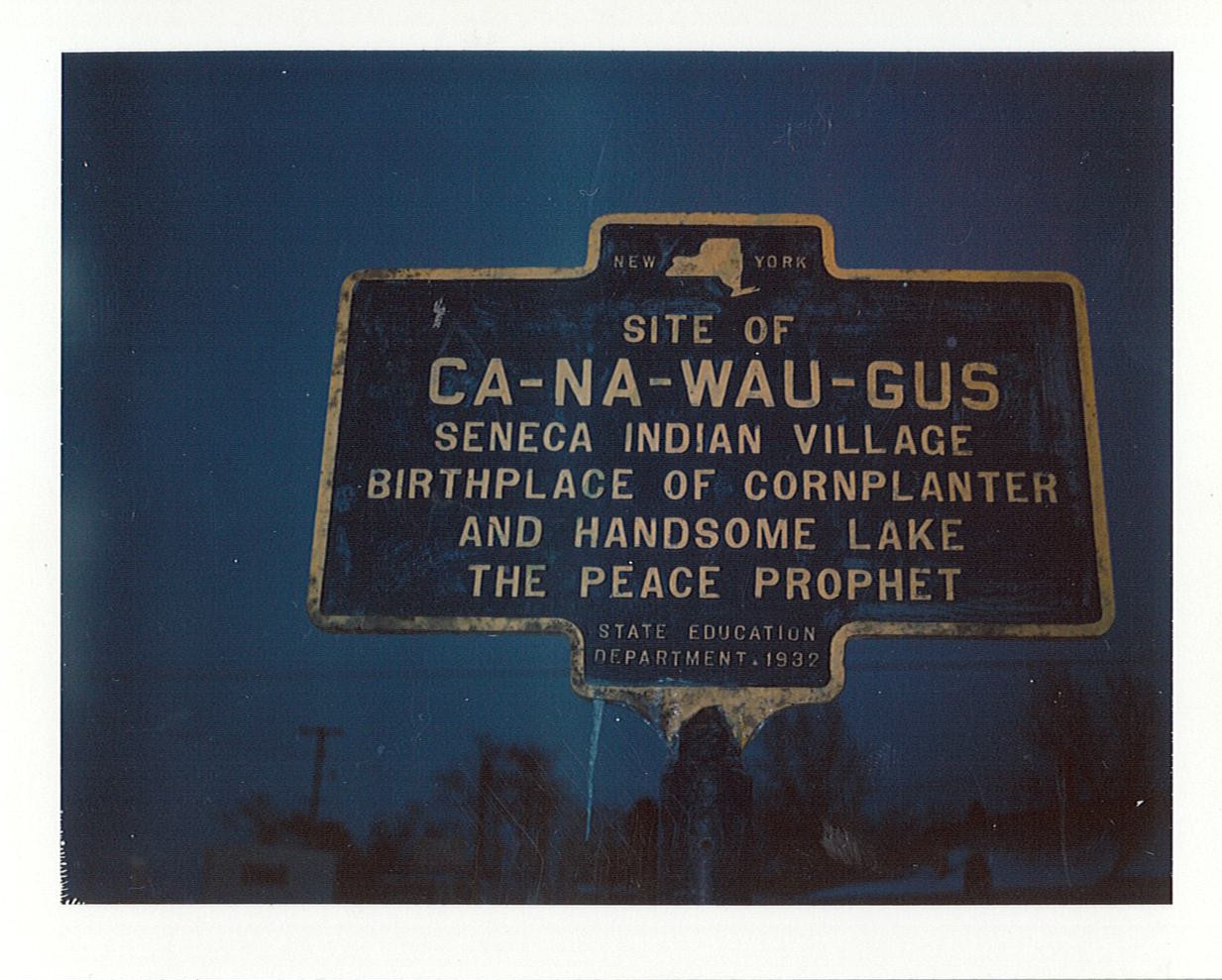
There were Senecas in the room old enough to remember when the United States constructed the Kinzua Dam over the objections of the Senecas. Before the reservoir flooded a good chunk of the Seneca Nation’s Allegany Reservation, bodies from graveyards were exhumed, and stacked like cordwood in the school yard. Senecas today remember watching this desecration of the dead from their classroom windows. It was a painful thing to experience. They see the Horseshoe project at the site of the Seneca town of Canawaugus in similar terms. Paul Winnie, from Tonawanda, saw the project as genocidal in intent, a destruction of what his people consider sacred. Melissa Smith, also from Tonawanda, was angry. “When you do this to our ancestors,” she said, “I hope it happens to you.” I noticed Ms. Scanlon smirking through five-minute talks that I found powerful and moving. Because destroying Native American graves and looting their burials is as American as apple pie, and white people’s graves are seldom destroyed in the name of progress.
Most of the speakers assumed that the state will approve the project. This hearing was not meaningful consultation, and it was not “a seat at the table.” Nor was it the “informed consent” required by the United Nations Declaration of the Rights of Indigenous Peoples. It was, the Mohawk journalist John Kane said, nothing more than “checking a box.” The corporations will get what they want. The sites at Canawaugus will be destroyed. Money always wins. The speeches, in that sense, did not matter much. Many of the opponents of the project assumed that the state had already made up its mind.
I share their views. They are probably right. I am pessimistic, I know, but I fully expect the state agency responsible for authorizing projects such as these to approve the Horseshoe solar project. The State of New York, and the corporate and business interests so incestuously connected to it, have never put the interests of Indigenous peoples first. One of the lessons of history, it seems to me, is to make sure you never get your hopes up. I hate to break it to you, kids, but I call them like I see them. Do not expect right to prevail, because quite often it does not. At least at the outset.
There are a lot of big questions we could talk about about the Horseshoe solar project. The debate over the fate of Canawaugus raises questions, seldom explored closely, about what it is that makes a site “sacred” and who gets to decide. Are all historic sites sacred? If some are and some are not, how ought that determination to be made? It is a big question, worth discussing. We can also talk about the flawed language of 19th and early 20th century anthropology and archaeology that crept into the energy company’s own reports. History, this report assumed, begins when Europeans arrive. Everything before that point is “prehistoric.” Horseshoe Solar’s experts described the sites excavated in the project area as “camps” and “seasonal sites.” Little did they seem to know that Senecas had lived and used the lands at Canawaugus for two millennia, that thousands of Senecas lived their lives, rich and full of meaning there, and that they were more than the sum of these camps and foraging sites. This was an Indigenous town, straddling the routes that moved from east to west and north to south through the Iroquois longhouse. Two of the most important leaders in Seneca history, Red Jacket and Cornplanter, were born at Canawaugus, as well as thousands of other Senecas. There they lived, and there they died. Into the twentieth century amateur pot-hunters were scooping up the remains from Seneca burials.
And then there is this even more painful question. If we cannot win, why play the game? I know. We have to protest. I understand there is a joy in mixing it up with the bad guys. But I am a historian, an employee of the State of New York. I have a book to write. I have classes to teach. I have loads of demands on my time. There is always something else I might be doing. I have never been bored. So this: I could have made the best speech in the history of the world, and I believe it probably would not matter one bit. These folks want a solar development, and they simply do not care what anyone else says.
So why do I bother? Advocating for the rights of Indigenous peoples in the State of New York is like playing tennis against an opponent who can raise and lower the net at will, widen or compress the lines while the ball is in the air. They write the rules, interpret them, and enforce them. I think about this a lot. I have been in this fight for a long time. In precisely one case involving one minor question in twenty-seven years have I been on the winning side. Indigenous peoples and their allies, in the American system, it seems are bound to lose.
I ask my students sometimes why they became interested in history. For some, it’s a simple attraction to the stories. They may have had a high school teacher who moved them with the power of his or her lessons in the classroom. This is a perfectly fine way to get into history. But for others, the stories that interest them connect to a sense that all is not well. They notice that there is a gap between the way things are and the way things ought to be, and they realize that to understand that sometimes yawning chasm requires the disciplinary skills of the historian. These students tend to me more critical in their questions, more skeptical of the stories they are told, better able to read sources with an eye towards bias, self-dealing, and veracity. We historians, after all, learn how to find the bodies. Our training teaches us where to find the receipts. We become adept at smelling rats and we will dig like badgers to find answers to the questions we began with. We act on the assumption that there always is an answer. It might take us a while to find it, and you might try to hide the answers from us. But everything we do is based on the premise that there is, somewhere, an answer and we will find it.
It is true, of course, that the Court system is built on a system of winning and losing. But historians, perhaps, never lose because the game never really ends. We did not find what we needed to find in time to help you with your case, but we can keep digging. And when we retire, die, or walk away, you can bet your bottom dollar that another historian will be bothered by the same question that bothered us, and they will pick up right where we left of. You will never get away from us. That is what I tell myself. Eventually, we will run the bastards down.
And if we never truly lose, that means you will never truly win. You might take a few rounds. Some people I know say that the “winners write history.” But the simple truth is that they don’t, not exclusively. More often than you think, history is written by those bothered by the fact that the winner cheated, or stacked the deck, or brought unfair advantages to the game. Some history is written by students who feel that the winner was a murder, a liar, or a thug. They will revise the story, and cast the winner’s deeds in a new light, one that is disorienting, unflattering, and jarring (I suspect this is why so many Republicans are in a full-blown freak-out about the teaching of history: now, perhaps more than ever, those who speak for the “losers” are calling the winners to account). Someone, someday, will expose the fallacies in these winners’ tales, or challenge their use of evidence, and question the assumptions and biases that informed their work. There may be decades where you feel your story is strong and it will stand, but the historians I know will find you.
An article from a Caledonia Newspaper, July 1894. Thanks to Brandon Burger for bringing this to my attention
So why do we keep at it? It is asking a bird why it flies. Asking questions about the way things are and the way things ought to be—it is what we do. So when you say that this tract of land once belonged to Indians who are no longer there, we may ask how that came to be. Why do Indians no longer own that land? And when you explain it was acquired through treaties, we will dig through those records and show that the proceedings through which the state acquired the lands at Canawaugus were rife with corruption and fraud. We will find out that the treaty was never ratified by the Senate as required under federal law. Our research will show that you are on land that was never legally acquired from the Senecas. And when you say there is nothing of significance at that site, we will show you that this is a racist lie. That white people have ample and abundant evidence of the many burials along the flats of the Genesee. They have been looting them for years. We will challenge all your assumptions. It is in our DNA. We cannot turn it off (If you are not a historian and have watched a movie on a historic topic with a historian, you know how unbearable we can be). Of course we cannot short-circuit this wiring to allow the bastards to win. But there is even more to it than that. We need to go to the records. We need to explore and explain why something bad is happening. We need to make our case. We will become experts. And know, even if we fail to persuade the unpersuadable and close-minded whose interest is in going forward with this destructive project, we will lay the groundwork for those who will follow and expose you for what you are. It would be nice to know that we can do that before the damage they do is too great.
On April 2, Angus Laborgne, a resident of the Haudenosaunee reservation at Akwesasne, was cited by New York Department of Environmental Conservation officers for spearing walleyes in Scriba Creek, near a state fish hatchery. The officers cited Laborgne for taking fish out of season, by “means other than angling,” and from what the state considered “closed waters.” Laborgne had speared twenty-three walleyes, all of which the DEC officers confiscated.
Steve Featherstone’s great reporting on NewYorkUpstate.com, and a friend who regularly keeps abreast of the news in Central New York, brought this story to my attention.
Laborgne’s action, according to John Harmon, the President of the Oneida Lake Association, was a “deliberate provocation.”
Three days later, Laborgne returned, accompanied by fourteen other Haudenosaunee fishermen, “from every single reservation.” They speared even more fish from the same waters. The DEC this time decided to stand down, hoping to deescalate what Featherstone described as “a conflict over a complicated legal gray area involving Native American fishing rights under state law—a long simmering fight that made it as far as the governor’s desk last year.”
Featherstone is referring to a bill vetoed by Governor Kathy Hochul that would have recognized Native Americans’ treaty-guaranteed right to be free from state and local fishing laws except for those cases in which the survival of the species was in question. The DEC implied that Laborgne’s fishing did just that. In a statement the DEC noted that “walleyes are concentrating in certain streams,” and are “vulnerable to over harvest” during spawning season. The DEC claim that it “recognized the importance of walleye as a subsistence and cultural resource for Indigenous nations, and is actively consulting with the leadership of the nine State-Recognized Indigenous Nations to advance our shared conservation objectives.”
Fair enough, but it is worth looking at Laborgne’s argument about his rights to fish, and whether the issue really is as complicated as Featherstone’s reporting suggests.
Mr. Laborgne told Featherstone that “according to what I understand, we have the right to all creeks, and all lakes, and all rivers.” The Haudenosaunee, he continued, are born with this right. He said that he planned to return to Scriba Creek, and he would continue to do so until the State of New York recognized “that this is our inherited right…and we have the right. They didn’t give it to us.”
Laborgne is right.
In order for me to show you how, I will have to persuade you to accept some principles that have long been fundamental to the entire field of American Indian law. First, Native American tribes can do whatever they want unless that activity is specifically prohibited by a treaty or an act of Congress. Second, in 1978, Supreme Court Justice William Rehnquist started messing around with this, adding to the principle of “explicit divestiture,” described above, the idea of “implicit divestiture”: Tribes could not exercise those powers that were somehow inconsistent with their status as “domestic dependent nations,” a concept coined by Chief Justice John Marshal 147 years earlier in the case of Cherokee Nation v. Georgia. Tribes, the logic goes, do not give up their sovereign rights as nations that predated the United States unless they do so explicitly. If they did not give away the right or power in question, and if it is not inconsistent with their status as domestic dependent nations, then that power they still possess.
There are a couple of more assumptions I need you to agree to before we move on. Before Europeans arrived in North America, Native American communities had the absolute right to hunt and fish wherever they chose. Thus, unless they specifically gave up that right, through some treaty or some act of Congress, they are still permitted to fish wherever they want.
So let’s talk about the treaties the state and the federal government entered into with the Oneida Indians in New York. The 1784 Treaty of Fort Stanwix protected Oneida land from encroachment, an acknowledgment by the United States of the Oneidas’ assistance in the Patriots’ cause during the American Revolution. In 1785 the state of New York coerced the Oneidas into giving up some of their reserved lands, and in 1788 the state came back for more. The 1788 Treaty is the most important one for our purposes, and we need to talk about it.
First, it is worth exploring how the state went about planning for and negotiating this treaty. I am going to spend some time on this because it is so important. I hope you will bear with me.
It seems reasonably fair to conclude that by 1788, the year in which he met with the Onondagas and Oneidas in New York’s Indian territory, Governor Clinton must have recognized that he presided over a state only nominally under his control. British troops continued to garrison forts at Oswego and Niagara, despite the provisions of the Treaty of Paris that had formally ended the Revolutionary War in 1783. These soldiers would not leave New York until 1795, after Jay’s Treaty had been approved. During the war, two of the eastern counties of the state and part of a third seceded, becoming in the process the independent republic of Vermont. Talk of other parts of the state breaking away occurred commonly enough for James Duane to fear that west of the Hudson “a second Vermont may spring up.” Though the punitive Treaty of Fort Stanwix extinguished Iroquois claims to lands largely to the west of New York, much of the territory in the Empire State remained firmly in Indian hands. Clinton needed those lands for his state. As historian Barbara Graymont pointed, Clinton and his colleagues pursued a three-fold program: They hoped to eliminate “any claim of the United States Congress to sovereignty over Indian affairs in the State of New York”; they wanted to extinguish “the title of the Indians to the soil”; and they were determined to eradicate the sovereign status of the Six Nations.
Doing so would not be an easy task, for New York State was not alone in trying to acquire the lands of the Six Nations. Massachusetts claimed much of the land in what is now New York owing to its colonial charter, which specified no western boundary to its territorial limits. The two states had worked out a compromise at Hartford late in 1786, with the result that New York exercised legal jurisdiction over the lands in question, but the Bay State retained the right of preemption, or first purchase, to Indian lands in upstate New York. Massachusetts promptly sold these preemption rights to two speculators, Oliver Phelps and Nathaniel Gorham who, in July of 1788, concluded a treaty with the refugee Mohawks, Oneidas, Onondagas, Cayugas and Senecas at Buffalo Creek. Phelps and Gorham acquired nearly 2.6 million acres of Iroquois land in western New York for five thousand dollars and the payment of an annuity to the Indians of five hundred dollars.
In addition to the problems posed by the Phelps-Gorham purchase, Clinton and his associates worried about the activities of the New York Genesee Company of Adventurers, a wealthy and influential group of land barons led by John Livingston. On the 13th of November, 1787, the Livingston Company negotiated a lease with “the Chiefs and Sachems of the Six Nations of Indians.” The sachems “leased” to the Livingston Company, for a term of 999 years, “all that certain Tract or Parcel of Land, commonly called and known by the Name of the Lands of the six Nations of Indians, situate, lying and being in the State of New York, and now in the actual possession of the said Chiefs and Sachems of the Six Nations.” Livingston and his associates agreed to pay to the sachems “the yearly Rent or Sum of Two Thousand Spanish Milled Dollars, in and upon the fourth Day of July.” Two months later, the Company negotiated an additional lease with the Oneidas, “for the said term of nine hundred and ninety-nine years, on a rent reserved for the first year of twelve hundred dollars per annum, until it shall amount to fifteen hundred dollars, of all those lands in the said writing described, as the Tract of Land commonly called and known by the Territory of the Oneida Indians.”
Early in 1788, Governor Clinton and his associates in the State Assembly and Senate undertook a concerted campaign to consolidate their control over the conduct of Indian policy in New York and the disposition of those lands the Iroquois could be persuaded to part with. Clinton and other New Yorkers wanted to acquire Iroquois lands for the settlement of the state’s obligations to its revolutionary war veterans. Without question paying off the state’s obligations to its soldiers was important to Clinton, but as historian Laurence Hauptman has shown, other factors were important as well. The consolidation of state control over its western lands, the development of the state’s economy, and the construction of a state wide transportation system all relied upon New Yorkers first acquiring title to Iroquois lands. The Six Nations were in the way.
Early in 1788 the New York State Assembly invalidated the Genesee Company of Adventurers’ “leases” of Six Nations land. According to a joint resolution approved by the State Senate and Assembly, the leases, by their terms, were for all intents and purposes “purchases of lands, and . . . by the constitution of this State, the said leases are not binding on the said Indians, and are not valid.” They determined that “the force of the State, shall from time to time, as occasion may require, be exerted to prevent intrusions on and for preserving to the people of this state, their rights to the lands and territories comprehended within the boundaries specified in the said leases.”
To prevent problems like that presented by the Genesee Company of Adventurers for the future, the Assembly and Senate on the 26th of February enacted a law “for directing the manner of proving deeds and conveyances to be recorded.” For a purchase of lands to be valid under New York state law, that purchase must be witnessed and recorded and proved “by one or more of the subscribing witnesses to the same, before one of the justices of the supreme court, or a master in chancery, or one of the judges of the court of common pleas in and for the county where such lands and real estate are situated.” Through this enactment, the state tightened its control over the procedures through which land changed hands. Furthermore, the Legislature on the 18th of March approved a law “to punish infractions of that article of the Constitution of this State, prohibiting purchases of lands from the Indians, without the authority and consent of the legislature; and more effectually to provide against intrusions on the unappropriated lands of this State.” No purchases of land from Indians, “within the limits of this State, shall be binding on the said Indians, or deemed valid, unless made under the authority, and with the consent of the Legislature of this State.” Any person who acted without the permission of the Legislature would pay a fine of 100 pounds to the people of New York, “and shall be further punished by fine and imprisonment in the discretion of the court.”
After taking these steps to ensure that no unauthorized parties acquired Indian lands within the state, and after depriving the New York Genesee Company of its ill-gotten gains, Clinton and his allies in the Legislature appointed commissioners to negotiate treaties with the Six Nations. There is, contrary to the claims of the defendants’ experts, no evidence they present that demonstrates that the Iroquois knew that the New York State Legislature had invalidated the Livingston Leases and nothing Clinton or the state commissioners told the Onondagas and Oneidas in the summer of 1788 could have led them to that conclusion.
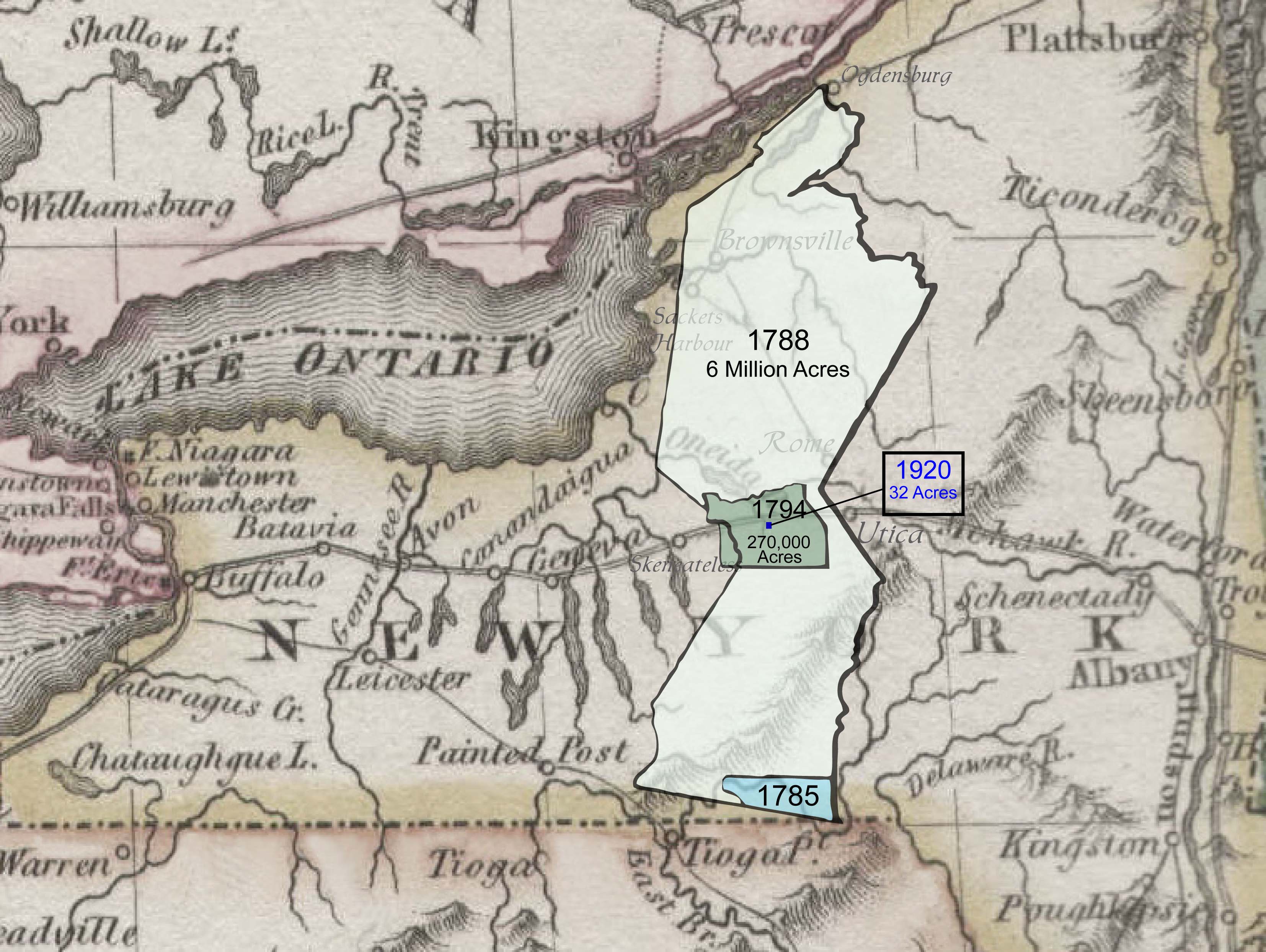
Map showing the Oneida cession of 1788. Under Article II of the agreement, the Oneidas retained the right to hunt and fish in the entire shaded area. No subsequent treaty every deprived them of that right.
At Fort Schuyler, the governor and the state’s Indian commissioners continuously warned the Indians that their lands remained in jeopardy unless they negotiated with the state. The governor accompanied the state commissioners to Fort Schuyler, formerly Fort Stanwix, where they would meet with as many Indians as could be gathered. The Six Nations, the governor hoped, would “open their ears to the voice of the Great Council of the State of New York,” and meet them to “brighten the Chain and renew the Covenant which had so long bound us together.” Clinton and the commissioners informed the Iroquois that they intended to protect the Indians from the many outside forces that clamored for their land. Deceptively, the governor and the commissioners hoped to exploit the confusion then reigning in Iroquoia, and obtain from the Six Nations an enormous cession of Indian lands.
Governor Clinton appears to have wanted to move quickly. He attempted to rush the proceedings. He informed the Onondaga sachems, for instance, that “the other public business of the State will not permit me to remain long from home and it will therefore be necessary for such of your people as propose to bee at the Treaty to come on with all possible haste or they may be too late.” Though there is no evidence that the Iroquois sachems clearly recognized, understood, or cared about the nature of that “public business,” Clinton indeed had plenty to worry about. New Yorkers overwhelmingly had opposed the new Federal Constitution drawn up at the convention held in Philadelphia in the summer of 1787, and the governor (albeit quietly) led the “Antifederalist” forces within his state. Advocates of a stronger national government felt the need to replace the Articles of Confederation for a number of reasons, but the “father of the Constitution,” James Madison, listed high on his list of “Vices of the Political System of the United States” the aggressive Indian policies pursued by several of the states, including New York. Article I, Section 8, of the new Constitution replaced the vague and ambiguous language of Article IX of the Articles of Confederation, with an assertive statement of federal authority over the conduct of Indian affairs: once the Constitution became the “supreme law of the land,” Congress would possess the exclusive authority “to regulate Commerce with foreign Nations, and among the several States, and with the Indian Tribes.”
New Yorkers had ratified the new constitution, reluctantly, in July, only a few short months before the gathering at Fort Schuyler. When word of the Constitution’s ratification in New Hampshire and Virginia arrived earlier that month, the Antifederalists of New York realized that they no longer could safely oppose the Constitution: the United States would exist under a new and more powerful frame of government. The question posed to the delegates at Poughkeepsie was now no longer whether or not New Yorkers would approve the Constitution, but whether or not they would become a member of the Union now that the requisite number of states had ratified. Complete independence was never considered by New York’s Antifederalists, who recognized that they would soon have to work within the new federal system. Governor Clinton must have felt the need to acquire for New York as much of the Iroquois estate as he could before the new government went into effect, and the rules of Indian diplomacy changed.
New York’s urgent appeal to the Six Nations was received by a people still recovering from the ravages of the Revolutionary War. Although the Oneidas suffered comparatively less than their brothers in the Confederacy, they may have been confused or concerned about Governor Clinton’s intentions. Certainly representatives of the Genesee Company of Adventurers tried to disrupt the proceedings at Fort Schuyler. A Seneca named Onyegat told New York’s Indian commissioners that men from the Genesee Company had told him that “the Governor’s Business at this proposed Treaty is to purchase your Lands, but you have leased them to us. He means to pay you all at once for them, and then in a few Years to drive you off and tell you that you have no Property here.” A Frenchman named Dominique Debarges, a fur trader from Montreal and a Genesee Company agent, along with an Indian named “the Infant,” told sachems on their way to Fort Schuyler that “it will be your Destruction if you go down to the Treaty called by the Governor of New York. I know his intentions,” Debarges continued, and “when you return you’ll have no Place to set your Foot on. You will be like wild beasts which are hunted.” Debarges also told the Indians that “the Governor had his troops collected at German Flatts, ready to fall upon them as soon as they returned.” The Oneidas, as well as the Onondagas, likely heard these rumors; the evidence suggests that the constituent members of the Confederacy regularly shared information and intelligence. That the missionary Samuel Kirkland served as an interpreter at Fort Schuyler could only have further confused the Indians attending the council. The minister and missionary had served as an interpreter at the federal Fort Stanwix Treaty in 1784, and his presence at Fort Schuyler may have done much to grant a veneer of legitimacy to Clinton’s efforts and supported the Governor’s contested claim to represent the only jurisdiction with a legitimate right to negotiate with the Six Nations.
The state commissioners chose to treat with the Onondagas first. The Oneidas returned home, and would not return to Fort Schuyler until the meeting with the Onondagas had been completed. By the middle of September, that business was finished, and the Oneidas returned to the fort.
Speaking through Kirkland, the Oneida spokesman Good Peter responded to the Commissioners’ invitation. He expressed to the Governor and the state’s men his understanding of the purpose of the gathering. Good Peter wanted to protect the Oneidas’ lands. He made clear to Governor Clinton that “in whatever Land we should cede to you, our Warriors should have the Privilege of Hunting and Fishing, and that a Line should be drawn round the Part we should reserve to ourselves to secure it to us and our Posterity.” In essence, Good Peter, like the Onondaga sachem Black Cap, offered to share the bulk of the Oneidas’ lands with the citizens of the state of New York in return for an annual payment. The remainder of their lands the tribe would keep for their own exclusive use.
Governor Clinton told the Oneidas that he desired to protect their lands from the Livingston Adventurers, who “had without any Authority from us, obtained from you a Lease of your Lands.” He had, he said, no interest in buying lands from the Oneidas, for “we have already more lands than we have People to settle on them.” His hope was to set things right, “to meet you at this Council Fire, and by a new agreement place Matters on such a footing as to prevent these Things for the future.” This pleased Good Peter, who responded to the Governor’s speech on the 20th of September. He was happy to hear that the state did not want the Oneidas’ land, and that New York would protect his people from the Livingston Company. “The Wind,” he told Clinton, “seems always to blow and shake this beloved Tree, this Tree of Peace.” Good Peter recalled that in 1784 “the United States” had “Planted the Tree of Peace with four Roots, spreading branches, and beautiful leaves, whose top reached the Heavens.” He feared “that by and by some Twig of this beautiful Tree will be broken off. I Love this Tree of Peace as my Life, and my Protection. I know you love it.” To preserve this peace, Good Peter concluded, the Governor must “punish these disorderly People.”
The point is simple. Throughout his speeches at Fort Schuyler that September, and consistently in his recollections of the treaty four years later, Good Peter believed whole-heartedly that the Oneidas had met with the governor and the state’s Indian commissioners to protect his people from dispossession by the Livingston Company. Indeed, at the close of the council, Good Peter proudly announced to Governor Clinton that “My Nation are now restored to a possession of their Property which they were in danger of having lost.” The 1788 Oneida treaty, Good Peter continued, secured to the Oneidas “so much of our Property which would otherwise have been lost.” Clearly Good Peter would have had no reason to make this statement if he knew, prior to the meeting at Fort Schuyler, that the Livingston leases had been invalidated by the State Legislature.
Here’s something else that treaty did. Even though the deceptive treaty read that the “Oneidas do cede and grant all their lands to the people of the State of New York forever,” with the exception of a small reservation, they reserved for themselves “and their posterity forever…the free right of hunting in every part of the said ceded lands, and of fishing in all the waters within the same.” The Oneidas reserved the right to hunt and fish in all the lands they ostensibly had ceded to the state of New York.
The 1794 Federal treaty of Canandaigua guaranteed the Oneidas and their longhouse kin the right to the “free use and enjoyment” of all their lands. Nothing in that federal treaty deprived them of the reserved fishing rights laid out at the 1788 Fort Schuyler treaty. Nor did any of the numerous land cessions signed by Oneidas in the decades that followed 1788. Not one of these agreements deprived the Oneidas of the right to fish in streams and lakes they ceded to the state in 1788. Those rights remain active still.
Of course the DEC has an interest in preserving walleye, and it is good that the Department recognizes that Haudenosaunee people do. There is reason to hope that this issue might be compromised. But until that compromise takes place—and Governor Hochul’s hostility to the state’s Indigenous peoples leaves me feeling uncertain that it ever will take place—Native Americans are free to exercise the rights guaranteed in their treaties. They are not asking for special privileges. Rather, they are asking that the State of New York honor its word. When it comes to Native Americans, perhaps the time for the state to finally start doing that is now.
Governor Kathy Hochul evidently believes that New York is able to lecture the state’s Indigenous peoples about the sanctity of contracts. She recently used the massive coercive power of the state to enforce an agreement that New York had first violated under her disgraced predecessor. It was a reprehensible display of raw power by the leader of a state government that has, from its inception, viewed the slightest trace of prosperity in Indian Country as a resource ripe for seizure and exploitation.
Governor Hochul recently froze the assets of the Seneca Nation of Indians, extorted from them a sum of several hundred million dollars, and proudly announced that those funds would cover the bulk of the state’s contribution to build a new football stadium for the Buffalo Bills. The Hochul family, because of her husband’s employment, stands to benefit enormously from the new stadium. She froze the Seneca Nation’s accounts because, in her view, they had not paid what they owed to the state and to several counties surrounding Seneca gaming enterprises in western New York. What neither she nor her supporters told you was that the Seneca Nation started withholding its payments when New York State violated its federally required compact with the Nation by allowing a competing gaming operation within the Senecas’ “exclusivity” zone.
I love the Buffalo Bills, but this stinks to high hell.
Let’s be clear. Neither the state nor the federal governments “gave” the Senecas the right to engage in casino gaming. According to the Supreme Court, gaming is a right encompassed within the inherent sovereignty of Native American Nations. What does that mean? Basically, under American law, Native American tribes can exercise any power they choose to exercise, so long as that power is not explicitly prohibited by a treaty or an act of congress, or implicitly prohibited by being somehow inconsistent with their status as “domestic dependent nations.” (Implicit divestiture is a murky concept, that has allowed a lot of state intrusion into the internal affairs of Native American Nations). Late in the 1980s, Congress passed a piece of legislation known as the Indian Gaming Regulatory Act, to set the ground rules for Indian gaming. For the most lucrative sorts of games—slots and the table games that most of us associate with casinos—Congress required that Indigenous nations enter a “compact” with the state in which they plan to do business. Many states extract a share of the casino revenue as one part of the agreement. In the Seneca Nation’s case, the state also guaranteed that the Senecas would have an exclusive right to operate gaming facilities in the western part of the state. When the state allowed competing enterprises to open, part of the Cuomo Administration’s ill-conceived plan to effectively tax people who are bad at math, the Senecas justly pointed out that the state violated the compact. Negotiations had been on-going up until the point when Governor Hochul realized she needed a ton of cash to support the Pegulas’ bid to build a new stadium for the Bills. As journalist David Kay Johnston pointed out, that agreement is a loser for taxpayers because the Pegulas easily could afford to construct the stadium themselves.
There is a long history here.
New York became the Empire State through a systematic program of Iroquois dispossession. That’s a fact. Though the Supreme Court declined to do anything about the process, arguing disingenuously that the injuries occurred too long ago to offer a workable remedy, most of the so-called treaties the state negotiated clearly violated federal law.
Not only were many of these transactions unambiguously illegal, but they were, as the kids say, as shady as hell. The Onondagas and Oneidas, for instance, entered into agreements in 1788 in which they were led to believe they would lease their lands to the State of New York. Turns out that when the treaty was written by New York officials, those leases had magically been transformed into sales. Dispossession through literacy in English. Other transactions took place with small
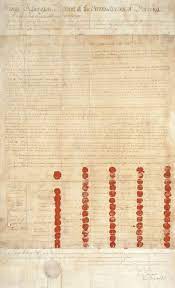
Federal Copy of the Treaty of Canandaigua, 1794
number of Indians present, few of whom were the proper people to sign treaties. And the United States, especially with regard to the Senecas, hardly kept its hands clean. The 1838 treaty of Buffalo Creek, a transaction designed to expel the Six Nations from New York State, is the most crooked treaty in the history of this country. That is saying something. Signatories were coerced or threatened, signatures were forged, and alcohol flowed freely. Meanwhile, both federal and state authorities in New York have ignored those provisions in treaties that protect Indigenous rights. For example, clauses guaranteeing the Senecas and their Iroquois neighbors the right to the “free use and enjoyment of their lands” in the 1794 Treaty of Canandaigua have been consistently ignored. They have ignored provisions in treaties guaranteeing Indigenous peoples the right to hunt and fish on the land they ceded to the state. The state has even tried to tax the “per capita” payments the Seneca Nation made to its members from the Nation’s gaming proceeds. It is just one assault after another. It is worth keeping in mind that the Seneca Nation has never asked for special privileges. It asked merely that the state of New York follow the rules to which it had agreed. Contracts are sacred, Governor Hochul suggested, unless they somehow limit her ability to funnel many millions of public dollars to private hands.
There is a principle that is very important to Iroquois people. The People who made up the Iroquois League conducted their lives in accordance
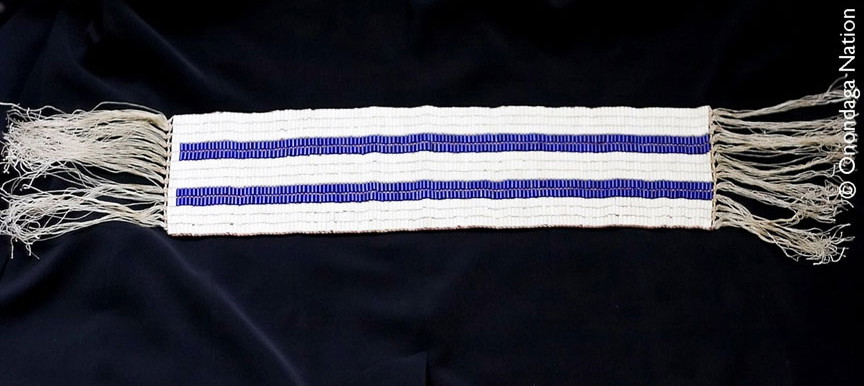
The Two-Row Wampum.
with this principle over the centuries. It is called “Guswenta,” and today it is represented by a very specific wampum belt known as the Two-Row, which depicted two parallel lines on a field of white. The lines represented the Iroquois and their non-native neighbors. They shared the same land, they occupied the same country, but they remained independent and autonomous. The lines did not cross, and neither natives nor newcomers should interfere in the affairs of the other. Indigenous peoples in this state have kept their part of the bargain. They have had little choice. The state, and its colonial predecessors, have not. The Indigenous people of this state have faced epidemic diseases, military invasions, the carrying away of their children to boarding schools, and systematic and deliberate attempts to wipe out their culture and take their land. Yet here they remain, developing their communities, looking forward, in a state that has been a steady and relentless adversary. They hoped the state would play by its own rules. Governor Hochul said no.
It is worth reading the statement from Seneca Nation president Matthew Pagels:
“New York’s hostile and shameless greed was laid bare for the world to see yesterday. After intentionally and unnecessarily holding the Seneca people and thousands of Western New Yorkers and families hostage for several days by strangling various bank accounts held by the Seneca Nation and our businesses, Governor Hochul couldn’t contain her excitement to boast about using her Seneca ransom money for a new stadium.
I’m sure that was welcome news to the Governor’s husband, whose company not only operates Video Lottery Terminals within the Seneca Nation’s supposed gaming exclusivity zone with the State’s blessing, but the company will also make millions of dollars in concession business inside the State-owned stadium. And it’s being paid for on the backs of the Seneca Nation. Quite a sweetheart deal.
We see, and we hope the world sees, the Governor’s announcement for what it is — the latest chapter in New York’s long history of mistreatment and taking advantage of Native people. Governor Hochul happily tried to strangle Western New York in order to squeeze every drop of blood she could get from the Seneca Nation.
It is not surprising to the Seneca Nation that the Governor thinks her actions should be applauded as progress. That’s the Albany way. The claims that a new day had dawned in Albany have turned into Groundhog Day — more of the same, just as it’s always been.
The Governor’s new stadium won’t be a product of progress. It will be a monument to Albany’s vindictive desire to punish the Seneca people. Ultimately, it’s something we’re all too familiar with.”
I have not posted to this blog as much as I have in the past. I am on sabbatical, working on a history of the Onondaga Nation that I began long ago. I won’t finish it during the semester I have off–it is just too big a project–but I hope to make some substantial progress.
I have been working my way through the Jesuit Relations, the annual writings of the French priests who began ministering to the Haudenosaunee in the middle of the seventeenth century. The first Jesuits arrived at Onondaga, at the very center of the Iroquois League, in 1654. They remained even after many of the converts left for mission settlements in the St. Lawrence Valley. After most of the devoted left, Father Jean de Lamberville found himself facing the Onondagas’ “ill humor and savage whims,” as well as their outright rejection. “The chief fruit that I have gathered,” he wrote, “has been among the dying.” Mostly, he baptized dying children. “This is the most certain fruit we gather in this country,” he wrote, “where it is desirable that the children should die before obtaining the use of their reason.” It is a constant theme in Lamberville’s writings. “The Church of Onnontague,” he wrote, “has been blessedly diminished this year by the death of some Christians who have gone to increase the number of the blessed.” Because of his medical skills, Lamberville often was granted access to the sick. Few of these “escape who are not baptized before they die.”
Lamberville baptized thirty-nine Onondagas in 1671, “twenty of them entering, soon after, into the possession of glory.” Of the twenty-seven people he baptized in 1672, “They all died, with the exception of three.” In 1673, he baptized eight “aged persons,” all but one of whom died. In a letter to his superiors written in June 1676, Lamberville reported that he recently had baptized forty-five children, “forty of whom are before God.” He admired, he wrote, the ways God adopted “for the salvation of his elect,” as he presided over a church composed of dead children.
We are facing a national crisis in history education, as Republican lawmakers across the country rush to downplay the Holocaust, erase slavery, deny the diversity of this country’s many stories, and proscribe the teaching of ideas they find suspect. History can be difficult work at times, carried on in defiance of those frightened men and women who worry that a frank discussion of our nation’s sins may not lead to forgiveness. And at times, writing history can be emotionally exhausting.
This is the final week of classes at Geneseo before finals next week. It has been a trying school year for many of us. Nonetheless I completed a few things. Peter Olsen-Harbich and I completed the third edition of Native America and submitted it to our publisher at Wiley. We expect to see it in print and e-book in time for the fall semester in 2022. That means this is the first bibliography that will be considered for the fourth edition of the book, if and when we get around to doing that work. Before we get to that, a long-awaited sabbatical, during which I hope to make a great deal of progress on my next book, a history of the Onondaga Nation. As always, if you think there is something missing here, please let me know and I will run down the cite. Have a good end of the school year.
Akins, Damon B. and William J. Bauer, Jr., We Are the Land: A History of Native California, (Berkeley: University of California Press, 2021).
Biolsi, Thomas. “The Treaty Imaginary and Tribal Sovereignty in South Dakota,” American Indian Quarterly 45 (Summer 2021), 209-249.
Clements, Christopher. “’There is no trouble at all if the state would keep out’: Indigenous People and New York’s Carceral State,” Journal of American History, 108 (September 2021) 296-319.
Dyck, Erika and Maureen Lux. “Population Control in the Global North? Canada’s Response to Indigenous Reproductive Rights and Neo-Eugenics,” Canadian Historical Review,102 (August 2021), 876-902.
Fisher, Julie A. “Roger Williams and the Indian Business,” New England Quarterly, 50 (September 2021), 552-571.
Haake, Claudia Bettina. “A Duty to Protect and Respect: Seneca Opposition to Incorporation during the Removal Period,” American Indian Culture and Research Journal, 44 (2020), 21-40.
Haider, Mellie and Manuel P. Teodoro, “Environmental Federalism in Indian Country: Sovereignty, Primacy, and Environmental Protection,” Policy Studies Journal, 49 (August 2021), 887-908.
Hart, William B. “For the Good of Their Souls”: Performing Christianity in Eighteenth Century Mohawk Country, (Amherst: University of Massachusetts Press, 2021).
Hoy, Benjamin. A Line of Blood and Dirt: Creating the Canada-United States Border Across Indigenous Lands, (New York: Oxford University Press, 2021).
Hausmann, Stephen R. “Erasing Indian Country: Urban Native Space and the 1972 Rapid City Flood,” Western Historical Quarterly, 52 (Autumn 2021), 305-329.
Kherag, Sean. “Against the Current and into the Light: Performing History and Land in Coast Salish Territories and Vancouver’s Stanley Park,” BC Studies, 211 (Autumn 2021), 131-143.
Meadows, William C. “Kiowa at the Battle of the Washita, 27 November 1868,” Ethnohistory, 68 (October 2021), 519-545.
Mize, Jamie Myers. “’To Conclude on a General Union’: Masculinity, the Chickamauga, and Pan-Indian Alliances in the Revolutionary Era,” Ethnohistory, 68 (July 2021), 429-448.
Mohlman, Nicholas K. “Making a Massacre: The 1622 Virginia ‘massacre,’ Violence and the Virginia Company of London’s Corporate Speech,” Early American Studies, 19 (Summer 2021), 419-156.
Nelson, Peter. “Where Have All the Anthros Gone? The Shift in California Indian Studies form Research ‘on’ to Research ‘with, for, and by’ Indigenous Peoples,” American Anthropologist, 123 (September 2021), 469-473.
Nesper, Larry. Our Relations…the Mixed Bloods: Indigenous Transformation and Dispossession in the Western Great Lakes, (Albany: State University of New York Press, 2021).
Nichols, David A. “A Note on Economic Depressions and Native American Opportunities,” Indiana Magazine of History, 117 (September 2021), 157-168.
Phillips, Katrina M. Staging Indigeneity: Salvage Tourism and the Performance of Native American History, (Chapel Hill: University of North Carolina Press, 2021).
Pustet, Regina. Lakota Texts: Narratives of Lakota Life and Culture in the Twentieth Century, (Lincoln: University of Nebraska Press, 2021).
Reed, Julie. Serving the Nation: Cherokee Sovereignty and Social Welfare, 1800-1907, (Norman: University of Oklahoma Press, 2021).
Ridner, Judith. “Archibald Loudon and the Politics of Print and Indian-Hating in the Early Republic,” Early American Studies, 19 (Summer 2021), 528-567.
Rizzo-Martinez, Martin. We Are Not Animals: Indigenous Politics of Survival, Rebellion, and Reconstitution in Nineteenth-Century California, (Lincoln: University of Nebraska Press, 2021).
Roberts, Alaina. “When Black Lives Matter Meets Indian Country: Using the Cherokee and Chickasaw Nations as Case Studies for Understanding the Evolution of Public History and Interracial Coalition,” American Indian Quarterly, 45 (Summer 2021), 250-271.
Shefveland, Kristalyn Marie. “Pocahontas and Settler Memory in the Appalachian West and South,” Western Historical Quarterly, 52 (Autumn 2021), 281-303.
Sutton, Victoria. Decolonizing the Foundations of American Indian Law, (Lubbock: Texas tech University Press, 2021).
Tongkeamha, Henrietta, et al., Stories from Saddle Mountain: Autobiographies of a Kiowa Family, (Lincoln: University of Nebraska Press, 2021).
Tucker, Patrick M. “Savage Barbarity: Native American Uncivilized (Guerilla) Warfare at Cold Creek in the Firelands of Ohio during the War of 1812,” Ohio History, 128 (Fall 2021), 1-22.
Verbeek, Vincent. “A Dissonant Education: Marching Bands and Indigenous Musical Traditions at Sherman Institute, 1901-1940,” American Indian Culture and Research Journal, 44 (2020), 41-58.
Witgen, Michael John. Seeing Red: Indigenous Land, American Expansion, and the Political Economy of Plunder in North America, (Chapel Hill: University of North Carolina Press, 2021).
Wotherspoon, Terry, and Emily Milne. “’Errors were Made:’ Public Attitudes Regarding Reconciliation and Education in Canada,” Canadian Review of Sociology, 58 (August 2021), 306-326.
Yarbrough, Fay A. Choctaw Confederates: The American Civil War in Indian Country, (Chapel Hill: University of North Carolina Press, 2021).
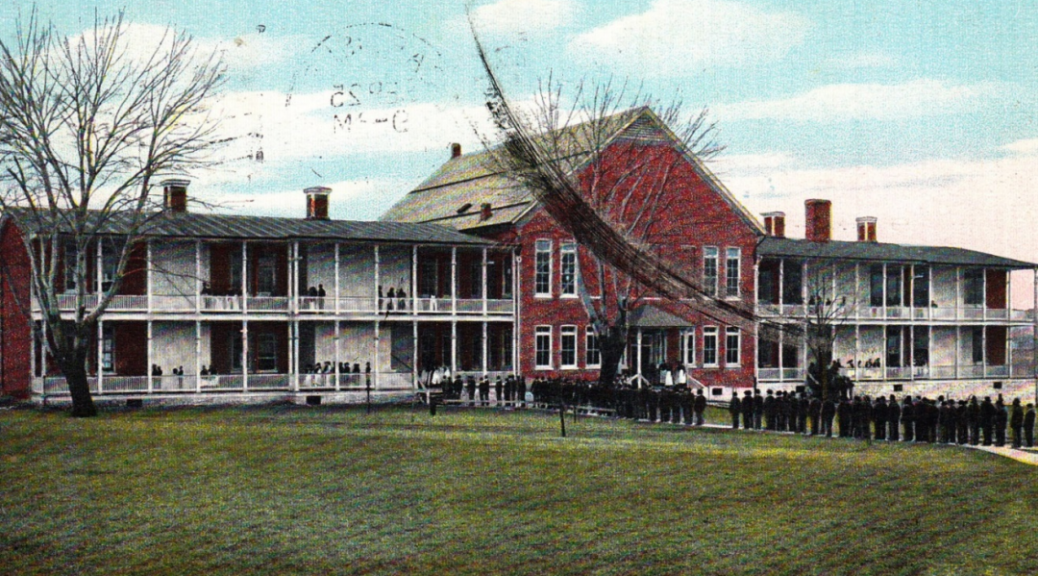
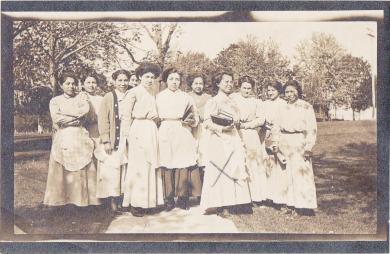
Della John and Ella Israel were the last two Carlisle girls to pass through Mrs. Jacobs’ House. There is no evidence as to why or what happened to cause her to give up this work. Maybe Mrs. Jacobs got old. Maybe she wanted her summers free, or no longer needed the help the Carlisle girls on outing might provide. She had been at it for more than a decade and a half. It would be an interesting research project indeed to compare Mrs. Jacobs’ work with Carlisle with that of other outing patrons. These patrons have not been studied at all, but they played a role of fundamental importance in the Carlisle students’ lives. They did a great deal of the teaching.
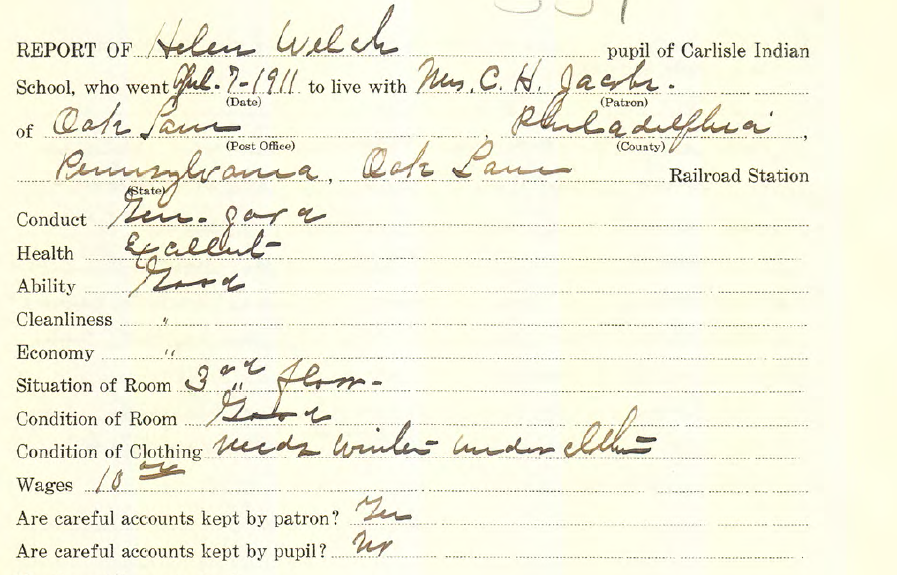
As we wrap up this brief discussion of those young women who passed through the home of Mrs. C. H. Jacobs of Oak Lane, Pennsylvania and Ocean City, New Jersey, it is worth noting that some of the girls who passed through lived lives that are difficult to reconstruct. Dora LaBelle, Francis Halftown, Agnes White, Theresa Brown, and Libby Skye left sparse records from their time at Carlisle. Others, like Helen Welch from Brothertown in Wisconsin, reported familiar themes.
She was doing well, she wrote to Superintendent Moses Friedman after her departure from the school, “but often wish I was back to dear Carlisle.” She left the school because she lacked “a sufficient degree of Indian blood.” She was living in Chicago in 1916, five years after her departure, still writing to the school. Times were tight, and she wondered if there was any money left in her Carlisle account from her outings, including the time she spent at Mrs. Jacobs’ house.
Report on Helen Welch’s placement at Mrs. Jacobs’ House
Della and Ella stayed at Mrs. Jacobs’ from the end of May until the beginning of September, 1915. Ella, a Cherokee, was 16 at the time. Della, who came to Carlisle from the Seneca Cattaraugus Reservation, was much older. An orphan, she was 26 years old. She hung around Carlisle after her graduation, continued to attend school during her outings, but did not have much to return home to. She suffered as well from ill health. She had a number of operations during her time at Carlisle, and was plagued by a “nervous disorder” that could be debilitating at times and for which she took medication.
Their time at Carlisle was not dissimilar to that of the other women I have written about in this series of essays. Both Della and Ella were active in the YWCA at Carlisle. Both were members of the Mercers, and both were active in debate. And both Ella and Della, after they left Carlisle, expressed their gratitude for the education they had received and their desire to remain in touch with events back at Carlisle.
I was grading papers as I worked through the final Carlisle files. I am reading drafts of term papers students are writing for my research methods course in Native American history. Two students, in their drafts, felt the need to say something about Carlisle. Both repeated what will be for many a familiar refrain about Carlisle. Students were taken to Carlisle against their will. Once there, they received humiliating haircuts and new names. They suffered from heartache and loneliness at an institution that imposed upon them a soul-crushing American-style education. They were prisoners.
But what the experience of the women who moved through Mrs. Jacobs’ house reveals is that these assumptions—accepted as gospel truth by many students of the Native American past—are not entirely true. Parents sent their children to Carlisle. They wanted for them the education they felt it would provide. The students we have visited with appreciated their time at Carlisle, missed it after they left, and tried to stay in touch with teachers, administrators, and fellow students. It is easy to imagine that the opportunity to learn a trade, to play a sport, to perform in an musical band, and to meet other young people from Native American communities across the country might have been attractive if not exhilarating. Della John’s best friend was a Creek young woman named Tookah McIntosh.
Carlisle opened in 1879. The first of the students I wrote about arrived twenty years later and arrived at Mrs. Jacobs’ house in 1901. Carlisle in its early years was different than in its later years. Record-keeping become more thorough. More and more of the students came from Christian families which had practiced agriculture on the American model. They were literate in English, and they had family names in which they took great pride.
We need to know more about Carlisle, and the boarding school experience in general. There are students who attended Carlisle about whom it is difficult to learn much at all. There are students who are difficult to trace once they left the school. There are so many unanswered questions. But we must be on our toes as historians. We must be willing to be surprised, to admit that our hypotheses are flawed, our accustomed and popular assumptions incorrect, and that what we have been told is wrong. This is an exciting time to be conducting research on boarding schools. The events of the recent past have underscored how fundamentally important and relevant this topic remains, and I am excited to see what happens.
I learned the other day that my old neighbor, Bob Jones, had died. He was a very old man. Mr. Jones was one of my history teachers when I was in high school. My parents and he were friends, and I knew through them that he followed my career until he was no longer able. I suspect his family will say he had a good life. Even though I had not spoken to him in many years, I wish that I could have gone home to California for his memorial service. I owe him a lot, I think.
Let’s be clear. I graduated from high school almost forty years ago. There are classes I took that I am certain I remember nothing about. There are other classes that I remember for reasons that had nothing to do with the content. I remember the mystery fiction teacher who looked just like Mark Mothersbaugh in his prime DEVO years (and I attended high school just after DEVO’s prime years.) I remember the guy who taught a class in science fiction and fantasy literature. He was an alcoholic. We all knew that, and he was falling apart a little bit each day. He was the first of a number of people I saw go to pieces. This may not be a good reason for remembering a class–I know we read the entire Lord of the Rings trilogy–but it was an education that added some strange element toour discussions of the trials of a small band of reluctant adventurers making their way into Mordor.
To be honest, I remember less about Mr. Jones’ class than where some of my friends sat in that classroom. I could draw a map of that room from memory. I know it was an American history class, and I can imagine that we talked about subjects that matter to me much more now than they did back then.
But there are two things I remember quite vividly. The first was a sort of Great Depression game. We played the stock market. Some students still play this game in high school history. The prices went shooting up. Should we sell? Mr. Jones asked us to think about this. Or should we wait and see if the prices continued to climb. Some of us did quite well. Some of us hung on to our stocks too long. We ended up holding worthless pieces of paper. Black Friday.
The second thing must have occurred on or near the first day of the term. Mr. Jones gave each of us a penny. Imagine, he said, that this is all that we know of a lost civilization, and you are the archaeologist who discovered this coin. This is all the evidence we have. What conclusions could you reasonably draw? Lincoln was God. I remember that coming from the discussion. But I also remember realizing for the first time that if you looked really closely, you could see Lincoln sitting in the Lincoln Memorial on the “tails” side of the coin.
The content, I would argue is beside the point. I remember both of these assignments because they were fun. I remember Mr. Jones having fun as well. Obviously he knew precisely when the market was going to fall, and I am sure he had done the penny project many times before, but he laughed when we laughed, and he was buoyed by our enthusiasm.
High school history teachers can do three things, it seems to me. They can help a student feel nothing towards history. They can help a student hate history. Or they can help a student fall in love with a subject. Mine was obviously in the latter category, and that penny project was the earliest instance I can think of in school where I was required to think like a historian.
High school was miserable for me. It always involved avoiding the Jocks who liked to pound on the punk rock kids and the skaters, made worse because the principal was the principal jock’s dad. I left school at lunch for my senior year because I signed up for a course I took at nights at the junior college. That was allowed back then. I had my afternoons off, and for three periods a day I did not have to attend school. Teachers ranged from the drunk to the deranged to the creepy and the frustrating. But there were a significant number of really good ones, and I am proud to say that I knew them.
Teachers have the power to destroy or to create, and they can do both with a single sentence. It is an incredible responsibility. I am glad that some of my teachers took that responsibility so seriously, that decades later I can remember them still. And in a history class, it had nothing to do with the actual content, but how that content was delivered. And in Mr. Jones’ class, even if I learned nothing else, I learned not only that history was interesting, but that it could be fun.
Annie Dibo and Susie Porter came to Mrs. Jacobs’ house because she was dissatisfied with the two Rosebud Sioux women who preceded them. Helen Kimmel and Grace Burnett arrived at Mrs. Jacobs’ place in April of 1910, and stayed only until the middle of June. Helen was nineteen years old when she arrived, and Grace Burnett was eighteen. They stayed with her in Oak Lane but not long enough to make it out to the beach in New Jersey.
Mrs. Jacobs told the Carlisle agent who visited her that Grace was an “inexperienced worker,” and that she was “indifferent to her work” and “does not try.” Helen, Mrs. Jacobs reported, “has never been contented,” and “is restless and anxious to return home.” Helen, “who neglected her work,” because of “her restlessness to return home” felt that way because “her father has recently placed money at Carlisle to buy her a ticket for her return home.” Grace, as well, had received “a letter containing money from her father to return home.” By June of 1910, Grace was on her way home. Helen did not leave Carlisle until October.
Grace Burnett’s review, reported by Mrs. Jacobs to the Carlisle visiting agent.
In each instance, the school noted as the reason for the discharge of the girls that they failed to return from their leaves of absence in 1910. Carlisle’s staff expected them to return but they did not. At first glance it seems that neither of the girls wanted to be at Carlisle. They both seem to have been unhappy, and wanted to get home at the first opportunity. As always, it is more complicated than that.
Helen’s file is pretty slim. She responded to the school’s request for information from her in 1912. She was at Rosebud, keeping house, renovating her family’s home, and working on the ranch. The family had 160 acres, 20 horses, 10 head of cattle, and a cat. We know that in September 1913 she married Lancelot DeCory, a graduate of the Flandreau Indian School, and moved with him to Valentine, Nebraska. DeCory was “engaged in the automobile business in Valentine,” according to the Carlisle Arrow, “where he has many warm friends, all of whom join in extending hearty congratulations, and best wishes, for a long and happy wedded life.”
And they seem to have had one. Both Lancelot and Helen were active in their community. Lancelot died in1938, but they had kids, Claude and Lancelot, Jr., who fought in the Italian campaign during the second World War. Helen lived into the 1960s, a very long and fruitful life.
Grace said a bit more about her time at Carlisle. She returned home to her parents’ house at Rosebud, “one of the largest ranches around here.” She filled her time with baking, sewing, and beadwork “to earn my pin money.” She had experienced some great sadness. “I am motherless,” she said, “and my grandmother died a year ago in July of 1911.” She had no women relatives and now wanted to return to Carlisle to graduate. She did make it back for a short stay.
She had hoped to return to Carlisle in the fall of 1912, she wrote in a letter dated January of 1913, for “now I am only an ex-student, and it is all my fault.” It wasn’t, and Grace was surely too hard on herself. “I wanted very much to return to Carlisle this fall,” she wrote, “but I could not, as there was lots of work to be done on our ranch and ‘hired men’ are scarce just about that time, so I had to help.” She did not get free until mid-December, and by then it was too late. So she kept doing housework, and spent her spare time riding horses, sleighing, and ice-skating. She said that she “got lonesome for Carlisle every time I read The Arrow, but I can’t do without the little paper.”
The Carlisle applications are a standardized document. They include a set of “endorsements” listing “the laws relative to the transfer of Indian children from reservations and schools.” The United States Statutes-at-Large said that “no Indian child shall be taken from any school in any state or territory to a school in any other state against its will or without the written consent of its parents.” Children could not be sent to a boarding school without the consent of his or her family, “and it shall be unlawful for any Indian agent or other employee of the government to induce, or seek to induce, by withholding rations or by other improper means, the parents of next of kin of any Indian to consent to the removal of any Indian children beyond the limits of any reservation.”
Some of the fine print.
It is not unreasonable to assume that laws like these existed for a reason, and that laws were intended to prohibit practices used to coerce Indian children to attend boarding schools. It does not take a deep dive into the records to see the heavy-handedness of federal policy makers. No doubt there was coercion employed at times and in places, and there were students whose experiences at Carlisle were horrific. Despite these cases, many students, and students’ families, saw much of value in a Carlisle education. These students, even when they felt lonely and ached to get home, missed the school greatly once they got home, and often they wished they could return.
This makes the story of Carlisle a difficult one that defies easy categorization. Different students had different experiences. We need to be careful how we talk about the boarding school experience. More news stories appear each week detailing horrifying tales of abuse and death. Just last week the New York Times ran a story about the Genoa Indian School under the headline of “Researchers Identify Dozens of Native Students who Died at Nebraska School.” Carlisle and the other boarding schools will give up their stories some day. We must prepare ourselves for stories that are complicated, full of heartbreak and cruelty to be sure, but also deeply ambivalent. Some Carlisle students loved what many of us wish they did not.