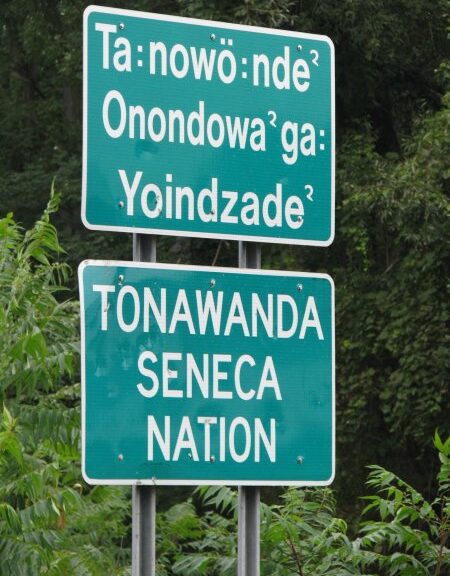
I am deeply disturbed, as a historian, by the proposed STAMP development project bordering the Tonawanda Seneca Nation territory. STAMP stands for the Science and Technology Advanced Manufacturing Park which will be built on the margins of the Tonawanda Seneca Nation. It’s another “Buffalo Billion boondoggle,” one journalist pointed out, a manufacturing facility boosted by the Genesee County Center for Economic Development that will, when built, damage wildlife habitat and the ways of living of the Tonawanda Seneca Nation. Millions have been spent, but not much has been accomplished yet. A hearing will be held tonight, Thursday, May 11th, at the Fire Hall in the Town of Alabama, New York.
I will leave it to those with expertise in the field to describe the significant ecological and environmental consequences of the project, though they seem quite significant and have not been persuasively addressed by the developer. What I would like to describe to you is the history of this state, and its long history of interactions with Native American Nations. New York could not have taken its current shape without a systematic program of Indigenous dispossession that at times explicitly violated the laws of the United States, and always basic standards of justice, honesty, and equity.
It is history in which the State of New York has consistently attempted to skim the cream off of whatever prosperity develops on Indigenous land; has aided and abetted in the environmental devastation of Indigenous homelands, and pursued on or around Native American communities projects that their NIMBY white constituents refuse to countenance in their own neck of the woods. It is a history of despoliation, devastation, and avarice, that is appalling even without reference to state boarding schools, military campaigns, and dishonesty in its dealing with the Indigenous Nations. Will the New York State Department of Environmental Conservation participate, once again, in this long and, frankly racist history? I hope that they will turn the page, write a new chapter, and look to a better future.
I am not optimistic. Governor Hochul has been no friend to the State’s Indigenous peoples. She presides over a state built on stolen land. One thing that Democrats and Republicans can agree on is that there shall never be a meaningful accounting. New York became the Empire State through a systematic program of Iroquois dispossession. That’s a fact. Though the Supreme Court declined to do anything about the process, arguing disingenuously that the injuries occurred too long ago to offer a workable remedy, most of the so-called treaties the state negotiated clearly violated federal law.
Short Eared Owl, one of several species threatened by the development.
Not only were many of these transactions unambiguously illegal, but they were, as the kids say, as shady as hell. The Onondagas and Oneidas, for instance, entered into agreements in 1788 in which they were led to believe they would lease their lands to the State of New York. Turns out that when the treaty was written by New York officials, those leases had magically been transformed into sales. Dispossession through literacy in English. Other transactions took place with small number of Indians present, few of whom were the proper people to sign treaties. And the United States, especially with regard to the Senecas, hardly kept its hands clean. The 1838 treaty of Buffalo Creek, a transaction designed to expel the Six Nations from New York State, is the most crooked treaty in the history of this country. That is saying something. Signatories were coerced or threatened, signatures were forged, and alcohol flowed freely. Meanwhile, both federal and state authorities in New York have ignored the treaty provisions that protect Indigenous rights. For example, clauses guaranteeing the Senecas and their Iroquois neighbors the right to the “free use and enjoyment of their lands” in the 1794 Treaty of Canandaigua have been consistently ignored. They have ignored provisions in treaties guaranteeing Indigenous peoples the right to hunt and fish on the land they ceded to the state. The state has even tried to tax the “per capita” payments the Seneca Nation made to its members from the Nation’s gaming proceeds. It is just one assault after another.
Northern Harrier, another bird species threatened by the development.
It is worth keeping in mind that the Seneca Nation has never asked for special privileges. It asked merely that the state of New York follow the rules to which it had agreed. Contracts are sacred, Governor Hochul suggested when she extorted the funding she needed to secure a new stadium for the Buffalo Bills, unless they somehow limit her ability to funnel many millions of public dollars to private hands.There is a principle that is very important to Iroquois people. The People who made up the Iroquois League conducted their lives in accordance with this principle over the centuries. It is called “Guswenta,” and today it is represented by a very specific wampum belt known as the Two-Row, which depicts two parallel lines on a field of white. The lines represent the Iroquois and their non-native neighbors. They shared the same land, they occupy the same country, but they remain independent and autonomous. The lines do not cross, and neither natives nor newcomers should interfere in the affairs of the other. Indigenous peoples in this state have kept their part of the bargain. They have had little choice. The state, and its colonial predecessors, have not.
The Indigenous people of this state have faced epidemic diseases, military invasions, the carrying away of their children to boarding schools, and systematic and deliberate attempts to wipe out their culture and take their land. Yet here they remain, developing their communities, looking forward, in a state that has been a steady and relentless adversary. They hoped the state would play by its own rules. Governor Hochul always has said no. She will support the elimination of Native American mascots–that costs her nothing–but when the rubber hits the road she is as Anti-Indian as they get.
So when a developer hopes to gain state support for an exchange of 665 acres of habitat linked by forests and wetlands to the Tonawanda Seneca Nation for fifty-eight acres of non-contiguous land and claims that it is an equivalent property and that the exchange will actually benefit the ecosystem, and when the developer ignores completely impacts on the Nation and its people, it is hard not to be skeptical. What is easy to see is yet another chapter in the State’s long, brutal, and exploitative history towards Indigenous peoples. The proposed swap is about so much more than economics. It makes a mockery of “consultation,” endangers endangered species, and is so patently inequitable that it is impossible to take seriously.
But all of this is very serious. Industrial development at STAMP will disrupt the Tonawanda Seneca Nation’s ability to engage in the free exercise of their traditional beliefs. By damaging the Big Woods, where medicines are harvested and subsistence hunting and fishing takes place, it threatens directly the health and welfare of the Tonawanda Seneca Nation and the Haudenosaunee, who with Tonawanda’s permission hunt, fish, and gather there too. A long time ago, New York Indians were told to give up their lands in New York for a sliver of desiccated earth in Kansas. The land out there in the west, American officials, New York businessmen, and white racists argued, is just as good as what you have in New York. It’s the same, these promoters of ethnic cleansing optimistically point out. Except that it was not alike at all, just like 58 non-contiguous acres is not at all the same as 665 acres of culturally significant and environmentally and ecologically sensitive land.
The Tonawanda Seneca Nation always has resisted the calls of wealthy New York developers, from Robert Morris in the 1790s to today, that they leave their homelands. In the 1838 Treaty of Buffalo Creek, the Tonawandas were surprised to learn their reservation had been given up, even though they were not parties to the treaty. Two decades later they were able to purchase back a portion of the reservation they never had consented to sell. They were ripped off, but they hung on, preserving their culture and their political system within a state that has historically respected that culture not at all. If any number of white people had their way, the Tonawanda Seneca Nation would no longer exist—their language, their religion, the land, their people—all would have been absorbed by the ceaseless State of New York.
The DEC will support the state’s long-standing racism towards Indigenous peoples if it supports this habitat destruction. Tonawanda Senecas, you see, want nothing more than for the State of New York to keep its word and leave them alone. This is the case for other Haudenosaunee peoples. But here we go again, the relentless drumbeat of exploitation, avarice, and racism. Tonawanda claims to the significance of the land and the species that live there are dismissed and shown no real respect.
I have been to hearings like the one that will be held this evening in the Alabama Fire Hall in the town of Alabama, New York. There is no meaningful “consultation” at meetings like this: the DEC officials sit at a table, fidget with their phones, as they listen uncomfortably to Indigenous peoples describe yet another assault on who they are and what they hope to become. I hope that this time, the members of the DEC in attendance will listen to what the Tonawandas say, and try to hear the sentiment beside it. I hope that they will put a stop to this ill-conceived and poorly thought-out industrial manufacturing development. I hope that they will break with a horrible history and, in the spirit of trust and reconciliation, seek pardon for the unresolved crimes of New York’s past.
And it was not terrible. As in his two earlier proclamations, Biden pledged to work with Native communities “to find justice, keep families safe, and help them heal.” The scourge of MMIWG was “an epidemic,” he said, that will not be cured until the United States responds “with urgency and the resources needed to stop the violence and reverses the legacy of inequity and neglect that often drives it.”
Biden recalled the work his administration has done, mostly through a 2021 executive order that required federal agencies to investigate “the cause of the crisis, collecting better data on these overwhelmingly underreported crimes, and develop a strategy to combat this epidemic, which most often impacts women, girls, LGBTQI+ people in the communities, and Two-Spirit Native Americans.” Is Biden the first American president to use the phrase “Two-Spirit”?
Biden has done a lot: investing in shelters and rape crisis centers on Tribal lands and “trauma-informed training that helps law enforcement and courts be more responsive” and sympathetic, as well as an expanded recognition of “Tribal courts’ jurisdiction over non-Native perpetrators suspected of committing crimes of stalking, sexual assault, child abuse and sex trafficking on Tribal lands.” Biden justly mentioned his role in writing the original Violence Against Women Act and in strengthening VAWA as Vice President and President. President Biden acknowledged the pain this day brought to many Indigenous peoples, and called “all Americans and all levels of government to support Tribal governments and Tribal communities’ efforts to increase awareness and address the issues of missing and murdered Indigenous persons.” He said that “we are working to address the underlying causes of violence from human trafficking to longstanding economic disparities, systemic racism, historical trauma, and the need for services to address substance use disorders.”
Has Biden done enough?
Of course not. Much remains to be done. His administration, like that of his predecessor, will not consider supporting legislation that would repeal the Supreme Court’s disastrous 1978Oliphant decision. The Supremes are poised within the next several weeks to gut the Indian Child Welfare Act, or ICWA, and have demonstrated little willingness to take seriously Native American nationhood when it threatens at a profound level state sovereignty. Though Biden’s approach to MMIWG is little different in its fundamentals than President Trump’s “Operation Lady Justice,” it is a start.
Presidential proclamations may not mean much. I am sure that only a tiny, tiny percentage of Americans read them. If the news media does not bring them to the attention of the American people, they fall on deaf ears. There is little this government can do to help Indigenous communities heal, not with Red State governments banning any sort of history teaching that suggests that children reflect on the uglier parts of this nation’s history. The Republican racists will work to silence America’s violent treatment of Native Americans. But it is a start. And the important thing to remember is that Biden, like Trump before him, has only come to see MMIWG as a national crisis because of the pressure placed upon him by thousands of Native American people and their allies committed to preventing the loss of any more stolen sisters.
I hope your spring semester is going well, and that you are finding time to do the sorts of things that bring you joy. The past few months have seen the publication of some exciting work on Indigenous communities across North America, and there is exciting work on the horizon, so there is plenty to read. You know the drill by now. If there is something that you think I missed, please let me now and I will update accordingly.
Arnott, Sigrid, David Maki and Franky Jackson. “Intervisibility, Invisibility, and Identity Conflict in the Dakota-US War of 1862: The Wood Lake Battlefield,” in Conflict Archaeology, Historical Memory, and the Experience of War: Beyond the Battlefield, ed. Mark Axel Tveskov and Ashley Ann Bissonnette, (Gainesville: University Press of Florida, 2023).
Balfe, Thomas. “Disguise Hunting and Indian Otherness in Theodor De Brey’s Brief Narration of What Befell The French in Florida (1591)” in Animals and Race, ed. Jonathan W. Thurston-Torres, (Lansing: Michigan State University Press, 2023).
Beck, Paul Norman. Inkpaduta: Dakota Leader, (Norman: University of Oklahoma Press, 2022).
Blaakman, Michael A. Speculation Nation: Land Mania in the Revolutionary American Republic, (Philadelphia: University of Pennsylvania Press, 2023).
Bohaker, Heidi. Doodem and Council Fire: Anishinaabe Governance Through Alliance, (Toronto: University of Toronto Press, 2020).
Bond, Trevor James. Coming Home to Nez Perce Country: The Niimiipuu Campaign to Repatriate their Exploited Heritage, (Pullman: Washington State University Press, 2021).
Borsk, Michael. “Conveyance To Kin: Property, Preemption, and Indigenous Nations in North America, 1763-1822,” William and Mary Quarterly, 80 (January 2023).
Burgio-Ericson, Klinton and Gwyneira Isaac, “Teluli’s Melancholy Picnic: Zuni Resistance to the Hendricks-Hodge Archaeological Expedition Amidst Assimilation-Era Politics,” New Mexico Historical Review, 97 (Spring 2022).
Cavalier, Crystal Ann. “Missing Murdered Indigenous Women on the Frontlines of North Carolina,”(Ed.D thesis, University of Dayton, 2022).
Matt Cohen, The Silence of the Miskito Prince: How Cultural Dialogue was Colonized, (St. Paul: University of Minnesota Press, 2022).
Connolly, Emilie. “Strategies of Succession and the 1797 Treaty of Big Tree,” William and Mary Quarterly, 80 (January 2023).
Crossley, Laura. “’An Exhibit as Will Astonish the Civilized World’: Seeking Separate Statehood for Indian Territory at the 1904 Louisiana Purchase Expedition,” Journal of the Gilded Age and Progressive Era, 22 (January 2023), 20-40.
Daggar, Lori. Cultivating Empire: Capitalism, Philanthropy, and the Negotiation of American Imperialism in Indian Country, (Philadelphia: University of Pennsylvania Press, 2023).
Dixon, Brad. “’In Place of Horses’: Indigenous Burdeners and the Politics of the Early American South,” Ethnohistory, 70 (January 2023), 1-23.
Dubcovsky, Alejandra. Talking Back: Native Women and the Making of the Early South, (New Haven; Yale University Press, 2023).
Endres, David J. and Ben Black Bear, Native American Catholic Studies Reader: History and Theology, (Washington, D. C., Catholic University of America Press, 2022).
Flake, Logan. “Oklahoman By Blood: Land Tenure from Indian Territory to McGirt,” M.A. Thesis, Central Oklahoma University, 2022).
Flores, Dan. Wild New World: The Epic Story of Animals and People in America, (New York: Norton, 2022).
Glendenning, Audrey L. “The Transfer of Federal Public Lands to Tribal Trust Ownership: Statutes and Cases from 1970-2020,” Ph.D. thesis, University of Montana.
Hauptman, Laurence M. “The Grand River Cayugas and International Arbitration, 1910-1926,” American Indian Culture and Research Journal, 45 (no. 2, 2021), 39-64,
Hoffmann, Robert Davis. Raven’s Echo: (Tucson: University of Arizona pres,2022).
Jacobs, Michelle R. Indigenous Memory, Urban Reality: Stories of American Indian Relocation and Reclamation, (New York: New York University Press, 2023).
Kasey R. Keeler, American Indians and the American Dream: Policies, Place, and Property in Minnesota, (St. Paul: University of Minnesota Press, 2023).
King, Julia A., Scott M. Strickland and G. Anne Richardson, “Rappahannock Oral Tradition, John Smith’s Map of Virginia, and Political Authority in the Algonquian Chesapeake,” William and Mary Quarterly, 80 (January 2023).
Kramer, Erin B. “Corlaer’s House: Diplomatic Spaces, Lineages, and Memory in the New York Borderlands,” William and Mary Quarterly 79 (October 2022), 499-532.
Lakomäki, Sami. “’Tell Them Nott To Bring Any Rum Here’: Alcohol Regulation, Authority, and Sovereignty Among the Shawnees, 1700-1860,” History and Anthropology, 33 (October 2022), 496-615.
Lee, Robert. “The Indian Boundary Line and the Imperialization of US-Indian Affairs, in The Early Imperial Republic: From the American Revolution to the US-Mexican War, eds. Michael A. Blaakman, Emily Conroy-Krutz, and Noelani Arista,(Philadelphia: University of Pennsylvania Press, 2023).
Little, J. I. “The In-Between World of a Coast Salish Shaman: Charlie Wilson/Chliraminset of Kuper (Penelakut) Island, British Columbia, 1880-1904,” Social History 55 (May 2022), 49-69
Luevano, Terrence Bradley. “A GIS Model of Shell Exchange between Coastal Southern California and Northern Arizona,” (M.A. Thesis, University of Arizona, 2022).
McGruder, Melanie. “Missing and Murdered: Finding a Solution to Address the Epidemic of Missing and Murdered Indigenous Women in Canada and Classifying it as a ‘Canadian Genocide,’ American Indian Law Review, 46 (no 1, 2022).
Magiliari, Michael F. “’A Species of Slavery’: The Compromise of 1850, Popular Sovereignty, and the Expansion of Unfree Indian Labor in the American West,” Journal of American History, 109 (December 2022), 521-547.
Martini, Elspeth. “Dangerous Proximities: Anglo-American Humanitarian Paternalists in the Era of Indigenous Removal,” Western Historical Quarterly, 53 (Winter 2022), 379-404.
Meniketti, Marco G. The Long Shore: Archaeologiies and Social Histories of California’s Maritime Cultural Landscapes, (New York: Bergahn Books, 2023).
Metcalf, R. Warren. “Lamb of Sacrifice: Termination, the Mixed-Blood Utes, and the Problem of Indian Identity,” Utah Historical Quarterly, 91 (no. 1, 2023), 23-36.
Meyer, Sabine. Native Removal Writing: Narratives of Peoplehood, Politics, and Law, (Norman: University of Oklahoma Press, 2022).
Negrin, Hayley “Cockacoeske’s Rebellion: Nathaniel Bacon, Indigenous Slavery, and Sovereignty in Early Virginia,” William and Mary Quarterly, 80 (January 2023).
Odle, Mairin, Under the Skin: tattoos, Scalps, and the Contested Language of Bodies in Early America, (Philadelphia: University of Pennsylvania Press, 2023).
Ostler, Jeffrey. “Denial of Genocide in the California Gold Rush Era: The Case of Gary Clayton Anderson,” American Indian Culture and Research Journal, 45 (no. 2, 2021), 81-102.
Pawlicki, Sarah. “’I Hear that God Saith Work’: Wunnampuhtogig and Puritans Laboring for Grace in Massachusetts, 1643-1653,” Early American Studies, 20 (Spring 2022), 189-214
Peterson, Teresa R. Voices from Pejuhutazizi: Dakota Stories and Storytellers, (St. Paul: Minnesota Historical Society Press, 2022).
Pluth, Edward J. “The White Red Men: The Improved Order of Red Men in Minnesota, 1875-1920,” Minnesota History, 68 (Winter 2022/2023). 134-143.
Quint, Jonathan. “New Gnadenhutten, Moravian Missionaries and Ojibwe Land Tenure on the Clinton River, 1781-1787,” Ethnohistory, 70 (January 2023), 25-44.
Richardson, Michael. “By, With, and Through: Officers Commanding Indian Scouts, 1867-1886: Creating Self and Shaping the West,” (Ph.D. diss., University of California, Los Angeles, 2022).
Riley, Angela R. and Sarah Glenn Thompson, “Mapping Dual Sovereignty and Double Jeopardy in Indian Country Crimes,” Columbia Law Review, 122 (November 2022), 1899-1956.
Ross, Frank. “Crow Dog’s Trial and Ledger Drawing: Cultural Production and Tribal Nation in the Maw of American Empire,” Western Historical Quarterly, 53 (Winter 2022), 325-352.
Rule, Elizabeth. “American Empire and the ‘Indian Problem’ in 2020: From Covid-19 Checkpoints to McGirt,” American Quarterly, 74 (September 2022), 783-789.
Stanciu, Cristina. The Makings and Unmakings of Americans: Indians and Immigrants in American Literature and Culture, 1879-1924, (New Haven: Yale University Press, 2023).
Steinke, Christopher. “Indigenous Waterways and the Boundaries of the Great Plains,” Journal of the Early Republic, 42 (Winter 2022), 1-27.
Teeters, Lila M. “’A Simple Act of Justice’: The Pueblo Rejection of US Citizenship in the Early Twentieth Century,” Journal of the Gilded Age and Progressive Era, 21 (October 2022), 301-318.
Trosper, Ronald L. Indigenous Economies: Sustaining Peoples and their Lands, (Tempe: University of Arizona Press, 2022).
Wakefield, Kyler T. “Native Americans Voting Rights in Utah: Federal Policy, Citizenship, and Voter Suppression,” Utah Historical Quarterly, 91 (no. 2, 2023), 4-22.
Winters, John C. “’The Great White Mother’: Harriet Maxwell Converse, the Indian Colony of New York City, and the Media, 1885-1903,” Journal of the Gilded Age and Progressive Era, 21 (October 20
One of the most important events of the modern Indian rights movement began today at the small hamlet of Wounded Knee, on the Pine Ridge Indian Reservation in South Dakota. You should be teaching students in your American History class about Wounded Knee, not as an explosive event, but one with origins reaching back to the nineteenth century.
The occupation, indeed, had deep routes.
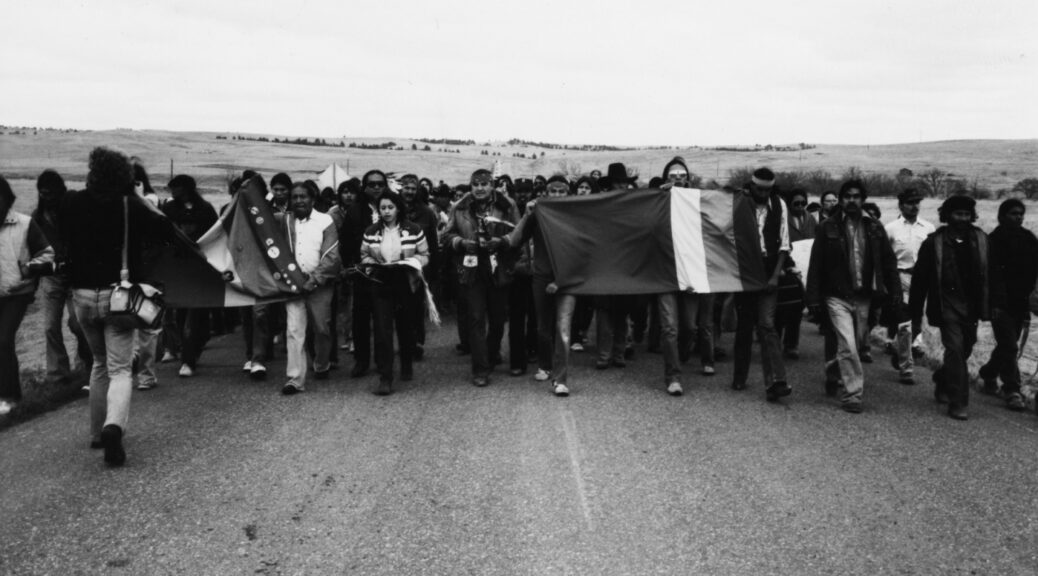
Several months after the occupation of the Bureau of Indian Affairs in 1972, the activism of the Nixon years reignited in South Dakota. In January of 1973, a white man killed a Sioux named Wesley Bad Heart Bull outside a bar in Custer County. Local authorities charged the attacker with manslaughter, nothing more, and AIM, the American Indian Movement, arrived to protest. Led by Dennis Banks, they asked the prosecutor to consider more serious charges. When he refused, a riot broke out. The protestors set the local Chamber of Commerce building on fire; local police and county sheriffs responded with tear gas and violence. Twenty‐two people were arrested, nineteen of them Indigenous peoples. In the aftermath of the Custer riot, elders at the Pine Ridge Reservation invited AIM to aid them in their struggles against tribal chairman Dick Wilson, the head of an Indian Reorganization Act government notorious for its corruption and strong‐arm tactics. THe New Deal era IRA led at times to tribal governments that did not fit with the traditional values of an Indigenous community, and that certainly was the case at Pine Ridge. Wilson maintained a personal police force, for example, the well‐armed GOON squad (Guardians of Ogalala Nation) to control and intimidate dissenters. He had defeated efforts by the Reservation’s residents to impeach him. His authority challenged, he called upon federal authorities for support: federal marshals with automatic weapons came to Pine Ridge, setting the stage for a showdown.
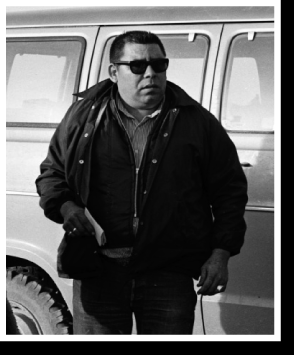
Dick Wilson
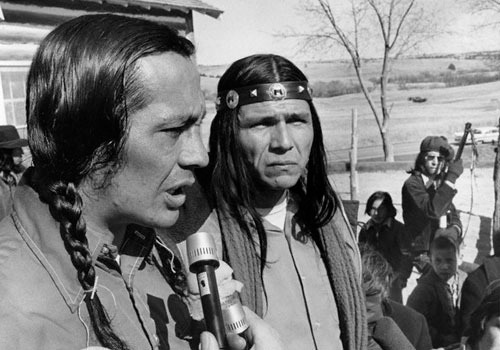
Russell Means, left, and Dennis Banks at Wounded Knee in 1973.
Led by Russell Means and Dennis Banks, AIM hoped to bring the attention of the world to the Pine Ridge Indian Reservation. If they had little familiarity with tribal traditions—both had spent much of their lives in cities—they knew well how to draw the media and generate interest. On February 27, 1973, they and a group of their followers, perhaps 300 in all, occupied the small village of Wounded Knee, the site of the massacre of Sioux Ghost Dancers eighty‐three years before. Most of the occupiers came from the surrounding Lakota reservations, but they received support small numbers of Kiowas, Pueblos, Potawatomis, Senecas, and many others. Two Rappahannocks who had lived in New Jersey traveled west to join AIM at Wounded Knee. The occupiers had a handful of rifles; one of the occupiers had an AK‐47 with an empty banana clip. Some had served in Vietnam and felt keenly the injustice of the colonial system existing at Pine Ridge, where reservation residents had few rights and no redress. Desperate means called for desperate measures. Wilson’s GOONs and federal forces quickly surrounded the occupiers with an impressive array of the latest military technology: armored personnel carriers, high‐powered rifles, machine guns, grenade launchers, and armor. The federal authorities fired off more than 130,000 rounds of ammunition during the occupation. In cities like San Francisco and Washington, the Nixon Administration was willing to exercise restraint in its response to Native American protests. Federal authorities had avoided using a heavy hand during the occupation of Alcatraz and the Bureau of Indian Affairs headquarters in Washington, D.C. Not so on a remote reservation in South Dakota.
On March 11, the occupiers issued a statement declaring the independence of the Oglala Nation. “We are a sovereign nation by the treaty of 1868,” the occupiers said, and “we want to abolish the Tribal Government under the Indian Reorganization Act. Wounded Knee will be a corporate state under the Independent Oglala Nation.” They rejected the “reorganized” government of the Pine Ridge Reservation and objected to a corrupt government out of touch with tribal traditions and willing to harass and violently persecute its opponents. Means and Banks attracted a considerable amount of attention but they could not achieve their fundamental goals, for the federal government would not see to the removal of Wilson, or address the fundamental structural causes of so much misery on Indian reservations. The occupation of Wounded Knee lasted seventy‐one days. At its end, two of the occupiers had died, and one federal marshal received a wound that left him paralyzed. Given the number of rounds fired, that so few were killed and injured was something of a miracle.
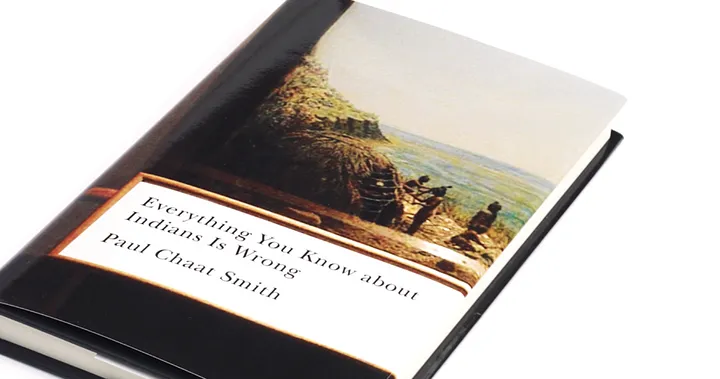
Always worth a look, Paul Chaat Smith’s excellent Everything You Know About Indians is Wrong
The occupiers left Wounded Knee in May of 1973. According to Banks, “Wounded Knee was the greatest event in the history of Native America in the twentieth century. It was,” he continued, “our shining hour.” Leonard Crow Dog, the spiritual leader and another of the occupiers, agreed that “our seventy‐one-day stand was the greatest deed done by Native Americans.” Still, Crow Dog noted, “we never got our Black Hills back, the Treaty of Fort Laramie was not honored, nor did the government recognize us as an independent nation.” In the words of historian Paul Chaat Smith, “there was a clear‐eyed, if often unspoken, acknowledgment that frequently our elders are lost or drunk, our traditions nearly forgotten or confused, our community leaders co‐opted or narrow,” but “they knew only one thing for sure: business as usual was not working, their communities were in pain and crisis, and they had to do something.” AIM brought considerable attention to the problems Indigenous peoples faced. Thanks to the organization’s efforts, many American people became aware for the first time of their nation’s long history of injustices toward American Indians. These achievements were significant.
Still, federal authorities relentlessly harassed and prosecuted the leaders of AIM. After the occupation, Dick Wilson resumed his campaign of repression against what he viewed as outside agitators. This violence led to the killing of two FBI agents in June 1975. After some shady legal maneuvering, a federal court tried and convicted Leonard Peltier, an AIM member, despite significant doubts about his guilt and procedural irregularities at his trial. Peltier remains in prison today. Protests against Wilson’s regime did little to remove the fundamental problem: the United States, though willing to embrace self‐determination, and to consider piecemeal changes in its policies toward Indigenous peoples, never abandoned the notion that Indians remained wards of the nation. It is important to remember this. The federal government in the second half of the twentieth century favored self‐determination and, in specific cases, implemented programs and policies that addressed historic injustice and the poor conditions under which many Indigenous peoples lived. But it would only go so far. A tension existed, between self‐determination and wardship, between sovereignty and colonialism, that individual Indigenous peoples, tribal, local, state and federal governments, and the federal courts would wrestle with over the coming years. Indigenous peoples survived termination’s direct negation of their political rights, and gained more control over their lives, but the ambiguities created by the conflicting forces of sovereignty and colonialism remained.
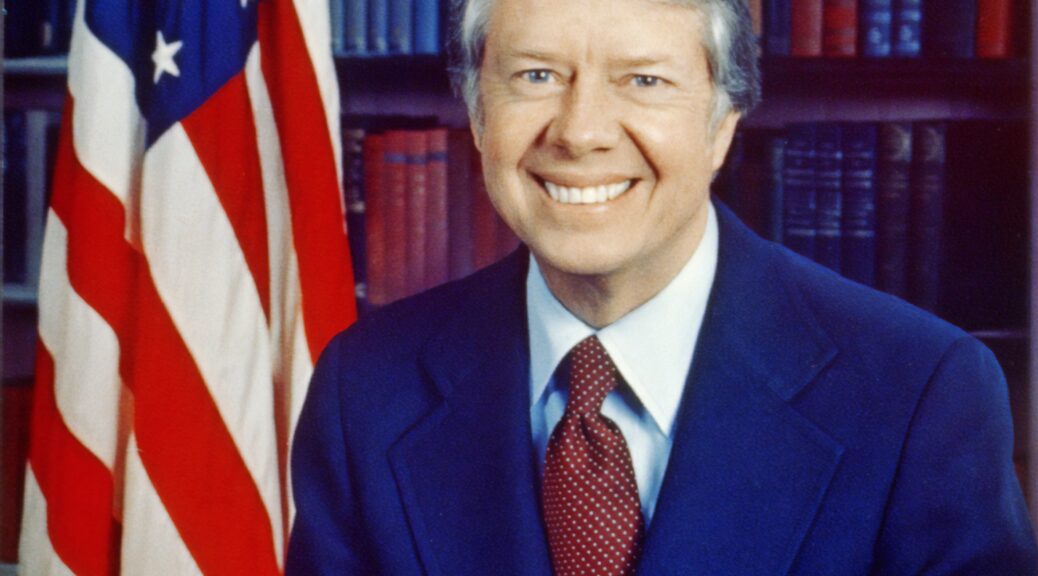
I did not pay much attention to Jimmy Carter during his presidency (I was too young at the time to care much), but I have believed for many years that he is among the greatest of the American nation’s former presidents.
Ask people of a certain age what they felt about the Carter presidency you will often hear harshly critical reviews. He was weak and indecisive, unable to solve a national “malaise,” serious economic crisis, and the Iran hostage crisis. Historians are gradually coming to view him in less unforgiving terms. According to Siena College, Carter ranks 24th in their list of American presidents. He was ranked second only to Lincoln for presidential integrity. Most polls place him right in the middle: well ahead of all those gilded age and antebellum failures, and ahead of Nixon, the second Bush, and Trump as well.
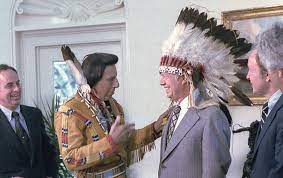
In the coming days we will see many assessments of Carter’s presidency. I expect none of those to say anything about Indian affairs. His policies with regard to Indigenous peoples in Alaska brought lasting change and significant hard feelings. (A good review is available here.) He famously posed for a White House photo with “Pretendian” Iron Eyes Cody. But President Carter also signed some of the most significant legislation enacted in any presidency.
Carter and “Iron Eyes” Cody at the White House.
President Carter followed and expanded on the shift towards “self-determination” in the conduct of the American Nation’s Indian policy. Congress took the lead, continuing work it had begun under Nixon and Ford, but Carter can take credit for signing the legislation into law.
Acknowledging that in the past the United States had pursued policies that “resulted in the abridgment of religious freedom for traditional American Indians,” Congress in August approved the American Indian Religious Freedom Act, which pledged the United States “to protect and preserve for American Indians their inherent freedom to believe, express, and exercise the traditional religions of the American Indian, Eskimo, Aleut, and Native Hawaiians, including but not limited to the access to sites, use and possession of sacred objects, and the freedom to worship through ceremonies and traditional rites.” AIRFA was limited in its effect by the Supreme Court, but it was an important statement from a government that historically had done so much to eradicate Indigenous religions.
Aware of the growing number of native peoples who belonged to communities that had neither signed treaties with the United States nor been the specific objects of federal legislation, Congress in early October established a set of guidelines for the “Federal Acknowledgment of Indian Tribes” that had not been officially recognized by the government in the past as Indian. The “acknowledgment” statute required that an Indian tribe, in order to be formally recognized as such by the Interior Department, demonstrate that they had “been identified from historical times until the present on a substantially continuous basis as ‘American Indian,’ or ‘aboriginal.’” They needed to demonstrate as well that the members of the community had inhabited a specific area or that they live “in a community viewed as American Indian and distinct from other populations in the area.” The petitioning tribe was also asked to establish that it had “maintained political influence or other authority over its members as an autonomous entity throughout history until the present.” Acknowledgment, the statute read, “is a prerequisite to the protection, services, benefits, from the Federal Government available to Indian tribes.” Such acknowledgment, the statute continued, “shall also mean that the tribe is entitled to all the immunities and privileges available to other federally acknowledged Indian tribes by virtue of their status as Indian tribes as well as the responsibilities and obligations of such tribes.”
Two weeks later, Congress passed the Tribally Controlled Community College Assistance Act, which provided grants for the operation of junior colleges on Indian reservations in order “to insure continued and expanded educational opportunities for Indian students.” Native communities had long recognized the importance of higher education, but access had always been a challenge. Cankdeska Cikana Community College, formerly known as Little Hoop College, was founded by the Spirit Lake Dakotas in North Dakota in the early 1970s. The college provided vocational and technical training, but also a curriculum that fostered “the teaching and learning of Dakota culture and language toward the preservation of the tribe.” Other communities established colleges throughout the West early in the 1970s, beginning with Navajo Community College. In response to the passage of the 1978 statute, a number of western tribes established new institutions of higher learning emphasizing a culturally relevant curriculum. Little Big Horn College, founded at Crow Agency on the Crow Reservation, struggled to survive with scarce resources in its early years but grew into a successful junior college. From thirty‐two students during its first semester in 1981, now more than 300 students enroll each term. All take courses in Crow Studies alongside a variety of skills‐based programs and courses designed to prepare them for transfer to four‐year colleges.
Congress in 1978 attempted to address the legacies of some of the nation’s most destructive policies toward Indigenous peoples. Early in November, Congress enacted a series of educational reforms for schools operated by the Bureau of Indian Affairs, designed to provide equal educational opportunity for Indigenous children. One week later, Congress passed the Indian Child Welfare Act, designed to halt the traumatic removal of Indigenous children from their homes through fostering and adoption. The problem was severe. Dakota Sioux at Spirit Lake, for example, had asked the Association of American Indian Affairs (AAIA) to investigate such removals, and the AAIA reported that of the 1100 Dakotas under the age of 21 who lived at Spirit Lake in 1968, 275 had been separated from their families. In states with large Native American populations, the AAIA found that between 25% and 35% of children had been removed from their homes. Indigenous peoples organized to halt this highly destructive practice, and the battle for the passage of the Indian Child Welfare Act, according to its best historian, “represented one of the most fierce and successful battles for Indian self‐determination of the 1970s.” ICWA, as it’s known, committed the United States “to protect the best interests of Indian children and to promote the stability and security of Indian tribes and families by the establishment of minimum standards for the removal of Indian children from their families and the placement of such children in foster or adoptive homes which will reflect the unique values of Indian culture.”
Decisions by the Supreme Court have already weakened many of these signal legislative achievements, and decisions looming on the Court’s calendar threaten to do even more damage. Carter certainly accomplished less than he might have hoped, but by following the lead of an energized legislative branch, he brought far-reaching change. In the assessments of his long career that appear in the coming days, this should not be forgotten.
City boosters could look to the future of Syracuse with enormous optimism. Harvey Baldwin, in 1846, gave a speech extolling the city’s many virtues, “the most sanguine, hopeful, confident,” that had ever been delivered on the Salt City’s. When Baldwin arrived in Syracuse, it had barely five hundred residents. Now more than ten thousand lived there. Baldwin expected Syracuse to continue to grow, to outpace its rivals Rochester and Buffalo. “Immense structures of compact buildings will in every direction cover this delightful plain, and every hill, knoll, and swell of ground be occupied by some stately mansion or neat cottage.” Meanwhile, “all bordering territory will have been brought into a high and perfect state of cultivation, and our beautiful lake, on all its beautiful shores and borders, will present a view of one continuous villa, ornamented with its shady groves and hanging gardens, and connected by a wide and splendid avenue that shall encircle its entire waters, and furnish a delightful drive to the gay and prosperous citizens of the town, who will, toward the close of each summer’s day, throng it for pleasure, relaxation or the improvement of health.” And “in every salt manufactory that studs its shores will be seen the ponderous steam engine, breathing forth its heated vapor, and by the same power drawing rich treasure from the bowels of the earth, and converting it into an article indispensable to the human family; while it drives a thousand wheels and propels cotton, woolen and flouring mills, and all the varied machinery known to man or that may be by man’s ingenuity designed and adopted to his necessities and wants.”
Syracuse grew into an important industrial center. Those economic enterprises Baldwin envisioned blossoming along the shores of Onondaga Lake produced what was, for many years, the most polluted body of water in North America. Onondaga Lake, which the Onondaga Nation today considers a sacred site, was brutalized by pollution. Years ago, I began working on a research project exploring the Onondaga Nation’s ties to the lake, and collecting evidence on the history of industrial pollution on the lake, on Onondaga Creek which flowed through the Onondaga Nation Territory, and other waters in the Onondaga Lake watershed. Though I am currently writing a book on the history of the Onondaga Nation, I have a lot of material on the lake’s toxic history that I thought would be appropriate to share here. If you have any suggestions or comments, please share. Someday, if time allows, I may produce documentary history of Onondaga Lake and its intersections with the history of the City of Syracuse and the Onondaga Nation.
Books, Dissertations, and Theses
There are a number of important books, articles, and dissertations that explore the history of Onondaga Lake. If you are interested in reading about the lake and its pollution, you should look at the following:
Alexander, Maurice The Ecology of Onondaga County and Vicinity, Syracuse: State University of New York, College of Environmental Science and Forestry, 1976.
Alexander, Michael Douglas. “Hanging Gardens: The Untold Story of Onondaga Lake,” CRP Honors Thesis, Cornell University, 2002).
Barnhill, S. Kathleen. “Negotiating Sacred Space: Indigenous Participation in Local Environmental Governance,” MS thesis, SUNY-ESF
Benton, L. M. “A Witches’ Brew: A History of Pollution in Onondaga Lake,” M.A. thesis, Syracuse University, 1992).
Bergeron, Emily. “From Sovereignty to Superfund: The Onondaga Nation’s Legal Battle for Land Rights, Environmental Justice, and the Remediation of Onondaga Lake,” Ph.D Dissertation, Cornell University, 2017.
Bray, William L. The Development of the Vegetation of New York State. Technical Publication No. 3, (Syracuse: New York State College of Forestry, 1915).
Connors, Dennis J. The Search for the Jesuit Mission of Ste. Marie de Gannentaha,(Liverpool, NY: Office of Museums and Historical Sites, County of Onondaga Department of Parks and Recreation, 1980)
Dumas, Ashley A. and Paul N. Eubanks, eds. Salt in Eastern North America and the Caribbean, (Tuscalossa: University of Alabama Press, 2021).
Gray, Barbara Anne. “An Eagle’s Cry: The Impacts of Environmental Injustice on Haudenosaunee Culture,” Ph.D. Thesis, Arizona State University, 2008.
Jamieson, Gerald S. “Cultural Loss and Traditional Values in the Natural Resource Damage Assessment and Restoration Process,” MS Thesis, SUNY-ESF, 2011
Kimmerer, Robin Wall. Braiding Sweetgrass. (Minneapolis: Milkweed Publications, 2013).
Landis, Catherine. “The Heart of the Country: Historical Ecology of Onondaga Lake,” Ph.D. Diss., State University of New York, College of Environmental Science and Forestry, 2018.
Metz, Elizabeth. Sainte Marie among the Iroquois: A Living History Museum of the French and the Iroquois at Onondaga in the Seventeenth Century, (Syracuse: Quartier Printing, 1995).
Munson, Lilian Steele. Syracuse: The City that Salt Built. (New York: Pageant Press International, 1969).
Rushak, Elaine. “A History of the New York State Salt Springs Reservation at Onondaga, 1788-1820,”( M.A. Thesis, SUNY-Buffalo, 1979)
Storey, Mike. Heartland: A Natural History of Onondaga County, New York., (Syracuse: Onondaga Audubon Society, 1977).
Stradling, David. The Nature of New York: An Environmental History of the Empire State, (Ithaca: Cornell University Press, 2010).
Vertigan, Richard. “Reclaiming Onondaga Lake: The Role of Community Attitudes,” MS Thesis, SUNY-ESF.
Newspaper Timeline:
The citations below include many of the quirks with which I work. This timeline could not have been assembled with the assistance of Will Porter and Peter Olsen-Harbich. Will and Peter both graduated from SUNY Geneseo, and went on to complete their doctoral dissertations at Harvard and William and Mary, respectively. Will completed his dissertation in English, Peter in Early American History.
1819 14 August Plough-Boy, “The Onondaga Salt works improve by experience. The present season will produce an increased quantity and of superior quality. Revenue estimated at 60,000 dollars, which belongs to the Canal fund.”
1822, 18 July “Course Salt.” Long-Island Star, “We yesterday received from Colonel Wheeler, of Salina, as a sample, a small box of salt, made at his works at Salina, byt the process of slow evaporation by means of heated tubes passing through vats of salt water. This, we are told, is altogether a new invention in the history of making salt….We are unable to say with what facility salt may be manufactured on this plant; but we are informed it can be made with much less expense than by the usual mode. The sample sent us is very superior.”
1822 2 August Spectator. New method of producing salt established and discovered. The brine at Saline is five or six times as saline as the ocean, and the result of the boiling produce “must of course be in the same ratio.
1824 1 July “Salt,” “Long-Island Star, “A cargo of salt, course and fine manufactured at Salina Onondaga county has arrived at Albany. The Albany Advertiser states that ‘there is no doubt but New York alone can supply all the northern states, if not the whole union, with salt of as good quality, and at as cheap a rate, as it can be afforded by the importers of that article of necessity.”
1826 8 June “A Great Curiosity,” Long-Island Star, “A stone has recently been found in the town of Salina, Onondaga county, which is pronounced by those who have examined it, to be a petrefaction of the human head. The outlines of the organs, and the exact proportion of their location, is almost demonstrable proof of the fact.”
1826 21 July “A Discovery,” New York Spectator. “The Syracuse Gazette says a salt spring has lately been discovered on the margin of the Onondaga Lake, about a mile and a half from the Salina Springs. Its water is represented to be heavier, and is pronounced by good judges to be equally as strong, as the water at Salina; and will afford as great a quality as either of the springs now in use.
1832 15 January “Onondaga Salt,”Evening Post (NY). A brief note on salt. “By a report of the superintendents, it appears that 1,514,037 bushels of salt have been inspected at Salina during the past year, of which 163,004 bushels is coarse salt, manufactured in vats by solar heat.”
1843 29 May “American Salt,” Letter to editor. Brooklyn Evening Star. Not sure how relevant this is, but thought I would note this for the sake of keeping track of the salt industry. “The supply of saline waters at Onondaga is inexhaustible, and no doubt derives its rich store from the salt gem close by. It will not be among the greatest wonders to see the beautiful Onondaga salt among the articles of export of our merchants. The state tax upon the salt made at Onondaga, was a tax upon labor, and therefore oppressive, and part of the last year compelled the laborer to be idle, and besides it was an embargo upon its locomotion for the salt could only be carried one way. If it come east it met the foreign salt, and was put down by competition. It is a source of gratification that salt can be brought into the market here and sold for 20 cents per bushel, from a distance of near 300 miles in the interior, and that the farmer can for about one pound of fresh butter purchase a bushel of the salt of Onondaga. The time was, when the back woods people gave two pounds of butter for one pound of salt.”
1843 20 July Salt. More on the salt industry, this time from the Brooklyn Evening Star. “The villages of Syracuse, Salina, Liverpool and Geddes, almost adjoin each other, and lie at the head of this lake, and probably at some day not far distant will form one great city. These villages are indebted for their prosperity and importance to the Salt trade which is so extensively carried on there. The Salines, the lake and the land was the property of the red man of the forest—the nation of Indians known as the Onondagas, resided here, and the remnant of that people still occupy a reservation a short distance from the Salines, which is known as the Onondaga Reservation. Near sixty years ago these Indians made a grant of the Salt Lake and the lands appurtenant to the people of this state, for the use of the Indians and the White men forever, for a small consideration in hand, and an annual payment of small amount in addition thereto.”
1845 4 December New York Herald: “A slat spring is said to have been discovered by some Indians of the Onondaga tribe, within but a short distance of our village. The spring has been visited by several of our citizens, two or three of whom have made arrangements to test the saline properties of the water and ascertain by experiment, whether the manufacture of salt from it can be made profitable.” Originally from the Ithacan Journal.
1856 22 November Syracuse Standard. OHA Clippings File. “We saw yesterday at a fish stall near Ashby’s grocery store, on the north side of the canal, a large and very fine lot of White Fish which were taken from the Onondaga Lake, at a depth of forty feet. Fishermen say this is the first season in twelve years that these fish have made their appearance in this Lake.”
1861 8 February Ice Advertisement, Syracuse Journal. OHA Clippings File. “My ice is all taken from the ONONDAGA LAKE, is hard, solid, and clear, free from impurities of every kind, put up in cold weather, and was selected with great care for Family Use . . . .” Jos. Savage.
1866 26 April. “Shad in Onondaga Lake, “ Albany Argus. Fish dealer is selling the “first shad ever caught in that lake.”
1872 21 March “Restocking Onondaga Lake with Fish.” Commercial Advertiser. 10,000 black bass and 10,000 salmon to be stocked.
1875 No Date “The River of the Senecas” Syracuse Newspaper in Beauchamp Scrapbook, Box 31. A travel journal highlighting the waterways flowing northward into Lake Ontario. “From the Onondaga Outlet to the lake is the old historic part of that river. Above that, indeed, it formed one great public highway for the red men, but whites were seldom found upon it until after the Revolution. Our early knowledge of it belongs especially to that part which the whites traveled, in seeking the castle of the Onondagas. Here came the early traders and missionaries. Here toiled or floated the army of Count Frontenac. Here ambassadors wended their way; and here war-parties passed to strike the French settlements.
1880 27 August Syracuse Journal. OHA Clippings File. “Several lads residing in the Seventh and Eighth Wards of this city and Geddes have had the skin of their bodies poisoned by bathing in Onondaga lake, near the mouth of Onondaga Creek.”
1884 16 June “Opening an Indian Burial Ground,”NYT. “On Saturday, while laborers were engaged in leveling a mound of earth in a grove at Long Branch, a Summer resort on the shores of Onondaga Lake, they came upon a pile of skulls and skeletons ranged side by side in regular order. The excavations were continued until the bones of a large number of Indians were discovered. The skeletons lay in a row with their heads to the south. The bodies crumbled to dust on being exposed to the air. The skulls were in a good state of preservation. A large number of flint arrowheads were found. The mound was undoubtedly a graveyard for the Onondaga Indians many years ago. Dr. Hamlin, the archaeologist, drilled into the mound which had excited his curiosity, but without discovering anything.”
1885 23 July “A Naturalist’s Ramble: The Great Text Book of Nature as Seen in Onondaga County.” Syracuse Journal. OHA Clippings. Piece by Beauchamp describing the natural world, including the mollusks of Onondaga Lake.
1886 No Date “Salt Manufacture: The Origins and Progress of that Important Industry,” Syracuse Newspaper Clipping, Beauchamp Scrapbooks, Box 36. Centuries ago there dwelt in our new beautiful city of Syracuse and its surroundings a tribe of Indians of whom the great Hiawatha said, ‘You Onondagas who have your habitation at the great mountains and are overshadowed by its crag, shall be the third nation, because you are greatly gifted in speech and mighty in war.’ The country occupied by the Onondagas was fertile and fruitful, and the extensive water facilities were of great service in commerce, as the different trading posts were more accessible by water than by land. The place where the Onondagas were situated was considered the center of the Iroquois nation.” The article goes on to describe the French mission and all the Europeans who wanted access to and control of the lake. The Onondaga Lake “was greatly prized by the Indians and many beautiful legends are told in connection with it. How beautiful must have been that picturesque lake with its charming blue waters and delicate white edging, as the mellow lights from the camp fires of the Indian braves overspread his waters. A spring bubbled here and there along the shore, depositing its waters on the bank, and as the water evaporated a white substance remained which they called salt. The existence of these springs was known to the Indians long before the advent of the early Europeans.”
1889 12 December “Removal of Disease Producing Material,” Northern Christian Advocate. “The matter of disposal of sewage forms a prominent question for inland cities and towns. The city of Syracuse, for example, is discharging its sewage into Onondaga Lake, just outside city limits, and is slowly making of it one immense cess-pool whose disease germs may some day return to smite the city as with a scourge.”
1890 2 February “Onondaga Lake Undergoing a Complete Transformation.” Syracuse Standard. OHA Clippings Files. “Ducks are quite numerous about the lake owing to the open water. Hunters who are hardy enough to stand the rough weather are having some fine sport. Early last week George Lodder bagged 13 and Edward Mann 11 in a walk around the lake. A wild goose, which weighed nine pounds, was shot by a hunter from the Second ward on Friday. There is a little ice on the borders of the lake, and large white fish are being speared through holes in the ice by some of the expert spearsmen.”
1894 6 October “An Unaccountable Change in the Color of Onondaga’s Waters.” Syracuse Standard. OHA Clippings Files. “Owen Donovan, proprietor of several popular resorts on the lake, was asked if he had noticed the change. ‘Yes, I have,’ said he, ‘and it is one of the queerest things I ever saw. Everybody who has been on the lake must have noticed the change in the color of the water. The last time I took a party across on my steamer we couldn’t talk of anything else. Some thought it was merely due to the reflection of the sun, but others declared that they had noticed the same phenomena when the sun was obscured. I believe it is owing to the Soda Ash factory. The refuse from that factory is carried by an inlet right into the lake. I think it will also have the effect of destroying our ice crop within a few years.”
1895 No Date “Old Spots Made New: Resorts of Pleasure-Seekers Known to the Indians and the Jesuits,” Syracuse Newspaper Clipping, Beauchamp Scrapbooks, Box 34. “Summer visitors to Onondaga Lake and its tributaries only go in the tracks of the aboriginals and pioneers of this country. The whole region round about is marked by footprints of an ancient occupation. If the farmers, who resort once a year after harvest time to Three River Point, lately called Three Rivers, knew that centuries ago this point was acknowledged as one of great strategic importance it might give them additional interest in its history.” The article proceeds to discuss various historic sites around the lake. “Two hundred years ago our locality was nearly the dividing line between two contending powers for supremacy in America.”
1896 May Local History Leaflet, Written by Beauchamp. Published by OHA, May 1896. OHA Clippings Files. “Before the middle of the seventeenth century the Onondagas had little use for the lake which bears their name. Almost all the Indian remains about it are of earlier tribes, having little affinity with them. They did occasionally visit the lake, and the formation of the Iroquois League, about 1600, is traditionally assigned to the high banks north of Liverpool. A few Iroquoian relics have been found there. .The French colony of 1656 drew a few Indians there, but they soon returned to their great village in Pompey, and we hear no more of the Onondagas at the lake until the year 1700. At that time Livingston wrote about a proposed fort at Onondaga, where the English had previously assisted in the building of one burned in 1696, a little south of the present village of Jamesville, and on the Watkins farm. He thought it ‘not proper to build a fort at Onondaga for these reasons: 1. Besides the difficulty of the two carrying places, you cannot come nearer than 16 miles to the Castle by water, except they go round by Kanienda, so that the carriage of provisions by land so far will be dangerous, difficult and chargeable.’ He also said that ‘Keneenda is within eight miles of the Castle.’ The same year a Seneca reported that the French intended building a fort ‘at Kaneenda, a fishing place of the Onnondages, eight miles from their castle, their landing place when they came from hunting over Cadaracqui lake,’ or Lake Ontario.”
1899 17 November Post Standard. OHA Clippings File. “The Members of the State Board of Health when in this city Thursday visited Onondaga Lake and expressed the opinion that the running of refuse into the lake must be stopped sooner or later. This is an observation that has been made at various times by people in Syracuse who are interested in the welfare of the city. With the growing interest taken in Onondaga Lake it is apparent that steps must be taken before long to preserve the purity of the water.”
1901 2 February “City’s Open Sewer to Lake.” Syracuse Journal. OHA Clippings File.“Complaints are being made that the Solvay Process refuse is choking up the Onondaga creek at the point where it enters Onondaga Lake, and fears are expressed that eventually the flow of sewerage into the lake will be impeded, if not entirely stopped. The attention of the city authorities has, it is said, been called to the alleged nuisance and it is possible that steps maybe taken to abate it.”
1909 27 November “Net Fishing is Blamed by Mr. Bierhardt for Disappearance of White Fish from Onondaga Lake.” Post Standard. OHA Clippings File. “Few Left now, he declares. Well known angler believes sewerage pollution responsible for extermination of other fish form the lake.” The story continues: “While the sewage from the city, carried to the lake, has contaminated the waters so as to render them practically deserted by the finny tribe, and Solvay refuse has destroyed the spawning beds, it was the predatory instinct of man that resulted in the death blow about ten years ago to this species of Onondaga fish, esteemed by epicures as a delicacy par excellence. . .”
1911 2 August “Water Quality Improved at the Summer Resorts.” POST STANDARD. Drinking water remains safe (unclear if water is from Onondaga Lake.
1912 9 July “Double Number of Swimming Places Needed in Syracuse—All Now Available Too Crowded, Says Superintendent Campbell—Hundred Use Municipal and Y.M.C.A. Pools Every Day.” POST STANDARD. David Campbell, superintendent of parks, understands the pollution of Onondaga lake as an act of “the white man.” He stated that “when the state and municipal improvements planned are carried out, when the sewage is disposed of by other means than it is now and when Onondaga lake in years to come again assumes something of the condition in which it was when the white man found it, it will be the greatest blessing known to Syracuse in summer.”
1912 12 September “Asks $500 for Plunge in Stream of Hot Waste—Stillman Bring Suit Against Solvay Company—Horse Killed When Bridge Falls.” POST STANDARD. Waste flowing from the Solvay Process Works company onto the shore of Onondaga Lake instantly kills a horse and burns a man up to his legs. Click
1914 19 June “Anglers Measure Catches made in Annual Contest—Awards to be Announced Next Week at banquet—Many Fishermen Display Prizes, Yet ‘It’s Not What it Used to be’ is the Complaint.” POST STANDARD. Anglers blame new barge canal for the lack of large fish in Onondaga Lake
1915 1 May “Discuss Sewer Screen System—W.L. D’olier And Intercepting Board Consider Purification Plans—Inspect Location Of Plant—Sanitary Corporation Men Go To Lakeview Point After Conference—Onondaga Creek Work Progressing Rapidly.” POST STANDARD. The state has indicated that it will require Syracuse to install screens or tanks in addition to filters in the water purification plant in construction at Lakeview Point
1915 12 October “Onondaga Park Overflow Problem For Commission—No Funds To Pay For New Main Suggested By Bureau Of Water.” POST STANDARD. A new ten-inch main is required to dispose of overflow from Onondaga Park Lake; dispute over responsibility for payment.
1916 22 June “Solvay Process Erecting Large Water System—Pump House And Conduit Line To Be Finished About Sept. 1—Investment Of $300,000—Pipes Extending 1,500 Feet Into Onondaga Lake Have Diameter Of Six Feet—Sections Weigh 8 Tons.” POST STANDARD. System will have the capacity to remove water from Onondaga Lake at a rate equal to that required by the entire city of Syracuse. Water will be used for cooling purposes only, and 95% of water will be returned to the lake “purer than before.”
1917 17 August “Semet-Solvay Plans To Stop Lake Pollution—Disposal Plant Will Be Erected To Take Care Of Split Rock Wastage—Will Divert Brook—Swimming Pool At Onondaga Lake To Be Supplied With Skaneateles Water During Construction Work.” POST STANDARD. Chemical waste has entered Hiawtha Lake through Stolp Brook. Some worry that the Woodlawn reservoir will not be able to supply enough Skaentaeles water for the swimming pool.
1917 7 October “Wanted: A New Canal Through Cicero Swamps—Project Would Cut Thirteen Miles From Present Water Way And Bring About New Factory Development—Oneida Lake To Onondaga—Planning Commission Backs Scheme To Increase Shipping Facilities For Syracuse—Experts Advise Quick Action—Cost Would Be Small In Proportion To Gain; But One Lock Needed; Private Concerns May Develop Scheme—Would Reclaim 10 Square Miles of Fertile Land—Canal Would Drain Large Territory and Restore Fertile Acres to Agriculture—Great Swamps to Disappear—Zone Two Miles Wide From New York Central Cut-Off to Oneida Lake is Needed—Industries Must Expand—Section North of City Only Available District; Channel Will Parallel Railroad, Getting Double Service.” POST STANDARD. Cicero swampland is extremely fertile and inhabited by Italian immigrants. The proposed canal from Oneida-Onondaga Lakes is listed as having three purposes: providing better water service to the city of Syracuse, draining the Cicero swamps (thus opening up its land for agriculture), and prompting the development of a new industrial section of Syracuse around the northern shore of Onondaga Lake.
1927 15 October “Ka-ne-en-da, Fishing Village of Indians, Now Under Waste: Syracuse Archaeologist Tells Members of historical Association of Early Iroquois Land Given to Englishman in 1752,” Post Standard, Newspaper Clipping, Beauchamp Scrapbook, Box 38. The site has disappeared under “Solvay lime waste.” And this: “Ka-ne-en-da is gone, but the Solvay Process Company wants to build a bulkhead across the south end of the lake, fill it with refuse and put on a top dressing of earth for the purpose of making it into a park, Dr. Hinsdale said.” Hinsdale was an archaeologist addressing the Onondaga Historical Association.
1930 23 February “Seek to Save Lake: Syracusans Would Restore Former Beauties of Onondaga.” NYT. “Before refuse was dumped into the lake it had all the charm it possessed when Hiawatha knew it in 1600. Hiawatha formed the Iroquois Indian confederacy on the easterly shore of the lake. This is historically true, Longfellow having used poetic license in associating the Indian leader with the Ojibways of the Middle West.” The story recounts the destruction: fish species eradicated, like the Whitefish, the smell, and the movement that was underfoot in the city to reverse course and save the lake. The point is that Syracusans at an early point in time recognized that they had a significant problem on their hands, and that the lake had a long cultural connection to the Onondagas.
1931 27 June “Solvay takes Up Indian’s Discovery. “ Journal. Newspaper Clipping. Beauchamp Scrapbooks, Box 40. “Discovery by Albert Shenandoah, an Indian living on the Onondaga Reservation, of a process for converting Solvay waste into building material, is under investigation by engineers of the Solvay Process Company, according to an announcement by Shenandoah Saturday. The process, on which the inventor has been at work for three years, involves combination of the waste—of which millions of tons are piled along the Onondaga lake shore—with other substances to form a mixture which can be molded into any shape or form and used in place of lumber or brick.”
1931 27 September “Indian’s Find May Restore Lake Beauty: Schanandoah Discovers use for Waste Piled Up About Onondaga.” Post Standard. Newspaper Clipping. Beauchamp Scrapbooks, Box 40. Important story. “Will an Indian whose forefathers paddled their canoes over its waters, fished in its depths and hunted along its shores be the one responsible for restoring Onondaga Lake in a large part to its natural beauty?” Scanandoah [the spelling changes in different stories] collected the waste. He guarded his secret closely, but did show the end result. “Years ago the company began acquiring lowlands along the shores of Onondaga Lake or the right to deposit its waste on them, and since the beginning has filled such lowlands from near Park Street on the south shore of the lake to and past the former mouth of Nine Mile creek on the west shore, north of the state fairgrounds, a distance of nearly four miles.” A “white-lime embankment along two thirds of the west shore of the lake” can be found
1932 13 November “First French Fort in Area Now the U.S. Will Be Reproduced on Original Site Overlooking Onondaga Lake.” Herald. Newspaper Clipping, Beauchamp Scrapbooks, Box 41
1933 30 July “Jesuit Well Rites Part of Parkway Fete: K of C. to Dedicate Salt Base on Onondaga Lake, Aug. 16. Indians Feared Spot.” Herald. Newspaper Clipping, Beauchamp Scrapbooks, Box 41.
1933 16 August “Replica of Jesuit Stockade Feature of Lake Parkway: Buildings of Settlement of 1656 Reproduced on Bluff Overlooking Onondaga.” Post Standard. Newspaper Clipping, Beauchamp Scrapbooks, Box 41. There was considerable interest in Syracuse about the city’s colonial past. The article said little about the Indians, and the Onondagas do not appear to have been involved in any of the planning, but there was a community offered abundant evidence about the lake’s historic significance
1935 29 September “Graves and Legends Reveal Life of Onondaga Tribe in Early Days when Settlers Came to Salt Springs: Pioneers’ Sugar Loaf Hill Once was Indians’ Beacon Pinnacle.” Herald. Newspaper Clipping, Beauchamp Scrapbook, Box 42. “Syracuse is in the center of a section noted for its Indian history. In early days a main encampment of the Onondagas was near Jamesville. The present reservation of the Onondaga Indians is located not far from the city. There are many spots within the city limits definitely associated with Indian history. Indian graves have been found on a knoll between West Genesee Street and Onondaga Lake, and near North Geddes Street, and again on the bank of Onondaga Creek, near West Genesee Street, proving that, at an early date, there was an encampment of Indians there, probably working the salt springs with which the region abounded.”
1946 3 February Letter to the Editor from William Maloney. Post Standard. OHA Clippings File. Blamed the city for despoiling one of God’s choicest gems, Onondaga Lake.” Citing Solvay Process, Maloney noted that “these huge pyramids of sludge built upon the shores of Onondaga Lake and city-owned land are mute testimony to the sins of our community.”
1946 28 April “Pump Moisture out of Solvay Sludge, Cover with Topsoil, Engineer Advises.” Post Standard. OHA Clippings File. “Plan for reclamation of Onondaga Lake and ridding the locality of the mountains of Solvay Process Co. sludge was advanced last night by Oscar D. Guilfoil, 213 Green Street.
1946 16 June “Lake Cleanup to be Pushed.” Herald Journal. OHA Clippings File. “Citizen-inspired movements to return Onondaga Lake to is natural state—for many years as ‘bogged down’ as the pollution itself—are gathering momentum, along with widespread public support, as evidenced by three major developments in the cleanup battle revealed yesterday.”
1946 18 June “State Probe Of Onondaga Lake Proposed.” POST STANDARD. Proposition calls for the creation of a committee run by state officials to conduct witness examinations and subpoena records pertinent to the pollution of Onondaga Lake. The committee will then submit drafts of legislation that will carry out their recommendations for restoring the Lake
1946 19 June “Officials Of State Being Tests For Pollution—Survey Is Aimed At Determination Of Effects On Fish.” POST STANDARD. State aquatic biologist tests portions of Onondaga Lake for organic and chemical pollution. Special attention is being paid to testing the water for phenols, which are present in the chemical waste of coke production.
1946 20 June “Plenty Of Carp Found By Biologists At Lake.” POST STANDARD. No other fish removed from Onondaga Lake. State conservation experts take this as evidence that pollution has affected “only the quality—not quantity” of fish life. The fish is not considered edible by upstate New Yorkers but is known to be “hardy” and “prolific” as well as resistant to pollution. The carp will be examined in a Rochester laboratory.
1946 23 June “Solvay Process May Not Fight State Action To Recover Lake Land.” POST STANDARD. Maloney, activist, has stated that Solvay has no chance in court if they attempt to make a claim to the land. It is believed that Solvay encroached on public land beyond the limits of its deed in order to further its pollution. The village of Solvay is also mentioned as a primary polluter, as its sewage system dumps directly into the Lake without any treatment.
1946 24 June Political Cartoon Commenting On Onondaga Lake Pollution. POST STANDARD.
1946 30 June “Survey Shows Leaks Into Onondaga Lake At Solvay Waste Beds.”POST STANDARD. Leaks from Solvay’s dykes result in a sludge channel that first combines with the village of Solvay’s sewage to form a stream of pollution directly into Onondaga Lake. A dead carp was spotted by a survey boat. “At times, the stream also runs almost wilk white far into the lake with Solvay waste…for several hundred yards out into the lake at the mouth of the creek, bubbles arise contently as in a stagnant pool.” Records indicate that Solvay and the city of Syracuse have been cooperating in their mutual dumping of sewage into the lake as far back as 1896. The Liverpool chamber of commerce hopes to show that Solvay has encroached on public land by dumping its sewage on lake bottom owned by the city, with the goal of this demonstration being to attract the attention of the state department of canals and waterways.
1946 3 July “Appeal Made To State To Halt Solvay Process Dumping—Court Writ Sought In Onondaga Lake Cleanup Campaign.” POST STANDARD. Appeal filed by William A. Maloney, pollution activist. Maloney protests the long extension granted to Solvay for answering the state’s pollution complaint.
1946 7 July “Lake Pollution Tours Slated.” Two surveys will be made of the Lake, one by a special sanitary engineer from Albany and the other by prominent Syracusans. Maloney praised the cooperation of the State in addressing the pollution issue.
1946 9 July “Trout Found Dead In Stream—Nine Mile Creek Pollution Source Sought By State.” POST STANDARD. Sixty dead trout found. Sanitary experts from Rochester have been dispatched to investigate. Paper and Woolen mills are located on the stream. Nine Mile Creek is the outlet of Otisco Lake.
1946 24 July “State Finishes Investigation Of Onondaga Lake.” POST STANDARD. The report of the state department of public works has been referred to Attorney General Goldstein. Maloney states that the department has gathered evidence of encroachment on state waterways.
1946 2 August “Fishermen Awaiting Report On Nine Mile Creek Pollution.” POST STANDARD. The state conservation department has been too concerned with Onondaga Lake to pay much attention to the creek.
1946 4 August “State Promises Support In Onondaga Lake Pollution Fight—Maloney Assured Of Albany Interest In Solvay Battle.” POST STANDARD. Assistat Attorney General Arthur Mattson pledges his support to Maloney. Maloney charges that the Syracuse chamber of commerce has demonstrated a “very definite lack of interest in the manner.”
1946 4 August “ ‘Pollution’ Sign Bearer At Thruway Demonstration Sues State—Unlawful ‘Arrest,’ Assault Claimed By Liverpool Man.” POST STANDARD.Albert E. Pope was arrested after attempting to attract the attention of Gov. Dewey by displaying placards. He was arrested while walking away from the demonstration.
1946 15 August “State Authorizes Onondaga Creek Control Project—Negotiations Due For Compromise With Indian Nation.” POST STANDARD Albany has given final approval for the creek plan. Congress has also approved financing. The state is responsible for obtaining rights-of-way, including furnishing land on the reservation.
1946 8 September “Welch Suggests Solvay Pay for Waste reclamation.” Post Standard. OHA Clipping Files. “Reorganizing operation of the state fair, to make it more truly representative of New York’s agricultural and industrial resources, and leaving it at its present site expanded to Onondaga Lake’s shore after making Solvay Process pay for reclamation of its wastelands are suggested in a new study of the future of the exposition. IN a 64-page illustrated book just published, Walter L. Welch, Syracusan long active in civic movements to improve the state fair, presents a detailed survey of the origins, history, and recommended future of the huge show.’ Welch said in this book that “’If the violated rights of the people of the state caused by the virtual encirclement and depreciation of the value of the fairgroundsby Solvay Process Co. are properly asserted by officials of the State who should do so, and proper restitution is made, there will be ample room available adjacent to the present site for a new exposition growing out of the old, with a beautiful promontory and lake side setting.”
1946 15 September “Onondaga Lake Group Charges State ‘Brushoff’—Maloney Asks Pollution Reports Be Made Public.” POST STANDARD. Maloney issues complaints that the pollution case has been repeatedly ignored by the attorney general, calls for the release of the report created by the canal and waterways division regarding Solvay’s encroachment.
1946 17 September “Pollution Probers To Be Taken On Onondaga Tour.” POST STANDARD. The Ostertag pollution investigators will be given a tour by the American Legion committee for improvement of Onondaga Lake.
1946 18 September “Legislator Asks United Effort In Cleaning Up Onondaga Lake—Ostertag Makes Appeal Following Survey By Boat.”POST STANDARD. Harold Ostertag, chairman of the special state committee on pollution abatement, declared that Onondaga Lake “has the appearance of a serious pollution problem,” and pleaded for the co-ordination of industrial, civil, and public effort in restoring the lake. Ostertag revealed that Governor Dewey had commented to him in conversation that the lake pollution was a “real problem.”
1946 19 September “Actions—Not Words—Demanded Of Legislators Water Pollution—100 Tell Committee Of Need For State To Clean Up Lakes.” POST STANDARD. The Ostertag committee was confronted by 100 citizens demanding the restoration of Onondaga and Oneida Lakes. The principal speaker for Oneida was the president of the Anglers Association, who recommended that a sanitary sewage district be established and that the state engage in a large scale program to eliminate carp. George W. Cregg, chairman of the American Legion committee on the improvement of Onondaga Lake, demanded that the current flow of pollution be stopped and that efforts be made to clean up existing damage. The Legion attracted the rebuke of a Syracuse citizen who stated that “we can’t persecute industries in Syracuse because we’ve got to make our daily bread.” Officials pledged solidarity on the pollution issue and the chairmain of the department of commerce reminded the assembly that New York state depends upon vacation revenues from those attracted to its waters. The assistant director of the division of sanitation of the state department of health reported that the municipalities of upstate New York must improve their sewage treatment facilities.
1946 29 November “Solvay Process Plant Installing Oil Burners—Half Of Required Power To Be Met By Coal Substitute.” POST STANDARD.
1947 30 May “Lake Reclamation Group is Chartered.” Post Standard. OHA Clippings. Onondaga Lake Reclamation Association, which will “wage a campaign to end pollution of the lake and restore it to its former condition.” It is worth pointing out that in the Onondaga Lake clippings file at the OHA, there is a synopsis of the Onondaga Lake Reclamation Problem written by Walter Welch, the research director of the Onondaga Lake Reclamation Association. See under Archival Collections, OHA.
1947 6 June “C Of C Lake Plan Called ‘Nonsense’—Move ‘Ducks’ Issue, Declares Maloney, Of Citizen Group.” POST STANDARD. Maloney stated that existing laws and commissions are sufficient to demand immediate state action on restoring the lake and to seize reparations and that the formation of new exploratory groups, as proposed by the chamber of commerce, is unnecessary. Maloney directly implicated local industry and local municipalities as the source of the lake’s ruin. Document is barely legible.
1947 30 June “Boy’s Essay on Reclamation of Lake Wins Check.” Herald Journal. OHA Clippings File. Thomas Clarke of Geddes St. won a contest from the Liverpool Chamber of Commerce. He made a number of arguments. The Lake was important in the city’s history. If clean, it could once again be a summer resort. And then, this: “The Onondaga Indians took pride in this lake and so resented the white man’s interference when they first tried to settle here. Would they take pride in that lake as it is today? It has lost its beauty, its fish, and other sports. The onetime Onondaga Lake could be restored to its former beauty and use within a few years if Syracuse would start a cleaning process on it.” Was he talking to Indians? Was Indians’ contribution common knowledge? Or was this a case of non-Indians romanticizing and appropriating Indian images for their own ends? Were the Onondagas involved in this debate? It is unclear.
1947 8 July “Onondaga Lake: Officials Fast Asleep.”POST STANDARD. Letter to the editor written by A.E. Pope. States that 19 corporations bordering Onondaga Lake and creek were served by the state with a 90-day limit threat of suit 75 days ago. Pope complains about being deprived of the state’s report on the lake. He implicates the municipal governments as negligent and culpable for the pollution.
1947 10 July “ ‘Brushoff’ Charged In Lake Reclamation—Maloney Hits Scientific Studies As Unnecessary.” POST STANDARD. Maloney states: “we’ll prove to the Albany officials that Onondaga lake either belongs to the people of the state or to the Indians who discovered it.” To the chagrin of Maloney, the state department of health refuses to act on pollution issue without further scientific studies that can demonstrate the lake’s pollution. Maloney dismissed the studies as superfluous and implicated the influence of “big interests and special privilege granted to corporate groups by the people we have elected to office” as the reason for further delays.
1947 14 July “Traisler to name pollution study group this week.” POST STANDARD. Group will be formed at the request of sportsmen groups. Nine Mile Creek, Onondaga Creek, and Onondaga Lake will dominate the group’s attention.
1947 15 July “Flash Fire Demolishes Part Of Solvay Plant—Two Men Hurt; Damage To Run Above $25,000.” POST STANDARD. Caused by the escape of benzol from storage tanks.
1947 3 August “N.Y. State Legion Adopts Onondaga Anti-Pollution Plan.” POST STANDARD. The N.Y State chapter of the American legion will present its demand for federal legislation against water pollution before the national Legion convention in New York City. Plan was presented by George W. Cregg, Syracuse activist for the restoration of Onondaga Lake.
1947 7 August “Inadequate Sewer Facilities Stressed At Pollution Parley.” POST STANDARD. Treatment of sewage at the main Syracuse plant achieves only 50% completion; many communities such as Solvay have no treatment of domestic sewage.
1947 20 August “Demand Solvay Alter Dumping Sewage In Lake—Proper Treatment Ordered By State Said To Be Ignored.” POST STANDARD. The Onondaga Lake Reclamation Association, Inc., demanded that the village of Sovay stop dumping its untreated sewage into Onondaga Lake after the division of sanitation revealed that Solvay had only been granted a permit to dump in Onondaga in 1932 on the condition that it treated its sewage. Maloney stated that he will travel to Albany in order to examine documents regarding the type of sewage being dumped by the Solvay company into Onondaga. He intends to attempt a legal revocation of the village of Solvay’s dumping permit.
1947 24 August “State Map Reveals Encroachments On Onondaga Lake Shore—Reclamation Body Asks Restrictions In Lake Dumping.” POST STANDARD. The state department of public works has shown the Onondaga Lake Reclamation Association, Inc., a map detailing the extent of Solvay Process Co.’s infringement on state lands. In response, the Reclamation association formally requested that the state department of health restrict Solvay Co. and the village of Solvay from dumping into Onondaga, asking explicitly for the revocation of the village of Solvay’s dumping permit. Maloney also stated that the revocation of the city of Syracuse’s dumping permit was imminent.
1947 26 August “Map Shows Lake Encroachment Of 3,400 Feet—Waste Beds Take 4 Separate Areas Along Shore Line.” POST STANDARD. Maloney intends to use the map to completely stop the dumping of sewage into Onondaga. He also plans to make a detailed study of the Syracuse sewage treatment plant. Click here 1947 28 August “2 Workers Escape As Chlorine Tank Explodes—Rendering Plant Section Damaged By Terrific Blast—Solvay Nitrogen Plant Razed For Scrap Steel” POST STANDARD.
1947 31 August “View Mire Of Onondaga Lake From Air To Realize Its Loathsomeness Compared To Gem Of Oneida.” POST STANDARD. Editorial condemning the poor treatment of Onondaga Lake in contrast to the majestic “gemlike” Oneida Lake.
1947 23 September “Pollution Hearing Set For Tomorrow.” POST STANDARD. Hearing will discuss the pollution of Skaneateles creek, Cross Lake and their tributaries. The Ostertag committee reported that the waters of the area are polluted with dye.
1947 27 September “Welch Scores Solvay Co. As Waste Flows Into Lake.” POST STANDARD. 48,000 gallons of Solvay waste poured into Onondaga Lake yesterday when a pump failed. This amount is about 10% of the total sludge disposed each day by Solvay. The company emphasized that the accident was not the result of a dyke leak and that they have not used the banks of the lake for dumping in four years.
1947 5 October “Pollution Hearing Set At N. Syracuse.” POST STANDARD. Pollution of Mud creek, Ley creek, bear Trap creek, and Oneida Lake will be discussed.
1947 12 October “Pollution Group Calls 4th Hearing.” POST STANDARD. Pollution of Limestone creek and Butternutt creek will be discussed.
1947 26 October “Pollution Hearing In City Wednesday.” POST STANDARD. Pollution of Onondaga creek and Lake will be discussed.
1947 30 October “Lack Of Evidence At Pollution Hearing Assailed—Brown Condemns City, Village, Firm For Failure To Aid.” POST STANARD. Don H. Brown, chairman of the county pollution commission, condemns Syracuse, the village of Solvay, and Solvay Process Co. for failing to present requested evidence at a public meeting. Maloney again emphasized that existing laws are capable of correcting the pollution problem, “but they don’t want to be corrected.”
1948 13 July “Fear Onondaga Lake May Be Health Menace—Commission Asks State To Try To End Pollution Of Water.” POST STANDARD. Onondaga county commission calls upon the state to take action against the pollution of Onondaga Lake on account that it “may become a serious health menace at any time.” The commission holds the state partially responsible for not acting years earlier.
1948 18 July “Authors Of Pollution Shirk Guilt—No Plan Drafted To Halt Dumping Waste Into Lake.” POST STANDARD. The village of Solvay and Solvay Process Co. have made no steps to taper their daily dumping of 600 tons of sewage into Onondaga Lake. An attorney for the village of Solvay commented that “maybe the state ought to take over” the expense of restoring the lake since such action would heavily indebt Solvay. Solvay Co. had no comment other than that it remains “civic minded” and will comply with any program worked out by the state. The city of Syracuse has invested $45,000 in a pollution analysis of the city’s sewer system and the tributaries of Onondaga. Onondaga county is assembling plans for expanding the Ley creek treatment setup and doubling the number of water treatment facilities capable of rending sewage waste 98% pure.
1948 1 August “Onondaga Group To Back Pollution Control Bill—Board Committee To Attend State Hearing Aug. 12.” POST STANDARD. New bill would prohibit any new pollution from entering the waters of the state and would require that existing pollution by eliminated through treatment methods on a specified time schedule. It is sponsored by Assemblyman Harold Ostertag.
1948 23 August “Start Onondaga Lake Restoration Now.” POST STANDARD. Letter to the Editor, anonymous. Advocates small-scale beautification of the lake through the planting of shrubs and grass. Indicts the city of Syracuse as “the worst offender in polluting the shores of the lake.”
1948 2 September “Limited State Fair Linked To Solvay Process Expansion—Rights Of People Infringed, Welch Claims In Article.” POST STANDARD. Welch, the executive secretary of the Committee of ran Expanded Exposition on Onondaga Lake, accuses Albany officials of essentially abandoning the old fair ground to Solvay’s pollution. Welch also indicated that he believes some amount of corruption exists between Albany and the Solvay company, which never refunded the state for loaning it assistance in cleaning the fair grounds after a pollution accident. Welch claims that the state has elevated the interests of Solvay over the rights of New York’s farmers, who have a natural right to the fair grounds.
1948 12 September “Loopholes Provided In Proposed Pollution Bill—Time Extension Clause To Aid Dumpers.” POST STANDARD. Section 130 of the proposed bill will allow the pollution boards it creates to grant punishment free extensions up to five year for polluters, provided they can demonstrate that complying with board demands to stop polluting are “impractical.” The board cannot grant extensions if the pollution in question creates “an actual or potential hazard to public health.”
1948 14 September “County To Spend $2,500,000 On Sewage Plant—Board Approves Bonds To Finance Ley Creek Job.” POST STANDARD.
1948 17 September “Puts Pollution Up To Dewey.” POST STANDARD. Letter to the Editor authored by John Van Duyn Southerworth, President of the Iroquois Publishing Co. Blames inaction on cleanup front on the chamber of commerce’s reticence to antagonize the Solvay Company. Southerworth writes to Dewey, warning him that reputation is dependent upon the condition of Onondaga Lake, as Syracuse citizens are beginning to wonder why he has not been more supportive of cleanup efforts.
1948 23 September “Solvay Waste Abatement Group To Conduct Hearings—Committee Plans Study Of Laws In Other Cities.” POST STANDARD. The group was formed by Solvay Mayor John J. Deegan to pressure the village to pass ordinances restraining Solvay Process Co. from polluting lime dust, fly ash, and soot.
1948 30 September “20 Testify At Air Pollution Hearing In Solvay—Residents Report Increase In Dust, Smoke In Village.” POST STANDARD. Residents report that their children are unable to play on their porches without having their clothes changed several times a day due to them becoming covered in fly ash and dust. An army veteran testified that he frequently smells chlorine gas in the air. More testimony will be compiled before the Solvay Air Pollution committee approaches Solvay Co. with their evidence.
1948 21 October “W. Solvay Industries To Aid Pollution Unit—4 Firms Indorse Committee Aims At Village Meet.” POST STANDARD. Pass & Seymour Co., Iroquois China Co., Frazer & Jones Co., and Stanton Foundry, Inc., publicized their support of the Solvay Air Pollution Committee.
1949 3 February “What Future Has Onondaga Lake?” Herald Journal. OHA Clippings File. “No effective method of disposing of the huge mounds of sludge on Onondaga Lake’s west shore has ever been offered. That stark fact stands out as the Solvay Process company in effect turns the lake back to the community, announcing that it will remove its pipes and sluices. . . Syracuse has a major issue on its hands, especially so because its sewage system is directly involved. The lake has been used for disposal of sludge from the city plant, a practice that will have to be stopped as anti-pollution demand for restoring the lake grows. Further, the whole future of the state fair is bound up in the issue. The problem demands a special study by the city planning commission or by a special commission. It is of key importance.”
1949 12 June “Solvay Process Shift Held Possible—Waste Problem May Force Firm To Move Away—Concern Halts Costly Program Of Rehabilitation.” POST STANDARD. Examination reveals that Solvay Process Co.’s waste disposal land in the town of Camillus was never zoned properly. In response, Solvay suspended its plan to rehabilitate its current plants. The “West Side Citizens association” understood the revelation as evidence of an impending “economic danger.”
1949 13 June “Solvay Moving Report Held Ruse To Intimidate.” POST STANDARD. Walter Welch, director of Onondaga Lake Reclamation Association, Inc., dismisses Solvay’s threat of moving as an intimidation tactic. Welch charged that Solvay had actually not suspended its rehabilitation project, but was actually moving forward with it. Welch also attacked the notion that Solvay properly purifies the water it releases into Onondaga Lake, stating that the company dumps approximately 600 tons of waste into the lake each day.
1949 3 July “West Side Association Criticizes Welch For His ‘Confusing’ Attack.” POST STANDARD. Welch has attacked the West Side Association for primarily concerning itself with preventing the closing of local Solvay plants over the pollution issue. The Association has critiqued Welch for employing language ‘not commonly used by a gentlemen.” The Association also defended Solvay’s pollution as a necessary externality for the community’s well-being, stating that the pollution was admittedly “unsightly, but it represents employment for many thousands for a period of about 70 years.”
1949 3 July “Maloney Hits Employment Defense In Lake Pollution; Sees Reclamation.” POST STANDARD. Maloney stated: “It is our opinion that the health of the entire community is paramount. We have scientific data furnished by the state department of health as to the cause of this health menace…we have no tolerance for any corporation that hides behind an employment of persons.” Maloney also reiterated that Solvay Co. holds no permits for the ongoing dumping of its waste in Onondaga Lake.
1949 15 July “Build New Lake In Onondaga Valley.” POST STANDARD. Letter to the editor. Advocates the complete filling in of Onondaga Lake and the construction of a new lake south of Nedrow. This new lake would displace the Onondaga, which the author views as a nonissue, advocating the relocation of the natives to farms or city homes.
1949 20 July “Liverpool To End Pollution Of Onondaga Lake—Ready In 3 Weeks, Pumping Station To Divert Raw Sewage.” POST STANDARD. A new pump in the town of Liverpool will reduce the town’s contribution to Onondaga Lake’s pollution.
1949 24 July Letter to the Editor, Post Standard. OHA Clippings File. Written by Walter L. Welch, advocate for lake cleanup. “Onondaga Lake will clean itself as soon as its sources of pollution are stopped, as they will be, and the fairgrounds can be extended to the shore of the lake for a fraction of the 50 million dollars, as soon as it becomes necessary or desirable. . . . Welch called the attention of the editor to the “historic relationship of Onondaga Lake and the Onondaga Indians.” Quoting from the Centennial Edition of the Post Standard, ‘—all of the so-called salt spring reservation, out of which the Walton tract and downtown Syracuse developed, was purchased by the state form the Indians by treaty for $5000 on July 28, 1795. ‘By previous treaty between the state and the Indians in 1788, the state had bought all the land, except the Salt Lake, or Lake Onondaga, and the lands for one mile around the same, which shall forever remain for the common benefit of the people of the state and the Onondagas for their posterity’. . . . . On Onondaga’s shores long ago was founded the great Iroquois Confederacy, prototype of a later federation of sovereign states known as the United States. A great principle had been demonstrated here which some historians credit with also having been the genesis of the United Nations concept. Another great principle will one day be re-established, either from choice or necessity, and perhaps here, and that is that the essential natural resources of our nation must be prudently conserved and administered in the interest of all of its people, not of the few.”
1948 15 August “Onondaga Lake Center Of Recreation In 90s.” POST STANDARD. “Onondaga Lake was a heyday center of recreation during the gay 90’s before waste dumping by the Solvay Process Co. changed the scene.”
1948 23 August “Start Onondaga Lake Restoration Now.” POST STANDARD. Letter to the Editor, anonymous. Advocates small-scale beautification of the lake through the planting of shrubs and grass. Indicts the city of Syracuse as “the worst offender in polluting the shores of the lake.”
1948 2 September “Limited State Fair Linked To Solvay Process Expansion—Rights Of People Infringed, Welch Claims In Article.” POST STANDARD. Welch, the executive secretary of the Committee of ran Expanded Exposition on Onondaga Lake, accuses Albany officials of essentially abandoning the old fair ground to Solvay’s pollution. Welch also indicated that he believes some amount of corruption exists between Albany and the Solvay company, which never refunded the state for loaning it assistance in cleaning the fair grounds after a pollution accident. Welch claims that the state has elevated the interests of Solvay over the rights of New York’s farmers, who have a natural right to the fair grounds.
1948 14 September “County To Spend $2,500,000 On Sewage Plant—Board Approves Bonds To Finance Ley Creek Job.” POST STANDARD.
1948 17 September “Puts Pollution Up To Dewey.” POST STANDARD. Letter to the Editor authored by John Van Duyn Southerworth, President of the Iroquois Publishing Co. Blames inaction on cleanup front on the chamber of commerce’s reticence to antagonize the Solvay Company. Southerworth writes to Dewey, warning him that reputation is dependent upon the condition of Onondaga Lake, as Syracuse citizens are beginning to wonder why he has not been more supportive of cleanup efforts.
1948 23 September “Solvay Waste Abatement Group To Conduct Hearings—Committee Plans Study Of Laws In Other Cities.” POST STANDARD. The group was formed by Solvay Mayor John J. Deegan to pressure the village to pass ordinances restraining Solvay Process Co. from polluting lime dust, fly ash, and soot
1948 30 September “20 Testify At Air Pollution Hearing In Solvay—Residents Report Increase In Dust, Smoke In Village.” POST STANDARD. Residents report that their children are unable to play on their porches without having their clothes changed several times a day due to them becoming covered in fly ash and dust. An army veteran testified that he frequently smells chlorine gas in the air. More testimony will be compiled before the Solvay Air Pollution committee approaches Solvay Co. with their evidence.
1949 3 February “What Future Has Onondaga Lake?” Herald Journal. OHA Clippings File. “No effective method of disposing of the huge mounds of sludge on Onondaga Lake’s west shore has ever been offered. That stark fact stands out as the Solvay Process company in effect turns the lake back to the community, announcing that it will remove its pipes and sluices. . . Syracuse has a major issue on its hands, especially so because its sewage system is directly involved. The lake has been used for disposal of sludge from the city plant, a practice that will have to be stopped as anti-pollution demand for restoring the lake grows. Further, the whole future of the state fair is bound up in the issue. The problem demands a special study by the city planning commission or by a special commission. It is of key importance.”
1949 12 June “Solvay Process Shift Held Possible—Waste Problem May Force Firm To Move Away—Concern Halts Costly Program Of Rehabilitation.” POST STANDARD. Examination reveals that Solvay Process Co.’s waste disposal land in the town of Camillus was never zoned properly. In response, Solvay suspended its plan to rehabilitate its current plants. The “West Side Citizens association” understood the revelation as evidence of an impending “economic danger.”
1949 13 June “Solvay Moving Report Held Ruse To Intimidate.” POST STANDARD. Walter Welch, director of Onondaga Lake Reclamation Association, Inc., dismisses Solvay’s threat of moving as an intimidation tactic. Welch charged that Solvay had actually not suspended its rehabilitation project, but was actually moving forward with it. Welch also attacked the notion that Solvay properly purifies the water it releases into Onondaga Lake, stating that the company dumps approximately 600 tons of waste into the lake each day.
1949 3 July “West Side Association Criticizes Welch For His ‘Confusing’ Attack.” POST STANDARD. Welch has attacked the West Side Association for primarily concerning itself with preventing the closing of local Solvay plants over the pollution issue. The Association has critiqued Welch for employing language ‘not commonly used by a gentlemen.” The Association also defended Solvay’s pollution as a necessary externality for the community’s well-being, stating that the pollution was admittedly “unsightly, but it represents employment for many thousands for a period of about 70 years.”
1949 3 July “Maloney Hits Employment Defense In Lake Pollution; Sees Reclamation.” POST STANDARD. Maloney stated: “It is our opinion that the health of the entire community is paramount. We have scientific data furnished by the state department of health as to the cause of this health menace…we have no tolerance for any corporation that hides behind an employment of persons.” Maloney also reiterated that Solvay Co. holds no permits for the ongoing dumping of its waste in Onondaga Lake.
1949 15 July “Build New Lake In Onondaga Valley.” POST STANDARD. Letter to the editor. Advocates the complete filling in of Onondaga Lake and the construction of a new lake south of Nedrow. This new lake would displace the Onondaga, which the author views as a nonissue, advocating the relocation of the natives to farms or city homes.
1949 20 July “Liverpool To End Pollution Of Onondaga Lake—Ready In 3 Weeks, Pumping Station To Divert Raw Sewage.” POST STANDARD. A new pump in the town of Liverpool will reduce the town’s contribution to Onondaga Lake’s pollution.
1949 24 July Letter to the Editor, Post Standard. OHA Clippings File. Written by Walter L. Welch, advocate for lake cleanup. “Onondaga Lake will clean itself as soon as its sources of pollution are stopped, as they will be, and the fairgrounds can be extended to the shore of the lake for a fraction of the 50 million dollars, as soon as it becomes necessary or desirable. . . . Welch called the attention of the editor to the “historic relationship of Onondaga Lake and the Onondaga Indians.” Quoting from the Centennial Edition of the Post Standard, ‘—all of the so-called salt spring reservation, out of which the Walton tract and downtown Syracuse developed, was purchased by the state form the Indians by treaty for $5000 on July 28, 1795. ‘By previous treaty between the state and the Indians in 1788, the state had bought all the land, except the Salt Lake, or Lake Onondaga, and the lands for one mile around the same, which shall forever remain for the common benefit of the people of the state and the Onondagas for their posterity’. . . . . On Onondaga’s shores long ago was founded the great Iroquois Confederacy, prototype of a later federation of sovereign states known as the United States. A great principle had been demonstrated here which some historians credit with also having been the genesis of the United Nations concept. Another great principle will one day be re-established, either from choice or necessity, and perhaps here, and that is that the essential natural resources of our nation must be prudently conserved and administered in the interest of all of its people, not of the few.”
1949 26 August “$2 Million Sewage Disposal Plan At One-Third Stage.” POSTT STANDARD. Construction details of the Ley Creek Sewage Disposal Plant.
1949 28 August “Solvay May Move If Zone Plea Fails—Approval Asked To Use Camillus Land For Waste—$20 Million Expansion Plea Being Delayed.” POST STANDARD. Solvay affirms its threat to relocate away from Camillus if the town does not rezone its property for dumping.
1949 28 August “Text Of Solvay Process Letter.” POST STANDARD. Written by Carlton Bates, director of operations of the Solvay Process division of Allied Chemical and Dye Corp. Charges that the zoning ordinance adopted by the town of Camillus in April of 1948 will make Solvay’s land holdings in Camillus useless. Bates questions the legality of the ordinance. The letter also details the historical development of Solvay’s dumping practices in Syracuse.
1949 31 August “Camillus Board Meets Next Week On Solvay Request.” POST STANDARD. Syracuse and Solvay business interests will appear the Camillus town board in order to lobby for the rezoning of its dumping ordinances.
1949 29 September “Solvay Process Sets Deadline For Waste Beds—Firm’s Future Up To Camillus Planning Board.” Post Standard. Porter Files, Batch 2. Solvay Process Co. vowed to leave the Camillus area if it was not given permission to acquire a new 500-acre sludge waste bed within five to six years. The firm asked for zoning changes in the area bounded by Nine Mile Creek. William Maloney, leader of the Onondaga Lake Reclamation Association, criticized the firm for polluting the Creek, claiming that its pollutants killed bacteria necessary to degrade the sewage discharges in Onondaga Lake.
1950 6 June “Action Would Bar Dumping By Solvay.” POST STANDARD. Citizens of Camillus oppose the town board’s recent decision to allow Solvay to use its former municipal airport site as a waste dump.
1950 12 June “Solvay Process Plant Votes To Strike Tonight—Talks Continue Today; Union Asks $100 Pensions.” POST STANDARD.
1950 15 June “Request To Dump Sewage Rejected—Geddes Board Refuses Use Of Solvay’s Lands—Onondaga Lake To Be Used Again Following Ruling.” POST STANDARD. The town of Geddes has refused to allow the city of Syracuse to dump its sewage in unused Solvay Co. waste beds within its borders. The city of Syracuse halted its usual practice of dumping sewage into Onondaga Lake when a strike at the Solvay plant meant that the sewage could no longer be diluted with Solvay waste. The town of Geddes refused to allow its lands to be used as sewage dump sites, despite the city’s assurances that it would properly chlorinate the waste.
1950 22 June “Mayor And Aides Inspect Pollution In Onondaga Lake.” POST STANDARD. “Conditions were reported to be worse than usual.” The Post argues for federal action to clean up the lake. DPW Commissioner Frank Harmon has suggested that the city spend $4.5M to improve its sewage treatment facilities. Click here. 1950 24 June “Oswald Urges Demolition Of City Disposal Plant—Favors Erection Of Modern Setup To Handle Sewage.” POST STANDARD. First District Councilman Clarence Oswald advocates the use of federal funds in the construction of a new treatment plant for Syracuse’s sewage
1950 30 June “State To Consider Chaotic Conditions In Onondaga Lake.” POST STANDARD. The NYS Health Department’s water pollution control board promised to give Onondaga Lake “early consideration” in its examination of state pollution.
1950 1 July “Water Board To Hold Hearing On Pollution Of Onondaga Lake—State Unit Session To Be Concluded At Lincoln July 10.” POST STANDARD. The State Water Board will conduct a hearing on Onondaga’s pollution, and is expected to classify the lake at “the bottom of the list.” Syracuse is seeking interest free loans from Albany in order to finance the construction of a new treatment plant.
1950 2 July “West Side Sewage System Planned—Plant To Serve Solvay; Taunton, Fairmount Area—Onondaga Works Group Requests Board Authority.” POST STANDARD. Plant would be located at the southwest end of Onondaga Lake and would finally begin treatment of the town of Solvay’s sewage. The plant aims to emulate the progress made by the Ley Creek treatment facility.
1950 11 July “State Board Orders Onondaga Lake Pollution Check—Survey Scheduled To Begin Oct. 1 For Typing Of Waters.” POST STANDARD.
1950 23 July “Pitts Filling Out Form For Loan To Plan Sewage Plant.” POST STANDARD. City Engineer Pitts will lobby for a federal loan to finance the surveys and plans for Syracuse’s new treatment facility. Click here. 1950 23 July “Solvay Process Seeks To Enter Amboy Suit—Defendant Status To Be Asked In Waste Bed Action.” POST STANDARD. Solvay wishes to defend its legal right to use the Amboy airport site as a dumping ground, a right that has been contested by some citizens of Camillus. Solvay reiterates its threat of closure if waste grounds cannot be secured
1950 10 August “State Will Being Pollution Survey Of Onondaga Lake.” POST STANDARD. The department of health will aim to gather information in order to aid in the classification of Onondaga Lake in its pollution ranking system. The rankings range from “fit to drink” to “fit only for boating,” with Onondaga reportedly falling in the boating class.
1951 10 April Post Standard. OHA Clipping File. Column by Grace Lewis. She writes of Onondaga Lake that “it’s a cesspool—a big cesspool atop the ground. It’s a cesspool of untreated solid sewage, of untreated industrial wastes, of scum and grease. It’s a breeder of disease, and luckily, so far as it is known, the cesspool hasn’t yet flowed over into the city. Warnings of probable epidemics are old stuff—they come every time a health official looks at—or smells—Onondaga Lake.”
1951 4 June “Syracuse’s ‘Expansion’ Isn’t ‘Progress.’” POST STANDARD. Letter to the Editor by Walter Welch. Written to response to the revelation that Syracuse’s industry is growing so rapidly that water from Skaneateles Lake will soon prove inadequate for the city’s needs. Welch questions the benefits of industry for wage earners, noting the increase in nervous disorders, heart failures, sewage waste and traffic. “Laissez-faire expansion does not bring automatic benefits for everyone.”
1951 29 June “Lake Purification Group Discusses Hiring Of Engineer.” POST STANDARD. .There is debate over whether to contract out the planning of the new sewage treatment plant to a private party or to hand over the project to City Engineer Pitts.
1951 30 June “Committee Hunts Sewage Engineer For 3-Town Check.” POST STANDARD. Onondaga Lake Purification Committee wishes to hire an engineer to determine if any sewage problems are occurring in the towns of Onondaga, Camillus, or Geddes. No town has asked to be surveyed.
1951 5 July “The Facts On Onondaga Lake.” POST STANDARD. Special piece by the Post Standard to clarify the facts about the pollution circumstance at Onondaga, written in response to “misrepresentation.” Writes that NYS will require higher waters standards for the lake, forcing the construction of new sewage facilities. It also clarifies the purpose of the Onondaga Lake Purification Commission as being solely limited to determining whether one large plant are multiple small plants should be built with the goal of minimizing expenditures
1951 12 July “Board To Discuss Sewage Plant Post.” POST STANDARD. The Onondaga Lake Purification Commission will announce its recommendation for head engineer on the sewage facility project. The engineer’s chief job will be to determine what the towns of Solvay and Westvale should do with their sewage.
1951 13 July “Purification Group Urges City Aid On Sewer Problems.” POST STANDARD. The Onondaga Lake Purification Commission failed to reach a consensus on an engineer recommendation. They asked that the city engineering department appoint someone to aid them in decision-making and cost estimating.
1951 14 July “Key Factor In Storage Plant.” POST STANDARD. Describes the cost of running a connecting sewer from the proposed location of the new plant to the old plant as the “heart” of the Onondaga Lake Purification Commission’s problems.
1951 19 July “Progress Reported On Sewage Survey.” POST STANDARD. Survey has begun and will take approximately two months.
1951 22 July “Lake Pollution Hearing Seen In 4 Months.” POST STANDARD. The Water Pollution Control Board has finished its report on the Onondaga lake drainage basin. Solvay states that it is opposed to paying any part of the cost of the new sewage treatment plant.
1951 25 July “Solvay Not ‘Out’ Of Sewage Issues Says Mayor Major.” POST STANDARD. The town of Solvay expressed its willingness to unify its sewage system with that of Syracuse’s in order to further anti-pollution efforts. Mayor Major stated that the town was “not in a position to hand out any money towards it now,” but assured that it was “all in favor of cleaning up Onondaga Lake.”
1952 1 June “City Threatens To Initiate Its Own Sewage Disposal Program—Corcoran Denies County’s Decision On Combined Plant.” POST STANDARD. Mayor Corcoran released a statement clarifying that should the Onondaga County Public Works Commission recommend that each municipality construct its own treatment plant, the city of Syracuse will reject this proposal and proceed with constructing a combined plant.
1952 4 June “Sportsmen Open Drive To Clean Up Onondaga Lake.” POST STANDARD. The Onondaga Federation of Sportsmen’s Clubs has organized to back the fight to attain a Class B purity standard for the lake, which currently has segments classified in the D range.
1952 4 June “Syracuse Asleep On Lake Opportunity.” POST STANDARD. Letter to the Editor. Praises the Sportsmen’s Clubs for standing for a Class B standard for Onondaga. Chastises other Syracuse citizens for not confronting the city about the lake’s standards.
1952 6 June “4 Months Seen Needed To Decide Sewage Problem.” POST STANDARD. It will be at least four months before any decision can be made as to whether a single combined or multiple sewage plants should be built in the West End sewage district of Onondaga Lake.
1952 7 June “Decision On Sewage Plant Next Week—Corcoran Will Call City Hall Leaders To Map Course.” POST STANDARD. Mayor Corcoran expressed frustration at the delays of the Onondaga Public Works Commission and plans to summon his own meeting of leaders and engineers in order to determine the city’s course of action. Corcoran stated that the Commission’s report is irrelevant, as everyone knows the city needs the plant, but it is questionable as to where the plant should be built. He also criticized the Camillus and Geddes town boards for not cooperating with Syracuse by impeding its access to dump sites.
1952 7 June “Anglers Demand A ‘B’ Standard For Entire Lake.” POST STANDARD. Urges anglers to remain united on demands for a Class B standard across the entire lake.
1952 8 June “Onondaga Lake Kept A Mess By State Order.” POST STANDARD. Letter to the Editor from “A Fisherman.” Expresses anger at NYS for allowing sections of Onondaga Lake to remain at D-level classification.
1952 22 June “Danger Of Typhoid In Onondaga Lake.” POST STANDARD. Letter to the Editor. Speculates (no science) that the lake is in danger of breeding typhoid. Complains about the presence of flies, mosquitoes, and the smell of the lake.
1952 25 June “Group To Estimate Cost Of Purifying Onondaga Lake.” POST STANDARD. The Onondaga County Public Works Commission will estimate the cost of obtaining B, C, and D rankings throughout Onondaga Lake. The commission will aim to classify the south end of the lake, which receives all industrial waste and sewage, with a D ranking.
1952 25 June “Sportsmen Spur Public To Back Lake Cleanup.” POST STANDARD. Letter to the Editor. The Sportsmen have lobbied to 160 different organizations to aid in the cleanup of the lake and the abatement of public apathy about the issue.
1952 27 June “You’re Invited To Join In Onondaga Cleanup.” POST STANDARD. Letter to the Editor. Calls on all citizens to attend a meeting of the Water Control board on the reclamation of the lake and to demand a universal Class B ranking.
1952 3 July “Information Sought On Sewage Plant.” POST STANDARD. The Onondaga Public Works Commission has inquired as to the actual purpose of the existing treatment plant, through which sewage has been flowing unfiltered into Onondaga for over a year. Mayor Alfred Haight promised to supply the Commission with an adequate answer.
1952 28 July “Stop Making Cesspool Out Of Onondaga Lake, Pitt Tells Control Board.” POST STANDARD. Class D water is defined as being suitable for agricultural and certain industrial uses. The director of the state health department’s office of legal affairs stated that the only possible change in ranking might be to improve the central area of the lake enough to qualify for a Class B ranking rather than a Class C. City Engineer Pitts argued that the entire lake should be classified as rank B. The Mayor’s office defended the board’s classifications and stated that they were in the best interests of the Syracuse taxpayer, believing that any greater improvements would impose unbearable financial costs. The Sportsmen presented a petition signed by 3,000 citizens demanding a universal Class B ranking for the lake
1952 15 August “Old Creek Channel May Be Used For Dumping Garbage.” POST STANDARD. DPW Commissioner Frank Harmon recommends using the old channel of Onondaga Creek as a garbage dump. Harmon stated that the city’s creeks are badly polluted and that machinery used for dumping could also serve to dredge filth out of existing waterways.
1952 16 August “Open Sewers, Open Sores.” POST STANDARD. Editorial from the Post Standard. Supports using Onondaga Creek as a dumping ground as a means of protecting other creeks; advocates fines for illegal dumping.
1952 24 August “Creeks Condition Known In 1948, City Slow To Act.” POST STANDARD. Editorial from the Post Standard written by William Maloney. Condemns Commissioner of Health Dr. Sargent for failing to recognize the work of City Engineer Nelson F. Pitts in publicizing the pollution of Onondaga Lake four years earlier. States that Pitts did not possess the authority to stop pollution, Sargent does as Commissioner of Health, and his inaction is unacceptable.
1953 4 June “O’Brien, Gere Sewage Disposal Plan Strikes Snag.” POST STANDARD. The Corcoran administration resist O’Brien & Gere sewage disposal plan on the grounds that the proposed lines would add additional waste to the Solvay sludge beds.
1953 7 June “Research Bureau Recommends County Sewage System—Cut Of $8 Million Seen In Construction Costs By Adoption Of Plan 3.” POST STANDARD. Calls the pollution of Onondaga Lake a “metropolitan problem.” County plan is favored over city plan due to a belief that the cities cannot be trusted to efficiently pursue pollution abatement. The proposed plan hopes to afford as much protection to Seneca River as Onondaga Lake.
1953 11 June “Sewage Facilities Held Mandatory.” POST STANDARD. Earl F. O’Brien states that the communities surrounding Onondaga Lake no longer have the option of not treating their sewage.
1953 12 June “North Syracuse Backs Ley Creek Extension Plans.” POST STANDARD. The Mayor of North Syracuse supports his city’s incorporation into the Ley Creek sanitary district.
1953 15 June “Sewage Plans Impractical Despite High Costs, Welch Holds—Engineers’ Report Based On Faulty Evidence, He Says.” POST STANDARD. Walter Welch of the Onondaga Lake Reclamation Association condemns the O’Brien & Gere sewage plans, citing a miscalculation of the community’s available water supply as well as a lack of consideration that the streams feeding Onondaga Lake are already mostly polluted.
1953 17 June “Sewage Disposal Plan Explained.” POST STANDARD. O’Brien & Gere conduct a public hearing on their plan.
1953 17 June “Need Engineer Check On Sewage Plan.” POST STANDARD. Editorial from the Post Standard. Asks that Syracuse engineers respond to the criticisms raised by Welch.
1953 28 June “Public Hearing On Sewage Plant May Be Deferred.” POST STANDARD. Issues concerning the determination of the rate of cost of the proposed Syracuse treatment plant have left the commissioners unsatisfied. They may demand a long study to determined whether the facilities. Click here. 1953 30 June “Delay To July 22 On Sewage Plan Public Hearing.” POST STANDARD. Delay stems from issues regarding the question of appropriating costs for the plant. The city is now only considering the sewage plan that will result in all treated sewage being transported to the Seneca River.
1953 19 July Photograph Of “Sludge Beds” POST STANDARD. On The Shore Of Onondaga Lake. Plant life has grown upon them.
1953 19 July “Beauty For Waste Beds—Two Men Outline Low Cost Planting Project.” POST STANDARD. Two men propose plan to beautify the Solvay waste beds on the western shore of Onondaga Lake through the introduction of plant life.
1953 23 July “Approval Of State Seen For Area Sewage Plan—City, County OK Of Plan 3 Needed To Start Program.” POST STANDARD. Col. A. F. Dappert of the New York State Water Pollution Control Board comes out in support of sewage plan and assures Syracuse that the plan will have state approval.
1953 24 July “County Group Favors Setting Up Districts To Solve Sewage Problems.” POST STANDARD. The plan will create new sewage districts through which costs can be appropriated to individual towns.
1953 11 September “Dewey Reveals Plan To Utilize Solvay Sludge—Tells Fair Crowd Project Slated To Begin Next Spring.” Post Standard. Porter Files, Batch 2. Gov. Dewey unveiled a plan to remove the “eyesore” of the Solvay sludge beds by “grading and landscaping for the most part, and not by wholesale removal of sludge deposits.”
1953 13 September “Onondaga Lake Bothers Conscience of Syracuse: Waste Dumping Thwarts Vision of First Mayor: Thousands of Dead Fish.” Post Standard. OHA Clippings. “Thousands of Dead Fish: “It was in the late 1890s that the community became aroused when ‘thousands upon thousands’ of dead fish polluted the unsavory Onondaga Lake waters. There was varied speculation, and in August of 1897, the Standard printed an explanation from Willis Barnum, one of the resort operators who qualified as an expert observer from his vantage point of being 64years old and a life fisherman on the lake. . . .Said Mr. Barnum: ‘Instead of carrying a current of fresh water, Onondaga Creek carries about all the sewage of the city and discharges it into the lake. Besides the sewerage of the city, the lake is taking in refuse form the soda ash work, the gas works, and other manufactories.” ‘It is my belief that all these things combine with the terribly hot weather to kill the perch in the lake. From that time on, the citizens of Syracuse—heedless to editorial pleas and published explanations—allowed waters of Onondaga Lake to become more and more polluted by sewage and industrial wastes. Solvay Process acquired vast acres of shoreline and piled up its waste—what waste, that is, that did not flow directly into the lake. One by one the resorts disappeared, and the west shore became a ‘perfect outrage.’
1953 29 September “Council Told To Consider Sewage Land Giveaway.” Post Standard. Porter Files, Batch 2. Councilman Glenni D. Tomb warned that the proposed metropolitan sewage plan will result in future city administrators being forced to provide new land for garbage and rubbish disposal. The city will consider the construction of trash incinerators.
1954 2 June “Continued Sewage Dumping Okayed.” POST STANDARD. Syracuse has granted Solvay Co. the right to continue dumping on its ash beds in the Second Ward.
1954 3 June “Dappert Approves Sewage Progress.” POST STANDARD. Dappert, NYS Water Pollution Control Board secretary, assured Mayor Mead that he approves of the city’s progress on pollution.
1954 5 June “Solvay Co. Says Additional Water Use Hazardous.” POSTT STANDARD. Solvay Co. disapprove of the New York Water Service Co.’s application to withdraw 4 million more gallons daily from Otisco Lake, stating that it could compromise their own use of the lake as a water source.
1954 6 June “County Watershed Mapped For Land, Water Conservation—Resources Council Begins Work On Limestone Creek.” POST STANDARD.
1954 7 June “Students Complete Beautified Creek On Drawing Board.” POST STANDARD. SUNY College of Forestry students construct plan to beautify Onondaga Creek and prevent drowning’s.
1954 8 June “Board Approves Two Bond Issues For Sewer Job.” POST STANDARD. The Ley Creek sewer will be extended into West and North Syracuse.
1954 9 June “Mayor, Staff Study Action On Sewage.” POST STANDARD. Mayor Mead reviews the actions of the Onondaga Public Works Commission and the Board of Supervisors, reporting that he is pleased with both.
1954 10 June “Equipment Lack Halts Sewage Job.” POST STANDARD. Congressman Grosso criticizes the Department of Public Works for failing to complete digging sewage ditches at Solvay Co.’s waste beds in the Second Ward. The DPW states that the job ceased due to a lack of funds for machinery, but that the job will resume soon.
1954 18 June “Grosso Demands Veto Proviso In Sewage Plan.” POST STANDARD. Congressmen Grosso threatens to table the sewage resolution unless a provision is added to give the Common Council veto power over resolutions adopted by the Board of Supervisors and the Onondaga Public Works Commission.
1954 18 June “Sewage Diverted Into Sludge Beds.”POST STANDARD. For the first time since 1950, sewage solids were diverted from flowing into Onondaga Lake, as the trenches in the Second Ward were completed.
1954 23 June “Solvay Conditions Assent To New Tapping Of Otisco.” POST STANDARD. Solvay Co. withdrew its objection to the New York Water Service Co.’s proposal to increase its withdrawal of water from Otisco Lake under the condition that Solvay is guaranteed 6 million gallons of withdrawal a day. e
1954 4 July “Board Will Get Onondaga Lake West Shore Plan.” POST STANDARD. Development plan to build lagoons and increase parking at Onondaga Lake.
1954 7 July “City, County Give Green Light To Sewage Treatment Project—District Created By Supervisors For New Plant—Selection Of Site Next Step For $11,707,000 Job.” POST STANDARD. The O’Brien & Gere sewage plan, Plan 3, passes the Common Council after 11 months of delay. The plant will likely be built along the Seneca River. The development plan constructed by SUNY Forestry students was also approved.
1954 20 July “More Water An Investment.” POST STANDARD. The Onondaga County Water Authority responds to concerns about the new sewage plant’s demands on the water supply by investigating methods of conserving water and tapping into new sources.
1954 22 July “New Sewage Plan To Be Drawn For Southeast Area.” POST STANDARD. New administration plan proposed for the managing of sewage districts
1954 20 August “Seek Liverpool Area Sewer Study.” POST STANDARD. O’Brien & Gere seek $5,000 to study whether the village of Liverpool should be included in the Ley Creek Sanitary District.
1954 22 August “Air Park Proposed On Solvay Waste—Local, Federal, State Officials To Get Plans—Air Expansion Seen Boost To New Field Site.” POST STANDARD. Solvay Waste beds may be converted into an “ultra modern” private Air Park.
1954 2 September “Airport On Solvay Waste Beds Approved.” Post Standard. Porter Files, Batch 2. Letter to the Editor expressing approval for the Lakeland airport on Solvay’s waste beds. “I feel very sorry for people who would rather have a beautiful atmosphere than a place to work.”
1955 1 June “Sewer Extension Contract Awarded.” POST STANDARD. .Extension of Ley Creek sewer system into the town of Salina is approved.
1955 5 June “Split Rock Blasts Kill Sixty-Five.” POST STANDARD. At least 65 killed at Solvay Co. plant at Split rock; the Worst Disaster In Syracuse History.
1955 21 June “34 Firms, Communities Face Pollution Penalties.” POST STANDARD. The State Water Pollution Control Board indicts municipalities and industries for their continued pollution of Onondaga Lake and its waterways. The Board threatened legal action. Solvay and many other firms listed as persistent polluters.
1955 27 June “Pollution Of Lake Discussion Topic.” POST STANDARD. The Board of Supervisors will discuss pollution abatement with the Onondaga County Public Works Commission and other city officials.
1955 1 July “Steady Progress On Lake Pollution Problem Reported.” POST STANDARD. The State Water Pollution Control Board stated that it was “well satisfied; in fact, delighted with the progress being made by the Onondaga Public Works Commission.” Click here. 1955 8 July “Chlorine Feels 10 Syracusans—Hiawatha Lake Boat Damaged As Fumes Ignite—Onondaga Park Ordered Closed By Chief Kelly.” POST STANDARD
1955 27 July “Camillus, Geddes Get Plan For New Sewage System.” POST STANDARD. The Sylvania Corp. and the Chapman Development Corp. announce that they will build and maintain a sewage disposal system for the West Side Sanitary district
1955 17 August “Solvay Industries Meet, Study Smoke Problem.” POST STANDARD.
1955 20 August “4½ Million Gallon ‘Oversight’ Costs Solvay Big Los In Precious Water.” POST STANDARD. Water escaped through an open valve at Solvay Process Co
1955 28 August “Million Dollar Lake Shore Reclamation Project Planned—100 Acres Of Fill Will Widen Park On Liverpool Site.” POST STANDARD. Recreational facilities, picnic and bathing areas, and lagoons will be built on Onondaga’s northwest shore, which will first be prepared for construction by the dumping of ‘heavy fill.’
1955 9 September “Solvay Firm This City Failure In Sewage Pact.” Post Standard. Porter Files, Batch 2. Solvay Co. has publicly criticized the city for using its trenches and waste beds for sewage disposal improperly
1955 14 September “City Due To Place $1 Million Price On Sewage Plant.” Post Standard. Porter Files, Batch 2. Syracuse is expected to estimate the cost of new sewage disposal and garbage reduction plants at $1 million. The Onondaga County Public Works Commission will pay the sum.
1955 21 September “Pollution Board Favors Industrial Usage For Creek.” Post Standard. Porter Files, Batch 2. The Water Pollution Control Board has recommended that Skaneateles Creek be classified “D,” thus allowing it to be used for any use other than fishing.
1957 14 July “State Health Maps Fight To Clean Lakes, Basins—Onondaga Tops List.” Post Standard. Porter Files, Batch 2. NYS Health Authorities have scheduled conferences with the cities of the state to discuss the pollution of sewage into Onondaga Lake and the Oneida River drainage basin areas.
1957 7 September “Onondaga Lake Project In Sight—Time To Plan Restoration.” Post Standard. Porter Files, Batch 2. Editorial urging for the creation of plans to restore the West Shore of Onondaga Lake upon the completion of the new sanitary system in 1960.
1958 20 August “Cover The Creek.” POST STANDARD. Editorial describing Onondaga Creek as an “open cesspool;” written by the pseudonym “Disgusted.”
1959 29 February “Survey Covers Creek, Brook.” Post Standard. OHA Clippings Files. “Mayor Henninger disclosed yesterday that the City of Syracuse will seek an advance of $64,300 from the federal government for an engineering study to ascertain what remedial measures are necessary to halt pollution of Onondaga Creek and Harbor Brook which in turn are polluting Onondaga Lake.” “In a report in 1957 the State Health Department satiated that between 30 and 50 percent of the city’s sewage intended for the city’s plant through the intercepting sewer system was not reaching the plant. The report stated that instead the sewage was being discharged into Onondaga Creek and Harbor Brook and was being carried by those streams directly into Onondaga Lake.”
1959 2 July “Classification Of Creeks Opposed.” Post Standard. Porter Files, Batch 2. Industrial interests have opposed the classification of Butternut and Limestone Creeks by the State Water Pollution Control Board. Officials from the Onondaga County Public Works Commission demanded that the creeks be classified as class “C.”
1960 19 July “Rullison Seeks State Aid On Ley Creek Pollution.” Post Standard. Porter Files, Batch 2. State Sen. Lawrence M. Rullison pledged to the Town of Salina that he would continue his efforts to obtain state aid in order to abate foul orders in the town. The source of the odor is believed to be inadequately treated sewage that is being discharged into Ley Creek
1960 21 July “Elusive Odors—Mattydale Unit Denies Ley Creek Sole Cause.” Post Standard. Porter Files, Batch 2. Representative of the Mattydale Improvement Committee have denied that Ley Creek is the only source of foul odors in the Town of Salina, questioning why the Town has failed to take action towards cleaning up its dump in Mattydale
1962 13 August “Clean Waterways.” POST STANDARD. Editorial complaining of garbage and oil dumping into the Seneca River. Author claims that the Anti-Pollution Board, Conservation Dept., and the Heath Department have been non-responsive.
1963 11 June “Sewage Flow Charged.” POST STANDARD. Photos allegedly showing raw sewage from the Village of Marcellus treatment plant flowing into Nine Mile Creek were presented to the State Water Resources Commission
1964 6 July “Board To Study Lake Pollution.” Post Standard. Porter Files, Batch 2. The County Board of Supervisors will investigate Onondaga Lake pollution.
1964 31 July “4 Counties Move To End Pollution—Group To Study Oneida Lake Problems.” Post Standard. Porter Files, Batch 2. Onondaga, Oswego, Oneida, and Madison counties have formed a committee to solve the pollution problem of Oneida Lake. Algae abatement is their chief concern.
1965 18 June “Sewage Flow Found In Creek.” PS Officials discover six sources of raw sewage entering Onondaga Creek from unknown origins
1965 25 August “Water Pollution Plan Offered To Voters.” PS. NYS voters will have the chance to approve $1 billion worth of bonds for the construction of sewage treatment facilities. 60% of the cost will be paid by the federal and state governments, 40% by municipalities.
1965 9 September “City Is Considering Creek-Pollution Test.” Post Standard. Porter Files, Batch 2. Syracuse officials heard testimony from engineers regarding new techniques for testing sewer flow in order to determine the degree of pollution entering Onondaga Creek. “The project is aimed at determining how much of the creeks’ pollution is caused by [sewage] overflow.”
1965 19 September “Water Pollution.” Post Standard. Porter Files, Batch 2. Letter to the Editor advocating investments in treatment plants as cost-effective in the long run. Condemns lack of action in the abatement of pollution entering Oneida and Onondaga lakes
1966 1 July “Information Sought To Aid Onondaga Lake Clean-Up.” Post Standard. Porter Files, Batch 2. All industries in Onondaga County have been mailed a survey concerning their waste disposal in order to determine the toxic makeup of the region’s waste and sewage discharges.
1966 28 July “Pollution Menace.” Post Standard. Porter Files, Batch 2. Letter to the Editor written by a Danforth sixth grade student condemning industrial pollution of Syracuse’s lakes and rivers.
1966 1 August “Crucible Steel Pledges Help In Lake Cleanup.” POST STANDARD. The manager of the plant announced that he “is proud to be associated with the county and Allied Chemical in combatting the pollution problem.” Waste materials will be pumped onto county land and covered with dirt in order to lay the foundations for a public park.
1966 20 August “Solvay Process Chided At Pollution Hearing.” POST STANDARD. Rep. Robert E. Jones of Alabama openly criticized Solvay Co. for its Onondaga Lake dumping. Federal reports indicate that Solvay continues to dump 4,000 tons of pollutants into Onondaga lake daily. Solvay denied that it is primarily responsible for the lake’s pollution. Solvay is defended by County Executive John H. Mulroy.
1966 25 August “Cure For Pollution Costly To Industry.” POST STANDARD. Editorial warning of the economic dangers of regulating Syracuse’s polluters.
1966 7 September “Pollution End County Target—Mulroy Talks.” Post Standard. Porter Files, Batch 2. County Executive John H. Mulroy stated that the cleanup of Onondaga Lake was a “top priority” for his administration. Mulroy proposed the creation of a countywide health department. Mulroy praised Allied Corp. for its “assistance in the pollution abatement program.”
1966 30 September “Melvin: Many Studies But Pollution Still Here.” Post Standard. Porter Files, Batch 2. Candall Melvin Jr., Republican candidate for assemblyman in the 118th district, criticized the numerous studies on the pollution of Onondaga Lake that have not lead to any tangible action.
1967 Winter Daniel F. Jackson, “Polluted Lakes of Onondaga County,” EVENT, pp. 10-16. OHA Clippings File. “When did the lakes of Onondaga County first become polluted? The answer to this question could be 15,000 years ago when the waters of the county were assigned to their channels and basins, or 1615 when Champlain visited the county, or in 1786 when Ephraim Webster built a trading post near the mouth of Onondaga Creek, or in 1803 when James Geddes began making salt on a large scale, initiating the first major industry in the county. Each of the answers is correct, depending on what is meant by the term ‘water pollution.’” Jackson, in a later piece, referred to the lake as a cesspool.
1967 1 June “Prof Cites ‘Boss’ As Major Air Polluter.”POST STANDARD Professor Jackson of Syracuse warned of impending air pollution, and stated that the state’s lake are excellent examples of politics’ nocuous effect on pollution cleanup. Jackson stated, “to date, however, nothing has been done to improve [Onondaga] lake’s water.”
1967 20 June “Connor Maps Pollution Fight—Onondaga Lake: ‘A Stinking Mess.’” POST STANDARD. John T. Connor, President of Allied Chemical Corp, declared that a new sewage plant may be constructed on Nine Mile Creek. Connor also declared that many of the liquids flowing from the Solvay plant (chlorinated water) are beneficial to Onondaga Lake’s ecosystem.
1967 21 June “Antipollution Progress.” POST STANDARD. Solvay President John Connor reemphasized the firm’s commitment to remove “Nine mile Creek’s turbidity” by 1971. Solvay desires to build a new plant with Crucible Steel and the county, but will pursue the project alone if necessary.
1967 27 June “Algae Specialists Mull Purification.” POST STANDARD. International summit on algae purification methods meets at Syracuse. SU engineers will pursue funding for a new purification method using lime. They also learned of a European technique of purifying water of nitrogen and phosphorous the outlet of lake’s.
1967 29 June “Liquid In Sewage Could Be Explosive.” POST STANDARD. Syracuse Metropolitan Sewage Disposal Plant Fire Marshal Fred Patuna warned that an unknown individual is dumping a kerosene-based liquid into the city’s sewers, which could result in an explosion. The liquid cannot be treated and has directly contaminated Onondaga Lake.
1967 1 August “WHO Expert To Eye Lake.” POST STANDARD. Dr. Vladimer Sladecek, a water pollution expert for the WHO, will spend three weeks studying Onondaga Lake.
1967 4 August “Lake Marl May Be Valuable.” POST STANDARD. The ‘marl,’ or calcium carbonate, that lines the floor of Onondaga Lake may actually be economically valuable. The marl was formed from Solvay Co.’s lime discharges; they are now dredging an area of Nine Mile Creek to reclaim it.
1967 25 August “House Report Cites Polluted Onondaga Lake.” POST STANDARD. The Government Operations Committee recommends federal aid for Onondaga Lake cleanup. The lake is used as a prime example of America’s pollution problems.
1967 28 August “Czech Urges Onondaga Cleanup.” POST STANDARD. Dr. Vladimir Sladecek, hydrobiologist, singles out Bristol Laboratories and Crucible Steel as the major contributors to Onondaga’s pollution. Sladecek recommended a new treatment plant.
1967 31 August “Peek Into Murky Water Brings Call For Money.” POST STANDARD. Professors Daniel Jackson stated that the Ley Creek treatment plant was proving inadequate. Fully cleaning up the lake will take $7 million.
1967 29 September “$7 Million Plus Sewage Plant Said Needed For Lake Cleanup.” Post Standard. Porter Files, Batch 2. Twenty local leaders and engineers have announced that with $7 million dollars to clean the bottom and shoreline of Onondaga Lake, the lake can be rehabilitated by 1976. The $7 million is in addition to the $25 million needed to construct the state mandated sewage treatment plant.
1967 29 September “State Fair Polluter Of Onondaga Lake.” Post Standard. Porter Files, Batch 2. The NYS Fair has not properly disposed of its sewage in the past. It will now be transported to the metropolitan sewage treatment plant rather than be dumped into Onondaga Lake.
1968 17 June “Study To Plumb Lake’s Depths.” POST STANDARD. The most far-reaching geological and chemical survey of Onondaga Lake in history will take place soon. The survey will study the composition of the lake’s bottom and be partly funded by a federal grant.
1968 10 July “Fair Haven Typical Of Water Pollution.” Post Standard. Porter Files, Batch 2. Letter to the Editor expressing outrage at the poor beach conditions of both Oneida and Onondaga Lake.
1968 10 July “Asks ‘Effluent Tax’ To Finance ‘Onondaga Cesspool’ Cleanup.” Post Standard. Porter Files, Batch 2. Dr. Daniel F. Jackson of Syracuse University’s civil engineering department has proposed additional taxes on the city’s industrial polluters. “It has been convenient for some to have Onondaga Lake polluted.” Jackson defended Allied Corp. as a cooperative partner in his research efforts and only one of many industrial polluters.
1968 15 July “CNY Pollution Pinch Not Yet Felt By Public.” Post Standard. Porter Files, Batch 2. Report by the Post Standard emphasizing the large increase in demand for natural recreational areas in the future, an increase that will not be met by the central NY region due to pollution.
1968 16 July “Effects Of Pollution Nearly Everywhere.” Post Standard. Porter Files, Batch 2. Overview of the pollution affecting all of the lakes in the Lake Ontario watershed. Discusses the growth of pathogenic bacteria in the watershed due to pollution.
1968 17 July “Beaches Hazardous To Health.” Post Standard. Porter Files, Batch 2. Discusses the widespread long-term closing of lake beaches in the central NY region. Notes that the lakes with few problems, Skaneateles and Keuka, are strictly protected against pollution.
1968 18 July “Outlook Bright For Pollution Battle.” Post Standard. Porter Files, Batch 2. Praises the State for opening new recreational facilities on central NY lakes and improving sewage facilities.
1968 19 July “County Health Code—Water Pollution Revision Slated.” Post Standard. Porter Files, Batch 2. The proposed Onondaga County Health Code will revise its water pollution section due to contradictions with state law. The Syracuse Manufacturers Association has also opposed the water pollution section of the code. William A. Mahoney, president of the NY Pure Water Association, has called the part of the code that gives the county health commissioner authority to fluoridate the county’s water supply “tyrannical and despotic.” Maloney considers fluoride “rat poison.”
1968 5 September “Report Shows Obstacles To Cleanup Of Lake.” Post Standard. Porter Files, Batch 2. Officials projected that all sewage currently exerting high oxygen demands on Onondaga Lake will undergo secondary treatment within three to four years.
1968 19 September “Decision Reversed On Sewage Plant.” Post Standard. Porter Files, Batch 2. The Onondaga Town Board has rescinded its approval of a new sewage plant.
1968 27 September “Onondaga Lake—State Speeds Cleanup Plans.” Post Standard. Porter Files, Batch 2. NYS has initiated abatement of pollution caused by the NYS Fair. $400,000 will be spent connecting sewer lines form the fairgrounds to the proposed Lakeside treatment plant.
1969 9 June “Pollution Scored.” PS Syracuse will either have to modernize its Willow Glen Sewage Treatment plant or prepare to be incorporated into a new Onondaga County-Skaneateles Sanitary District, according to new orders from the corporation counsel for Syracuse.
1969 18 June “Fears For Lake.” PS. Editorial discussing the dumping of Empire Oil Co. into Oneida Lake; fears a replication of Onondaga Lake conditions.
1969 20 June “Algae Use Eyed To Purify Lake.” PS The County Department of Public Works is studying a new method of abating algae growth by introducing zooplankton in order to curb the population of toxic algae in Onondaga Lake.
1969 24 June “Drain Onondaga Lake?” PS Editorial suggesting that Onondaga Lake be drained and refilled with clean water. Discusses how study after study of the Lake has produced little results.
1969 26 June “Onondaga Lake Renewal Project.” PS Letter to the editor from Dr. Daniel Jackson in response to the June 24th editorial. Jackson says that a clean lake would be polluted again quickly and that the real solution is to make the area around the lake a state Park.
1969 7 August “81 Landfill Squeezes Ley Creek Drainage.” PS The private dumping of demolition debris has interfered with the normal flow of Ley Creek and narrowed its stream, causing flooding. City officials blamed the private residents along Ley Creek.
1969 23 August “Sewage Facility Finish Seen Before 1970 Fair.” PS A new sewage treatment facility plant will be built along Nine Mile Creek in order to eliminate its pollution flow into Onondaga Lake.
1969 11 September “Tired Of Pollution.” Post Standard. Porter Files, Batch 2. Letter to the Editor condemning boaters and campers for pollution of central NY lakes.
1969 18 September “Officials Lax On Sewage Treatment.” Post Standard. Porter Files, Batch 2. Letter to the Editor criticizing Onondaga County officials for failing to construct secondary and tertiary sewage treatment plants.
1969 25 September “Sewage Disposal Critics Supported.” Post Standard. Porter Files, Batch 2. Additional Letter to the Editor emphasizing the insufficiency of primary sewage treatment.
1969 27 September “Statistics Obscure Sewage Conditions.” Post Standard. Porter Files, Batch 2. Letter to the Editor by Dr. Daniel F. Jackson criticizing the use of statistics by Asst. Deputy Commissioner John J. Hennigan Jr. in a September 24th letter to the Post Standard. Jackson claims that Hennigan’s statistics do not accurately represent the quality of sewage treatment in Onondaga County.
1969 23 November “SU Prof’s Idea: Indian Park Proposed.” Herald American, OCPL Clippings, Volume 1. “A state historic park—dedicated to the culture of New York’s Iroquois Indians—has been suggested for a site close to the Onondaga Penitentiary, near Jamesville. The idea originated with Prof. Spencer Parratt of Syracuse University. It has been discussed informally behind the scenes until now.” Parratt spoke with the Interior department and with Onondaga Chiefs. Both were responsive. He also talked to the Chairman of Allied Chemical, who owns lands adjacent to the penitentiary.
1970 16 May “State Orders Ban: Onondaga Lake Fishing Halted.” Herald Journal. OHA Clippings File. “Onondaga Lake is closed to fishermen. Fish caught in Lake Ontario and the Oswego River should not be eaten . . .Onondaga Lake has earned the distinction of becoming the first lake in the state to be placed entirely off limits to fishermen. State spokesmen said the action was taken due to mercury contamination which is considerably above the safe level of 0.5 parts per million.”
1970 13 July “Mercury Poisoning New Ecological Disaster—Onondaga Lake Affected.” Post Standard. Porter Files, Batch 2. Mercury has official been discovered in waterways in 20 states, causing the FDA to announce that it is “uncomfortable” with the degree to which the element is present in the nation’s fisheries. Congressional officials announced their surprise at the find; having once believed that mercury was too valuable to be disposed of by firms. No drinking water bans have been reported.
1970 13 July “Probes Yield Information On Pollution.” Post Standard. Porter Files, Batch 2. Environmental researchers at SUNY ESF have concluded that bleaching liquors used in pulp bleaching do not contribute significant among of chlorophenols or have any apparent effect on fungi or insect life, thus declaring the use of the liquors environmentally safe.
1970 14 July “Sewer Plant Parley Seen.” Post Standard. Porter Files, Batch 2. County Executive John H. Mulroy has called for an informal session of the County Legislature to discuss 22 alternate sewage treatment plant plans in consideration for construction on Onondaga Lake.
1970 15 July “Sewage Plant Discussed; Doors Closed.” Post Standard. Porter Files, Batch 2. A bipartisan discussion o the failed $48.8 million sewage treatment plant proposal took place behind closed doors.
1970 15 July “Concern For ‘Dollar’ Said Prolonging Pollution.” Post Standard. Porter Files, Batch 2. Dr. Harold Wolf, a federal environmental official, told a Syracuse University group that pollution will continue so long as communities value “the damn dollar” more than human welfare. Wolf related a history of water pollution dating back to the Roman Empire.
1970 16 July “Pollution Tied To Public Attitude.” Post Standard. Porter Files, Batch 2. Robert Smith, a member of the federal Water Pollution Control Administration, told a Syracuse University group that inducing towns without sewage treatment plants to construct them is the largest problem facing water pollution abatement. Syracuse professors called for pollution controls above the local level.
1970 16 July “Sargent Cites Sewage Plan Essentials.” Post Standard. Porter Files, Batch 2. Letter to the Editor by Willis Sargent, County legislator, defending his vote against the $48 million plant proposal by arguing that the plant was excessively costly. Sargent emphasizes the need for any large anti-pollution expenditure to fully restore Onondaga Lake and permanently stop continuing pollution.
1970 17 July “Pure Water Pleasures Cited As Cleanup Aim.” Post Standard. Porter Files, Batch 2. Speakers at Syracuse University’s conference on pollution emphasized the aesthetic benefits of clean water and the public ownership of the natural environment.
1970 16 July “Ottinger To Force U.S. To Jail Water Polluters.” Post Standard. Porter Files, Batch 2. Rep. Richard Ottinger will attempt to use an 1889 law prohibiting the discharge of all refuse besides sewage in order to jail industrial pollution. The Justice Department has refused to enforce the law. Ottinger is supported by conservation organizations across the U.S.
1970 18 July “Sewer Plant Argument Heats Up Legislature.” Post Standard. Porter Files, Batch 2. Partisan conflicts continued to plague the Legislature due to concerns over the cost-efficiency of the $48 million Metro plant proposal.
1970 22 July “Metro Sewage Start Up For Second Vote.” Post Standard. Porter Files, Batch 2. The legislature will vote on beginning the first stage of the $48 million Metro plant proposal on August 3rd.
1970 23 July “Solvay Plant Said Polluting.” Post Standard. Porter Files, Batch 2. The State DEC has cited Allied Corp. as one of eight mercury-polluting industries in NYS. The department has accused Allied of making direct mercury discharges within the last month. It has asked that all polluting industries draw up plans for curtailing their mercury discharges.
1970 23 July “Mercury Pollution.” Post Standard. Porter Files, Batch 2. Editorial arguing that “the fact that 13 companies are now facing Justice Department action” for their pollution “indicates that they have failed to have the required Corps of Engineers permits of have failed to abate the pollution voluntarily.”
1970 24 July “Assemblyman Seeks Name Of Polluters.” Post Standard. Porter Files, Batch 2. Assemblyman Donald L. Taylor vowed to force the new State DEC to reveal the identities of the state’s mercury polluters.
1970 25 July “State Could Sue On Sewage Issue—County On Spot.” Post Standard. Porter Files, Batch 2. NYS may sue Onondaga County if its legislature does not approve the $48 million Metro plant. The county was informed that it is “technically delinquent” on meeting state standards, which it was supposed to do by 1966.
1970 27 July “Ottinger Asks Lake, River Commercial Fish Ban.” Post Standard. Porter Files, Batch 2. Rep. Richard L. Ottinger has called on Gov. Rockefeller to immediately close Lake Ontario and the St. Lawrence to commercial fishing after presenting laboratory evidence that fish taken from the waterways exceed the FDA’s safe mercury limit by 175%. Ottinger commissioned the laboratory test himself due to his belief that NYS “has concealed the full extent of the danger” of mercury pollution. Atty. Gen. John Mitchell has filed lawsuits against ten mercury-polluting firms, including Allied Chemical Co. for its dumping into Onondaga Lake.
1970 28 July “Mercury Input Halt Ordered.” Post Standard. Porter Files, Batch 2. U.S. Attorney James M. Sullivan has filed a restraining order against Allied Chemical Corp. to halt its direct discharge of mercury into Onondaga Lake. Allied has reportedly reduced its daily input of the metal from 26 to 3 pounds, but the Justice Department seeks to completely eliminate the plant’s mercury discharges.
1970 31 July “Allied Solvay Plant Faces Closes—Pollution Deadline Monday.” Post Standard. Porter Files, Batch 2. NYS has warned Allied Chemical Corp.’s Solvay plant that it will be shut down unless it can create “a satisfactory plan to eliminate” its mercury discharges into Onondaga Lake. The company “fully expects” to present an adequate plan on time. The plant has already reduced its mercury discharges from 21 pounds of mercury per day to 1 pound per day.
1970 1 August “Keenan Asks Hearing On Mercury Pollution.” Assemblyman Edward Keenan called on the Assembly Speaker to run mercury tests on Lawrence River, as he believes its pollution is affecting the area’s tourism.
1970 4 August “Allied Submits Cleanup Plan.” In response to Governor Rockefeller’s threat of shutdown, Allied Chemical Corp. has pledged to reduce its Solvay plant’s mercury pollution into Onondaga Lake to one tenth of a pound daily. PS
1970 5 August “Sewage Plant Plans In Troubled Waters.” Due to technicalities in the County Legislature, the new Metropolitan Sewage Treatment Plant could not be approved, inciting threats of legal action from the State Department of Environmental Conservation.
1970 6 August “Pollution Parley Due At ‘Burg.” County officials and regional industry will discuss mercury pollutions and its possible abatement. PS
1970 6 August “Alter Sewage Facility, State Urges Canastota.” NYS encouraged Canastota to improve its sewage facility in order to remove certain industrial pollutants.
1970 6 August “Walinsky Scores GOP On Mercury Pollution.” Adam Walinsky, Democratic candidate for Attorney General, incorporates abatement of mercury pollution into his primary platform.
1970 7 August “Sewage Plant Vote Wednesday.” County legislature will hold a special vote on the Metropolitan Sewage Treatment Plant. PS.
1970 7 August “State Unit Still Mulls Allied Plan.” The state failed to meet its own 72-hour deadline to begin acting on mercury abatement plans submitted by Allied Chemical. POST STANDARD.
1970 8 August “Sewage Plan Aspects Hit By Sargent.” Legislator Willis Sargent explains that he voted against the new sewage treatment plan due to a fear of its inefficiency and a desire to ensure that industry pay their full share of the cost. POST STANDARD.
failed due to opponents who do not believe the county should pay the treat the waste of private firms. POST STANDARD.
1970 13 August “12 Fish Species Suspect In Mercury Poison Alarm.” The State Department of Environmental Conservation warned that 12 species of fish in Lake Ontario and the St. Lawrence Right may have mercury levels in excess of .05 ppm. POST STANDARD.
1970 13 August “Sewage Plant Goes Down For Third Time.” Political conflicts lead to the legislature rejecting funding for the Metropolitan Sewage Treatment Plant for the third time. POST STANDARD.
1970 20 August “DDT, Mercury Levels Studied At Rome Lab.” Lake Delta is being tested for DDT and mercury pollution. As a result of state studies, Onondaga Lake has also been closed to fishermen. POST STANDARD
1970 20 August “Rocky Sets Deadline For Sewage Plant.” Governor Rockefeller set a strict deadline of September 8th to begin working on the Syracuse Metropolitan Sewage Treatment Plant or face the withdrawal of state aid. POST STANDARD.
1970 21 August “Mayor Enters Sewage Issue.” Mayor Alexander will consult with the county legislature, determined that “a way can be reached and an understanding arrived at.” POST STANDARD.
1970 21 August “Allied Said Striving To Abate Pollution.” Gov. Rockefeller identifies Allied Chemical as “a major” air polluter. POST STANDARD.
1970 21 August “Mercury In State Waters Being Rapidly Reduced.” The known discharge of mercury into state waters has been reduced from 71 pounds daily in May to less than 3 pounds daily, mostly due to threats of shutdown from Governor Rockefeller. POST STANDARD.
1970 26 August “Rocky Hit Over Sewer Aid Threat.” William Maloney, secretary of the Onondaga Lake Reclamation Association, chided Governor Rockefeller for threatening to halt issuance of sewer connection permits should the sewage treatment plant fail to receive county funding. He wonders why no threats have been levied against the actual polluters of Onondaga Lake. POST STANDARD.
1970 26 August “Claim Saving In Sewer Plan.” Union Carbide Corp. will present to the County legislature a method of treating sewage with pure oxygen as a means of reducing the cost of the proposed Metropolitan Sewage Treatment Plant by 20-40%. POST STANDARD.
1970 26 August “Tons Of Septic Waste Enter Lake.” Letter to the Editor from Walter Welch, director of the Onondaga Lake Reclamation Association. Welch argues that Syracuse’s storm water sewers are a major source of pollution that flush hundreds of tons of septic waste into Onondaga Lake due to their outdated design. He advocates for separate storm and septic sewers. Welch also states, “it was the original Solvay Process Co. which had been primarily responsible for the physical desecration of the lake and its shores.” He calls the placing of taxes upon the people of Syracuse for cleaning the lake “ little short of criminal.” POST STANDARD.
1970 29 August “Salanger Plan Aimed At Sewage Plant Deadlock.” Legislator James F. Salanager offers to vote for treatment plant in exchange for Republican concessions to agree to cost saving measures. POST STANDARD.
1970 3 September “Rock Unveils Program To Halt Water Pollution—Seven Point ‘Strategy’ For The 70s.” Post Standard. Porter Files, Batch 2. Governor Rockefeller called his new pollution abatement plan the “largest anti-pollution effort ever undertaken—anywhere in the world.” Rockefeller will propose seven pieces of legislation to prevent future water pollution problems. He will aim to remove sludge from lakes and rivers, curtail phosphate fueled plant growth, prevent toxic discharges, utilize thermal energy for industrial processes instead of polluting it, seek an end to storm sewer overflows, and help impoverished communities construct basic sewer systems. Rockefeller will press for “total elimination” of mercury discharges.
1970 5 September “Minister Cites Pollution Evils.” Post Standard. Porter Files, Batch 2. Letter to the Editor encouraging citizens to be individually responsible for reducing pollution through selective consumption, reuse, and appropriate disposal
1970 11 September “State Cuts Aid To Metro Sewage Plant.” Post Standard. Porter Files, Batch 2. The State DEC has rescinded over $343,000 in state aid for the Metro treatment plant after the Onondaga County Legislature failed to approve the entire amount of $48.8 million in bonds necessary for the plant’s construction.
1970 12 September “County Stops Issuing New Sewer Permits.” Post Standard. Porter Files, Batch 2. Onondaga County Health Department has stopped issuing sewage permits within the Metro sewage plant district in accordance to a NYS DEC directive penalizing the County for failing to pass bond authorization for the entire $48.8 million Metro plant. Buildings currently in construction will not be authorized to connect their plumbing systems to Metro sewers.
1970 16 September “GOP Rule Linked To Cesspool Lake.” Post Standard. Porter Files, Batch 2. Letter to the Editor blaming the Syracuse Republican Party for the continued pollution of Onondaga Lake.
1970 28 September “Lakes And Streams Must Be Polluted.” Post Standard. Porter Files, Batch 2. Letter to the Editor criticizing the Post Standard for not recognizing that “the laws of gravity and economics” require sewage discharges into waterways.
1972 11 August “City Biggest Polluter Of Lake.” POST STANDARD. Letter to the Editor condemning the city of Syracuse as “the biggest polluter of Onondaga Lake” due to sewage runoff.
1972 16 August “Long-Range Lake Study Urged.” POST STANDARD. Robert Werner, SUNY ESF faculty member, disputed the efficacy of Skaneateles copper sulfate treatment, believing that the solutions concentration was likely insufficient to treat algae. He also called the spraying a “permanent poison used on a temporary problem.”
1972 23 August “EPA And State At Odds On Crucible Waste Plan.” POST STANDARD. The state has supported Crucible Steel Co.’s assertion that it cannot complete its water pollution abatement plans quicker than 9 months. The EPA pushed Crucible to speed up its timetable, which centers on the construction of a wastewater facility by December of 1974.
1972 29 August “Fair No Longer Pollutes Lake.” POST STANDARD. The NYS fair will no longer discharge its waste into Onondaga Lake. The waste will be discharged into the new Lakeside Pumping Station, the same process that was used at the 1971 fair.
1972 7 September “Onondaga Lake Not That Bad.” Post Standard. Porter Files, Batch 2. Letter to the Editor defending the scenic aesthetic of Onondaga Lake despite its pollution.
1973 27 June “Storm runoff blamed for lake pollution.” POST STANDARD. Robert D. Hennigan, chairman of the Environmental Management Council, informed the Skaneateles village board that storm runoff “contains sewage materials equal in concentration to the effluent from…sewage treatment plants.”
1973 19 July “Lefkowitz Replies On Pollution.” Post Standard. Porter Files, Batch 2. Letter to the Editor from Louis J. Lefkowitz, Attorney General of NYS, defending his office’s timeliness in pursuing a crackdown on Central New York’s industrial polluters. Lefkowitz encourages citizens to notify his office of environmental issues necessitating legal action
1973 25 July “Seek Planning Role In Waste Projects.” Post Standard. Porter Files, Batch 2. The Executive Committee of the Central New York Regional Planning and Development Board has urged Gov. Rockefeller to designate CNY as a “substantial water quality problem area.” They also urged Rockefeller to appoint their planning board the official agency for waste treatment management planning in the area.
1974 31 July “Hated Creek To Get Cleaning.” Post Standard. Porter Files, Batch 2. Syracuse will clean Harbor Brook Creek of sewage. The creek has been polluted by interceptor sewers that feed into it.
1974 28 August “State Aid Helps Clean Region’s Water.” POST STANDARD. Article on the history and present implementation of the Pure Waters grant program.
1974 30 August “Say Tests Show Allied Chemical Pollutes.” Evidence is presented by the State Environmental Control Agency accusing Allied Chemical of rampant air pollution. POST STANDARD.
1974 14 September “Pollution Remover May Benefit Lakes.” Post Standard. Porter Files, Batch 2. Union Carbide Corp. has gained exclusive market rights to a phosphorous removal process known as PhoStrip. The EPA believes the process may aid in pollution abatement in the Great Lakes region
1975 23 July “Biking And Hiking Trails—Onondaga Lake Project Posed.” Post Standard. Porter Files, Batch 2. County Executive John H. Mulroy will seek $1.6 million in county funds for the construction of hiking and bicycle trails on the north shore of Onondaga Lake.
1975 22 August “Creek pollution study aids urged.” City Engineer Harry Rook has recommended that the county set up monitoring equipment at Onondaga and Harbor Brook Creeks in order to keep track of sewage overflow. POST STANDARD.
1976 20 September “Ducks Eat PCB Carriers.” Post Standard. Porter Files, Batch 2. 25% of ducks tested in 1976 showed a higher PCB level than is allowed in commercially sold chicken.
1979 15 June “$70M Sewer Project In Works—Aims At Halting Lake Pollution.” The new project aims to remedy the continuing problem of pollution from Syracuse’s combined sewer-drainage system. Rain water overflows into Onondaga Lake, which occur 65 days a year on average, “defeats the efforts of the new Metro plant to cleanse the lake.” POST STANDARD
1979 23 July “Brine Leak Causes Massive Fish-Kill.” Post Standard. Porter Files, Batch 2. All fish residing in Onondaga Creek within the two-mile span of the Onondaga Reservation and Seneca Turnpike were killed after an Allied Chemical Corp. brine pipeline erupted. Allied faces fines up to $10,000 for each day of the spill, which occurred from Wednesday to Sunday.
1979 24 July “Onondaga Creek May Need 2 Years To Recover.” Post Standard. Porter Files, Batch 2. Allied Chemical Corp.’s brine spill into Onondaga Creek has been classified as a “significant economic disaster” by the state Environmental Conservation Department. The Department believes that insect life was also affected by the spill. Irving Powless Jr. of Onondaga stated that he did not believe the spill would dramatically affect waters on the reservation
1979 25 July “Allied Aids In Cleanup Of Fish.” Post Standard. Porter Files, Batch 2. Allied workmen collected thousands of dead fish in plastic bags while wading through Onondaga Creek. The dead fish were described as “more a nuisance than a health hazard.”
1979 27 July “Allied Brine Spill Leaves Creek, Fisherman’s Days Empty—Disappointed Young Anglers Seek New Spot.” Post Standard. Porter Files, Batch 2. Syracuse’s youth mourn the loss of fishing in Onondaga Creek. All fish along a 10-mile stretch were killed by the brine spill of Allied Chemical Corp.
1979 30 August “Chemical Spill Rein Tightened.” Federal agencies have been given more power to fine those responsible for chemical spills and the ability to take cleanup action if those responsible fail to. POST STANDARD
1979 13 September “Allied Fined $5,000 For Causing Spill.” Post Standard. Porter Files, Batch 2. Allied Chemical Corp. has been fined $5000 by NYS for its July brine spill into Onondaga Creek. The company has also been ordered to install an alarm system along its pipeline. The idea of replacing the entire decaying pipeline was ruled out due to immense cost.
1979 20 September Advertisement from Allied Chemical wishing The Syracuse Post Standard a happy 150th birthday. Emphasizes Allied’s contributions to the economy of Syracuse throughout history.
1980 5 August “Illegal Waste Dumping By State, County, Crucible Found.” POST STANDARD. The state, county, and Crucible Co. have been illegally dumping into the Solvay waste beds according to the state DEC. The DEC stated that they do not intend to prosecute and will merely ask that all dumping parties receive appropriate permits.
1980 17 September “Onondaga Lake Dream Spoiled—Toxic Chemicals From Land To Water: Third In A Series.” Post Standard. Porter Files, Batch 2. Extensive article on the discovery of chlorobenzene in Onondaga Lake. Chlorobenzene is known to accumulate in the flesh of fish. Allied discovered in 1979 that .01 pounds of benzene was seeping into Onondaga Lake each day. Wells near the Lake showed a concentration of chlorobenzene of 111,700 ppb; NYS healthy guidelines recommend no drinking water contain more than 4.7 ppb. Oxygen remains nonexistent in the lake below depths of 25 feet.
1980 18 September “State Tracks Down Waste Producers—Toxic Chemicals From Land To Water: Last In A Series.” Post Standard. Porter Files, Batch 2. Extensive list of industrial polluters in NYS and the chemical composition of their pollution. DEC Regional Engineer Daniel Halton stated, “this department isn’t doing anything but responded to crises.” Click here and here. Studies have shown that only 100 firms in NYS generate about 90% of the toxic waste in New York.
1980 20 September “Pollution ‘Superfunds’ Approved By House.” Post Standard. Porter Files, Batch 2. The House has approved two $375 million Superfunds to deal with oil and chemical spills into the nation’s water supply. A third Superfund of $1.2 billion has been proposed to deal with existing toxic waste sites.
1981 14 July “Keep Spotlight On Lake.” Post Standard. Porter Files, Batch 2. Letter to the Editor questioning the validity of Allied Chemical’s claim to have “accidentally” leaked chemicals into Onondaga Lake. Also calls attention to the continued pollution of the Lake by Syracuse sewage overflows.
1981 31 July “Pollution Data Invalid? DEC Official Wonders.” Post Standard. Porter Files, Batch 2. DEC director Bill Hicks has questioned the validity of data used by the EPA to calculate a pollution rating for the city of Syracuse that placed it as possessing some of the 34 most polluted waterways in America. Onondaga Lake and the Seneca River were included on the EPA list.
1983 2 June “Onondaga Lake Plan—Hearing Set For June 9.” POST STANDARD. The legislature is expected to consider a new $17 million proposal to prevent raw sewage from flowing into Onondaga Lake sometime soon.
1983 14 June “Why Not Drain Onondaga Lake And Fill It With Tax Dollars?” POST STANDARD. Editorial decrying the new treatment proposal for Onondaga Lake as an unconscionable waste of taxpayer money, as many politicians have made similar promises in the past with no success.
1983 18 June “Leg Committee Oks Lake Cleanup Plan.” POST STANDARD. The Ways and Means Commission has endorsed the new Onondaga Lake cleanup proposal, which will allow the county to “install a web work of plastic sheets through which water and sewage could be contained from Harbor Brook and Onondaga Creek during heavy rainstorms.”
1983 21 June “County To Get Lakeside In State Trade.” POST STANDARD. The county will acquire 252 acres of Onondaga Lake shoreline, including the formal waste refuse sites used by Allied Chemical, from NYS in exchange for other land parcels. The county desires to use the land to expand its bike paths.
1983 7 July “Save Onondaga Lake.” Post Standard. Porter Files, Batch 2. Letter to the Editor encouraging the cleanup of Onondaga Lake and terming it “one of our greatest assets.”
1983 7 September “Bigger, More Expensive Project Sought For Lake.” Post Standard. Porter Files, Batch 2. County Drainage and Sanitation Commissioner John Hennigan will seek $35.3 million from the county for three treatment plants and a system of floating curtains designed to prevent sewage pollution of Onondaga Lake.
1984 19 July “Stop Dirtying Lake, State Orders County.” Post Standard. Porter Files, Batch 2. The State DEC has ordered Onondaga County to stop polluting Onondaga Lake with suspended solids. The County is accused of violating federal emission standards in its discharges from the Metro Plant, which are believed to be calcium-loaded due to waste from Allied Chemical Co. Allied has warned that its plant is “marginally profitable” and could shut down if it is forced to pretreat its waste.
1984 1 August “Lake Cleanup Would Open A Whole New Can Of Politics.” POST STANDARD. Editorial condemning the wasted taxpayer money on failed cleanup efforts at Onondaga Lake. “Not even the descendants of the Indians who once did all those things in the lake [swim, eat, drink] want it—I have forgotten the exact source, but it made sense when I learned that in all the Indian land claim cases, Onondaga has been excluded. They don’t want it!”
1984 7 August “More Than Just A Body Of Water.” POST STANDARD. Letter to the Editor criticizing The Post Standard’s editorial writer who argued that Onondaga Lake is beyond saving. Author argues the editorial writer is scientifically misinformed about the current state of pollution in the lake, which is actually improving.
1984 14 September “Amid The Stench And Greed, A Serene Beauty On The Lake.” Post Standard. Porter Files, Batch 2. Personal account of a canoe trip on Onondaga Lake. Notes that the odors emanating from the lake “ranged from mildly gagging to the mysterious reek of cheap bathroom soap,” but remarks that the lake still has a beautiful quality, and that “maybe it really is worth spending a few more bucks to undo the damage.”
1984 14 September “Seminar May Determine The Future Of Onondaga Lake.” Post Standard. Porter Files, Batch 2. Experts and citizens will assemble for an all-day seminar at Onondaga Lake in order to determine what exactly it is that Onondaga County citizens want from the lake. Many want to use the lake for swimming, fishing, biking, and hiking.
1984 18 September “County To Reduce Lake Pollution.” Post Standard. Porter Files, Batch 2. Under pressure from the DEC, Onondaga County officials have agreed to stop the pollution of Onondaga Lake with suspended solids by April, agreeing that the Metro Treatment Plant was not working properly. Calcium-loaded waste from Allied Corp.’s Solvay Process Division is the root cause of the plant’s malfunction, as the waste is “pretty much insoluble” but has been dumped into the lake regardless. The county will not ask Allied to change its production methods or pretreat its waste.
STANDARD. The Onondaga County Legislature has endorsed game finishing on Onondaga Lake. Proponents of lifting the ban do not want to legalize consuming the fish. Opponents say that lifting the ban would harm pollution abatement efforts, as it would encourage Syracuse citizens to believe the lake is pure.
1985 2 July “Lawmakers OK $300G To Study Allied Fallout.” Post Standard. Porter Files, Batch 2. Onondaga County will spend $300,000 on two studies of the problems created by Allied Corp.’s decision to close its Solvay plant. Allied’s machinery and lime products play major roles in the county’s current method of treating its sewage sludge, and most of the money will go towards exploring alternative methods of disposing of the sewage waste. It is estimated that replacing Allied’s contributions to the treatment process will cost the county $1.6 million.
1985 5 July “Sewage Plant Blamed For Neighborly Holiday Odor.” Post Standard. Porter Files, Batch 2. Residents of northern Clay have complained that an unpleasant odor of sewage sporadically appeared around their homes over the course of two days. The origins of the odor are indeterminate, though residents spoke confidently that it was sewage.
1985 16 July “Officials Raid Candle Factory, Seize Evidence In Pollution Case.” Post Standard. Porter Files, Batch 2. Police and state investigators raided the Will & Baumer Inc. candle factory under suspicion that the firm has been illegally dumping hazardous wastes into Onondaga Lake. Investigators seized company records and took samples of wastewater discharges. It is believed that the company was discharging phosphorus and phosphoric acid into Ley Creek.
1985 18 July “Critics: Decision To Lift Fishing Ban Premature.” Post Standard. Porter Files, Batch 2. Conservationists decried Environmental Conservation Commissioner Henry G. Williams’ decision to reopen Onondaga Lake for fishing as premature. The DEC tempered the decision by saying that a full agency review must occur before the lake can be reopened.
1985 20 July “Allied Pays $48G Fine, Signs Order.” Post Standard. Porter Files, Batch 2. Allied Corp. has paid the DEC $48,000 in fines for its pollution of brine and waste due to breakages in its liens. An October spill in 1984 killed more than 1,000 fish in Onondaga Creek. A separate February spill in 1985 did not kill any fish, “largely because fish populations were already depleted by the earlier incident.”
1985 10 August “Study: Create Commission To Oversee Lake Cleanup.” A new state-financed report recommends the creation of a special commission to guide all future Onondaga Lake cleanup efforts. The report also recommended that Syracuse turn over all responsibility for Onondaga Creek and Harbor Brook to Onondaga County. “Among the key scientific findings of the report is that Allied is primarily responsible for making the lake so salty. About 85 percent of the chlorides in the lake are attributable to the chemical company.” POST STANDARD.
1985 14 August “Company Given Permit For Discharging Wastes.” The Will and Baumer Inc. Candle factor has obtained a permit for dumping wastes into the metropolitan sewer system. The firm has faced allegations that it has been dumping illegally into Onondaga Lake for at least two years. The EPA raided the factory in July and found evidence of dumping. POST STANDARD.
1985 17 October “A Harrowing Journey into the Deep,” PS,. Part of a series of stories on “Onondaga Lake: Paradise Lost?” An examination of the scale of pollution in the lake. Other articles in the series, and published on this date, include pieces titled “A Lake Grown Old Before Its Time,” “Scientists Worry About Benzene Level,” and “Mercury Mystery: A Deadly Hazard Baffles the Experts.”
12 November 1985 “Allied’s Closing May Cause Big Onondaga Lake Fish Kill,” HJ.
1986 11 June “Will & Baumer Fined $60,000, Told To Obey The Law.” U.S. District courts imposed the fines on Will & Baumer Inc. and sentenced the company’s president, Howard Nybo, to a year in prison for his role in the firm’s intentional pollution of Ley Creek. POST STANDARD.
1986 4 July “County: Dump Sludge On Shore.” Post Standard. Porter Files, Batch 2. Onondaga County executives have proposed to dump 500,000 gallons of sewage sludge per day on the shores of Onondaga Lake as “an emergency solution…for about six months,” as the county faces pressure from the DEC to stop using waste beds in Camillus. Those waste beds are leeching pollution into ground water supplies. Allied Chemical Co., which ones the beds, has given the county until August 1st to stop using the beds due to the company’s closure.
1986 8 July “Sludge: Shortsighted Threat To Lake.” Post Standard. Porter Files, Batch 2. Editorial condemning Onondaga County officials for proposing to dump 500,000 gallons of sludge daily on the shore of Onondaga Lake.
1986 8 July “State: Don’t Dump Sludge On Lake Shore.” Post Standard. Porter Files, Batch 2. The DEC has spoken out against Onondaga County’s plan to dump sludge on the shore of Onondaga Lake. The DEC has the power to halt the plan by denying the County a dumping permit. County officials have defended the plan as a necessary emergency solution that will be temporary.
1986 9 July “County May Move Sludge To 2nd Camillus Waste Bed.” Post Standard. Porter Files, Batch 2. Onondaga County is considering dumping its sludge in another Camillus waste bed rather than Onondaga Lake. Camillus environmental attorneys have vowed to fight the proposal
1986 17 July “Lawmakers OK Plan To Turn Sludge To Solid.” Post Standard. Porter Files, Batch 2. Onondaga County has allocated $2.2 million in order to pump its sludge into a second waste bed in the town of Camillus rather than Onondaga Lake, as originally proposed. Critics of the plan have called attention to the fact that the supposed “emergency solution” is a result of poor planning by County officials, who have known since 1985 that they would have to find a new place to store county sludge.”
1986 18 July “Sledge Dumping To End By Jan. 31—County Oks Sludge Plan.” Post Standard. Porter Files, Batch 2. Onondaga County and NYS officials have signed an agreement that will force the county to stop its dumping of sludge onto waste beds in Camillus by January 31st. The County admitted that it is violating state environmental laws by dumping into the waste beds without a permit. Before the end of January, county will have to halt its dumping into waste bed 15 and move dumping to bed 12, but will have to dewater its sludge before dumping into waste bed 12.
1986 2 August “Need Action, Not Talk, On Lake Commission.” POST STANDARD. Letter to the editor from the president of Friends of Historic Onondaga Lake imploring Gov. Cuomo to sign Bill S8894 to create the Onondaga Lake Commission.
1986 5 August “Bragman Says Cuomo Scotched Lake Panel.” POST STANDARD. Gov. Cuomo has vetoed S8894, which would have created a new commission to “promote the orderly development of [Onondaga] Lake.” Cuomo opposes temporary commissions that have a tendency to become permanent and costly.
1986 7 August “Zimmer: Lake Panel Will Be Named Soon.” POST STANDARD. Cuomo will appoint a 17-member advisory committee on Onondaga Lake to explore pollution abatement and tourism development.
1986 12 August “Senator Says Lake Could Become Big Recreational Center—Oneida Lake Committee To Study Development.” POST STANDARD. Sen. Tarky Lombardi warned that the work of the Onondaga Lake Committee would be ineffective if the city of Syracuse does not stop polluting the lake.
1986 20 August “Pooler Vows Work On Lake Problems.” Congressional candidate Rosemary Pooler vowed to work towards the cleanup of Onondaga Lake by securing “untapped federal funds for lake revitalization.” POST STANDARD.
1987 9 June “County Legislators Tour Polluted Waters Of Onondaga Lake.” POST STANDARD. The lawmakers were told that no oxygen exists in the lake more than 25 feet below the surface.
1987 9 June “Allied land, laboratory would cost $3 million.” Post Standard. Porter Files, Batch 2. The total expense and tax loss of purchasing the land and laboratory facilities of Allied Chemical Corp. would cost Onondaga County around $3 million. Allied has agreed to assume responsibility for any toxic materials found in the discussed land. Some county legislators questioned the wisdom of removing the land from tax rolls without having an immediate purpose for it.
1987 10 July “Lake Research To Cost County Another $800G.” Post Standard. Porter Files, Batch 2. Onondaga County will be asked to allocate another $800,000 in consultant fees in order to aid the county in its search for federal and state aid in abating sewage overflows into Onondaga Lake.
1987 11 July “County Pumps In $50,000 To Keep Lake Tests Going.” Post Standard. Porter Files, Batch 2. Onondaga County approved $50,000 in “emergency funding” to continue testing of Onondaga lake water until the end of July. County Legislators expressed irritation at rising costs and declining state and federal aid for the project, which aims to end sewage overflows into Onondaga Lake.
1987 23 July “Pirro: Lake Cleanup Needs State Money.” Post Standard. Porter Files, Batch 2. Onondaga County Legislature Chairman Nicholas Pirro has expressed concern that NYS will attempt to shift a larger share of the cleanup costs for Onondaga Lake onto Onondaga County taxpayers.
1987 24 July “State Will Make Loan, Not Grant, For Cleanup.” Post Standard. Porter Files, Batch 2. In the wake of the Clean Water Act, NYS has diverted most of its grant funding into a “revolving loan program,” thus depriving Onondaga County of grant money for the cleanup of Onondaga Lake. Onondaga County will now bear 100% of the cost for cleaning the lake.
1987 25 July “Lake Cleanup—State Ruling A Big Setback.” Post Standard. Porter Files, Batch 2. Editorial imploring Governor Cuomo to restore grant financing to Onondaga County to aid in the cleanup of Onondaga Lake.
1987 30 July “Firm’s Suggestion That County Burn Its Sludge “Worth Looking At.’” Post Standard. Porter Files, Batch 2. The engineering firm O’Brien and Gere has proposed building an incinerator to burn Onondaga County’s semi-solid sewage sludge as the county looks for alternatives to shipping its waste to Buffalo. The plant could generate electricity as well as deal with the county’s waste problems. County Executive John Mulroy favors using Camillus waste beds owned by Allied Chemical Co. instead. Camillus Environmental Attorney John Ferris approves of dumping in Camillus so long as preliminary studies directed by Allied can be preformed. Ferris stated that Camillus would be “delighted to have Allied in command of the operation,” and criticized the county as being a “successful failure” in its implementation of waste policies.
1987 4 August “County Allocates Money For Onondaga Lake Study.” POST STANDARD. $130,000 has been allocated from the Department of Drainage and Sanitation for daily monitoring of bacteria and turbidity in Onondaga Lake. The data will be used to develop computer models of the lake’s condition in order for the county to qualify for state and federal grants towards the lake’s cleanup.
1987 24 September “Oil City Plan Revives Interest In Allied Land.” Post Standard. Porter Files, Batch 2. Onondaga County has viewed the shutdown of Allied Chemical Co. as an opportunity to extend its ownership of Onondaga Lake shoreline. Incomplete article.
1987 25 September “Sludge To Soil Transformation Beginning On Allied Waste Beds.” Post Standard. Porter Files, Batch 2. Allied and Onondaga County will preform a $160,000 experiment, mixing Allied’s calcium carbonate waste with the county’s sewage in an attempt to create an artificial soil. If successful, the experiment will turn Allied’s waste beds into a grass bed.
1988 6 June “The Man Behind A $50M Pollution Lawsuit—Atlantic States Group Has Polarizing Effect.” POST STANDARD. Profile of Atlantic States Legal Foundation, an antipollution group that has filed a $50 million lawsuit against Onondaga County over its pollution of Onondaga Lake. The group is Syracuse based and has filed 200 lawsuits against polluters across 20 states.
1988 7 June “Legislators Vote $291,000 To Finish Lake Trail.” POST STANDARD. The county legislature has approved funds to complete the Onondaga Lake bike trail.
1988 10 June “Mercury Suspected—LCP’s Wastes Tested At Beds In Camillus.” POST STANDARD. NYS is investigating the possibility that LCP Chemicals Inc. has discharged toxic mercury into the Camillus waste beds. Studies have shown that material from the waste beds can be washed into Nine Mile Creek and thus Onondaga Lake. LCP has agreed to stop discharging material into the beds by August.
1988 25 June “Creek, Sewage Plant Need Smells Of Success.” POST STANDARD. Odors emanating from the Metropolitan treatment plant and Onondaga Creek may stymie plans to reinvigorate Onondaga Lake waterfront business.
1988 1 July “More Mercury Found In LCP’s Waste Water.” Post Standard. Porter Files, Batch 2. Mercury has been detected in the waste of LCP Chemicals Inc. that flows towards Onondaga Waste. The company has shut down due to pressure from state officials. LCP self-reported the pollution, which stemmed from an accidental spill, to the DEC. LCP has reported eight mercury discharges since June 17th.
1988 1 July “County Near Agreement To Resolve Lake Lawsuit.” Post Standard. Porter Files, Batch 2. Atlantic States Legal Foundation is close to settling its lawsuit against Onondaga County for the pollution of Onondaga Lake. Details of the settlement are unknown.
1988 14 July “Pirro Supports Proposed Deal On Lake Suit.” Post Standard. Porter Files, Batch 2. Onondaga County Executive Nicholas Pirro has endorsed a proposed settlement of Atlantic States Legal Foundation’s lawsuit against the county over its pollution of Onondaga Lake. Pirro considers the settlement a victory in that it will not require homeowners to replace their illegal sewer hook-ups, a proposal he has staunchly opposed. Atlantic States will receive a sizeable monetary settlement to develop a computer model of Onondaga Lake and a commitment from the county to inspect homes with illegal sewer hook-ups.
1988 16 July “Pirro: State Must Weigh Effects Of Crackdown On LCP Pollution.” Post Standard. Porter Files, Batch 2. Onondaga County Exectuive Nicholas Pirro has asked the DEC to consider the economic consequences of the state permanently shutting down LCP Chemicals Inc., which employees 150 people. Pirro will attempt to convince the DEC to allow LCP to remain open while it works to abate its mercury discharges. The DEC has said that it has always been the department’s goal to reopen the plant after its pollution problems have been solved.
1988 19 July “Moynihan Pledges Cleanup Of Lake—Moynihan Promises ‘Drinkable’ Onondaga Lake.” Post Standard. Porter Files, Batch 2. U.S. Senator Daniel Patrick Moynihan promised to secure federal funds for the cleanup of Onondaga Lake by 1994 if reelected. Moynihan pledged that the lake will “be fishable, swimmable, drinkable.” Moynihan stated that his rank as chairman of the Senate Water Resources, Transportation and Infrastructure Committee would guarantee his ability to secure the funds from the allocation created by the Clean Water Act.
1988 20 July “Lake Trail Plan ‘Near Fruition,” Maclachlan Says.” Post Standard. Porter Files, Batch 2. Gary MacLachlan, commissioner of the Onondaga County Parks and Recreation Department stated that although no budget or construction schedule have been set, progress has been made on the creation of a 12-mile bikeway around Onondaga Lake. MacLachlan expects Onondaga County to acquire land owned by Allied-Signal Corp., the only part of the lake shore’s not currently owned by the county. The county will attempt to secure federal and state aid for the cost of the bike trail.
1988 22 July “Swallow This, And Onondaga Lake Water Should Be Easy.” Post Standard. Porter Files, Batch 2. Editorial criticizing Senator Daniel Moynihan for promising to “pour more of everyone else’s money into Onondaga Lake” as Syracuse politicians have done for decades.
1988 29 July “Lakeside Extravaganza: Entertainment, Recreation Fill 9 Days At Onondaga Lake.” Post Standard. Porter Files, Batch 2. The Onondaga Lake Waterfront Extravaganza will showcase “the economic and recreational potential of the heavily polluted lake.”
1988 5 August “Lake Group’s Report Makes A Pitch For ‘Salmon 2000’—Plays Main Role In Panel’s Onondaga Lake Study.” POST STANDARD. The Onondaga Lake Advisory Committee’s first report articulates a hope to purify the lake to the point that a salmon population could live and breed there. This would necessitate clean, oxygenated water at a depth of around 15 feet. The report also made recommendations to the DEC to hold Allied Co. accountable for its waste beds, which continue to leech into the lake.
1988 12 August “Build A Cultural Center For Indians Near Fort.” POST STANDARD. Letter to the Editor crediting the Iroquois for creating the foundation of the American constitution. Suggests creating an Indian cultural center on the shore of Onondaga Lake as a means of giving back.
1988 23 September “Moynihan Proposes $100 Million Lake Cleanup.” Post Standard. Porter Files, Batch 2. U.S. Senator Daniel Moynihan has introduced legislation to acquire $100 million in federal funds for the cleanup of Onondaga Lake, announcing that he intends to restore the lake “to the condition it was in a century ago.” The funds may be acquired in October 1989 at the earliest. Moynihan clarified that he will ask Allied Chemical Co. to contribute to the lake’s cleanup costs, stating, “they owe us. They can’t walk away.
1988 27 September “Lake Suit Settled; Sewer Inspections To Begin.” Post Standard. Porter Files, Batch 2. Onondaga County has agreed to settle the multi-million dollar lawsuit filed against it by Atlantic States Legal Foundation by beginning random inspections of homes for illegal sewer hookups. The County has “fought for years” against being forced to inspect homes for the illegal hookups, which contribute to sewage overflows that pollute Onondaga Lake.
1988 29 September “Sludge Land Application Shows Great Promise.” Post Standard. Porter Files, Batch 2. Letter to the Editor from the Atlantic States Legal Foundation voicing cautious support for land disposal of Onondaga County sewage sludge. The letter calls for increased testing of sludge and a limiting of the hazardous material that may be put into it. It concludes that the use of Allied waste beds for the disposal “shows great promise.”
1989 10 June “Company To Admit It Kept Spill Quiet—Hess Continues Cleanup Of Oil Spill On Lakeshore.” POST STANDARD. Amerada Hess Corp. will plead guilt y on the charge that it failed to report a 17,000 gallon oil spill on the south shore of Onondaga Lake in 1988.
1989 27 June “State To Sue Allied Over Lake—Action Will Seek Cleanup Money.” POST STANDARD. The State Attorney General’s office and the DEC will pursue damages from Allied-Signal Inc. for its mercury pollution and aesthetic damage to Onondaga Lake in order to help finance the lake’s restoration. Allied reported $11.1 billion in revenue in 1988.
1989 28 June “Lake Cleanup Billed To Allied—State To Use Waste Rules And Lawsuit.” POST STANDARD. The State will ask Allied to pay for whatever the cost of cleaning Onondaga is, estimated to be in the “tens of millions” of dollars. Allied claims that it complied with all contemporary permit regulations throughout its dumping period. Allied netted $1.4 billion in profits last year. The most recent surveys of Onondaga reveal that 69% of the lake’s bottom is covered in mercury at least 6 inches deep. The DEC has recently reclassified Onondaga Lake as a class 2 site, meaning it is considered a significant public health threat.
1989 29 June “State: Oswego Mercury May Be From Allied.” POST STANDARD. The DEC believes that mercury found in Oswego Lake may have been brought there from Onondaga Lake via the Seneca River.
1989 8 July “Cheers For Suit Against Allied.” Post Standard. Porter Files, Batch 2. Letter to the Editor praising stat Attorney General Robert Abrams for filing suit against Allied-Signal Inc. for its pollution of Onondaga Lake.
1989 11 July “Clean Lake, Then Develop.” Post Standard. Porter Files, Batch 2. Letter to the Editor criticizing the development of the Carousel Mall before the cleanup of Onondaga Lake.
1989 20 July “Odors Threaten Camillus Sludge Dumping.” Post Standard. Porter Files, Batch 2. The town of Camillus may shut down the dumping of Onondaga County sludge on Allied Corp. waste beds located in the town due to “intolerable” odors. The firm hired to mix the county’s sludge with Allied’s wastes, Bio-Gro, claimed that the odors are not being generated by the waste beds, but rather algae growths caused by heavily rains.
1989 1 September “New Product Key To LCP’s 1992 Restart.” Post Standard. Porter Files, Batch 2. LCP Chemicals Inc. will apply for DEC permits in order to open a new manufacturing facility in 1992 that would produce sodium chlorate rather than chlorine, LCP’s former primary output. LCP was fined $650,000 in March 1989 for polluting Onondaga Lake with mercury. The company plans that it’s new manufacturing practice will not include mercury discharges. It still intends to discharge its wastewater into Onondaga Lake.
1989 13 September “Senate Panel Earmarks $500,000 For Cleanup Of Onondaga Lake.” Post Standard. Porter Files, Batch 2. A Senate Appropriations Committee has allocated $500,000 into the EPA budget for the cleanup of Onondaga Lake. Another $250,000 has been allocated for a study of the lake’s water quality by the Army Corps of Engineers.
1989 19 September “Environmentalists To Sue Bristol And PICO.” Post Standard. Porter Files, Batch 2. Bristol-Myers Co. and PICO Products Inc. have been notified that they will be sued for millions of dollars by the Atlantic States Legal Foundation due to their over discharging of wastewater in violation of the Clean Water Act. Both of the company’s waste ends up in Onondaga Lake and sewage sludge.
1990 21 June “Lake Advisory Chairman To Offer To Share His Title.” Richard Smardon, the newly elected chairman of the Onondaga Lake Citizens Advisory Committee, will offer to share his chairmanship title with his defeated opponent, the president of Niagara Mohawk Power Corp. POST STANDARD.
1990 25 June “Compromise Key To Lake Cleanup Leader—Lake Ecologists Get Mediator In Smardon.” Niagara Mohawk Power Corp. president has rejected Richard Smardon’s offer to share the chairmanship of the Onondaga Lake Citizens Advisory Committee. Smardon stated that he sees himself as a conciliator and not a “rabid environmentalist.” POST STANDARD.
1990 6 July “Guards: Security In Toxic Site Lax—Oil City Workers Walked Over Site.” Post Standard. Porter Files, Batch 2. Workers at the Carousel Center construction site in Oil City fear that they may have entered the contamination zone of the site inadvertently due to poor security. Some workers have complained of respiratory problems or rashes.
1990 29 August “Forecast Worsens for Trash Plant Mercury Output.” The county has announced that mercury emissions at the Onondaga County trash plant on Rock Cut Road will be double what was estimated in 1988. Environmentalists fear that the mercury will be introduced to local water systems due to rain, with one man stating, “This will almost guarantee that Jamesville Reservoir becomes another Onondaga Lake.” POST STANDARD.
1990 30 August “Storm Dumped Sewage into Lake.” Heavy rains pushed at least 6 million gallons of raw sewage overflow into Onondaga Lake Tuesday night, the largest instance of pollution in the lake’s recent history. Power outages at the Baldwinsville treatment plant also resulted in the county having to pump 10,000 gallons of raw sewage into the Seneca River. Drainage overflows are caused by the connection of sewers with drainage systems, which characterize around 60% of the sewers in Syracuse. POST STANDARD.
1990 8 September “Concert Begins A Mission: The Lake Needs A Hug.” Post Standard. Porter Files, Batch 2. Syracuse spiritualist David Yarrow has begun to raise awareness and finances for his planned “Healing Circle of Unity,” a vision of assembling 20,000 people to link hand-to-hand in a circle around Onondaga Lake. The event will be sponsored by the Phoenix Festival, which also seeks to “nurture a rebirth of Onondaga Lake.” Yarrow roots his spirituality and commitment to the lake in the oral history of the Iroquois, stating, “the lake is the birthplace of North America’s oldest democracy—the Six Nations Confederacy of the Iroquois, the Haudenosaunee.” He has invited an Onondaga Nation representative to his announcement of the project at the Phoenix Festival.
1990 14 September “Lake Cleanup Paddles Forward.” Post Standard. Porter Files, Batch 2. The Senate has approved $1.5 million of federal funds for the cleanup of Onondaga Lake.
1991 27 June “Lake Researchers Find ‘Funky’ Gunk.” A diving team found what they believe to be roofing tar along a 1,000 meter stretch of a shallow portion of Onondaga Lake. POST STANDARD.
1991 30 June “Amid Pollution and Strife, a Faithkeeper Endures.” Herald American. OCPL Clippings, Volume 4. Profile of Oren Lyons.
1991 4 July “Firm’s Solution: Seal Waste Sites.” Post Standard. Porter Files, Batch 2. Terran Environmental Inc. has patented a process of “entombing hazardous waste in a rocklike compound” in order to prevent leaks that contaminate groundwater. They claim the process can work on existing landfills, and accomplished “entombment” through injections of calcium carbonate. The company has identified the Allied-Signal Inc. waste beds as an excellent potential application of the technology, which could stop the beds from leaking mercury into Onondaga Lake.
1991 9 July “Article About Lake Gave High Points.” Post Standard. Porter Files, Batch 2. Letter to the Editor commending a Post Standard contributor for writing positively about the health of Onondaga Lake fish, and for helping to provide education to the public “about future opportunities for developing a viable fishery in this polluted lake.”
1991 12 July “Lake’s ‘Tar’ Is New Hazard—State Searching For Source Of Polluted Patch.” Post Standard. Porter Files, Batch 2. The DEC has discovered tarlike sediment in Onondaga lake containing hazardous levels of chlorobenzene. The pollution is believed to have been produced by either Allied Chemical Co. or a petroleum spill.
1991 18 July “Dumps Poison ‘Mother Earth’—Besieged Onondagas Begin To Resist Fast-Buck Haulers.” Post Standard. Porter Files, Batch 2. In August, the EPA will begin its cleanup of the Onondaga Nation Reservation, which is polluted with 1,200 drums of industrial waste and acids scattered over a 25-acre section of the reservation. There are other waste sites on the reservation, including a “makeshift landfill” sloping into Onondaga Creek, a collection of “medical waste bags” littering a stream bank, and dozens of areas where “untested demolition debris” has been left by Syracuse contractors. Much of the waste has been dumped illegally and without the consent of the Onondaga. In May 1991, 200 bags of asbestos-laced pipe casing were dumped on the reservation. The Onondaga responded by implementing 24-hour road patrols. Irving Powless Jr., Onondaga Chief, expressed his anger, stating, “we’ve been here 4,000 years and never polluted the lake. You people come in and in 100 years ruin the lake. We’re not in control of all that, it’s you people, your industry. The pollution that we have is coming from the outside.” One Onondaga, John Deer, started his own dumping business on the reservation, charging contractors less than one percent the market rate to dump their demolition debris on his reservation land. Deer’s landfill, which runs into Onondaga Creek, tested positive for PCBs, arsenic, and lead.
1991 18 July “Polluted Lake Is Allied’s Burden, Lawmakers Say.” Post Standard. Porter Files, Batch 2. Onondaga County Legislators Willard Lipe and James Salanger have argued that Allied Chemical Corp., not county taxpayers, should bear the financial burden for cleaning up Onondaga Lake due to its pollution of the lake. Allied is already being sued to establish its liability.
1991 19 July “Lack Of State Funds Chokes Lakes With Overgrown Weeds.” Post Standard. Porter Files, Batch 2. The Soil and Water Conservation District has not received adequate state funds to remove overgrown weeds from NY lakes
1991 23 July “State Traces Creek Pollution To Nimo’s Air Conditioning—Power Company Promises To Stop Dumping Water.” Post Standard. Porter Files, Batch 2. The DEC has announced that Niagara Mohawk Power Corp. is polluting Onondaga Creek through discharges from its AC system. This pollution is increasing the salinity of Onondaga Lake. 25% of the salt entering Onondaga Lake during the summer can be attributed to the discharges. The DEC has decided against demanding the immediate cessation of the discharges, because this would result in NiMo having “no air conditioning at all in their buildings.” The company had originally speculated that the salinity levels in Onondaga Lake could be attributed to Allied Corp. pollution.
1991 30 August “Airing Out Onondaga Lake’s Pollution—Oxygen May Scrub it Clean.” The Onondaga Lake Management Conference will investigate the benefits of pumping oxygen into the lake. POST STANDARD.
1991 16 September “Muscling Into The Lake—Zebra Mussels’ Arrival Could Help Cleanup.” Post Standard. Porter Files, Batch 2. A SUNY ESF professor believes that the introduction of zebra mussels, considered an invasive species across the U.S., could help cleanup Onondaga Lake by consuming algae and mercury in the lake. Other cleanup activists have advised against the measure, calling the mussels “dangerous pests.” Because fish eat mussels, the fixation of the toxin in the creatures might actually intensify the contamination of the lake’s food chain.
1991 18 September “New Look Finds Hope At Lake Floor—Scientist Shatters Long-Held View Of Murky Bottom.” Post Standard. Porter Files, Batch 2. New research indicates that Onondaga Lake’s bottom has “less gunk” than previously believed. It is not as deep or as filled with Allied waste as was once thought. “Allied material can be found in only the top 23 inches of the soil.” Researcher Chandler Rowell stated that Onondaga Lake “was in the process of going eutrophic before Allied and, in fact, before white settlers ever came and cleared ground.” Rowell did note that calcium carbonate discharged by Allied into the lake has significantly altered its chemistry and encouraged high rates of sedimentation.
1991 27 September “More Money Floats To Lake Cleanup.” Post Standard. Porter Files, Batch 2. Congress has approved $1.25 million in funds for the cleanup of Onondaga Lake. The federal government’s financial commitment to the lake now exceeds $5 million.
1992 1 June “Rebounding Fish Make Big Splash in Lake—Mercury Contaminates Lake Catch.” Scientists have expressed caution at the rebound of fish species in Onondaga Lake, claiming that the lake’s fish remain inedible due to high mercury concentrations. POST STANDARD.
1992 10 June “Scientist Support Shipping Treated Sewage to River.” Lake scientists support Onondaga County’s proposal to reroute treated sewage into the Seneca River instead of dumping it into Onondaga Lake, stating that the sewage will end up in the river anyway after lingering in the lake for three months. POST STANDARD.
1992 20 June “Lake Committee Floats Proposal For Study Center.” The Onondaga Lake Advisory Committee advised the construction of a “water research center” on Onondaga Lake to conduct research on the lakes, water fish, plants, wildlife, and history. POST STANDARD.
1992 22 June “Lake Goo Remains Mystery For Researchers.” The DEC has announced it cannot identify the “funky gunk” discovered at Onondaga Lake and previously thought to be tar. It believes the base of the material is lime-based waste from Allied Co. POST STANDARD.
1992 1 July “County Accused Of Blocking Lake Cleanup.” Post Standard. Porter Files, Batch 2. Timothy Mulvey, executive director of the Onondaga Lake Management Conference, has accused county leaders of obstructing the cleanup of Onondaga Lake by refusing to even consider the cessation of wastewater discharges into Seneca River instead of the lake.
1992 30 July “Allied-Signal Moves To Remove Toxics Near Onondaga Lake.” Post Standard. Porter Files, Batch 2. Allied will remove a pool of pure chlorobenzene discovered only fifteen feet from the shore of Onondaga Lake. The pool could be sixteen feet thick.
1992 30 July “Storm Sewers Should Bypass Sewage Plant.” Post Standard. Porter Files, Batch 2. Letter to the Editor encouraging further dumping of raw sewage into Onondaga Lake, which “ought to be able to handle it very easily,” compared to the Seneca River, given its size. Encourages a storm sewer system that bypasses the sewage disposal plant altogether to dump directly into the lake.
1992 31 July “Senate Committees Put Aside Millions For Lake Cleanup.” Post Standard. Porter Files, Batch 2. Senate subcommittees have agreed to allocate $1.75 million for the Onondaga Lake Management Committee and $2 million in “a transportation spending bill for lakefront development.”
1992 20 August “Audience Skeptical of Sewage Bypass.” A 45-person audience attending a meeting of the Common Council raised criticisms of the new plan to divert treated sewage into Onondaga Lake and the Seneca River. Environmentalists articulated fears that the sewage would encourage algae growth in the lake, already a serious problem. POST STANDARD.
1992 21 August “Crowd Calls For Cleanup Of Lake.” Angry citizens demanded the town crack down on manure leakage into Owasco Lake and reopen the lake’s beaches. POST STANDARD.
1992 23 September “Federal Funds Boost Cleanup Program For Onondaga Lake.” Post Standard. Porter Files, Batch 2. Another $1.75 million has been allocated from federal coiffeurs for the cleanup of Onondaga Lake.
1993 1 July “Public Debates Whether Cleanup Is Worth The Cost.” Post Standard. Porter Files, Batch 2. The Onondaga lake Management Conference has created a plan to clean Onondaga Lake for $775 million by taking all sewage discharge out of the lake with two pipelines. Onondaga County Executive Nicholas Pirro believes that the plan cannot be implemented without 75% state and federal aid. Onondaga Chief Irving Powless spoke to the Conference and said that “he remembered an ancestor telling him that one day Onondagas would see muddy water in Onondaga Creek” and now “that prophecy is true.” Powless added that the Onondaga do not have a solution to the lake’s pollution, but that “if you don’t clean up the lake, you shall perish.”
1993 13 July “NiMo Pays For Harbor Park.” Post Standard. Porter Files, Batch 2. Niagara Mohawk Power Corp. has agreed to build a park along the Onondaga lake harbor creek walk area in order to “make up” for polluting Onondaga Creek. The park will cost $500,000 and emerged out of negotiations with the DEC. Originally the DEC wanted NiMo to build a boat launch, “but that proved too complicated when toxic goo was found on the west shore of Onondaga lake near the launch location chosen.”
1993 14 July “Water-Filled Damn Raised To Clear Creek.” Post Standard. Porter Files, Batch 2. The U.S. Soil and Conservation Service has built a 4-foot-high plastic dam in order to prevent sand, clay, and silt from flowing into Onondaga Creek through mud boils. Mud flows from the creek have disrupted the harbor development of Onondaga Lake.
1993 30 July “Creekwalk Ceremony Gives Harbor Project An Official Start.” Post Standard. Porter Files, Batch 2. Ground has been broken on Onondaga Lake’s inner-harbor project.
1993 24 August “Pollution fines hang over county—county could owe two sets of penalties for pollution.” NYS and Atlantic States Legal Foundation has threatened court action against Onondaga County if they further delay cleaning Onondaga Lake. POST STANDARD.
1993 26 August “Lake conference under fire.” Onondaga County Legislature Chairman William Sanford will ask President Clinton and Congress to withdraw funding for the Onondaga lake Management Conference. POST STANDARD.
1994 2 June “For Now, Bikeway Is A Path To Nowhere.” The proposed Onondaga Lake bikeway, which has been in construction since 1987, still does not surround the lake as originally intended. POST STANDARD.
1994 3 June “Discharge Of Treated Toxic Waste Would Start Owasco Lake Decline.” Editorial written by “we, the resident of Cayuga County” condemning the DEC approval of sewage discharges into Owasco Inlet. “We fear the creation of another Onondaga Lake.”
1994 8 June “Pirro’s Plan For Lake May Hinder Cleanup.” Letter to the Editor criticizing County Executive Nick Pirro’s plan for discharging waste into Onondaga Lake due to its failure to consider “induced currents.” POST STANDARD.
1994 23 June “Ads Will Promote Plan To Clean Onondaga Lake.” The Onondaga Lake management Conference has approved $5,000 for advertising to urge residents to become educated about its lake cleanup plans. POST STANDARD.
1994 1 July “Salt boilers’ Ball To Benefit Onondaga Lake.” Post Standard. Porter Files, Batch 2. The Friends of Historic Onondaga Lake will hold the “Salt Boilers’ Ball” in order to raise funds for their group, which contributes to “capital improvements at the lake park’s museums” and “programming and equipment at the Salt Museum and Ste. Marie among the Iroquois.”
1994 7 July “Early Settlers In County Found The Going Tough.” Post Standard. Porter Files, Batch 2. History of the early settlement of Onondaga County. “Residents had a love-hate affair with Onondaga Lake. They loved its trout, but the swamp around it was filled with malaria-carrying mosquitoes. Although the locals were on good terms with the Onondagas, they feared that Onondagas who had gone of to fight wars in Ohio would return and drive the settlers out.”
1994 7 July Timeline of notable events in Onondaga County from 1814-1823. Post Standard. Porter Files, Batch 2. “1822: level of Onondaga Lake lowered by widening and deepening outlet, partly to save money on construction of the Oswego Canal.”
1994 7 July Timeline of notable events in Onondaga County from 1874-1883. Post Standard. Porter Files, Batch 2. “1881: Solvay process organized. The company’s plant in Solvay would make soda ash and, in the process, pollute Onondaga Lake. It would also provide thousands of jobs.”
1994 7 July “History On Exhibit At Museums.” Post Standard. Porter Files, Batch 2. List of Onondaga County museums. Notes Sainte Marie among the Iroquois, which “joins drama and local Native American heritage to present Onondaga County history. The costumed staff re-creates the 1657 encounter between native Americans and Europeans on the shores of Onondaga Lake.”
1994 16 July “Repeating Past Mistakes With Lake Will Only Cost More In Long Run.” Post Standard. Porter Files, Batch 2. Editorial written by Thomas P. Mulvey, executive director of the Onondaga Lake Management Conference, encouraging the cessation of sewage discharges into Onondaga Lake from the Metro Sewage Treatment Plant. In 1966, the County decided against constructing a main to discharge waste into the Seneca River instead of the Lake after it was determined that the sewage effluent was needed to dilute waste from Solvay Process Co. The closure of Allied has “effectively isolated METRO as the dominant source of pollution to the lake.” The May 1992 report on Onondaga Lake stated, “The most effective measure to reduce pollution loads to Onondaga Lake is rerouting of METRO discharge.”
1994 25 July “Put Lake Cleanup Plan On Ballot In November.” Post Standard. Porter Files, Batch 2. Letter to the Editor asking Timothy Mulvey, executive director of the Onondaga Lake Management Conference, to place the issue of lake cleanup onto a referendum, which the author is sure will be rejected, leaving Mulvey “as jobless as are many taxpayers.”
1994 27 July “Use Water From River To Give Lake Current.” Post Standard. Porter Files, Batch 2. Letter to the Editor disagreeing with Timothy Mulvey, executive director of the Onondaga Lake Management Conference. Mulvey has asserted that Syracuse should direct its sewage into the Seneca River rather than Onondaga Lake. The Author suggests pumping fresh water into the lake from the Seneca River instead, which will create a current in the lake and stop it from becoming “a cesspool.”
1994 30 July “No ‘One Thing’ Holds Key To Onondaga Lake Cleanup.” Post Standard. Porter Files, Batch 2. Editorial written by Nicholas J. Pirro as a response to criticisms against Onondaga County published by Timothy Mulvey, executive director of the Onondaga Lake Management Conference. Pirro criticizes Mulvey for simplifying the cleanup issue to sewage discharges and cites the magnitude of existing pollution in the lake.
1994 17 August “Free Oxygen May Help Clean Onondaga Lake.” Letter to the Editor proposing that air be pumped into Onondaga Lake rather than costly pure oxygen. POST STANDARD.
1994 27 August “$8 Million Snafu Hits Local Lake Cleanup.” The promised federal funding for the cleanup of Onondaga Lake has been reduced by $8 million. POST STANDARD.
1994 1 September “Lake Politics.” Post Standard. Porter Files, Batch 2. Editorial harshly criticizing Timothy Mulvey for politicizing the issue of cleaning up Onondaga Lake and compromising “the independence of his office.”
1994 3 September “Slime Coats Onondaga Lake.” Post Standard. Porter Files, Batch 2. The largest batch of blue-green algae growth seen in twenty-five years has appeared on Onondaga Lake. The algae has permeated the first twenty-five feet of water in the lake across nearly the entire surface. Blue-green algae are believed to be flourishing in the lake due to the presence of zooplankton, which consume other varieties of algae, and the fertilization of blue-green algae by overflows from Onondaga County’s sewage treatment plant.
1994 7 September “Every Time You Flush You Add To Lake Woes.” Post Standard. Porter Files, Batch 2. Letter to the Editor encouraging the present generation of Onondaga County residents to take some blame for the current pollution of the lake due to their sewage waste.
1994 12 September “County Seeking Pros For Lake Cleanup Fight.” Post Standard. Porter Files, Batch 2. Onondaga County has sent out 22 requests for proposals to law firms around the nation in its various lawsuits with Atlantic Sates Legal Foundation, the EPA, and Allied Corp. over the cleanup of Onondaga Lake.
1994 12 September “More Red Tape.” Post Standard. Porter Files, Batch 2. Editorial condemning Congress for allocating $2.7 million to the DEC to coordinate the cleanup of Onondaga Lake, the exact job it created the Onondaga Lake Management Conference to do in 1990. “no money will be spent on cleaning up the lake,” only creating a bureaucracy to manage the cleanup and run further studies on the lake’s sources of pollution. “Maybe if we use all the paper from all the studies, we could just blot up the pollution.”
1994 13 September “Use Dam To Make Lake On Onondaga Nation.” Post Standard. Porter Files, Batch 2. Letter to the Editor encouraging the U.S. Army Corp of Engineers to use the dam in the Onondaga Reservation to “create a lake” for mud boils that plague Onondaga Lake “to settle.” The lake could also act as “a worthwhile recreation spot for the Onondagas.”
1995 8 June “Complex Issues Confront County, State On Onondaga Lake Cleanup.” Editorial by Nicholas J. Pirro, county executive, defending Onondaga County’s cleanup of the lake and criticizing Atlantic States Legal Foundation for simplifying the cleanup issue and disregarding the boundaries the county is forced to work within. POST STANDARD.
1995 13 June “Lake Policy Recommends 25-Year Cleanup.” The Onondaga County Legislature has recommended postponing plans to pump treated sewage into Onondaga Lake for as long as 25 years. Currently, sewage effluent is discharged on the lake’s surface. POST STANDARD.
1995 1 July “County Fixates On Obstacles To Cleaner Onondaga Lake.” Post Standard. Porter Files, Batch 2. Opinion piece by Donald J. Hughes, consultant for the Atlantic States Legal Foundation, criticizing Onondaga County for staying “focused on the obstacles and in the process, [spending] million of tax dollars on endless studies of the lake.” Hughes criticizes Onondaga County executive Nicholas J. Pirro for dismissing the positive effects rerouting sewage away from Onondaga Lake and into the Seneca River would have.
1995 19 July “Lake Cleanup Perspective Needed.” Post Standard. Porter Files, Batch 2. Opinion piece by Nicholas Pirro written in reply to Donald Hughes, consultant for Atlantic States Legal Foundation. Pirro defends his ongoing decision not to redirect Onondaga County sewage into Seneca River instead of Onondaga Lake, citing minimal benefits at tremendous costs.
1995 1 August “Feds’ $15 Million May Flow To Lake—Lake Cleanup Funds OK’d By Assembly.” A $15 million spending bill has passed through the House that would provide money for the Onondaga Lake cleanup project. Plans to use the money to address sewage overflow were criticized by the executive director of the Onondaga Lake Management Conference, who stated that “the core of the problem with the lake is the Metro plant, so don’t tell the public that by fiddling with these second and third-tier problems…we’re going to see results.” POST STANDARD.
1995 8 August “Lawmakers Adopt ‘Road Map’ For Lake Cleanup.” The Onondaga County Legislature has voted to proceed with the cleanup of Onondaga Lake in small steps rather than massive projects. All work done on the county’s sewers will be done in small phases. Democrats criticized the adopted plan for failing to outline cost allocation and delaying all major improvements of the Metro treatment plant. POST STANDARD.
1995 9 August “Senate Gives Final OK For $4 Million Lake Cleanup Project.” The U.S. Senate has approved $4 million for a new sewage treatment facility on Hiawatha Boulevard to capture sewage overflows. POST STANDARD.
1996 7 June “Bond Has $75M For Lake Cleanup.” Gov. Pataki has introduced a $1.5 billion Environmental Bond Act to be submitted to lawmakers and voters. If approved, the act will allocate $75 million to the cleanup of Onondaga Lake. POST STANDARD.
1996 20 September “Onondaga Lake Sours Voters On Environmental Bond.” Post Standard. Porter Files, Batch 2. More than fifty citizens called into Syracuse Newspapers to voice their opinions on Governor Pataki’s proposed $1.75 billion environmental bond act. The response was “overwhelmingly against the bond act.” Many called said “they saw no reason to spend $75 million cleaning Onondaga Lake.” One citizen stated, “I don’t think if we spent $50 billion that we’d touch the pollution that’s there. We ought to leave it alone and let nature take its course over the next several hundred years.”
1997 12 June “Pollution Can Stop, But Lake Can’t Be Cleaned.” Letter to the Editor condemning NYS and the city of Syracuse for its shifting of blame onto Solvay Process Co. for the pollution of Onondaga Lake. POST STANDARD.
1997 14 July “Lake Cleanup Plan Gets EPA Approval.” Post Standard. Porter Files, Batch 2. The EPA has approved a plan to up the Metro treatment plant that will bring the plant’s sewage discharges into compliance with water quality standards by 2012. Timothy Mulvey, executive director of the Onondaga Lake management conference, “vehemently opposes the plan” due to his belief that the proposed upgrades to the Metro plant will be insufficient in creating safe discharges. Onondaga County officials have expressed concerns that the plan gives too much power to state and federal agencies. Atlantic States Legal Foundation ahs also criticized the plan doing nothing but get government officials “off the hook” for their legal obligation to attempt to make discharges into Onondaga higher quality.
1997 21 July “Is Lake Cleanup Mired In Studies?” Post Standard. Porter Files, Batch 2. County Legislature Chairman Bill Sanford has called the issue of cleaning up Onondaga Lake “over studied.” Three hundred different studies on the lake have been preformed since the mid-1800s. More than half of those studies occurred after 1980. In 1991, the U.S. Army Corps of Engineers was given $435,000 to study and summarize past studies of the lake. Allied-Signal has spent $14.5 million since 1992 to study mercury pollution in the lake.
1997 25 July “Why Does County Insist On Fouling The Lake?” Post Standard. Porter Files, Batch 2. Letter to the Editor criticizing the Syracuse and Onondaga County politicians for refusing to stop the city’s dumping of sewage into Onondaga Lake.
1997 28 July “Pollution Changes Lake’s Ecosystem.” Post Standard. Porter Files, Batch 2. The pollution of Onondaga Lake is probably responsible for the disappearance of the Onondaga Lake whitefish, once considered a delicacy in Syracuse restaurants. Researchers primarily blame the pollution of calcium carbonate from Solvay/Allied-Signal, and also the phosphorous added by the sewage of Onondaga County.
1997 4 August “Obstacles Confront Lakefront Project.” The development of the Onondaga lakefront has been delayed due to odors and the presence of hazardous waste, in addition to other economic issues. POST STANDARD.
1997 8 August “Studying Onondaga Lake.” Letter to the Editor clarifying the purely research based and apolitical function of the Upstate Freshwater Institute. Another letter defends the large number of scientific studies that have been conducted on Onondaga Lake; the letter also attributes the lake’s pollution mostly to waste discharge. POST STANDARD. Click
1997 12 August “Mud Flows Persist in Onondaga Creek: An Onondaga Chief Recalls When his People Swam There; Allied Signal Denies Responsibility.” Syracuse Herald. OHA. Interview with Irving Powless, Jr. “’There used to be bass, trout, whitefish and suckers in the creek,’ Powless said. ‘That was in the 40s and 50s. I went into the service in 1950. When I came home, nobody was swimming in the creek anymore because of the chocolate waters flowing through hear.’ Powless attributes the ‘chocolate’ water to the Tully Valley mud boils. . . .Powless blames Allied Signal Corp. for the mud boils and the resultant damage to Onondaga Creek. Allied mined brine in the Tully Valley for use at its Solvay soda ash plant.” Powless stood for this interview along Tully Farm Road, just north of Savoy Road and south of the mud boils. “For Powless, the fact that the water in the creek is clear until it mixes with the muddy sentiment from the area around the mud boils is proof enough of Allied’s responsibility.
1997 13 August “Cleanup Plan To Go Before Legislator—Proposed Lake Cleanup To Cost $350M-$400M.” Atlantic States Legal Foundation has approved a new proposal, to be submitted to the Onondaga County Legislature, to cleanup Onondaga Lake at a cost of $350-400 million to local, state, and federal taxpayers. The majority of the funds would go towards upgrading the Metropolitan plant. The Atlantic group claims that the county has done little to abate its sewage pollution of the lake in violation of the Clean Water Act. POST STANDARD.
1997 16 August “Onondagas Pray For Sacred Lake.” Editorial written by Sean Kirst on the sacred nature of Onondaga Lake to the Onondaga Nation. Kirst asks his readers to imagine a world in which a foreign group conquered Jerusalem and dumped “raw human waste” on “the most sacred places,” which Kirst believes occurred when white Americans polluted Onondaga Lake. He calls the lake in the pre-colonial period a “spectacular beauty…the center for an indigenous religion.” He quotes Audrey Shenandoah, who approved of his Jerusalem analogy and expressed doubts about pending plans to clean the lake. Kirst states that the Onondaga believe that the Iroquois Peacemaker assembled the chiefs of the five Iroquois Nations on the shores of Onondaga Lake during his founding of the Iroquois Confederacy. Kirst notes that the Onondaga consider the 1795 sale of the lake for $400 to NYS an “illegal land grab.” Shenandoah told Kirst that he has memories of “the elder people saying how the lake wasn’t being respected, how some day all of this would turn on the (polluters).” Shenandoah also stated that the Onondaga “hold ceremonies now in which we mention the lake…there are ceremonies here that mention our hope for the return of the area, and mention our hope it will someday be cleaned up.” POST STANDARD.
1997 21 August “Group Sees Flaws In Plan To Clean Up Onondaga Lake.” The Upstate Freshwater Institute has expressed doubts that the new $380 million to clean Onondaga Lake will be successful in restoring the lake to meet federal clean water standards. UFI researchers criticized the plan as possessing “a loss of objectivity.” Sen. Daniel Patrick Moynihan has promised not to lobby for federal funds for the project unless the plan meets federal water quality standards. The county plans to raise $120 million for the plan through increases in the county’s sewage unit charges. POST STANDARD.
1997 21 August “Lake Cleanup Plan Won’t Do The Job, Scientists Say.” Article summarizing the Upstate Freshwater Institute’s criticisms of the cleanup plan. POST STANDARD.
1997 25 August “Harvest Dinner Set Sept. 14 At Ste. Marie Among The Iroquois.” The dinner will act as a fundraiser for the Friends of Historic Onondaga Lake Guild. Iroquois will be present to discuss the history of the site. POST STANDARD.
1997 29 August “Business Groups Back Proposal For Onondaga Lake.” The Metropolitan Development Association supported the new $380 million cleanup plan of Onondaga Lake, which finances the cleanup purely from tax revenue. POST STANDARD.
1997 8 September “Critic: Lake Polluter To Monitor Itself.” Post Standard. Porter Files, Batch 2. Steven Effer, director of research for Upstate Freshwater Institute, has criticized the new cleanup plan for Onondaga Lake for allowing Onondaga County, the lake’s current largest polluter, to monitor its own compliance with the federal Clean Water Act. Effer also criticized the accuracy of the data being used by the county, stating that it contains faulty measurements of the lake’s pH and phosphorous levels. Onondaga County officials have responded by stating that there are adequate checks and balances built into the plan to ensure accurate monitoring on the part of the county.
1997 8 September “Onondaga Lake Plan Latest Of Boondoogles.” Post Standard. Porter Files, Batch 2. Letter to the Editor criticizing the new $300 plan to clean Onondaga Lake as a “quick, expensive, partial fix” that will fail to remove mercury and other metals in the lake.
1997 18 September “County Oks Lake Cleanup.” Post Standard. Porter Files, Batch 2. A $380 million plan to make Onondaga Lake swimmable in 15 years has been approved by the Onondaga County legislature, thus officially ending the lawsuit filed against the county in 1988 by Atlantic States Legal Foundation. Robert Hennigan, one of the foremost researchers on the lake, criticized the plan vehemently for not adequately addressing sewage flows into the lake and stated he was “disappointed legislators approved the plan.” The plan will force the Metro treatment plant to remove more phosphorous and ammonia from its sewage discharges and will attempt to end sewage overflows into the lake. It will raise sewer bills by around 70% over the next twenty years.
force the Metro treatment plant to remove more phosphorous and ammonia from its sewage discharges and will attempt to end sewage overflows into the lake. It will raise sewer bills by around 70% over the next twenty years. Click here and here. 1997 23 September “Volunteers Clear A View To Troubled Lake.” Post Standard. Porter Files, Batch 2. The Onondaga County Parks department has removed 10 years worth of overgrown brush and trees blocking the view of Onondaga Lake along the Onondaga Lake Parkway in order to showcase the true extent of the lake’s pollution
1998 2 July “Lakefront Group Says Clean-Up Closer To Reality.” Post Standard. Porter Files, Batch 2. Lakefront Development Corporation, the firm that plants to redevelop 800 acres of land on the southern shore of Onondaga Lake, announced that their redevelopment plan was well under way. Officials expected that the foul odors of sewage would disappear by early next year, when odor controls are finished at the Metro plant.
1998 21 July “A Dead Lake Killed A Pioneer’s Dream.” Post Standard. Porter Files, Batch 2. Bob Hennigan, SUNY ESF professor and Onondaga Lake researcher, has encouraged the citizens of Syraucuse remind themselves that Onondaga Lake has always existed as “the focus and centerpiece of this community from the beginning.”
1998 23 July “Pirro Seeks Pact On Lake.” Post Standard. Porter Files, Batch 2. Onondaga County executive Nicholas Pirro has completed a project labor agreement that will send about 60-65% of the labor on the Onondaga Lake cleanup project to union companies.
1998 28 July “Lake Cleanup Pact Angers Contractors.” Post Standard. Porter Files, Batch 2. Non-union contractors have spoken out against the labor agreement pushed by Onondaga County executive Nicholas Pirro that will reserve most of the contracting jobs created by the $380 million cleanup of Onondaga Lake for unionized labor, calling it anticompetitive. Pirro believes the agreement will save the city money by preventing the emergence of labor disputes that could slow down the cleanup.
1998 29 July “Who Legally Owns Syracuse?” Post Standard. Porter Files, Batch 2. The Onondaga hope to file their land claim suit for 100-square-miles by the end of the year. Article describes Onondaga Lake as “one of the Onondaga’s holiest sites…it was there, according to the Iroquois faith, that the Peacemaker assembled Iroquois chiefs. He gave them the Great Law that still guides traditional Iroquois.”
1998 6 August “Lake Cleanup Plan Creates Labor Mess—All Workers Would Pay Union Dues, Obey Union Rules.” The new Onondaga Lake cleanup plan has ignited tensions between union and non-union labor. The plan requires that 75% of workers on the cleanup site be unionized, infuriating non-union contractors. Union workers claim that the clause exists to ensure that jobs are given to community laborers. POST STANDARD.
1998 28 August “Open Shops Claim Cleanup Savings.” Open-shop (non-union) contractors have promised to save Onondaga County $40 million if the county agrees to remove a clause in the Onondaga lake cleanup proposal requiring the county to hire 75% union workers for the project. POST STANDARD.
1998 29 September “Pataki Adds $20M To Lake Cleanup.” Post Standard. Porter Files, Batch 2. Governor Pataki has promise $5.8 million in state funds to Onondaga County for combined sewer overflow facilities, $5.9 million for sewer piping, $1.2 million to test sewage treatment disinfection technologies, $1.1 million to reline sewer pipes, $4.8 million to improve the Metro treatment plant, and $1.2 million to remove ammonia from Onondaga Lake.
1999 25 June “Now You Can Eat Onondaga Lake’s Fish—Onondaga Lake’s Fish Grow More Diverse.” State officials have lifted a 27-year warning on the safe consumption of Onondaga Lake fish, but continued to advise that residents do not consume the fish more than once a month. Children and women of childbearing age are not advised to consume any of the lake’s fish. A Syracuse University expert in mercury decried the lifting of the warning as premature. POST STANDARD.
1999 3 August “DEC: Botulism Killed Onondaga Lake Ducks.” 55 ducks found dead near Onondaga Lake last month were killed by botulism and not blue-green algae, as previously believed. POST STANDARD.
1999 10 August “Native History Museum Planned.” A Native American museum will be constructed near Onondaga Lake in order to “demonstrate the importance of Onondaga Lake to the Onondaga,” according to the Nation’s lawyer, Joseph Heath. The idea of the museum is credited to conversations held between the late Leon Shenandoah and Metropolitan Development Associate chairman Stephen Rogers “about eight years ago” as a means to reduce the negative press associated with Iroquois land claims. The Onondaga claim that the Peacemaker gave the Iroquois Chiefs the Great Law on the shores of Onondaga Lake.
1999 11 August “Onondagas Get MDA Backing For Museum.” Metropolitan Development Association leaders have agreed to help the Onondaga Nation seek funding to build a museum near Onondaga Lake after listening to an appeal by Chief Irving Powless Jr. POST STANDARD.
2000 5 January “Federal Expert Visits to Get to Bottom of Lake Debate: Water Expert’s Visit is part of a Promise from Clintons’ Summer Vacation,” Post Standard.
2000 2 June “Don’t Give Up On Lake Cleanup.” Letter to the Editor from a SUNY ESF Professor criticizing cleanup groups for inefficiencies and the conditions imposed upon the cleanup (the Metro must continue to discharge into Onondaga Lake and improvements to the Metro must occur onsite) as delaying an “optimal solution” to the lake problem. Author also criticizes the current cleanup plan for exclusively focusing on sewage pollution to the lake instead of industrial pollution. POST STANDARD.
2000 6 August “From Empire To Reservation—How The Onondagas Lost Their Land More Than 200 Years Ago—Revolutionary War Split Iroquois Nations.” Introduction to the Post Standard’s series on the history of the Onondaga. Picture of Sid Hill in full ceremonial dress standing on the shore of Onondaga Lake, with caption: “The Onondagas consider the polluted lake sacred because the Iroquois Confederacy was formed on its shores centuries ago.” Article views the American Revolution as the first instance of conflict between Iroquois peoples after the formation of the Confederacy, citing the 177 Battle of Oriskany. “After the Revolutionary War ended, the Iroquois never regained the unity or power they enjoyed before the Great Peace was shattered.” POST STANDARD.
2000 9 August “Lake Partnership Sets Sail Under Army Corps’ Command.” Government and conservation officials will gather for a public signing ceremony of the Onondaga Lake Partnership charter. POST STANDARD.
Specifically, of what value is the Pope’s “heartfelt” apology to Canada’s First Nations about the treatment they received in residential schools across much of the twentieth century?
At one level, it is not a question for me to answer. I write from the privileged position of a scholar who never had to experience that which generations of Indigenous Canadians have had to live through, and continue to live with. The legacies of Canada’s system of residential schools, supported and enforced by the Catholic Church and other major Protestant denominations is clearly visible. The resources for learning this history are increasing in number and becoming more accessible to non-Indigenous audiences every day. Connie Walker’s fantastic journalism is just one of many examples.
I do not think there is any doubt about the significance of what the Pope did yesterday. Hobbled by sciatica and other ailments that have limited his mobility, the Pope visited the site of a residential school at Maskwacis, Alberta, yesterday, and issued a formal apology to the members of the commuity. (A full video of the gathering is available here.)
Pope Francis spoke of his visit as the first stop on what he called a “penitential pilgrimage.” He traveled, he said, to the community “to tell you in person of my sorrow, to implore God’s forgiveness, healing and reconciliation.” He acknowledged their long-standing ties to the land, their stewardship of the land. He acknowledged the trauma the community had experienced, and that his words might cause individual members of the community great pain. He quoted Elie Wiesel: “The opposite of love is not hatred, it’s indifference.” He hoped that the world would watch and learn from his apology, and that this was the first step in an effort to make the world a better place for all who have suffered.
“I am here because the fist step of my penitential pilgrimage among you is that of again asking forgiveness, of telling you once more that I am deeply sorry. Sorry for the ways in which, regrettably, many Christians supported the colonizing mentality of the powers that oppressed the Indigenous peoples. I am sorry. I ask forgiveness, in particular, for the ways in which many members of the Church and of religions communities co-operated, not least through their indifference, in projects of cultural destruction and forced assimilation promoted by the governments of that time, which culminated in the system of residential schools”
“Although Christian charity was not absent, and there were many outstanding instances of devotion and care for children, the overall effects of the policies linked to the residential schools were catastrophic.” He knew, he said, that these policies were a mistake, one incompatible with the Gospel. It was a “great evil.”
The Pope wished to reaffirm this point, “with shame and unambiguously. I humbly beg forgiveness for the evil committed by so many Christians against the Indigenous peoples.” But begging pardon, he said, was only a first step. The Catholic Church must “conduct a serious investigation into the facts of what took place in the past and to assist the survivors of the residential schools to experience healing from the traumas they suffered.”
It was a good statement. It was far superior to the legalistic apologies the United States has enacted from time to time. It is difficult to imagine what more the Pope might have said. Some members of the audience were visibly moved by the Pope’s apology. They had waited a long time, but at long last, the Pope had made the journey to their homelands to apologize in person. Francis said that he could not visit all the communities that had invited him. Still, some clearly appreciated his visit.
Others expressed some skepticism. An apology without action was meaningless, and they wanted to see what action followed before they passed further judgment. Some wished that the Pope would have renounced the discovery doctrine, by which the Catholic powers claimed in the late fifteenth century their lands in the Americas. Deeds, they argued, were more important than the colonizers’ words.
That is entirely fair. Indigenous peoples have listened to those who speak for government agencies and missionary organizations talk a good game, but they have reason to be suspicious. Look on Twitter, and you could detect the clenched reception to news that the missionary Will Graham, one of Billy’s grandsons, was going to preach on reservation’s across South Dakota. So much damage has been done by those who carried the Bible into Indian Country.
There is in the United States a substantial number of people who do not like to hear about the negative parts of US history. I am willing to bet that the same is true in Canada, as well. I have heard this sentiment a lot over the years, and it takes different forms: discussion of the negative parts of history is unpatriotic, or demoralizing, or depressing; telling these stories might come at the expense of telling more positive and uplifting stories that could bring young people to respect and revere American institutions; or, occasionally, telling the stories of those individuals and groups who have fallen by the wayside or who suffered as a result of American progress somehow diminishes the dominant narrative and those white people who populate and benefit from it. These reactionary forces are powerful. Those who bring these stories up can expect to be criticized severely, to have their integrity and their objectivity as scholars questioned, or to be dismissed with that empty-headed epithet that their work is “politically correct.” I saw this first hand when I taught in Montana at the beginning of my career in the 1990s. Speaking out on these issues, it turned out, nearly cost me my job.
The Pope’s apology is a limited response. His words can be seen as those of the Church he leads, but also as an expression of sorrow from a single man who has learned from this blighted hellscape of a story and wishes in some small way to try to set things right, to assuage the grief, to comfort those injured. The Pope’s apology, I hope, will open up dialogue and discussion. That discussion is needed badly in Canada, and even more so in the United States.
Both nations continue to deal with the unaddressed problem of missing and murdered indigenous women, and the deep structural problems that gave rise to the Idle No More movement, has undertaken efforts to talk about its painful past. I have mentioned on this blog the National Centre for Truth and Reconciliation housed in Manitoba: it is a marvelous project that might equip Canadians to tell the story of Canada’s residential schools, the young people taken by law and by the authorities from their families to be educated, and the consequences and legacies of these wrong-headed and evil policies.
In the United States, in places, there are efforts to begin an accounting for the nation’s past misdeeds. Confederate memorials are coming down. Some buildings, on some college campuses, named after racist and cruel figures from the American past, are being renamed, though not without controversy. Some universities with ties to the slave trade, like Brown and Georgetown, have undertaken programs to atone for their sins. President Biden’s Secretary of the Interior Deb Haaland is looking into the legacy of boarding schools in the United States.
But when it comes to native peoples, we are way behind Canada and Australia. Small gestures, no doubt, are taking place: some members of some religious congregations have pushed their churches to renounce the so-called “doctrine of discovery,” a symbolic gesture that in the end would cost these churches little. More real, perhaps, was the decision by the Society of Jesus several years ago to return land given to it by the United States on the Rosebud Reservation to the community. But a larger accounting has not occurred.
And without such an accounting, young people can only with great difficulty arrive at an understanding of the moral complexities of their nation’s past. We need more than an apology, couched in legalese, that nobody knows about. I have mentioned the congressional apology on this blog. You can read it here, and see how truly deficient a document it is. It is as if a Senate staffer went through an American history textbook, found the points where bad things happened to native peoples, and cobbled them together into a tepid and half-baked statement of regret. We are sorry, but want it understood that nothing in this apology opens us up to suit.
The resources to write and teach this history are out there, and contrary to what you might have been taught, native voices are not hard to find in the historical record. In the Agency records housed at the National Archives, for instance, hundreds and hundreds of reels of microfilm, each containing hundreds of pages of documents, allow committed researchers to reconstruct the government’s systematic programs to incarcerate native peoples on reservations, Christianize and civilize them, and take their land, all in the name of “Progress.” Scattered around the country in state, local, and organizational archives are the historical documents that reveal the herculean efforts of native peoples to survive these policies. In these records are the stories of native peoples who lived their lives under this oppressive regime. Their stories are worth talking about. Obviously if I did not believe this very strongly I never would have written Native America. We need to know these stories, for without comprehending the damage done we can hardly understand that for which we apologize. And without apologies, we cannot even begin to show repentance for the crimes of the past. The Pope has apologized in Canada. I hope it is followed by action, both in Canada and the United States.
Justice Brett Kavanaugh wrote a destructive opinion in the case of Oklahoma v. Castro-Huerta that, simply put, threatens the entire field of American Indian law as it has developed and devolved in this country over the course of two hundred and forty-six years. The Supreme Court’s recent term has been nothing short of revolutionary, in all the worst ways. And it is going to get worse.
“Indian country is part of the State, not separate from the State” Kavanaugh wrote, and “as a matter of state sovereignty, a State has jurisdiction over all of its territory, including Indian country.” Keep these words in mind, for they have explosive implications.
Kavanaugh’s words in the Castro-Huerta case are nearly identical to the position Andrew Jackson took shortly after his inauguration in March of 1829. The United States, his secretary of war John Eaton told the Cherokees, would never halt a state in the exercise of its powers over Native Americans residing within its borders because “that is not within the range of powers granted by the states to the general government.” Indians must submit to the laws of the state they lived in or leave. Chief Justice John Marshall slapped that idea down three years later in his monumental opinion in Worcester v. Georgia, still the single most important decision in the field of American Indian law.
There is a concept with which all students of American Indian law are familiar: Congressional plenary power. It is based on Article I, Section 8 of the United States Constitution, in which the American people gave to Congress the right to regulate “commerce with the Indian tribes.” Basing his decision in Worcester on that constitutional clause, Marshall said that the Cherokee Nation is a “distinct community, occupying its own territory, with boundaries accurately described, in which the laws of Georgia can have no force, and which the citizens of Georgia have no right to enter, but with the assent of the Cherokees themselves, or in conformity with treaties, and with the acts of Congress. The whole intercourse between the United States and this nation, is, by our Constitution and laws, vested in the government of the United States.” The conduct of Indian affairs, then, belonged strictly to the United States, and sovereign Indigenous nations stood between the national and the state governments in the constitutional framework of the United States. Native American sovereignty was real, it was constitutional, and it mattered.
There were good reasons for this. During the Confederation era and thereafter, the individual states pushed the Indigenous nations that lived within their borders to the brink of wars the United States could hardly afford to fight. The worst military defeat suffered by the United States at the hands of Native American opponents came not along the Little Bighorn in 1876 but along the Maumee, in 1791. Powerful Indian nations posed an existential threat to the United States. George Washington and all his successors except for Andrew Jackson, looked for ways to rein in the states, which they believed posed the gravest threat to frontier order.
If you jump forward a few years and read the Annual Reports of the Commissioners of Indian Affairs, you will see the same sentiments expressed. Federal control over Indian affairs was necessary because locals consistently stirred up trouble with Indigenous peoples. They stole lands and committed unspeakably cruel acts of violence.
Over the years, the idea that states can not intrude into Indian affairs has eroded considerably. For instance, tribes have no right to prosecute non-Indians who commit crimes on their lands, the Court held in 1978. Only in certain specific circumstances do tribes possess regulatory authority over the activities of non-Indians who do business on their lands. And we should be clear—federal plenary authority is hardly a good thing. Sure, it restrains the states, which historically have always been worse, but plenty of evil has been done by the United States.
American Indian law is not always a complicated subject. There are a few simple principles that, once mastered, can help you make your way through the morass. For much of this nation’s history, Indian tribes could essentially exercise any power they wanted unless they were specifically prohibited from doing so by a treaty or an act of Congress. That is Marshall’s logic in Worcester, and it held up for many years. Some lawyers call this principle explicit divestiture. In 1978 Justice William Rehnquist added the idea called implicit divestiture: Indian nations can exercise any power they want, unless explicitly prohibited from doing so by a treaty or act of Congress, or if the power in question is somehow inconsistent with their status as “domestic dependent nations.” A starkly drawn line between federal and state authority has been blurred.
As Stephen Pevar put it in his useful ACLU Handbook The Rights of Indians and Tribes, there are five basic principles about criminal law in Native American territory:
Because of the plenary power doctrine, Congress can decide which governments exercise criminal jurisdiction in Indian Country, and Congress can increase or decrease the amount of power tribes, states, and federal governments might possess.
Tribes have the inherent sovereign right to exercise criminal jurisdiction over its own members, with the exception of certain “major crimes” which Congress made federal crimes.
Neither the state, according to Marshall’s Worcester decision, nor the federal government, according to the case of Ex Parte Crow Dog can exercise any criminal jurisdiction over tribal members for crimes committed in Indian Country unless Congress has explicitly given them that power.
Indian tribes have no criminal jurisdiction over non-Indians unless Congress has specifically allowed for the exercise of that power, as it did in a limited manner in the Violence Against Women Act.
Finally, owing to the 1881 McBratney decision, a state may exercise jurisdiction over crimes committed on reservations by non-Indians against non-Indian victims.
Kavanaugh’s opinion would have made Andrew Jackson proud. States are sovereign. They are free to conduct their elections in any manner they choose, to draw electoral districts however they like, to choose on their own whether or not to recognize the fundamental rights of women, and to conduct business with the Native American nations that live within their boundaries (and predate the existence of the state) however they choose. Victor Manuel Castro-Huerta, a non-Indian residing in Indian Country, is an awful person, an abuser of a Native American child and a man who injured his daughter in ways that are horrifying to read. Because of last year’s McGirt decision, much of the eastern half of Oklahoma remained “Indian Country” because Congress had never disestablished the Creek Reservation. The state wanted to prosecute Castro-Huerta, did so, and sentenced him to thirty years in prison. When McGirt forced his conviction to be overturned, federal authorities tried him and sentenced him to seven years in prison. The state appealed to the Supreme Court, and Kavanaugh said that states have concurrent jurisdiction with the United States over crimes committed by non-Indians in Indian territory. States had never relinquished that power, so with them it remained. That tribes predate the states did not matter one bit to the Court majority. That tribes had their own governing institutions, their own legal systems, and their own very real need to maintain law and order on their lands did not matter at all. That most tribes had never relinquished the right to prosecute outsiders who commit crimes on their land? Nope. Did not matter to Kavanaugh. No justification was needed to dismiss Indigenous nationhood. The Court’s Radical Right made might make right.
Kavanaugh increased state authority on reservations over crimes committed by non-Indians with Indian victims, a field that previously could be prosecuted by the United States. It is important to realize this. The Castro-Huerta decision is as much an assault on the plenary power doctrine as it is an assault on the rights of Native American nations. And you should expect things to get considerably worse in the next year or two.
The Brackeen case, a legal battle in which the fate of the Indian Child Welfare Act of 1978 hangs in the balance, I fear is precisely the sort of Indian law case for which Justice Clarence Thomas has been waiting. Thomas is the most anti-Indian of the Court’s nine justices. The case that I worry about most is Brackeen v. Haaland. The Court will hear the Brackeen case in October.
The Supreme Court’s conservative majority has done an immense amount of damage to its own legitimacy owing to its recent decisions. Brackeen focuses on an important 1978 statute known as the Indian Child Welfare act, or ICWA, for short. I worry that the Court will, with Brackeen, deliver a fatal blow not only to ICWA, but the entire foundations of American Indian Law. That will hurt the Court, but it will hurt Indigenous peoples even more.
By nearly every objective measure, ICWA has been a great success. Congress enacted the ICWA in 1978, an important piece of legislation designed to halt the traumatic removal of native children from their homes through fostering and adoption. The problem was severe.
Dakota Sioux at Spirit Lake, about whom I write in Native America, asked the Association of American Indian Affairs to investigate, and the AAIA reported that of the 1100 Dakotas under the age of 21 who lived at Spirit Lake in 1968, 275 had been removed from their families. In states with large Native American populations, the AAIA found that “child welfare” agencies had removed between 25 and 35 percent of children from their homes. Native peoples organized to halt this highly destructive practice, and the battle for the passage of the ICWA, according to its best historian, “represented one of the most fierce and successful battles for Indian self-determination of the 1970s.” The legislation committed the United States “to protect the best interests of Indian children and to promote the stability and security of Indian tribes and families by the establishment of minimum standards for the removal of Indian children from their families and the placement of such children in foster or adoptive homes which will reflect the unique values of Indian culture.” Native American children, under the legislation, must be placed with family members, with members of their tribe, or with members of another native nation, before they are placed in the care of non-Native American foster parents.
Texas Attorney General Ken Paxton, and a growing number of conservatives, argue that the law has gone too far. “In practice, the ICWA compels states to disregard the ordinary approach of determining a child’s best interest and to treat Native American foster children differently based on nothing more than their race,” Paxton wrote in an editorial that appeared in the Washington Post early in 2019. “The law gives Indian tribes a trump card to play in any state child-welfare proceeding, allowing them to dictate outcomes whenever a child is or even could be a member of a tribe.” For Paxton, it’s a states rights issue. “If no biological family members can be found, the law requires state courts and agencies to make a priority of adoption by other ethnically Native American families.”
“Native American children, strictly because of their race, thus can be kept apart from foster families eager to adopt them. If federal law treated any other class of people this way, it would be roundly condemned, and rightly so. According to the Department of Health and Human Services, 10,529 American Indian/Alaska Native children were in foster care in fiscal 2017.
Some claim that the ICWA relies on a political designation, rather than a racial one, because a tribe is a political entity. But no political or cultural link to a tribe must exist for the Indian Child Welfare Act to apply to a given child. Tribal eligibility — determined in virtually every case by genetic ancestry — is sufficient. The idea that the ICWA relies on a political designation rather than a racial one is further undermined by the fact that if no family from the child’s tribe volunteers to adopt, any Native American from any tribe, anywhere, takes automatic precedence over a non-Native American couple. This requirement relies on racist and reductionist assumptions about the supposed interchangeability of drastically different tribal cultures.
You would not know it from Paxton’s piece, but his opinions are those of a distinct minority. Twenty-one state attorneys-general, along with thirty child welfare organizations, 325 tribal governments and fifty-seven tribal organizations have expressed their support for the Indian Child Welfare Act. The law, they write, “was designed to reverse decades of cultural insensitivity and political bias that had resulted in one-third of all Indian children being forcibly removed by the government from their families, their tribes and their cultural heritage.” The law was a signal achievement, and it has done its job. The ICWA ensures the “stability and cohesion of Tribal families, Tribal communities and Tribal cultures,” in the face or organizations and entities that have sought their destruction.
Beginning in the second half of the twentieth century, the Court opened the door to increasing state power over native peoples and their lands. Conservatives on the Court have worked consistently to reduce the power of tribal governments. Justice Thomas, it seems to me, has led the way, making the case in a number of decisions over his long tenure on the Court that the plenary power doctrine is unconstitutional.
Why do I feel that way? First, Thomas believes that much of the Court’s jurisprudence on Native American questions lacks constitutional grounding. Indeed, Thomas on more than one occasion has questioned the constitutionality of the “Plenary Power” doctrine.
In the 2004 case of US v. Lara, for instance, Thomas said that he was troubled by the “premises and logic of our tribal sovereignty cases.” Thomas felt that the court had not attempted to remove the important tensions between two assumptions that struck him as contradictory. “First, Congress (rather than some other part of the Federal Government) can regulate virtually every aspect of the tribes without rendering tribal sovereignty a nullity.” It did so, however, while it maintained that “the Indian tribes retain inherent sovereignty to enforce their criminal laws against their own members.”
Thomas could not accept the Court’s assertion “that the Constitution grants Congress plenary power to calibrate the ‘metes and bounds of tribal sovereignty.’” He had read the Constitution and in it, he wrote, “I cannot locate such congressional authority in the Treaty Clause. . . or the Indian Commerce Clause.” The phrase– “commerce”–had been defined too broadly.
Furthermore, Thomas questioned the constitutionality of the 1871 enactment through which Congress put an end to treaty-making, because “the making of treaties, after all, is the one mechanism that the Constitution clearly provides for the Federal Government to interact with sovereigns other than the States.”
Thomas reviewed the Lara reasoning, and that used by the Court in its antecedents: Oliphant, US v. Wheeler (1978), and Duro. He was skeptical. In his conclusion, Thomas wrote,
The Court should admit that it has failed in its quest to find a source of congressional power to adjust tribal sovereignty. Such an acknowledgment might allow the Court to argue the logically antecedent question whether Congress (as opposed to the President) has that power. A cogent answer would serve as the foundation for the analysis of sovereignty issues posed by this case. We might find that the Federal Government cannot regulate the tribes through ordinary domestic legislation and simultaneously maintain that the tribes are sovereigns in any meaningful sense.
In Adoptive Couple v. Baby Girl(2013), Thomas again considered the constitutional basis for plenary power, in another case involving the 1978 Indian Child Welfare Act. “Although the Court has said,” he wrote, “that the central function of the Indian Commerce Clause is to provide Congress with plenary power to legislate in the field of Indian affairs,” neither the text nor the original understandings of the Clause “supports Congress’ claim to ‘plenary’ power.” The contested adoption proceedings at the heart of the Baby Girl case involved neither commerce nor tribes, and Thomas believed that “there is simply no basis for Congress’ assertion of authority over such proceedings.”
Three years later, in the case of US v. Bryant, Thomas once again returned to these questions. Thomas’s Bryant opinion is heavily cited in the Texas petition. Congress’s “purported plenary power over Indian tribes,” Thomas wrote, rests on shaky foundations. “No enumerated power–not Congress’ power to ‘regulate commerce…with Indian tribes,’ not the Senate’s role in approving treaties, nor anything else, gives Congress such sweeping authority.” Thomas found the origins of this claim to power in the 1886 Kagama decision, which upheld the constitutionality of the previous year’s Major Crimes Act. Native American weakness, in that case, justified the extension of federal power. The government’s power, the Kagama court wrote, “over these remnants of a race once powerful, now weak and diminished in numbers, is necessary to their protection… It must exist in that government, because it has never existed anywhere else.” That seemed like a claim to power that was not supported by the Constitution and it was time, in Thomas’s view, to review these decisions.
And in an 2017 dissent in a case involving the Secretary of the Interior’s decision to take 13,000 acres of Oneida land in New York into trust, Thomas again criticized the Court’s Indian Commerce Clause rulings. Allowing the federal government to take land within a state into trust on behalf of an Indian tribe, Thomas argued, could not be supported by any language in the Constitution, and it would have shocked the “Founding Fathers” to “find such a power lurking in a clause they understood to give Congress the limited authority to ‘regulate trade with Indian tribes living beyond state boundaries.”
So in his petition to the Supreme Court, the Texas Attorney General has built upon a foundation ready-made by Justice Thomas. “Relying on the Indian Commerce Clause,” the petition reads, “the Indian Child Welfare Act of 1978 creates a race-based federal child-custody system and requires the states to implement it for all Indian children who appear before their courts.” Relying on a district court ruling that found ICWA unconstitutional, Texas argued that “no provision of the Constitution gives Congress `plenary power’ over Indian affairs.”
Texas wants clarity, it says. It wants to do what’s best for the “most vulnerable among us—children residing in dangerous circumstances.” Rebecca Nagel in her excellent “This Land” podcast, argues that this case is about far more than children. It’s about an assault on the entire apparatus of federal control over Indian affairs. I think she is right.
Read colonial laws. Read the writings of the royal commissioners who visited Virginia in the wake of Bacon’s race war against all Indians, or the writings of Henry Knox, or the annual reports of the commissioners of Indian Affairs during the second half of the nineteenth century. In all you see an effort by authorities representing the state to control the activities of frontier residents, both Native and newcomer. They blamed frontier whites for frontier violence. The goal of imperial control and then federal control over the conduct of Indian policy always was contested by provincials, by the inhabitants of the territories, and the citizens of the sovereign states. If the Supreme Court chooses to hear the Brackeen case, it could strike down the important Indian Child Welfare Act. It also could, in the process, decide that the plenary power doctrine is unconstitutional. In terms of Indian law, the consequences of this would be earth-shattering.
Think about it this way: what if the Constitution does not give Congress plenary power over Indian affairs? Article I, Section 8 of the Constitution says that “Congress shall have the power to regulate Commerce with foreign nations and among the several states, and with the Indian tribes.” According to constitutional scholar Gregory Ablavsky, the Founding Fathers used the word “intercourse” far more often than they did the word “commerce,” and that this word has a wider range of meanings. There is a lot of truth to that. The first federal Congress, in order to flesh out the sparse language of the Constitution, enacted in the summer of 1790 the first of a series of “Indian Trade and Intercourse Acts.” But look at the legislation. Seriously. Read it. The Indian Trade and Intercourse Act regulated those instances where native peoples and newcomers came into contact by limiting the actions of non-Indians: Americans could not trade with Indians without a license, for instance, and purchases of Indian land could be made only by the national government. In the Indian Trade and Intercourse Act, one could argue that Congress asserted no power to regulate the internal affairs of any native nation.
Maybe plenary power is a lie, a fiction, or a fraud. Maybe Thomas is right, in that the Court, over many years, has just sort of made stuff up to suit its purposes.
I have many friends who spend a great deal of time decrying the so-called “Doctrine of Discovery,” the notion that somehow the Europeans’ discovery of America gave them title to land on this continent. Many of them are calling for a repeal of the doctrine, and for its repudiation by the churches who originally espoused it. Is the notion of “plenary power” any less a fiction? Can it be justified in any way from the sparse language in the Constitution which, Justice Thomas has asserted consistently throughout his career (whatever you think of him), truly matters? Justice Thomas has asserted that the Court’s Indian Commerce Clause rulings are built on a fiction, that they stand without justification in the Constitution’s language.
Perhaps, rather than placing that power in the hands of state governments, as Justice Thomas seems to suggest, it more accurately could be asserted that the Constitution recognized native nations as separate polities, over which it exercised no control and no authority, save for an authority superior to the states to regulate interactions between these native nations and the American people. Congress, rather than the states, could regulate commerce and intercourse by regulating the activities of American citizens, but it could claim no power to do anything within and over native nations themselves, because no such power is stated in the Constitution. If the Doctrine of Discovery is a racist sham, as its critics assert, then perhaps the Congressional plenary power doctrine is a falsehood, too, a misinterpretation of framers’ intent and a complete fiction that the United States ought to address if it wants honor its endorsement several years ago of the UNDRIP. And if it is a fiction, we are left with one conclusion about the federal government’s claim to exercise absolute authority in the realm of Indian affairs: that its claim to plenary power rests on nothing more, at the end of the day, than brute force. Colonialism is alive and well.
These questions will not be addressed in the way I would like when the Court rules on the Brackeen’s appeal. And we must keep in mind why Texas is devoting so much energy to combating ICWA. What is in it for Texas? If the court hears the case, and Thomas persuades his colleagues on the Court to follow the logic of his rulings over the years, the Supreme Court could hold that the entire plenary power doctrine is unconstitutional, that under the 10th Amendment, ” powers not delegated to the United States by the Constitution, nor prohibited by it to the states, are reserved to the states respectively, or to the people” and throw the regulation of Native nations over to the states. Their lands, and the mineral wealth that lies beneath, would be subject to state legislatures who seek to skim the cream off of any prosperity that could conceivably come to Indian country. These states could rush to place Native peoples on the same plane as the rest of their citizens, not as members of Indigenous Nations whose existence predates the establishment of the United States, but as individuals untethered and unprotected from tribal governments. And that could be catastrophic for native nations. I hope I am wrong, but nothing in Kavanaugh’s most recent ruling makes me hopeful for the future.
As many of you who follow me on social media know, about two weeks ago my uncle passed away. With the help of my cousins and my sister, I wrote an obituary. It was too long for us to be able to afford to post it in the Los Angeles Times (an abbreviated version will appear there in Sunday’s paper), but I wanted to share the whole thing here. It’s been a rough couple of months, people. Stay safe and take care of one another.
James Sayre Sexton was born on November 11, 1944, in Scarsdale, New York, but he lived most of his life in Southern California, where he made many friends and touched many lives.
Jim taught school in Huntington Beach for thirty-five years, at Wintersburg and Valley Vista. He taught English to some of the most damaged children and hard luck cases this country can produce. His colleagues described him as a teacher dedicated and kind, a skilled listener and a committed and creative member of the school community, a perfect colleague and a devoted friend. He was “the quirky teacher who all the kids loved,” “ahead of his time” in the way that he presented new material to his students. He was both colleague and friend to his fellow teachers and was respected and loved by them for those qualities. If you ever told Jim about your family, your life, or your children, he would remember and ask you about them and how they were doing. He was an excellent teacher and was named Huntington Beach’s “Teacher of the Year” in 2004.
Jim taught classes at Los Angeles Harbor College as well–English as a Second Language, basic paragraph writing, composition. Over the course of his long career as an educator, he taught narcotics offenders attempting to turn their lives around, single mothers striving to continue their education, and drop-outs hoping to get past mistakes they made earlier in their lives. He could have chosen an easier path as an educator, but he wanted to help those who needed help the most. He did so with compassion and without judgment. He never doubted the ability of the immigrants, the poor, the cast-offs and those facing enormous challenges to learn and grow as human beings.
Jim collected cars, some of which went very fast but he drove very slow. He designed and built a chrome downhill racing bike, super heavy but super fast. He may have traveled faster on that bike than he ever did in a car he drove. He received a $3000 grant from the Schwinn Corporation to design, develop, and build a bicycle intended to set a land speed record, and in 1978 won the New Mexico State Cycling championship. He loved to tinker, to repair, to replace, and to innovate.
He played with frisbees and yo-yos, and when he was off from work he could sleep until noon. He never cooked, and was a regular at several local restaurants. The staff always looked forward to his visits. He was a good uncle.
He collected animal friends as well. He cared for and fed neighborhood strays, and squirrels and jays, and one really lucky skunk who he must have known was crashing the stray cat party. As in his teaching, he cared for those who, it seemed, so few cared about.
One of these things is not like the other.
Most of all, he collected friends and colleagues who respected him immensely. When Jim wrote the name of a business down in his address book, he made note of the people who waited on or served him, and many of these people came to know him quite well. He was unfailingly generous, curious and kind.
Jim is survived by his sister, Patricia Sexton Oberg, his brother John Sexton, and his nieces and nephew Noreen Ippolito, Christy De Lange, Caron Laird and Michael Oberg, as well as their combined ten children, including his godson Adam Ontiveros-Oberg.
The family requests in lieu of flowers that donations be made in JIm’s name to the CSULB Foundation, the Wounded Warriors Project, the ASPCA, the Planetary Society, and the National Cat Protection Society.
It has been a brutal couple of weeks. The news is all bad. Fires are burning in the west and its still early. But at least our brothers and sisters working in the field of Native American history are remaining productive. This is your latest quarterly bibliography of stuff that I think is worth your attention. Please note, about 2/3 of the way down this list, that the third edition of Native America, co-authored this time with Peter Jakob Olsen-Harbich, will be released this fall.
Barnes, Benjamin J. and Stephen Warren, Replanting Cultures: Community-Engaged Scholarship in Indian Country, (Albany: State University of New York Press, 2022).
Bennett, Cheryl Redhorse. Our Fight Has Just Begun: Hate Crimes and Justice in Native America, (Tucson: University of Arizona Press, 2022)
Bentley, Matthew and John Bloom, The Imperial Gridiron: Manhood, Civilization and Football at the Carlisle Indian Industrial School, (Lincoln: University of Nebraska Press, 2022).
Berthelette, Scott. “’Les Scioux n’étoient bons qu’a manger’: LaColle and the Anisinaabeg-Dakota War, 1730-1742,” Ethnohistory, 69 (No. 1, 2022), 1-27.
Blansett, Kent and Cathleen D. Cahill, Indian Cities: Histories of Indigenous Urbanization, (Norman: University of Oklahoma Press, 2022).
Bold, Christine. “Vaudeville Indians” on Global Circuits, 1880s to 1930s, (New Haven: Yale University Press, 2022).
Burge, Daniel J. “Genocidal Jesting: The ‘Comic Indian” in US Popular Culture, 1850-1900,” Pacific Historical Review, 91 (Spring 2022), 163-189.
Chakraborty, Tuhin. “Michigan Indian Education Before and After 1934: From Oppression to Neglect,” Michigan Historical Review, 48 (Spring 2022), 63-80.
Daggar, Lori J. Cultivating Empire: Capitalism, Philanthropy and the Negotiation of American Imperialism in Indian Country, (Philadelphia: University of Pennsylvania Press, 2022).
DeJong, David H. Paternalism to Partnership: The Administration of Indian Affairs, 1786-2021, (Lincoln: University of Nebraska Press, 2022).
Erlandson, Jon, Robert L. DeLong, and Kelly M. Robertson, “Fin Whale (Balaenoptera physalus) bones from a 5850 Year Old Shell Midden on San Miguel Island, California, USA,” Journal of Island and Coastal Archaeology, 17 (January-March 2022), 142-151.
Feller, Laura J. Being Indigenous in Jim Crow Virginia: Powhatan People and the Color Line, (Norman: University of Oklahoma Press, 2022).
Geiger, Andrea. Converging Empires: Citizens and Subjects in the North Pacific Borderlands, 1867-1945, (Chapel Hill: University of North Carolina Press, 2022).
Hill, James L. Creek Internationalism in an Age of Revolution, 1763-1818, (Lincoln: University of Nebraska Press, 2022).
Hodge, Adam. “Tradition, Sovereignty and Conservation: The Controversy Surrounding the Wind River Indian Reservation Game Code,” Western Historical Quarterly, 52 (Winter 2021), 369-391.
Huebner, Karin L. “’Brother, after this conduct, Can You Blame Me?’: The Echo of Native American Memory of the 1782 Massacre at Gnadenhutten,” Journal of the Early Republic, 42 (Spring 2022), 1-30.
Hugill, David. Settler Colonial City: Racism and Inequity in Postwar Minneapolis, (Minneapolis: University of Minnesota Press, 2021).
Iati, Noelle Marie. “’The Doors of Immorality were Set Wide Open by State Authority’: Violence Against Indigenous Women in the Jacksonian Southeast, 1830-1840,” Essays in History 54 (2022), 1-25.
Jurss, Jacob. “Relations Across the Lands: Ojibwe and Dakota Interactions in the Indigenous Borderlands of the Western Great Lakes,” America Indian Quarterly, 45 (Fall 2021), 307-335.
Kelton, Paul. “Pandemic Injustice: Irish Immigrant, Enslaved African American, and Choctaw Experiences with Cholera in 1832,” Journal of Southern History, 88 (February 2022), 73-110.
Kruer, Matthew. Time of Anarchy: Indigenous Power and the Crisis of Colonialism in Early America, (Cambridge: Harvard University Press, 2021).
Krupat, Arnold. From the Boarding Schools: Apache Indian Students Speak, (Lincoln: University of Nebraska Press, 2023).
Lambert, Valerie. Native Agency: Indians in the Bureau of Indian Affairs, (St. Paul: University of Minnesota Press, 2022).
McGrath, Ann, Laura Rademaker and Jakelin Troy, eds., Everywhen: Australia and the Language of Deep History, (Lincoln: University of Nebraska Press, 2023).
Meadows, William C. “Kiowa at the Battle of the Washita, 27 November 1868,” Ethnohistory, 68 (October 2021), 519-545.
Meyer, Sabine N. Native Removal Writing: Narratives of Peoplehood, Politics and Law, (Norman: University of Oklahoma Press, 2022).
Morrow, Julie. “Adapting Against Assimilation: Recovering Anishinaabe Student Writings in Carlisle Indian School Periodicals, 1904-1918,” Australasian Journal of American Studies, 40 (December 2021), 71-101.
Oberg, Michael Leroy and Peter Jakob Olsen-Harbich, Native America: A History, 3rd ed., (Malden, MA: Wiley, 2022).
Odle, Mairin. Under the Skin: Tattoos, Scalps, and the Contested Language of Bodies in Early America, (Philadelphia: University of Pennsylvania Press, 2022).
Oskison, John M. Unconquerable: The Story of John Ros, Chief of the Cherokees, 1828-1866, (Lincoln: University of Nebraska Press, 2022).
Pawlicki, Sarah. “’I hear that God Saith Work’: Wunnampuhtogig and Puritans Laboring for Grace in Massachusetts, 1643-1653,” Early American Studies, 20 (Spring 2022), 189-214.
Pigeon, Emilie and Carolyn Podruchny, “Bannock Diplomacy: How Metis Women Fought Battles and Made Peace in North Dakota, 1850s-1870s,” Ethnohistory 69 (Issue 1, 2022), 29-52.
Radding, Cynthia. Bountiful Deserts: Sustaining Indigenous Worlds in Northern New Spain, (Tucson: University of Arizona Press, 2022).
Richwine, Lindsay. “Comity at the Crossroads: How Friendships between Moravian and Native Women Sustained the Moravian Mission at Shamokin, 1745-1755,” Pennsylvania History 89 (Winter 2022), 1-29.
Simpson, Leanne Betasamosake, Noopiming: The Cure for White Ladies, (Minneapolis: University of Minnesota Press, 2022).
Smith, A. Lynn. Memory Wars: Settlers and Natives Remember Washington’s Sullivan Expedition of 1779, (Lincoln: University of Nebraska Press, 2023).
Smithers, Gregory D. Reclaiming Two-Spirits: Sexuality, Spiritual Renewal, and Sovereignty in Native America, (Boston: Beacon, 2022).
Snyder, Christina. “Many Removals: Re-evaluating the Arc of Indigenous Dispossession,” Journal of the Early Republic, 41 (Winter 2021), 1-29.
Vaught, Sabina, Bryan McKinley, Jones Brayboy, and Jeremiah Chin. The School Prison Trust, (St. Paul: University of Minnesota Press, 2022).
Weaver, Jace and Laura Adams Weaver, Red Clay, 1835: Cherokee Removal and the Meaning of Sovereignty, (Chapel Hill: University of North Carolina Press, 2022).
Wright, Miller Shores. “Matrilineal Management: How Creek Women and Matrilineages Shaped Distinct Forms of Racialized Slavery in Creek Country at the Turn of the Nineteenth Century,” Journal of Southern History, 88 (February 2022), 39-72.