
All posts by admin

What You Need to Read, March 2025

Assembling the quarterly bibliography brought to my attention some really interesting new work. As always, I hope this is useful and, if there is something that I missed, I hope you will let me know.

Adams, Mikaela M., Jessica Dimka, Svenn-Erik Mamelund, and Lisa Sattenspiel, “’I Would Advise That It Be Kept from the Schools at All Cost’: The Influenza of 1918-1920 at Nonreservation Indian Boarding Schools,” Ethnohistory, 72 (January 2025).

Apekaum, Charles E. Autobiography of a Kiowa Indian, Benjamin R Kracht and Weston La Barre, eds., (Lincoln: University of Nebraska Press, 2025).

Barnett, Lisa D. Peyote Politics: The Making of the Native American Church, 1880-1937, (Norman: University of Oklahoma Press, 2025).

Baylis, Elena. “Looted Cultural Objects,” Columbia Law Review, 124 (December 2024), 183-220.

Brown, Kaitlin M and Shyra Ligouri. “Rediscovering Lost Narratives: The Hidden Cache of a High-Status Indigenous Family at Mission La Purisima Concepcion and its Significance in California History,” International Journal of Historical Archaeology, 28 (September 2024), 612-641.

Burnham, Philip.  The Education of Clarence Three Stars: A Lakota American Life, (Lincoln: University of Nebraska Press, 2024).

Carson, William O., Felina M. Cordova-Marks and S.R. Carroll, “Exploring the Historical Complexities of Native Identity Formation, Blood Quantum, and Modern Tribal Enrollment Criteria,” Journal of Global Indigeneity, 8 (no.1, 2024), 1-16.

Carvalho, Joseph III., “The Cogamucks: A Multiracial and Multicultural Community of the Congamond Lake Region, Southwick, Massachusetts,” New England Journal of History, 81 (Fall 2024), 56-74.

Eure, Eve. “Intergenerational Testimonials and the Politics of Black Cherokee Belonging,” American Literature, 96 (December 2024), 671-690.

Fisher, Andrew. “What Land Back Looks Like: The Yakama Nation’s 160-Year Fight for Tract D., Oregon Historical Quartelry, 125 (Winter 2024), 326-359.

Fixico, Donald L. Chitto Harjo: Native Patriotism and the Medicine Way, (New Haven: Yale University Press, 2025).

Frey, Benjamin E. Rising Above: Language Revitalization in the Eastern Band of Cherokee Indians, (Lincoln: University of Nebraska Press, 2025).

Galler, Robert W., Jr. Taking Charge, Making Change: Native People and the Transition of Education from Stephan Mission to Crow Creek Tribal School, (Lincoln: University of Nebraska Press, 2025).

Harrell, Bruce and Dan Strauss, “More Than Land Acknowledgment: Authentic Tribal and Urban Native Engagement,” National Civic Review, 113 (Fall 2024), 18-31.

Her Many Horses, Emil, et. al., Unbound: Narrative Art of the Plains, (Washington: National Museum of the American Indian, 2024).

Hopkins, Kelly, Iroquoia: Haudenosaunee Life and Culture, 1630-1783, (Ithaca: Cornell University Press, 2025).

Isenberg, Andrew C. The Age of Borderlands: Indians, Slaves, and the Limits of Manifest Destiny, 1790-1850, (Chapel Hill: University of North Carolina Press, 2025).

John, Maria. Sovereign Bodies, Sovereign Spaces: Urban Indigenous Health Activism in the United States and Australia, (Chapel Hill: University of North Carolina Press, 2025).

Kamper, David. Rezballers and Skate Elders: Joyful Futures in Indian Country, (Lincoln: University of Nebraska Press, 2025).

Kane, Randy. “Prelude to the Little Bighorn: Failure of the Allison Commission,” Nebraska History, 105 (Winter 2024), 192-201.

Kelley, Lucas P. Marking Native Borders: Indigenous Geography and American Empire in the Early Tennessee Country, (Norman: University of Oklahoma Press, 2025).

Kent-Stoll, Peter. “Dispossessory Citizenship: The Settler Colonial State and the Bureau of Indian Affairs’ Relocation Program, 1955-1972, Social Problems, 71 (November 2024), 1014-1031.

Kilgore, Paul. “The Rabbit Lake Cases: Minnesota Grapples with Questions of Shoreland, Lake and Mineral Ownership,” Minnesota History, 69 (Fall 2024), 94-105.

Kiser, William S. The Business of Killing Indians: Scalp Warfare and the Violent Conquest of North America, (New Haven: Yale University Press, 2025)

Kleber, Michaela. “’No Cause for Distrust’: Gender Plurality in Illinois-French First Contacts,” Journal of American History 111 (September 2024), 241-266.

Lowry, David Shane. Lumbee Pipelines: American Indian Movement in the Residue of Settler Colonialism, (Lincoln: University of Nebraska Press, 2025).

McCreary, Tyler and Frank Schmitz, “Engineering Indigenous Dispossession and Plantation Slavery in the Southeast Gulf Coast,” Journal of Historical Geography, 86 (December 2024), 107-116.

MacDonald, Douglas H. “When did People Arrive in Montana? An Excerpt from Land of Beginnings: Archaeology of Montana’s First Peoples,” Montana: The Magazine of Western History, 74 (Winter 2024), 28-39.

McGready, Blake. “Ravage the Country: Gendering Environmental Violence in the Revolutionary Hudson Valley,” Early American Studies, 23 (Winter 2025).

Meadows, William C. “’Just Give Me That Respect, I’m a Veteran’: The Kiowa Women Warriors Color Guard—Changing Women’s and Veteran’s Roles Among the Kiowa,” American Indian Quarterly, 48 (Winter 2024).

Midge, Tiffany and Devon A. Mihesuah, The Dreamcatcher in the Wry, (Lincoln: University of Nebraska Press, 2024).

Morseau, Blaire. Mapping Neshnabé Futurity: Celestial Currents of Sovereignty in Potawatomi Skies, Lands, and Waters, (Tucson: University of Arizona Press, 2025).

Myers, Kit W. The Violence of Love: Race, Family, and Adoption in the United States, (Berkeley: University of California Press, 2025).

Ortiz, Beverley R. and Gregg Castro, “Respectful Tribal Consultation Protocols from Native California Perspectives,”Parks Stewardship Forum,  41 (2025), 83-93.

Ramones, Ikaika. “’Insurgent Indigeneity’: A New Threshold of Indigenous Politics,” American Quarterly, 76 (September 2024), 567-590.

Renoir, Megan and Sally Covert., “Recognition as Resilience: How an Unrecognized Indigenous Nation is Using Visibility as a Pathway toward Restorative Justice,” American Historical Review, 129 (December 2024), 1567-1598.

Richotte, Keith. The Worst Trickster Story Ever Told: Native America, the Supreme Court, and the U.S. Constitution, (Palo Alto: Stanford University Press, 2025).

Rogers, Donald W. “An Ongoing Presence: Native People in Progressive-Era Connecticut, 1890s-1910s,” Connecticut History Review, 63 (Fall 2024), 3-35.

Sanchez,Andrea Maria McComb. Of Corn and Catholicism: A History of Religion and Power in Pueblo Indian Patron Saint Feast Days, (Linclon: University of Nebraska Press, 2025).

Schenck, Theresa M. Ojibwe Ethnogenesis, 1640-1740, (Lincoln: University of Nebraska Press, 2025).

Seymour, Deni J. “A Muted Legacy: O’Odham Encounters with the Coronado Expedition,” International Journal of Historical Archaeology, 28 (December 2024), 1137-1167.

Shanta, David G. American Indian Cowboys in Southern California, 149301941: Survival, Sovereignty, and Identity, (Lanham, MD: Lexington Books, 2024).

Sowry, Nathan. Turning the Power: Indian Boarding Schools, Native American Anthropologists, and the Race to Preserve Indigenous Cultures, (Lincoln: University of Nebraska Press, 2025).

Strang, Cameron B. “’Presumptuous Enough To Tell us that It Is A Fine Country’: Competing Visions During the Chickasaw, Choctaw, and Creek Exploring Expedition of 1828,” Atlantic Studies, 21 (September 2024), 419-436.

Sussman, Naomi. “’Related Around the Mountain’: Relational Sovereignty and Coalition Building in the California Interior,” William and Mary Quarterly, 81 (October 2024), 721-766.

Thomas, Peter A. “King Philip’s War and the Ambush at Bloody Brook (Deerfield, 1675): Sorting out the Details of History,” Historical Journal of Massachusetts, 53 (Winter 2025), 117-137.

Thompson, Sally. Black Robes Enter Coyote’s World: Chief Charlo and Father De Smet in the Rocky Mountains, (Lincoln: University of Nebraska Press, 2024).

Van Dusen, Nancy E. “Indigenous War Captives and Mobility-Oriented Punishments: An Atlantic-Mediterranean World Perspective,” Atlantic Studies, 21 (September 2024), 342-371.

Vaughan, Bill. The Plot Against Native America: The Fateful Story of Native American Boarding Schools and the Theft of Tribal Lands, (New York: Pegasus, 2024).

Warren, Stephen. “Red Codes and Removal: Racial Exclusion and Indigenous Persistence in the Midwest,” American Indian Quarterly, 48 (Spring 2024).

Whiteley, Kathleen C. “History on the Lost Coast: Locating Wiyot Stories of Resilience in Nancy and Matilda Spear,” American Historical Review, 129 (December 2024), 1542-1566.

Whitt, Sarah A. Bad Medicine: Settler Colonialism and the Institutionalization of American Indians, (Durham: Duke University Press, 2025).

Yarbrough, Fay A. Choctaw Confederates: The American Civil War in Indian Country, (Chapel Hill: University of North Carolina Press, 2025).
History Education at the Carlisle Indian School

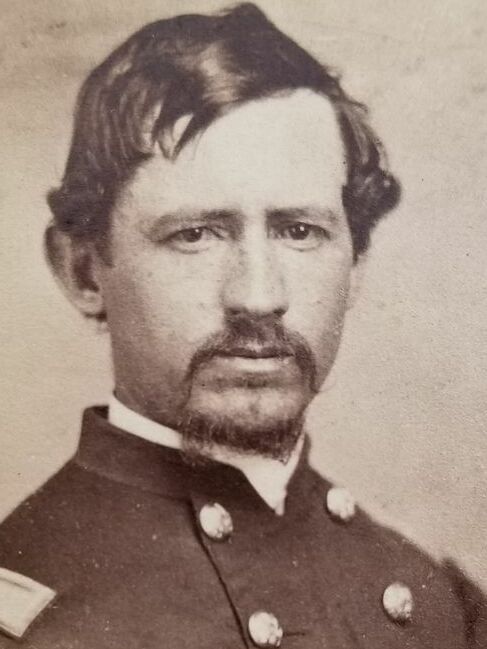
Native Americans, said Commissioner of Indian Affairs Thomas Jefferson Morgan, must surrender who and what they are and assimilate into the broader American culture.  They must either conform to the dominant American culture, he wrote, “or be crushed by it.” Morgan attempted to ban the practice of Indigenous religion on reservations during his watch, require that Indigenous peoples only speak English on the reservation, and included them in a far-reaching program of education that included off-reservation boarding schools.  No opposition could be tolerated.

Thomas Jefferson Morgan, in his uniform with the 14th United States Colored Infantry Regiment

            Morgan thought a lot about education, and he saw instruction in American history as fundamental to his goal of assimilating Indigenous peoples. “It is in the highest degree important,” he wrote in his 1889 Annual Report, “that specific attention should be paid, particularly in the higher grades of the school, to the instruction of Indian youths in the elements of American history, acquainting them with the leading facts in the lives of the most notable and worthy characters.” Morgan believed that in the classroom, “the wrongs of their ancestors can not be ignored,” but “the injustice which they once had suffered can be contrasted with the larger future open to them, and their duties and opportunities rather than their wrongs will most profitably engage their attention.”

            Morgan wanted Native American students, across a vast educational system that included reservation day schools, on-reservation boarding schools, and off-reservation institutions like Carlisle, to understand civics, to engage in debating societies. The American flag should be prominently displayed in Indian schools, and “patriotic songs should be taught to the pupils, and they should sing them frequently until they acquire complete familiarity with them.” Furthermore, “patriotic selections” should be memorized and recited publicly, “and should constitute a portion of the reading exercises.”

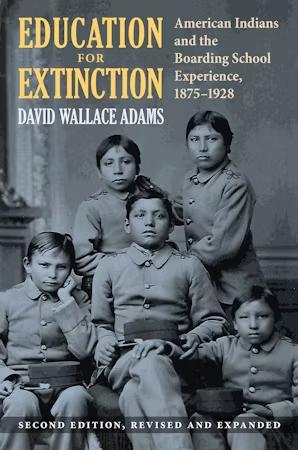
            This is what the historian of boarding schools David Wallace Adams called “Education for Extinction.” Morgan, like other commissioners, spoke with a powerful conviction that the salvation of Indigenous peoples would follow only from the course of action he prescribed. “In all proper ways,” he wrote, “teaching in the Indian Service should endeavor to appeal to the highest elements of manhood and womanhood in their pupils, exciting in them an ambition after excellence in character and dignity of surroundings, and they should carefully avoid any unnecessary reference to the fact that they are Indians.”

            The only value Morgan seemed to see in Indigenous people was that they might, with the proper application of a heavy hand, be guided to become something of value.  Part of his program was the teaching of a past directed towards turning students to what Morgan saw as the only possible future. We shall use the past, he suggested, to teach them to move forward.

            This got me thinking. Occasionally, I teach my department’s “Historical Methods” course. I focus on the Carlisle Indian Industrial School.  We know what Commissioners of Indian Affairs and other government officials working in Indian policy wanted to achieve. But how were these pronouncements turned into educational policy? And more specifically, what did Carlisle students read in their history classes? Did they engage in debates about American history and culture? To what extent might we term history education at Carlisle propaganda? And, if so, what impact did this education have? What of this education stuck? You might have been young once. Perhaps you still are.  Think back to your high school history class. How much of what you were taught do you actually remember? Be honest. Maybe you thought it was all bullshit and blew it off. Maybe Carlisle kids ignored their history lessons with the same alacrity as did you and I.

This is where research projects come from. I am a historian, interested in continuity and change, measured across time and space, in peoples, institutions, and cultures. I have been interested in the Carlisle Indian Industrial School. What, I have wondered, was history education like at Carlisle, and in what ways did it matter?

            These are not difficult questions to answer. The work, in terms of technique, and the types of sources one must find to answer the question, are straightforward. The Carlisle Indian Industrial School Digital Resource Center has made digging through the sources so much easier than it would have been, say, at the beginning of my career. Many relevant sources are published, so they are not hard to find. I know the secondary source literature—that written by scholars who have pored through the sources—quite well. The only thing keeping me from doing this work is time, a commodity which I always seem to have less of than I would like. Someday, I will come back to these questions, and answer them fully. I am hopeful that a student will beat me to the punch, and choose this topic for a research paper.  I would love to see what they come up with.  Until then, some preliminary thoughts, based on some of the stuff I have stumbled across over the past few years I have spent reading about boarding and residential schools. (I have written a lot about Carlisle on this blog: Search for Carlisle, above, and most of that stuff ought to pop right up for you).

STUDENTS AT CARLISLE received history education in several ways. There was the classroom, of course, at Carlisle and, for some students, in the public schools they attended while on their “outing” assignments. There were the historical materials included in the school’s publications, some of which were written by the students themselves, some by Indigenous and non-Indigenous writers with varying degrees of expertise and knowledge. Where students did not write the work, those in the print shop set the type, but I cannot tell how many of them actually read the periodicals Carlisle produced. Finally, historical topics were addressed in school activities: lectures, debating societies, and historical pageants in which students played the lead roles.

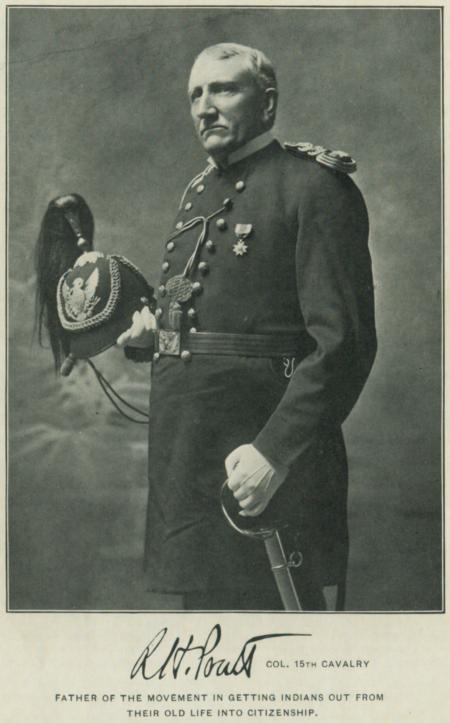
            From an early point in the school’s history, its founder Richard Henry Pratt was concerned about how the students might be portrayed when it came to historical pageants. In an 1880 letter to the Commissioner of Indian Affairs, the year after Carlisle opened, Pratt made suggestions on the role Carlisle students could play at the “Indian exhibit” at that year’s Columbian Exposition.  Pratt favored a chronological organization of the display.  The first period, he wrote, should be that in which “the settlers were dependent on the forebearance of the Indians; illustrating this by a large wall map showing the whole country as Indian except for a few white settlements say 1565 to 1620.” Next there should follow the period “when the whites entered regularly on the occupation of the country and by force or purchase obtained large possessions, as by King Philip’s War and Penn’s treaty.” The third period would focus on Cherokee Removal and the Seminole War.  “The Indians as dependent on the Government for protection, placed on restricted areas and partly supported by Government” would follow and, finally, “present policy of dealing with Indians, by education, training in agriculture and other industries leading to citizenship and absorption into the masses.”  Pratt emphasized that throughout, the exposition “should be historical and utilitarian, exhibiting the Indian both as an historical and present factor in our national life and by no means purely or mainly from a scientific or ethnological stand point, that properly belongs to another time and place.”

            The school’s founders seem to have worried about portrayals of Indigenous peoples that might lead audiences to conclude that Indians were part of the past. When students participated in “the Indian scene of the Historical Pageant “that commemorated the anniversary of the founding of Philadelphia in 1909,” the school’s leaders insisted that the students—sixty boys and five girls—wear their uniforms at all time except when performing.

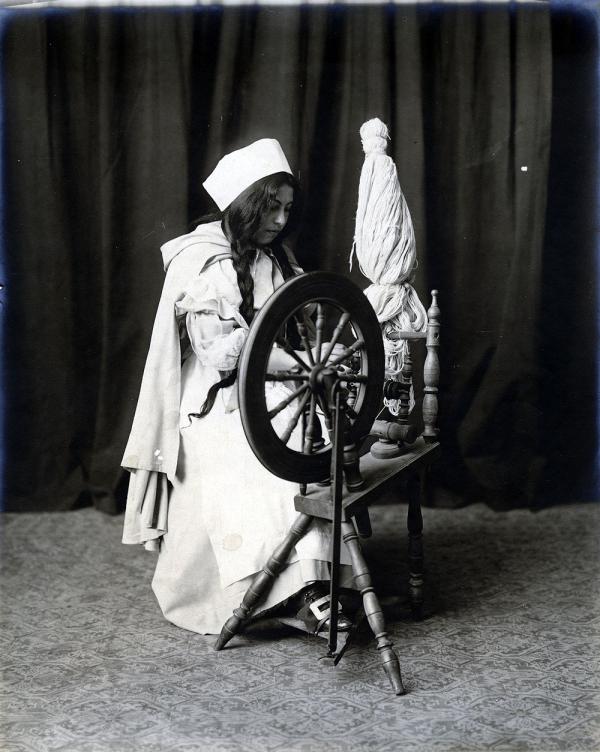
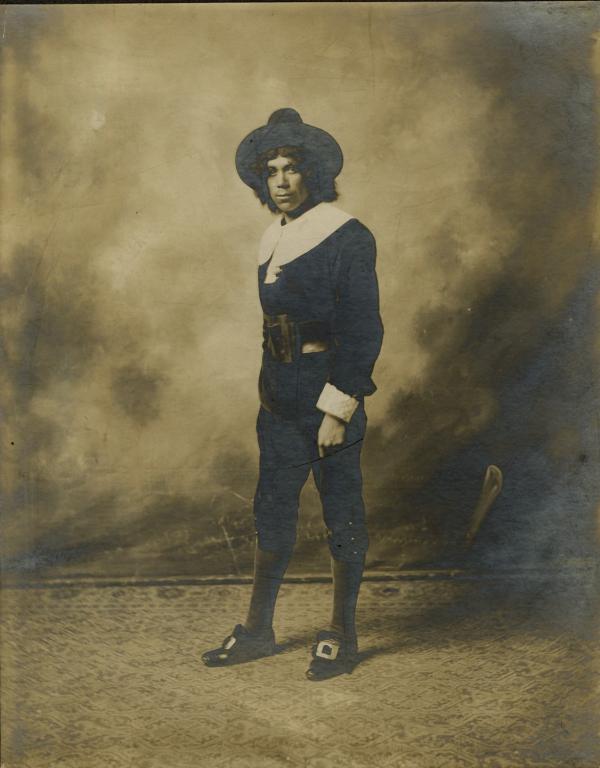
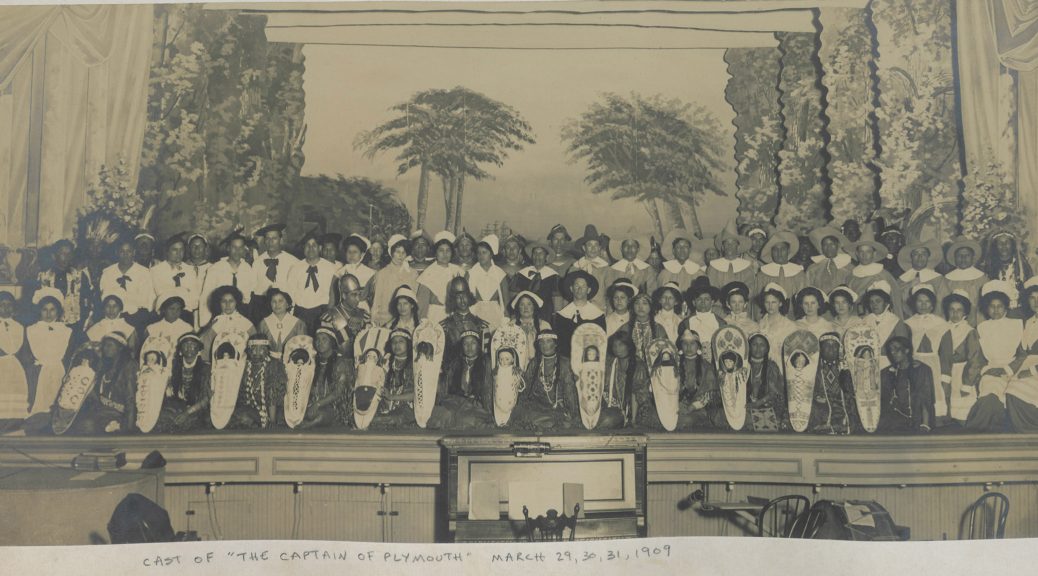
            Many of these performances were intended to instruct. Pratt had retired a half-decade before students at Carlisle staged The Captain of Plymouth: A Comic Opera in Three Acts, written by Seymour S. Tibbals and Harry C. Eldridge. Students played both English pilgrims and the Indigenous people who greeted them. The play opens with the Plymouth leader Jonathan Brewster, played by a 23-year-old Akwesasne student named John White, worried that “the unclean spirit has reached this land before us.” Miles Standish, meanwhile, played by a fascinating Oneida student from New York named Montreville Yuda, was preparing to marry Priscilla, the “fairest maiden in Plymouth, played by a Menominee, born in Denver but raised in Ohio, named Carlysle Greenbrier. Things go wrong when Standish is

Carlysle Greenbrier

captured by the Indians. With Standish out of the picture, John Alden, played by a Hoopa from California, Albert Scott, lusts for Priscilla. Ketonka, the “Indian Princess” in the village where Standish is held, played by Emma Esanetuck, frees Standish, but she has a price. “You have won my timid heart,” she tells Standish, and she will release him only if he promises to marry her. In return, she pledges that “I will forsake my home, my people, my all, and henceforth cling only to you.” Sort of like what Carlisle’s founders wanted their students to do. It is easy to see why they might have chosen the play and presented it in consecutive years, however dumb and filled with demeaning stereotypes of Indians. In any event, Harry Eldridge caught a performance and was quite impressed.

Montreville Yuda as Miles Standish.

            Pageants like these were familiar to Americans in the late-nineteenth and early-twentieth century.  Filled with patriotic themes, they emphasized national progress, America’s rise from humble origins. Some were, at their heart, virtual dramatizations of the “Turner Thesis,” with Indigenous peoples one of the obstacles American settlers had to overcome on their way west. The student’s participation in these pageants, in this sense, conformed to white reformers’ expectations of what Indians’ were (a people with a proud past) and what they might become (non-troublesome, fully assimilated and productive members of American society).

            It is hard to say how students felt about playing these roles. We do know, however, that in Philadelphia for performances they were sometimes not chaperoned as closely as the school’s directors would have liked, and they proved as capable as other teenagers, at other times and in other places, of finding trouble when unleashed upon an American city.

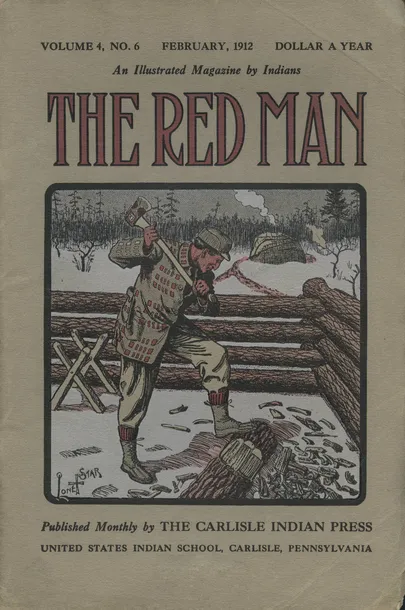
SOME CARLISLE BOYS were trained in the school’s print shop, where they learned typesetting and other skills that would allow them, their teachers hoped, to find employment when their time at Carlisle expired. The Red Man, “a magazine in the interest of the American Indian,” was an outward-facing publication directed toward the school’s supporters. It included essays on current events in Indian country, anthropological, ethnographic, and historical pieces, and analyses of federal Indian policies. The articles were written by Indigenous and non-Indigenous authors. The May 1900 issue, for instance, included a story about the Florida Seminoles that asserted that “there is not found on the page of history, in any country, an instance of a scattered remnant of a tribe, so few in number, defending themselves against the assaults of a numerous and disciplined army, with the same heroism and triumphant results as the Seminoles resisting American troops. Seventeen years later, The Red Man returned to the Seminoles, arguing that

today the 600 Seminoles of the Everglades are the descendants of this heroic band–a people without a country! Too honest to speak, to proud to beg, eking out but a pitiful existence in the land of his nativity. Why? Because the same master greed that has driven the American Indian across a continent has entered the sacred homes of Florida’s Indian population.

(A century later, in the first quarter of the twenty-first century, making such claims in a classroom in Ron DeSantis and Christopher Rufo’s Florida could get a teacher in a lot of hot water. Carlisle students were setting type on articles containing arguments that could get Red State teachers fired!)

            The January 1915 issue included an essay by the Seneca Arthur C. Parker describing the reform program of the Society of American Indians. The April 1911 issue featured a piece by the important Crow leader Robert Yellowtail who explained “Why the Crow Reservation Should Not be Opened.” Yellowtail, at the time, was resisting efforts by the federal government to allot lands on their Montana reservation. Also in that issue appeared a historical essay about William Penn, the founder of the colony of Pennsylvania, known in myth and memory for his just treatment of Indigenous peoples. Where “the general practice” in colonial America “was to entirely ignore the Indian ownership when a grant in this country was to be taken up, and the new settlers not only appropriated what was granted to them by charter rights, but they would grab everything in sight,” Penn was different.  Much of what appeared in The Red Man reflected the interests of Progressives, Indian and white, interested in Indigenous affairs: Assimilation, to be sure, but also citizenship;  Education, not strictly in manual labor, but in colleges and the professions as well; citizenship and equality before the law, and a willingness to challenge negative representations and stereotypes about Indigenous Americans.

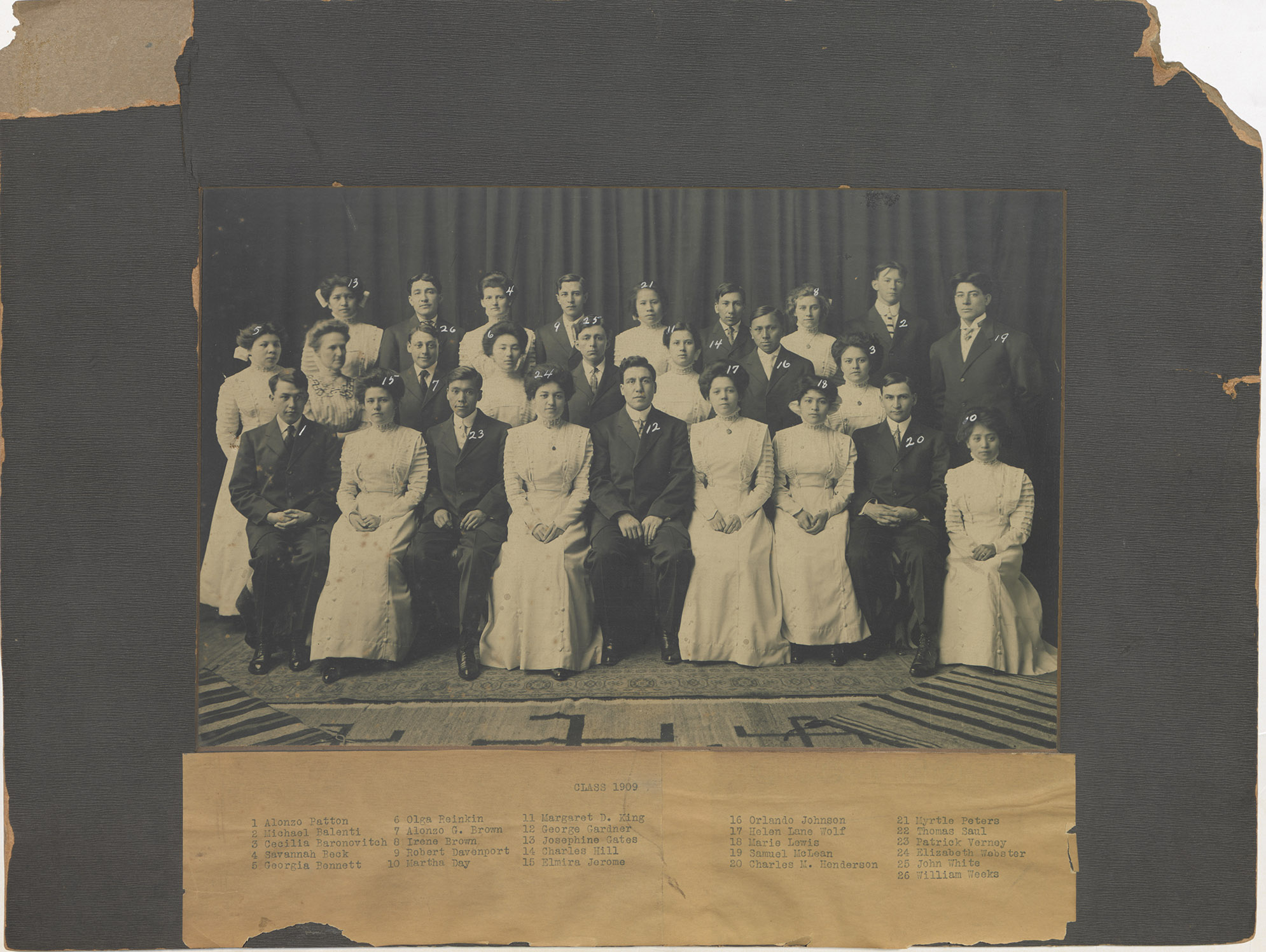
            It is not clear to me how many students read The Red Man. It does seem pretty certain that they read the school’s student newspapers, much of which was written by the students. There are many hundreds of pages of these papers on the Carlisle Indian School Digital Resource Center website. I did not read all of them, but do believe it will be worthwhile some day to pore through them thoroughly to learn what I can. From the pages I read, we can see that students engaged in debates about matters relevant to politics and society. They wrote in the school newspaper about their people and their history. Michael Balenti, a Cheyenne, wrote for The Arrow a brief history of the Comanches. Michael had also served as a first tenor in the Sailors’ chorus in The Captain of Plymouth. Elmira C. Jerome wrote about the history of the Munsees. Her writing ability was recognized in the paper, and we learn that she had a beautiful voice and had taken up learning shorthand.

Elmira Jerome is Number 15, the second from the left in the front row.

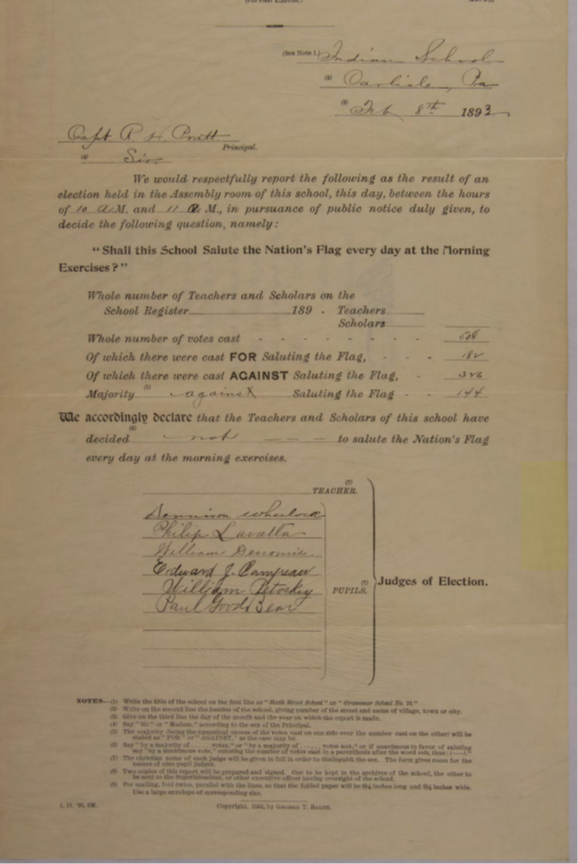
            Allowing and encouraging students to discuss public affairs involved risks. It is easy to imagine that school officials wielded control over what might appear in the newspaper. It is not possible to consider The Arrow a free press. For the most part, students expressed views that conformed closely to those of reformers interested in Indigenous affairs, both Indian and white. But the students were free thinkers. Anyone who has taught history well knows that once students have considered why things are a certain way, it is an easy step for them to begin considering why things are not some other way. For example, in February of 1893, the college students gathered to vote on the following question: “Shall the school salute the National flag every day at Morning Exercises?” 508 students cast votes. Only 182 students voted in favor; 326 decided that the school would no longer salute the flag.

            The vote took place on the 8th of February, 1993, the sixth anniversary of the passage of the Dawes, or General Allotment Act. A story in The Indian Helper, the school’s newspaper at the time, said that the day was celebrated “by exercises of a patriotic nature in the morning and a reading of the Bill and some discussion of the same in the evening.”  The vote followed these discussions.  Reflecting on its outcome, “The Man-on-the-band-stand,” the all-seeing and all-knowing eye of the school’s administration, said that he “knows that our pupils are not against saluting the flag.” Indeed, “if there be such a one let him hide his head in shame!” How to make sense of the outcome? The Man-on-the-bandstand said “that the sacred colors of our country should be treated in such a common way is what struck many of our pupils in an unfavorable light.”  I’m a bit skeptical. Aren’t you?

OF COURSE MOST HISTORY EDUCATION for Carlisle students took place in the classroom. Though it has been said that Carlisle taught young people to hate their people and their culture, one of the stated purposes of its educational program was “to preserve all that is the best in Indian folktales and hero stories and race heritage, which is to be handed down by mothers to their children as an inspiration for racial advancement and progress.” Students with artistic talent should be urged to develop their skills. “Indian art should be fostered and encouraged in every possible way,” and “girls should be encouraged to get all that is best in their tribal art, to become proficient in its use, to understand its symbolism, and to apply it to the materials and furnishings of their new types of homes.”

            According to the school catalogue, students in first and second grade should study history in the form of “stories of primitive people; industrial life; home, schoolroom, and playground ethics,” and “memory gems” like the dates of major American holidays. In third grade they learned about “inventions and inventors, societies of men and people in connection with geography, civics, stories, selections and adaptations from literature.” This would continue through fourth grade, while in fifth grade they learned “stories of discovery and colonization” and local government as they read from the textbook, Civics for Young Americans as a guide. In sixth grade, they learned about “colonial growth and independence,” and in seventh grade “formulation of the government; beginning of the National Period,” with Dole’s American Citizen, the text that would guide the teachers. In eighth grade, instruction in American history came to a close.

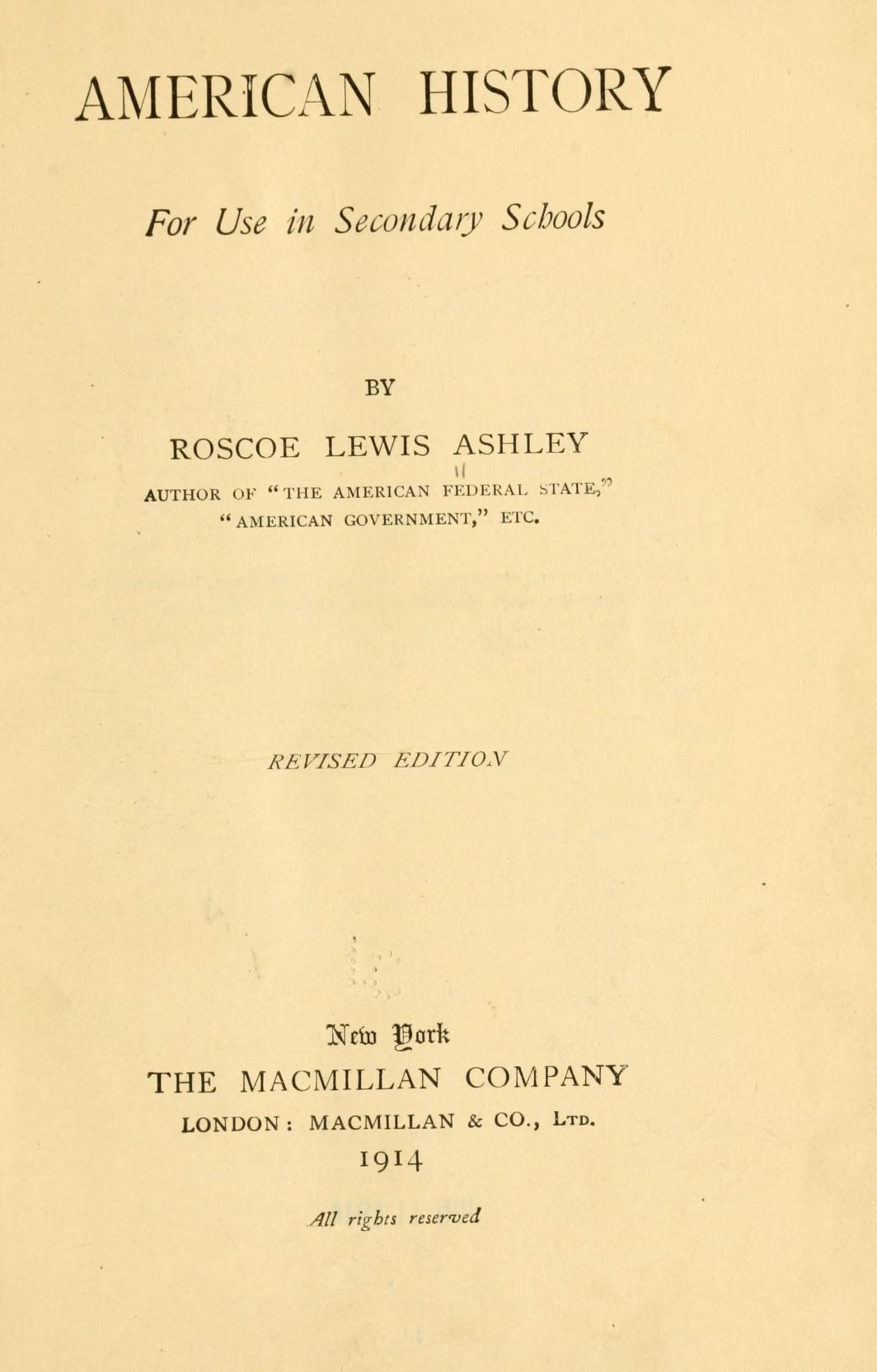
            One of the history books used at Carlisle was Roscoe Lewis Ashley’s American History for Use in Secondary Schools, first published in 1907. It is a product of its time.  The early colonists, the first chapter reads, “came into contact with the red man.” These “savage hunters were especially numerous along the heavily timbered Atlantic slope, within easy reach of the great supply of fish on the one hand and the animals of the forest on the other.” They “had not reached a high degree of civilization,” but they seemed to know their lands, even though they “were not attached to the soil and removed their wigwams with ease,” and their villages “were often little more than headquarters for hunting expeditions and raids.”

Only the Iroquois defied this ugly depiction. It was the Iroquois, Ashley wrote, “whose political organization, the most perfect of any north of Mexico, enabled them to conquer all their neighbors, either Iroquois or Algonquins, so that they often controlled the territory as far south as the Kenawha and as far west as the Wabash.”  They were important in American history.  “Of great ability and courage unusual even among Indians, the Iroquois have left an impress on our history that is out of all proportion to their number.” All the rest, he said, were ruled by passions. Ashley quoted the racist Francis Parkman, who thought that there is “much that is dark, cold, and sinister” in the Indians’ character.  “Treacherous himself, he is always suspicious of treachery in others.” Indeed, Ashley concluded, “it was perhaps fortunate for the English that the Indian race was incapable of civilization, for it prevented the mixing of races.”

That is quite a lot.  Many Carlisle students attended school in towns throughout Pennsylvania and New Jersey. They attended the public schools in they areas where they were on their “outing” assignments. But many took classes at Carlisle and likely would have been exposed to Ashley’s lessons, or from books similar to his. Ashley’s book was not designed for Indian school students. It was read by children across the United States. In that sense, it is difficult to prove that Carlisle kids received a history education that was different from non-Indigenous children.  For all Americans, history education was moral training, vital in preparing citizens for a republic where white people were in charge.  But there is so much we cannot see in the records—the condescension, perhaps, of a teacher who quietly believed everything Ashley said about civilization, or who abhorred the prospect of mixed races.  All kids probably learned stuff like this in their history courses, but they did not occupy the same position relative to the material that the Carlisle students did. The lessons that Indigenous people were incapable of civilization, and prone to “ambition, revenge, envy, jealousy” as part of the “ruling passions” that governed “his cold temperament” obviously would have resonated in a deeper and darker tones for Indigenous students.

I have a lot left to read. The thoughts I have expressed here are tentative.  I hope to keep digging through this material.  I think I see the Carlisle students talking back to this in their school papers. When they describe their communities, in terms that are affectionate and respectful and not in the slightest bit ashamed, I think they knew they were working on several planes at once: showing their readiness for civilization, but also their defiance towards those who embraced the idea that they were not ready for equality.  I think also, as I read what they wrote, of our current political moment. So much disturbing news.  But when the president decrees, and Americans cheer, an unconstitutional executive order that requires a “patriotic education” that leaves no white child feeling ashamed for what his ancestors did to those they enslaved or dispossessed, I wish they would stop and think for a moment.  White people have, of course, decided what history is in this country.  Look at the monuments placed across public spaces the length and breadth of this country. Remember the reaction when people of good taste and character came together to take some of them down. To put it bluntly, white people have been shoveling shit in their classrooms for a very long time.  Indigenous students know that.  And the response to their calls for a more complicated story, one that respects the nation’s many pasts, is to wave a flag and shout it down.  You shall not do, Trump and his amoral supporters are saying, what we have done to so many for so long.  They are not setting things right.  They are burying inconvenient truths.

The Center Will Not Hold

Friends,

I have some news to share with you about the Geneseo Center for Local and Municipal History. I feel like I did some good work, but it is time for me to step away and focus on other things. Frankly, I give up. The Center, really, was my office.  We did a lot, but we did not have any meaningful support from the upper administration at my college and at the SUNY HQ.

            Last Super Sunday, I was scheduled to speak at a conference in Albany, sponsored by the SUNY system.  It was called Public Good U: Strengthening the Case for Public Higher Education. If you read my blog, or have spoken with me for more than a few minutes, you know how strongly I feel about the importance of supporting public higher ed.  Foul weather prevented me from making the trip. It snowed heavily the night before, and all along the route, and I would have had to leave Rochester at 4AM to pick up a student in Geneseo and make it to Albany in time. It was too risky.  But the truth is that my heart was not in it. The storm was a relief. I have become demoralized, and I am ready for something else. I will continue to teach and write at Geneseo, a school that I love, but I am going to let go of my heavy local history commitments. Call it a strategic withdrawal in the name of preserving peace of mind. It has nothing to do with any of you.

I came up with the idea for a Geneseo Center for Local and Municipal History in the fall of 2018. I did so with the support of colleagues in my department at the college. It all began humbly—a small grant of about $850, and then a luncheon meeting in February of 2019 attended by about 75 people, to discuss the development of a program that would place students in the offices of government-appointed historians to work on local history projects. Some of you were there. We parted that afternoon enthusiastic about the possibilities, but daunted by the challenges.

            I was excited.  I was energized. I know that some of you were, too.  I wanted this to work.  The program began, entirely by coincidence, during the 100th anniversary of New York’s Government-Appointed Historians Law, enacted in 1919 to commemorate, in part, the state’s young men slaughtered in the First World War.  Only Connecticut has a similar statute on the books. Under state law, New York requires every municipality to have an official historian. When you do the math, that comes out to one historian for each of the five boroughs of New York City, 12 Community Historians in Manhattan, 62 city historians, 932 town historians, and 544 village historians.  Add to that the 62 county historians, the scores of small historical societies, and the dozens of small archives, collections, and history museums, and you have the foundation for a vibrant local history community.

            Some of these local historians are more active than others. Some have more resources at their disposal. A huge percentage of them serve as volunteers. Many of them are retirees, doing work they love with great enthusiasm in the name of preserving their community’s past.  To varying degrees, they coordinate their efforts, and meet together to discuss common interests and concerns, like the meeting of the Government Appointed Historians of Western New York (GAHWNY) or the Association of Public Historians in New York State (APHNYS). I attend occasionally. It is a hodge-podge, with a thousand moving parts, but the work they do is exciting and important.

            I had never written a grant proposal before I began this work.  Turns out, I had a knack for it. We received a small grant from the Rochester Area Community Foundation that allowed me to employ several Geneseo history majors in the construction of a website telling the Indigenous story of Geneseo. With the help of my friends and colleagues in the college’s grants office–Anne Baldwin, Sue Rubright, Sheila McCart, and Betsy Colon–I then brought in a nice chunk of money from the National Endowment for the Humanities that allowed me, for a time, to employ a director for the Center. Dr. Joel Helfrich did some amazing work with Geneseo students. Then I received a much larger grant from the Robert David Lion Gardiner Foundation on Long Island.  We established the Robert David Lion Gardiner Semiquincentennial Summer Fellowship Program, placing students in local historians’ offices to work on projects connected to the 250th Anniversary of American Independence.  It was a truly unique program. We provided well-paying fellowships to students from Geneseo, to be sure, but also Canisius, Albany, Brooklyn College, Potsdam, New Paltz, Cornell, and Stony Brook University.  Between these two programs we paid 71 students to return to their hometowns and perform work that was important to their communities and that was, for some of them, a life-changing experience. Two of the students wrote books!  I worked with such great professors at my partner institutions:  Ben Carp, Jon Parmenter, Sheila McIntyre, Tom Baker, Maeve Kane and Rich Bailey all stand out. I met some fantastic local historians doing such important work. In addition to these 71 students, I oversaw dozens of directed studies and internships where students examined the history of their hometowns, honed their research skills, and answered important questions about their community’s past.  We worked through a global pandemic. I am immensely proud of the work these students did, and I got to see and learn so much.

            Those of you who worked with us, I am sure, will get that. It was good work and it is vital, in my view, for the health of the republic. At a time when our nation is governed by a tyrant at war with the entire historical enterprise, an enemy of facts and tough questions, this work is more important than ever.

At the Albany conference, I wanted to show off the work of the Gardiner fellows. But I also intended to say that while I welcome SUNY’s recent embrace of the importance of civic education and creating colleges that serve the public good, it’s all eyewash without system support. If I am going to make the case for strengthening public higher education, the most significant obstacle I have to overcome is SUNY Central and the Chancellor’s office, which in its allocation of the money appropriated by the state legislature is making budgeting decisions that are strangling colleges like mine and literally killing the sorts of programs that enriched the education of scores of students.

The Gardiner Foundation Semiquincentennial Summer Fellowship, as a program operated at Geneseo, will be coming to an end this year because drastic budget cuts have left us unable to contribute the matching funds required by our funder. I will continue to work with Gardiner, as a consultant, on a new program. It will be headed by a Rochester non-profit that is interested in civic education. The lesson, I hope, is clear, and it truly pains me to write these words: It is easier for me to provide high impact and meaningful educational experiences to students in SUNY by working with a non-profit outside of SUNY than trying to do something on campus.  

Indeed, we have another civic education program which we were in line to have funded by the Teagle Foundation—Students in Geneseo’s American Cornerstones Project would spend two semesters on campus during the freshman year reading significant works in the American civic tradition, examining themes of equality and inequality, freedom and unfreedom, community and individualism, and citizenship and exclusion.  Then, over the summer, they would go home, work with local historians and write or otherwise produce a work that looks at one or more of these themes in their community. Our funder was enthusiastic. We were, she said, the only college in the United States doing this. Geneseo was truly unique. We have had to withdraw from a grant competition that would surely have provided us $300,000 to implement this program because budget cuts have left us with too few faculty to effectively operate it.

This is such important work. It is, I believe, so important. I hope that SUNY will someday put its money where its mouth is when it comes to civic education and creating colleges that serve the public good. It takes money to bring in money, and it is such a worthwhile investment.  We literally changed students’ lives. I know those of you who participated understand that.

But I cannot continue to throw hours of work into an effort at a college where I could get no meaningful support or publicity from the President’s office, in a university system that seems committed to destroying colleges like mine. The institution, a wise friend once told me, will not love you back. Some of you, my friends and fellow historians, have been so supportive and so encouraging. Your enthusiasm and recognition of the importance of the work we do was exhilarating.  It kept me going.  And students, I learned so much from you. Really. The two weeks I spent each summer visiting you and the historians with whom you worked was a blast. I have never had as much fun doing history. You energized me. There is spot for you all in my heart, and I so wish the work could continue.

I am not stepping away from local history entirely. My next book will be a detailed history of the Sullivan-Clinton campaign against the Iroquois in 1779. Native American history, I long have argued, is local history. Furthermore, in my capacity as the vice-president of the Rochester Historical Society, I will work with my fabulous colleagues on the board to revive and revitalize an institution that has been allowed to slip into disrepair and irrelevance. I think we are going to make a difference. I will keep writing, and continue to visit local history sites. And, when and where I am able, I will continue to push SUNY’s leadership to support all its colleges, not just the big four universities. This work has been a lot of fun.  I am sorry to see it come to an end, but I cannot continue. Local history is important.  It matters. You matter, and your story matters.

Peace.

The Birthright Citizenship Executive Order: The Trump Administration, the 14th Amendment, and Indigenous Nations

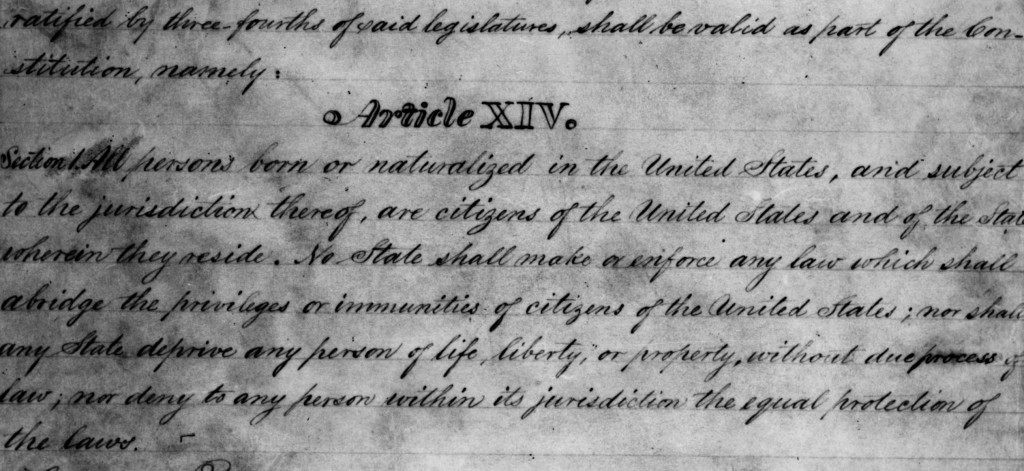
Two courts have slapped down Donald Trump’s executive orders against “birthright citizenship,” guaranteed in the first section of the 14th Amendment. This is a good thing.  Like a lot of you, I am feeling a bit overwhelmed by all of Trump’s actions.  Though I am heartened to see the Democrats making noises like they wish to act as an opposition party, it is on us to stay informed.  And I have pledged to do all the reading necessary to understand the threat posed by the old new administration to Indigenous people and their communities.  I have a lot to learn, I am sure, but here are some tentative thoughts. I would love to hear from you about the issues these executive orders raise.

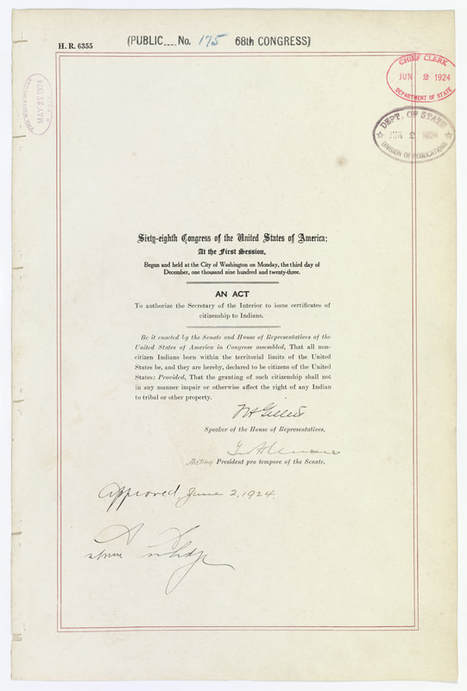
            In making their case against birthright citizenship, Trump’s lawyers brought up the example of Indigenous peoples in the federal republic. After the ratification of the 14th Amendment, and before the 1924 Indian Citizenship Act, Indians born within the territorial bounds of the United States did not receive, and were not considered, citizens of the United States. Therefore, the lawyers argued, the grant of birthright citizenship is limited and not comprehensive, and applied only to the formerly enslaved people Trump’s lawyers claimed the Reconstruction amendments were designed to protect. Children born in the United States to parents who are “illegal aliens,” a term the Trump team continues to use, thus cannot legitimately claim citizenship under the 14th Amendment. There are solid historical reasons why this legal argument is wrong, spelled out in detail by the judges who ruled against Trump. What I want to focus on is the Trump team’s reliance on arguments about Indigenous peoples and nations.

            The Constitution makes two explicit references to Indigenous peoples. There is the “Indian Commerce Clause” of Article I, Section 8, that spells out the powers of Congress, and a reference to “Indians not taxed” as a class that could not be counted in calculating the number of a state’s congressional representatives. The first limits congressional power to regulating “commerce with the Indian tribes,” a phrase that has expanded dramatically in terms of the breadth of its meaning. It has been transformed over two centuries into the “plenary power doctrine” that makes Congress virtually absolute in governing Indian affairs.  The latter clause, which implies that some Indians are or will be taxed, at the same time suggests that Indigenous peoples for the most part are beyond the jurisdictional realm of the United States or the separate states. In the Founder’s Constitution, Indigenous peoples were independent polities who owed no allegiance to the US, and over whom the United States claimed no power to interfere in their internal affairs.

            The federal courts did little initially to help clarify the issue, probably because the idea that Indians were not citizens was assumed. Chief Justice John Marshall, in the cases of Johnson v. McIntosh (1823), Cherokee Nation v. Georgia (1831), and Worcester v. Georgia (1832) helped define Indigenous nations in the United States, but said far less about Native American individuals. In the simplest possible terms, Chief Justice Marshall’s famous “trilogy” of cases established that Indigenous Nations can exercise whatever power they want unless they are explicitly prevented from doing so by a federal treaty or an act of congress. Legal scholars call this concept “explicit divestiture.”

            The first significant case that addressed Native American citizenship in a comprehensive manner was United States v. Elm, decided in the Northern District of New York on Christmas Eve in 1877. Abraham Elm was an Oneida who lived in New York’s Madison County, the heart of the Oneidas’ ancestral homeland. Claiming that he was a citizen of the United States, Elm voted to select his congressional representative in the election of 1876. Authorities arrested, indicted, tried, and convicted Elm for illegal voting. The courts suspended his sentence while they addressed the weighty question of “whether or not the Oneida Indians are citizens of the United States and, as such, entitled to vote.”

            The 14th Amendment, the Court reminded its readers, decreed that “all persons born or naturalized in the United States and subject to the jurisdiction thereof are citizens of the United States and of the state wherein he resided.” That second clause— “subject to the jurisdiction thereof”—was important to the Court. “Those persons who, though born here, are born with the allegiance of a foreign sovereign, or of another government, are not subject to the jurisdiction of the United States.” For example, “the children of ambassadors, though in fact born here, are, in the theory of the law, born within the allegiance of the foreign power the parent represents.” In a similar vein, the Court continued, “Indians who maintain their tribal relationships, are the subject of independent governments, and, as such, not in the jurisdiction of the United States…because the Indian Nations have always been regarded as distinct political communities.”

            But had the Oneidas “maintained their tribal relationships”? The state had taken nearly all their lands and declared the Oneida Nation dissolved. Because Elm’s “tribe has ceased to maintain its tribal integrity,” he was largely on his own. In the courts’ eyes, Abraham Elm “is a citizen, within the meaning of the fourteenth amendment.” The passage of time and the course of history had dismantled the Oneida Nation, at least in the opinion of the court. There was, in other words, no native nation remaining to which Elm might belong.

            But what happened in the case of “an Indian, born a member of one of the Indian tribes within the United States, which still exists and is recognized as a tribe by the government of the United States, who has voluntarily separated himself from his tribe, and taken up his residence among the white citizens of a state, but who had not been naturalized, or taxed, or recognized as a citizen either by the United States or by the state”? Was this Indian a citizen of the United States under the birthright citizenship provision of the 14th Amendment?

            These questions lay at the heart of Elk v. Wilkins, an 1884 case heard by the United States Supreme Court. John Elk, in 1880, had attempted to vote in the city of Omaha in a municipal election. He was denied and sought damages. Wilkins, the local official, Elk accused of failing to recognize his birthright citizenship under the 14th Amendment and his rights under the 15th amendment, which said that no citizen could be deprived of their right to vote on the basis of race, color, or previous condition of servitude. Justice Horace Gray wrote the majority opinion. Indian tribes, he wrote, “were not, strictly speaking, foreign states, but they were alien nations” whose members “owed immediate allegiance to their several tribes.” Examining the language of the 14th amendment, Gray reasoned that “Indians born within the territorial limits of the United States, members of and owing immediate allegiance to one of the Indian tribes (an alien though dependent people), although in a geographical sense born in the United States, are no more ‘born in the United States and subject to the jurisdiction thereof,’ within the meaning of the first section of the Fourteenth Amendment, than the children of subjects of any foreign government born within the domain of that government, or the children born within the United States of ambassadors or other public ministers of foreign nations.”

            That should sound familiar to you by now.

            The nation to which Elk belonged, not mentioned in the Court’s opinion, was neither taxed nor counted to calculate representation. “Their absolute exclusion,” Gray said, “from the basis of representation in which all other persons are now included is wholly inconsistent with their being considered citizens.” John Elk might become a citizen though a congressional action, but he did not become a citizen by separating himself from his tribe. And because Elk was not “a citizen of the United States under the Fourteenth Amendment of the Constitution,” he “has been deprived of no right secured by the Fifteenth Amendment.”

Justices John Marshall Harlan and William Burnham Woods dissented. Based upon their reading of the congressional record, they believed that the senators and representatives who approved the 14th amendment intended to “grant citizenship to every person of the Indian race in this country who was unconnected to any tribe, and who resided, in good faith, outside of Indian reservations and within one of the states or territories of the Union.” That argument failed to persuade, until Trump’s lawyers found it.

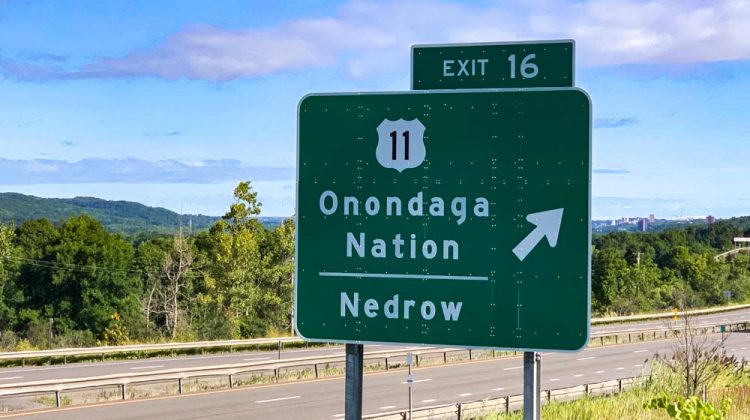
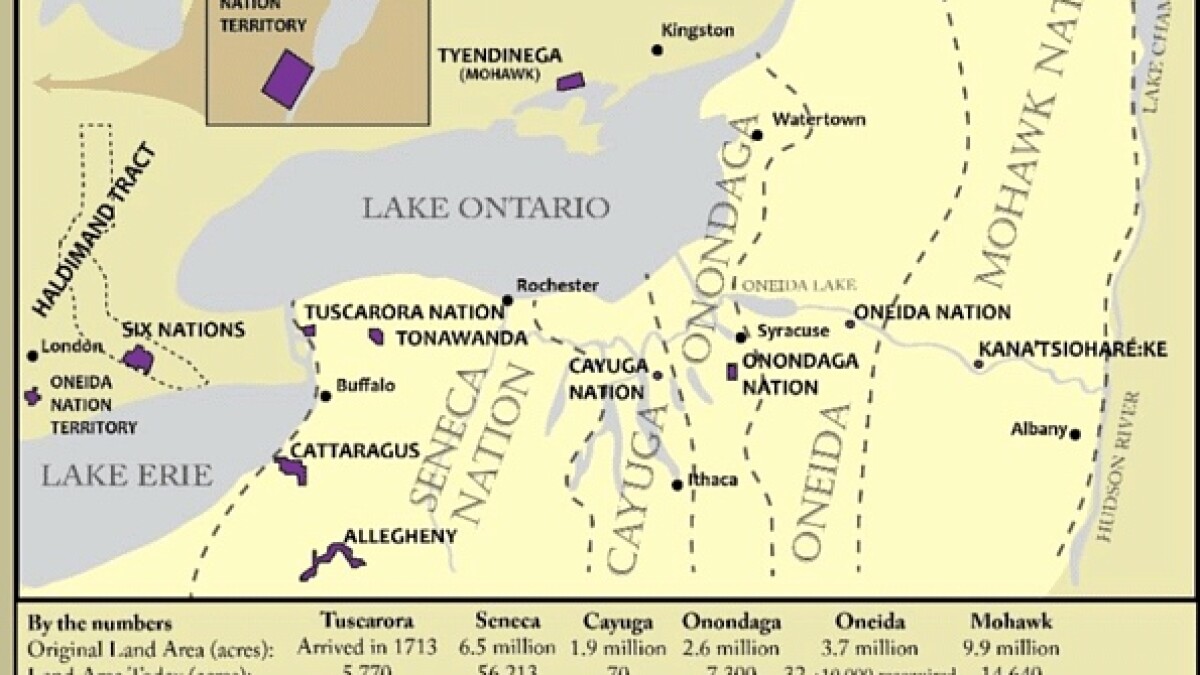
In the years following Elm and Elk, Congress did make some provisions for Indian citizenship. Recipients of allotments under the terms of the Dawes Act, who had passed successfully through their trusteeship period, received United States citizenship. Native American veterans of the first World War who received honorable discharges also received citizenship.  And, in 1924, Congress passed the sweeping Indian Citizenship Act, that made all Indians born in the United States citizens. Many of the Haudenosaunee people I write about in my own research objected to this.  The Onondaga Nation, for instance, rejected this unwelcome extension of the rights and responsibility of American citizenship over them. They still do today. They see themselves as apart from the United States and the state of New York, even while living within the bounds of the larger settler state.

In parts of the United States, the Native American vote constitutes a significant bloc. Indigenous voters can help swing Wisconsin, Michigan, Minnesota, North Carolina and Arizona red or blue. Indigenous candidates have successfully run for office in several states with large Native American populations. Given their record of military service, one could make the case that Native Americans are more patriotic than the rest of us.  But that does not mean that Native American nationhood is not real.

            The Trump Administration sought evidence to support its claim that the first section of the Fourteenth Amendment did not apply to “all persons,” despite the first two words in the first section of the Amendment.  Trump’s team used Indian nations as an example to help them make that case. It is a nasty sort of historical revisionism to search for evidence, and to cherry-pick from the record, to advance arguments that fly in the face of the constitution’s language. Trump and his allies are, and always shall be, on the wrong side of history. They are ignoring the basic language of a constitutional amendment.  The Trump Administration’s arguments are as wrong as they are vile.

            Indigenous people did not receive “birthright citizenship” because of some limitation on the scope of the Fourteenth Amendment, but because they were members of foreign polities that predated the creation of the United States. It’s that simple, really. Their status provides no ammunition for racist Republicans who seek to exclude immigrants and refugees from shelter in America. In an assault on what is arguably their party’s greatest historical achievement, the Reconstruction amendments, Trump wants to tell us that the phrase “all persons” does not mean what it says.

            Indigenous nationhood is a complicated subject. It is not taught in school. The status of Indigenous nations and individuals has vexed, and continues to vex, legal and political systems in many states. New York State, for instance, struggled for many years to answer questions about whether the state or the federal government had jurisdiction over Indian lands (Neither, the Onondagas would have said). The state long had legislated for Indians, but it did so in the absence of clear constitutional approval. Then, in 1948 and 1950, Congress authorized New York to extend its criminal and civil jurisdiction over Indigenous lands within the Empire State. Onondagas argued against this, too.  They could not be made citizens if they did not want to. That birthright citizenship did not apply to them was never because the 14th Amendment does not mean what it says, but because American officials, imperfectly and with great reluctance, could see the reality of the Indian nations that stood before them. They were not citizens because they were not part of the United States. To argue otherwise, as Trump’s lawyers have done, is at best disingenuous.

The FBI, AIM Leader Dennis Banks, and the Onondaga Nation: What the FBI Files Reveal

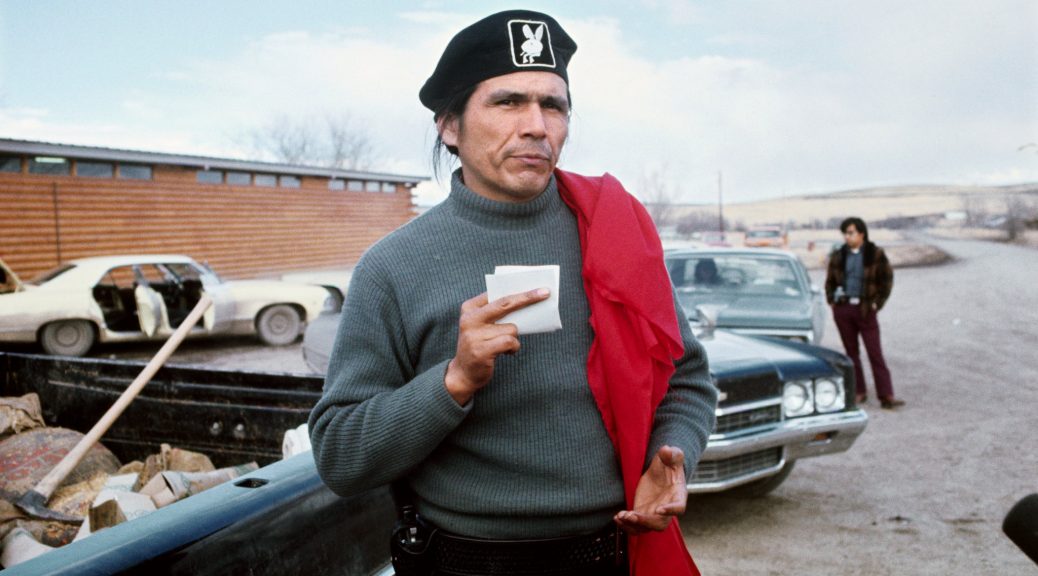
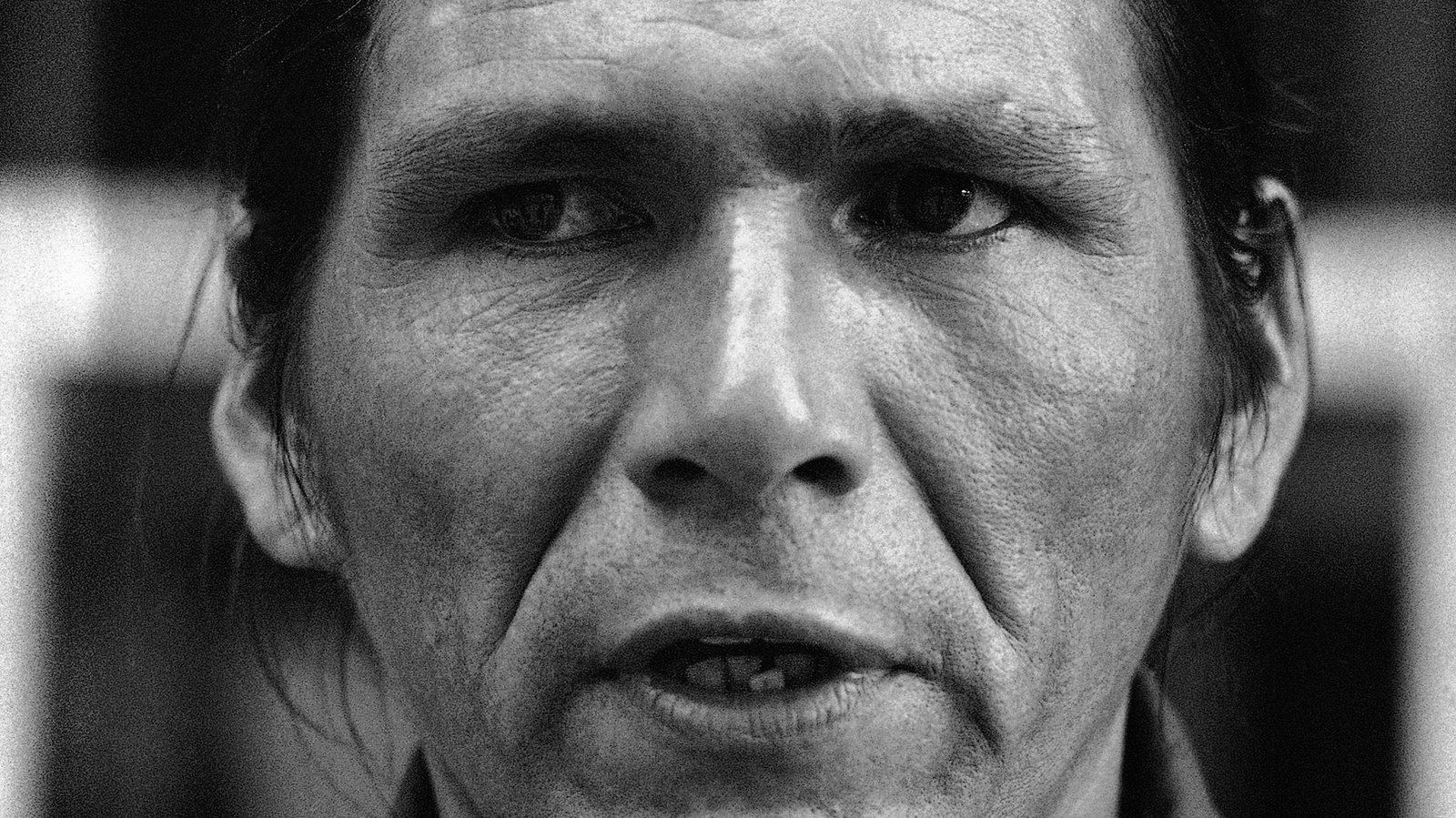
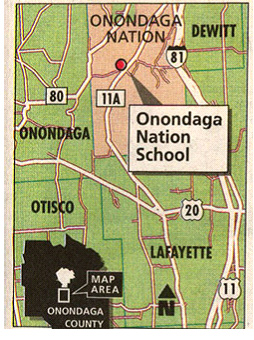
Early in 1983, the important American Indian Movement leader Dennis Banks arrived at the Onondaga Nation. Convicted of crimes in South Dakota, a state that ruthlessly pursued AIM activists, Banks found refuge for a time in California. But late in 1982, the state’s new governor-elect said that he would honor calls to extradite Banks to South Dakota. Banks fled once again. He believed that New York Governor Mario Cuomo would permit him to continue fighting extradition. Banks knew Oren Lyons and the clan mothers Audrey Shenendoah and Alice Papineau. Originally intent on heading for New York City, Banks changed course and found shelter with his friends at the Central Fire.

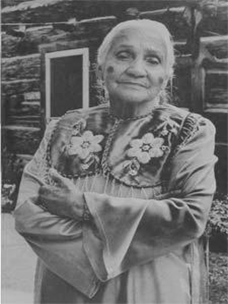
Alice Papineau

Word of Banks’ arrival traveled fast. Onondaga County Sheriff John Dillon said that he would “attempt to resolve the situation in a calm and professional manner that would not jeopardize the longstanding relationship enjoyed by the sheriffs’ department and the Council of Chiefs.” FBI officials said they would not attempt to seize Banks from an autonomous Indigenous nation. One reason for this, FBI officials knew, was because the reservation was crawling with weapons, “very heavily armed with five to seven hundred Indians.” Dillon did not want another Wounded Knee.

This was a story that interested me.  I wanted to learn more.  Several years ago, during the first Trump presidency, I submitted a Freedom of Information Act (FOIA) request for any information the United States Department of Justice, and in particular the Federal Bureau of Investigation, had about Banks during the 21 months he spent at the Onondaga Nation. I received a quick response. Items on Dennis Banks were available on the FBI website.  None of these had anything to do with Banks’ time at the Central Fire of the Haudenosaunee. I appealed, and was told they had nothing responsive to my request. 

            That I received a negative response disappointed but did not surprise me. I set Banks’ story aside. I continued to work on the history of the Onondaga Nation that I had been writing for many years. I had enough information to write that portion of the book that dealt with Banks, but the FBI, it seemed, was preventing me from digging deeper than I would have liked.

            Late last November, shortly after Donald Trump defeated Kamala Harris, I received two square cardboard envelopes from the Justice Department. Each contained a CD-Rom. Each disc was labeled so that it was clear what I had received: the record of the FBI’s attempts to surveil Banks, infiltrate the Onondaga Nation, and capture the fugitive AIM leader. Late in January, I received yet another CD. I went to the college library and checked out a device that could read the CDs. The files revealed that though FBI officials may have told local officials that they were willing to wait out Banks, it was clear that their patience gradually ran out, and that they looked for opportunities to seize the man who they considered a significant fugitive. If you are interested in seeing the files, send me an email at my campus address, and I will be happy to share.  In all, the FBI shared with me 517 pages of material, our of the 787 pages they located.

            Chief Irving Powless Jr., kept Sheriff Dillon informed of the chiefs’ and clan mothers’ decision-making. He may have communicated with FBI officials, or they reached out to him, but we cannot be sure: Powless’s number and mailing address appear written on what appears to be a note pad. The FBI had many questions. Would the Onondagas turn Banks over to state authorities? Would they grant him asylum and attempt to persuade the state of New York, in the words of attorney William Kunstler, to grant Banks “asylum and immunity from prosecution” as well?

            Religious leaders in Syracuse and the local NAACP chapter expressed their support for Banks. He stayed with Alice Papineau. He met with Tadodaho Leon Shenendoah, who told Banks that he was powerless to grant sanctuary on his own. “There’s a certain process that we have to follow,” Banks recalled Shenendoah saying. “It has to come from the people, and it has to go to the clan mothers,” and “from them it goes to the chiefs of the Onondaga Nation, then they give it to the Grand Council of the Six Nations Federation.” He had entered the Longhouse through the smoke hole, not the Eastern or Western Door. Banks went house to house, making his case. Some of the clan mothers were suspicious. They worried about the consequences of allowing a foreigner to find refuge at the Nation.  The state could honor South Dakota’s request for extradition. State or federal law enforcement might then raid the Nation.

            The clan mothers and the chiefs “inspected” Banks. Late in March, they granted him sanctuary. The Cuomo administration, meanwhile, pledged that while Banks remained on the reservation, he would not be bothered. The young leaders of the Nation—Oren Lyons, Irving Powless, Jr., and Billy Lazore, along with some of the clan mothers, had welcomed Banks to Onondaga. One of the leaders of the most important Native American “Red Power” group, it made perfect sense that the fugitive Banks found shelter under the Tree of Peace, at an Indigenous nation that had vigorously asserted its independence from state and federal authorities.

            The FBI did not rely solely on Sheriff Dillon for information. It cultivated sources, though who these people were cannot be known for certain. The files are full of redactions.  The FBI did hear a rumor that Banks would leave the Onondaga Nation Territory for an event in the Hall of Languages at Syracuse University. Four large armed guards, the story went, would accompany Banks. The FBI heard many rumors. They prepared ambushes and traffic stops. They heard that Banks traveled between Onondaga and the Akwesasne reserve in New York’s North Country. There were large supplies of arms and ammunition at Akwesasne, the FBI believed, and they worried that Banks and his followers would use these weapons against state and federal authorities. When the FBI learned that Banks’ daughter was marrying in Minnesota, and that Banks had decided that he would attend, they again scrambled to intercept.  They worried, at other times, that Banks would seek to leave the Nation, and find refuge in Costa Rica, Honduras, or Cuba.

            AIM had been persecuted and prosecuted relentlessly by Federal officials. Yet federal officials continued to view Banks as a significant threat. He still led AIM.  He stood before the media during their most well-known actions. He was a charismatic leader, easily one of the best-known Indigenous figures in the United States. And AIM, the FBI feared, despite its weakened state, nourished plans of revolution. They were stockpiling ammunition and weapons. Rudolfo “Corky” Gonzalez, a radical and shit-stirrer with contacts in the Black Panthers and a dozen lesser-known radical groups, like Denver’s Revolutionary Crusade for Justice, was equipping and training Banks’ followers. AIM, the FBI feared, acted under “Communist influence.” They were dangerous and AIM must be stopped.

            The FBI files indicate that the Bureau needed better information. Sheriff Dillon provided agents with what he heard. Agents picked up bits and pieces around the edges of the Nation territory.  The FBI relied heavily on Syracuse’s newspapers.  It all seemed unreliable and incomplete. The FBI must infiltrate the Onondaga Nation, and develop a source close to Banks.  They wanted to know Banks’ next move before he made it.

            In the papers the FBI sent me, the identity of their source is concealed, as is information on where the individual stayed, the type of car they drove, and so on. I wondered, nonetheless, if there was enough evidence in the file to allow someone to identify the source. It has been more than forty years, but perhaps someone remembers something.

            So the FBI hatched its plan.  A “source,” who knew Banks, would be recruited.  “If the Source is controllable and receptive,” the Albany FBI office “would recommend source enter the Onondaga Indian Reservation for the purpose of learning of Banks’ plans to escape/departure from the United States to Canada, or to legally accompany Banks off the reservation in such a way as to effect an arrest.” The plan could work, the FBI believed, because “it would not be out of the ordinary for an individual with Indian background to appear” at Onondaga. Many Indigenous people, driving cars with out-of-state plates, had been spotted on the Nation Territory.  “Physically the reservation is open and accessible to visitors and Albany believes source could appear on the reservation without arousing suspicion.”

            The source knew Banks in South Dakota.  The FBI flew the source to Rochester. Agents picked the source up there, drove the source to a hotel in Syracuse, and provided the source with a rented vehicle. They told the source to enter the reservation and “obtain information regarding Banks future plans and any travel being done by Banks off the Onondaga Indian Reservation.” The FBI knew their source ran risks, because they “will be kept under close observation by persons sympathetic to Banks.” The FBI believed its agents could arrest Banks within a few days of the source’s arrival on the reservation.

            Early in June of 1983, six months after Banks’ arrival, the source was listening in on conversations with Thadodaho Leon Shenendoah. The source had access, and reported that Banks was well-protected. Lookouts at the entrance to the reservation notified Banks and his bodyguards of any suspicious arrivals on the reservation. An armed bodyguard accompanied Banks everywhere. The source heard Banks’ family warn him not to leave the reservation, and to remain vigilant lest the FBI use some deceptive means to persuade him to leave.  The “source advised [that] the Onondaga Nation would consider any attempts by the FBI to enter the reservation and capture Dennis Banks as an act of war and they would arm themselves and protect” him. They might also “insure his escape through a pre-planned route of trails and gullies leading through the buffalo herd which grazes on the boundaries of the reservation.” At least two Onondagas, the source reported, carried automatic weapons, and the rest were well-armed with shotguns, hunting rifles and handguns.

            In July, one month later, the source reported that Banks and his family had left the Onondaga Nation.  The source reported that “his house on the reservation has been vacated and clothing removed,” and that he was driving a 1981 Datsun wagon with a U-Haul carrier on the roof. Agents went on alert. They monitored the roads and highways. It turned out to be a false alarm. The press learned of Banks’ potential departure and covered the Bureau’s scramble to capture him.  Banks remained at Onondaga, however, and intense aerial surveillance resulted in no evidence on the location of the car. Onondagas, however, complained about having their cars searched when they left the territory. “These searches,” the source reported, “have contributed to some Onondaga tribal members’ opposition to Banks’ continued presence on the reservation.” Indeed, the source reported that exasperated Onondagas might give Banks three choices:

  1.  To turn himself in to authorities from South Dakota or the United States.
  2. “Leave the Onondaga Reservation and seek sanctuary elsewhere.”
  3. “Remain on the Onondaga Reservation and cease any and all activities and/or associations with any groups or organizations outside the Onondaga Indian Reservation.”

The source, late in August 1983, felt confident that the Onondagas “are serious in their efforts to resolve this matter and that it would be in Banks’ best interest to turn himself in to federal authorities.”

            Late in September, a letter with an “Apex Detective Agency” letterhead arrived at FBI headquarters in Albany. The writer and the addressee are redacted, but the author reported that Banks had supporters, that he and his family were “very respectful” to the Onondagas, and good citizens “who stand up for his Indians people & for any community he has spoke out for the young and old.” He was not dangerous, and “he has not murder no one.”

Dennis has chosen a hard life of service to Indian communities; he has shown the courage of his heart that we so admire, his young and old he has told them to be proud to be a Indian and not to harm your body with drugs and alcohol, look after your family and respect them and your elders, he help us believe in ourselves.

Let him stay at Onondaga. “I’m sure we donot need another wounded knee/I’m sure Onondaga doesn’t need that there enought Murders in our community now.”

            While some Onondagas had grown tired of the stress of harboring a fugitive, others appreciated all that Banks represented.  By early 1984, however, some FBI officials thought things had gone on long enough. Some “wanted to go in and get Banks.” An additional source had infiltrated Onondaga Nation Territory. The Bureau watched the Nation from the air and from concealed locations on high ground just off the reservation. Agents sought out location for the placement of “high-power optics.” They believed that Banks’ presence had tired the largest of they factions on the Nation Territory, “the progressives or Christians who are non-violent.” Banks himself, sources said, appeared “depressed and quiet,” and some chiefs reportedly wished he would leave.

            But any sort of raid would not be easy, and there were significant reasons for caution. It seemed significant to the FBI that Onondaga “was the first New York State tribe to send delegates to Wounded Knee” in 1973. The young leaders of the Naton, who the FBI labeled “traditionalists,” were younger and angrier, armed and committed to the AIM movement. The “more militant and radical individuals” on the Nation Territory, young, male, and for the most part unemployed, admired Banks. “They have been taught to have a real anger towards the white people.” Agents whispered that “there have been rumored reports,” totally unverified, “that shots have been fired from the reservation at vehicles proceeding on Interstate 81,” which passed through Onondaga territory. Armed guards accompanied Banks at all times and when he went for a run, which he did frequently, “he is ‘covered’ (followed} by two vehicles, each containing three to five armed supporters.” (It is worth noting that divisions between “traditionalists” or pagans and Progressives had been drawn and overdrawn by white observers since the middle of the nineteenth century.)

            If an attempt to capture Banks failed, FBI strategists thought, “the resultant increased security may well preclude any second chance once the surprise element is lost.” What’s more, the FBI thought that “it is conceivable that as a direct reaction to the Banks apprehension,” if it did succeed, “a hostage(s) could be taken by Banks’ supporters onto the reservation and held as a trade for the subject.”

            In a lengthy report dated January 18, 1984, and directed towards Special Agent in Charge Paul Daly, one advisor offered his “strong recommendation that an attempt not be made” to capture Banks. Any attempt to take him would likely result in “an armed conflict.” Even getting to Banks would require precise intelligence about his specific location that was seldom available. The areas where he had been known to stay were “located on Route 11A in the approximate center of the reservation in either direction” which “could result in an assault or ambush of the arresting agents as they attempt to transport Banks to an appropriate location for appropriate processing.” Any attempt to arrest Banks on the Nation Territory, Daly was warned, “would be viewed as an invasion of the ‘sovereign’ territory with the resultant potential for violence on the part of the Indians on this reservation.”

            The report went to the very top, and FBI Director William H. Webster decided that because “Banks is confined to the reservation, in a state of possible depression, and is getting no notoriety by reason of his being there,” and because any efforts to arrest him “would elevate him immediately to celebrity status and evoke substantial sympathy among non-Indian support groups,” it was best to keep him where he was and to continue negotiations.

            FBI agents continued to monitor the reservation, and kept tabs, as much as possible, on Banks’ location. Occasionally, the sources reported that Banks had snuck off the reservation, always for a short time, always accompanied by younger armed Indians who the sources described as “bad-asses.” The FBI knew the identity of Banks’ bodyguards, but that information is redacted in the files they sent me.

            In August 1984, the FBI sources reported to their handlers that the clan mothers on the Onondaga Nation had once again called Banks before them, and once again they called on him “to maintain a lower profile and stay out of any media coverage. By the end of the month, the sources indicated that the number of Onondagas who wanted Banks gone had increased.  Banks, the sources learned, was not welcome at Akwesasne either.  “Allegedly,” one report for August 30 indicated, “Banks was physically beaten up on the Onondaga Indian Reservation by his own people.” By September 8th, the FBI sources reported that Banks had left the reservation. His whereabouts were not known, but he had been “ordered to stay off by the chiefs and clan members.”

            The FBI accounts of Banks’ time on the Onondaga Nation Territory surprised me. Information that they received from their own sources differed from what was reported in the Syracuse media, which followed the story closely. Certainly there was considerable tumult and conflict at Onondaga in the 1970s through the 1990s, and the FBI may have read into that context conclusions about Banks and his presence that over-emphasized division and disorder. It appears clear to me, anyways, that the FBI mistook an Indigenous Nation that for the most part wished to be left alone for one that threatened the American state.

            AIM, some scholars say, was well into its decline by 1980—the killing of Anna Mae Aquash, the Peltier trial, the murder trial of the AIM members in Los Angeles accused of a murder in Box Canyon, along with years of FBI infiltration and disruption. Of course AIM made outrageous demands that never were going to be fulfilled.  Of course their actions, at time, generated opposition among certain members of the communities in which they worked.  At times, by any standard, AIM members behaved badly.  It would be foolish to expect native peoples to speak with one voice, for factionalism and disagreement are facts of Native American life.  And it would be foolish as well to expect one organization, no matter how charismatic its leaders, to wipe out the enormous injustices and inequalities native peoples faced.

But Banks’ journey to Onondaga, the Central Fire of the Haudenosaunee, is significant. That Banks founds shelter at the Central Fire makes perfect sense. Onondaga was an Indigenous capital, with its own highly adept and persuasive leaders.  In the last quarter of the 20th century, Onondagas were among the most outspoken advocates for Indigenous nationhood and sovereignty on the continent. But Banks missed out on a lot during his sanctuary, was homesick, and at times struggled to keep busy on the small nation territory.  He organized running clubs, took a job, but the evidence in Syracuse newspapers and other sources suggest that not all Onondagas were happy with his residence on the nation territory.  So he left.  He surrendered to federal authorities in September 1984, was sent to South Dakota, and served a short sentence before he returned to the issues that mattered to him. Some sources suggest that the exile changed him, that he began to look for ways to collaborate with the settler state to provide benefits to Indigenous peoples. He was, in terms of his rhetoric, less strident and confrontational than he was before. Yet his career, in New York and beyond, was far from over. 

Resist

Donald Trump is indeed “flooding the zone” with unconstitutional executive orders drawn directly from the pages of the chilling Project 2025 playbook.

Two days ago, on January 29th, President Trump reestablished the “1776 Commission,” which he first ordered into existence in November of 2020. A council of hacks and weirdos, still utterly transfixed by the late Howard Zinn, the commission released a cursory report in January of 2021. In its current iteration, it will promote what the Trump administration ominously calls “Patriotic education.”

This all is part of an executive order “ending racial indoctrination in K-12 schools,” that for strange reasons spends a great deal of time punching down on transgender youth and the adults who care for and about these kids. But it also calls for the elimination of federal funding for schools that defy Trump’s edict. Patriotic education, the order reads, will include an “accurate, honest, unifying, inspiring, and ennobling characterization of America’s founding and foundational principles.” Patriotic education will consist of “a clear examination of how the United States has admirably grown closer to its noble principles throughout its history,” and promote “the concept that celebration of America’s greatness and history is proper.” Criticize the republic, and you can wind up in trouble As I asked two years ago, when might we expect the book-burning to begin?

Though no specific examples are cited, much indeed seems to be at stake. “In recent years,” the order reads, “parents have witnessed schools indoctrinate their children in radical, anti-American ideologies while deliberately blocking parental oversight.” As a result, “innocent children are compelled to adopt identities as either victims or oppressors solely based on their skin color and other immutable characteristics.”

Good Lord! That sounds terrible! It is also, plain and simple, a dangerous load of horseshit.

I am not a patriotic educator. I believe that America is a racist country, that inequality is hard-wired into the system, and in my classes we discuss the historic roots of these problems. How can we fix them, after all, without understanding them? To do any less would be historical malpractice. I suggest to my students that after the passage of 250 years, if we have not yet lived up to our “noble principles,” perhaps we do not hold those principles very closely at all. The same document that proclaims that “all men are created equal” denounces the “Indian savages” who fought to defend their homelands from white invasion and enslaved peoples who, from the beginning of this nation, pointed out the yawning gap between American ideals and reality and the emptiness of its founding rhetoric. The Founders, hardly a god-like group, created a constitution that counted enslaved people as 3/5 of a human being, and that would solve its financial problems through the massive expropriation of Indigenous land.

We should not laugh off these attacks on the integrity of our work. It is time to push back, and push back hard. It is not the job of the historian, we might suggest, to make you feel food about the past, to tell you comforting myths, that if this country just keeps trying, it just might get things right. It is, in fact, our job to point out how this administration is playing a very old game by trying to cement inequality in place, to uphold white supremacy, and that racism, in the country’s past and in this administration’s present, is fundamental to the story of the United States. Saying that, under this executive order, is now illegal.

There always has been tension between history-as-patriotic-education and history as an academic discipline that asks critical questions about the past and examines in a systematic manner processes of continuity and change, measured across time, in peoples, institutions and cultures. Teachers at the K-12 level wrestle with these tensions far more directly than do most college history professors. But we need to be involved. Talk to a history professor. Chances are she or he will tell you about the many times students have approached after class, and expressed their amazement and disappointment that nobody had taught them this material before. College students learn many things, but one of those is the lies they were told in high school. It happens in my Native American history class nearly every semester: students who attend school in New York State, for instance, learn about Cherokee Removal, but nothing about their state’s treatment, and removal, of much of its own Indigenous population. Even Deep Blue New York conceals from its students the truth of its own campaigns of dispossession, its own efforts to eradicate Indigenous peoples.

If you have followed the Right’s war on history, there is nothing new in this order. These perverts are obsessed with students’ sexuality; these racists are determined to halt discussions of race and inequality. They are working with determination to secure white supremacy and white privilege by outlawing any educator who teaches that “the United States is fundamentally racist, sexist, or otherwise discriminatory.”

The Trump Administration demands that teachers lie about this country’s past. For Trump and his followers, war is peace, freedom is slavery, and ignorance is strength. If they can convince you to believe that this country past is different than what the documents clearly show, the can claim that what has always been unjust is just, what has always been exploitative is fair, and what has always been explicitly evil is good. On those rare occasions when they concede a shortcoming, they say we have never failed because we have not yet finished trying to fix problems that ought to have been fixed generations ago.

If Trump’s friends read this, they will say that I am part of the problem, that if I just stuck to the facts in my classes, and if I left out my biases, my revisionist inclinations, and my “anti-American ideas,” all would be well. I would challenge these people to point out something in a book that I have written, or a class I have given, that is factually incorrect. Fight back, my friends. Don’t let these fascists and trolls denigrate your vital work. Don’t stop teaching your students to ask tough questions, to search relentlessly for answers, to demand to see the evidence, and show courage in the face of those who despise them and the work you are teaching them to do.

There is a lot that is great in this country. Its political system and governing class are not. I’m not interested in unverifiable assertions that the United States is the greatest country on earth–we seem to lead the world only in military spending, women’s basketball, and the mass incarceration of people of color. The Trumpzis are entitled to their opinions. But let me just say this: if you have to lie to young people to get them to accept your vision for what this country is and ought to be, the problem is not disloyal or treasonous teachers. It’s you, and your ideas about this nation and its history.

What You Need To Read, December 2024

I recently signed a contract with Yale University Press to publish The Central Fire: The Rise, Fall and Rise Again of the Onondaga Nation. If I get my last few edits done on time, the book should be out early in 2026. I also have signed an advance contract for a history of the Sullivan-Clinton Campaign, the American Continental Army’s invasion of the western Iroquois nations in 1779. My plan is to write a book that reverses the familiar narrative. I do not want to follow the army from town to town, but rather to focus on how Haudenosaunee people understood and perceived the events of that tumultuous year, as well as the consequences.  I think it will be a story that surprises some of you. Neither of these books will appear on this list any time soon. As always, I hope you are managing to hold things together as the semester limps to a close. There is some exciting work coming out.  I hope you find this list of value. It is always possible that I have overlooked something that you found particularly interesting or important. If so, I do hope you will reach out and let me know.  I hope you had a very nice Thanksgiving.

Ballew, Zada. “’The Indian Side of the Question’: Settling the Story of Potawatomi Removal in the Twentieth-Century Midwest,” Journal of the Gilded Age and Progressive Era, 23 (April 2024), 170-189.

Bobel, Peg and Linda G. Whitman, Native Americans of the Cuyahoga Valley: From Early Peoples to Contemporary Issues, (Akron: University of Akron Press, 2024).

Brown, Kaitlin M and Shyra Liguori, “Rediscovering Lost Narratives: The Hidden Cache of a High-Status Indigenous Family at Mission La Purísima Concepción and its Significance in California History, International Journal of Historical Archaeology, 28 (September 2024), 612-641.

Burnham, Philip. The Education of Clarence Three Stars: A Lakota  American Life, (Lincoln: University of Nebraska Press, 2024).

Campbell, Lyle. The Indigenous Languages of the Americas: History and Classification, (New York: Oxford University Press, 2024).

Clemmons, Linda M. Unrepentant Dakota Woman: Angelique Renville and the Struggle for Indigenous Identity, 1845-1876, (Pierre: South Dakota Historical Society Press, 2023).

Davis, Elisabeth C. “’For Actions He Took Against the Sisters’ School’: Imperial Politics, Quechan Resistance, and the Sisters of St. Joseph at the Fort Yuma Mission,” Journal of Arizona History, 65 (Spring 2024), 3-30.

Eich, Ritch. “A Story of Resiliency and Success: Beyond the Native American Boarding School,” Journal of Values Based Leadership, 17 (Summer/Fall 2024), 1-9.

Emanuel, Ryan On the Swamp: Fighting for Indigenous Environmental Justice, (Chapel Hill: University of North Carolina Press, 2024.

Fixico, Donald L. The State of Sequoyah: Indigenous Sovereignty and the Quest for an Indian State, (Norman: University of Oklahoma Press, 2024).

Gomez, Abel R. “(Re)riteing the Land: Sogore Te’ Land Trust, Amah Mutsun Land Trust, and Indigenous Resurgence in California,” American Indian Culture and Research Journal, 47 (no. 2, 2024), 1-20.

Gray, Kathryn N. and Amy E Morris, eds., Mataoka, Pocahontas, Rebecca: Atlantic Identities and Afterlives, (Charlottesville: University of Virginia Press, 2024).

Gross, Stephen and Elizabethada A. Wright, “Unorthodox Pleas for Contract Schools: Mother Mary Joseph Lynch and the Boarding School for Native Students in Morris, Minnesota., American Catholic Studies, 135 (Summer 2024), 23-49.

Hauptman, Laurence M. “Native American History Through a Different Lens: Indigenous-African Connections in Colonial Westchester County and Environs,” Hudson River Valley Review, 40 (Spring 2024), 2-19.

Hill, Christina Gish, Matthew J. Hill and Brooke Neely, eds., National Parks, Native Sovereignty: Experiments in Collaboration, (Norman: University of Oklahoma Press, 2024).

Huhndorf, Shari M. Native Lands: Culture and Gender in Indigenous Territorial Claims, (Berkeley: University of California Press, 2024).

Ignace, Danielle and Niiyokamigaabaw Deondre Smiles, “Expressions of Gratitude: Two Indigenous Scholars Share Their Experiences with the Work of Robin Wall Kimmerer,” Bulletin of the Ecological Society of America, 105 (July 2024), 1-6.

Johnson, Amanda. “Ganienkeh, Out of City and Away from the Reservation: The Making of an Indigenous Space, 1974-1979, Ethnohistory, 71 (April 2024), 271-291.

Keeler, Kasey. “Beyond the White Picket Fence: American Indians, Suburbanization, and Homeownership,” American Indian Culture and Research Journal, 47 (no. 2, 2024).

Konkle, Maureen. What Jane Knew: Anishinaabe Stories and American Imperialism, (Chapel Hill: University of North Carolina Press, 2024).

Lutz, John Sutton and Keith Thor Carlson, “The Smallpox Chiefs: Bioterrorism and the Exercise of Power in the Pacific Northwest, Western Historical Quarterly 55 (Summer 2024), 87-104.

Mays, Kyle. City of Dispossessions: Indigenous Peoples, African Americans, and the Creation of Modern Detroit, (Philadelphia: University of Pennsylvania Press, 2022).

Meadows, William C. “’Just Give Me that Respect, That I’m A Veteran’: The Kiowa Women Warriors Color Guard—Changing Women’s and Veteran’s Roles among the Kiowa,” American Indian Quarterly, 48 (Winter 2024), 58-95.

Nagle, Rebecca: By The Fire We Carry: The Generations-Long Fight for Justice on Native Land, (NY: Harper, 2024).

Narrett, David. The Cherokees: In War and At Peace, 1670-1840, (Cambridge: Harvard University Press, 2025).

Osborn, Katherine. “Stealing the Sacred: Water and Colonialism in Arizona: A Comparative Review Essay,” New Mexico Historical Review, 99 (Winter 2024)

Parker, Angela K. Damming the Reservation: Tribal Sovereignty and Activism at Fort Berthold, (Norman: University of Oklahoma Press, 2024).

Reed, Kaitlin. Settler Cannabis: From Gold Rush to Green Rush in Indigenous Northern California, (Seattle: University of Washington Press, 2023).

Rice, Glen E., Arleyn W. Simon and Chris Loendorf, Vapaki: Ancestral O’Odham Platform Mounds of the Sonoran Desert, (Salt Lake City: University of Utah Press, 2023).

Sudol, Christopher, “Dammed Conquest: Environmental Projection, Coercion, and the Colonial Transformation of the Indigenous Arizona Borderlands,” Journal of Arizona History, 65 (Autumn 2024), 273-307.

Sussman, Naomi. “’Related Around the Mountain’: Relational Sovereignty and Coalition Building in the California Interior,” William and Mary Quarterly, 81 (October 2024), 721-766.

Taylor, Marie Balsley. Indigenous Kinship, Colonial Texts and the Contested Space of Early New England, (Amherst: University of Massachusetts Press, 2023).

Thomas, Ariane E., et. al., “The Dogs of Tsenacomoco: Ancient DNA Reveals the Presence of Local Dogs at Jamestown Colony in the Early Seventeenth Century,” American Antiquity, 89 (July 2024), 341-359.

Thornton, Arland and Linda Young-DeMarco. “Literacy Among American Indians: Levels and Trends from 1900-1930 and Across Birth Cohorts from 1830-1920,” Ethnohistory, 71 (July 2024), 379-408.

Usner, Daniel H. Native American Women and the Burdens of Southern History, (Baton Rouge: Louisiana State University Press, 2023).

Voight, Matthias Andre. Reinventing the Warrior: Masculinity in the American Indian Movement, 1968-1973, (Lawrence: University Press of Kansas, 2024).

Warren, Stephen. “Red Codes and Removal: Racial Exclusion and Indigenous Persistence in the Midwest,” American Indian Quarterly 48 (Spring 2024), 165-194

Webster, Rebecca M. “In Defense of Sovereignty: Protecting the Oneida Nation’s Inherent Right to Self-Determination,” (Madison: University of Wisconsin Press, 2023).

Whitman, Kyle, “Indians Fish Just Because it is Their Right to Fish: Michigan Native Americans and the Battle for Fishing Rights,” Michigan Historical Review, 50 (Spring 2024), 45-63.

Apologizing for History


It seems very likely that President Biden’s last official act affecting Indigenous peoples will be the “formal apology” he issued late in October. He apologized for the American Nation’s treatment of the thousands of Native American children it placed in dozens of boarding schools across the country. Like so much about Biden, his apology had the potential to be so much more than what it was.

            Biden was following the lead of the Federal Indian Boarding School Initiative, launched in the summer of 2021 under the leadership of the first Native American Secretary of the Interior, Deb Haaland.  Item 1 in their report was “Acknowledge, Apologize, Repudiate, and Affirm.” That meant that:

There were problems with the final report. It was incomplete, and understandably rushed.  The staffers working on it knew that the clock was ticking and, indeed, it is difficult to imagine that a work of this sort, or any formal apology, would emerge from the administration of President-Elect Trump. Assistant Secretary of the Interior for Indian Affairs Bryan Newland claimed that those who compiled the Initiative’s two reports read through 103 million pages of government records between June of 2021 and July of 2024. That means they worked through nearly 89,000 pages a day, an impossibly large number of pages to read thoroughly, or at all.  They were undisciplined in their approach to examining continuity and change over time, for the boarding schools were not static entities: they solved some problems as they failed to address others. There is little evidence that they examined closely student files. Their count of the number of children attending these schools, and the number that died while attending them, appears low.  It was, by its own admission, a first step.

            Despite these problems, the Report is significant. There have been attempts by the United States government to apologize for its past treatment of Indigenous peoples—the best brief summary of them appears in Sarah Deer’s The Beginning and End of Rape—but Biden’s apology had the potential to do more—to come clean about the misdeeds, to examine the receipts and present the data, and try to move forward.  The report’s recommendations for government action are all reasonable and would be helpful, and I find it difficult to believe that the incoming Trump Administration will follow through with any of them. That is one of many disappointments adhering to Trump’s victory.

So on October 25th, President Biden visited the Gila River Crossing School in the Gila River Indian Community, not far from Phoenix. He came on stage. He joked with his friends. He was generous in giving credit to others, especially Secretary Haaland. His delivery was predictably untidy.  You know how he speaks. He recalled a conversation he had at the hotel where he stayed. The person with whom Biden had spoken, he claimed, had never heard of boarding schools. Biden wanted people to know, he said, about the “generations of Native children stolen, taken away to places they didn’t know with people they never met who spoke a language they had never heard. Native communities silenced.  Their children’s laughter and play were gone.” Once the children their clothing was removed, their hair cut, and their names “literally ersed and replaced by a number or an English name.” Children were beaten, Biden said, for speaking their own language. He continued:

The boarding school system was “horribly, horribly wrong,” Biden said, “a sin on our soul.”

            Biden then called for a moment of silence.  Then he shouted the apology.  “I formally apologize,” he said, “as president of the United States of America, for what we did. I formally apologize. And it’s long overdue.” He was then interrupted by an audience member, shouting out about “the people in Gaza.” Biden said to let the protestor speak, for “there’s a lot of innocent people being killed, and it has to stop.” When the disturbance died down, he spoke of his administration’s accomplishments. He was appealing to Native American voters.  His apology led into a campaign speech describing all that the Biden-Harris administration had done for Indigenous people.

            We know now that Native Americans, like every other group in America, swung to the right in 2024.  If his goal was to secure votes for his successor, it is unlikely that he succeeded. Biden has aged. That is clear. He seems feebler every time I see him.  Like Trump, he can do little but read from a teleprompter and, like Trump, at times he struggles to do even that.  It is easy to dismiss this apology for these reasons.  But as Native News Online put it in an editorial that appeared a couple of days ago, “Indian Country Deserves a President Who Shows Us Respect.”  Of course Biden’s apology, and the Boarding School Initiative Report on which it was based, flattened a complex history, and treated incompletely the complications, nuances, and ambivalence that is present in the record.  But it is significant. Sandwiched between two Trump administrations, the first of which was a disaster for Indigenous communities, Biden at least leaned in the direction of admitting the sins of a country that will now be consigned to the hands of those who view any criticism of the nation not merely as a cardinal sin, but a crime that just may be prosecuted. He showed some respect, even if it may turn out to be too little, too late.

Get Ready for the Plunder

I wrote nearly every week on this blog during the four years when the Trumpzi party controlled the Executive Branch. I let things slide a bit during the Biden years. Though Biden was so much less than I wish he was, there was indeed much less to be outraged about. Now, Trump will be returning to the White House. The American people, with eyes wide open, looked past his criminal convictions, his obvious lack of character and integrity, his racism and sexism, and his manifest unfitness. He will be back, and he will be looking to finish the work his advisors tell him to do. Let’s face it: I am a woke historian. Studying history, after all, can break your heart. Working to remedy the injustices of the past, I believe, is one way to heal. And we are going to have a lot of work to do.

If you are a historian, you probably have a list of rules, formal or informal, that you share with your students. Some of them may have to do with how you like your students to write and conduct research. But I also share with them certain assumptions about how the past works. Mostly I share these with them as a way to let them know where I am coming from, how I have learned to view the past. I tell them that they should never bet against the power of white supremacy and colonialism.

During the campaign, Trump began to distance himself from Project 2025, a mammoth tome highlighting changes the extreme right would like to make as it overhauls the federal government as we know it. I read the sections about education. I read where the contributors described American historians as people who hate their country and feed distorted and partisan information to their students. I fully expect the next four years to be brutal for those of us who teach students to think about the past and the sometimes considerable gap between the way things are and they way they ought to be.

I also read the section of the book which treated the Department of the Interior and, under that heading, the Bureau of Indian Affairs. The Trumpzis are coming for the American Nation’s public lands. After all, Project 2025 reads, 61% of the mineral wealth in the continental United States occurs on federal land, but less than a quarter of the nation’s oil and 12% of its natural gas come from those lands. The Biden Administration, the authors assert, waged war “domestically available fossil fuels.” And by discouraging Indigenous nations from mining, fracking, and drilling, the Project 2025 plotters argued that the Biden administration unconstitutionally breached its trust responsibility to native nations (536).

So Project 2025 calls for the federal government to work toward the following two goals:

For Project 2025, it was simple: “A significant percentage of critical minerals need by the United States is on Indian lands, but the Biden Administration has actively discouraged development of critical mineral projects on Indian lands rather than assisting in their advancement”(536-537).

Drill, baby, drill.

There are Indigenous nations that have aggressively exploited their mineral wealth. The Crows, discussed in detail in Native America, are an example of a Native Nation that has seen in mining its rich coal fields a path out of poverty, and they have placed mining over the health and environmental consequences of mining. Project 2025 would have the Trumpzi Party “end the war on fossil fuels and domestically available minerals and facilitate their development on lands owned by Indians and Indian Nations.” The federal government should no longer require Indigenous Nations to adhere to federal environmental policies. The government should open tribal lands for corporate exploitation, and Project 2025 respected tribal sovereignty so far as it made it easier to extract the mineral wealth in Indian Country.

Nothing was said in Mein Trumpf about other areas where tribes have asked for additional authority over Indian country. Prosecution of federal crimes remains the business of the federal government. Nothing about Missing and Murdered Indigenous Women, environmental despoliation of Indigenous lands, police brutality, and the weight of continuing colonialism.

It’s not Mordor. It’s the Crow Reservation in Montana.

We are going to enter a period of unmitigated corporate rape of some of the most beautiful places in the United States. I find it difficult to believe that Trump’s avaricious young white guys are all ready to issue a flurry of executive orders opening reservation and federal land and reservation territories. It will unquestionably have adverse affects on the health and safety of Indigenous People who live nearby, and a general lowering of quality-of-life as health standards fall.

Keep your eyes on who Trump appoints to head the Interior Department and, even though the media will not cover it, who he places in charge of the BIA. Watch these people. Monitor their actions. See what they say. Hold them to account. We are the only guardrails left.

An “Unfinished Revolution” May Not Be Much of a Revolution At All

            According to a recent story by Kathleen Moore that appeared in the Albany Times-Union last week, the State Board of Regents had a chance to look at the new way the New York State Parks department will depict the American Revolution.  The parks department’s new displays at several sites will “include powerful new videos detailing the lives of unheard people from that time.” One of the videos, which focuses on the struggles of an Oneida woman who fought the colonists in hopes of keeping her Nation’s land, ends with a black screen with the following words: “Since its founding, the United States has never upheld a treaty made with an Indigenous Nation.”

            That’s a provocative claim. (And a complicated one, but that’s another story.) In all, there are forty videos, which have not yet been released to the public.  The Board of Regents “immediately praised the new pieces, but worried that they would get another deluge of criticism similar to what happened when they approved diversity, equity, and inclusion policies.” They will need to be brave, and the Regents are readying themselves for combat. According to Chancellor Lester Young, Jr., “we are the body that is responsible for the education of all students and it’s important that we maintain the courage to do what’s right.”

            “The new way of viewing the Revolution, as designed by the State Education Department’s Office of Cultural Education and the State Parks Department is called ‘The Unfinished Revolution.’” The Revolution was “incomplete” in that it “did not include women as voters, obviously enslavement was allowed for decades, so how do we grapple with that history?” That is what Devin Lander, the New York State Historian, said when he spoke with Moore.  “The idea,” writes Moore, “is to see the revolution as the impetus for 250 years of striving to meet the ideals of the Declaration of Independence.”

Think about that. 

250 years.

Two and a half centuries.

A quarter of a millennium.

It’s a long time.  We have yet to fulfill the ideals of the Declaration after 250 years.

Maybe we are just not that into the so-called “ideals” of the Declaration. After all, Jefferson’s Declaration also expressed that nasty old hypocrite’s anger that the King was stirring up slave rebellion and bringing down upon the frontiers the “merciless Indian Savages.” Jefferson and the other “Founding Fathers” baked hatred of the other into the American Nation’s founding documents.

Framing the Revolution as “unfinished” will leave students ill-equipped to explain how it was that our supposedly ruthless imperial overlords in Britain managed to abolish slavery and recognize the right of women to vote well before the United States.  It may seem to these students that the enemies of the principles laid out in the Declaration were quicker to realize them than our new “Empire for Liberty.” That might seem strange to them, a real head-scratcher.

The Board of Regents requires that students in New York learn about Cherokee Removal.  The notion that New York could not have become the Empire State without a systematic program of Indigenous dispossession that, at times and places, violated federal law will never be mentioned.  That New York continues to attempt to skim the cream from the barest hint of prosperity that comes to Indigenous nations in the state will never be mentioned. Continued treaty violations, today, are never addressed.  Hochul and Cuomo, both Democrats, were as bad as the Republican George Pataki.

That white New Yorkers, today, are the beneficiaries of this process of dispossession is as heretical a doctrine to racist dingbats as it is to the Board of Regents, who hardly are as courageous as they would like to believe.

In the last election, nearly 75 million people voted for a dim-witted tyrant whose followers, at a convention broadcast on national TV, held pre-printed poster with the slogan, “Mass Deportation Now!” The Republican Presidential candidate and his running mate repeatedly state the known falsehood that immigrants are eating dogs and cats. It’s a vile, racist, lie. And they do not stop. Police violence against people of color is an American reality. I read the history of the past 250 years and it is overwhelming.  The few occasions where this country’s leaders stood up for justice and equality came because people of color compelled them to do so. Maybe, just maybe, we do not value freedom and equality for all Americans. Many of us—too many—are comfortable with deeply entrenched inequality in American life.  Too many people turn away from too much injustice.  That, I am sorry to say, is a beat that runs through much of American history like a throbbing wail.  So instead of saying outright, that we have failed to create a just and decent society, we claim that despite the passage of 250 years, we continue to strive to live up to the ideals of an enslaver who could turn a nice phrase.  We have not failed because we have not had a chance to fail even though 250 years have passed and we have not succeeded. An unfinished revolution, you see, may not be much of a revolution at all.