All posts by admin

It’s All About White Supremacy

When FBI Director Kash Patel fired two agents who had kneeled in solidarity with the Black Lives Matter movement five years before, his actions had the effect of upholding white supremacy. No statement of sympathy for those grieving the murder of young men of color by militarized police forces could be tolerated.  Never mind that the agents kneeled in Minneapolis, where George Floyd died, and where the police officer involved was convicted of murder. Africans Americans are the other, Patel’s actions showed, on whom acts of humanity are wasted. Only some lives matter.

            When Donald Trump refused to continue commemorations of Missing and Murdered American Indians and Alaska Natives Day, a national commitment he pioneered in May of 2020 to end “the disturbing violence against these Americans and to honoring those whose lives have been shattered and lost,” he demonstrated that to him Indigenous lives did not matter, either. Indeed, when Trump tried to stir up white resentment in an affluent Long Island suburb against those who insisted that the local high school change its name, he worked in defense of white supremacy. The grievances of people of color, whether Indigenous or African-American, are illegitimate and worthy of contempt.  You need not take these concerns seriously.  Same thing with the former names of the Cleveland Guardians and Washington Commanders, two teams that have done just fine since they dropped their racist names and imagery.  People of color want you to change what you are doing, Trump suggested, something they have no right to ask you to do.  Only some people’s feelings matter.

            We won’t talk about the past, Trump and his supporters have suggested, unless we do so in a way that instills a “patriotism” that celebrates white supremacy. You do not have to listen to the “Anti-American” complaints of those who have suffered for American empire. Images of slavery will be removed from museums, historic sites, textbooks and classrooms. The Trump Administration has demanded that teachers lie about this country’s past. For Trump and his followers, war is peace, freedom is slavery, and ignorance is strength. If they can convince you to believe that this country’s past is different than what the documents clearly show, they can claim that what has always been unjust is just, what has always been exploitative is fair, and what has always been explicitly evil is good. On those rare occasions when they concede a shortcoming, they say we have never failed because we have not yet finished trying to fix problems that ought to have been fixed generations ago. The notion that slavery and Indigenous dispossession benefited white immigrants to this settler nation is heresy in eyes of Republicans.

            You can see it in the racist memes sent out by the fascist Department of Homeland Security, overseen by a freak who murders dogs and a meathead who hunts “illegals” while collecting bribes in paper bags. Above George Caleb Bingham’s painting of Daniel Boone leading settlers through the Cumberland Gap—into lands unceded by the Indigenous people who lived upon them—DHS posted on its Instagram page this image:
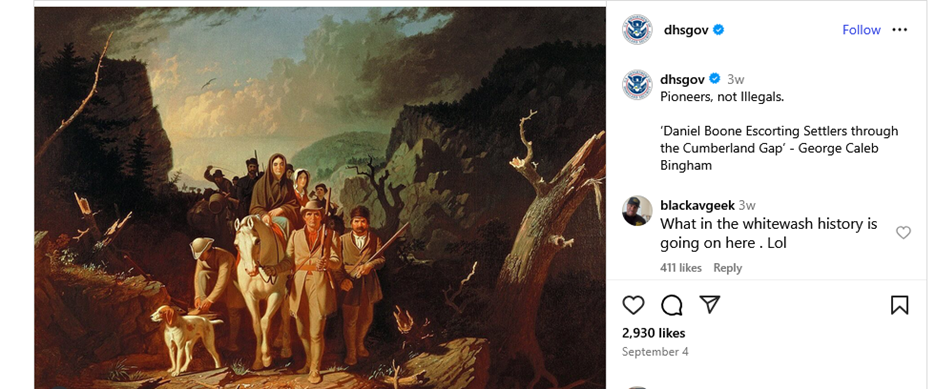
When white people cross a border and seize property from Indigenous peoples, it is something to celebrate.  That point is made clear when DHS posted John Gast’s “American Progress,” a painting that represents more clearly than any other American work of art the racist ideas and attitudes underlying Manifest Destiny, with the caption “A Heritage to be proud of, a Homeland worth Defending.”

To point out that this country took its shape through a systematic program of Indigenous dispossession is to risk one’s life and liberty.  That heritage is filled with racial violence. Republicans, meanwhile, attack affirmative action in colleges, encourage fear of American cities, and attack the integrity and character of people of color. They create a climate of fear, silencing dissent. The Republican Party, a diseased organism entirely in the thrall of its corrupt leader, truly has nothing else. They have no constructive or positive agenda.  The economy is a wreck. The United States has squandered the respect of our friends and allies. And fascism has taken root. They have no significant legislative achievements and, indeed, their weak leader can only govern by the “executive orders” a weak Congress and amoral Supreme Court continue to permit. They have nothing.

There are three factors that can help the Republicans continue to hold power.  One is the continued cowardice and fecklessness of the Democratic leadership which has been unwilling and unable to rise to the occasion. At the same time, Republicans stir up white resentments against the weakest and most marginalized groups in American society: the LGBTQIA+ community, immigrants (undocumented or not), and racial and ethnic minorities.  They have nothing, and they know it. They stand for nothing but hatred and white supremacy. So they will also work with determination to rig the electoral system and make it difficult for those who wish to vote. All they can hope for is that they are able to continue to generate hatred and division. And despondency. It worked for Donald Trump spectacularly well in 2024.  It is up to us not only to see that it does not happen again, but that we keep the receipts and hold accountable the Party and its leaders in the future for the things they have said and done. Democrats should loudly and proudly promise that if they take the legislative and executive branches of government, they will expand the Supreme Court and call to account Republican law-breakers.

            Their viciousness is a sign that they sense that they are losing.  I am so fortunate to spend my time talking with young people baffled by the party’s hatred. Like pests, the Republicans will break institutions and hurt people and ruin lives, but their time is limited.  Once young people who could not care less about the culture war issues that haunt the Republicans’ take over, I hope this nightmare will be over.  We can make the Republicans go away. It will take time and enormous effort to rebuild all that they have ruined.  But we need to act.  The sooner the better.  2026 cannot come soon enough.

The World Is God

I regularly teach a course called Indigenous Law and Public Policy, but I have little faith in the American legal system. Even when the law clearly recognizes an Indigenous right, the United States seems to work at times hand-in-hand with the court system to find a way around whatever legal obligations stand in its way. The law was not written by Indigenous peoples, and it is safe to assume that its fundamental premise is to protect the interests of the white majority. In this racist, settler state, built on Indigenous land, state and federal governments will only support the rights of Indigenous nations and individuals to the point where it begins to cost them something or when it is in their interest to do so.

            Thus I found it entirely unsurprising when former Attorney General Bill Barr penned an op-ed in the Wall Street Journal earlier this month in support of a multinational mining operation’s drive to destroy Oak Flat, a site sacred to many Apaches in Arizona. The proposed copper mine will create a massive crater and bring environmental devastation to a significant swath of territory. Nobody disagrees that the mine will infringe upon the Apaches’ constitutionally-protected right to the “free exercise” of their religion.

            Barr said not a word about the damage the mine will do to the land, sky, and water. He trotted out a series of familiar arguments, derived largely from a 1988 Supreme Court decision called  Lyng v. Northwest Indian Cemetery Protective Association (1988), which held that the government did not need to respect minority religious rights when it had an overriding “rational basis” for doing so. (A higher standard, the “compelling interest test,” Barr also believes the government would pass). Dismissing the Apaches’ case as a “dubious” claim to religious liberty, Barr argued that all Americans have the right to practice their religion in the privacy of their own home or personal place of worship. But no one, he said, has the right “to demand perpetual access to federal property, for religious worship or any other purpose.” Oak Flat, Barr continued, is not all that special anyways, because some Apaches have said so. Indigenous peoples, Barr suggests, must unanimously agree that a place is sacred if they are to have any chance to prevent its destruction. A few Indians, he said, should not be allowed to block needed infrastructure projects, like the mine proposed by Resolution Copper, that “are essential to the American economy.”

            There are so many problems with this argument. No similar burden is placed on Christians, for example, when they deem a site sacred.  If Catholics think a site is sacred, their views are not considered illegitimate because Protestants do not feel the same way.  And what happens when the site slated for destruction IS the place of worship? Oak Flat is unique.  Indeed, if you get a chance to visit it you will see this. The Apaches who worship there literally cannot hold their rites anywhere else. Would Barr favor the destruction of St. Patrick’s Cathedral if a rich vein of copper were found underneath? Of course not, even though Catholics could trot down the street to the nearest Catholic church and practice the exact same rituals.  Barr, like so many pro-corporate leaders in the past, argues that the copper that will be torn from the earth at Oak Flat is so valuable to the corporation that the United States government has a “rational basis” for supporting its extraction, even if that corporation is based overseas and most of the copper will leave the US. His arguments are racist, ugly, and colonial.

            And also so short-sighted. Several years ago Apache Stronghold leader Dr. Wendsler Nosie gave the annual Great Day lecture at my college.  He placed the destruction of Oak Flat in a larger context framed by considerations of extractive industry and environmental destruction. You want AI? You want batteries that can power your electric vehicle? You want a green economy? You need copper. However, as Dr. Nosie pointed out, the dangerous addictions of western society to ripping valuable resources from the soil will destroy us all eventually.

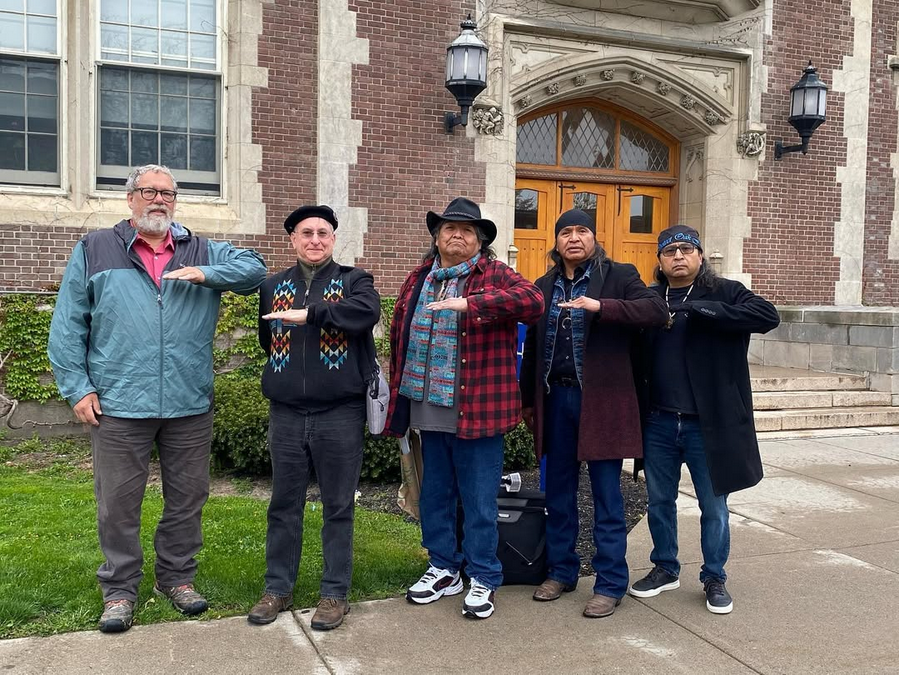
Dr. Wendsler Nosie, second from right, visiting Geneseo

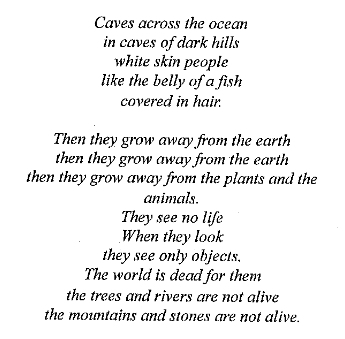
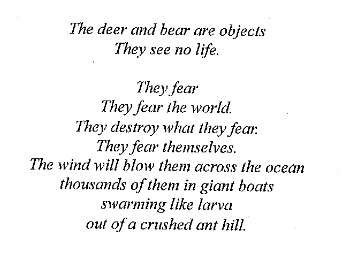
            The law may very well support Barr’s position. That law functions to protect corporate wealth and its Democratic and Republican allies. But is it not obvious how short-sighted and destructive this is? I think of the witchery described in Leslie Marmon Silko’s Ceremony. White people, the most frightening witch warns, emerge from :

It was during a long flight home from California that I thought about Barr’s essay. I had been reading through Thomas Blackburn’s December’s Child: A Book of Chumash Oral Narratives. Blackburn sifted through the massive collection of oral accounts assembled by J. P. Harrington early in the twentieth century.  In Blackburn’s retelling, it was an enormous undertaking.  One of Harrington’s sources told a story that struck me in terms of our failed political system, or dying planet, our insensitivity to the beauty that surrounds us. Fernando told Harrington about an interconnected world in which “all the animals are related.”

The horned toad is the wot of all beasts, the swordfish of all fish, and the slo?w of all birds. The bear is the older sibling of all the animals. The eagle, condor, and buzzard are said to remove the foulness of the world. I told Fernando of the San Gabriel belief that the condor rips up carcasses for the buzzard—that they are first cousins. Fernando replied that an old man told him that we are all brothers, and our mother is one: this mother earth. He has always believed what the old people told him when he was a boy—that the world is God.

The destruction that will be done to Oak Flat has been ably described by my friend and colleague Joel Helfrich. Barr never mentions any of this. He relies on a legal system that permits the United States to enable an atrocious moral wrong.

What You Need to Read, September 2025

            Some really exciting work has come to my attention, either recently published or forthcoming, that I wanted to share with you in the latest quarterly bibliography of new and noteworthy work in Native American/Indigenous studies.  I hope you will take a look, and if I have missed anything, please feel free to let me know. New quarterly bibliographies are posted every December, March, June and September, going back to early 2017.   Enjoy.

Adler, Michael A. Transilient Acts and Resilient Villages: Pueblo Community Persistence in the Northern Rio Grande, (Phoenix: University of Arizona Press, 2026).

Beckmann, Sydney. “Pan-Indianism and Authenti(city): Refusing Colonial Borders,” American Indian Culture and Research Journal, 48 (no. 2, 2025), 59-70.

Bender, Margaret and Thomas N. Belt, The New Voice of God: Language, Worldview, and the Cherokee Bible, (Norman: University of Oklahoma Press, 2023).

Bigart, Robert J. Indian Chiefs vs. Government Agents: Politics and Law Enforcement on the Flathead Indian Reservation, 1875-1910, (Lincoln: University of Nebraska Press, 2026.

Crepelle, Adam. Becoming Nations Again: The Journey Towards Tribal Self-Determination, (Cambridge: Cambridge University Press, 2025).

Faull, Katherine M. Cultures at the Susquehanna Confluence: The Diaries of the Moravian Mission to the Iroquois Confederacy, 1745-1755, (University Park: Penn State University Press, 2025).

Fauvelle, Mikael, and Alvaro Montenegro, “Do Stormy Seas Lead to Better Boats? Exploring the Origins of the Southern Californian Plank Canoe Through Ocean Voyage Modeling,” Journal of Island and Coastal Archaeology, 20 (July-September 2025), 588-608.

Frey, Benjamin E. Rising Above: Language Revitalization in the Eastern Band of Cherokee Indians, (Lincoln: University of Nebraska Press, 2025).

Galler, Robert W., Jr., Taking Charge, Making Change: Native People and the Transition of Education from Stephan Mission to Crow Creek Tribal School, (Lincoln: University of Nebraska Press, 2025).

Gamble, Evan. “Into the Jurisdictionverse: How Tangled Jurisdictional Lines Around Indian Country Thwart Attempts to End the Crisis of Missing and Murdered Indigenous Women,” American Indian Law Review, 49 (no. 1, 2025), 57-96

Gauthier, Ethan Paul, ‘A Separate and Distinct Tribal Entity’: The Resilience of the Modoc Nation of Oklahoma,” Ph.D. diss., University of California at Riverside, 2025.

Gere, Anne Ruggles. Agents of Survivance: Indigenous Women Teachers in the Boarding School Era, (Lincoln: University of Nebraska Press, 2026).

Giancarlo, Alexandra, Janice Forsyth and Braen TeHiwi., Beyond the Rink: Behind the Images of Residential School Hockey, (Winnipeg: University of Manitoba Press, 2025).

Grande, Sandy. “Grounded Engagement Against Empire,” American Quarterly, 77 (June 2025), 251-255.

Grillot, Thomas. The Pursuit of Family: A History of Dakota and Lakota Family and Kinship on the Standing Rock Reservation, 1794-2022, (Lincoln: University of Nebraska Press, 2026).

Haake, Claudia B. “The Value of Words: Wampum in Iroquois Diplomatic Petitions of the Removal Era,” Journal of Imperial and Commonwealth History, 53 (June 2025), 510-544.

Havard, Gilles. Empire of Pelts: French Fur Traders in North America, 1600-1800, (Lincoln: University of Nebraska Press, 2026).

Humalajoki, Reeta, “Bribed With Our Own Money: Federal Abuse of American Indian Funds in the Termination Era/Wardship and the Welfare State: Native Americans and the Formation of First-Class Citizenship in Mid-Twentieth-Century America,” American Studies in Scandinavia, 57 (May 2025), 85-90.

Isenberg, Andrew C. The Age of the Borderlands: Indians, Slaves, and the Limits of Manifest Destiny, 1790-1850, (Chapel Hill: University of North Carolina Press, 2025).

Johnston, Carolyn and Terri M. Baker, Living Indigenous Feminism: Stories of Contemporary Native American Women, (Athens: University of Georgia Press, 2025).

Kelley, Lucas P. Marking Native Borders: Indigenous Geography and American Empire in the Early Tenessee Country, (Norman: University of Oklahoma Press, 2025).

Kiel, Douglas Metoxen. Unsettling Territory: The Resurgence of the Oneida Nation in the Face of Settler Backlash, (New Haven: Yale University Press, 2026).

Knolle, Lila Teeters. “Indians Now Taxed: Citizenship and Taxation in Settler-Colonial South Dakota,” Journal of American Ethnic History, 44 (Summer 2025), 44-72.

Kushner, Aaron. Cherokee Nation Citizenship : A Political History, (Norman: University of Oklahoma Press, 2025).

Lewis, Jacob. “The Native Fight for Hunting Rights: The Crow Tribe and Herrera v. Wyoming,” American Indian Law Review, 49 (no. 1, 2025), 97-115.

Minch-de-Leon, Mark. Indigenous Imhumanities: California Indian Studies after the Apocalypse, (Minneapolis: University of Minnesota Press, 2025).

Miron, Rose. Indigenous Archival Activism: Mohican Interventions in Public History and Memory, (Minneapolis: University of Minnesota Press, 2026).

Morris, Michael. Cherokee Odyssey: The Journey from Sovereign to Civilized, (Lanham,MD: Lexington Books, 2025).

Murphy, Thomas W. Unsettling Scripture: Iroquois and the Book of Mormon, (Salt Lake City: University of Utah Press, 2025).

Narrett, David E. The Cherokees: In War and Peace, 1670-1840, (Cambridge: Harvard University Press, 2025).

Nichols, David Andrew. To Be Men of Business: The Origins of Chickasaw Capitalism, 1700-1840, (Lincoln: University of Nebraska Press, 2026.

Oberg, Michael Leroy. “Vast Indigenous America,” William and Mary Quarterly, 82 (April 2025), 299-306.

Parent, Anthony S., Jr., Flocks of Birds: Virginia Colonialism into Native Country, 1670-1776, (Columbia: University of South Carolina Press, 2025).  

Prior, Charles W. A. Treaty Ground: Diplomacy and the Politics of Sovereignty, from Roanoke to the Republic, (Lincoln: University of Nebraska Press, 2026).

Radde, Hugh D., Wendy G. Teeter, Desiree Martinez and Karimah Kennedy Richardson, “A Critical Evaluation of Radiocarbon Dates and Indigenous Settlement Patterns on Santa Catalina Island, California,” Journal of Island & Coastal Archaeology, 20 (July-September 2025), 703-727.

Reed, Julie L. Land, Language and Women: A Cherokee and American Educational History, (Chapel Hill: University of North Carolina Press, 2026).

Richards, Katherine Morton. “Thoughts and Prayers: Comparing Public Apologies for Residential Schools in Canada,” American Indian Culture and Research Journal, 48 (no. 2, 2025), 93-113.

Singer, Eliot A. “’Their Beautiful Storycraft’: Restoring the Original Manuscripts for Schoolcraft’s Algic Researches by William Johnson and Others,” American Indian Culture and Research Journal, 48 (no. 2,, 2025), 143-155.

Stone, Erin Woodruff. Captives of Conquest: Slavery in the Early Modern Spanish Caribbean, (Philadelphia: University of Pennsylvania Press, 2025).

Usner, Daniel H. Jr., From Bayou Teche to Fifth Avenue: How Basket Diplomacy Saved the Chitimacha Indian Nation, (Lincoln: University of Nebraska Press, 2026).

We Need to Talk About Genocide When We Teach Native American History

            Bret Stephens wrote a piece in the New York Times a while back in which he asserted that what Israel is doing to Palestinians, despite its violence and the enormous loss of life, does not constitute genocide. Stephens’ logic is familiar to those of us who teach Native American history. Written under a headline that reeks of condescension, (“No. Israel is Not Committing Genocide in Gaza”) Stephens mounts several familiar arguments.

            If the Israelis really were acting with genocidal intent, why hasn’t their offensive in Gaza “been more methodical and vastly more deadly?” If it wanted to, Stephens argued, Israel could wipe Gaza off the map. It hasn’t, he says. “In short,” he writes, “the first question the anti-Israel genocide chorus needs to answer is: why isn’t the death count higher?”

            Stephens can’t help himself. You see it, don’t you? He cannot write without dismissing the seriousness of the other side’s views. What he calls the “anti-Israel genocide chorus,” to others might more accurately be called “humanitarians,” or “people who think it is wrong to murder children or starve civilians.”  He does not care about what you think.

            Stephens next tries to make his case by relying on a strictly literal reading of the United Nations Convention on Genocide, which says that genocide is “the intent to destroy, in whole or in part, a national, ethnical, racial, or religious group as such”. Genocide, Stephens argues, does not mean “too many civilian deaths,” which he sees as just another unfortunate consequence of warfare.  Genocide, Stephens argues, is what the Nazis and Hutus of Rwanda did—they systematically tried to kill every person in a certain target population.  Israel is not doing that, he says, but Hamas surely did when it attacked young Israelis attending a music festival.  There are no death camps in Gaza, Stephens seems to suggest, and because of that, the Israelis cannot be considered guilty of genocide.

Stephens next dismisses what he sees as a “handful of remarks by a few Israeli politicians dehumanizing Gazans and promising brutal retaliation,” as inadequate to prove genocidal intent. But it wasn’t a handful of statements, a fact of which Stephens is surely aware. It was five hundred statements. Defense Minister Yoan Gallant called the Palestinians “animals.” Prime Minister Benjamin Netanyahu called Gaza “a city of evil,” its residents “monsters.” “This is a battle, not only of Israel against these barbarians, it is a battle of civilization against barbarism.” Nor is it only a matter of Israel’s words. The U.N. Convention, created after the World War II, saw genocide as more than killing, but also an attempt at “causing serious bodily and mental harm to members of the group,” or inflicting “conditions of life calculated to bring about its physical destruction in whole or in part.” You cannot watch the news and not see actions that meet these definitions. Gaza has been destroyed, its population is dead, gone or starving.

            And here’s another point. Stephens does not believe Israel is committing genocide. Many politicians in both parties would agree with him. Those people would also be unwilling to admit that America’s historic treatment of Indigenous people was genocidal. They quote the UN Convention. They think of what the Nazis did.  Nope, they say, this is not that.

            I have a different approach. At the American Society for Ethnohistory Conference in Florida in November of 2023, a colleague who I respect deeply asked me, quietly, “you’re going to talk about it, aren’t you?” Israel had just begun its campaign of retaliation, and we both heard how familiar the Israeli statements sounded. What Israelis said, blood-thirsty Americans said as well, before they launched their assaults on Indigenous people. So in my Native American survey course, we talk about genocide. How could we not? My students read Jeff Ostler’s fantastic essay that appeared in the William and Mary Quarterly back in 2015. Ostler cut through much of the debate over whether American conduct towards Indians was genocidal or not.  Listen to Indigenous peoples, Ostler said. They believed that the British, and then the Americans, operated with genocidal intent. Americans said it again and again, and they acted on those words just enough to make the belief that white people wanted to kill all Indians plausible.

            My plea is for people like Stephens to listen less to the perpetrators of violence, and certainly to take seriously those who denounce the actions of Israeli forces. Listen to those on the receiving end. Take what they say to heart. Stephens and those who share his views can strictly scrutinize the UN Convention, and quibble over the meaning of words, or they can simply listen to the people living in Gaza. I do not feel myself bound by the UN definition, written almost seventy-five years ago as people tried to make sense of a form of evil that remains still too common. Like so many Indigenous peoples in the Americas, the Gazans are saying that the Israelis are killing us, with bullets, bombs, and now starvation. “They are killing us,” people in Gaza say. “They want us dead.” Who, watching what has happened over the past two years, can say that is an unreasonable assessment of their reality.  Israel is doing in Gaza what historians of Indigenous America have seen before. There is no excuse. It is vicious. And it needs to stop now.

An Appreciation of Stan Grant

As I make plans to teach my Indigenous Law and Public Policy course in Australia in December and January of 2026-2027, I have been reading what I can on the history of its Indigenous peoples. I have learned a lot, benefited from the reading, and become aware of parallels in the history of Indigenous peoples in North America and Oceania which are new to me. I am glad I am doing this work. It is good to be learning something new. Perhaps because I have spent so much more time this summer on the Pacific coast, my interests have been pulled westward.

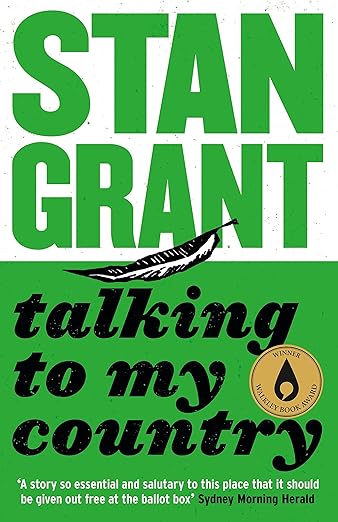
            One of the books that has stuck with me is Stan Grant’s Talking to My Country, first published back in 2016. A former CNN journalist, well-respected in Australia, Grant came of age in a nation carved from the lands of aboriginal peoples it had murdered and otherwise attempted to erase. He wrote as Australia confronted, incompletely, its past and moved slowly towards “reconciliation,” itself a fraught and contested topic.

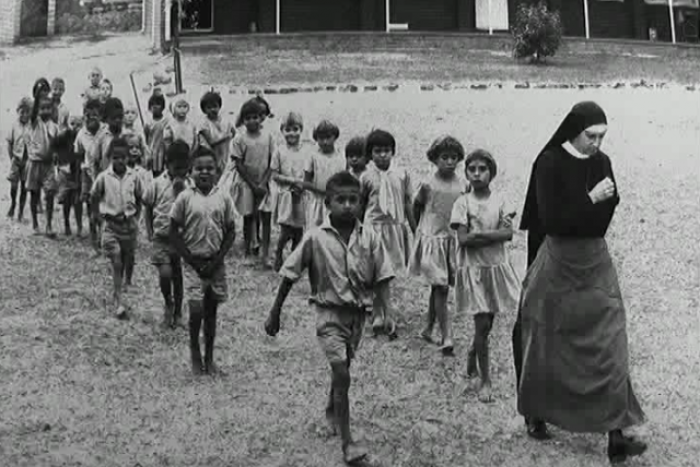
            Grant hoped to explain to Australians how he viewed “the Australian Dream.” At its worst, he wrote, it is a story of “babies buried in the sun and decapitated, women raped, men killed as they hid in the forks of trees, waterholes poisoned, flour laced with arsenic.” His ancestors faced genocidal violence. But they also faced the attempts to erase those who survived the slaughter and the epidemics. After the initial invasion, he wrote, “the Australian Dream abandoned us to rot on government missions, tore apart families, condemned us to poverty.” Grant recalls his community’s struggles in terms that are clear and urgent. “There was no place for us in this modern country and everything we have won has come from dissent, it has been taken from the reluctant grasp of a nation that for much of its history hoped that we would disappear”(25-26).

            Saying this in an American classroom in the dark age of Trump could get a teacher in trouble. The conditions Grant describes clearly transcend Australia’s bounds. “Being good and great,” he writes, “does not absolve you from a terrible sin, and a pain inflicted on a people who did nothing to deserve it. Remember that: the first people of this land, who have suffered for your greatness did nothing to deserve it.” And, Grant says, “a truly great country—if we truly believe that—should be held to great account”(26).

            He’s right. It’s one of many ways that MAGA movement is doing nothing to make the United States great. I would love to see American leaders engage with so powerfully stated an argument.

            Australians, like Americans, tell lies about their country’s past. Students learn stories in both countries of white people’s bravery and conquest of a wilderness but not the costs extracted from those in colonialism’s line of fire. The records to tell the truth about the Australian past, as in the US, are not hard to find. The accounts are clear and available. Grant discusses the work of some of the first Australians who described the Indigenous people the settlers encountered. They reveal the barbarism with which white people treated Australian natives: “food left out to lure the blacks who were then gunned down; hunting parties formed to drive black men, women and children over cliffs to their deaths. White observers, in Australia as in the United States embraced “the slow certainty of expected extinction” when they wrote about aboriginal peoples.

            Americans still tend to view Indigenous peoples as part of the past.  Donald Trump’s efforts to stir up white resentment by protecting Native American mascots in Massapequa and, more recently, in a discussion that mentioned the Cleveland Guardians and Washington Commanders, makes this intractable problem even worse.  And viewing Indigenous people as part of the past makes it more difficult for uninformed Americans to take seriously their very real grievances in the present.  Australian and American historians are doing wonderful work to uncover the past and make connections with the present, but so little of this is taught in schools in the two countries, and the public has been slow to absorb this knowledge. 

            Grant wants his readers to know what it has been like. He has written “a story so essential and salutary to this place that it should be given out free at the ballot box,” according to the Sydney Morning Herald. His family, Grant wrote, has “felt the brutality of Australia.” Indigenous people in North America would nod their heads in agreement, I believe.

“We have had our land—our inheritance—stolen. Our language was banned. Our children have been taken away. We have been herded onto missions. We have been forced onto the margins of society. We have lived in tin humpies and tents. We have been powerless before the state. Welfare officers and police have invaded our lives at will.”

Grant continues. “The weight of history in Australia suffocated us,” he wrote. “Our history leaves its marks on our bodies and our souls.” He is not the first person to make this observation. When I have taught this class in the past I have used Thomas King’s The Inconvenient Indian and Harold Napoleon’s Yuuyaraq. But he makes that point very, very well.

            It is so easy to walk through Australia and be blind to all of this, Grant writes, and he remains surprised by how often people approach him to say that they just did not know. If you teach or write about Native American history, you likely have heard similar things. Sometimes the people who say this are angry and feel betrayed by an educational system that has lied to them in the name of serving the interests of a nation jaggedly carved from Indigenous land. Others seek some sort of absolution. I did not have anything to do with it, they may as well say, even though the evidence is right there in front of them if they choose to look, and even though they remain the beneficiaries of their nation’s original sins.

What You Need to Read, June 2025

A lot of exciting new work has appeared, or is slated to appear, in the coming months. Take a look, share with your friends and, as always, if I have missed something that you think I ought to add to the list, please do not hesitate to let me know.

Adams, Mikaëla M., Jessica Dimka, Svenn-Erik Mamelund, and Lisa Sattenspiel, “’I would Advise That It Be Kept from the Schools at All Cost’”: The Influenza of 1918-1920 at Nonreservation Indian Boarding Schools,” Ethnohistory, 72 (2025), 1-39.

Alves, Alexandre Guilherme da Cruz, “The Alcatraz Occupation and the American Indian Movement, 1969-1971,” Journal of American History, 111 (March 2025), 735-749.

Andersson, Rani-Henrik, Logan Sutton and Thierry Veyrié, eds., Great Plains Ethnohistory: New Interdisciplinary Approaches, (Lincoln: University of Nebraska Press, 2025).

Apekaum, Charles E. Autobiography of a Kiowa Indian, with Weston Le Barre and Benjamin R. Kracht, (Lincoln: University of Nebraska Press, 2025).

Barnett, Lisa D. Peyote Politics : The Making of the Native American Church, 1880-1937, (Norman: University of Oklahoma Press, 2025).

Bender, Margaret and Thomas N. Belt., The New Voice of God: Language, Worldview, and the Cherokee Bible, (Norman: University of Oklahoma Press, 2025).

Bigart, Robert J. Indian Chiefs vs. Government Agents: Politics and Law Enforcement on the Flathead Reservation in Montana, 1875-1910, (Lincoln: University of Nebraska Press, 2026).

Bowman, Travis M. and Matthew A. Zembo, Clearing Iroquoia: New York’s Land Grab in the 1779 Campaigns of the American Revolution, (Lanham, MD: Lexington Books, 2025).

Canby, William C. American Indian Law in a Nutshell, 8th ed., (Eagan, MN: West Academic, 2025).

Coleman, Daniel, Ki’en Debicki and Bonnie M. Freeman, eds.,  Deyohahá:ge: : Sharing the River of Life, (Waterloo, ON: Wilfrid Laurier University Press, 2025).

Conathan, Lisa. “We Are the Bearers of His Name: Memorialization of Ephraim Williams, Jr.,” New England Quarterly, 98 (June 2025), 171-201.

Cox, James H. “Lynn Riggs and the Art of Citizenship,” American Literary History, 37 (Spring 2025), 124-134.

Davis, Elisabeth C. Catholic Sisters, Narratives of Authority, and the Native American Boarding Schools, 1847-1918, (Lanham, MD: Lexington Books, 2025).

Dixon, Bradley. Republic of Indians: Empires of Indigenous Law in the Early American South, (Philadelphia: University of Pennsylvania Press, 2025).

Duwe, Samuel. Tewa Worlds: An Archaeological History of Being and Becoming in the Pueblo Southwest, (Tucson: University of Arizona Press, 2025).

Feathers, James K. and Shannon A. Mahan, “Luminescence Dating of Stone Structures in the Northeastern United States,” American Antiquity, 90 (January 2025), 174-190.

Frey, Benjamin E. Rising Above: Language Revitalization in the Eastern Band of Cherokee Indians, (Lincoln: University of Nebraska Press, 2025).

Galler, Robert W., Jr. Taking Charge, Making Change: Native People and the Transition of Education from Stephan Mission to Crow Creek Tribal School, (Lincoln: University of Nebraska Press, 2025).

Glowacki, Donna M. and Scott Van Keuren, eds., Religious Transformation in the Late Pre-Hispanic Pueblo World, (Tucson: University of Arizona Press, 2025).

Hill, Norbert S. and Megan Minoka Hill, Beyond Blood Quantum: Refusal to Disappear, (Lakewood, CO: Fulcrum Publishing, 2025).

Hopkins, Kelly Y. Iroquoia: Haudenosaunee Life and Culture, 1630-1783, (Ithaca: Cornell University Press, 2025).

Howey, Meghan C. L., The Shock of Colonialism in New England: Fragments from a Frontier, (Tuscaloosa: University of Alabama Press, 2025).

John, Maria. Sovereign Bodies, Sovereign Spaces: Urban Indigenous Health Activism in the United States and Australia, (Chapel Hill: University of North Carolina Press, 2025).

Kamper, David. Rezballers and Skate Elders: Joyful Futures in Indian Country, (Lincoln: University of Nebraska Press, 2025).

Kehoe, Jacqueline. “Archaeologists are Finding Dugout Canoes in the American Midwest As Old as the Great Pyramids of Egypt: In The Waterways Connected to the Great Lakes, Researchers Uncover Boats That Tell the Story of Millennia of Indigenous History,” Smithsonian, Jan/Feb 2025, 1-2.

Kelley, Lucas P. Marking Native Borders: Indigenous Geography and American Empire in the Early Tennessee Country, (Norman: University of Oklahoma Press, 2025).

Lewis, Courney. “Appropriating Corporate Personhood: Constructions of the Person-Corporation and Native Nation Sovereignty,” American Anthropologist, 127 (March 2025), 108-120.

Link, Alessandra La Rocca. The Iron Horse in Indian Country: Native Americans and Railroads in the US West, (New York: Oxford University Press, 2025).

Loew, Patty. “Indigenizing Mainstream News Coverage of Native Americans,” Journalism and Communication Monographs, 27 (Summer 2025), 146-155.

Lowry, David Shane. Lumbee Pipelines: American Indian Movement in the Residue of Settler Colonialism, (Lincoln: University of Nebraska Press, 2025).

Mapes, Lynda V. The Trees are Speaking: Dispatches from the Salmon Forests, (Seattle: University of Washington Press, 2025).

Meadows, William C. The Handgame of the Kiowa, Comanche, and Apache: Spirited Competition on the Southern Plains, (College Station: Texas A&M University Press, 2025).

Miller, Douglas K. Washita Love Child: The Rise of Indigenous Rock Star Jesse Ed Davis, (New York: Liveright, 2025).

Morseau, Blaire. Mapping Neshnabé Futurity: Critical Currents of Sovereignty in Potawatomi Skies, Lands and Waters, (Tucson: University of Arizona Press, 2025).

Nichols, David Andrew. To Be Men of Business: The Origins of Chickasaw Capitalism, 1700-1840, (Lincoln: University of Nebraska Press, forthcoming, April 2026).

Nooe, Evan. “’It’s In the Blood’: Settler Family Memories of Native Violence in the American South,” History and Memory, 37 (Spring/Summer 2025), 164-193.

Oberg, Michael Leroy. “Vast Indigenous America,” William and Mary Quarterly, 82 (April 2025), 299-306.

Prior, Charles W. A. Treaty Ground: Diplomacy and the Politics of Sovereignty, from Roanoke to the Republic, (Lincoln: University of Nebraska Press, forthcoming, May 2026).

Rosenthal, Nicolas G. Painting Native America: Indigenous Artists in the Twentieth Century, (Lincoln: University of Nebraska Press, 2026).

Sanchez, Andrea Maria McComb. Of Corn and Catholicism: A History of Religion and Power in Pueblo Indian Patron Saint Feast Days, (Lincoln: University of Nebraska Press, 2025).

Schenk, Theresa M. Ojibwe Ethnogenesis, 1640-1740, (Lincoln: University of Nebraska Press, 2025).

Skogen, Larry C., ed., To Educate American Indians: Selected Writings from the National Education Association’s Department of Indian Education, 1905-1909, (Lincoln: University of Nebraska Press, 2026).

Sowry, Nathan. Turning the Power: Indian Boarding Schools, Native American Anthropologists, and the Race to Preserve Indigenous Cultures, (Lincoln: University of Nebraska Press, 2025).

Stamatopolou, Elsa. Indigenous Peoples in the International Arena: The Global Movement for Self-Determination, (New York: Routledge, 2025).

Thomas, Peter A. “King Philip’s War and the Ambush at Bloody Brook (Deerfield, 1675): Sorting Out the Details of History,” Historical Journal of Massachusetts, 53 (Winter 2025), 117-137.

Tuininga, Matthew J. The Wars of the Lord: The Puritan Conquest of America’s First People, (New York: Oxford University Press, 2025).

Villeneuve, Matthew. “Habeas Corpus and American Indian Boarding Schools: Indigenous Self-Determination in Body and Mind, 1880-1930,” Western Historical Quarterly, 56 (Summer 2025), 93-115.

Warren, Stephen. “Red Codes and Removal: Racial Exclusion and Indigenous Persistence in the Midwest,” American Indian Quarterly, 48 (Spring 2024), 165-194.

Waselkov, Gregory A. and Ashley A. Dumas, “’I Have Been to the Country Above’: Indigenous Revitalizations in Late Sixteenth-Century Southeastern North America,” Ethnohistory

72 (April 2025), 187-229.

Wickstrom, Lucy. “’A Portion of Land that was Part of Nipmuc Territory’: Tufts University and the Grafton Land Struggle,” New England Quarterly, 98 (June 2025), 231-260.

Younging, Gregory, Warren Cariou, Deanna Reder, Lorena Sekwan Fontaine and Jordan Abel. Elements of Indigenous Style: A Guide for Writing By and About Indigenous Peoples, 2nd ed., (Edmonton, Alberta: Brush Education, Inc., 2025).

Stumbling Stones

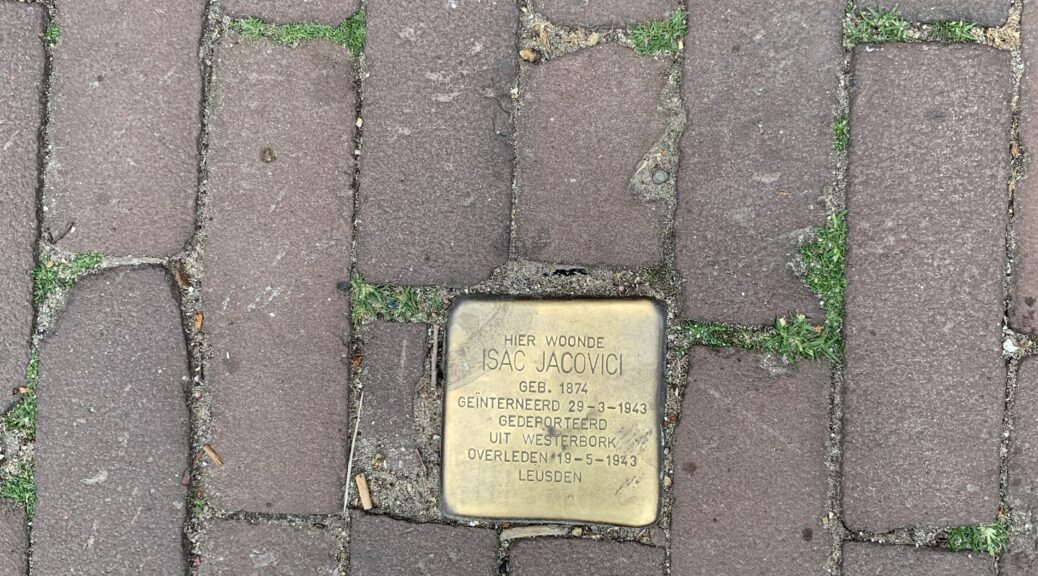
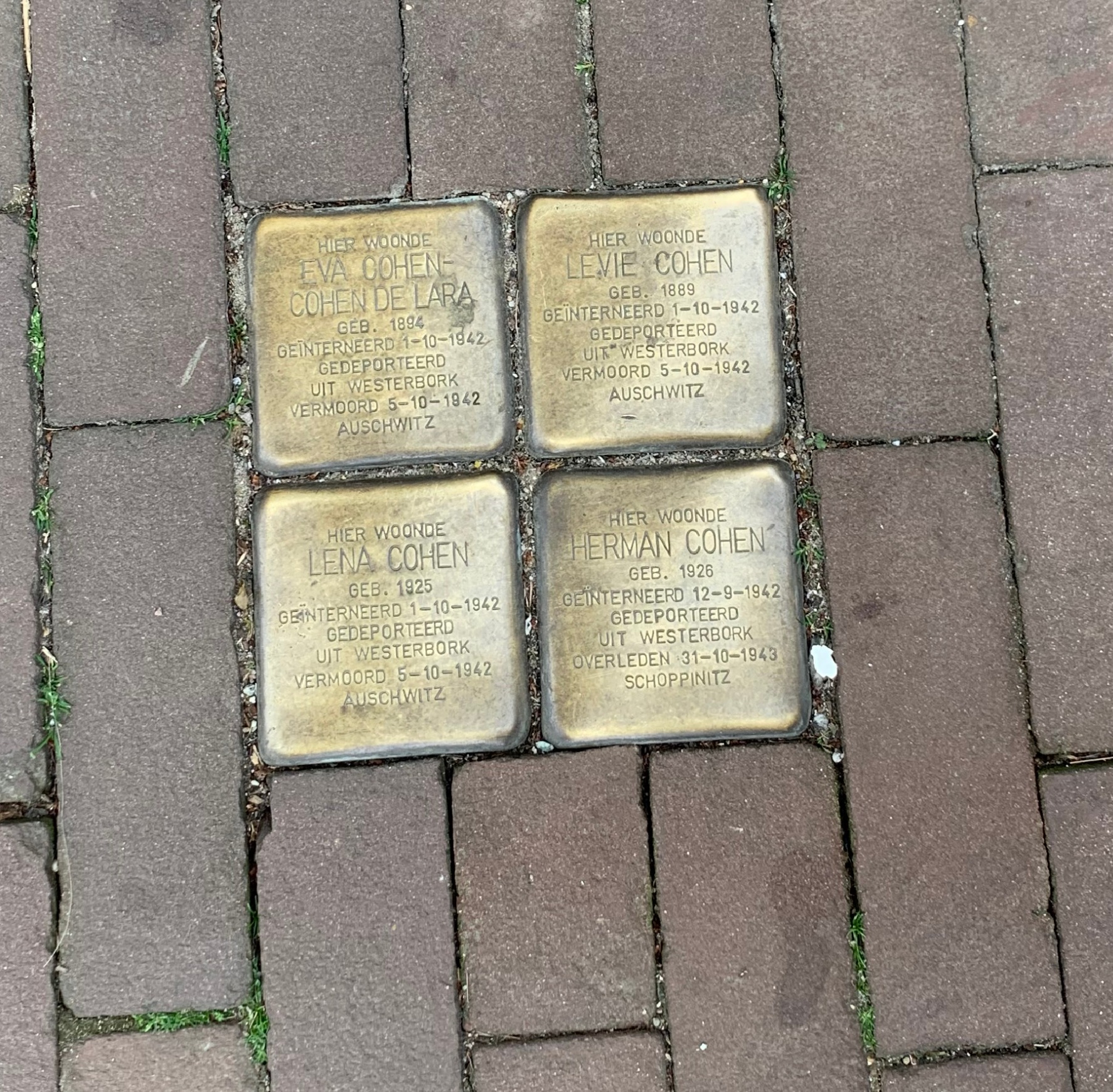
Gold Stumbling Stones appear frequently in what was once the old Jewish quarter of Amsterdam. It is impossible to miss them. In other parts of the city, they appear with less frequency but, still, they caught my attention. They tell you who lived in a given property, the year they were born, the day they were arrested, and the date and place where the Nazis murdered them.

They are visible reminders of an extraordinary historical crime. Striking in their simplicity and clarity, I encountered them on this visit to Amsterdam on my way to my favorite museum in town, the Verzetsmuseum Amsterdam, or the Dutch Resistance Museum. So much more than its name suggests, the Verzetsmuseum confronts visitors with the range of choices facing the Dutch after the Nazis occupied their country. Some sought the path of least resistance, and some hoped they might assist in directing the Nazis’ viciousness into less destructive channels, and blunt the sharp point of Nazi genocidal hatred. Others, heroically, resisted. They hid Jews in their homes. They smuggled food to those in hiding. At times, they took up arms.

It is an incredibly powerful and effective presentation, showing how ordinary people did extraordinary things in horrifying circumstances. The cowardice and the courage, hatred and heroism, and complicity and commitment are all present. The Verzetsmuseum asks visitors, “which will you be?” When faced with evil, will you keep your head down or will you resist? You will understand history better when you leave the museum. You will also know yourself better, too.

I visited the museum the Saturday before last. And though I did not follow American news closely while overseas, I remained well aware of the how the Trump Administration, led by a vicious, shallow narcissist and a soulless, creepy zillionaire, has attempted to whitewash the American nation’s history, pull plays out of the Nazi playbook that Americans saw as grounds for rebellion when the King tried them in 1776, and, in the name of an obscene and cynical campaign against Antisemitism, attempted to crush dissent. They made me feel sorry for Harvard, of all things. And for those they dragged off to Salvadoran Concentration Camps. My visit to the Verzetsmuseum left me angry about what I saw back home.

I can remember a time when Elon Musk’s Nazi salute would have ended a person’s public career. Not any more. He was welcome in the White House afterwards. He did not mean it, some of his sycophants said. It was not what it looked like, others argue. I’m being woke, or politically correct, or, somehow, stunningly, anti-Semitic because I consider the life of a Palestinian child as valuable as that of any Jewish child. If I could speak with these people, I would tell them to knock it off. You’ve shamed yourselves.

I see them. I listen to them. I read the words they put down on the page or pound out with angry thumbs in the early hours of the morning. And after visiting the Verzetsmuseum, I feel I owe as much allegiance to Donald Trump and his supporters as the Dutch did to the Nazis who occupied their country. Donald Trump, I know, is not Hitler. The vast majority of his followers, I known, are not Nazis. But I see no reason to believe that they would have stood in the Nazis’ way. They have no courage or moral character. To me, they are different in degree, but not in kind, from the monsters who inflicted so much evil on the world. They are, after all, inflicting evil and suffering on the world right now.

Not too long ago, Donald Trump wondered if there was not some love in the Nazi Death Camps. It was one more absurd statement from an absurd man. Perhaps he knows what he is part of. Perhaps he is trying to convince us that he is not a monster, and that he is not the leader of something monstrous.

The Verzetsmuseum makes clear the formidable forces the Dutch resistance faced. We have luxuries they did not have. If a handful of Republicans in Congress and the Senate could muster the courage to show an ounce of virtue, they might curb the excesses of this terrible and dangerous regime. We have time, but it is running out. This nation’s leaders are failing a test of character, and the opportunities to set things right grow fewer each day.

Water is Life

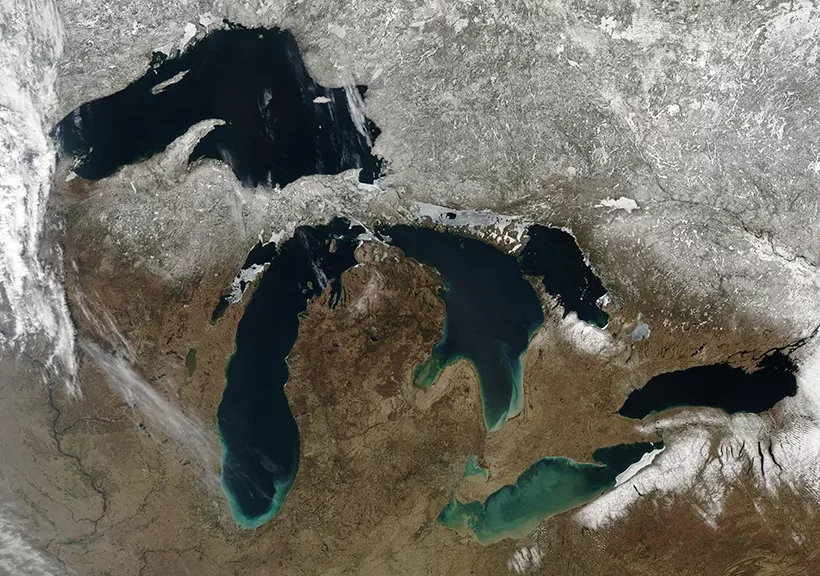
Does water have natural rights? New York State Assemblyman Patrick Burke of West Seneca thinks so, and if his bill to create a Great Lakes Bill of Rights passes, those of us who are not toxic polluters will certainly benefit.

            Burke’s bill asserts that “the Great Lakes, and the watersheds that drain into the Great Lakes and their connecting channels, as well as the watersheds and ecosystems throughout” the State, “shall possess the unalienable and fundamental rights to exist, persist, flourish, naturally evolve, regenerate, and be restored by culpable parties, free from human violations of these rights and unencumbered by legal privileges vested in property, including corporate property.” From this, it follows that “the people and the natural environment, including each ecosystem and watershed within the state of New York shall possess the right to a clean and healthy environment, which shall include the right to clear and healthy Great lakes and the Great Lakes ecosystem.”

            Burke’s bill also recognizes a right “to freedom from toxic trespass.” People living in New York and the Great Lakes Ecosystem and all the waters in the state “possess a fundamental and unalienable right to the integrity of their bodies, ecosystems, and physical aspects, and to be free from toxic trespasses upon or within them.”  These waters belong to everyone. These waters “possess the unalienable and fundamental rights [to] not be owned, privatized or monetized.”

            Burke’s bill asks New Yorkers to shift their thinking, not only about the meaning of rights, but also about the type of world in which they would like to live. Americans claim a powerful commitment to individual rights, and under law they recognize corporations as individuals, as Mitt Romney infamously pointed out several years back.  Those individual rights involve the capacity of owners to use their private property with only the most minimal concern for others. Water is a “resource” that owners feel they can treat as they see fit.

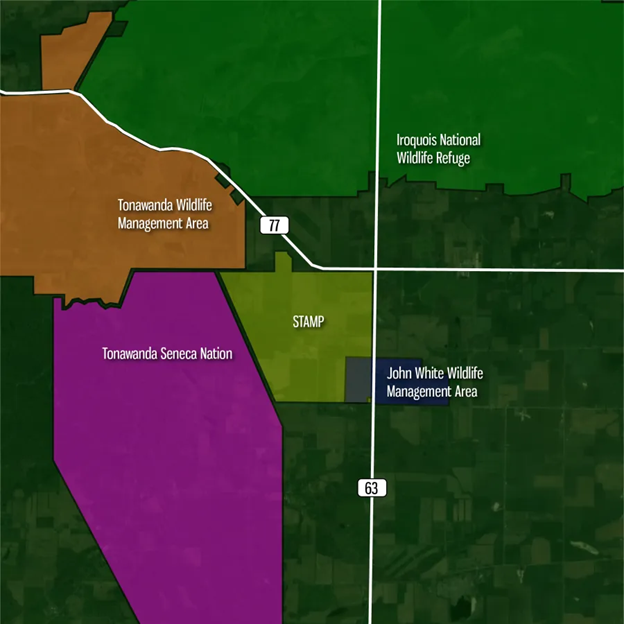
            I hope Burke’s bill moves forward, and that at a minimum, the Assembly and State Senate discuss and debate the important questions it raises. To study the Indigenous history of New York State is, in part, to study water, and the damage non-Indigenous people have done to it over many generations. I began my research into Onondaga history long ago by investigating the history of pollution in Onondaga Lake in Syracuse, for a time the most toxic body of water in North America. Though remediation has unquestionably improved the quality of the water, the clean-up process did not satisfy the Onondaga Nation, and I certainly would not touch the water there. Onondaga Creek, where it flows through Syracuse, has been a toxic cesspool for more than one hundred and fifty years. Upstream, where the creek flows through the Onondaga Nation, the water once ran cool and clear, with good fishing for clean water fish like trout. Now it is a murky brown that looks like chocolate milk, caused by the “mud boils” at Tully, a product of salt brine extraction which has damaged the underlying bedrock deep below the creek bed. Federal projects like the construction of the St. Lawrence Seaway, power plants along the Niagara River, and a dam on the Allegheny River, led to significant loss of land by the Mohawks, Tuscaroras, and Senecas at Allegany respectively. Even today, the STAMP Industrial Development boondoggle in Genesee County threatens waters flowing through the Tonawanda Seneca Nation. The “Green” part of this “green manufacturing mega-site” is money. Millions and millions have been invested in this already failed project.

STAMP threatens the Tonawanda Seneca Nation and the waters flowing through it, as well as the surrounding Wildlife Management Areas and Wildlife Refuges.

Haudenosaunee people have over many years called upon state leaders to treat the natural world with respect. In the Thanksgiving Address, Haudenosaunee people “give thanks to all the waters of the world for quenching our thirst and providing us with strength.” As they say, “water is life,” and “we know its power in many forms—waterfalls and rain, mists and streams, rivers and oceans.” It cannot be lived without.

The likelihood of Burke’s bill passing I suspect is slim. No other members of the Assembly signed on to co-sponsor his bill. With a Republic regime tearing down environmental enforcement on the grounds, incredibly, that it is possible for water to be too clean, and a Democratic Party in New York State that will fawn over any corporate entity that promises to create even a few jobs, Burke’s bill is nonetheless an important intervention. Call your assemblyperson if you are a resident of New York State, and your state senator as well. Let’s have a discussion and a debate. Let’s make our political leaders explain why they will not support this bill. Water is life. We are fortunate to have so much of it here in New York. Let’s come together, recognize our interdependence with each other and the waters that flow around us. Join me in supporting Assemblyman Burke’s important bill.

Don’t Back Down

A long time ago I wrote an editorial in the Billings Gazette attempting to defend the National History Standards from conservative criticism.  The Standards were, according to the conservative columnist George F. Will, waging “a war of aggression against the Western Political tradition and the ideas that animate it.” According to Lynne Cheney, the Standards “make it sound as if everything in America is wrong and grim.” Backed by academic historians, the creators of the National History Standards were shoving aside famous and important Americans who students ought to learn about in favor of people and topics that were, in the language of the time, “politically correct.”

At that time, I wrote, the promoters of the National History Standards had been “too timid” in their defense of their work.  The conservative critics, I wrote, were not arguing in good faith.  They had “not focused on scholarship, and the canons of argumentation and proof that accompany this pursuit, but on the very subject matter of much of the recent historical writing.”  They could not prove that the history was wrong, so they announced that they did not like the content. Theirs was, I said, “a knee-jerk, intolerant, and culturally insensitive response to the recognition that people of all races, cultures, colors and creeds contributed to what we now recognize as a complex American past, and that no understanding of that past can be achieved without examining the role played by all Americans.” Calling something “politically correct,” like calling something “woke” today, I wrote, “has become a conservative smear to be employed against anyone who calls for a more inclusive, complex, and truly democratic portrayal of the past.”

That editorial appeared in January of 1995, a bit over thirty years ago. Think about that. I have been at this for a long time. The words I wrote then are still applicable today.

And as tired as I sometimes feel, it is as important now as it was then to resist, to engage with those who hate and fear what we do without truly understanding the nature of our work.

Just last week, President Trump issued another of the unconstitutional pronouncements that he alleges are “executive orders” with the force of law. Aiming his ire at the Smithsonian Institution, Trump declared that “over the past decade, Americans have witnessed a concerted and widespread effort to rewrite our Nation’s history, replacing objective facts with a distorted narrative driven by ideology rather than truth.” These historians, he said, have sought “to undermine the remarkable achievements of the United States by casting its founding principles and historical milestones in a negative light.”  Instead of “fostering unity and a deeper understanding of our shared past, the widespread effort to rewrite history deepens societal divides and fosters a sense of national shame.”

The president cited some examples.  The Smithsonian American Art Museum, he said, had challenged, in Trump’s words, “the view that race is not a biological reality but a social construct.” (If you want evidence of the virulence of Trump’s racism, well, there you go). A Fascist, Trump is angry that the museum asserted that “race is a human invention.” It’s incredible, really. We who resist are fighting a battle that has been going on for ages.

That is why I love the statement from Loyola Marymount University in defense of its diversity, equity, and inclusion programs.

We practice diversity, equity, and inclusion because we are Catholic and our faith and the First Amendment protect our right to live out these values. Efforts to restrict DEI are in opposition to Christ’s teachings or radical inclusion and love. Loyola Marymount University will continue to champion academic freedom, social justice, and human dignity not as politics, but as moral imperatives required by our faith.

            It is direct, defiant, and unapologetic. Historians should take note. Trump is going to do enormous damage to our work. Hours before I wrote these words, I learned that a fantastic, NEH-supported project at Brown University examining the enslavement of Indigenous New Englanders had its grant revoked. Friends worked for years on this monumental project that answers important questions about the American past. Trump and his thugs killed the program.

They will hurt us and they will score points. They will please the racists. So much of what they do, after all, is about protecting and upholding white supremacy.  But in other ways, they have already lost this fight. That is why reasoning with them can be like talking to a caged rat. They won’t listen to truths they are afraid to confront. But to teach that race and racism are hard-wired into the Nation’s founding documents, after all, is hardly a revolutionary insight any longer. That race, as a nefarious social construct, has wielded enormous power for evil in America’s past is a basic statement of fact. That New York, where I teach now, became the Empire State through a systematic program of Indigenous dispossession that at times and places violated the laws of the United States, is hardly controversial at all. Its a fact. Our efforts, in other words, have already carried the day. Even as the textbooks lag behind, we have done the work. Our students know that an uncritical and celebratory history of the United States is bullshit. They know that history matters, and they expect that it will include stories that connect with their own, and that explore—and explain—the enormous gap that sometimes exists between the way things are and the way they ought to be.

Some of you who read these words are college professors.  I am willing to bet that you have been approached by a student, probably many times over the course of your career, who told you how they could not believe they were never taught this stuff in high school. You want to teach a kid to not respect this nation’s history? Lie to her about it.

But that is what our amoral leader is calling for. An angry and unlettered old man, he will do his damage. He will try to destroy the archives and the libraries and museums that bring this inclusive and complex history to more and more people every year. He will, and already has attempted to, ruin the lives of those who do this work. He will try to silence museum workers, archivists, librarians, writers and teachers who know at the very marrow of their being that it is not their job to tell students comforting stories about the past, but rather, to teach them to ask questions about the past and insist on reasoned, reasonable and evidence-based answers. If things are this way, why could they not have been another way, and so on—we play a role in unleashing the revolutionary capacity of an inquiring mind. Trump will promote charlatans and whores like JD Vance who will say anything, even when they know better, to win the approval of the amoral leader.  They will continue to beat up on the weakest people they can find, the refugees, the immigrants, the poor and the marginalized.  But they cannot suppress the stories we tell about the past. Not entirely. Let those of us who are privileged in these dark times to be able to do this important work, stand tall in defiance of these dangerous and unthinking enemies of justice and free thought.

James Kirby Martin and Edward Countryman

Earlier this semester I learned that James Kirby Martin passed away. He was Professor Emeritus of History at the University of Houston. Last week, I learned that Professor Edward Countryman of Southern Methodist University had died as well. In the span of several weeks, two very important historians of the American Revolution in New York State had left us.

            I did not know Edward Countryman well. We spoke when our paths crossed at conferences. He was always interested and interesting, the kind of senior scholar who was consistently welcoming and encouraging toward his younger colleagues. From the beginning of my career as a historian, I loved Professor Countryman’s work. His book, A People in Revolution, I read during my first few weeks in grad school at Syracuse. Countryman captured the excitement of the Revolution, the tension and the violence as well, in a work that I found deeply impressive. I wrestled with questions my undergraduate education never forced me to confront about the nature of the Revolution and its consequences. When I first taught my course on the American Revolution, I assigned A People in Revolution. It was probably too much for most of my undergraduates in Montana, but those who persevered learned that the Revolution involved movements that engaged people who previously had been excluded from imperial and provincial networks of power. Researching and writing this book must have been a massive undertaking, and teaching it helped me understand in new ways the complexity of the story.

            When I began to assemble lectures for my own course on the Revolution, I relied heavily, and even assigned a few times, Countryman’s brief one-volume history of the American Revolution published by Hill and Wang. It’s a wonderful brief synthesis that conveys the excitement and energy, and the significant shortcomings, of the Revolution. Countryman was truly a historian who worked from the bottom of society upwards, bringing the insights of what at the time was called the “new social history” to the Revolution. When I taught the American History survey course, I assigned Americans: A Collision of Histories. I hated the big textbooks then in vogue in survey courses. If you are going to teach a survey, it is best to assign a book you are willing to read and able to enjoy.  It was a perfect brief survey of the first half of the American story.

Edward Countryman

            I paid less attention to James Kirby Martin’s work when I was in grad school. He was more interested in military history, it seemed to me, and that is not where my interests rested. It turned out that assessment was, like many grad student judgments, both harsh and incomplete, for Jim had eclectic interests.

I met Jim for the first time early in 2009 at the American Historical Association conference in New York. It was a job interview of sorts, and Jim played a large role in bringing me to the University of Houston in the fall of 2009. I enjoyed teaching at UH, and I liked my colleagues, but Houston was a bad fit for my family. We bolted. Though I only lasted a year, Jim did all he could to persuade us to stay. As a colleague during my year in Texas, Jim was always friendly and supportive (I realize that not all my UH colleagues felt the same way about him). I never would have written a book on the Treaty of Canandaigua had not Jim asked me to contribute to the series he edited for Oxford University Press. It feels like every year I tell one student or another to look at Jim’s biography of Benedict Arnold. Jim remained a productive and active scholar until the end. He could not have been farther politically from Ed Countryman. Jim was a devout Christian and a Tea Party conservative. What too many of our critics fail to recognize is that it is the work that matters. Both historians produced work that mattered.

James Kirby Martin

            Martin and Countryman both wrote about the Iroquois during the Revolutionary era. Jim Martin’s Forgotten Allies, co-written with Joseph T. Glatthaar, provided readers with a sweeping narrative history of the Oneidas’ experience during the war. He drew a large audience, became close with the Oneidas of New York, and for a time pursued the possibility of turning portions of the book into a motion picture. Jim loved the history of New York State. He was a regular attendee at the Fort Plain History Conference. The last time Martin and I spoke was during a Zoom call. I was trying to assemble a group of historians interested in constructing a “1779 Project” to look closely at the role of Indigenous dispossession in New York State. Jim attended as a representative of the Oneidas. He and I did not see eye-to-eye on the Sullivan-Clinton Campaign, but nonetheless I was glad to see him. Though I soon thereafter left the project and took my work in another direction, I am glad that Jim and I had kept in touch after I left Houston. I wish I would have reached out more often.

            Countryman’s most significant contribution was his 1996 article in the William and Mary Quarterly entitled “Indians, the Colonial Order, and the Social Significance of the American Revolution.” It came out just before I moved back to New York, and just before I began thinking seriously about the Haudenosaunee. Countryman, in a historiographical essay that ranged widely in its 22 pages, placed dispossession at the center of the Revolution in New York. “Fostering public virtue, rewarding soldiers of the Revolution, and establishing American communities all figured among the motivations of the architects of the American land system,” he wrote. “So did paying the national debt without anybody except Indians having to sacrifice.”

BACK IN 2013 at the Omohundro Institute for Early American History and Culture conference in Baltimore, several of us mid-career historians gathered for lunch. Thinking about the sorry state of the academic job market, one of us mused that we were among the last generation of tenured full professors in our field. Since that time, as assaults on public higher education intensify, the situation has become even more dire. There is a sadness, for me, in watching an earlier generation of prolific and important historians exit the stage while my profession succumbs to the death by a thousand cuts inflicted by right-wing ideologues, troglodytes and trolls; neoliberal approaches to university management; and the growth of a feckless class of college administrators with degrees in “higher education” who have done their best to suck the life out the system. Martin and Countryman both did work that matters. At a time when our profession is under assault, as politicians join in criticism of history and historians, and as schools go through restructurings that will change and diminish them forever, it’s worth keeping in mind all that we have lost.