Native Americans, said Commissioner of Indian Affairs Thomas Jefferson Morgan, must surrender who and what they are and assimilate into the broader American culture. They must either conform to the dominant American culture, he wrote, “or be crushed by it.” Morgan attempted to ban the practice of Indigenous religion on reservations during his watch, require that Indigenous peoples only speak English on the reservation, and included them in a far-reaching program of education that included off-reservation boarding schools. No opposition could be tolerated.
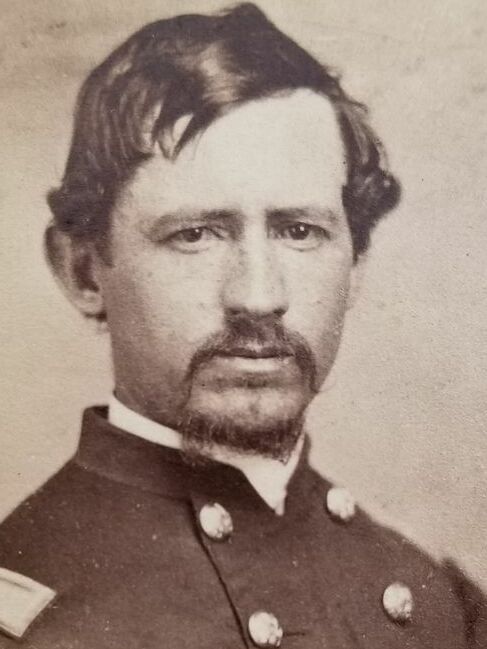
Morgan thought a lot about education, and he saw instruction in American history as fundamental to his goal of assimilating Indigenous peoples. “It is in the highest degree important,” he wrote in his 1889 Annual Report, “that specific attention should be paid, particularly in the higher grades of the school, to the instruction of Indian youths in the elements of American history, acquainting them with the leading facts in the lives of the most notable and worthy characters.” Morgan believed that in the classroom, “the wrongs of their ancestors can not be ignored,” but “the injustice which they once had suffered can be contrasted with the larger future open to them, and their duties and opportunities rather than their wrongs will most profitably engage their attention.”
Morgan wanted Native American students, across a vast educational system that included reservation day schools, on-reservation boarding schools, and off-reservation institutions like Carlisle, to understand civics, to engage in debating societies. The American flag should be prominently displayed in Indian schools, and “patriotic songs should be taught to the pupils, and they should sing them frequently until they acquire complete familiarity with them.” Furthermore, “patriotic selections” should be memorized and recited publicly, “and should constitute a portion of the reading exercises.”
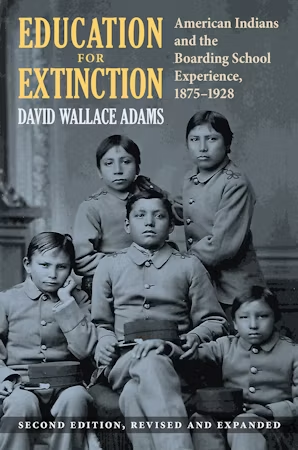
This is what the historian of boarding schools David Wallace Adams called “Education for Extinction.” Morgan, like other commissioners, spoke with a powerful conviction that the salvation of Indigenous peoples would follow only from the course of action he prescribed. “In all proper ways,” he wrote, “teaching in the Indian Service should endeavor to appeal to the highest elements of manhood and womanhood in their pupils, exciting in them an ambition after excellence in character and dignity of surroundings, and they should carefully avoid any unnecessary reference to the fact that they are Indians.”
The only value Morgan seemed to see in Indigenous people was that they might, with the proper application of a heavy hand, be guided to become something of value. Part of his program was the teaching of a past directed towards turning students to what Morgan saw as the only possible future. We shall use the past, he suggested, to teach them to move forward.
This got me thinking. Occasionally, I teach my department’s “Historical Methods” course. I focus on the Carlisle Indian Industrial School. We know what Commissioners of Indian Affairs and other government officials working in Indian policy wanted to achieve. But how were these pronouncements turned into educational policy? And more specifically, what did Carlisle students read in their history classes? Did they engage in debates about American history and culture? To what extent might we term history education at Carlisle propaganda? And, if so, what impact did this education have? What of this education stuck? You might have been young once. Perhaps you still are. Think back to your high school history class. How much of what you were taught do you actually remember? Be honest. Maybe you thought it was all bullshit and blew it off. Maybe Carlisle kids ignored their history lessons with the same alacrity as did you and I.
This is where research projects come from. I am a historian, interested in continuity and change, measured across time and space, in peoples, institutions, and cultures. I have been interested in the Carlisle Indian Industrial School. What, I have wondered, was history education like at Carlisle, and in what ways did it matter?
These are not difficult questions to answer. The work, in terms of technique, and the types of sources one must find to answer the question, are straightforward. The Carlisle Indian Industrial School Digital Resource Center has made digging through the sources so much easier than it would have been, say, at the beginning of my career. Many relevant sources are published, so they are not hard to find. I know the secondary source literature—that written by scholars who have pored through the sources—quite well. The only thing keeping me from doing this work is time, a commodity which I always seem to have less of than I would like. Someday, I will come back to these questions, and answer them fully. I am hopeful that a student will beat me to the punch, and choose this topic for a research paper. I would love to see what they come up with. Until then, some preliminary thoughts, based on some of the stuff I have stumbled across over the past few years I have spent reading about boarding and residential schools. (I have written a lot about Carlisle on this blog: Search for Carlisle, above, and most of that stuff ought to pop right up for you).
STUDENTS AT CARLISLE received history education in several ways. There was the classroom, of course, at Carlisle and, for some students, in the public schools they attended while on their “outing” assignments. There were the historical materials included in the school’s publications, some of which were written by the students themselves, some by Indigenous and non-Indigenous writers with varying degrees of expertise and knowledge. Where students did not write the work, those in the print shop set the type, but I cannot tell how many of them actually read the periodicals Carlisle produced. Finally, historical topics were addressed in school activities: lectures, debating societies, and historical pageants in which students played the lead roles.
From an early point in the school’s history, its founder Richard Henry Pratt was concerned about how the students might be portrayed when it came to historical pageants. In an 1880 letter to the Commissioner of Indian Affairs, the year after Carlisle opened, Pratt made suggestions on the role Carlisle students could play at the “Indian exhibit” at that year’s Columbian Exposition. Pratt favored a chronological organization of the display. The first period, he wrote, should be that in which “the settlers were dependent on the forebearance of the Indians; illustrating this by a large wall map showing the whole country as Indian except for a few white settlements say 1565 to 1620.” Next there should follow the period “when the whites entered regularly on the occupation of the country and by force or purchase obtained large possessions, as by King Philip’s War and Penn’s treaty.” The third period would focus on Cherokee Removal and the Seminole War. “The Indians as dependent on the Government for protection, placed on restricted areas and partly supported by Government” would follow and, finally, “present policy of dealing with Indians, by education, training in agriculture and other industries leading to citizenship and absorption into the masses.” Pratt emphasized that throughout, the exposition “should be historical and utilitarian, exhibiting the Indian both as an historical and present factor in our national life and by no means purely or mainly from a scientific or ethnological stand point, that properly belongs to another time and place.”
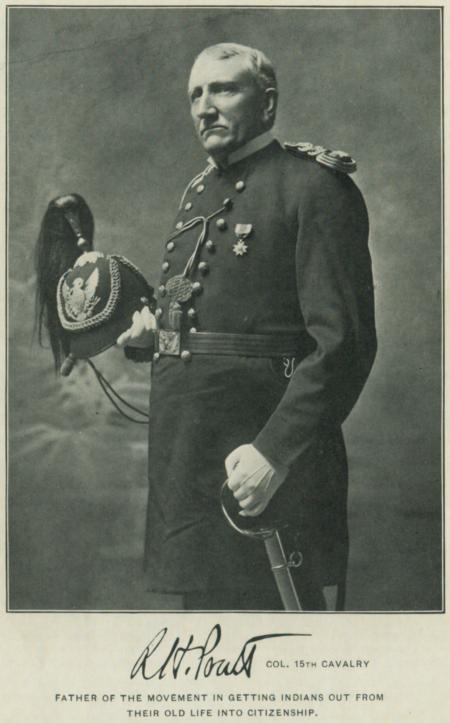
The school’s founders seem to have worried about portrayals of Indigenous peoples that might lead audiences to conclude that Indians were part of the past. When students participated in “the Indian scene of the Historical Pageant “that commemorated the anniversary of the founding of Philadelphia in 1909,” the school’s leaders insisted that the students—sixty boys and five girls—wear their uniforms at all time except when performing.
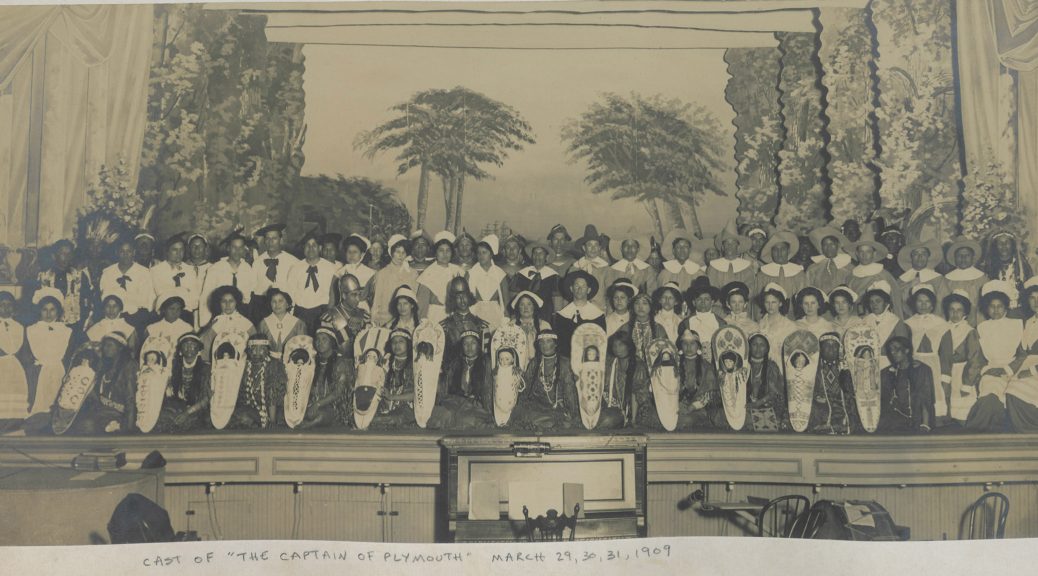
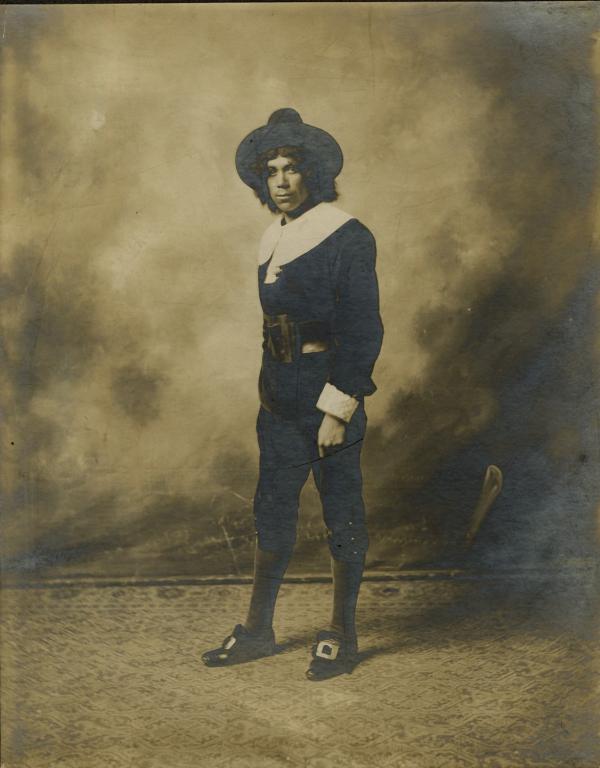
Many of these performances were intended to instruct. Pratt had retired a half-decade before students at Carlisle staged The Captain of Plymouth: A Comic Opera in Three Acts, written by Seymour S. Tibbals and Harry C. Eldridge. Students played both English pilgrims and the Indigenous people who greeted them. The play opens with the Plymouth leader Jonathan Brewster, played by a 23-year-old Akwesasne student named John White, worried that “the unclean spirit has reached this land before us.” Miles Standish, meanwhile, played by a fascinating Oneida student from New York named Montreville Yuda, was preparing to marry Priscilla, the “fairest maiden in Plymouth, played by a Menominee, born in Denver but raised in Ohio, named Carlysle Greenbrier. Things go wrong when Standish is
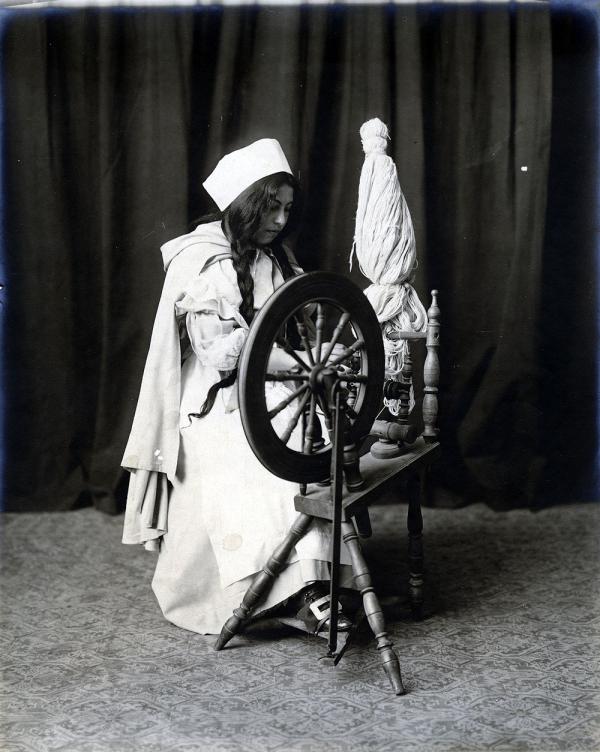
captured by the Indians. With Standish out of the picture, John Alden, played by a Hoopa from California, Albert Scott, lusts for Priscilla. Ketonka, the “Indian Princess” in the village where Standish is held, played by Emma Esanetuck, frees Standish, but she has a price. “You have won my timid heart,” she tells Standish, and she will release him only if he promises to marry her. In return, she pledges that “I will forsake my home, my people, my all, and henceforth cling only to you.” Sort of like what Carlisle’s founders wanted their students to do. It is easy to see why they might have chosen the play and presented it in consecutive years, however dumb and filled with demeaning stereotypes of Indians. In any event, Harry Eldridge caught a performance and was quite impressed.
Pageants like these were familiar to Americans in the late-nineteenth and early-twentieth century. Filled with patriotic themes, they emphasized national progress, America’s rise from humble origins. Some were, at their heart, virtual dramatizations of the “Turner Thesis,” with Indigenous peoples one of the obstacles American settlers had to overcome on their way west. The student’s participation in these pageants, in this sense, conformed to white reformers’ expectations of what Indians’ were (a people with a proud past) and what they might become (non-troublesome, fully assimilated and productive members of American society).

It is hard to say how students felt about playing these roles. We do know, however, that in Philadelphia for performances they were sometimes not chaperoned as closely as the school’s directors would have liked, and they proved as capable as other teenagers, at other times and in other places, of finding trouble when unleashed upon an American city.
SOME CARLISLE BOYS were trained in the school’s print shop, where they learned typesetting and other skills that would allow them, their teachers hoped, to find employment when their time at Carlisle expired. The Red Man, “a magazine in the interest of the American Indian,” was an outward-facing publication directed toward the school’s supporters. It included essays on current events in Indian country, anthropological, ethnographic, and historical pieces, and analyses of federal Indian policies. The articles were written by Indigenous and non-Indigenous authors. The May 1900 issue, for instance, included a story about the Florida Seminoles that asserted that “there is not found on the page of history, in any country, an instance of a scattered remnant of a tribe, so few in number, defending themselves against the assaults of a numerous and disciplined army, with the same heroism and triumphant results as the Seminoles resisting American troops. Seventeen years later, The Red Man returned to the Seminoles, arguing that
today the 600 Seminoles of the Everglades are the descendants of this heroic band–a people without a country! Too honest to speak, to proud to beg, eking out but a pitiful existence in the land of his nativity. Why? Because the same master greed that has driven the American Indian across a continent has entered the sacred homes of Florida’s Indian population.
(A century later, in the first quarter of the twenty-first century, making such claims in a classroom in Ron DeSantis and Christopher Rufo’s Florida could get a teacher in a lot of hot water. Carlisle students were setting type on articles containing arguments that could get Red State teachers fired!)
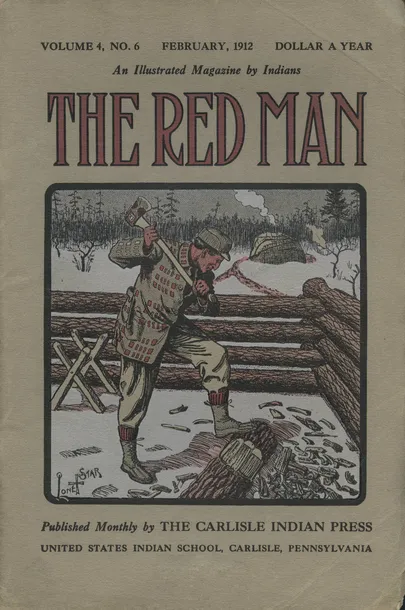
The January 1915 issue included an essay by the Seneca Arthur C. Parker describing the reform program of the Society of American Indians. The April 1911 issue featured a piece by the important Crow leader Robert Yellowtail who explained “Why the Crow Reservation Should Not be Opened.” Yellowtail, at the time, was resisting efforts by the federal government to allot lands on their Montana reservation. Also in that issue appeared a historical essay about William Penn, the founder of the colony of Pennsylvania, known in myth and memory for his just treatment of Indigenous peoples. Where “the general practice” in colonial America “was to entirely ignore the Indian ownership when a grant in this country was to be taken up, and the new settlers not only appropriated what was granted to them by charter rights, but they would grab everything in sight,” Penn was different. Much of what appeared in The Red Man reflected the interests of Progressives, Indian and white, interested in Indigenous affairs: Assimilation, to be sure, but also citizenship; Education, not strictly in manual labor, but in colleges and the professions as well; citizenship and equality before the law, and a willingness to challenge negative representations and stereotypes about Indigenous Americans.
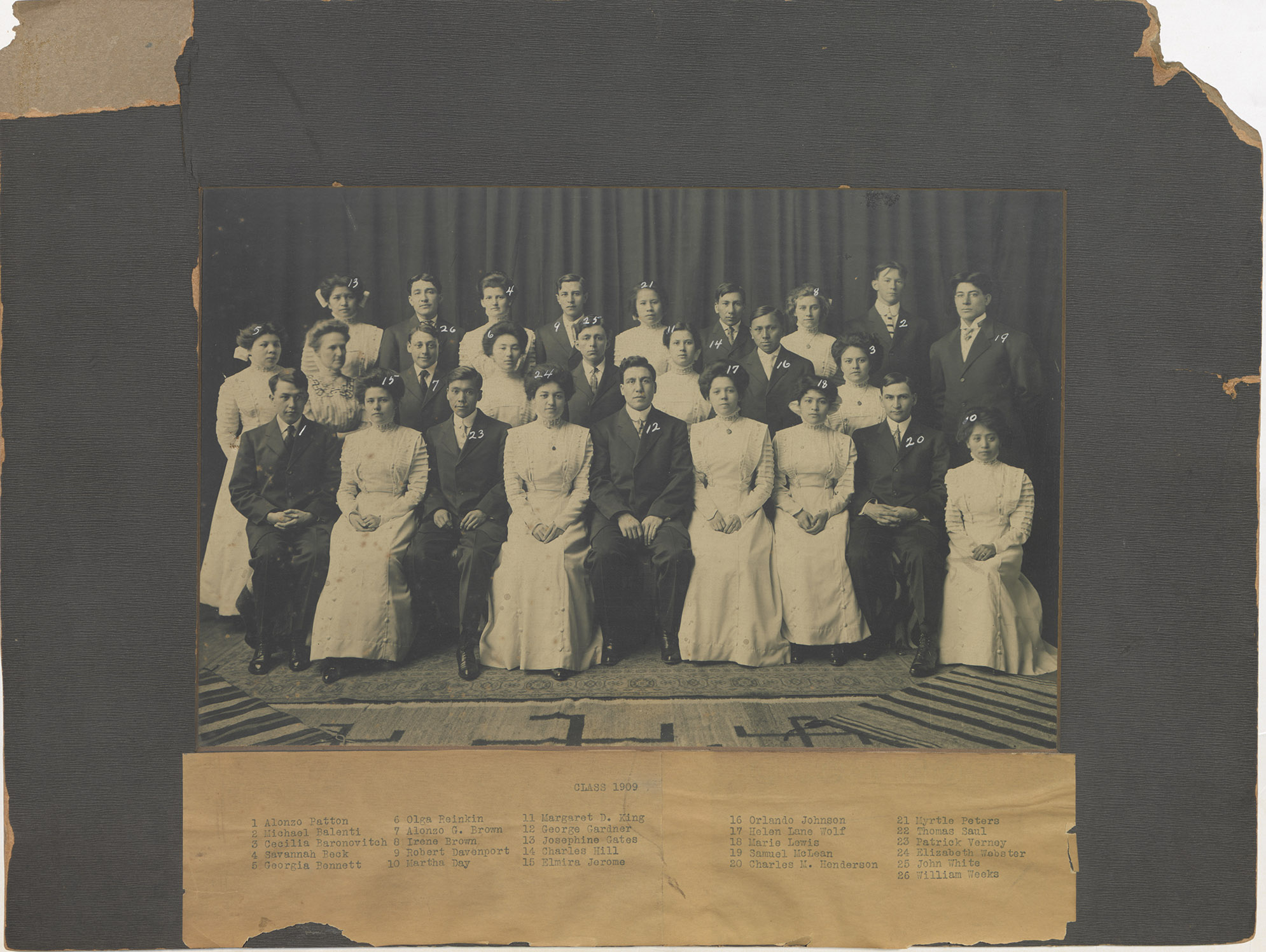
It is not clear to me how many students read The Red Man. It does seem pretty certain that they read the school’s student newspapers, much of which was written by the students. There are many hundreds of pages of these papers on the Carlisle Indian School Digital Resource Center website. I did not read all of them, but do believe it will be worthwhile some day to pore through them thoroughly to learn what I can. From the pages I read, we can see that students engaged in debates about matters relevant to politics and society. They wrote in the school newspaper about their people and their history. Michael Balenti, a Cheyenne, wrote for The Arrow a brief history of the Comanches. Michael had also served as a first tenor in the Sailors’ chorus in The Captain of Plymouth. Elmira C. Jerome wrote about the history of the Munsees. Her writing ability was recognized in the paper, and we learn that she had a beautiful voice and had taken up learning shorthand.
Allowing and encouraging students to discuss public affairs involved risks. It is easy to imagine that school officials wielded control over what might appear in the newspaper. It is not possible to consider The Arrow a free press. For the most part, students expressed views that conformed closely to those of reformers interested in Indigenous affairs, both Indian and white. But the students were free thinkers. Anyone who has taught history well knows that once students have considered why things are a certain way, it is an easy step for them to begin considering why things are not some other way. For example, in February of 1893, the college students gathered to vote on the following question: “Shall the school salute the National flag every day at Morning Exercises?” 508 students cast votes. Only 182 students voted in favor; 326 decided that the school would no longer salute the flag.
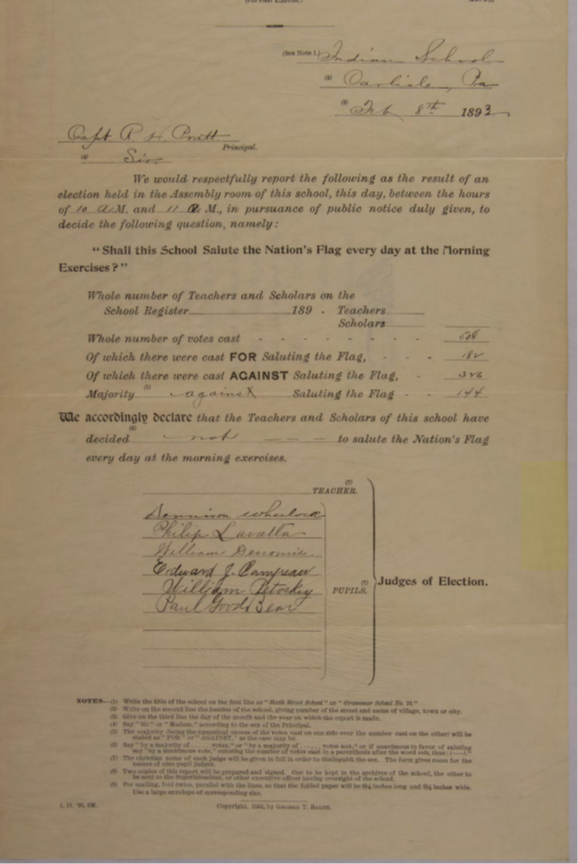
The vote took place on the 8th of February, 1993, the sixth anniversary of the passage of the Dawes, or General Allotment Act. A story in The Indian Helper, the school’s newspaper at the time, said that the day was celebrated “by exercises of a patriotic nature in the morning and a reading of the Bill and some discussion of the same in the evening.” The vote followed these discussions. Reflecting on its outcome, “The Man-on-the-band-stand,” the all-seeing and all-knowing eye of the school’s administration, said that he “knows that our pupils are not against saluting the flag.” Indeed, “if there be such a one let him hide his head in shame!” How to make sense of the outcome? The Man-on-the-bandstand said “that the sacred colors of our country should be treated in such a common way is what struck many of our pupils in an unfavorable light.” I’m a bit skeptical. Aren’t you?
OF COURSE MOST HISTORY EDUCATION for Carlisle students took place in the classroom. Though it has been said that Carlisle taught young people to hate their people and their culture, one of the stated purposes of its educational program was “to preserve all that is the best in Indian folktales and hero stories and race heritage, which is to be handed down by mothers to their children as an inspiration for racial advancement and progress.” Students with artistic talent should be urged to develop their skills. “Indian art should be fostered and encouraged in every possible way,” and “girls should be encouraged to get all that is best in their tribal art, to become proficient in its use, to understand its symbolism, and to apply it to the materials and furnishings of their new types of homes.”
According to the school catalogue, students in first and second grade should study history in the form of “stories of primitive people; industrial life; home, schoolroom, and playground ethics,” and “memory gems” like the dates of major American holidays. In third grade they learned about “inventions and inventors, societies of men and people in connection with geography, civics, stories, selections and adaptations from literature.” This would continue through fourth grade, while in fifth grade they learned “stories of discovery and colonization” and local government as they read from the textbook, Civics for Young Americans as a guide. In sixth grade, they learned about “colonial growth and independence,” and in seventh grade “formulation of the government; beginning of the National Period,” with Dole’s American Citizen, the text that would guide the teachers. In eighth grade, instruction in American history came to a close.
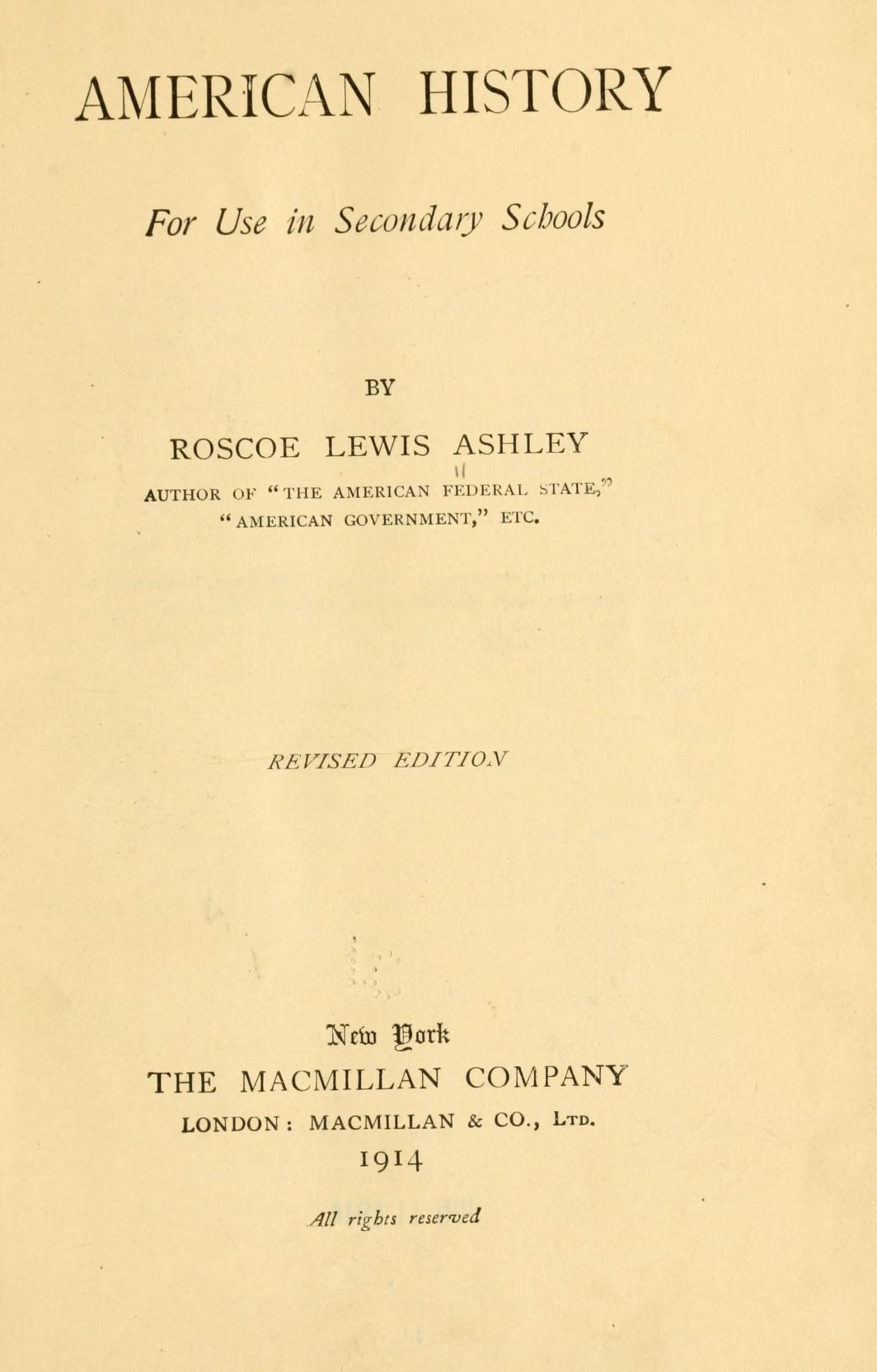
One of the history books used at Carlisle was Roscoe Lewis Ashley’s American History for Use in Secondary Schools, first published in 1907. It is a product of its time. The early colonists, the first chapter reads, “came into contact with the red man.” These “savage hunters were especially numerous along the heavily timbered Atlantic slope, within easy reach of the great supply of fish on the one hand and the animals of the forest on the other.” They “had not reached a high degree of civilization,” but they seemed to know their lands, even though they “were not attached to the soil and removed their wigwams with ease,” and their villages “were often little more than headquarters for hunting expeditions and raids.”
Only the Iroquois defied this ugly depiction. It was the Iroquois, Ashley wrote, “whose political organization, the most perfect of any north of Mexico, enabled them to conquer all their neighbors, either Iroquois or Algonquins, so that they often controlled the territory as far south as the Kenawha and as far west as the Wabash.” They were important in American history. “Of great ability and courage unusual even among Indians, the Iroquois have left an impress on our history that is out of all proportion to their number.” All the rest, he said, were ruled by passions. Ashley quoted the racist Francis Parkman, who thought that there is “much that is dark, cold, and sinister” in the Indians’ character. “Treacherous himself, he is always suspicious of treachery in others.” Indeed, Ashley concluded, “it was perhaps fortunate for the English that the Indian race was incapable of civilization, for it prevented the mixing of races.”
That is quite a lot. Many Carlisle students attended school in towns throughout Pennsylvania and New Jersey. They attended the public schools in they areas where they were on their “outing” assignments. But many took classes at Carlisle and likely would have been exposed to Ashley’s lessons, or from books similar to his. Ashley’s book was not designed for Indian school students. It was read by children across the United States. In that sense, it is difficult to prove that Carlisle kids received a history education that was different from non-Indigenous children. For all Americans, history education was moral training, vital in preparing citizens for a republic where white people were in charge. But there is so much we cannot see in the records—the condescension, perhaps, of a teacher who quietly believed everything Ashley said about civilization, or who abhorred the prospect of mixed races. All kids probably learned stuff like this in their history courses, but they did not occupy the same position relative to the material that the Carlisle students did. The lessons that Indigenous people were incapable of civilization, and prone to “ambition, revenge, envy, jealousy” as part of the “ruling passions” that governed “his cold temperament” obviously would have resonated in a deeper and darker tones for Indigenous students.
I have a lot left to read. The thoughts I have expressed here are tentative. I hope to keep digging through this material. I think I see the Carlisle students talking back to this in their school papers. When they describe their communities, in terms that are affectionate and respectful and not in the slightest bit ashamed, I think they knew they were working on several planes at once: showing their readiness for civilization, but also their defiance towards those who embraced the idea that they were not ready for equality. I think also, as I read what they wrote, of our current political moment. So much disturbing news. But when the president decrees, and Americans cheer, an unconstitutional executive order that requires a “patriotic education” that leaves no white child feeling ashamed for what his ancestors did to those they enslaved or dispossessed, I wish they would stop and think for a moment. White people have, of course, decided what history is in this country. Look at the monuments placed across public spaces the length and breadth of this country. Remember the reaction when people of good taste and character came together to take some of them down. To put it bluntly, white people have been shoveling shit in their classrooms for a very long time. Indigenous students know that. And the response to their calls for a more complicated story, one that respects the nation’s many pasts, is to wave a flag and shout it down. You shall not do, Trump and his amoral supporters are saying, what we have done to so many for so long. They are not setting things right. They are burying inconvenient truths.

Fascinating and well put. I appreciate your direction to sources with which I am unfamiliar. Thank you.
Darle W. Balfoort