
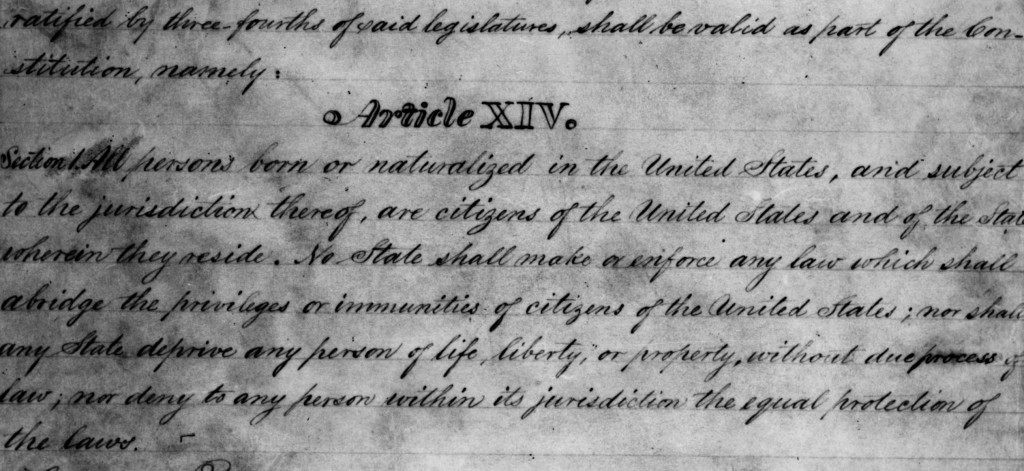
Two courts have slapped down Donald Trump’s executive orders against “birthright citizenship,” guaranteed in the first section of the 14th Amendment. This is a good thing. Like a lot of you, I am feeling a bit overwhelmed by all of Trump’s actions. Though I am heartened to see the Democrats making noises like they wish to act as an opposition party, it is on us to stay informed. And I have pledged to do all the reading necessary to understand the threat posed by the old new administration to Indigenous people and their communities. I have a lot to learn, I am sure, but here are some tentative thoughts. I would love to hear from you about the issues these executive orders raise.
In making their case against birthright citizenship, Trump’s lawyers brought up the example of Indigenous peoples in the federal republic. After the ratification of the 14th Amendment, and before the 1924 Indian Citizenship Act, Indians born within the territorial bounds of the United States did not receive, and were not considered, citizens of the United States. Therefore, the lawyers argued, the grant of birthright citizenship is limited and not comprehensive, and applied only to the formerly enslaved people Trump’s lawyers claimed the Reconstruction amendments were designed to protect. Children born in the United States to parents who are “illegal aliens,” a term the Trump team continues to use, thus cannot legitimately claim citizenship under the 14th Amendment. There are solid historical reasons why this legal argument is wrong, spelled out in detail by the judges who ruled against Trump. What I want to focus on is the Trump team’s reliance on arguments about Indigenous peoples and nations.
The Constitution makes two explicit references to Indigenous peoples. There is the “Indian Commerce Clause” of Article I, Section 8, that spells out the powers of Congress, and a reference to “Indians not taxed” as a class that could not be counted in calculating the number of a state’s congressional representatives. The first limits congressional power to regulating “commerce with the Indian tribes,” a phrase that has expanded dramatically in terms of the breadth of its meaning. It has been transformed over two centuries into the “plenary power doctrine” that makes Congress virtually absolute in governing Indian affairs. The latter clause, which implies that some Indians are or will be taxed, at the same time suggests that Indigenous peoples for the most part are beyond the jurisdictional realm of the United States or the separate states. In the Founder’s Constitution, Indigenous peoples were independent polities who owed no allegiance to the US, and over whom the United States claimed no power to interfere in their internal affairs.
The federal courts did little initially to help clarify the issue, probably because the idea that Indians were not citizens was assumed. Chief Justice John Marshall, in the cases of Johnson v. McIntosh (1823), Cherokee Nation v. Georgia (1831), and Worcester v. Georgia (1832) helped define Indigenous nations in the United States, but said far less about Native American individuals. In the simplest possible terms, Chief Justice Marshall’s famous “trilogy” of cases established that Indigenous Nations can exercise whatever power they want unless they are explicitly prevented from doing so by a federal treaty or an act of congress. Legal scholars call this concept “explicit divestiture.”
The first significant case that addressed Native American citizenship in a comprehensive manner was United States v. Elm, decided in the Northern District of New York on Christmas Eve in 1877. Abraham Elm was an Oneida who lived in New York’s Madison County, the heart of the Oneidas’ ancestral homeland. Claiming that he was a citizen of the United States, Elm voted to select his congressional representative in the election of 1876. Authorities arrested, indicted, tried, and convicted Elm for illegal voting. The courts suspended his sentence while they addressed the weighty question of “whether or not the Oneida Indians are citizens of the United States and, as such, entitled to vote.”
The 14th Amendment, the Court reminded its readers, decreed that “all persons born or naturalized in the United States and subject to the jurisdiction thereof are citizens of the United States and of the state wherein he resided.” That second clause— “subject to the jurisdiction thereof”—was important to the Court. “Those persons who, though born here, are born with the allegiance of a foreign sovereign, or of another government, are not subject to the jurisdiction of the United States.” For example, “the children of ambassadors, though in fact born here, are, in the theory of the law, born within the allegiance of the foreign power the parent represents.” In a similar vein, the Court continued, “Indians who maintain their tribal relationships, are the subject of independent governments, and, as such, not in the jurisdiction of the United States…because the Indian Nations have always been regarded as distinct political communities.”
But had the Oneidas “maintained their tribal relationships”? The state had taken nearly all their lands and declared the Oneida Nation dissolved. Because Elm’s “tribe has ceased to maintain its tribal integrity,” he was largely on his own. In the courts’ eyes, Abraham Elm “is a citizen, within the meaning of the fourteenth amendment.” The passage of time and the course of history had dismantled the Oneida Nation, at least in the opinion of the court. There was, in other words, no native nation remaining to which Elm might belong.
But what happened in the case of “an Indian, born a member of one of the Indian tribes within the United States, which still exists and is recognized as a tribe by the government of the United States, who has voluntarily separated himself from his tribe, and taken up his residence among the white citizens of a state, but who had not been naturalized, or taxed, or recognized as a citizen either by the United States or by the state”? Was this Indian a citizen of the United States under the birthright citizenship provision of the 14th Amendment?
These questions lay at the heart of Elk v. Wilkins, an 1884 case heard by the United States Supreme Court. John Elk, in 1880, had attempted to vote in the city of Omaha in a municipal election. He was denied and sought damages. Wilkins, the local official, Elk accused of failing to recognize his birthright citizenship under the 14th Amendment and his rights under the 15th amendment, which said that no citizen could be deprived of their right to vote on the basis of race, color, or previous condition of servitude. Justice Horace Gray wrote the majority opinion. Indian tribes, he wrote, “were not, strictly speaking, foreign states, but they were alien nations” whose members “owed immediate allegiance to their several tribes.” Examining the language of the 14th amendment, Gray reasoned that “Indians born within the territorial limits of the United States, members of and owing immediate allegiance to one of the Indian tribes (an alien though dependent people), although in a geographical sense born in the United States, are no more ‘born in the United States and subject to the jurisdiction thereof,’ within the meaning of the first section of the Fourteenth Amendment, than the children of subjects of any foreign government born within the domain of that government, or the children born within the United States of ambassadors or other public ministers of foreign nations.”
That should sound familiar to you by now.
The nation to which Elk belonged, not mentioned in the Court’s opinion, was neither taxed nor counted to calculate representation. “Their absolute exclusion,” Gray said, “from the basis of representation in which all other persons are now included is wholly inconsistent with their being considered citizens.” John Elk might become a citizen though a congressional action, but he did not become a citizen by separating himself from his tribe. And because Elk was not “a citizen of the United States under the Fourteenth Amendment of the Constitution,” he “has been deprived of no right secured by the Fifteenth Amendment.”
Justices John Marshall Harlan and William Burnham Woods dissented. Based upon their reading of the congressional record, they believed that the senators and representatives who approved the 14th amendment intended to “grant citizenship to every person of the Indian race in this country who was unconnected to any tribe, and who resided, in good faith, outside of Indian reservations and within one of the states or territories of the Union.” That argument failed to persuade, until Trump’s lawyers found it.
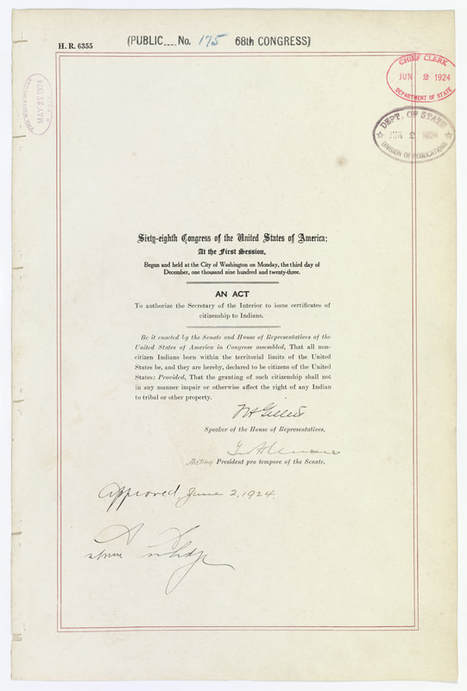
In the years following Elm and Elk, Congress did make some provisions for Indian citizenship. Recipients of allotments under the terms of the Dawes Act, who had passed successfully through their trusteeship period, received United States citizenship. Native American veterans of the first World War who received honorable discharges also received citizenship. And, in 1924, Congress passed the sweeping Indian Citizenship Act, that made all Indians born in the United States citizens. Many of the Haudenosaunee people I write about in my own research objected to this. The Onondaga Nation, for instance, rejected this unwelcome extension of the rights and responsibility of American citizenship over them. They still do today. They see themselves as apart from the United States and the state of New York, even while living within the bounds of the larger settler state.
In parts of the United States, the Native American vote constitutes a significant bloc. Indigenous voters can help swing Wisconsin, Michigan, Minnesota, North Carolina and Arizona red or blue. Indigenous candidates have successfully run for office in several states with large Native American populations. Given their record of military service, one could make the case that Native Americans are more patriotic than the rest of us. But that does not mean that Native American nationhood is not real.
The Trump Administration sought evidence to support its claim that the first section of the Fourteenth Amendment did not apply to “all persons,” despite the first two words in the first section of the Amendment. Trump’s team used Indian nations as an example to help them make that case. It is a nasty sort of historical revisionism to search for evidence, and to cherry-pick from the record, to advance arguments that fly in the face of the constitution’s language. Trump and his allies are, and always shall be, on the wrong side of history. They are ignoring the basic language of a constitutional amendment. The Trump Administration’s arguments are as wrong as they are vile.
Indigenous people did not receive “birthright citizenship” because of some limitation on the scope of the Fourteenth Amendment, but because they were members of foreign polities that predated the creation of the United States. It’s that simple, really. Their status provides no ammunition for racist Republicans who seek to exclude immigrants and refugees from shelter in America. In an assault on what is arguably their party’s greatest historical achievement, the Reconstruction amendments, Trump wants to tell us that the phrase “all persons” does not mean what it says.
Indigenous nationhood is a complicated subject. It is not taught in school. The status of Indigenous nations and individuals has vexed, and continues to vex, legal and political systems in many states. New York State, for instance, struggled for many years to answer questions about whether the state or the federal government had jurisdiction over Indian lands (Neither, the Onondagas would have said). The state long had legislated for Indians, but it did so in the absence of clear constitutional approval. Then, in 1948 and 1950, Congress authorized New York to extend its criminal and civil jurisdiction over Indigenous lands within the Empire State. Onondagas argued against this, too. They could not be made citizens if they did not want to. That birthright citizenship did not apply to them was never because the 14th Amendment does not mean what it says, but because American officials, imperfectly and with great reluctance, could see the reality of the Indian nations that stood before them. They were not citizens because they were not part of the United States. To argue otherwise, as Trump’s lawyers have done, is at best disingenuous.
