
It seems very likely that President Biden’s last official act affecting Indigenous peoples will be the “formal apology” he issued late in October. He apologized for the American Nation’s treatment of the thousands of Native American children it placed in dozens of boarding schools across the country. Like so much about Biden, his apology had the potential to be so much more than what it was.
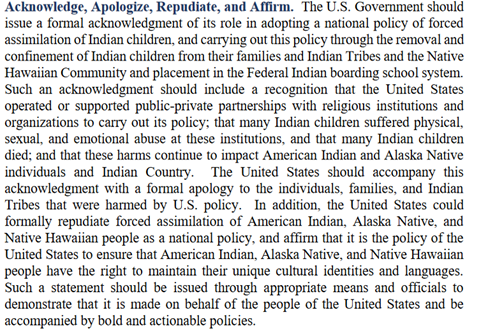
Biden was following the lead of the Federal Indian Boarding School Initiative, launched in the summer of 2021 under the leadership of the first Native American Secretary of the Interior, Deb Haaland. Item 1 in their report was “Acknowledge, Apologize, Repudiate, and Affirm.” That meant that:
There were problems with the final report. It was incomplete, and understandably rushed. The staffers working on it knew that the clock was ticking and, indeed, it is difficult to imagine that a work of this sort, or any formal apology, would emerge from the administration of President-Elect Trump. Assistant Secretary of the Interior for Indian Affairs Bryan Newland claimed that those who compiled the Initiative’s two reports read through 103 million pages of government records between June of 2021 and July of 2024. That means they worked through nearly 89,000 pages a day, an impossibly large number of pages to read thoroughly, or at all. They were undisciplined in their approach to examining continuity and change over time, for the boarding schools were not static entities: they solved some problems as they failed to address others. There is little evidence that they examined closely student files. Their count of the number of children attending these schools, and the number that died while attending them, appears low. It was, by its own admission, a first step.
Despite these problems, the Report is significant. There have been attempts by the United States government to apologize for its past treatment of Indigenous peoples—the best brief summary of them appears in Sarah Deer’s The Beginning and End of Rape—but Biden’s apology had the potential to do more—to come clean about the misdeeds, to examine the receipts and present the data, and try to move forward. The report’s recommendations for government action are all reasonable and would be helpful, and I find it difficult to believe that the incoming Trump Administration will follow through with any of them. That is one of many disappointments adhering to Trump’s victory.
So on October 25th, President Biden visited the Gila River Crossing School in the Gila River Indian Community, not far from Phoenix. He came on stage. He joked with his friends. He was generous in giving credit to others, especially Secretary Haaland. His delivery was predictably untidy. You know how he speaks. He recalled a conversation he had at the hotel where he stayed. The person with whom Biden had spoken, he claimed, had never heard of boarding schools. Biden wanted people to know, he said, about the “generations of Native children stolen, taken away to places they didn’t know with people they never met who spoke a language they had never heard. Native communities silenced. Their children’s laughter and play were gone.” Once the children their clothing was removed, their hair cut, and their names “literally ersed and replaced by a number or an English name.” Children were beaten, Biden said, for speaking their own language. He continued:
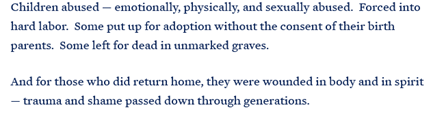
The boarding school system was “horribly, horribly wrong,” Biden said, “a sin on our soul.”
Biden then called for a moment of silence. Then he shouted the apology. “I formally apologize,” he said, “as president of the United States of America, for what we did. I formally apologize. And it’s long overdue.” He was then interrupted by an audience member, shouting out about “the people in Gaza.” Biden said to let the protestor speak, for “there’s a lot of innocent people being killed, and it has to stop.” When the disturbance died down, he spoke of his administration’s accomplishments. He was appealing to Native American voters. His apology led into a campaign speech describing all that the Biden-Harris administration had done for Indigenous people.
We know now that Native Americans, like every other group in America, swung to the right in 2024. If his goal was to secure votes for his successor, it is unlikely that he succeeded. Biden has aged. That is clear. He seems feebler every time I see him. Like Trump, he can do little but read from a teleprompter and, like Trump, at times he struggles to do even that. It is easy to dismiss this apology for these reasons. But as Native News Online put it in an editorial that appeared a couple of days ago, “Indian Country Deserves a President Who Shows Us Respect.” Of course Biden’s apology, and the Boarding School Initiative Report on which it was based, flattened a complex history, and treated incompletely the complications, nuances, and ambivalence that is present in the record. But it is significant. Sandwiched between two Trump administrations, the first of which was a disaster for Indigenous communities, Biden at least leaned in the direction of admitting the sins of a country that will now be consigned to the hands of those who view any criticism of the nation not merely as a cardinal sin, but a crime that just may be prosecuted. He showed some respect, even if it may turn out to be too little, too late.
