It might be worth noting that on the same weekend that witnessed the anniversaries of the the ATF raid on the Branch Davidian compound in Waco and the bombing of the Oklahoma City Federal Building–both terribly violent events involving anti-government, gun-crazy extremists–the President of the United States encouraged armed protests against state governors who have asked their citizens to stay home in order to “flatten the curve” and halt the spread of the Coronavirus. These governors recognize that various “social distancing” measures have saved many thousands of lives.
The President’s call to “liberate” the states nonetheless brought out hundreds of heavily-armed protestors, social distancing be damned, to state capitol buildings. Some of them believe that the economic costs of the shutdown are greater than that of the many thousands of lives that will be lost through a premature re-opening of businesses and public spaces. Others say that they are in good health and will be able to survive the infection should they contract it. Others rehearse crazy conspiracy theories about the Coronavirus as some sort of subversive attack on the President. These protestors–frightened, infantile racists who cling to guns and a deviant version of Christianity that makes a fetish of violence, represent much that is wrong with this country. They neither read nor reason, and they believe that the solutions to problems can only be achieved through the threat of violence. That they engaged in this paramilitary cosplay on the eve of the anniversary of the Columbine Massacre and Hitler’s birthday tells you all you need to know about the President and his most hysterical followers.
What stories will we tell about this pandemic spring, and how will this time of dislocation, isolation and, in places, overwhelming grief, shape the stories we historians tell about those pasts we choose to investigate? The answers to these questions are always more connected than we care to admit.
There are of course the daily stories of the blundering incompetence of our most craven President, who fiddled while the virus burned up much of what seemed familiar and comfortable. There are his brazen lies, his attempts to rewrite the past and erase his many denials of the magnitude of the health threat we all face, and his failure to deliver even a fraction of the testing kits he asserted would be ready by now. Beside the stories of this president’s cowardice and malfeasance, there are the stories of heroic health care workers, doing battle against the virus often without the equipment that might allow them to do their work with less risk. Of course there are the stories of those who have suffered and died, and those who grieve these deaths. There are many more of these stories yet to be written, I am afraid. Anyone with the eyes to see knows this to be true. These stories can overwhelm if we let them.
At home, I attempt to steal away moments here and there to work on the book project that has kept me busy for many years now. It may be my last book. Sometimes I feel that way when I consider the scope and scale of the project. The project gets bigger while my world, in a sense, becomes smaller. I work from home. I no longer encounter my students face-to-face, bump into colleagues, or visit libraries and archives. I keep my distance from others to keep myself safe. The world seems limited and constrained.
When I attempt to look at this project in all its breadth, I find myself distracted, restless and anxious. Working on a project this broad requires me to think of the future, to make plans and set goals. I feel strange doing that now. It is only when I step back and slow down, and when I take a look at the small stories, that I am able to focus and devote some energy to my research. I look at the smallest pieces of the puzzle, the most interesting pebbles on a beach of enormous expanse.
In January of 1907, Harrison Hill, a teenager from Onondaga shot and killed his brother-in-law Elijah Peters on the Tonawanda Indian Reservation, located about halfway between Rochester and Buffalo in western New York. Hill had attended the Thomas Indian School on the Senecas’ Cattaraugus reservation beginning when he was eight years old. I have not been able to reconstruct all his movements. He left Thomas after four years. A half decade later he got himself into some kind of trouble, and ended up at the state industrial school in Rochester. The school’s records are housed at the Rush Rhees Library at the University of Rochester, but the archives are closed due to the coronavirus pandemic. All I know for sure is that once he got free or escaped or finished his term, he made his way to Tonawanda to live with his sister and her husband. His mother joined him there shortly thereafter.
It is not clear to me exactly what happened next. I am certain that after some sort of confrontation that involved Hill asking Peters for money, Peters asked Hill to leave his house. Some time later, Hill shot Peters as he exited the house, delivering to his brother-in-law the fatal wound.
In every account Hill is described as educated and stunningly good looking. But sullen, and angry, as well. After the shooting, he ran for it. Neither his sister nor his mother claimed to know where he had gone, but the police never believed them. They thought that he could be hiding in Syracuse, or on the Onondaga Nation territory, where he still had relatives. The police offered a reward for his capture, and two days later a sheriff captured him near the farm of a guy named Byron Gardner in Wyoming County. According to the report in the Buffalo Courier, Hill “was walking in the road when he met the officer, armed with a loaded revolver from which two cartridges had been fired, and the sheriff believes that had the prisoner known him he would have had difficulty capturing him.” Hill did not know that Peters had died. The Courier reporter wrote that
Hill is nineteen years of age, bright and intelligent looking, neat in appearance and speaks good English. He at one time attended the Carlisle Indian School and wore several pins on his coat, one of which was a fraternity pin from Carlisle. On arriving at the jail, he made a complete confession of the crime.
There is no evidence that Hill ever attended Carlisle. It is hard to say where he got these pins, but undoubtedly he had family members who had spent time in Pennsylvania. The description of Hill’s confession paints a vibrant, if incomplete picture, of a young man who found himself in a great deal of trouble:
He says that on the morning of the day of the shooting Peters turned him out of the house and he has a very quick temper it made him very mad and he determined to get revenge by shooting him. He says he went to Peters’ house in the evening and concealed himself behind a clump of bushes near the rear of the house and that when he saw Peters coming from the barn he took aim and fired the bullet. He says he fired but once and then ran, and after going to his room at Johnson’s and getting a package he walked that night to Oakfield and Batavia, and then to LeRoy and south to Pavilion. He says that Tuesday and Wednesday nights he slept in barns and finally reached Gardner’s farm where he found a job cutting wood. He stayed at Gardner’s Thursday night. When asked if he was sorry for what he had done he said he was not; that he did not care much. He takes his arrest cooly and does not appear to be at all concerned over his fate.”
Many Onondagas attended boarding school. Some went to Thomas, the state-run institution that remained open into the 1950s. Others went to the infamous Carlisle School in Pennsylvania. A small number went to schools elsewhere—Lincoln, in Philadelphia, or the Haskell Institute in Kansas, and some others that I cannot think of. Some of them struggled when they came home. Some put their skills to use and did well for themselves. For many, attending Carlisle was a badge of honor—even Harrison Hill who never went there wore Carlisle pins on his jacket.
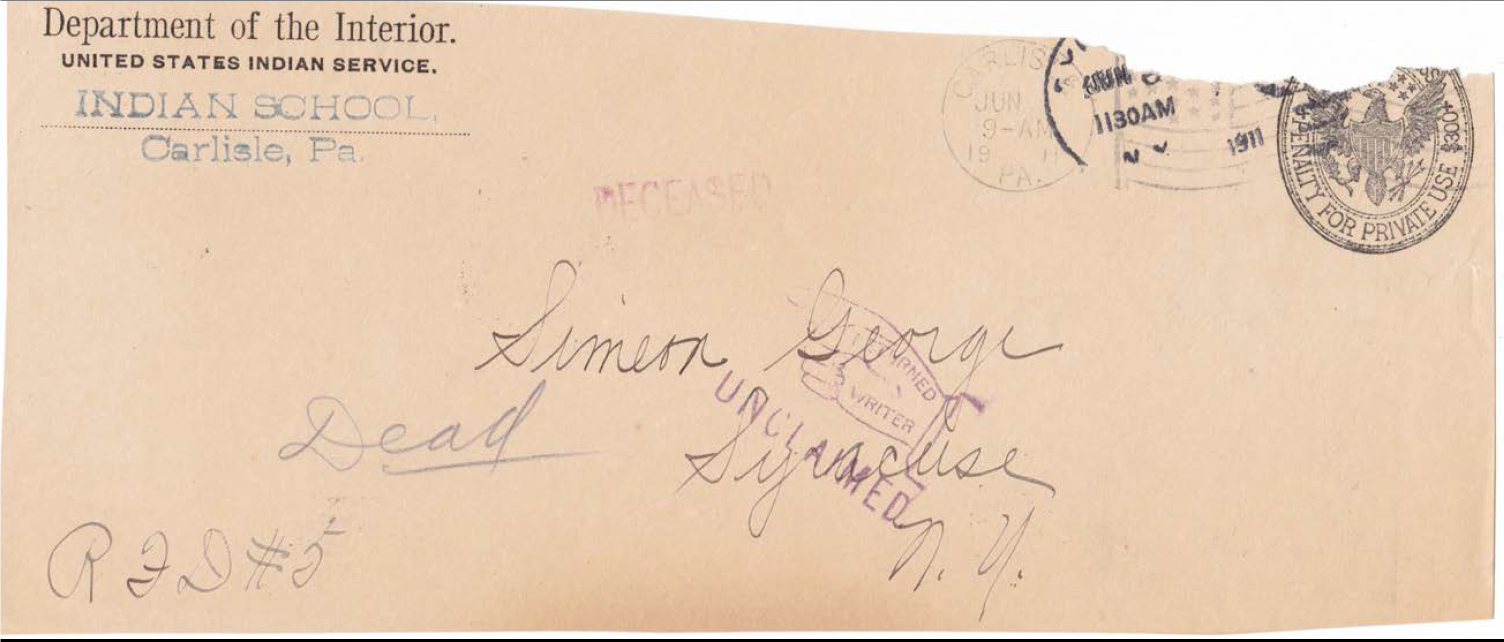
I do not know how Simeon George felt about his time at the boarding school He arrived at Carlisle in 1893. His student record is sparse, little more than a couple of information cards. He attended sporadically, going home at his parents’ request between each May and October. After May of 1896, he never returned to the school. As a 22-year old, he was too old to attend the school any longer.
I have not been able to find out much about George and his life at Onondaga. He doesn’t show up in the newspapers. I cannot travel to the Nation territory to talk to people there about him until the pandemic subsides.
What I do know for sure that is on April 21 1907, while Harrison Hill sat in jail awaiting trial on charges of murder, George was in his home on the reservation, eating supper. A knock at the door. George answered It was a sheriff’s deputy from Madison County, Michael Mooney.
Deputy Mooney told George to finish his supper, but to come outside when he was done. Mooney told him he would wait. George finished his meal quickly, and grabbed his coat. He placed a loaded revolver in his pocket. When the deputy put his hand on George’s shoulder, he pulled out the gun and fired, wounding Mooney in the shoulder. As Mooney fell, George fired again, hitting him in the back.
George ran into the house, leaving Deputy Mooney for dead. He told his nineteen-year-old wife Lydia Billings, who he had married ten months before, that he was going to kill himself. He ran from the house and headed toward an expanse of woods to the south. “It was believed at the reservation yesterday that George had carried out his threat,” the Syracuse Post Standard reported. That is what Lydia believed. She told police that one of George’s brothers had committed suicide four years earlier.
But where was his body? Police searched the woods for a couple of days. People from the community, I imagine, must have helped out. They found nothing. By the 26th, police began to suspect that George was alive, that his announcement of his intent to kill himself was an attempt to throw the police off his tail. Keep them busy, looking for his body, while he fled from the reservation. A mail carrier in East Hamilton, about 45 miles east of the reservation, reported seeing an Indian who matched George’s description going door-to-door begging for whatever the residents might spare.
The mail carrier, it turned out, had spotted someone who was neither George nor an Indian. On the 29th, as Detective Mooney slowly recovered from his wounds, officers found George’s body, a bullet wound in his head, his revolver by his side. They found him in the wounds a short distance from his house where he said he would go.
Whatever his own demons, whatever he had done, Simeon George was loved. His funeral took place at the reservation Wesleyan Methodist Church. 200 people attended, “the little church crowded to the doors.” The entire twenty-one members of the Onondaga Indian band performed in his honor. They performed a dirge entitled “Forest Home,” composed in 1898, and another piece called “Religioso.” His life, about which it is so difficult to learn much at all, mattered immensely to those people at Onondaga who knew him.
Harrison Hill’s trial began three weeks after George’s funeral at the United States District Court. His attorney argued that Hill shot Peters in self-defense and never intended to hurt him. Hill had gone to Peters’ house to ask for some money to help his brother, Moses Hill, who was incarcerated in the Onondaga County Jail on charges of grand larceny. Peters went after Hill, who fired the gun in an effort to frighten him. Hill took the stand in his own defense, and was “subjected to a sharp cross-examination on the part of the people, but in the main struck to the story given in his direct examination.”
The judge overseeing the trial, in his instructions to the jury, told them that Hill was entitled to a fair and impartial trial, “but that you must not be influenced by sympathy for his youth and must not consider it in your deliberations. There should be no prejudice against his race or color,” the judge said, “and nothing about his manner of testifying should influence you. You know,” he continued, “the nature of the Indian is stoical and any hesitations in answering questions should not militate against him.”
I have not had a chance to try to find the trial record. The jury believed Hill. He was acquitted on all charges. I do not know what happened to him after that. But I did find this story in the Rochester Democrat and Chronicle seventeen months later:
Robert Hill, 20 years old, an Onondaga Indian, was brought to jail last night by Railroad Detective Elliott. Hill was arrested on Thursday morning by Constable Charles Platt, of Gates, who arraigned him before Justice of the Peace Leddy on charges of burglary and larceny. Hill was caught after he had broken into a freight car in the Buffalo, Rochester, and Pittsburg yards in Lincoln Park. …..Hill is a bad Indian. Despite his years he has seen a good deal of the country. Some nine months ago he shot and killed his brother and law in an Indian settlement near Batavia. He was tried, but was acquitted. Next he was accused of having stabbed a brakeman in Salamanca. He got away, and at Wyoming took off his coat and flagged a train. He rode into Rochester where he was arrested by Detective Spillings and railroad Detective Elliott. He wasn’t held long, as it was impossible to prove that he had done the stabbing. Thursday morning Constable Platt found the red man industriously breaking open packages in a freight car in the Lincoln Park yards. When he started to place the Indian under arrest the latter drew a revolver. Platt didn’t wait for him to use it, but laid his flat on the Indian’s nose. The blow was so straight and so effective that Hill surrendered without further ceremony. Director Whaley caused Hill to be photographed yesterday. He thinks the Indian is wanted in some Western state.
The details do not match up completely, but you have to admit that there are some similarities between the story of Robert Hill, a 20-year old from Onondaga arrested in October of 1908, and Harrison Hill, a 19-year old arrested in 1907. It is a question I have not been able to investigate. Lydia Billings, Simeon George’s young wife, left the reservation after his suicide and found work at the Columbia Hotel in Niagara Falls as a domestic. When the upper floors of the hotel caught fire in January of 1909, she jumped from the fourth floor to save her life. According to the Buffalo Evening News, she “sustained a broken rib on the right side, a fracture of her right wrist and a fracture of the left ankle.” I have many more unanswered questions, but for now, the trail has grown cold.
There has been in our profession a flourishing “microhistorical turn” over the span of the past decade or so. I expect more of us will be drawn to these small stories if the suffering caused by the coronavirus continues and increases, as every informed person says it will.
The historical record left from these years will surely highlight the incompetence of the executive branch in the face of a global crisis and the grotesque self-dealing of the arrogant bunglers. We will have numbers and charts and data, telling the story of the pandemic’s spread, and the damage it did as it slashed its way around the world. What might not show up easily in the archives of the future will be the brutal but quiet reality that this pandemic will have been the most important event in the lives of millions of Americans. It was this virus that took from them their lives and their loved ones, or led them to lose their jobs, their homes, or their businesses. Dreams shatter. The cord breaks in the spring of 2020, and nothing for these many people will ever be the same again.
We historians look for the significance in the events that we write about. We do not simply recount the past. We identify and explain why it mattered. We might find significance in a battle, an election, and act of Congress or an act of God. Perhaps with this pandemic more of us will recognize that the events that make us who we are can be as small as a death in the family.
In Native American history, we have become more attuned to historical trauma as a force shaping indigenous communities. Often we tie this to a history of violence, dispossession and disease. In my own attempts to understand the history of the Onondagas, an indigenous community that would have disappeared long ago if their white neighbors had their way, I find immense meaning in these small stories, a way of knowing and seeing this history not often available in the conventional sources, conventionally read. If the coronavirus pandemic continues to inflict trauma as some people fear it might, these small stories will not only offer an essential means to view the history of this country during this ear, but an important means for speaking truth to power. There are those like this President and his craven supporters, for instance, who will attempt to distance themselves from the destruction their incompetence has wrought. These millions of small stories will stand as witness against them. Perhaps it is true what one of the very wise Geneseo students who accompanied me to Oxford last year had to say: the bigger the issue, the smaller you write.
We recently completed a search at my institution for a historian of the Islamic World with a specialization in the vast period before 1800. I chaired the search, and am chairing another search in a different department right now. From the isolation of my family quarantine, I have thought a lot about the search. I am very excited about the person we hired. Still, as I reflect upon the process and what I hear from my younger colleagues, it seems to me that there is much that we as a profession might do better.
When I began applying for jobs a long time ago, the system was very different from today. Credentials stuck in files at the AHA, or mailing in letters and a CV with letters of recommendation to follow. All carried out through the U.S. Mail. Administrators and their so-called efficiencies have changed the way we conduct searches.
My campus, like many, uses an online employment system. Applicants upload the documents we ask for (a letter, a CV, and a statement of teaching philosophy). The system generates automatic emails acknowledging receipt of the applicant’s materials. If I let it, the system will also generate automatic emails informing applicants that they did not get the job. This is the default setting. That seemed a bit harsh and disrespectful to me, and a bit inhumane, but I have come to understand that these robo-mails, or no message at all, have become the norm. Applicants can be forgiven for feeling chewed up and spitted out, scorned and abused. It takes a lot of work to apply for an academic job. The opportunities are few and the stakes are high. An automatic email seems an unnecessarily callous ending in a world filled with callousness.
We must do better.
So I sent sixty-one emails personally, one to each of the applicants. It took a bit of time, but not much. I wanted the applicants to know that I appreciated the time and effort they put into their applications. I acknowledged the rottenness of the job market, and how I wished we could have interviewed more people. I told them how impressed my colleagues and I were with their credentials, and how difficult a time we had narrowing the applicants to a number of candidates we could meaningfully interview.
I expected nothing in response, but thirty-one of the applicants replied to my email. This surprised me. Though one was gently and reasonably critical of the time the search took, all were appreciative and thanked me for treating them with courtesy and respect. All of them either said, or strongly implied, that such minimal courtesy is all but unheard of in today’s academia.
I spend a fair amount of time on Twitter, so I read a lot from recent Ph.D recipients describing their searches for a tenure-track job. These are tales of desperation, despair and depression, with not a few instances of shabby treatment by hiring institutions along the way. We who are lucky enough to be tenured or on the tenure track must, and can, do better. Writing a personal message is only the start.
Decency matters.
Decency matters so much that it is worth the extra effort to treat job applicants as you would like to be treated. Yes, the market was brutal when I went out twenty -five years ago, but it is much worse now. Believe recent graduates when they tell you that.
We must recognize that we are so fortunate to have the jobs we have. Colleges and universities, I know, as workplaces can vary widely in quality. I spent the first four years of my career at a dysfunctional hellhole in Billings, Montana. But even in the midst of the shit-show that was that college, I enjoyed my students, the teaching, and the advising. I enjoyed the moments I squirreled away to work on my first book. Once I closed the classroom door or my office door, I was happy.
And even if you feel justified in whining about your place of employment, remember this: there are literally hundreds of people who would like to do what you are doing, but will never get that chance. This brutal reality imposes upon all of us the obligation to be the best historians and teachers we can be. You must remember, no matter how good you think you are at this work, no matter how paradigm-shattering you consider your research, it is almost certain that there is someone better than you, shut out by the brutality of the academic job market. One of my colleagues at the dysfunctional hellhole, who doubled as an associate pastor at a local Missouri Synod Lutheran Church, told me during my on-campus interview that being a college professor was the best part-time job in the world. I suspect that we all know people who take this approach to academia, who do not produce or take their teaching seriously, but I can think of no attitude more loathsome and disrespectful to the many hundreds of talented historians who will never get a chance.
We cannot undo all the macroeconomic changes in higher education. I recognize the magnitude of the fiscal challenges facing colleges and universities. But let’s push back against the increasing bureaucratization of the job search and the increasing role played by computers in the hiring process. Perhaps you have an Ivy-League pedigree, and you feel your research is so important that you cannot be bothered to pay attention to the lowly peons who want to join your department. Perhaps you went to a second-tier school and never looked back. Whoever you are, wherever and whatever you studied, there is no excuse for not being kind. Resist every institutional protocol, and every barrier, that keeps you from treating job applicants the way you would like to be treated. If you are that barrier, and find that you cannot find the time to treat applicants with decency, perhaps you ought to step aside. Be kind and be decent. Most of all, show compassion. It matters.
We are entering a period of uncertainty. For me, part of that uncertainty involves the effort to continue offering quality instruction through a computer. I cannot tell you that the transition will be seamless or easy. There are going to be some significant bumps in the road. I have a lot to learn about using Canvas, Zoom, and a host of other platforms my more knowledgeable friends have recommended to me. I will communicate with you all as thoroughly and completely as possible. If going home poses difficulties for you, let me know. If you do not have reliable internet access at home, let me know that, too. You can email me, or message me on Twitter (@NativeAmText).
I know you took your books home with you for Spring Break. You will need them over the course of the next two months. I will be working in the coming days to learn how best to continue our class discussions online. Because I do not lecture, and because I do not use Powerpoints, I suspect there might be some reasonably easy fixes for our classes. But I don’t know for sure, and I will keep you informed about what I learn, and I am open to any suggestions you might have. We will get through this.
You are living through historic times, I suspect. I think back to the Great Depression, when the collections of shacks and shelters thrown together by the homeless were called “Hoovervilles,” after the particularly ineffective President who watched the Nation’s economy flow down the drain. I wonder if we will someday soon call the quickly constructed emergency medical centers, should they be required, “Trump Hotels,” or something like that, given our current particularly ineffective President’s bumbling response. Still, I remain hopeful that if we are smart and conscientious, and that if sensible precautions are followed, that the impact of this deadly virus will be blunted. It is best to err on the side of caution.
As a historian, I might suggest you keep a journal of this plague year, a record of the events you witnessed, your fears, and your concerns. That one of your eight semesters at college was significantly disrupted by a global pandemic is something I suspect you may remember for the rest of your life. I am willing to bet that the historians of the future would love to read about your experiences during this crisis. And if keeping a journal is not your style, do something creative. Do some art, if that is your thing. Write some poetry or some music. Take care of yourselves and those who you hold close. The coursework, whatever form we agree it will ultimately take, is not as important as your health and the health of those people you care about. I can be flexible. We are all in uncharted territory.
I spent the end of last week and the beginning of this one sitting in a hospital room, and then in a skilled nursing facility. My mom had a major health crisis that has really thrown all of us in my family for a loop. Your health is a fleeting and a fragile thing, and it can be gone in a second. I think about this a lot, about how quickly our fortunes can turn.
—
The “In-Person” part of our semester in the Humanities class ended with the Gospels. As we move forward, we will make our way through Augustine’s Confessions, Dante’s Inferno, More’s Utopia, Father Gregory Boyle’s Tattoos on the Heart, and Hamlet. All of these texts can be read in such a way that they force us to consider how to live meaningful lives in the midst of grave crisis. In a world that can seem so cruel and foolish, so short-sighted, empty and mean, it is worth considering the significant questions these readings raise: How to be virtuous, brave, and compassionate. Some of us may be tested in the days and weeks ahead.
We can stand in a circle, as I told you in class, with no one excluded. No us and them–just us. No one excluded, cast aside, or discarded. Help those in need. Be generous and kind. Remember that we all have a lot weighing upon us. Maybe, with compassion, we can emerge from this crisis wiser and better than we were before.
I will stay in touch. I hope you will, too. I look forward to reading what you write, and hearing your thoughts as we move forward together.
The
last week in December forces those of us who study history to remember two
particularly gloomy, and revealing, episodes in the Native American past. On December 29th, 1890, American
soldiers massacred Lakota Sioux at Wounded Knee, an atrocity for which the
United States government awarded a number of medals of honor. Congress is considering legislation to revoke those awards. And on the
26th of December, 1862, American military officials executed at
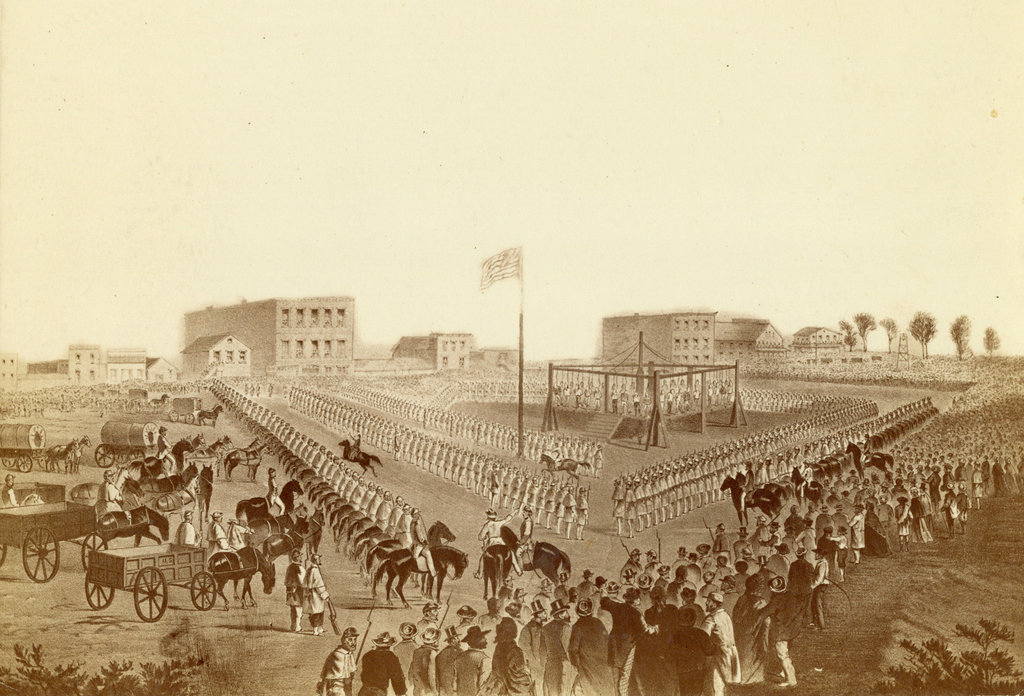
Mankato, Minnesota, thirty-eight Dakotas identified as “ring-leaders” in their
war against the forces of American colonialism. I have been thinking about both
of them over the course of the past two weeks.
There was a fair amount of
commentary on these horrific events on and around their anniversaries. In reading about the execution of the
Dakotas, I learned that after the execution, William W. Mayo, who later founded
the world-famous Mayo Clinic, dug up at least one of the recently buried bodies
of the condemned, dissected it in front of his physician colleagues, and kept
the bones around his house as a child’s play thing.
I had never heard this before. I
read about it in a tweet. I asked the
person who posted it about the evidence.
This was a stunning story, revealing in what it says about Minnesotans’
attitudes toward their native neighbors.
But I could not share it with my students until I knew for sure that it
was true. The person who posted
suggested I visit Google; he was merely repeating something he had heard. I poked around, on Google and elsewhere, and
found some news stories that demonstrated that this tale of grave-robbing and
desecration was indeed true.
In September of 2018, the Mayo
Clinic apologized for desecrating the grave and body
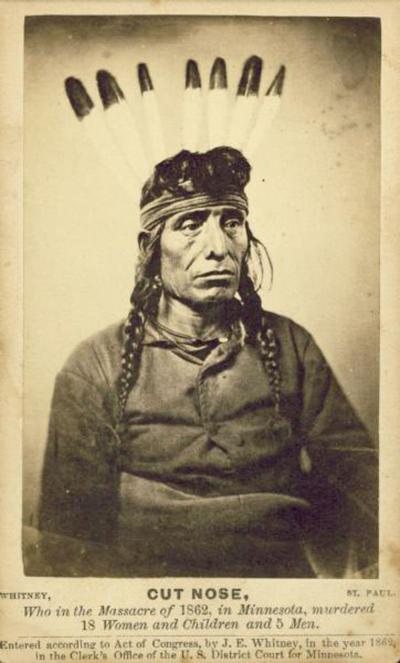
of Marpiya Okinajin, known to the Americans as Cut Nose. His remains stayed at
the Mayo Clinic until 2000, when they were repatriated and reburied. Jeffrey Bolton, a Mayo Clinic administrator,
flew from Rochester, Minnesota, to the Santee reservation in Nebraska. The Mayo Clinic was establishing an endowed
scholarship for Native Americans who aspired to work in medicine, and Bolton
wanted to apologize formally for the Mayo Clinic’s hurtful act in person on the
reservation.
Bolton’s apology was widely covered
in Nebraska and Minnesota news media, but I missed the story when it came
out. The coverage was kind to the Mayo
Clinic, generally pointing out that after the passage of a century and a half,
it was trying to set things right.
Stories of white apologies for the past are sometimes covered like this,
it seems. Reporters and columnists
celebrate the courage of those who apologize, recognize their bravery and their
contrition, but they too often do so without delving into the violence and
dispossession that provided the vital context for the particular act in
question. That really bothers me.
We’re all apologies, but only for the fouls we commit in a game that you must know was rigged from the very beginning.
The execution of the Dakota 38 was
an atrocity, no question. But it was not the only one committed before, during,
and immediately after the Dakota “Uprising.”
By the end of the 1840s, most Dakota Sioux were
destitute. The number of white settlers in Minnesota, which became a territory in 1849,
continued to increase. Hard-pressed and impoverished, the Dakotas, under the
leadership of Little Crow, signed treaties in 1851 at Mendota and Traverse des
Sioux in which they gave up their claims to all their lands in Minnesota save
for reservations along both sides of the Minnesota River north of New Ulm, and
extending upriver for 140 miles.
The Dakotas signed the treaty in 1851 after accepting
federal assurances that the cession would benefit them. They trusted their
white father. The sale would provide them with the annuities they needed to
purchase the necessities for survival in a tightening circle. But Federal officials viewed the treaty
differently. They hoped to civilize and Christianize the Santees,
to teach them the value of private property, and transform them into farmers on
the white model. By reducing the amount of land they owned, and opening the
ceded lands to white settlement, Commissioner of Indian Affairs Luke Lea noted
that the Dakotas would now “be surrounded by a
cordon of auspicious influences to render labor respectable, to enlighten their
ignorance, to conquer their prejudices.” Reservation life would bring
preservation to the Dakotas.
The government established two federal
agencies to oversee the civilization program, the Lower Sioux Agency at
Redwood, and the Upper Sioux or Yellow River Agency. Some Dakotas
accepted the changes proposed by their agents. Leaders like Wabasha, Wakute,
and Mankato cut their hair. Others encouraged their followers to begin farming
and living and dressing like their growing numbers of white neighbors. Yet
these changes generated divisions. According to Big Eagle, those who “took a
sensible course and began to live like white men” received special treatment
from the agents. “The government built them houses, furnished them tools … and
taught them to farm.” The “Blanket Indians,” or the “Long-Hairs” who rejected
the benefits of American civilization, resented this special treatment. They
objected to the pushiness and cultural arrogance of the agents and
missionaries. As Big Eagle observed, “the whites were always trying to make the
Indians give up their life and live like white men … and the Indians did not
know how to do that, and did not want to anyway.” Too much change, Big Eagle
said, called for in too short a period of time. Big Eagle and many other Dakotas resented the racism of white men who “always
seemed to say by their manner when they saw an Indian, ‘I am much better than
you,’” and he did not like that “some of the white men abused the Indian women
in a certain way and disgraced them.”
Some warriors assaulted the farming
Indians. Some may have shot at and poisoned Christian converts. Those who
accepted the government program seemed to ignore many of their obligations to
their neighbors. The houses built for farmer Indians had their own cellars that
encouraged the hoarding, rather than the sharing, of food. The acceptance of
Christianity signaled in part the abandonment of the teaching of Dakota
shamans. The refusal to join warriors at the agent’s request signaled the
declining authority of traditional leaders. The civilization program threatened
in fundamental ways Dakota culture and community, and their world was out of
balance.
Other sources of tension gripped the
Dakotas. The white population of Minnesota continued to
grow as large numbers of Germans and Scandinavians settled near the two
agencies. Many Dakotas learned to hate the
emigrants, who not only took their land and ran off their game, but refused to
share what they had with hungry Indians. The Dakotas
viewed them as intruders.
The settlers did not want Dakota
hunters trooping across land that they felt was theirs, but the conduct of
federal authorities at the agencies left them with little choice. Agents and
other employees used their positions all too often for personal enrichment.
They overcharged the government for goods and services that they provided to
the Dakotas, and they claimed for themselves a
share of the Dakotas’ annuities. They held
much of the rest of the annuity money for payment of debts to traders. What’s
more, in an effort to encourage Dakotas to
embrace the civilization program, the agents withheld annuity payments to
traditional Dakotas. Without food and money,
the discontented left to search for game. They viewed the farmers and traders
and agents as fundamental threats to their existence. They were very hungry.
When Little Crow complained about the behavior of the traders, Andrew Myrick,
one of their number, announced that “so far as I am concerned, if they are
hungry let them eat grass or their own dung.” Astute observers recognized how
dangerous the situation had become. The Episcopal Bishop for Minnesota, Henry B. Whipple, solemnly warned
that “a nation which sowed robbery would reap a harvest of blood.” Nobody paid
him much heed.
By the summer of 1862, the annuities
still had not been paid. Four Dakotas rummaging for food killed several white
settlers who confronted them near Acton, Minnesota. Rather than surrender the
four warriors, the traditional Indians at the Redwood Agency resolved upon war.
Before they struck, however, they sought the advice of Little Crow. He had
participated in the government’s civilization program. He told the warriors
that “the white men are like the locusts when they fly so thick that the whole
sky is a snowstorm. You may kill one—two—ten,” he said, “as many as the leaves
in the forest yonder, and their brothers will not miss them.” However many you
kill, ten times more will come to kill you. “Count your fingers all day long
and white men with guns in their hands will come faster than you can count.”
He doubted that the Dakotas could prevail, but he reluctantly joined in the
assaults. He feared the consequences of the earlier attack on the settlers, and
he knew the demands for vengeance would be great. Best to take a stand now. On
August 18, 1862, the Dakotas fell upon the Redwood Agency, killing two dozen
agents and traders. The attacks thereafter became more general. Nearly 400
settlers died in the first few days of fighting. The Dakotas
then attacked Fort
Ridgely and New Ulm. The
settlers drove back both attacks and from late August the Dakotas
went on defense. Some called for opening negotiations with the federal
authorities for peace. Light Face, a Sisseton, said that “he lived only by the
white man and, for that reason, did not want to be an enemy of the white man;
that he did not want the treaties that had been made to be destroyed.”
Meanwhile, the federal forces converged on the Dakotas.
Led by Colonel Henry Sibley, the American troops defeated a Dakota attack at Wood Lake
in September.
Many of the Dakotas
fled. Sibley convened a military tribunal to collect evidence against those who
participated in the uprising. By November, he had condemned over 300 to death.
As the condemned marched downriver, they faced the insults and anger of the
frontier population. White settlers pelted the prisoners as they moved toward
the place of execution. A white woman, one observer noted, rushed “up to one of
the wagons and snatched a nursing babe from its mother’s breast and dashed it
violently upon the ground.” The child died several hours later.
President Lincoln pardoned most of the condemned, many
of whom, along with their families, had converted to Christianity while
imprisoned. They had found some hope in the new religion. The President ordered
them incarcerated at Davenport,
Iowa. Thirty-eight others,
Lincoln concluded, did deserve to die. His decision was unpopular in
Minnesota. An editorial in the Winona Daily Republican thought that all 300
should die.
“It would be amusing, were the circumstances too solemn to be turned into a subject for ridicule, to point out the subtle distinctions which are thus made in the cases of these murderous barbarians—how one Indian is to be hanged by the neck until dead, because he fired the fatal shot which sent a defenceless white settler suddenly into eternity—how another is to be pardoned because he stood by approvingly until the shot had been sent on its mission of death, and then indulged his savage instincts by scalping the victim and horribly mutilating his dead body. The barbarian ravishers of women and the butcherers of infants are to be divided into two classes, guilty and innocent, upon the principle of nice metaphysical distinctions which turns over to execution one assassin where it directly applauds the conduct of ten others by pronouncing them worthy of again entering into society and running at large as the independent lords of a land laid desolate by their devilish deeds of outrage and blood.”
On the day
after Christmas, they went to the gallows. As they waited for the trap to open,
they sang their war songs and said their farewells to their families. It was
the largest mass execution in American history. And it clearly wasn’t enough
for many Minnesotans. The St. Cloud Democrat resented the in depth
coverage of the executions, and the treatment received by the condemned. “The soldiers, reporters, officers and
preachers, who shook hands with those demons, should each and every one wear
his paw in a sling during the term of his natural life, or dip it into boiling
lye and skin it.” The paper’s editorial
writer continued:
“It makes one sick to think of the cunning, cowardly brutes thus lionized in sight and hearing of many of their surviving victims and in close neighborhood to the unburied bones of others, as they bleach in the wintry winds. Uncle Samuel’s soldiers are so busy feeding Indians, guarding Indians and shaking hands with Indians, that they have not had time to bury the neglected remains of their victims.”
White settlers killed by “miscreants,” “pigs,” and “wild beasts.” They were animals, and should be disposed of like the menace they were. If Minnesotans “do not shoot, or hang, or drown, or poison with wolf-bait, these erring misguided, unfortunate, wronged injured Siox [sic] hyenas they will deserve and receive the contempt of the civilized world.” White people in Minnesota “should kill them as they would crocodiles.” They were not worthy of the sympathy reporters showed them. “The sights and sounds of horror, the tales of death partings and hideous tortures brought into St. Paul by hundreds of survivors of the massacre of fifteen hundred whites has not occupied half the space in the St. Paul dailies which is consumed in the farewell grunts, dying hypocracies, and obscenities of thirty-eight of these demon-brute murderers.”
Little Crow escaped, but only for a time. He fled
west, but returned later to the Minnesota
valley. On July 3, 1863, a settler gunned him down as he picked berries near
Hutchinson, Minnesota. His scalp was placed on display. The Dakota Sioux were driven out of
Minnesota. Any Indian presence was too
much for white Minnesotans in the aftermath of race war.
The New York Times 1619 Project has been in the news a good bit lately. Older historians, some of whom have not done much work at all in the history of slavery and the enslaved, have dismissed the enterprise. That older historians dismiss the work of their younger colleagues is nothing new, of course. It is the way that hey dismissed this important work that is troubling. They question the centrality of slavery in the formation of the American state and society. They see the institution of slavery as standing in contradiction to the nation’s founding principles.
As a scholar who studies Native American history, the
opposition of these old-timers at elite institutions to their younger
colleagues is baffling. They may still
have power and influence, but no longer much by way of respect. Not any more.
I look at the past and see a continent taken from native peoples, built
on stolen lands, with labor seized from enslaved Africans and
African-Americans. Dispossession and
slavery, colonialism and racism: they rest at the black heart of the American
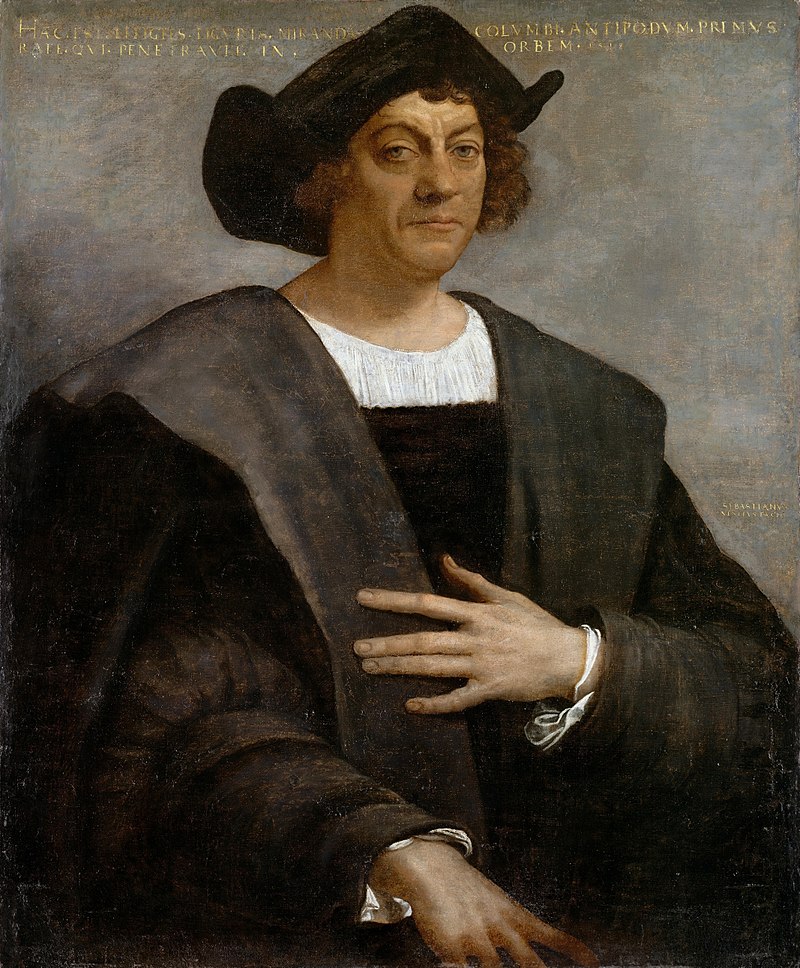
story, from the arrival of Columbus to its Trumpian apocalypse. The founders,
who too many people still revere as demi-gods, knew what they were doing and
were open about it. True, they spoke occasionally of civilizing and
assimilating native peoples, but that effort cannot be separated from the
larger effort o acquire Indian lands and erase their culture. The Mayo Clinic has taken significant steps
to address this repugnant part of its past, of its own history. This country has barely even started.
Because
I teach a first year writing seminar at my college on the history of the
Carlisle Boarding School, I have spent a fair amount of time reckoning with the
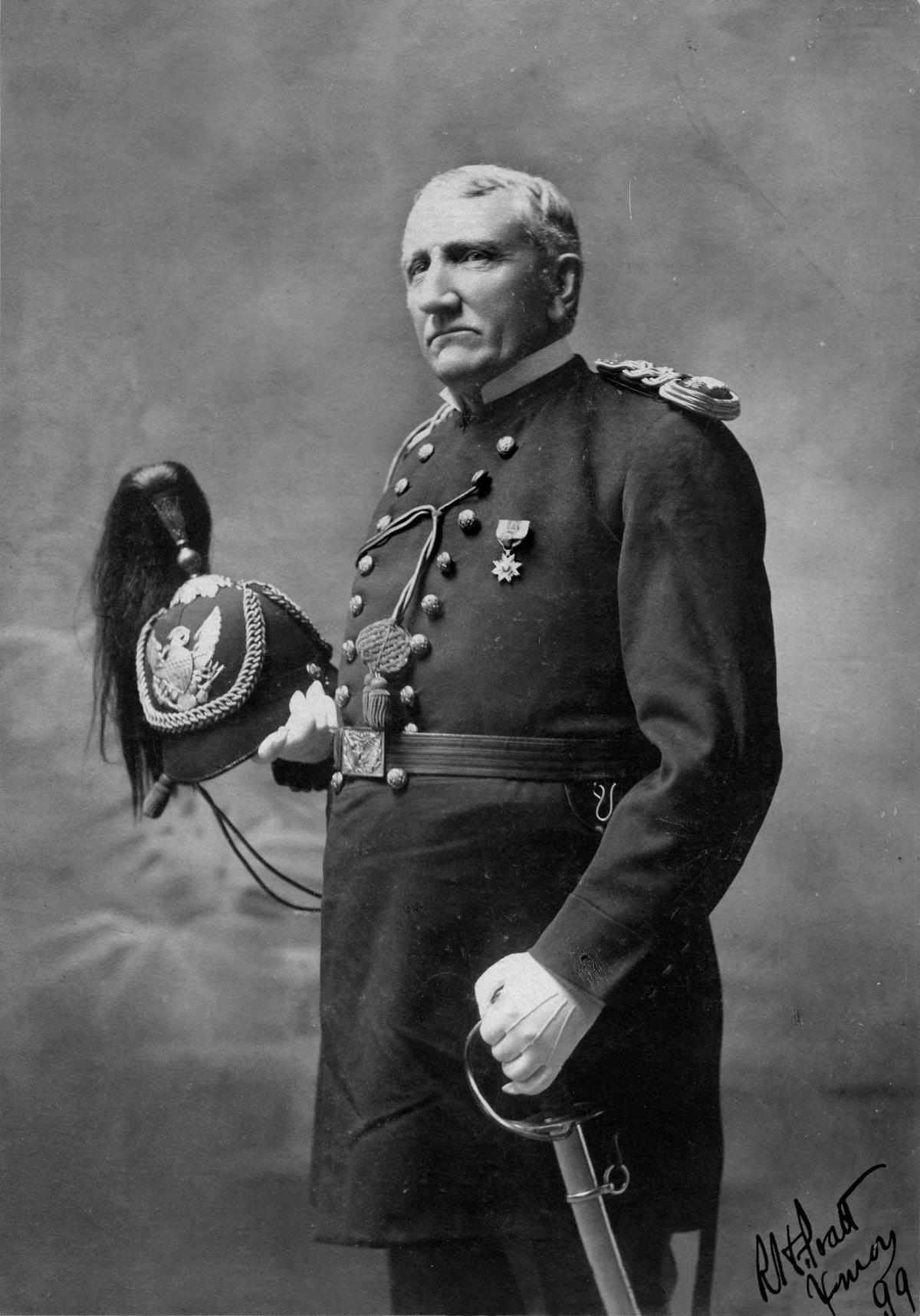
words and deeds of Colonel Richard Henry Pratt, the Indian’s school’s founder
and chief propagandist.
The
school’s history fascinates me. In my
own research on the history of the Onondaga Nation, I have followed those who
attended the school through its records and reconstructed their lives as much
as the evidence permits. Like my
students, I make use of the digitized school records available at the Carlisle
Indian School Digital Resource Center.
One
thing I have not done is visit Yale’s Beinecke Library, where Pratt’s personal papers are housed. I have read his published writings, and in
them I find it difficult to detect any self-doubt, any questioning, of the
school’s fundamental premise: to best prepare Native American men and women for
citizenship and participation in the American body politic and economic system,
they must be removed from their homes and educated away from the
reservation.
Pratt was quite explicit about
this. The attachments of home generated
a powerful pull. Even boarding schools located on reservations could not work,
Pratt believed, because the sights, sounds, and scents of home provided a
powerful distraction. Best to remove the
students entirely. Speaking to a gathering
of Baptist ministers, Pratt said that “In Indian Civilization, I am a Baptist,
because I believe in immersing the Indians in our civilization and when we get
them under holding them until they are thoroughly soaked.” Because of his tendency to make statements
like these, scholars and the interested public describe the boarding schools as
brutal institutions. Pratt, they say,
acted with genocidal intent. He said,
indeed, that he hoped to “kill the Indian,” and save the man.
There is no doubt that there was
cruelty, brutality and short-sightedness.
There was coldness and callousness and inattention. Some students resisted. One of my students is working on a paper I
very much look forward to reading on firestarters, girls who set fires at
Carlisle and were expelled. Yet the
graveyard at the school contains the bodies of students who died far from home,
the victims, in Calvin Luther Martin’s phrase, of “blundering goodwill.” Efforts are underway to repatriate some of
these children, to return their bodies to their homelands. There are stories at
Carlisle to melt a historian’s heart.
At the same time, we historians
generally find simple morality tales uninteresting, because the past is always
more complicated. For example, I
recently reviewed a book by a historian named Keith Burich about the Thomas Indian School in New York, located on the Seneca Nation’s
Cattaraugus Reservation. Thomas was open for a century, from the 1850s to the
1950s. There are people alive today who
attended Thomas. The consequences of the
school’s treatment of Iroquois children, Burich writes, were horrific. The school’s policies and its approach
created in the students “a state of dependency and perpetual childhood that
guaranteed the students’ inability to adjust to life outside the institution.” Arriving at Thomas from families broken by
the forces of colonialism, “the same ‘pathologies’ that landed them at
Thomas—poverty, divorce, alcohol abuse, and domestic violence—followed them
when they left, ensuring that there would be future generations of Thomas students.”
Yet the evidence that Burich provides
suggests that he may not be attuned enough to the school’s ambivalent legacy.
The Mohawk Andrew Herne, disappointed by the public school opportunities at
home, hitchhiked to Thomas to enroll.
Burich points out that for many of the children, “Thomas provided a far
better educational opportunity than the public schools on or near their
respective reservations.” The Seneca
Arthur Nephew remembered the school as the best part of his life. “We were taken care of, we had shelter, we
had food, we had medical care, we had all kinds of recreation, and all kind of
trades we could learn,” he wrote. Thus it appears that Burich’s claim that the
school left children “unable to survive outside an institutional setting where every
aspect of their lives was dictated and controlled by the institution” is an
oversimplification at best, that underestimates the resilience and toughness of
Iroquois families and children. His claim that the school left its students
shattered in self-esteem and “unable to adjust to life after Thomas” seems
inadequately supported and, indeed, contradicted by some of the evidence he
presents. There was suffering to be sure, as Iroquois people have pointed
out. But there was more to Thomas than
that.
And Carlisle, too.
Pratt left Carlisle in 1904. Robert
Utley, who wrote the introduction to the University of Oklahoma Press edition
of Pratt’s From
Battlefield to Classroom
said that the school’s founder “retired.”
Technically that is correct. But Pratt left under duress, and a number
of powerful critics of the entire off-reservation boarding school enterprise
had emerged in the early twentieth century, most notably Francis Leupp, who served
as Teddy Roosevelt’s Commissioner of Indian Affairs.
Utley said that Pratt retired to
Rochester, New York, where I live. Other sources say the same thing. The
Rochester Public Library has done an incredible job of digitizing its local
history resources, so I set off in search of the retired Colonel Pratt. His name does not appear in any of the
published city directories, nor does that of his wife or any
of his children. I asked friends for
help, and I followed some other leads, but still no luck. Where was Colonel
Pratt? I did not know, and I worried that Utley might have been wrong.
I am fairly certain that if I had
limitless time and limitless resources, and no family and no need to do things
other than history, I could have made the trip over to New Haven. I bet there are answers there about Pratt’s
time in Rochester. But I don’t, and I
couldn’t, so I didn’t, and the staff at Yale did not answer my email queries.
I poked around a bit more and I
found what I was looking for in the newspapers.
Pratt had daughters, and they married. It did not take long to figure
out that his son-in-law Edward M. Hawkins lived in Rochester, on Highland
Avenue, a five-minute bicycle ride from where I live (I know. I tried it).
I am not sure how much time Pratt
spent in town, but he was in Rochester often. In retirement he spoke out
against the Indian Bureau, and the “ethnologists” whose work informed the
critiques of Pratt’s program for Carlisle.
Long after off-reservation boarding schools had fallen out of favor, he
continued to champion the entire effort as worthwhile and significant. He was
proud of Carlisle, and he seems to have kept in touch with former students and
even attended a reunion of former Carlisle students in 1913 in Akron, New York,
near the Tonawanda Seneca Nation.
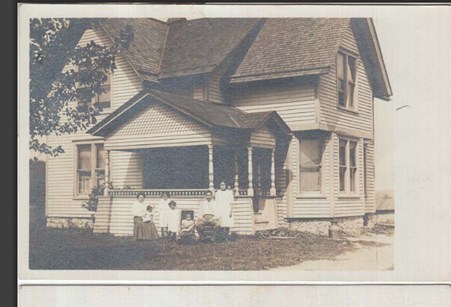
Just a couple of dozen Tonawandas attended Carlisle. More than three hundred went to Thomas. Of those who went to Carlisle their experiences seem to have mirrored those of other Haudenosaunee people who attended the boarding school. Some appreciated their time at the school and expressed their gratitude to Pratt and to his successors as superintendent. Daisie Doctor Snyder, for instance, in 1907 expressed her regret that she would not be able to return to Carlisle for that year’s commencement ceremony. She missed “Dear Old Carlisle,” and wrote that “I only hope this Commencement will surpass all others, and that the out going class are prepared to stand the hard knocks of the cold world and to fight a hard battle for the right and also to still uplift our race. Rosalie Doctor Poodry invited the administrators at Carlisle to visit her at her handsome, two-story frame house in Basom, New York, and said that she would love to send her children to Carlisle someday. She sent the superintendent a postcard,
with a photograph of the house. The baby, a little girl named Marion, had
died a few weeks before she mailed the card, and Rosalie understandably still
was broken up. As much as she looked
forward to reading the school newspapers that she received in the mail, she
asked that they not say anything about her dead child.
Rosalie
Doctor Poodry’s letter was intimate and revealing. Other Tonawandas told the
school what they were up to, but did not share too much more than that. Hiram Moses was farming forty-five acres of
reservation land, and working when needed on the state highway. He attended the Presbyterian church on the
reservation. Joseph Poodry lived in Buffalo. He worked at the Pierce Arrow plant there,
and managed the Seneca Indian baseball team.
Others
said little about their time at the school, chose not to keep in touch, and did
not reply to the school’s questionnaires.
Many of them returned to the reservation and lived lives that would have
differed little from what they might have experienced had they never gone away
to school Some succeeded, and attributed
their successes to what they learned at Carlisle. Others did not do so well. Perhaps their hardships stemmed from the
dislocation caused by the years they spent away, or the difficulties they faced
in reintegrating themselves into the community after they returned.
Yet
despite the boarding school experience, the criticism of their culture they
routinely listened to there, and their years away from home, Tonawanda remained
an indigenous homeland. Despite the
efforts of the state to break up their lands and dispossess them, a story the
Tonawandas knew all too well, they remained native peoples. And they asserted this, publicly and
frequently, in ways that Pratt could not have missed.
Colonel
Pratt is one of the villains in Native American history. He spoke of eliminating Native American
cultures, and carried out his policies, for a time, with the enthusiastic
support of American officials. But if he really believed the erasure of Indian
identity was an attainable goal, he could not have missed the reality that he
failed spectacularly. His legacy is
ambiguous, and defies easy categorization.
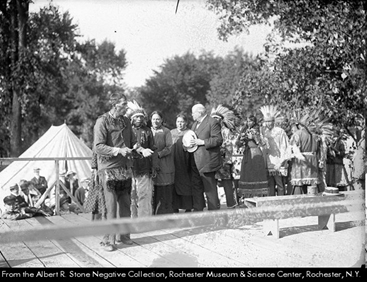
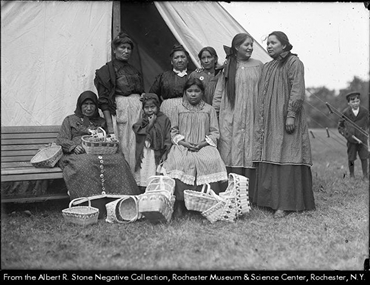
Every year, Tonawanda Senecas came into Rochester. I am pretty certain they were in town when Pratt was there, too. The Tonawandas went to Maplewood Park, one of the city’s popular gathering places. They set up a stage. They advertised their gathering in the papers, and the press attended and described what they saw. The Tonawandas routinely adopted and granted names to powerful white men, like Mayor Hiram Edgerton, in this photo housed in the collections of the Rochester Museum and Science Center. And as white Rochesterians gathered, and watched Indian
teams play baseball and demonstrate their lacrosse skills, and as they purchased the baskets and other items of craft produced by Tonawanda Seneca women, the Tonawandas danced.
The men wore ribbon shirts and their gustoweh. Women wore their calico dresses, their moccasins. They dressed in the traditional attire of Haudenosaunee people, with a few Plains-style feather headdresses thrown in for good measure. I like to think that Pratt, if he was in town, would have attended. He liked native peoples, after all, and liked to meet with former students. And in front of him, and white audiences who easily imagined that native peoples were part of the past, and who supported the allotment of their lands, the dissolution of aboriginal culture, and the erasure of their language, they gathered in the center of Rochester. They danced, and they proceeded to proclaim that they were still here, and that here they would remain. They were supposed to have been gone long before. If warfare or the dispossession of the nineteenth century didn’t get them, assuredly they would disappear as the century progressed. But here they were, in the middle of an important industrial city, announcing to all who cared to watch that anything the forces of colonialism might throw at them, they would survive as native peoples.
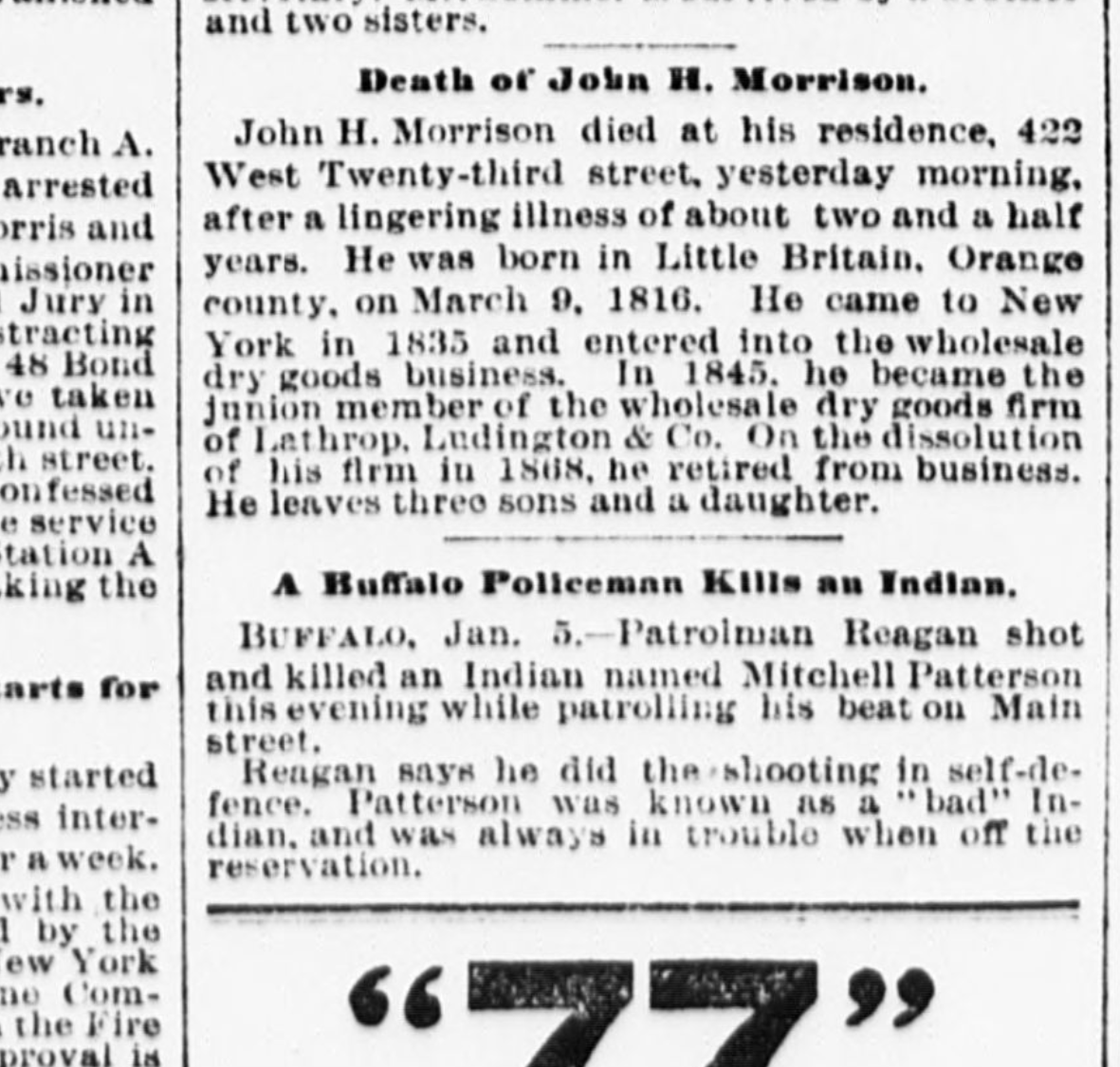
He’s a “Good Injun Now.” That’s how a headline in the Buffalo Morning News announced the death of Mitchell Patterson, a Tuscarora Indian whose life of violent crime came to a close on Lock Street in Buffalo in January of 1895.
That headline writer was riffing on the famous line attributed to the American military leader Philip Sheridan, perhaps the most famous thing Sheridan ever said: “The only good Indian is a dead Indian.” It was a joke that headline writers liked.
I have put a lot of time recently into my current research project, a history of the Onondaga Nation. I am at that stage of the research when I am collecting and reading newspaper articles. Variations on this theme appear quite often. Two decades after Patterson’s death, the Brooklyn Citizen published a story under the headline, “A Good Indian–And Alive,” chronicling the surprising career of Charles Doxon, an Onondaga who attended the Hampton Institute, and became a regular lecturer for the Six Nations Temperance League and on matters religious.
Newspapers in the late nineteenth and early twentieth centuries contain a wealth of information about the lives of native people. They provide a window into the events that impacted these communities, and through a glass darkly, into the lives of native peoples as they made their way through a world that at best wanted them to disappear. Newspapers have allowed me, for instance, to reconstruct the lives of Onondagas who attended the Carlisle Indian Industrial School and other Native American boarding schools: those who succeeded as farmers, or as housewives, or as leaders of a native nation. We meet football players and musicians in the newspapers, but also Onondaga bootleggers and outlaws, including a man who took his own life after shooting a Madison County sheriff’s deputy.
They are rich sources, and indispensable. I could not do the work I need to do without them. I subscribe to newspapers.com, use a couple of the newspaper databases to which my college library provides access, and I make frequent use of the quirky Fulton History website, which contains a trove of information.
They are flawed sources, too. They include an enormous amount of racist and stereotyped information about native peoples. They report on examples of what their editors still considered savagery, and they told stories of crime and dysfunction in native communities. Besides stories chronicling the resistance of native peoples to the forces of settler colonialism, they carry stories of Onondagas shooting their guns at the moon during an eclipse, and resting satisfied that their actions returned the world to light, of “Pagan” ceremonies, and of superstitious dancing and despair. Much that took place in these communities, I am certain, struck editors as entirely uninteresting and unworthy of even a single column inch. Much, I am certain, has been missed or left out.
Still, I had to check. And reading newspapers can lead one down a rabbit hole, as you follow a lead you did not expect through its challenging twists and turns. It was on one of these journeys that I encountered Mitchell Patterson.
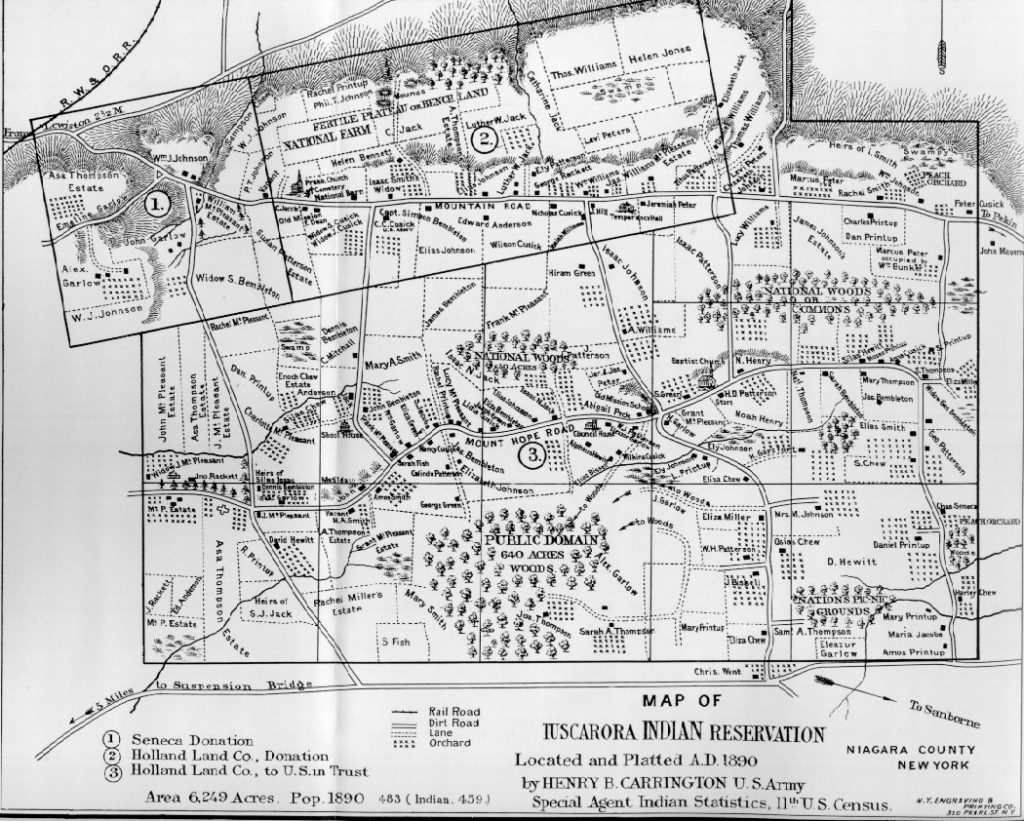
In June of 1880, Patterson attacked “a young white woman” in Lewiston, Niagara County, not far from the Tuscarora Reservation in western New York. He “cut her eyes out, split her ears, and otherwise disfigured her.” Other accounts disagreed about the identity of the victim, indicating that Patterson’s wrath fell upon his aunt Nancy, who told him that he could not come home drunk any more. Patterson got angry, one Tuscarora neighbor recalled, and, in the Indian-speak newspapers loved to utilize, “he go sharpen stick and stab her eyes out.” Patterson fled across the Niagara River into Canada. Officials found him in a Brantford jail, not far from the Six Nations Reserve in Ontario, due to be released in October on some unrelated charge. He was somehow arrested in New York, and sentenced to ten years in prison for the violent attack.
He must have been released early. Patterson shows up in the papers again in April 1889. The Niagara County grand jury indicted Patterson for “shooting at an officer on the Tuscarora Reservation” the previous February. Four years later the district attorney in Lewiston charged him with shooting “Zacharia Green on the reservation.” And just seven months after that, a Niagara County court found Patterson guilty of selling alcohol to Indians on the reservation. He was imprisoned in the county jail for two months and fined twenty-five dollars.
He did his time. The Buffalo Commercial reported on March 28, 1894, that “the sentence of Mitchell Patterson, the bad man from the Tuscarora reservation, expired to-day, and a warrant was waiting for him the moment he was released.” The Commercial pointed out that Patterson “is a bad man and Indian that has made the marshal no end of trouble, and when he gets in this time it is to be hoped he will stay.” The charge, this time, was the beating of Lafayette Printup, in Sanborn, the previous November, 1893.
Patterson disappeared from the papers for a few months. He appeared again in November of 1894. Perhaps he had been in jail, but it is not possible to tell from the newspapers. Wherever he had been, that fall day Patterson went to the home of his neighbor, a “good Indian” named Isaac Clause. Patterson called for Clause to come out, and as soon as his neighbor appeared, “Patterson knocked him down and kicked him in the head.” Then he forced Clause to come with him, and “marched him to the village store and made him treat to tobacco, afterward robbing him of all his money.” Patterson “pounded and robbed” Clause, said one paper, “leaving him in a semi-conscious state in the road.” Clause’s relatives feared that he “is so badly injured he may die.”
Just two months later, Buffalo police officer Daniel Reagan began to hear about an Indian walking along Commercial Street in the city who had made a number of “indecent remarks” to a couple who was out for the evening. Officer Reagan found the suspect–it was Patterson–and he began to follow. Patterson turned on to Evans Street and picked up his pace. Reagan caught up, grabbed the much larger Patterson by the collar with one hand, and pulled his night stick out with the other. Patterson yelled, “Let go me, you son of a gun!” He then pulled out a pistol, pointed it at Reagan’s head, and then turned and ran without firing a shot.
Officer Reagan pursued. Patterson ran in the middle of the street, Reagan on the sidewalk. An “iron framework” ran between them, that “separated the drive way on the bridge from the footway for pedestrians.” At one point, Patterson turned and fired a round. He missed. Reagan drew his own weapon and continued to pursue.
A couple of seconds later, Patterson turned onto Lock Street, “a narrow, unlighted thoroughfare.” Reagan “could see the tall form of the Indian running along the west sidewalk of Lock Street,” about fifty feet ahead. Patterson fired again, and this time Reagan returned fire. “There came a fusilade of shots, which were heard from blocks around.”
Reagan hit Patterson three times. He and some witnesses carried the wounded man into the light of a saloon. They called for an ambulance, which rushed Patterson to the hospital. The surgeons, the newspaper reported, “have little hope of the man’s recovery, as a great hemorrhage resulted from the perforation of the liver, and the shock to the system was intense.”
And, then, the only description of Patterson. Six feet, two inches tall, weighing close to 250 pounds. He was “about 40 years old,” and “has the face of the typical reservation Indian,” with “a sparse mustache and goatee.” Patterson was “profusely tattooed.”
On his right arm is a figure of Mitchell, the pugilist, and on his left the word ‘Wisdom,’ in large letters. On the left leg is another potrait of Mitchell, for whom his namesake seems to have a great admiration.
In the hospital, Patterson gave an “ante-mortem statement” to the coroner.
My name is Mitchell Patterson. I live on the Tonawanda Reservation. I was walking on Canal Street and a policeman shot me. Another Indian was with me by the name of Frank Wooley, who had a gun and shot at the policeman. I had no gun. The other Indian had a gun. I sail on the lakes and come to Buffalo quite often. He had two guns and he gave one to me I shot once but did not hit anybody.
This was certainly a confused, and confusing account, that does not square at all with what Officer Reagan reported. Evidently the coroner did not find it satisfactory, either, because he visited the hospital again the next morning to take an additional statement from Patterson, who must have been in miserable shape. I include it here in its entirety:
My name is Mitchell Patterson. I live on the Tuscarora Reservation, near Lewistown. I am thirty-five years of age and am a single man. I came to Buffalo from Keating Summit, where I was working in the lumber regions, about a week ago. I have been boarding with a man named Walters, on Main Street. I was walking on Canal Street about 8 o’clcok last night when a policeman came up to me and said: ‘You big Injun; want you.’ He put his hand on my collar. I jerked away and ran over the Evans Street bridge, and there, I think, I shot at the policeman once. I ran into Lock Street and shot at him again, and he shot at me and hit me.
I carried a revolver one week, which I bought on Canal Street. I had two extra cartridges in my pocket. I do not remember if the policeman told me not to shoot or not. I was drunk and do not remember everything. I might have shot four or five times. I do not remember. I served three years in Auburn [a state penitentiary] for fighting another Indian. I was sentenced at Lockport. I kicked the life out of him. I have been out of prison for two or three years.
A more detailed account, indeed, but one that contradicts much that appeared in the first statement, taken the night of the shooting. The coroner thought the second statement was more accurate and thorough, but still not complete. Patterson was dying of his wounds, answering questions after surgery. I can hear in his narrative, I think, the coroner’s questions, Patterson’s short answers, and the coroner’s efforts to fashion this into a narrative.
Patterson died at 3:00pm, roughly eighteen hours after Officer Reagan shot him. In the days that followed his death, Buffalo newspapers continued to flesh out Patterson’s story, reporting on the bits of information they recovered from Tuscaroras who visited Buffalo. They told the story of a “heap bad Injun,” to be sure, who seemed to have terrified his native neighbors in several native communities, as well as the police who always approached him armed because they knew Patterson was ready for a fight. Violence defined Patterson, according to the newspaper reports.
Patterson was a life-long criminal with a violent temper, and he spent more than half his adult life behind bars. But these stories, perhaps in ways the editors did not intend, paint a more complex picture of a Native American man who traveled through Haudenosaunee communities across a broader Iroquoia. He spent time at Onondaga, at Tonawanda, and at the Six Nations Reserve in Ontario. He worked on Great Lakes Steamers, cut timber in Ontario, Michigan, and New York, and squeezed a few bucks here and there by selling alcohol to his neighbors at home on the Tuscarora Reservation.
He had family connections. He beat Noah Patterson, his grandfather, to defend his grandmother from a wife beater. After the latest attack from her husband, she “got mad and look for a man big ’nuff to lick Noah.” Mitchell Patterson fit the bill. Three Tuscaroras visited Mitchell Patterson in the hospital, according to one story more to satisfy their curiosity than express their sympathy. They said little, according to a white witness, but that does not mean they did not care. Mitchell Patterson’s mother–she is unnamed in the newspapers, and identified only as “Old Mrs. Patterson”–arrived at the coroner’s office two days after her son’s death. The newspaper said “there was not a trace of grief upon her face.” She wanted to see her son’s body, and carry it home for burial. The coroner guided her in. “She viewed the body for a few moments,” the newspaper said, and “uttered a few words in the dialect of her tribe.” Her wagon was not large enough to carry the remains, so “it was accordingly arranged to place the body in a rough box and ship it to Sanborn for burial in the Indian cemetery there on the Tuscarora Reservation.”
Perhaps “Old Mrs. Patterson” showed no grief. But I am not sure that is true. One of the many stereotypes about native peoples was their supposed “stolid” nature. Maybe the coroner saw what he wanted to see. Perhaps the grief she felt was real, significant, and deep, expressed in a few quiet words in the Tuscarora language, by a mother who wanted to take her wayward son home for burial.
Newspapers provide a remarkable and important source for reconstructing Native American life. But we must remember that white newspaper editors and non-Indian journalists made decisions about their paper’s content, and they did not often ask native peoples what they thought. Indians appear in the newspapers when the white people in charge wanted them to appear, when they did something that they felt might interest their white readers. This might include instances of the continuing “savagery” and “paganism” of Haudenosaunee peoples. Native peoples appear frequently in the newspapers as athletes and criminals, too. Boarding school students who did good, and boarding school students who met tragic ends, appear in the papers. There are also stories of Native American organization and institution building, protest, and activism: instances when native peoples worked together to protect their communities in ways that non-natives might perceive as threats to their own lives, liberty, and property.
In between, in the gaps, silences, and the behaviors and actions described by newspapermen but not understood, there are fleeting images of a world that historians of Native Americans struggle to recover. Mitchell Patterson may have been a criminal, a sadist, a “Bad Injun,” and a source of terror to those who knew him. But he also moved through indigenous communities throughout western New York and Ontario, communities with stories that have not always been told with the richness they deserve and a careful and critical analysis of the sources will allow.
This past June a congressman from Washington state named Denny Heck introduced the “Remove the Stain Act,” which would rescind “each Medal of Honor awarded for acts at Wounded Knee Creek on December 29, 1890.” This may be old news for many of you, but I have wanted to write about the bill for some time. Deb Haaland and a Republican from California named Paul Cook co-introduced the measure, which was promptly referred to the Committee on Armed Services, where it currently sits. The fate of the bill is uncertain.
A friend who is active in the organization Veterans for Peace told me about the bill, which his organization supports. The Democratic presidential candidates Julian Castro, Elizabeth Warren, Kamala Harris, Bernie Sanders, John Delaney, and Marianne Williamson all have expressed their support. Each has joined in calling upon Congress to rescind the nation’s highest military honor from twenty cavalrymen who took part in the massacre at Wounded Knee.
Wounded Knee was one of those defining moments in the history of the American West, central to so many historians’ understandings of the Plains Wars and the place of native nations in the United States. Think back to Dee Brown’s Bury My Heart at Wounded Knee, a flawed book which nonetheless influenced me greatly in my development as a historian, to the much more recent book by Heather Cox Richardson entitled simply Wounded Knee. Richardson’s book is well worth your time.
I tell the story of Wounded Knee in Native America. It is a story of native peoples searching for answers as they tried to adjust to life under the federal policy of concentration, and the brutal realities of the reservation system. Far out in the west, a Paiute shaman named Wovoka began to preach a message that combined Christian themes with nativist principles that answered their concerns. Wovoka, a messiah, had received visions, and he promised his followers peace if they lived honest lives and performed the Ghost Dance. He called for a return to ritual. The Ghost dance offered a way to restore balance to the world.
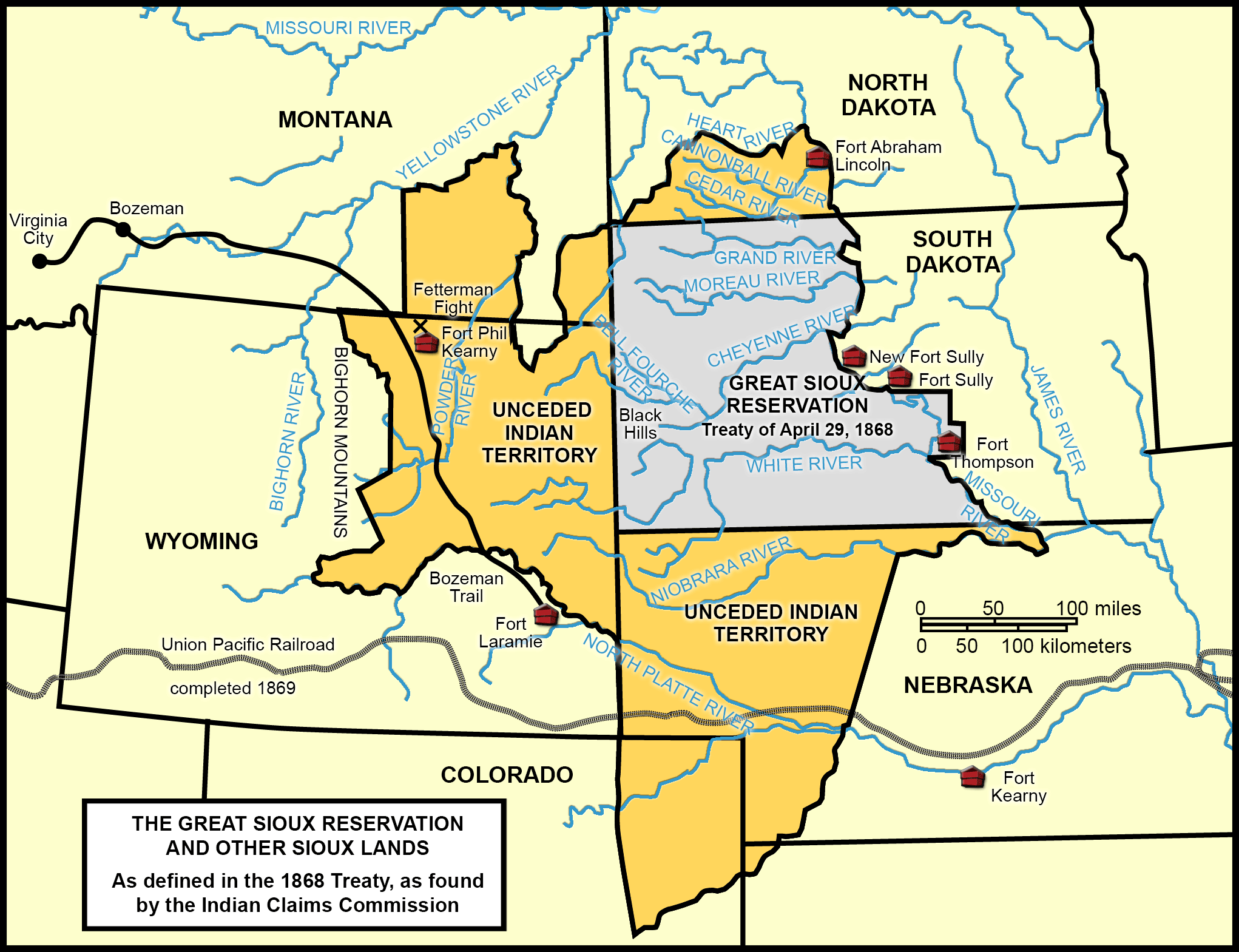
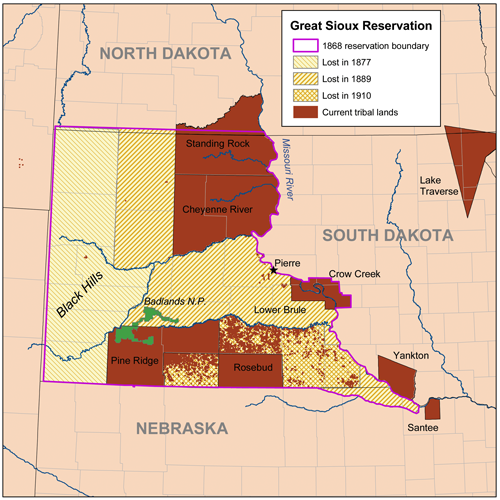
Word of the new religion spread rapidly. Native peoples sent emissaries to learn from Wovoka. Some rejected his teachings. Others found in them important truths, and as they adopted its central ritual, they transformed and altered elements of the original message. Lakotas, for instance, who returned from visiting Wovoka in March of 1890, taught that performing the Ghost Dance would bring back the buffalo and cause white people to disappear. The Lakotas had many grievances. Hunger constantly hounded reservation Indians. The government broke up the Great Sioux Reservation in 1889, reducing the lands held by the Lakota and severing the binds connecting communities together.
Sensing discontent, federal troops remained a heavy presence in Lakota country. The Lakota believers wore “Ghost Shirts” that some believed would stop bullets, and this made the federal authorities nervous. They worried that Sitting Bull, the great Lakota leader, would join the movement. When American authorities and the newly-constituted tribal police tried to prevent this, Sitting Bull resisted arrest. He and seven others died in a gunfight on 15 December 1890. It is hard to overestimate how crushing his death must have been.
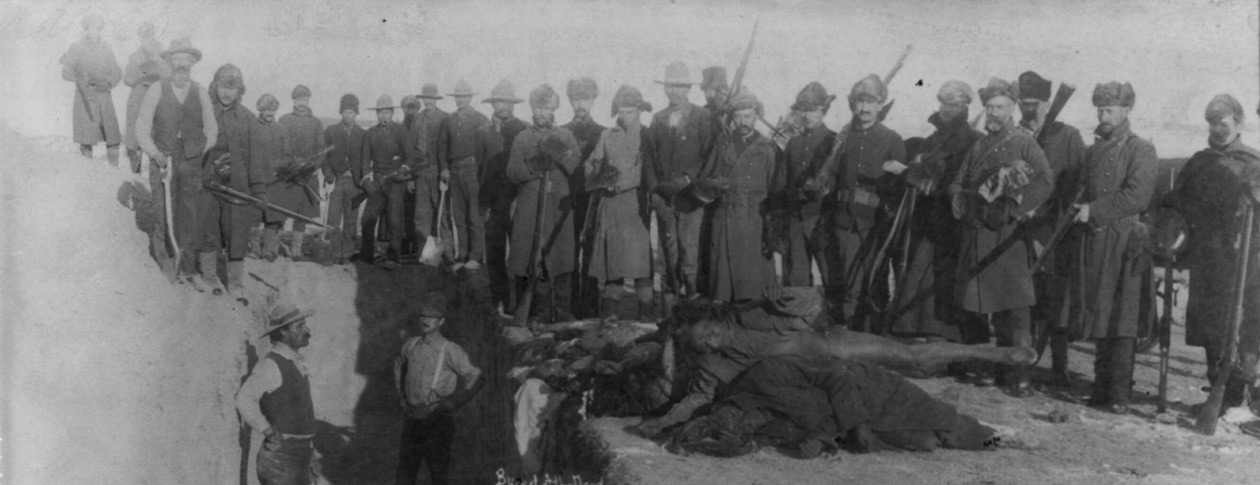
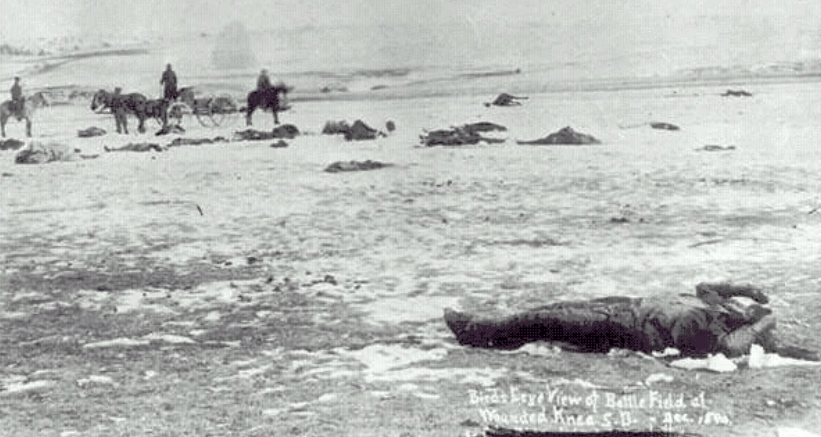
Another group of Ghost Dancers, led by Bigfoot, and consisting of many women and children, fled out onto South Dakota’s badlands. The government sent nine thousand troops to South Dakota, and five thousand of these to Pine Ridge. Fully a third of the United States Army, in its largest mobilization since the end of the Civil War, took up positions to suppress this peaceful protest. Federal troops surrounded them at Wounded Knee Creek in advance of moving them back to the Pine Ridge Agency. When the cavalrymen went to disarm Bigfoot’s followers, a shot was fired, perhaps accidentally, when a deaf young man refused to surrender his weapon. The federal troops opened up with rifles and artillery. 146 Indians died, including forty-four women and 18 children. It was the last military engagement between native peoples and American soldiers on the Plains, and the Wounded Knee massacre wiped out a religious movement among the Lakota Sioux that offered them hope for the future and a means for making sense of their life on reservations.
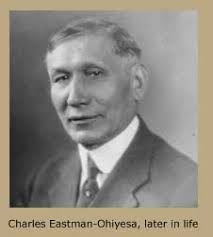
Charles Eastman, the newly-appointed doctor at the Pine Ridge Agency in South Dakota, learned of the massacre at Wounded Knee when the wounded started coming in. Most were women and children. “Many,” he wrote, “were frightfully torn by pieces of shell, and the suffering was terrible.” A blizzard blew in, and it took Eastman a couple of days before he could return to the battlefield. The first physician to arrive at that frozen and bloody ground, the experience affected Eastman deeply.
He saw the mangled bodies, and did what he could for the small number who had miraculously survived the federal artillery and gunfire. When he reached the site of Big Foot’s camp, he “saw the frozen bodies of men who had been in council and who were almost as helpless as the women and babes when the deadly fire began.” Eastman struggled to keep his composure. All about him he heard the “excitement and grief of my Indian companions, nearly every one of whom was crying aloud or singing his death song.” He found a few survivors, all babies. All were adopted by white people.
The massacre at Wounded Knee received condemnation at the time it occurred. Of the 350 or more native peoples who died, fully two-thirds were women and children. General Nelson A. Miles, he who ran down Chief Joseph’s followers just shy of the Canadian Line more than a decade before, wrote in 1891 that “I have never heard of a more brutal, cold-blooded massacre than that at Wounded Knee.”
When and if the “Remove the Stain” becomes law, the Medals of Honor will be rescinded, and the names of the twenty recipients will be removed from the Medal of Honor Roll. No family members will be required to return their ancestors’ medals to Congress, and the bill states that it “shall not be construed to deny any benefit from the federal government,” but its intent is clear. A symbolic act to be sure, passage of the bill will offer an important statement that in this instance Congress does not consider the slaughter of native peoples in any way to be meritorious, and that the stories told by the government about Wounded Knee are wrong.
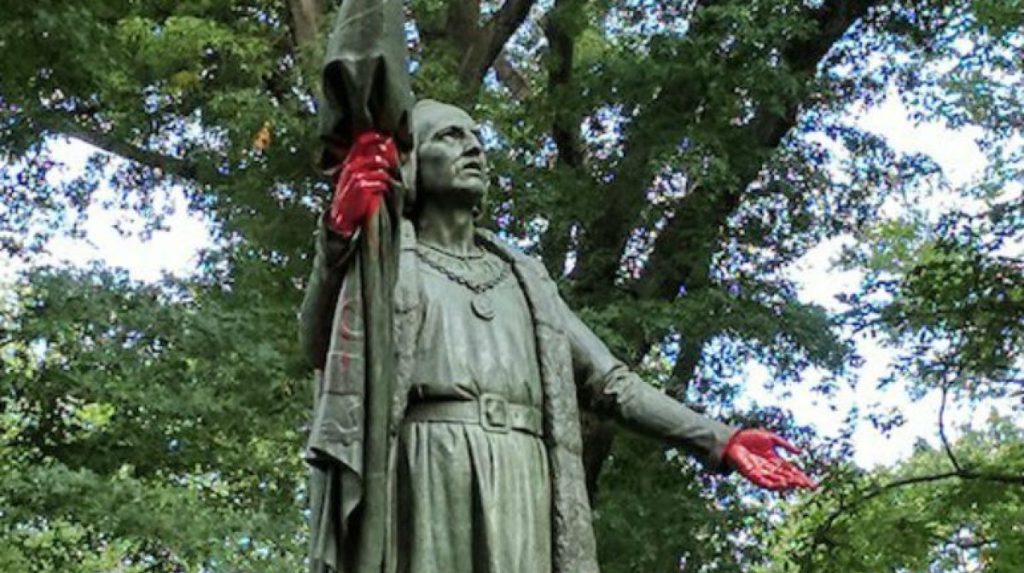
It is worth talking about this bill in your classes, for it bears much in common with other, better known, efforts to revise American history. Activists have taken on Columbus Day and are replacing it with Indigenous Peoples’ Day, and they have commenced a powerful movement to remove racist commemorations of the Confederacy. They call for renaming buildings dedicated to slave owners and they are trying, I hear so often, to fix other places and spaces with names deemed offensive. The reaction of the right has been predictable. You heard it if you listened to the President’s speech before the United Nations General Assembly several weeks ago. He singled out academics who have launched an all-out assault on American values.
I think it is important to talk about all of this in our history classes. In places we have seen vandalism and destruction, but I would suggest that part of what we are seeing is a desire to fix a story that is broken, to revise and edit and set things right. What some might see as wanton destruction, others might see as an attempt to revise and reinterpret. It is raucous and rude, but it has provoked vital discussions.
Occasionally I will hear one public figure or another denounce “revisionist” history, or historians whose work they dismiss as “politically correct.” You can believe these people if you want to, but if that’s your choice, it is only with a poor understanding of what it is in fact that we historians do. Maybe we need to do a better job of explaining how we work to the public. We are the people, after all, who demand to see the evidence. We are the ones who relish the opportunity to hunt relentlessly for every scrap of relevant information. Never underestimate the tenacity of a historian determined to find what you might prefer to remain hidden. If we do not know where to look, we will figure it out, and we do not care what names you call us. We will debate you and insist on engaging you and we will make sure you understand that we are not in the business of repeating comforting myths or making you feel good about yourself. We look closely at the evidence. We keep receipts. Heck’s bill is a response to calls to set our stories right. It shows that many Americans believe that the time for an accounting is long past due.
If we replace
Columbus Day with Indigenous Peoples’ Day, are we guilty of engaging in
partisan “revisionist” history? Are we
doing something that is unsavory, disrespectful, or mean? American history, of course, is being revised
all the time in scholarship, but also in the streets, in public spaces, and at
sites of commemoration. A Christopher Columbus statue in Central Park with
bloody hands: like a torn-down Confederate monument, or the Oñate monument’s
missing foot, these acts of vandalism are, at some level, commentaries and
rebuttals to interpretations of the American past that individuals and groups
find objectionable.
Several years ago I had an opportunity to speak about Indigenous Peoples’ Day at Lasell College, just outside of Boston. The students had been asked to read the opening sections of Howard Zinn’s People’s History of the United States and Larry Schweikart and Michael Allen’s Patriot’s History of the United States.As I told the students at Lasell, I am a historian. I teach and write about Native American history and Early American history, so as part of my daily job I try to keep abreast of the scholarship on Columbus, and what historians have been saying about the so-called “Columbian Encounter” or “Columbian Exchange,” or, more generally, “First Contact” between natives and newcomers. I explained that scholars who work in this field do not generally bother with Zinn’s People’s History or Schweikart’s Patriot’s History. Not when we are doing our own research and teaching. There is so much better material written by historians who have actually gone back to the primary sources. Both of the books are highly partisan. Both allowed their politics to shape the answers to the questions they posed, a cardinal sin for historians. Both are simplistic, at times and in places poorly tuned to ambivalence and nuance, unwilling to explore fully the exceptions to their rules. But both of them, as well, have been very widely read.
Zinn’s People’s History is on that short list of deeply flawed books that
has been, on the basis of its strengths, highly influential among American
historians in teaching them that the history of ordinary working Americans
matters. Zinn, of course, wrote with an agenda.
That agenda is clear and present in the book’s title. He wanted to tell the story of ordinary
Americans in the making of their nation’s history. He wanted to shift the story away from the
elites, where it had been focused for so long, towards working people, women,
the enslaved, and Native Americans. His
goal was to write an inclusive history that challenged those comforting myths
that have for so long dominated that narrative:
a democratic history that was anything but celebratory. He wanted to
show that what America as a nation has accomplished came at the expense of
large numbers of people; and because the contributions of those people had
traditionally been neglected, that those in power sometimes, indeed quite
often, acted in their own interests and used their power to justify occasional
acts of extraordinary cruelty, exploitation, and violence. Love of one’s country cannot occur without an
honest look at the past. Ordinary people
were not merely acted upon. Their
resistance and their protests and their movements shaped much of American
history. Ordinary, non-elite people were
forces in history.
These are laudable goals, and Zinn
constructed at times a powerful story that could carry his readers along,
despite his occasional tendency to reason beyond what his evidence would
bear. Some of his shots misfired, but it
is difficult still to overstate how refreshing and liberating this approach to
the nation’s past was, certainly to my own generation of historians.
Schweikart and Allen, on the other
hand, wrote with chips on their shoulders.
They call out Zinn for his “Marxism” in their opening paragraph, even if
Zinn said different things about his ideology at different points in his
career, and they then proceed to bash one straw man after another in their
attempt to protect the nation from “academics” who too often say, according to
Schweikert and Allen, “my country, always wrong.”
You hear this a lot in my line of work. I think back to President Trump’s unhinged address at the United Nations General Assembly in 2019. The media and academic institutions, he said, “push flat out assaults on our histories, traditions, and values.” College professors, even though they cannot persuade their students to do the reading, or put away their cell phones, somehow can indoctrinate them with socialist principles. The President here is repeating a bald-faced lie, a willful and complete mischaracterization of the historical profession carried out for partisan purposes that is so irresponsible it is going to get someone hurt. If for Zinn, the purpose of history is to look critically at the American past, to question long-cherished truths, and dispel pernicious myths, for Schweikart and Allen, its purpose is to instill patriotism. Their goal is to protect the stories that have, in their view, been unjustly assailed by Zinn, and by a generation of historians since Zinn first wrote.
This sort of logic can have devastating consequences for public policy. If you saw the Pew Research poll in August of 2019, the results are troubling. According to the data, the percentage of Republicans who see value in a college education fell from 53% in 2012 to just 23% in the most recent survey. Nearly 80% of Republicans believe higher education is headed in the wrong direction because of professors bringing their political and social views into the classroom. Republicans are far more likely than Democrats (73% to 56%) to assert that the problem of students not receiving skills they need to succeed in the workplace is a major reason why higher education is headed in the wrong direction. And three-quarters of Republican respondents felt that rampant political correctness is a significant problem in American higher education.
So A Patriot’s History, they say.
That’s what is needed. But what’s
the opposite of a Patriot? A traitor, someone who is ashamed of their country,
or disloyal, or dangerous. You have seen
in recent months where rhetoric like this leads. From “Send her Back!” to “Blood and Soil!” to
caged children, the dead in a Texas Walmart killed by an armed racist who hated
Mexicans, this sort of rhetoric can escalate quickly and violently.
History is such a fraught subject—it
always has been, but now, especially so. It matters. And the work historians do
is often implicated in assaults on what makes this country great, a menace to
what the Boston Review called the
“fragile patriotism of the American Conservative.” If only we would stop
harping on the bad stuff.
So let me give you a definition: for
those of us who are historians for our living, history is the study of
continuity and change, measured across time and space, in peoples,
institutions, and cultures. It is not a science, but it is a discipline. When we do our work properly, we ask
questions about the past, we dig like badgers for the evidence we need to
answer these questions, examine and assess this evidence with our eyes, ears,
and hearts open, and then try to present our answers with a measure of grace
and style. We must be truthful, honest,
always, when it comes to this evidence. We want to persuade you that our answer
is right, our thesis correct, and our questions important. Sometimes we
succeed. Sometimes we fail. The measure of this must be the quality of the
evidence and the strength of our reasoning.
As a result, history can be a brutal
business. We question everything. We are
not in the business of telling you want you want to hear. History can provide us with an explanation
for what happened, why, and the difference it made, but it seldom provides us
with comfort, and solace, and your cherished myths will find no shelter with us
around. It can be dark and violent and, at times, filled with heroism and
bravery indeed, but there is also deceit and evil. When the great ancient Greek historian
Thucydides wrote in his history of the Peloponnesian War, that “war is a
violent teacher,” it for him was not a comforting story at all, but one of the darkest,
most brutal depictions of human nature to appear in the western tradition.
And about those questions that
historians ask. When I was taught long
ago how to be a historian in my research methods class at California State
University at Long Beach, my professor emphasized the importance of objectivity. Several years later, one of the professors
that I studied with at Syracuse wrote at length about the historic emergence of
objectivity as a value in historical scholarship. Many of those who criticize
our work may raise objections that we are biased, and driven by our agendas to
predetermined outcomes, that we lack objectivity. Bias and prejudice and ideology can indeed
cause the undisciplined to ask loaded or bad questions, or to read the evidence
in a distorted manner, to make it say things that it does not say. That is bad history. But our preconceptions, as well, which we can
think of as the lenses through which we look at the world, color our
perceptions of what is good and bad, right and wrong.
The point I would like to make is that
all historical writing, whether it is the essay assigned you by teacher or
professor, or a term paper, or a doctoral dissertation or a book, is an attempt
to answer a question. And whether we are
on the right or the left, the questions that present themselves to us as
historians—that strike us as important, and worth answering, and worth
investing all the time, travel, expense and energy to answer, come to us from
our experiences in life, and in the archives, from our hard work, and, quite
often, from our sense that all is not well. That is as true for Zinn as it is
for Schweikart and Allen.
My experience has been that if you
read history long enough, eventually you will feel regret. Asking why a certain reality is ours can lead
the curious mind to wonder if indeed other realities were possible. And if other possibilities existed, why did
they not come to be? Who benefited from this particular outcome, and what might
they have had to lose through other outcomes?
And if one of these possible outcomes seems superior to our current
state of affairs, how do we get there, or why did we not get there? Questions, you see? History, this process of asking about
continuity and change across time and space, can make clear the yawning gap
between the way things are and the way things might have been.
If history can help us identify
alternative paths, how can we responsibly look away? To ask, “Why This?” leads easily to “why not
that?”
Doing history well forces us to
always be willing to reconsider our assumptions, and sometimes it involves so
profound a reassessment that it becomes difficult to abide, for example, the
continued presence of statues or monuments commemorating a particular part of
the past. These statutes—these
monuments—are texts, right? They make a claim, state an assertion about the
past. They argue for the significance of
this, or that, or another person, place, or thing. They offer an
interpretation, and the assumptions and the evidence behind those assertions—it
is our job as citizens and scholars to question them. Sometimes these
monuments, these interpretations, are based on myth more than history.
What’s the difference? Myths are
stories that are not completely false, but that we accept and repeat anyways
because of their explanatory power. They
explain what we claim to stand for, what we believe in, why we fear what we
fear, who we are and how we came to be.
And so, at last, we come to Christopher Columbus, who is one of these mythical figures. He is perhaps better known as a symbol than for what and who he actually was. Take, for instance, President Trump’s proclamation commemorating Columbus Day in October of 2018. It is routine for Presidents to make a proclamation on Columbus Day. In 1492, the President claimed, “Columbus and his mighty three-ship fleet…first spotted the Americas. His historic achievement ushered in the age of discovery that expanded our knowledge of the world.” Columbus’s “daring journey,” the President continued,
marked the beginning of centuries of transatlantic exploration that transformed the Western Hemisphere. On Columbus Day, we commemorate the achievements of this skilled Italian explorer and recognize his courage, will power, and ambition — all values we cherish as Americans.
Columbus’s spirit of determination and adventure has provided inspiration to generations of Americans. On Columbus Day, we honor his remarkable accomplishments as a navigator, and celebrate his voyage into the unknown expanse of the Atlantic Ocean. His expedition formed the initial bond between Europe and the Americas, and changed the world forever. Today, in that spirit, we continue to seek new horizons for greater opportunity and further discovery on land, in sea, and in space.
Although Spain sponsored his voyage, Columbus was, in fact, a proud citizen of the Italian City of Genoa. As we celebrate the tremendous strides our Nation has made since his arrival, we acknowledge the important contributions of Italian Americans to our country’s culture, business, and civic life. We are also thankful for our relationship with Italy, a great ally that shares our strong, unwavering commitment to peace and prosperity.
There is nothing in this statement that is glaringly incorrect, as far as it goes. But it is selective, as I will point out, and incomplete. Still, these sentiments are widespread. Let me give you another example: A guy named Alejandro Bermudez wrote an op-ed piece in the Wall Street Journal denouncing efforts at Notre Dame University to cover up murals depicting scenes of Columbus. Politically correct students, in his view, were determined to erase one of the great figures in the history of Europe and the Americas. Bermudez said that Columbus was “ahead of his time.” Native peoples lived lives that were solitary, poor, nasty, brutish, and short, Bermudez suggested, and they practiced human sacrifice. “In bringing the first of many missionaries who showed millions of people the path to salvation,” he wrote, Columbus helped put an end to this barbarism.
The Columbus Day holiday, of course, has its own history. It found its origins in the Italian-American community. Columbus, from Genoa, sailed in the service of Ferdinand and Isabella, the authors of the Spanish Reconquista, and in 1492 he “discovered” America. He was, his advocates claim, an Italian and an American hero. The holiday in his honor asserted that Italians, themselves victims of bigotry and discrimination, were Americans, too. And so it goes. A long-time conservative talk show host on AM Radio in Rochester, New York, where I live asserted via tweet on Columbus Day that “other than the birth, death, and resurrection of Jesus, the discovery of the Americas by Columbus was the most important event in human history.”
There is a defensiveness in all of this, and in Schweikart and Allen’s book as well. That is because a growing number of people have argued that there is nothing edifying in the story of Columbus, save for the native peoples who at times and places survived the carnage. It is a story rife with avarice, violence, and bigotry. So we see a movement with scholars playing a role, writing polemical works like Kirkpatrick Sale’s The Conquest of Paradise or David Stannard’s American Holocaust, but led largely by indigenous peoples throughout the Americas, calling on all of us to reconsider the Columbus holiday. It is worth pointing out that there was not one mention in the President’s proclamation, or in similar statements by others, of the catastrophe that followed in the wake of discovery.
In his 2017 proclamation Trump said that “the permanent arrival of Europeans to the Americas was a transformative event that undeniably and fundamentally changed the course of human history and set the stage for the development of our great Nation. Therefore, on Columbus Day, we honor the skilled navigator and man of faith, whose courageous feat brought together continents and has inspired countless others to pursue their dreams and convictions — even in the face of extreme doubt and tremendous adversity.” Not one mention of native peoples. Many of us see that as a problem because native peoples were not incidental to this story, and that, in fact, one cannot arrive at a full understanding of the Columbian encounter, and indeed American history, without assessing its consequences for native peoples. We are witnessing a reaction against the very notion that native peoples have a place in this story that is worth remembering and retelling.
So the Columbus Day holiday is under siege. He discovered nothing, some of his critics point out, for the “New World” he stumbled across in search of the riches of Cathay was already occupied by millions of people. The 500th anniversary of Columbus’s voyages in 1992 reawakened interest in the explorer and his actions in the New World, and that attention did not cast Columbus in a good light. Recently, a growing number of colleges and municipalities across the country have recognized Indigenous Peoples’ Day, to be held on the federal Columbus Day holiday.
Now,
an Italian-American friend of mine asked me once why any one of the other 364
days of the year could not be chosen for Indigenous Peoples Day. In his
view, the movement to obtain recognition for Indigenous Peoples’ Day generated
conflict where none was needed, and caused offense to Italian-Americans. I
do understand this. Similar arguments
were raised in this town, when a petition was presented to recognize Indigenous
Peoples’ Day. The answer given by its proponents is that the Columbus Day
holiday many native people now view as a day for mourning the victims of an
American holocaust and 500 years of genocide.
The
Columbian Encounter is the beginning of a horror story for the native peoples
of the Americas, North, South, and Central, as well as the indigenous population
of the Caribbean, who were quickly destroyed as autonomous peoples by the
Spanish newcomers. Columbus, his supporters might argue, gets too much of
the blame. He did nothing to native peoples in North America because he
never set foot on the North American continent. This much is true, but
Columbus has become, and perhaps always has been, a symbol standing in for the fundamental
violence of discovery. For some he is a symbol of heroism and bravery, for
others a symbol of racism and genocide.
Long ago I taught at a one-day NEH gathering on the
Blackfeet Reservation way up in northwestern Montana. The subject was
children’s literature that treated in different ways the history of America’s
native peoples. One of the books was Michael Dorris’s Morning Girl (1992),
written by a Native American novelist. The story followed Morning Girl
and her brother Star Boy, indigenous children playing and exploring in the
“Pre-Columbian” Caribbean. It is a story that is wise and gentle. But at
its close, it takes a darker turn. Morning Girl swims out to see a
strange sight approaching the beach.
Dorris ends the story
with a lengthy excerpt from Columbus’s journal:
In order that they would be friendly to us — because I recognized that they were people who would be better freed and converted to our Holy Faith by love than by force — to some of them I gave red caps, and glass beads which they put on their chests, and many other things of small value, in which they took so much pleasure and became so much our friends that it was a marvel. Later they came swimming to the ships’ launches where we were and brought us parrots and cotton thread in balls and javelins and many other things, and they traded them to us for other things which we gave them, such as small glass beads and bells. In sum, they took everything and gave of what they had very willingly. But it seemed to me that they were a people very poor in everything. All of them go around as naked as their mothers bore them; and the women also, although I did not see more than one quite young girl. And all those that I saw were young people, for none did I see of more than 30 years of age. They are very well formed, with handsome bodies and good faces. Their hair coarse — almost like the tail of a horse-and short. They wear their hair down over their eyebrows except for a little in the back which they wear long and never cut. Some of them paint themselves with black, and they are of the color of the Canarians, neither black nor white; and some of them paint themselves with white, and some of them with red, and some of them with whatever they find. And some of them paint their faces, and some of them the whole body, and some of them only the eyes, and some of them only the nose. They do not carry arms nor are they acquainted with them, because I showed them swords and they took them by the edge and through ignorance cut themselves. They have no iron.
Their javelins are shafts without iron and some of them have at the end a fish tooth…. All of them alike are of good-sized stature and carry themselves well. I saw some who had marks of wounds on their bodies and I made signs to them asking what they were; and they showed me how people from other islands nearby came there and tried to take them, and how they defended themselves; and I believed and believe that — they come here from tierrafirme to take them captive. They should be good and intelligent servants, for I see that they say very quickly everything that is said to them; and I believe that they would become Christians very easily, for it seemed to me that they had no religion. Our Lord pleasing, at the time of my departure I will take six of them from here to Your Highnesses in order that they may learn to speak…
Now, when you look at this passage, what do you see?
Morning
Girl, then, is the story of that child who Columbus saw
as his men approached landfall in October of 1492, and whose gentleness and
innocence led the wayward Admiral to conclude that her people would make good
servants.
We
spent quite a bit of time that morning discussing Dorris’s book. The Native
American teachers from Blackfeet felt very differently about the book than did
some of the non-native teachers. The Blackfeet teachers all agreed that
if they were to use Morning Girl in class, they would cut out that last
piece. They would have physically removed the last page from the
book. Too painful, and too traumatic for the children who might read it,
they thought. In Fourteen-Hundred and Ninety-Two, Columbus sailed the
ocean blue…and contemplated how indigenous children might make good slaves.
Columbus was a brilliant navigator. He discovered routes across the Atlantic that
blazed the trail for subsequent colonization of the Americas. No question. But there is more to this
story. Columbus sought the riches of
Cathay, of course. He sought gold and spices and the exotic riches European
explorers knew could be found in the Orient. Zinn makes a big deal in the
opening pages of his book about Columbus’s greed. But Columbus found little of value, and the
expense of the expeditions pushed Columbus to find some other commodity. The
consequences were horrifying. While the scholars who have looked at the
question disagree, at times intensely, over the size of the population of the
Americas and the Caribbean before Europeans arrived, there is little doubt as
to what happened afterwards. By the
1550s, a mere sixty years after Columbus arrived and described those docile
native peoples in the Caribbean, they had ceased to exist as a people, and many
Caribbean Islands became eerie, uninhabited paradises.
To be fair, Columbus and his supporters did not set out
to initiate a new world genocide. They
wanted empire. They wanted to extend the reach of Christendom. They wanted
wealth. They extended the Reconquista that drove the forces of
Islam out of the Iberian Peninsula outwards across the Atlantic.But the findings were paltry. Slavery
offered a critical solution of funding this “enterprise of the Indies.” In February of 1495, Columbus sent 550
Indians from Española crammed into four ships.
These he chose out of the 1600 brought to the docks because they were
“the best males and females.” On the passage home, about 200 of them died,
their bodies tossed into the sea. Those
who survived arrived in Spain in a weakened state. In effect, Columbus
inaugurated the Middle Passage, complete with the overcrowding and high
mortality rates associated with African slavery.
His enslaving plans reached their peak in 1495-1496. “Under the protection of the Holy Trinity,
from here [his new world] we can send all the slaves needed, and if the
information that I possess is correct, we could sell four thousand slaves who
will be worth at the very least twenty cuentos.” The shipment of slaves on this scale would
have required thirty to forty ships, a massive undertaking. As Andres Resendnez has pointed out in his
book The
Other Slavery, Columbus would have turned the new world into a slave
exporting center, were it not for his monarch’s reluctance to enslave the
people whose souls they hoped to save. But more potent than the King and
queen’s opposition to a transatlantic trade in slaves was the growing number of
colonists’ recognition that those native peoples were needed to harvest the New
world’s riches, through labor systems like the encomienda, which came to
resemble many of the elements of slavery.
If you read excerpts from Bartolome De Las Casas’s Devastation of the Indies–and if you are a student in a Native American history course treating this period you likely will–you can read about the sheer brutality of the Spanish conquistadors who followed Columbus. Las Casas provides a first-hand account of the first modern genocide: Spanish ships able to sail homeward without need of navigational instruments because all they needed to do was follow the trail of floating corpses, enslaved Indians who died on the Atlantic crossing. Las Casas described how Spanish colonists could buy human flesh for their dogs, and how Spanish war dogs tore native peoples literally limb from limb. Las Casas described the competition between conquistadors to see who could run through the most Indians with one thrust of the pike, and how Spaniards burned native peoples in groups of thirteen in honor of Jesus and the apostles, and bashed their children’s heads in by swinging them against the rocks.
Historians
long have focused upon so-called “Virgin Soil Epidemics”, that took millions of
indigenous lives, but there are problems in connecting these biological
explanations with what the first-hand observers wrote. Las Casas, who arrived
in 1502, said that greed was the reason that Christians “murdered on such a
vast scale,” killing “anyone and everyone who has shown the slightest sign of
resistance,” and “subjected all males to the harshest and most iniquitous and
brutal slavery that man has ever devised for oppressing his fellow men,
treating them, in fact, worse than animals.” It is true that Las Casas became
famous for championing the humanity of native peoples, and he may have had a motive
therefore to trump up these charges of brutality, but the same descriptions
were given by other early observers.
And
all this brutality, all the subjugation that occurred under the aegis of the
Spanish encomienda system, exacerbated the consequences of epidemic
diseases, which in places killed off 80% of the population. Brutality made
native peoples less able to resist the onslaught of disease. Millions died. They were not all killed by Columbus, but the
deaths followed from processes of colonization he pioneered, with which he is
so closely associated by both his critics and his champions.
So
here’s the thing. I really do not want
to talk about Columbus. I am not terribly interested in the claims of those who
support his colonizing ventures. Let me suggest an alternative way of looking
at this period, one made more viable perhaps if we recast Columbus Day as
Indigenous Peoples’ Day. We can focus on heroism and bravery, but that does not
get us very far. We can focus on victimization and cruelty. God knows,
Columbus and his successors were violent and brutal and victimized many. No
one can look at the documents and question this reality. But to focus on
victimization alone does a deep disservice to the history of native peoples.
In my own work, to the extent that the sources permit, I
try to tell the story of the first European explorers who came to North America
from the Indians’ perspective, reading these sources against the grain,
considering sources like oral tradition and archaeology that American
historians a generation ago when I started out were reluctant to use. What native peoples saw when they looked at
these newcomers, their strategic calculations, how they fit the Europeans into
their conceptual universe, these are questions that interest me. If you
look at the story of the French explorer Jacques Cartier, who sailed into the
St. Lawrence River in the 1530s, or his Spanish contemporary Coronado who
wandered throughout the American southwest, or Soto’s violent exercise in
futility in the Southeast, or the Juan Pardo expedition, or Cabrillo’s
ineffectual reconnaissance of the California coast, or even the Roanoke voyages
of 1584-1590, you cannot help but see one consistent theme. It is so obvious in
the surviving documents. What is clear in every account is the utter dependence
of the newcomers upon the native peoples who cautiously welcomed them into
their communities, cultivated them as military allies and trading partners,
enlisted them in their struggles with their neighbors, and contemplated
transforming them into kin. When the newcomers wore out their welcomes in
North America, their enterprises were doomed, their situation worse than
desperate. These European explorers discovered what they believe they
discovered only because native peoples allowed them to do so. And the
effects of the visits by these European sojourners were remarkably short-lived,
the consequences fleeting. Even with De Soto, who many scholars long had
blamed for spreading epidemic disease into the continent’s interior, we now
know from the work of historians like Paul
Kelton and anthropologists like Robbie
Etheridge that his disastrous expedition had little long-term
effect. The wasting plagues came in the seventeenth century, not the
sixteenth, a product of an Anglo-American trade in Native American slaves, the
scope of which was vast and mind-boggling. Before roughly 1720, more Native
American slaves were exported from the American colonies than African slaves
imported
Commemorating Indigenous Peoples’ Day in this way need
not belittle or demean the western tradition. What it does do is allow us
to pay attention to the experience of those native peoples whose losses were
Europeans’ gain, and who have endured and survived through five centuries of
discrimination, dispossession, and slaughter. If, after all, any number of
people in our nation’s history had had their way, native peoples would be gone:
They would have been wiped out by warfare and epidemic and chronic disease; or
they would have been “removed” to make way for the “settlers” who championed
the rise of Andrew Jackson in the first few decades of the nineteenth century;
or confined on tiny reservations until the missionaries and teachers and
government farmers wiped away any trace of their identity as native peoples; or
assimilated into the American body politic; or “terminated” in the middle
decades of the twentieth century, with the reality of their native nations
erased by congressional statute. Indians were supposed to disappear.
Viewed as unfit, native peoples were not supposed to survive. If any number of
people had their way, Native American people would not be here to call for an
Indigenous Peoples’ Day.
A final point we need to discuss, one that many
historians of this subject feel keenly. The reaction to Indigenous Peoples’ Day
coming from the political right reflects the increasingly oft-expressed anger
of white males at nearly any expression of grievance by people of color.
Protestors who assert that “Black Lives Matter, and who complain about the
alacrity with which militarized police deploy violence against African
Americans are dismissed as violent; the protests of principled men like Colin
Kaepernick and other African-American NFL players is regarded as an assault on
the flag, and a demonstration of a lack of patriotism, with no discussion
whatsoever of the issues that generated those protests. Suggestions that
monuments to racist Confederates be removed or revised are treated as an
assault on white identity and southern heritage; and the recent New York Times “1619” series, which
historians will tell you was entirely reasonable, is maligned by the right as
“propaganda.” Native peoples, meanwhile,
are told to get over it. The crimes you “allegedly” suffered took place
long ago, and therefore the problems occurring in your communities are entirely
your fault. No attempts at truth and reconciliation as in Canada, no
“Sorry Day” as in Australia. Nope, just
a bunch of people saying, at best, “Bummer, but we had nothing to do with that.”
I
have been teaching and writing about Native American history for a long time,
more than thirty years. Every day when I talk with my very good students, I
realize that I still have so much to learn. Every time I read new
scholarship, I realize that there are so many more stories out there that we
should tell. I will be a student of this subject forever.
But
one thing is so very clear to me. Racism towards Native Americans is a real
thing. The inequalities experienced by native communities are
significant. The statistics
do not lie. History is a force in that story. Its presence is keenly felt
and, for those who wish to see it, clearly visible. New York, for example, where
I have lived for all but five of the last twenty-seven years, became the Empire
State, through a systematic program of Iroquois dispossession. You could not
have one without the other.
The
transactions through which New York acquired Iroquois land happened a long time
ago, but these were transactions that violated federal laws the United States
lacked the power and perhaps the willingness to enforce. These were not
acts of nature. They were not inevitable. They were crimes. The Supreme Court has
held that these illegal transactions occurred so long ago that nothing can be
done to right these wrongs, but that does not mean that the rights retained by
native peoples should be ignored, or their history dismissed.
New
York’s native peoples have seen, through a long history, their homelands
invaded. They experienced waves of epidemic disease. They faced
dispossession, and then the effort to “remove” them to new homes in Arkansas,
or Wisconsin, or the Indian Territory, and then to re-educate their children,
and disable their governments. Disease, warfare, dispossession, diaspora:
the injuries occurred a long time ago, but their legacies remain. And
when native peoples and their allies suggest that we commemorate that history
on a special day, one up to now associated with what they see as the symbol of
a genocidal process against native peoples, their arguments are dismissed.
Columbus
Day found its origins in discrimination against Italian-American immigrants. We
were here from the beginning, Italian-Americans said, and we have as great a
claim to this continent as any other group. In celebrating the mythical
Columbus, the holiday has seldom encouraged any significant and honest
discussion of the consequences of the Columbian Encounter, a process which was,
as historian Alfred Crosby showed a long time ago, a global process much bigger
than one wayward Genoese mariner. It is time for the bad history and the
myth associated with this day to be reconsidered, and if recognizing Indigenous
Peoples’ Day helps I am all for it. If you oppose Indigenous Peoples’ Day, you’re
too late. It is coming. So let’s talk about Columbus, to be sure, and
the European invasion of America, but let’s do so with our eyes firmly upon
those native peoples whose losses were Europeans’ gain, and who have endured
and survived through five centuries of discrimination, dispossession, and
slaughter.
Recently I attended a planning meeting for New York’s commemoration of the 250th anniversary of the American Revolution. National, state, and local organizations are planning events. Although I am all for public engagement with history and its consequences, discussions like these sometimes fill me with dread.
New York’s state historian Devin Lander convened this meeting at the Ganondagan State Historic Site, where French forces attacked and destroyed a Seneca town late in the seventeenth century. His goal is to create a commemoration that is inclusive and that incorporates the state’s history in all of its complexity and diversity. Hence the meeting at Ganondagan: the state historian agrees whole-heartedly that Native American history is New York State history. That’s a laudable and important goal, but it is going to be enormously challenging to pull it off. When it comes to commemorations, sometimes the desire to celebrate can cast out those who look at events with a critical eye.
Shawn McBurney, from the United States Semiquincentennial Commission, laid out his vision for the commemoration at the national level. America has never been perfect, McBurney said, but the commemoration effort should remind Americans that the nation has always tried to do better. McBurney emphasized “contributions” made by different groups to the American story. He spoke of emphasizing “the continued vitality of American institutions,” and the “shared ideals and values” embraced by Americans. The tone struck me as celebratory, as in “we” have accomplished something special, unique, and valuable in world history over the course of the past two and a half centuries. I am not always sure that “we” have worked to make things better: some us, to be sure, but hardly all of us. And that part of McBurney’s job is to raise funds from corporate donors makes me wonder how critical a reassessment of our shared past might result from these efforts. McBurney, too, has a difficult job.
Other speakers pointed out that the American Revolution is the source of ideals that we as a nation have not completely realized. They spoke of the Revolution as something that is “continuing” and “unfinished.” So Whiggish, I thought. Onward and upward. Always progressing. Always getting better. Our failures are not failures because we have not completely had a chance to fail yet.
The American Revolution, no doubt, is an important event. Obviously it led to the creation of the United States. Like a child, however unlovable it becomes as it matures, this birth of a new nation we view almost automatically as cause for celebration.
But was the Revolution a good thing? I asked the question at this meeting. The answers, to me, seemed fumbling. It is not the job of historians to describe events as good or bad, I was told. But we do that all the time. Hitler? He was bad. Penicillin? That was a good thing. See? It’s easy. So I ask again, was the Revolution a good thing? Did it make the world a better place? Seriously. We assume so, but was it objectively, demonstrably so?
Was it something more than a chapter in the long story of vicious frontier warfare that began fifteen years before the Revolution and continued for another fifteen afterwards? It was a nightmare for many native peoples in the eastern half of the continent. For enslaved peoples? A handful found freedom as a result of the Revolution, but the vast, vast majority remained enslaved and confronted hardening racial attitudes in the new republic. Women? Nope. The Revolution did nothing for them, and the Founders made no effort to “remember the ladies.” Revolution, war, and the economic dislocation that accompanied these ruined many people.
Well, of course, the promoters of commemoration might reply. You can’t make an omelette without breaking a few eggs. You have overlooked the liberating forces set free, the “transforming hand of Revolution.” Those “self-evident truths” described by Thomas Jefferson in the preamble to the Declaration of Independence included the “unalienable rights” to “life, liberty, and the pursuit of happiness.” The Revolution was about freedom, liberty, and maybe a bit of equality. We began a journey in 1776, and we are getting closer to completing it every day.
Never mind that Jefferson never came close to living up to those ideals in his own life. If after the passage of two and a half centuries we have not yet fully lived up to those revolutionary ideals, isn’t it possible that we really do not value them much at all? America’s commitment to liberty and equality has been ambivalent at best. Great Britain, America’s opponent during (and after) the Revolution, abolished slavery before the United States without five years of fratricidal warfare, and it recognized the rights of women to cast ballots earlier as well. Certainly it is true that revolutionary movements in other parts of the world have borrowed the language of the American Revolution, but they seem more into its rhetoric than its substance. If after two-and-a-half centuries we continue to live in communities where inequality is so readily apparent, perhaps it is not unreasonable to ask whether we really do cherish liberty, freedom, equality, and democracy.
Perhaps we claim too much for the Revolution. Though historians have produced important scholarship, my students are shocked by revolutionary violence, saddened by the disruptions it caused, disappointed by its promises unfulfilled. Changes–at the local, continental, and global level–that are sometimes attributed to the Revolution may have occurred without it.
So what do we do, then, as part of a commemoration of the 250th Anniversary of the American Revolution? I hope we can leave behind uncritical stories of patriotism and heroism, of great leaders and Founders’ Chic. I hope we can avoid a repeat of the orgy of self-congratulatory nonsense that accompanied the bicentennial celebration forty-three years ago. When the American Battlefield Trust, for instance, states that the semiquincentennial “provides us with an unparalleled opportunity to celebrate the democratic ideals enshrined in the Declaration of Independence – principles that continue to guide us as a country and inspire people throughout the world,” I am skeptical. Can anyone honestly look at the conduct of our Bronze Creon, or Moscow Mitch McConnell, or the Republican party generally, and see any semblance of “democratic ideals” at all?
I hope that this commemoration looks instead at the different revolutionary experiences of people living on this continent to assess what the Revolution was, what it changed, and why it mattered. It is the sort of work that historians like Kathleen DuVal and Maya Jasanoff are doing, both in books my students are reading this semester in their course on the American Revolution. Different people experienced different Revolutions, and for many there was little in their story to celebrate.
Perhaps it is a function of commemorations to invoke patriotism, but that is not the job of historians. If commemorations there shall be, whether at the local, state, or national level, we historians must cast a critical eye on the troubling events of these violent years. History can be a brutal business. We historians tolerate myths poorly. We hold nothing sacred, save the critical methods we have learned over years of training. It is not our responsibility to help Americans feel good about their past. It is our job to point out to Americans their inattention and lack of interest in values and ideals for which their attachment to is hardly self-evident.