Category Archives: Teaching Native American History

My High School History Teacher Died

I learned the other day that my old neighbor, Bob Jones, had died. He was a very old man. Mr. Jones was one of my history teachers when I was in high school. My parents and he were friends, and I knew through them that he followed my career until he was no longer able. I suspect his family will say he had a good life. Even though I had not spoken to him in many years, I wish that I could have gone home to California for his memorial service. I owe him a lot, I think.

Let’s be clear. I graduated from high school almost forty years ago. There are classes I took that I am certain I remember nothing about. There are other classes that I remember for reasons that had nothing to do with the content. I remember the mystery fiction teacher who looked just like Mark Mothersbaugh in his prime DEVO years (and I attended high school just after DEVO’s prime years.) I remember the guy who taught a class in science fiction and fantasy literature. He was an alcoholic. We all knew that, and he was falling apart a little bit each day. He was the first of a number of people I saw go to pieces. This may not be a good reason for remembering a class–I know we read the entire Lord of the Rings trilogy–but it was an education that added some strange element toour discussions of the trials of a small band of reluctant adventurers making their way into Mordor.

To be honest, I remember less about Mr. Jones’ class than where some of my friends sat in that classroom. I could draw a map of that room from memory. I know it was an American history class, and I can imagine that we talked about subjects that matter to me much more now than they did back then.

But there are two things I remember quite vividly. The first was a sort of Great Depression game. We played the stock market. Some students still play this game in high school history. The prices went shooting up. Should we sell? Mr. Jones asked us to think about this. Or should we wait and see if the prices continued to climb. Some of us did quite well. Some of us hung on to our stocks too long. We ended up holding worthless pieces of paper. Black Friday.

The second thing must have occurred on or near the first day of the term. Mr. Jones gave each of us a penny. Imagine, he said, that this is all that we know of a lost civilization, and you are the archaeologist who discovered this coin. This is all the evidence we have. What conclusions could you reasonably draw? Lincoln was God. I remember that coming from the discussion. But I also remember realizing for the first time that if you looked really closely, you could see Lincoln sitting in the Lincoln Memorial on the “tails” side of the coin.

Penny Tail (Back) | Matthias | Flickr

The content, I would argue is beside the point. I remember both of these assignments because they were fun. I remember Mr. Jones having fun as well. Obviously he knew precisely when the market was going to fall, and I am sure he had done the penny project many times before, but he laughed when we laughed, and he was buoyed by our enthusiasm.

High school history teachers can do three things, it seems to me. They can help a student feel nothing towards history. They can help a student hate history. Or they can help a student fall in love with a subject. Mine was obviously in the latter category, and that penny project was the earliest instance I can think of in school where I was required to think like a historian.

High school was miserable for me. It always involved avoiding the Jocks who liked to pound on the punk rock kids and the skaters, made worse because the principal was the principal jock’s dad. I left school at lunch for my senior year because I signed up for a course I took at nights at the junior college. That was allowed back then. I had my afternoons off, and for three periods a day I did not have to attend school. Teachers ranged from the drunk to the deranged to the creepy and the frustrating. But there were a significant number of really good ones, and I am proud to say that I knew them.

Teachers have the power to destroy or to create, and they can do both with a single sentence. It is an incredible responsibility. I am glad that some of my teachers took that responsibility so seriously, that decades later I can remember them still. And in a history class, it had nothing to do with the actual content, but how that content was delivered. And in Mr. Jones’ class, even if I learned nothing else, I learned not only that history was interesting, but that it could be fun.

Montana Story, Part II: Apply Yourself

And about that college in Montana. It is not that the people in my department did not care about my research. It’s that they saw any small success that came my way as something to resent. Sometimes I told myself that they saw my work through a lens of insecurity, that my productivity reflected on their own lack of productivity. But I was not all that productive in Montana. Anyways, I know now that this was never the case. They were just mean-spirited bastards, and I let those assholes get under my skin.

I have thought about this a lot in light of the Netflix show “The Chair.” I saw someone on twitter ask about Bob Balaban’s character, the starchy and elitist professor of American literature Elliot Rentz. Pembroke University, the fictional setting for “The Chair,” looks like paradise compared to MSU-Billings, which at the time I taught there was a demoralizing hellscape led by a dunce of a President and a dumbbell Dean.

My department consisted of two Jeopardy Champions. One, who was working on a bibliography of lynching, insisted that the infamous Willy Horton advertisement was perfectly acceptable and had nothing to do with race in America. The other was a Harvard-trained historian of the French Revolution who had been denied tenure at two other institutions before he landed in Billings. He did not drive, and relied on students to drive him around. He liked to hang around the dorms. When I left Billings, he warmly congratulated me, told me how great my new department chair was, and then scurried off to tell him how awful I was. My new chair assured me that this reflected badly on everyone in Montana but not on me.

There was also in the department an Iraqi Seventh-Day Adventist who believed that African Americans were moving to Billings because it was an easy place to commit crimes, and a Missouri-Synod Lutheran pastor who proudly claimed that being a professor “was the best part time job in the world.”

There are all sorts of people in the United States who do not want to hear anything bad about the American past. These people can make our jobs difficult. What I think is often overlooked, however, are the barriers to doing the work we do inside the academic institution: administrators who don’t want to draw the dangerous attention of dingbats in the legislature or on the Board of Trustees by discussing controversial subjects; penny-pinching college leaders unwilling to make the investments, personally and financially, to make the college a welcoming space for Indigenous students; and students, even in areas where Native Americans are the largest minority group of campus, who sometimes care nothing at all and Indigenous peoples and their communities. Racism of these stripes was a genuine repressive force in Billings.

I taught there for four years, in an era when it seemed the internet was still in its infancy, without cell phones, and with no computer provided by the college. And because I was a single parent for three of my four years, I could easily stay out of the loop. I was really busy, and Billings felt far away from everything. The right-wingers like Lynne Cheney and Pat Buchanan who, at that time, denounced “politically correct” history, really did not affect me much at all. Not directly, anyways. What mattered more was teaching a subject that was considered provocative, in a bad way, at an institution presided over by leaders who actively discouraged discussions raising challenging questions about the American past.

I was hired to teach the history of Early America, from the colonial period through the “Age of Jackson.” It just so happened that not only had my predecessor left, but another guy, who taught Native American history was retiring. During my on-campus interview, he drove me forty miles to a bar in Columbus, Montana, where we split a six pack of Budweiser. He was a good guy, I think. He left me a ton of books. He taught the subject as little more than the history of the Plains Wars.

New Atlas Saloon in Columbus, Montana – Legends of America
The New Atlas Bar, Columbus MT.

That wasn’t me. I focused my research on the seventeenth century. I was turning my dissertation into a book. I had a much broader coverage in mind. What do to, then, when the Dean of the College of Liberal Arts, in a meeting after my first contract renewal, told me that she wanted to see more “relevant” and “applied” research? No one in Montana cared about the history of the Chesapeake or New England, she seemed to suggest.

Eastern Montana State Normal School, Billings, Montana

Contract renewals were tough. Each year my contract came up for renewal. Each year, the two Jeopardy champions voted to fire me. Each year, the Pastor and the Seventh-Day Adventist voted to keep me around. One student member of the committee, God bless them, voted each year to save my job. It was tense, and I needed every ally I could get.

So I tried to play ball. I started speaking with some of my students who drove to Billings from the Crow Reservation. I learned a lot, things I had read in no scholarly monograph. What came from these conversations was the racism these students faced–in high school in Hardin, Montana, in the city of Billings, and in classrooms at my college. Perhaps there was a story to tell here.

I cannot remember the details. There had been some event at Hardin High. The non-Indigenous students stayed home from some sort of cultural awareness day, their truancy excused by their parents. The Crow kids, as kids will do, made some noise about racism. The next day, distributed throughout Hardin, were copies of some white nationalist text like The White Man’s Bible. I went down to Hardin. I tried to learn more. I tried to blend in and listen. I talked to a few people about racism in Hardin. I had gathered some great insights about racism in a reservation border town. This struck me as immediately significant and relevant to life in Montana and in a host of western states. In the end, it was too difficult to do the research. I would have had to spend a lot of time in Hardin, an hour’s drive from where I lived, and my family life would not permit that. But the bigger barrier was the Dean, who somehow had become the Provost, or something like that. I ran into her, somewhere on campus, whcih almost never happened, and told her about the project. I could see clearly from her reaction that this was not what she had in mind at all.

I left Billings in 1998. At Geneseo, where I have taught pretty much ever since, I have been able to do what I wanted to do. We do not have a lot of money, but in every other way my research has been supported.

And that’s the key point. To do research requires a network of support. It is easier for us to do our work when we have interested colleagues who encourage us and provide pointed criticism, administrators who recognize the value of what we do. With that assistance, we can stand up to the racists, the haters, the bigots and trolls. That part of the job becomes easy. It’s when these things are missing that our academic lives can be miserable.

Montana Story, Part I: Erasure

During a cross-country drive last month, we stopped in Billings, Montana, where I lived in the mid-1990s. It was at Montana State University-Billings where I began my career as a professor in the fall of 1994. We drove around the town, looked at the houses where we used to live. It was clear that the city had changed a lot in the more than twenty years since I last had been there.

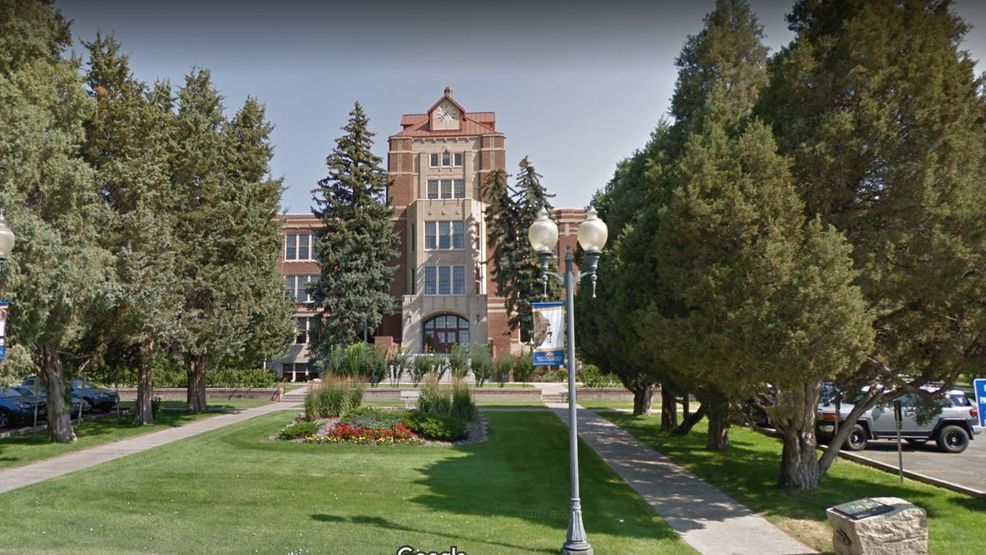
            I was eager to see the campus. I left my family at the hotel—they all wanted to hang out by the pool—and I drove up 27th Street North to the campus. I struggled to find my bearings. It had been a long time. An addition to the science building had taken over what formerly had been a faculty parking lot. I headed toward the Liberal Arts Building.  My office had been on the eighth floor, I believe, and all the classes I taught were held in that imposing edifice. I spent some time walking around the campus on a quiet Sunday evening.  All the buildings were locked, so I could not go see my old office or the classrooms where I taught.

File:MSUB LA Building.JPG - Wikimedia Commons
More Daunting than Mordor

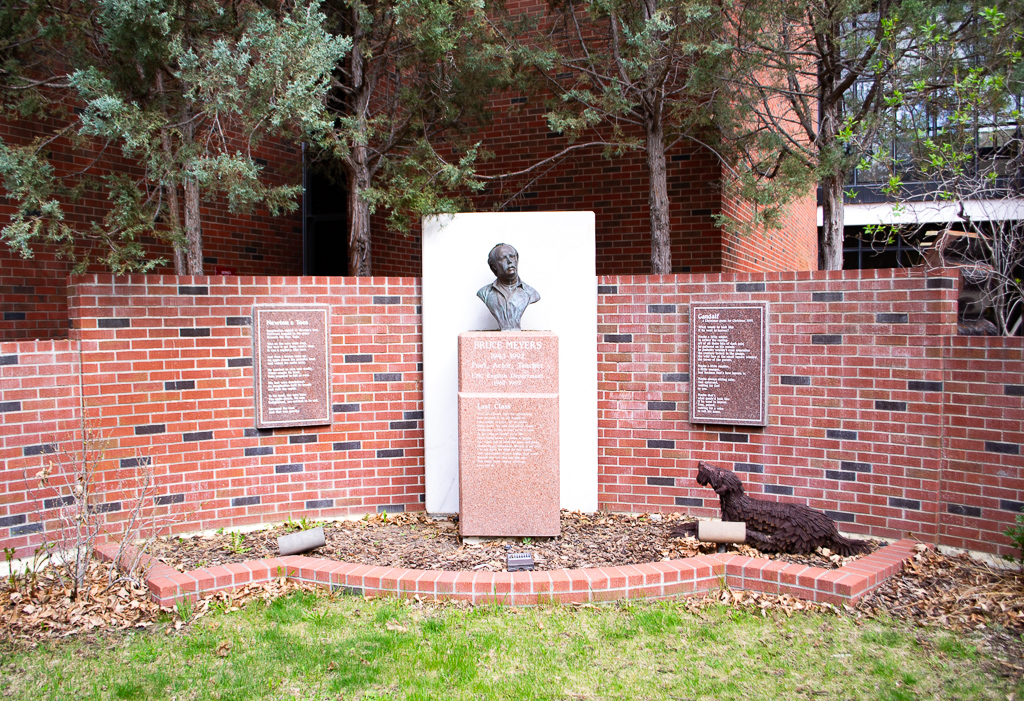
            Much had changed, so much that I felt a bit lost. Buildings had grown. It seemed like a very different place, and I noticed things I had forgotten over the years, especially the small garden that stands in the shadow of the Liberal Arts Building.  The garden was named after an English professor named Bruce Myers, who had died young—younger than I am now—two years before I arrived in Billings. A centerpiece in the garden was a poem Myers wrote shortly before his death:

“Last Class”

Seeds are floating from the cottonwoods

And the wind is up. All around us

Poets gather on grass the air carries

White puffs. We read each other’s words

Wondering if this as close as we’ll come

To the flight of clouds? Or is this

What flying means—sitting in Spring

Our bodies, full of birds and grass and words,

Wondering as cottonwoods whisper at our ears?

I do not know the word for this vision

This congregation of poet bodies, poet words

Beneath this tree. But last this once

This single sunlit singing afternoon

Love will do.

What a perfect statement of the depth of the joy that teaching can bring.

Where is Cookie?: Remembering: Poet's Garden honors legacy of a fine teacher

            I learned a lot from teaching in Montana. It was the first time in my career where I had significant numbers of Native American students in my classes. They drove in from Crow and from the Northern Cheyenne Reservation. I learned from these students things that put my academic and scholarly concerns in perspective. Many of the debates that dominate the field of Native American Studies and Native American History on college campuses simply do not carry much register in Native American communities on the Northern Plains.

            I learned a lot, but I spent much of my time at Billings trying to find a job someplace else. I was in a deeply dysfunctional department on a struggling campus, where more people left than went up for tenure.  The Dean of the College of Liberal Arts had no respect for what I did and said that whatever research I produced should be “relevant” and “applied.”  I asked her what she thought that meant, and I never really got a good answer, but it was clear that unless she thought it was important and relevant, today, to her, that it would not count for much.  Bruce Myers’ words meant nothing to her.

            I would like to think that things are better in the field of Native American history than they were in the 1990s, and that the field is booming.  A tremendous amount of scholarship is produced each year. Native American history no longer exists on the margins of the field. But the same day I arrived in Billings last month, I read on Twitter of a bill introduced into the Texas legislature by one of the Lone Star Republic’s many East Texas lunatics. He sought, in his effort to combat what he saw as the mortal threat posed by “Critical Race Theory,” to remove from the state’s social studies standards a requirement that students learn about “the history of Native Americans.”  If we do not talk about the bad things, they never happened.

            Erasure.

            When it appears this baldly, it puts our academic and interpretive debates in perspective. We argue about interpretations, evidence, and approaches, and then there are those who could not care less about any of this.  “Cast all this aside,” they seem to say. History must be a celebration of White Christian America’s greatness.  Nothing else matters.

            I began teaching in Montana in 1994. That same semester conservatives worried about the spectre of political correctness.  Lynne Cheney had recently gone on a crusade against the National History Standards.  Liberal professors, she argued, were out to indoctrinate American students, to teach them that America’s story was one of racism, oppression, and greed.  They were teaching “multiculturalism” and emphasizing the bad parts of American history.  It is an old, old, argument, a tried-and-true Conservative tactic to avoid talking about historical moments that challenge their cherished and largely fictional narrative of the American past. Some of my colleagues in the department, too, shared Cheney’s concerns. They attempted, and to my embarrassment succeeded, in making my life miserable because I was newly hired on a tenure-track gig. I made the mistake of caring what these old racists thought. I hold no malice towards them now: they are retired, dead, or out of the academy, and I have spoken to none of them since the Clinton years. But they did not see Native American history as central to the American story.

            I have been at this for thirty years and there always have been people who claim to know something about my line of work that do not want to hear anything that is not a celebration of American greatness. I have friends who find it exhausting, the feeling of always having to justify their work. I am sympathetic. I felt that way during my four years in Montana, before I got out. As I walked around the quiet and empty campus, I realized how much I have changed. I have great faith in the power of teaching still, like Professor Myers, and I can view encounters with those who reject what I do as teachable moments, as opportunities for dialogue and engagement.  I feel like I must.  Of course, there are those who do not want this, and recoil from dialogue, who retreat from any situation in which their cherished notions of the past are called into question.  I have no control over that. So I work to keep my mind open, to exclude no one, to keep working with Indigenous communities, as I have done for the past 23 years, and to keep trying to produce scholarship as well. Doing good work in this field means trying to get it in front of as many eyes and into as many ears as possible.

            I learned from my time in Billings that in academia, as in so many other things, one must learn to accept that there are things beyond our control.  Accepting that brutal fact will help you sleep at night. The job market in higher education is, well, not much of a market at all.  Administrators can be cruel or obtuse, colleagues selfish and petty, and students, sometimes, just are not able to care.  There are those out there who reject everything we do without reading a word of what we write or listening to a word of what we say. Some of them are open to reason. You can engage with them.  But others will not listen no matter what you say.  Why let those people get to you?

            I do my work. I teach classes. I do service, on campus and off. I am fortunate to be able to work with, for, and in Indigenous communities. I write books and articles, knowing full well that more people will read this post on my obscure little blog than anything that appears in a scholarly journal.

            The first time an English-speaking writer put pen to paper to try to understand the Native American past and the Native American present on its own terms, there were English-speaking readers who not only rejected this work, but actively tried to discredit the author. Some tried to keep others from reading that author’s work.  The textbook policing of those little men who crusade against CRT—they are nothing new. Their assault on higher education, against free inquiry of any kind—may seem like a pernicious and unprecedented threat. It is not unprecedented at all. Remember what the anti-racists say. The rot is deep, and it goes to the core. It is fundamental. There have always been white loudmouths crying “Patriotism” and “Love of Country” and “MAGA!” as wittingly or unwittingly they seek to exclude, marginalize, and erase.

            Don’t laugh at these people. Don’t ignore them. Have the courage to engage them when the opportunity presents itself (and you absolutely should seek out those opportunities). Ask them questions. Hold their feet to the fire. Accept that this may be frustrating. They may be too fragile to engage you in dialogue. And that is the way it always has been. Take care of yourself, but do not give up and do not retreat. Peace.

Maybe, Just Maybe

I am hearing it again and it really bothers me. It is the end of the semester. I am tired, and so are my students. Yet I listen too often to laments from faculty members talking about how the quality of our students has declined. They are not doing the reading. They have no work ethic. They are just not prepared for college work. And they could not write their way out of a paper bag.

But maybe, just maybe, it has something to do with the global pandemic we are struggling through. I have been hearing the same laments from the same instructors for a long time, so it has to be more than that. Maybe, just maybe, as students worry about the dicked-up world our generation has bequeathed to them, we have failed to inspire them to do the work. Maybe they do not do the work because they really cannot get to it right now. Maybe they can’t get to that work because you and I have failed to convince them that this work is important and that it matters more than all the other stuff they are dealing with. Maybe, just maybe, they do not care about the work because, frankly, we have not given them reason to care about what we do and why we think it is important.

Maybe, just maybe, some of us college professors ought to look at what high school and elementary school teachers go through. Their students, they say, are often not prepared for classwork. They have lots of things going on in their young lives that cause them to view school as less important than other things on their list of concerns. And you know what? Those teachers still have to teach. Their jobs depend on it. They do not get to blame the students. They have to meet certain standards, whatever we might think about those standards, or they can face penalties. The good teachers find ways to inspire their students to work and to learn.

When I look at my Zoom screen, I see a small number of black boxes. Because the students are at home, I do not feel comfortable asking them to turn on their cameras if they do not want to–I have no idea what might be going on in their homes, and if they feel a need for privacy, I feel bound to respect it. I wish their cameras were on, but I am not willing to make an issue out of this. Some of my students, I know, are not doing all the reading. I tell them to do their best. I firmly believe that if they are interested, at some point they will come back to this subject if they miss it now. I suspect that one of the reasons why their journals (300 words a week) are coming in late is because some of them, rather than writing each week, waited until the last possible second to do the work. I know that two of my students have buried a parent, and that a half dozen or so have either been sick themselves or in quarantine for Covid exposure. I do not blame the students for any of this. If the students in your classes are not reading, if they are not participating in your class discussions as much as you would like, if they seem uninterested, it might be more productive to look in the mirror before you start beating down students.

Maybe, just maybe, you will have to adjust your standards, or make fundamental changes to the way you teach. I think here of people like Kevin Gannon, Cate Denial, and Thomas LeCaque, who have helped to inspire me to rethink how I approach my classes. If the students truly “are not as strong as they used to be,” then you may need to change your approach. You may have to reconsider how you teach. I firmly believe this, and it is a hill I will die on: if our students are failing to learn what we are trying to teach them, then you and I are failing as teachers. And if this is something you would rather whine about than fix, perhaps you can find something else to do with your life. Maybe, just maybe.

As this semester approaches its end, I can admit to my students that I am exhausted. We are approaching Christmas, with all the busy-ness that entails. I had Covid in early November and, three weeks after being cleared by the County Health Department, I still do not feel like I have fully recovered. My tank is nearly empty. But I have no papers to write, no final exams to study for, no all-nighters that I need to pull. All that is left for me this semester as a (virtual) classroom teacher is to read what my beleaguered, stressed-out, sometimes careless and sloppy, but always interesting students have to say. And I feel fortunate to be here for that. Maybe, just maybe, we can make a resolution for the New Year: No more bitching and moaning about students.

Stay safe out there.

Trace

I just finished reading Lauret Savoy’s Trace. “We make our lives among relics and ruins of former times, former worlds,” she writes. “Each of us is, too, a landscape inscribed by memory and loss.” These words weigh on me, in the seventh month of my mother’s illness, in the midst of a global pandemic that has turned everything upside down.

It is not safe for me to travel to visit my family. I will fly home in January for a visit. Traveling in these times fills me with dread. I worry I will become sick, or will pick up the sickness and carry it with me to people more vulnerable than I.

“From what do we take our origin? From incised memories?” There is so much wrong in this world, and so much darkness. I think of my home town often. Thinking of place, and her place in it, Savoy notes that the “American land preceded hate.” Always, I think that things did not have to be the way that they are. It is the historian’s incessant cry: Along with “Why?” there is always the question of “Why not something else, something better?”

An immense land lies about us. Nations migrate within us. The past looms close, as immediate as breath, blood, and scars on a wrist. It, too, lies hidden, obscured, shattered. What I can know of ancestors’ lives or of this land can’t be retrieved like old postcards stored in a desk drawer.

Savoy speaks to me. As a person struggling to get by, feeling burdened and unmoored. I have work to do, and I attempt to do it as we careen towards an election where the irrational and the millions of Americans who are historically illiterate threaten to cast aside those things we hopefully tell ourselves make us special. About place names, Savoy wisely writes that “if history can be read in the names of the land, then the text at the surface is partial and pieced.”

A reader might do well to look beyond ‘official’ maps for traces of other languages, other visions. He or she might do well to acknowledge, and mourn, the loss of innumerable names born out of textured homelands that no longer reside in living memory. We all might do well to remember that names are one measure of how one chooses to inhabit the world.

Where are we? Who are we? Sometimes I feel like I do not know how to answer these questions. So many people seem never to bother asking them in the first place.

In one chapter Savoy tells of her visit to Walnut Grove Plantation in the South Carolina piedmont. She took the tour, listened to the docent. The tour and educational materials produced about the plantation lionized the owners as hard-working immigrants who had attained self-sufficiency and independence. The enslaved peoples, whose graves Savoy saw nearby, were not mentioned. The visit reminded her of Edmund S. Morgan’s “American Paradox”: that American freedom and American slavery are intertwined and entangled so thoroughly that one cannot be understood apart from the other. In American history, and at Walnut Grove.

“What to remember, what to forget?” Savoy asks. “How a society remembers can’t be separated from how it wants to be remembered or from what it wishes it was–that is, if we believe stories of ancestors reflect who we are and how we came to be. The past is remembered and told by desire.”

We do not comfortably tell stories of enslavement, Savoy writes, or of dispossession. Stories like these don’t work well with “heritage tourism.” Americans do not like to be reminded of their nation’s misdeeds. The current president has declared a culture war on those who seek to undermine American heroes and challenge American monuments. And here’s the problem with that.

A supposedly long-gone past offers an illusory comfort to the living. It’s not my fault. I didn’t own any slaves, and neither did my family. Barricaded safely in the present, the living can condemn the institution while ignoring what made it desirable to privileged classes–and what has fed an ever-mutable caste system to the present.

Reflecting upon, and rejecting, the history taught her as a child, Savoy writes that

the events that occurred and the narratives told of them can never be complete or single-voiced. Each of us participates in it. We contribute to it as players, as witnesses, as narrators, as producers, and consumers in an ongoing past to present.

“What to remember, what to forget?” Much of my own teaching serves to dismantle the comforting myths and half-truths my students learned in elementary, middle, and high school. Thinking of the burial ground at Walnut Grove, Savoy notes all the graves of the enslaved, and the stories not told about those people who enabled the owners’ self-sufficiency and independence. Few of us want to look there. Few of us wish to see where the bodies are buried. Yet the Walnut Grove burial ground, she writes, “seemed to belie the enslavers’ power to extract work without consent from the enslaved. Not just work, but blood, breath, life itself. Silence reminded me, too, of pieces erased from a many-storied past: complex communities excised, interior lives of ‘property in person’ ignored.” Pasts erased, lives forgotten, experiences ignored.

She writes

We live among countless absences of memory in this country. They convey both remembrances and omissions, privileging partial arcs of story while neglecting so many others. Historical sites are contested story sites for the meaning of America’s past-to-present.

To whom is history responsible? What I realized at the burying ground was that each of us is implicated in locating the past-to-present.

History layers itself in language and acts, “of meanings shrouded over generations. The question has to be turned around and made personal: What then is my relationship with history, told and untold, on this land.”

It is hard to engage painful elements of America’s past and be self-reflective, particularly if one must confront deeply ingrained beliefs and ideas that have shaped, or made comfortable, one’s sense of self or place. Or if one seeks to shed a sense of inherited shame or pain in order to step away from stories of group victimization. But the legacy of slavery, and the racism it fed and reinforced, remains a malignant symbiosis. It feeds who we Americans think we are, as citizens and as communities. It still festers as untended wounds, open and disfiguring to some, hidden from view to others.

This is a beautiful reflection on the work of the historian, at least as I have come to see it over the thirty-odd years I have spent in graduate school and as a teacher. I write about Indigenous peoples. I work to understand the processes of dispossession that shaped the land upon which I live. I have worked, in small ways, in the conqueror’s courts in what so often seems like a futile effort to obtain some remedy for the clear crimes of the past. Always, I tell myself that it wasn’t inevitable, that hardly anything is inevitable. It did not have to be this way, and there is another path if we wish to take it. Sometimes, however, when I am reading through the mountains of evidence that document these injustices, I find this especially difficult to believe. But I hope. Always. Savoy’s concluding thoughts about her visit to Walnut Grove resonate with me.

I don’t have answers, but I do have desires. That the intricate relations implicating us in each other’s lives could be acknowledged by the recent immigrant and native, by descendant of colonists and those enslaved by colonists. This isn’t being trampled by history or consumed by guilt over the past, nor is it being victim without end. It is instead honoring the lives of those so often unacknowledged by taking responsibility for the past-in-present–by opposing injustices today for which accountability is direct. This comes closest to my mind for a true re-pairing toward truth and reconciliation.

Covid-19 and Writing History: The Stories We Tell

What stories will we tell about this pandemic spring, and how will this time of dislocation, isolation and, in places, overwhelming grief, shape the stories we historians tell about those pasts we choose to investigate? The answers to these questions are always more connected than we care to admit.

There are of course the daily stories of the blundering incompetence of our most craven President, who fiddled while the virus burned up much of what seemed familiar and comfortable.  There are his brazen lies, his attempts to rewrite the past and erase his many denials of the magnitude of the health threat we all face, and his failure to deliver even a fraction of the testing kits he asserted would be ready by now.  Beside the stories of this president’s cowardice and malfeasance, there are the stories of heroic health care workers, doing battle against the virus often without the equipment that might allow them to do their work with less risk.  Of course there are the stories of those who have suffered and died, and those who grieve these deaths. There are many more of these stories yet to be written, I am afraid.  Anyone with the eyes to see knows this to be true. These stories can overwhelm if we let them.

            At home, I attempt to steal away moments here and there to work on the book project that has kept me busy for many years now.  It may be my last book.  Sometimes I feel that way when I consider the scope and scale of the project. The project gets bigger while my world, in a sense, becomes smaller. I work from home. I no longer encounter my students face-to-face, bump into colleagues, or visit libraries and archives. I keep my distance from others to keep myself safe. The world seems limited and constrained.

            When I attempt to look at this project in all its breadth, I find myself distracted, restless and anxious. Working on a project this broad requires me to think of the future, to make plans and set goals. I feel strange doing that now. It is only when I step back and slow down, and when I take a look at the small stories, that I am able to focus and devote some energy to my research.  I look at the smallest pieces of the puzzle, the most interesting pebbles on a beach of enormous expanse.

In January of 1907, Harrison Hill, a teenager from Onondaga shot and killed his brother-in-law Elijah Peters on the Tonawanda Indian Reservation, located about halfway between Rochester and Buffalo in western New York.  Hill had attended the Thomas Indian School on the Senecas’ Cattaraugus reservation beginning when he was eight years old.  I have not been able to reconstruct all his movements. He left Thomas after four years.  A half decade later he got himself into some kind of trouble, and ended up at the state industrial school in Rochester.  The school’s records are housed at the Rush Rhees Library at the University of Rochester, but the archives are closed due to the coronavirus pandemic.  All I know for sure is that once he got free or escaped or finished his term, he made his way to Tonawanda to live with his sister and her husband.  His mother joined him there shortly thereafter. 

            It is not clear to me exactly what happened next. I am certain that after some sort of confrontation that involved Hill asking Peters for money, Peters asked Hill to leave his house.  Some time later, Hill shot Peters as he exited the house, delivering to his brother-in-law the fatal wound.

            In every account Hill is described as educated and stunningly good looking. But sullen, and angry, as well.  After the shooting, he ran for it. Neither his sister nor his mother claimed to know where he had gone, but the police never believed them. They thought that he could be hiding in Syracuse, or on the Onondaga Nation territory, where he still had relatives. The police offered a reward for his capture, and two days later a sheriff captured him near the farm of a guy named Byron Gardner in Wyoming County.  According to the report in the Buffalo Courier, Hill “was walking in the road when he met the officer, armed with a loaded revolver from which two cartridges had been fired, and the sheriff believes that had the prisoner known him he would have had difficulty capturing him.”  Hill did not know that Peters had died.  The Courier reporter wrote that

 Hill is nineteen years of age, bright and intelligent looking, neat in appearance and speaks good English. He at one time attended the Carlisle Indian School and wore several pins on his coat, one of which was a fraternity pin from Carlisle. On arriving at the jail, he made a complete confession of the crime.

There is no evidence that Hill ever attended Carlisle.  It is hard to say where he got these pins, but undoubtedly he had family members who had spent time in Pennsylvania.  The description of Hill’s confession paints a vibrant, if incomplete picture, of a young man who found himself in a great deal of trouble:

He says that on the morning of the day of the shooting Peters turned him out of the house and he has a very quick temper it made him very mad and he determined to get revenge by shooting him.  He says he went to Peters’ house in the evening and concealed himself behind a clump of bushes near the rear of the house and that when he saw Peters coming from the barn he took aim and fired the bullet.  He says he fired but once and then ran, and after going to his room at Johnson’s and getting a package he walked that night to Oakfield and Batavia, and then to LeRoy and south to Pavilion.  He says that Tuesday and Wednesday nights he slept in barns and finally reached Gardner’s farm where he found a job cutting wood.  He stayed at Gardner’s Thursday night.  When asked if he was sorry for what he had done he said he was not; that he did not care much. He takes his arrest cooly and does not appear to be at all concerned over his fate.”

Many Onondagas attended boarding school.  Some went to Thomas, the state-run institution that remained open into the 1950s. Others went to the infamous Carlisle School in Pennsylvania.  A small number went to schools elsewhere—Lincoln, in Philadelphia, or the Haskell Institute in Kansas, and some others that I cannot think of. Some of them struggled when they came home. Some put their skills to use and did well for themselves.  For many, attending Carlisle was a badge of honor—even Harrison Hill who never went there wore Carlisle pins on his jacket. 

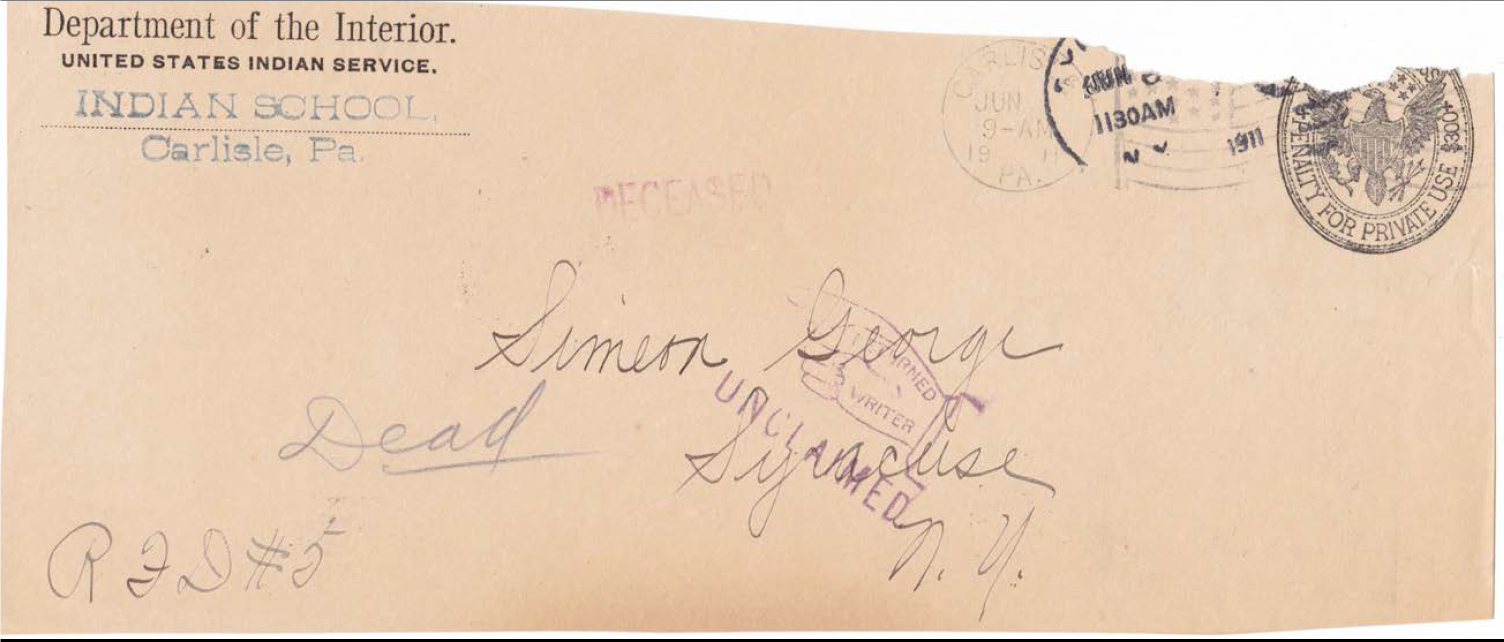
            I do not know how Simeon George felt about his time at the boarding school  He arrived at Carlisle in 1893. His student record is sparse, little more than a couple of information cards.  He attended sporadically, going home at his parents’ request between each May and October. After May of 1896, he never returned to the school. As a 22-year old, he was too old to attend the school any longer.

            I have not been able to find out much about George and his life at Onondaga.  He doesn’t show up in the newspapers. I cannot travel to the Nation territory to talk to people there about him until the pandemic subsides.

            What I do know for sure that is on April 21 1907, while Harrison Hill sat in jail awaiting trial on charges of murder, George was in his home on the reservation, eating supper. A knock at the door. George answered It was a sheriff’s deputy from Madison County, Michael Mooney.

            Deputy Mooney told George to finish his supper, but to come outside when he was done. Mooney told him he would wait.  George finished his meal quickly, and grabbed his coat.  He placed a loaded revolver in his pocket. When the deputy put his hand on George’s shoulder, he pulled out the gun and fired, wounding Mooney in the shoulder. As Mooney fell, George fired again, hitting him in the back.

            George ran into the house, leaving Deputy Mooney for dead.  He told his nineteen-year-old wife Lydia Billings, who he had married ten months before, that he was going to kill himself.  He ran from the house and headed toward an expanse of woods to the south.  “It was believed at the reservation yesterday that George had carried out his threat,” the Syracuse Post Standard reported.  That is what Lydia believed. She told police that one of George’s brothers had committed suicide four years earlier.

            But where was his body?  Police searched the woods for a couple of days.  People from the community, I imagine, must have helped out. They found nothing. By the 26th, police began to suspect that George was alive, that his announcement of his intent to kill himself was an attempt to throw the police off his tail.  Keep them busy, looking for his body, while he fled from the reservation.  A mail carrier in East Hamilton, about 45 miles east of the reservation, reported seeing an Indian who matched George’s description going door-to-door begging for whatever the residents might spare.

            The mail carrier, it turned out, had spotted someone who was neither George nor an Indian.  On the 29th, as Detective Mooney slowly recovered from his wounds, officers found George’s body, a bullet wound in his head, his revolver by his side.  They found him in the wounds a short distance from his house where he said he would go.

            Whatever his own demons, whatever he had done, Simeon George was loved.  His funeral took place at the reservation Wesleyan Methodist Church.  200 people attended, “the little church crowded to the doors.”  The entire twenty-one members of the Onondaga Indian band performed in his honor.  They performed a dirge entitled “Forest Home,” composed in 1898, and another piece called “Religioso.”  His life, about which it is so difficult to learn much at all, mattered immensely to those people at Onondaga who knew him.

Harrison Hill’s trial began three weeks after George’s funeral at the United States District Court. His attorney argued that Hill shot Peters in self-defense and never intended to hurt him.  Hill had gone to Peters’ house to ask for some money to help his brother, Moses Hill, who was incarcerated in the Onondaga County Jail on charges of grand larceny. Peters went after Hill, who fired the gun in an effort to frighten him. Hill took the stand in his own defense, and was “subjected to a sharp cross-examination on the part of the people, but in the main struck to the story given in his direct examination.” 

            The judge overseeing the trial, in his instructions to the jury, told them that Hill was entitled to a fair and impartial trial, “but that you must not be influenced by sympathy for his youth and must not consider it in your deliberations. There should be no prejudice against his race or color,” the judge said, “and nothing about his manner of testifying should influence you. You know,” he continued, “the nature of the Indian is stoical and any hesitations in answering questions should not militate against him.”

            I have not had a chance to try to find the trial record. The jury believed Hill. He was acquitted on all charges. I do not know what happened to him after that.  But I did find this story in the Rochester  Democrat and Chronicle seventeen months later: 

Robert Hill, 20 years old, an Onondaga Indian, was brought to jail last night by Railroad Detective Elliott. Hill was arrested on Thursday morning by Constable Charles Platt, of Gates, who arraigned him before Justice of the Peace Leddy on charges of burglary and larceny.  Hill was caught after he had broken into a freight car in the Buffalo, Rochester, and Pittsburg yards in Lincoln Park.  …..Hill is a bad Indian.  Despite his years he has seen a good deal of the country. Some nine months ago he shot and killed his brother and law in an Indian settlement near Batavia. He was tried, but was acquitted. Next he was accused of having stabbed a brakeman in Salamanca.  He got away, and at Wyoming took off his coat and flagged a train. He rode into Rochester where he was arrested by Detective Spillings and railroad Detective Elliott. He wasn’t held long, as it was impossible to prove that he had done the stabbing.  Thursday morning Constable Platt found the red man industriously breaking open packages in a freight car in the Lincoln Park yards. When he started to place the Indian under arrest the latter drew a revolver. Platt didn’t wait for him to use it, but laid his flat on the Indian’s nose. The blow was so straight and so effective that Hill surrendered without further ceremony.  Director Whaley caused Hill to be photographed yesterday. He thinks the Indian is wanted in some Western state.

The details do not match up completely, but you have to admit that there are some similarities between the story of Robert Hill, a 20-year old from Onondaga arrested in October of 1908, and Harrison Hill, a 19-year old arrested in 1907.  It is a question I have not been able to investigate. Lydia Billings, Simeon George’s young wife, left the reservation after his suicide and found work at the Columbia Hotel in Niagara Falls as a domestic.  When the upper floors of the hotel caught fire in January of 1909, she jumped from the fourth floor to save her life.  According to the Buffalo Evening News, she “sustained a broken rib on the right side, a fracture of her right wrist and a fracture of the left ankle.”  I have many more unanswered questions, but for now, the trail has grown cold.

There has been in our profession a flourishing “microhistorical turn” over the span of the past decade or so.  I expect more of us will be drawn to these small stories if the suffering caused by the coronavirus continues and increases, as every informed person says it will.

The historical record left from these years will surely highlight the incompetence of the executive branch in the face of a global crisis and the grotesque self-dealing of the arrogant bunglers.  We will have numbers and charts and data, telling the story of the pandemic’s spread, and the damage it did as it slashed its way around the world. What might not show up easily in the archives of the future will be the brutal but quiet reality that this pandemic will have been the most important event in the lives of millions of Americans. It was this virus that took from them their lives and their loved ones, or led them to lose their jobs, their homes, or their businesses.  Dreams shatter.  The cord breaks in the spring of 2020, and nothing for these many people will ever be the same again.

            We historians look for the significance in the events that we write about. We do not simply recount the past. We identify and explain why it mattered.  We might find significance in a battle, an election, and act of Congress or an act of God.  Perhaps with this pandemic more of us will recognize that the events that make us who we are can be as small as a death in the family.

            In Native American history, we have become more attuned to historical trauma as a force shaping indigenous communities. Often we tie this to a history of violence, dispossession and disease.  In my own attempts to understand the history of the Onondagas, an indigenous community that would have disappeared long ago if their white neighbors had their way, I find immense meaning in these small stories, a way of knowing and seeing this history not often available in the conventional sources, conventionally read. If the coronavirus pandemic continues to inflict trauma as some people fear it might, these small stories will not only offer an essential means to view the history of this country during this ear, but an important means for speaking truth to power. There are those like this President and his craven supporters, for instance, who will attempt to distance themselves from the destruction their incompetence has wrought. These millions of small stories will stand as witness against them.  Perhaps it is true what one of the very wise Geneseo students who accompanied me to Oxford last year had to say: the bigger the issue, the smaller you write.

The Lonely Death of Carlos Pico

I am teaching for the first time a freshman writing seminar on the history of the Carlisle Indian Industrial School in Carlisle, Pennsylvania. The students have read a couple of secondary works, but the bulk of their work will involve research in the documents collected by the Carlisle Indian School Digital Resource Center. It is an amazing resource, filled with revealing records from the school, but also amazing human stories.

The students are selecting the topics for their research papers. They obviously cannot go through the thousands and thousands of student records, and much of my time meeting with them last week was directed towards trying to help them narrow their topics down to a manageable scope and size. One way to do that was to follow the students from a given native nation, to explore their experiences at the school, and as much as possible, to try to figure out how they fared once they left.

Only a small number of the students are history majors, and they come to the work with a wide range of interests. Some of the delight in teaching the course comes with working with these diverse students, and approaching the records anew, from the perspectives of, say, education, or psychology, or epidemiology, or nutrition. I learn a lot from working with these students, and find myself constantly forced to think about the sorts of stories these records can tell.

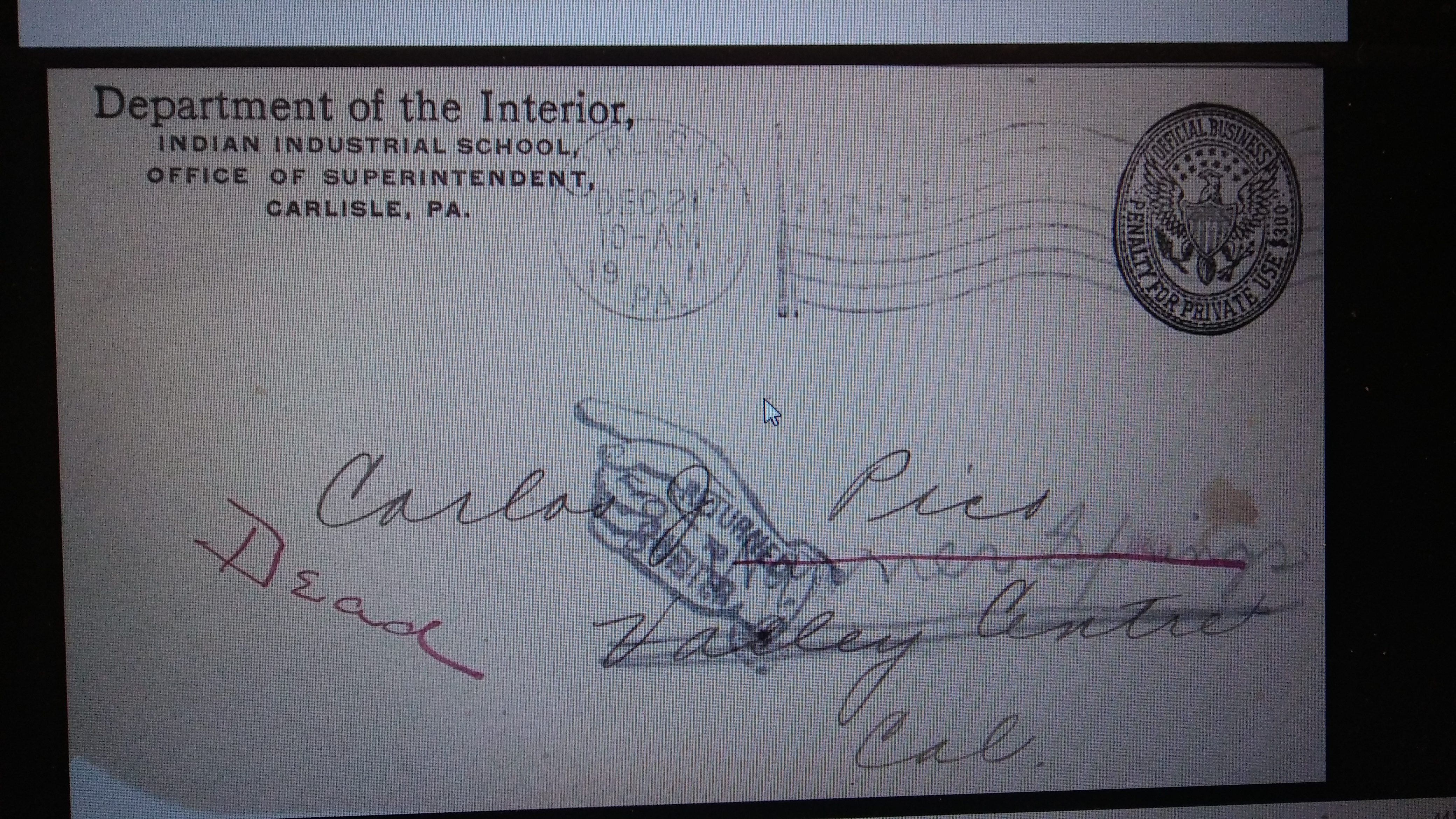
I keep coming back to the human stories, of young people, often far from home, who came to the school, experienced it, and then moved on. Carlos Pico was one of those students.

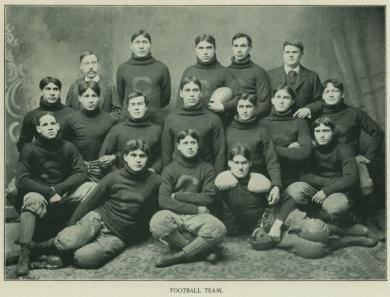
Carlos was 17 when he came to Carlisle in 1899. Last Thursday, the 7th of March, was the 120th anniversary of his arrival at Carlisle. Carlos was huge, six-and-a-half feet tall, 174 pounds. There is a story that he played on the Carlisle football team under Pop Warner, who coached at Carlisle from 1899 to 1903 and from 1907 to 1914. Carlos was at Carlisle for the first part of that period, but he left the school in June of 1904. I am not certain that he played. He is not listed in a newspaper article on the school football team in 1900. His student file shows that his outing–in Mt. Airy, New Jersey, and in Penn Valley and Morrisville, Pennsylvania, ran from the spring until late August or early September. If Carlos played on the 1900 team, he was not included in this picture of the players.

We do know that by 1905 Carlos was home in California and working as a farmer and a blacksmith, using the training he received while away from home. In May of 1910, he married Thomasa Penna. She was a Mission Indian, too, living in California. As he responded in August of that year to a Carlisle questionnaire, he had “a happy home my wife and my self.” He had “enough horses to do my work. And enough money to carry me on.” But something went wrong.

Carlos’s student file includes a pair of newspaper clippings. One read that “We regret very much the death of Carlos Pico of Rincon, who was brought to Pala Thursday in critical condition. The death of his wife, which occurred recently, preyed so heavily on his mind that he became mentally unbalanced and died Saturday morning.” Another read that “An Indian, Carlos Pico, of Rincon, California, grieved so over the death of this wife that he lost his mind. Death soon come to his relief.”

It’s hard to know what to do with stories like this. Grief saturates the story of Carlos and his wife. It is difficult to imagine the loneliness and a depth of grief so consuming that it produced in this young man derangement and self-destruction. I have poked around a bit. Carlos is still remembered and still has relatives in his community. Much of his story nonetheless remains out of reach. Perhaps county records might reveal more. Perhaps there is more that can be learned about is wife (Thomasa Penna? Tomasa Pena? It is hard to be certain of the actual spelling of her name). A historian would have to spend some time on the ground in California, hitting the archives, looking for needles in different haystacks. Stories like this leave students grasping for more, and they teach the difficulties that come with historical research. Sometimes we can only go so far. Trails grow cold, the lineaments of the story difficult to trace. But they connect students to the past at an emotional level, and call them to dig deeper, and to recognize that the work of reconstructing the past is never complete. As a historian, and as a human being, it is hard to forget stories like these.

Town Destroyer in Paradise: How George Washington Ended up Just Outside Handsome Lake’s Heaven

I recently read Colin Calloway’s book on The Indian World of George Washington, and that got me thinking about two very different depictions of our nation’s first President.  I write about the Senecas, with whom these particular depictions originate, in Native America. In the late 1790s, the great Seneca prophet Handsome Lake experienced a series of visions that became the basis of the Gaiwiio, the good news of peace and power, the “old time” religion still practiced by many Haudenosaunee Iroquois traditionalists in New York State and Canada.   This was a critical moment in Seneca history, and the emergence of this gospel, and Handsome Lake’s message, was one of enormous significance, bringing hope and an explanation for their historical experience to Haudenosaunee peoples.  As related in the 1850s to the early anthropologist Lewis Henry Morgan by the Tonawanda Seneca Jemmy Johnson, George Washington “stood preeminent above all of the white men” because “of his justice and benevolence to the Indians.”  Johnson told Morgan that the Senecas believed “that the Great Spirit had received” Washington “into a celestial residence upon the plains of heaven, the only white man whose noble deeds had entitled him to this heavenly favor.”  The only one. Not in paradise, but just outside. Washington resided there, silent and content.  “No word ever passes his lips. Dressed in his uniform, and in a state of perfect felicity, he is destined to remain through eternity in the solitary enjoyment of the celestial residence prepared for him by the Great Spirit.”

It is quite an image, and one difficult to reconcile with the man known by many Indians as the “Town Destroyer,”  a name originally claimed by his great-grandfather for the fighting he did along the Potomac frontier in the 1670s, and which our Washington appears to have appropriated and used when it served his purposes.  From his birth to his death, Washington lived in a world carved out of Indian land.  Washington spent nearly his entire career thinking about and fighting against native peoples, engaging them in diplomacy, and laying plans and conceiving of policies to acquire Indian lands for himself, for his fellow investors, and, later, for his nation. Indeed, Washington was instrumental in the dispossession of native peoples. The country he played so fundamental a role in founding rose on lands lost by native peoples.

During the colonial period, during the era of the Revolution, during the Confederation and under the new Constitution, Americans could disagree intensely over the conduct of Indian policy. This long-running debate, however, for white Americans was always over means, not ends.  The debate boiled down to defining the nature of the Indians’ defeat.

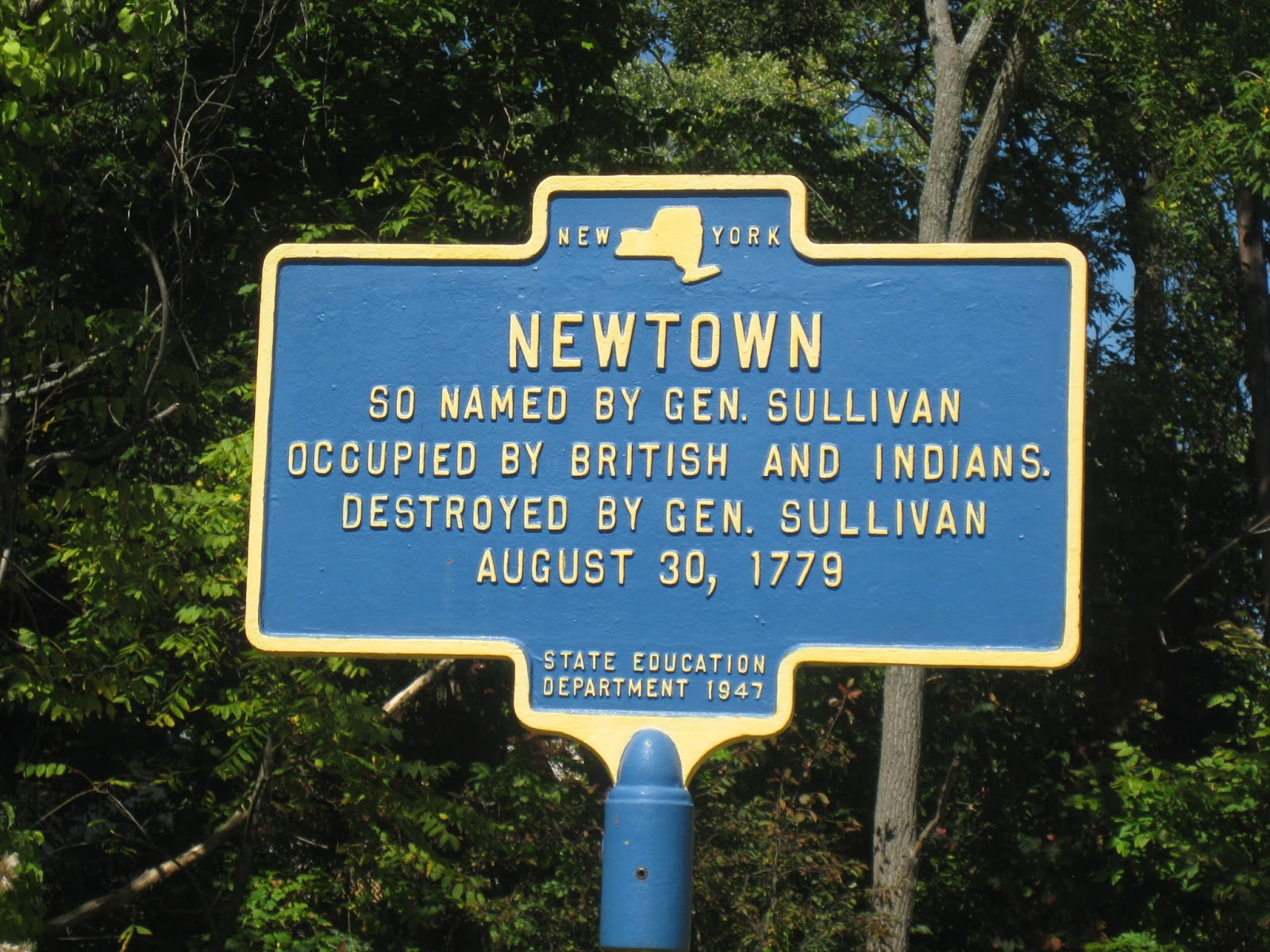
Washington’s treatment of Native America makes clear that the answer would involve violence. During the Revolution, Washington ordered invasions of the Iroquois that resulted, if we choose to believe Haudenosaunee voices, in the rape and murder of Onondaga non-combatants by New York militiamen following Colonel Goose Van Schaick. It resulted in what can justly be called war crimes against Senecas and Cayugas as well the destruction of their crops and orchards, and dozens of towns in 1779 as part of the infamous Sullivan campaign.  Washington hoped that Sullivan’s men would “distract and terrify” the Indians and, in Washington’s own words, “extirpate them from the Country.”  Sullivan’s soldiers drank a toast promising, among other things, “civilization or death to all American savages.”
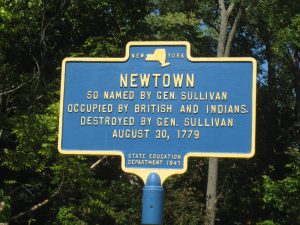
As my kids sometimes say, “That’s pretty racist.”  Not a pretty picture at all.  So how did this guy end up outside the Senecas’ heaven, close to, but not quite inside, paradise?

To best answer that question, I suggest that we flip the narrative, and try to look at these important events in American history as native peoples might have experienced them. As I point out in Native America, we can start with the words we use.

Words like ‘Indian,” for example, or phrases like “Native American,” of course are flawed.  They obscure more than they reveal, and they would have meant little to peoples whose names for themselves often translated as “people” or “the real people,” or “the real human beings.”  But the problem with words goes even deeper than this.  Too many historians, for too long, have relied upon flawed dichotomies: there was a “pre-contact” or “prehistoric” period that came before “contact” and before the arrival of Europeans ushered in the “historic” era.  Native peoples obviously had long histories on this continent before Europeans arrived. They interacted and exchanged with and fought against native neighbors near and far, and these contacts bred a host of cultural practices that pertained to their “contact” with others.  They did not simply drop these aboriginal practices when Europeans arrived.

Language can be difficult, and words tricky things.

Colonists “settle” but Indians do not: they are depicted nomads who wander and roam when they in places were more fixed and tied to place than the newcomers.  Europeans plant crops, but Indians do not, according to conventional wisdom; colonists serve as soldiers while native peoples fight as warriors. Language can emphasize difference, and an emphasis of difference can be misleading, for example, because it might make violence seem inevitable, or reinforce racial and racist stereotypes.  In reality, the differences between natives and newcomers at the outset might not have been as great as our flawed language leads us to believe. Both, for example, relied upon an agriculture centered upon corn to stay alive. Both supplemented their agricultural produce with sources of protein they acquired systematically.  Native peoples, for instance, managed forests, burned underbrush, and generated new growth that attracted game that hunters could more easily harvest.  Newcomers, meanwhile, turned their livestock loose and allowed it to forage and fend for itself.  When the settlers got hungry, they went out into the woods to hunt down their nearly feral cattle and hogs.

Some more words.  The “Founding Fathers,” the patriots, and white settlers who encroached on native peoples’ lands, Indians saw not as freedom fighters but as “perfidious cruel rebels” and, tellingly, as “white savages.” They referred to them not as champions of liberty but as “Butchers,” and “Killers,” and “Madmen.” They called them “Big Knives” or “Long Knives,” names that chillingly reflected the violence with which they were associated.  Native Americans in this part of the country in the eighteenth and nineteenth centuries feared that Americans acted with genocidal intent, and they said it again and again and again. One solution to the Indian question, for some white settlers, you see, was extermination, and groups of white Americans expressed that desire and acted on it in ways that confirmed the nightmares of native peoples.  You can think of the murder and mutilation of children carried out by the Paxton Boys late in 1763, acts of horrific violence that have brought my students to the edge of tears.  Children murdered by white vigilantes armed with tomahawks.

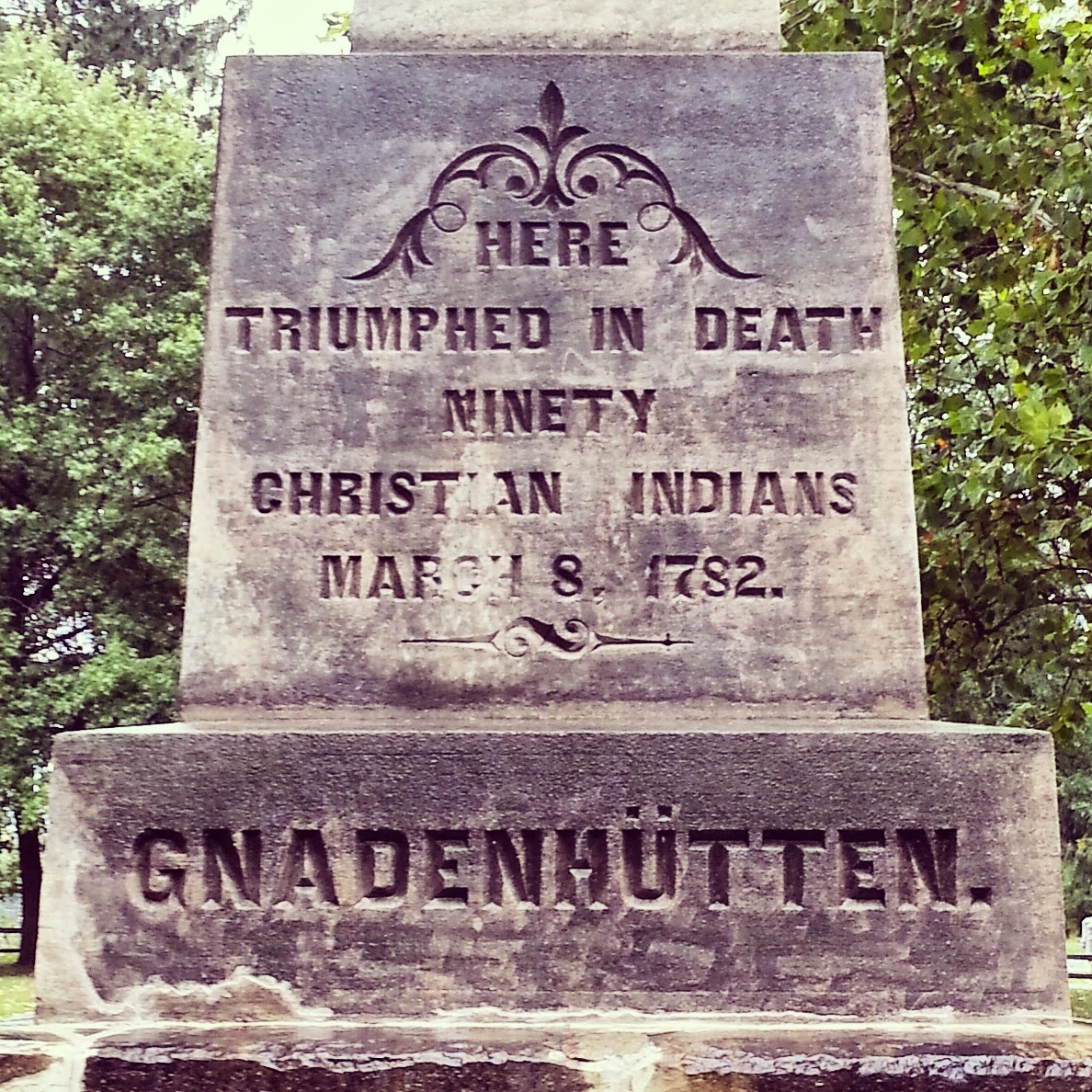
Or the massacre at Gnaddenhutten, 1782.  Gnaddenhutten– “The Houses of Mercy.” That’s what that name means.  No mercy there for the Christian Indians who lived and prayed and worked there. The soldiers from Pennsylvania surrounded the Christian Indians at Gnaddenhutten.  They had them at their mercy.  So they held a vote on whether or not to kill the one hundred Christian Indians they had taken captive.  This was, for many native peoples, what American democracy looked like.  I have written about the massacre at Gnaddenhutten on this website.   It is a devastating history. One could write a history of Native Americans that uses the violence meted out on native children as the vehicle driving the narrative, from the earliest period to the present.
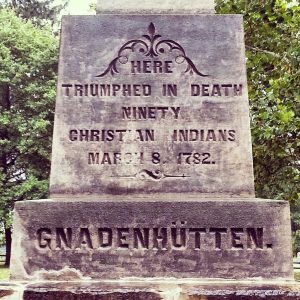
I tell my students about these violent episodes.  These events allow us to mess around with words.  Murder at Gnadenhutten becomes an expression of democracy. Frontier settlers become savages.  I try to decenter things, to upset expectations.  And I think we need to do this if we are to understand why so many native peoples so forcefully and effectively resisted the newly independent United States. And, also, how the Senecas,–the victims of a brutal invasion ordered by Washington and by acts of vigilante justice for decades thereafter– might pass a silent George Washington, the man who ordered the burning of their towns and forced them to flee their homeland, on their way into heaven.

After the war, after he resigned his commission, Washington’s advice was sought out and given on Indian affairs.  In a letter he wrote to James Duane of New York in the fall of 1783, he called for effective and meaningful oversight of the settlement of the western territories.  He always had distrusted squatters, and feared the unregulated expansion of white settlement. He wanted peace and order on the frontier, to acquire land without conflict. “To suffer a wide extended Country to be over run with Land Jobbers, Speculators, and Monopolisers or even scatter’d settlers,” he wrote “is pregnant of disputes with the Savages, and among ourselves, the evils of which are easier, to be conceived than described.”  Native peoples, he asserted, had sided with Great Britain against the American states and all good advice.  A “less generous people” than we, he said, would drive them out.  Recognizing that this would involve a renewal of conflict with native nations that had been battered but not defeated during the war, Washington suggested that the Indians be told that the past will be forgotten. The United States, however, whether they liked it or not would “establish a boundary line between them and us beyond which  we will endeavor to restrain our people from hunting, or settling, and within which they shall not come, but for the purpose of Trading, Treating, or other business unexceptionable in its nature.”  Indians would give up lands in the process, to the United States or to the states with the best claim to those lands.  The sale of Indian lands allowed states to pay their soldiers.  The sale of Indian lands allowed New York to abstain from taxing its citizens before the War of 1812. Indian dispossession made New York the empire state.

But the result of these Confederation policies was chaos.  The Articles of Confederation, the new nation’s first constitution, established a limited government in which the states retained all rights they had not explicitly granted to the national government.  In Article IX of the Articles, which listed Congressional powers, the states granted the national government the “sole and exclusive right and power” of “regulating the trade and managing all affairs with the Indians, not members of any of the States, provided that the legislative right of any State within its own limits be not infringed or violated.” Who might these Indians be? New York? Virginia? North Carolina? Georgia?  This crazy ambiguity allowed aggressive states like North Carolina, Georgia, and New York, and even entities like the upstart “State of Franklin,” to conduct their own Indian policies, negotiate their own treaties, and extract their own land cessions, at times in defiance of Congress and, in the case of Georgia, at the point of a gun.  Land speculators, squatters, cattle rustlers, timber cutters, state politicians, congressional commissioners, and Indian killers—they all assaulted the Native American estate.  And Congress itself, in the treaties it convened with Indian nations it claimed to have defeated, operated on a “conquest theory,” asserting that because the Indians had aligned themselves with Great Britain, and Britain had lost, so too had the Indians.  Native peoples seethed with resentment at the treatment they received from national and state officials during the Confederation, as congressional commissioners cast aside long-established protocols for conducting diplomacy, and thumped Indian leaders in the chest demanding cessions.

This could not stand, for these native nations maintained the capacity to resist.  Washington certainly supported efforts to replace the Articles of Confederation with a more powerful central government based on the imperial model.  He agreed with the Virginians who saw the faults in the Articles.  Like James Madison. In his white paper laying out the “Vices of the Political System of the United States,” Madison placed as number two on his list “encroachments by the States on Federal authority,” and he gave as an example “the wars and treaties of Georgia with the Indians,” state aggressions against the powerful Creeks that threatened the entire Southern frontier. Washington frequently expressed a similar complaint.

The new constitution of 1787 eliminated the ambiguity of the Articles of Confederation. In Article I, Section 8, we the people granted to Congress power “to regulate Commerce with Foreign Nations, and among the several States, and with the Indian tribes.” That’s it. That is all it says.

To flesh out that spare language, Congress in 1790 passed the first of several Indian trade and Intercourse Acts. (The first was enacted in 1790, the last in 1834).  The law, which reflected perfectly the views of Washington and his secretary of War Henry Knox about the conduct of Indian policy, provided rules governing those instances when native peoples and newcomers came into contact.  Legal land sales required the oversight of an appointed federal commissioner and the subsequent ratification of the transaction by the Senate.  Trade without a license obtained from federal agents was prohibited.

It is important to say a few words about this important piece of legislation, the nation’s first Indian law. Washington, in a letter written to the Senecas in December of 1790, saw the new law as a watershed.  The Iroquois had indeed lost much to the State of New York during the Confederation years but now, he wrote, “the case is entirely altered—the general government only has the power to treat with the Indian nations, and any treaty formed and held without its authority will not be binding.”  The Trade and Intercourse Act would provide “security for the remainder of your lands.” The United States, he continued, “will never consent to your being defrauded,” “will protect you in all your just rights,” and “considers itself bound to protect you in all the lands” you still possess.  Washington never claimed any power over the internal workings of native nations.  Nor did the Constitution grant to the national government any powers over the internal workings of native nations.  Sovereign native nations were a force Washington and his contemporaries recognized.

Washington needed a peaceful and orderly frontier, but the government he commanded was a tiny thing.  The total number of non-uniformed employees of that national government in 1801, the first year for which we have good figures, was less than three thousand, and the vast majority of these worked in customs or other revenue-related functions, or the postal service.  The number of federal officials in all of New York working in Indian affairs, for instance, could be counted on one hand.  The government and its agents, then, could do little to curb encroachment, or prevent theft, or timber cutting or cattle rustling, by white people in Indian country.  Even if the will was there—and that is a matter that is debatable—the institutional apparatus was not.

The states continued to purchase Indian lands.  Settlers continued to encroach.  Conflict erupted in Georgia, the Carolinas, and in the Ohio Country, where growing numbers of militant native peoples came together in a spirited resistance against American expansion.  This territorial and physical aggression unquestionably frustrated Washington, but aware fully that power claimed but not exercised was power lost, he largely held his tongue. Controlling state governments was one thing; controlling the violence of settlers still another.  Thirteen Senecas, to cite one example from some of my own work, were murdered by white frontiersmen between 1784 and 1790 and probably another half-dozen more in the couple of years that followed that.  Native peoples found their life, liberty, and property in jeopardy.  For them, these were times that tried men’s souls.

And here’s the thing.  These grievances were significant, and Washington understood this.  He mentioned them in his annual messages to Congress.  He worked to negotiate treaties to resolve them, always looking for additional cessions of land.  Indians in the so-called Northwest Territory shared many of these grievances.  So while the government hoped to extract cessions and purchase the land upon which settlers settled and squatters squatted, native peoples increasingly committed themselves to protecting their homelands by force.  So they were ready when, in September of 1790, General Josiah Harmar led a force of 1450 regular soldiers and Kentucky militiamen out against the native towns along the Wabash and Maumee rivers in what today is the state of Indiana. Native peoples from many nations—Shawnees, Miamis, Ottawas, Potawatomis, Weas, and Kickapoos—ambushed Harmar’s force along the Maumee and killed 180 of his men. The defeated American force returned home by the end of October.

The defeat of Harmar’s invasion emboldened those native peoples willing to resist American forces, and swelled their ranks. Potawatomis and Shawnees, along with Delawares and Miamis, attacked a settlement called Dunlap’s Station just north of Cincinnati in January of 1791, while Potawatomis joined with Ottawas and Chippewas to attack targets elsewhere along the Ohio. By the spring, land speculators in the Ohio country complained that they found it difficult to recruit prospective settlers. “The Indians kill people so frequently,” they wrote, “that none dare stir into the woods to view the country.”

Native peoples had their own fears, of course. When Kentucky militiamen attacked a cluster of villages in northern Indiana where Potawatomis and many other native peoples lived, they threatened them with extermination. If native peoples refused to make peace, Brigadier General Charles Scott said, “your warriors will be slaughtered, your towns and villages ransacked and destroyed, your wives and children carried into captivity.” Many of those who lived in the Ohio country saw in the United States, whatever its claims to desire peace, a truly existential threat, the menace of genocide.

Meanwhile, Congress had already laid plans for another military invasion to take place in 1791. Arthur St. Clair, whose chief qualification was his seniority, led American forces into the Miami River Valley in September. Most of his soldiers were militiamen, poorly trained and poorly supplied. Before dawn on November 4, a force that consisted of Potawatomis, Shawnees, and large numbers of others—Ottawas, Chippewas, Wyandots, Mingos, Delawares, Miamis, and a few Chickamauga Cherokees—attacked St. Clair’s much larger force. The soldiers panicked and ran. Over 640 soldiers were killed or captured or unaccounted for. Another 250 were wounded. Fewer than 500 men made it to safety unharmed. They killed only a small number of Indians in the largest defeat ever suffered by American military forces at the hands of native warriors. Twenty percent of the American military had been wiped out in one day.

By 1792, native peoples from many nations had gathered at a site called the Glaize, near today’s Defiance, Ohio. There they reflected upon the meaning of their victories over the American forces. Native peoples with grievances against the Americans settled there, and their numbers included Potawatomis, Shawnees, Delawares, Miamis, Sacs, Foxes, Ottawas, Hurons, Munsees, Conoys, Mingos, and Cherokees and Creeks. The presence of the southern nations showed that the diplomatic connections between militants north and south remained strong. American agents feared that the powerful and well-armed Creeks and Chickamaugas would join with the Shawnees and other northerners to attack American settlements. The Indians gathered at the Glaize, according to the Shawnee leader Painted Pole, would unite to resist further invasions. The inability of the American government to control its vicious backcountry settlers, and its own rapacious desire for Indian land, had unified its many enemies into a powerful native force.

With the British still occupying forts on American soil, and imperial officials brazenly discussing the policy of creating a neutral Indian barrier state north of the Ohio River, with native peoples hostile towards the United States insulating Britain’s holdings from American expansion, the situation was dire indeed.  It is stunning.  Britain hoped to snap off that part of the United States north of the Ohio River to create a neutral Indian barrier state.  If powerful groups like the Senecas, with the potential to receive easily British arms and ammunition from Fort Niagara joined with the victorious northwesterners, the entire frontier could be set ablaze.  Washington ordered another invasion of the Ohio Country.   Late in the summer of 1794, American general Anthony Wayne led his force of 3000 soldiers toward the Maumee Valley. There, on August 20, he defeated the confederated tribes at the Battle of Fallen Timbers. Although casualties were roughly the same on each side, the Americans took the field, and razed the Indian towns. The fleeing warriors headed toward the British post at Fort Miami. British agents had remained active in the Northwest since the close of the Revolution, and they had armed and encouraged the natives’ resistance to American expansion. Now, however, they kept closed the gates to their forts and refused to fire upon the pursuing Americans. Once again, the British abandoned their native allies and demonstrated, if the point still required demonstration, that native peoples in the Old Northwest needed the British more than the British needed them.

They now had no choice but to make peace with the United States. A year after the battle, at Greenville, the Potawatomis, Shawnees, Delawares, Ottawas, Chippewas, Miamis, Weas, Kickapoos, Piankashaws, and Kaskaskias agreed to a peace that “shall be perpetual … between the United States and Indian tribes.” They paid as the price of that peace a massive cession of lands to the United States. The confederated tribes gave up tracts of land in Indiana and Illinois, and, more significantly, all of southern and eastern Ohio.

The Treaty of Greenville revealed the sort of changes that the President and the Secretary of War hoped to bring to their defeated enemies.  Each of the nations signing the treaty would receive an annuity, a yearly payment of money and other items the tribe could use to supply its wants. If the tribes should “desire that a part of their annuity should be furnished in domestic animals, implements of husbandry, and other utensils convenient for them, and in compensation to useful artificers who may reside with or near them, and be employed for their benefit,” they need only to inform the federal agent stationed nearby and “the same shall at the subsequent annual deliveries be furnished accordingly.” The United States would thus see to the civilization of the Indians, by transforming them from wandering hunters into settled farmers on the American model. Because farming required less land than the hunt, the thinking went, more land soon would be opened for white settlement and expansion. To make this argument, of course, required the Americans who wrote the treaties, like Wayne, and those who ratified and proclaimed them, like the members of Senate and the president, ignore the vast Indian cornfields that American forces destroyed, or the herds of cattle and swine that even now native peoples relied upon for food. To save the Indians, Americans would civilize them, and civilization required that they live upon less land. Americans took native land in the name of helping native peoples become civilized. Taking, as one historian put it, became giving.

There were still the problems in Iroquoia that caused Senecas to contemplate joining the Indians to their west.  Their disaffection was real, the threat they posed to the United States significant. As Anthony Wayne invaded the Maumee valley, the American commissioner Timothy Pickering met with the Six Nations at Canandaigua in western New York. He hoped to resolve long-standing difficulties with the Senecas. Their lands formed the central issue at the council. Through the Treaty of Canandaigua, signed on November 11, 1794, Pickering and the Senecas redefined the boundaries of the Seneca estate. The new western boundary of their lands ran “along the river Niagara to Lake Erie.” This gave to the Senecas access to the river and the islands and access to British Canada to their west, a freedom, they hoped, that gave them an outlet and the opportunity to avoid the fate of other encircled Indian tribes. The Senecas did not wish to become “mere makers of baskets and brooms.” This was an important concession. The ability to move through space, to interact with Haudenosaunee communities distant from them, was of immense importance to Iroquois peoples. Pickering also agreed to pay to the Senecas “a quantity of goods to the value of ten thousand dollars,” and, further, that “with a view to promote the future welfare of the Six Nations,” an annuity of $4500.

As with the treaty negotiated eight months later at Greenville, the United States sought to civilize the Six Nations and transform them into farmers on an American model. To the Senecas, however, the 1794 Treaty of Canandaigua recognized their sovereignty.  This is why it is so critical. It is why they honor Washington still and commemorate the treaty every year.  Pickering, on the president’s behalf, pledged that the United States would never claim the Senecas’ lands, “nor disturb the Seneka nation, or any of the Six Nations, or their Indian friends residing thereon and united with them, in the free use and enjoyment thereof.”  The Free Use and Enjoyment of their lands: it is a critical phrase. They could, they hoped, live upon their lands without the interference of outside authorities, and with the protection of the United States against unlawful intrusion. The treaty, the Senecas believed, recognized their right to exist upon their ancestral lands as a nation free from outside interference.  It recognized their nationhood.

1794, by any standard, was a momentous year in the history of the Early Republic.  There’s the Whiskey Rebellion, and the foreign policy problems occasioned by war between France and Great Britain.  And Indian affairs. That year, Washington said that he had hoped to oversee the orderly expansion of American settlement while pursuing a policy “calculated to advance the happiness of the Indians and to attach them firmly to the United States.” He wanted peace, and to see to the “civilization” of native peoples. To this end, congress enacted and he signed the Trade and Intercourse Acts, designed to ensure order along the frontier and peace in relations between native peoples and the citizens of the young republic. He abandoned the conquest theory advanced by the Continental Congress in the immediate aftermath of the Revolution for a system based on treaties that, he hoped, would regulate American expansion while guaranteeing native nations the lands that they did not cede—at least until the next treaty council.

Yet Washington that same year lamented “the insufficiency of the existing provisions of the laws toward the effectual cultivation of peace with our Indian neighbors.” By 1796, the final year of his presidency, Washington still hoped to restrain “the commission of outrages upon the Indians,” but he feared that “scarcely anything short of a Chinese wall, or a line of troops, will restrain Land jobbers, and the encroachment of settlers upon the Indian territory.”

A Chinese Wall was out of the question.

The policies advanced by Henry Knox and he failed to achieve their cardinal goals for a number of reasons. Many native peoples, of course, already considered themselves civilized, and saw little attractive in the arrogant assumption that they must abandon their culture in order to survive. Others dressed like their white neighbors, bore Anglo-American style names, and lived in American-style housing. Many of them spoke English. They may even have listened to missionaries who worked to save their souls. Many already were members of Christian congregations. But they borrowed selectively, took what they wanted, and they lived on the margins of American society in communities of their own making. Though they incorporated substantial amounts of Anglo-American material culture into their lives, they remained quietly indifferent to what many Americans felt they had to offer native peoples.

Those native peoples who did work with the Americans—the leaders who, hoping to avoid the horrors of wars they feared they could not win, or the continuing loss of their lands—signed treaties guaranteeing them all that remained until they were ready to sell. They may have attended to the missionaries, accepted agricultural implements and livestock, and tried to make changes in their ways of living because they believed that doing so offered the best chance for their people to survive. But making these changes raised all sorts of challenges.

The frontier, we must remember was a violent and at times a frightening place. Many settlers living on war-ravaged frontiers simply could not trust their Indian neighbors, no matter how small a sliver of their original lands they retained. Settlers in the Ohio country, for example, experienced the horrors of warfare just as did Indians. Some of them witnessed the death of friends and neighbors in Indian attacks. More of them heard horrifying stories of Indian attack. These settlers had occasion to fear Indians and they found in their fears justification for horrible acts of terror. They could, as did those Ohio country settlers in 1782, conclude that the singing of psalms by Christian Indians at the Moravian mission at Gnadenhutten was not the expression of praise for a peaceful and loving God, but the ranting and boasts of savages who had wet their hands in the settlers’ blood.

These acts of violence, along with the failure of the young republic to control its land-hungry settlers, and the continued suffering in many native communities, gave encouragement to those leaders who called for an armed resistance against the Americans. By 1794, much of this resistance had collapsed, and native peoples paid an enormous price for it. Warfare, and the resulting dislocation, devastated native communities. The Cherokees surrendered over 20,000 square miles of their territory. The Six Nations, combined, lost much more, and the population of both nations declined significantly between 1776 and 1794. The birth of the new republic, an “empire for liberty” in Jefferson’s view, proved catastrophic for many native peoples.  Washington always wanted to dispossess Indians, to acquire their lands. He hoped to do so peacefully, through treaties, with a minimum of cost and violence. Unlike, say, Jefferson, who wrote at length about native peoples, he never gave much thought to their history and culture. Native peoples were, for him, an obstacle, and a problem to be solved.  A creature of empire, his solutions were imperial, even if his was an imperialism tempered by his limited control over his countrymen, and a recognition of the power, and the nationhood, or native peoples.  Some of these natives succeeded against long odds in remaining upon their lands.  That was the case with the Senecas and the Tuscaroras I visited yesterday, who in their casino enterprises, their tribal businesses, in their programs for cultural preservation, continue to assert their untrammeled right to the “free use and enjoyment of their lands” as their departed relatives move past Washington, who signed the treaty that recognized their enduring nationhood, on their way into paradise.
 

Easy A

Over the break, while sitting in the airport in Las Vegas, I took a few minutes to read Gary Landerman’s essay in the Chronicle of Higher Education, “Why I’m Easy: On Giving Lots of A’s.”

Landerman correctly notes that many of our students experience enormous amounts of stress in college.  Grades, he correctly argues, wield enormous influence in determining the sorts of opportunities a graduate will enjoy.  Part of Landerman’s plan, then, “is to try to show love and empathy rather than contempt and derision, as some of my colleagues do.  Hell, students already have enough stress and uncertainty in their lives, as they adjust to living on their own, making new friends, feeding themselves, and taking crazy-making courses” in other fields.

Landerman seems to teach a significant number of general education courses on a variety of topics in his field of Religious Studies.  Some of these courses are quite large, enrolling more than two hundred students.  Landerman wants the content in these courses “to go down easily and smoothly, to be both entertaining and effortless—a nice break from their other courses, which are sober, regimented, and demanding.”

There are some obvious counter-arguments.  Not all required courses for majors are “crazy-making,” “sober,” and “demanding.”  A professor can maintain high standards in courses covering difficult subject matter in a manner that is not contemptuous and derisive.  I have many colleagues who show a great deal of empathy and love to their students while forcing them to work their way through challenging assignments.  If you have taught for as long as I have, you will learn that it is not uncommon for students to love professors who made them work their asses off.  And Landerman, it seems to me, seems to underestimate just how “stimulating” and “entertaining” the demanding courses that majors take can be.

There was a time when concerns such as these would have led me to dismiss Landerman’s essay entirely, to be so annoyed by his claim that he can get away with what he does because he is tenured that I would completely tune him out.  The students he sees seem more fragile, less able to handle hardship and adversity than those I have known, and far less willing to tackle difficult work.

Landerman teaches large classes, he tells us.  In a class with two hundred students, it is obviously impossible to engage every student in discussions. It is difficult to develop assessments for classes that large that measure the students’ grasp of abstract concepts.  Landerman, indeed, tells us that his exams are easy, and multiple choice.  He does not have to spend a lot of time grading, and jokes that only idiots struggle to receive an A or a B in his classes.

Still, Landerman raises an issue about which I do not hear enough discussion.  “Why,” Landerman asks, “should I assign a grade to an effort at human growth?”  Setting aside the obvious answer that in efforts at human growth, some students work harder and are more successful improving themselves than others, maybe it would be better to ask different questions: what do I want students to get out of my classes, and what is the relationship between the grades I give and actual learning?

I have a colleague, for example, who assigns her students a handful of short papers, ten or so, over the course of the semester.  This she does in lieu of exams.  The paper assignments require students to confront weighty topics.  It is demanding work.  And students must complete all the papers.  So, let’s say, a student completes nine of the ten essays, and earns an “A” on each paper.  Some situation, however, whether a family emergency, an illness, a breakup, or a simple mistake in keeping track of assignments and due dates, keeps the student from turning in the tenth paper.  That student would fail my colleague’s course.

Where is the justice in that?  The policy strikes me as punitive and pedantic. There is no relationship between that student’s failing grade and what she learned over the course of the semester.

I understand that some professors believe students should be “responsible.”  Good training for the real world, they say.  They want to teach students that deadlines matter.  Most of their students, I believe, understand that perfectly well from high school, and if you know a historian who has never missed a deadline, I hope you will introduce me to that sparkly unicorn.  We may not be the people best suited to provide lessons on the subject, “Deadlines Matter.”

This is an extreme example, but there have been many occasions where I have wondered about the relationship between an assignment, the grade, and student learning.  I know that I have made mistakes, and that I have given assignments that did not necessarily measure well the student’s learning.  I still feel like there is a lot I can learn. As a result, I have become more flexible, and that flexibility has led me to be more lenient in my grading. I still require a lot of work but, like Professor Landerman, I have become a generous grader.

Like him, I want my students to think about complex issues.  I want them to engage with important and challenging ideas.  Students in my classes have written essays of such grace, beauty, and intelligence that they have moved me to tears.  Other students write with not nearly that much ease. They struggle to express themselves. They come into my class less well-prepared, or with fewer academic or educational resources than their “Straight A” classmates, but they may have travelled father to get there.  They may have learned more.  They may have been more affected by what they read or, I hope,  by what we talked about in class, than students who perform better in terms of standard measures of student learning and achievement.  Like Professor Landerman, I want to help in a small way to expand these kids’ horizons. I feel fortunate that I can remember how easy it is to be turned on by something I learned in class, that I remember how an idea can change your life.

Just this morning, at the opening convocation at Loyola Marymount University, I listened to the faculty member chosen to address the students and their parents say that at LMU, “Faculty don’t give students’ grades; at LMU, students earn their grades.”  The line received a good deal of applause, but it struck me as completely inane.  This speaker had given a talk that, it seemed to me, revealed a contemptuous attitude toward her students.  You need an alarm clock to succeed, she said, because you do not want to oversleep.  Do your homework. Read the syllabus.  Give me a break.  I hate statements like these that so underestimate students.  As for the grading part of her speech, she seemed to remove her own biases and beliefs and values from the equation.  The students do the work. I decide what they have earned.  But of course she is giving grades, and if she is not careful and conscious and thoughtful, she may enter scores and marks that reflect more what she expected from the students than what they actually learned.  As the parent of a freshman sitting in that audience, I found that a chilling and depressing thought.

Onondaga, 1918: A Declaration of War, and Other Stories

In August of 1918, the following news story appeared in the Syracuse Post-Standard.   Under the headline, “Indians to Declare War Upon Germany,” and a smaller title indicating that “Gohl Says He Has Been Chosen to Draft Paper Because Stranded Onondagas Were Insulted” we learn something of an adopted Onondaga, a group of imprisoned circus performers, and inexplicably angry Germans and Austrians.

“Edward M. Gohl, adopted Onondaga Indian and adviser of the tribe, announced tonight he had been delegated by the Onondagas to draft a declaration of war against Germany for the imprisonment of seventeen members at the outbreak of the war in 1914.

The Indians put in prison were a part of two German circuses and the Germans in the company joined the army. The stranded Indians were insulted and beaten by the Germans and Austrians.  They were finally imprisoned for their own protection, but later their release was obtained.

By the terms of a treaty between General Washington and the twenty-three chiefs of the Onondaga tribe in 1788 the Onondagas were declared a separate nation from the United States and both sides have always respected the treaty.

In his declaration of war Mr. Gohl states he also will call on every able-bodied man in the tribe to enlist on the side of their allies. 

Mr. Gohl’s Indian name is Tya Goh Wens.

There is, to say the least, a lot going on here, more than meets the eye. Though the Onondagas negotiated a treaty in 1788, it was with the State of New York and not George Washington, and there was little in the agreement that was worthy of respect. Gohl shows up frequently in the press as a representative for the Onondagas, though there is much about the relationship that I do not yet understand. And the passive voice: “their release was obtained,” but by whom, how, and when?  Documents like these, so suggestive yet so frustrating, I like to give to my students on those rare occasions when I teach my department’s required course in historic research methods, or when I teach a freshman writing seminar that I sometimes call “Life Stories.”  Stories like these, it seems to me, open a world of questions, a series of trails to follow that all are utterly enticing.


I’ve been working on my history of Onondaga as a place and a native nation for almost a decade now and I have still a couple of more years of research before I will be able to set pencil to paper and begin my writing process.  So many documents, and so much material, I still have to look at.  There are still a number of archives to visit and a large amount of evidence to collect and consider.  And so many of these small pieces of information, these bits of stories, raise questions that demand answers. They tug at me. They present alluring side trails that seem so worthy of investigation.  Down these by-ways and detours and secret paths we can find the human stories that, when they are told well, bring history to life.  Even when the answers are not certain, and the conclusions drawn are far from definitive.

In the summer of 1914, sixteen Indians from the Onondaga Reservation just south of Syracuse New York made their way to Europe to perform with a German circus company.  After they arrived in Berlin, they split into two groups.  One headed eastward toward Russia, the other south towards Italy.  Nobody at Onondaga had heard from them in several weeks the Post-Standard reported in August of 1914, and their friends at home were worried.  It was August, and the Great War had begun.

I have much still to learn about these sixteen Onondagas and their experiences overseas.  I do not know as of yet the name of this particular circus, how these Onondagas were recruited to join it, and what their lives were like once they returned home. I do not know how the sixteen Onondagas in 1914 became seventeen three years later.  I know little about what they saw in Europe, or how their journeys affected them.  I do not know where they performed, what they did, and what those audiences expected from them. I know that not all historical questions have answers.  We who write about the past are often left with only our ability to imagine, and that is just fine.

I know the names of the sixteen Indians from Onondaga, of course.  It seems likely to me that Jerry Homer, one of the Onondaga Jeremiah Homer Student Information Cardperformers, was the Onondaga Jeremiah Homer who, ten years before, had arrived at the Carlisle Indian School. He was one of five Homer children to attend Carlisle.  According to the school’s records, he was ten years old when he arrived. He was a tiny, tiny kid, just three-and-a quarter feet tall. He weighed only fifty pounds.  He may have arrived malnourished, though his older sister, who died young, was also reported to have had a very slight build.

The Carlisle School sent questionnaires to former students. They liked to know what their alums had done with their lives.  The students’ answers allow small glimpses into the lives of ordinary native peoples who lived late in the nineteenth and early in the twentieth centuries.  Jeremiah Homer did not say much in his response.  In 1911 he reported that he was living on the Onondaga Nation territory and that he wished that the school would send him copies of the Carlisle Arrow, the school’s newspaper.  He indicated as well that he was now married to Mary Cornelius, an Oneida woman whose family lived at Onondaga.

Mary Cornelius did not attend Carlisle, but she was enrolled for two years at the state’s Thomas Indian School from 1907 until 1909.  One of the sixteen Indians from Onondaga who went to Europe, and who was later imprisoned, was Mary Cornelius. Jerry met Mary, I would guess, sometime after they returned to Onondaga from their time at boarding school. Both were home by 1909. They were married by 1911, Jerry indicated, and the otherwise unnamed “Baby Cornelius” mentioned in the story must have been their child.

Mary Cornelius became an important figure in the twentieth-century history of the Oneidas.  You can read a profile here.  Jerry Homer is tougher to figure out. Mary and Jerry do not appear to have lived together upon their return to the reservation, and Jerry or Jeremiah Homer disappears from the reservation census records by 1920.   I wish I knew more about what happened to him, but at this point, that is as far as the trail leads. By-ways and detours.  Some times you wander down a path, only to realize the need to return to the main trail. The resources to answer the questions I have about this family, about their experience in Europe–they are not at my disposal right now.  I will have to travel, hit the archives once again, to finish telling this small story.

I am confident that I will be able to find the evidence that will help me flesh out these stories. Perhaps some of you reading this now know more than I and, if so, I hope you will share with me what you know.  If the evidence exists, I will find it.  It might take time.  Many paths I follow–that any historian follows–invariably lead to dead ends.

So why bother?  Is there something in this, as one of my professors used to ask, of more than mere antiquarian interest? I am writing a book looking at one small piece of land, and the people who lived there, over a span of more than six centuries.  Given the vastness of that story, why give so much time and thought to two individuals about whom it is possible, at the end of the day, to know very little?

It is fun, for one thing.  It is hard sometimes for my students to appreciate this. They have a lot to carry, and we compel them when we assign research projects to come up with something meaningful to say in a short, fifteen-week semester.  They do not have the time to wander down back alleys and by-ways in search of interesting stories.  I think that is something about which we need to be more aware.  I have no deadline on this project.  A lot of us do the work we do, which so often we do alone and in isolation, because it is so immensely satisfying.  we pour hours into our projects, into our attempts to find answers to the questions that bother us. Our work does not always result in publication.  But the work, for many of us, is its own reward.

But more than that, telling the stories of people like Jerry/Jeremiah Homer and Mary Cornelius allows us to paint a more accurate picture of the communities about which we write.  Being Onondaga, or being an Oneida living at Onondaga, or being Native American generally, meant so many different things to so many different people.  White lawmakers in New York State, federal officials, Christian missionaries, local law enforcement–they all had their own views of who Indians were and what they might become. And native peoples themselves always defied and complicated these necessarily limited understandings and racist stereotypes. Writing the history of a place like Onondaga, then, means looking not only at the policy makers and the nation’s faction-tattered leaders but the lacrosse players who tested themselves against Ivy League teams, or the members of the “American Indian Concert Band,” formerly known as the “Onondaga Indian Concert Band,” which was led by David Russell Hill and claimed to be the “only professional Indian band known to both hemispheres”; or the bricklayer who learned his craft so well at Carlisle and whose future seemed bright, only to come crashing down in the face of racism and discrimination when he went to Syracuse seeking work; and circus performers who went to Europe on an eight-month contract.  These native peoples went to Europe.  They were swept up in forces beyond their control.  They were incarcerated briefly, apparently for their own protection, and they returned home.  As America’s entry into the Great War approached, debates occurred over whether native peoples, who as yet were not citizens of the United States, could be drafted.  The Onondagas’ declaration, justified by the base treatment their friends and families had experienced a couple of years before, quieted the issue for a time, until 1940, when it would surface once again.


Biographies of great men and women fill my bookshelves, life histories of people who did great things.  They fought wars, won elections, discovered one thing, or destroyed another.  The lives of famous people are linked to the events that they shaped, and that in turn shaped us.  There is a place for books like these.  You read them and I read them.  We all have a list of them that we really like.

But think of your own life.  What are the events that made you who and what you are? Have you done things, or had things happen to you, after which nothing ever could be the same?  I ask my students this question each semester when I want them to consider the meaning of history. Always they ask for clarification.  They want to know if I am interested in some public event, something “historical,” or something personal.  I do not give them any guidance, for I want them to consider what constitutes a historical event.  They will struggle with this because they are young and they have not lived through a lot.  They might mention the attacks on 9-11, though all of them now are young enough that they  can have no memory of that terrible day. Some will say the election of Barack Obama, which most of them think they remember.  I will listen to them as they compare their lists.  But I come back to my question.

What are the events that made you who and what you are?

Was it a marriage? A divorce? A birth or a death or a relocation? A breakup? A particularly cruel thing said someone said to you or a particularly empowering statement of support?  What events in their life left an impression, or a scar?

In writing a history that covers hundreds of years and focuses on a relatively small piece of what has become upstate New York, it is easy to lose sight of individual stories, and to focus on the forest much more than the trees. But it is in the small stories, the brief snapshots of ordinary lives, where we can find answers to some of the most important questions about our shared histories, and our shared humanity, across space and across time.