
Category Archives: Current Events

Remembering the Boarding and Residential Schools–Gord Downie’s “The Secret Path”

One of my very good former students told me about “The Secret Path,” a multimedia project produced by Gord Downie, the lead singer of the Canadian rock band The Tragically Hip in the fall of 2016.  An animated film, a musical album, a graphic novel, The Secret Path tells the story of Chanie Wenjack.  Twelve years old when he fled from the Cecilia Jeffrey Indian Residential School, Chanie wanted to return to his family at Ogoki Post, four hundred miles away.  He did not know how long a journey he had, and he never made it home. He died from exposure, exhaustion, and hunger along the tracks that he thought would lead him to his family in October of 1966.  Just a kid.

The Secret Path is a simple but searing portrait of the experience of children in Canada’s residential schools.  From the late nineteenth century into the 1980s (Cecilia Jeffrey closed in 1974), Downie wrote,

“All of those Governments, and all of those Churches, for all of those years, misused themselves. They hurt many children. They broke up many families. They erased entire communities. It will take seven generations to fix this. Seven. Seven is not arbitrary. This is far from over. Things up north have never been harder. Canada is not Canada. We are not the country we think we are. “

Children at Cecilia Jeffrey were subjected to medical “experimentation and treatment of ear disease” in the 1950s,  government documents later revealed.  Children suffered, emotionally and physically.   Their families did, too, and a lot of people knew about it.  If you are interested in this history, or the parallel history of boarding schools in the United States, you should watch the film, listen to Downie’s music, and learn from the panel discussion treating the painful legacy of these institutions, filled with children taken by law from their parents aboard “Trains of Tears” which transported them hundreds of miles from their homes.  Between 20,000 and 50,000 children were sent to residential schools in Canada.  As in other parts of the history of native peoples, the numbers can stagger, become too abstract. What Downie does so well is force us to look at the entire broken and horrible process from the perspective of one child.

There is a large literature on the history of American Indian boarding schools. The bibliography will guide you to some of the books I like. The best treatment of the famous Carlisle Indian School in Pennsylvania remains the unpublished dissertation written by Genevieve Bell, “Telling Stories out of School: Remembering the Carlisle Indian Industrial School, 1879-1918,” (Ph.D diss., Stanford University, 1998).  You will likely have to get it through your college library’s interlibrary loan.

Bell showed that we have not told the story of the American boarding schools as effectively as we might, that the important insights from this vast scholarship have not trickled down to high school and college American history textbooks.  For one thing, we have allowed Richard Henry Pratt, the founder of Carlisle, to shape too much of the narrative.  Pratt liked to boast that he would “kill the Indian and save the man.” He liked to produce before-and-after pictures, showing “savage” children from the western wilds and the same children, cleaned up and with their hair cut, in the military uniforms worn by Carlisle students.  Pratt wanted his supporters to believe that he was “civilizing”

Sylvester Long’s Report Card, before he became Buffalo Child Long Lance

wild Indians.

The reality was more complex, a point Bell makes convincingly. The most numerous children at Carlisle came from native communities in the east–Oneidas, for instance, or eastern Cherokee.  These children  spoke English and already were familiar with agricultural work on a white American model.  Many of them already were Christian.  They studied Latin and Trigonometry. Many of them wrote English beautifully.

But the institutions still were cruel.  Institutions in general where “the other” was corrected, improved, educated, reformed, rehabilitated, or detained, were routinely brutal.  Children died at these schools, far from home, some without knowing how much their parents and siblings missed them, without knowing how much they were loved.

I took this picture on a very rainy day nearly a decade ago in the graveyard that still stands on the site of the former Carlisle Indian School.  I was inspired to visit the site one day while I was in the area after reading Calvin Luther Martin’s The Way of the Human Being, which I mentioned in my previous post.  In that book’s closing pages, Martin and his wife visited the graveyard at Carlisle.  Having left his teaching job at Rutgers, and having spent some time teaching the real people in Alaska, Martin looked at the columns and rows of tombstones as if they were the seats in a classroom.  He presented to them, in a sense, his last lecture.

“I took my position at the front of the class and looked around, professor for the last time. Before me, attentive students in silent formation. The last class at the Carlisle Indian Industrial School.  They died before becoming blacksmiths and carpenters, shoemakers and tinsmiths, tailors, printers, harnessmakers, plumbers, bricklayers, or laundresses, cooks, and seamstresses. But they were already real people, I thought, as I fought back my anger–people who understood the way of the human being in this place. I was a man, a historian, standing before a cemetery created by blundering good will.

I paused and reconsidered. I had to leave them with something more satisfying than my bitterness. . . I apologized to these kids. I apologized not as an angry historian but simply as a sorrowful human being. What else can one possibly be, standing in a graveyard? I called some by name as I did so. I told them we were traveling west, and I invited any lingering spirits to come along. All I heard were the cars, though sometimes, more powerfully, the wind.”

The United States, several years ago, apologized for its historic treatment of native peoples.  You probably missed it. The apology received little attention.  Largely the work of then-Senator Sam Brownback, a Kansas Republican, the resolution included the formal “Whereas” statements that appear so often in Senate documents: Indians had been treated badly, they had been dispossessed, and, “Whereas the United States government condemned the traditions, beliefs, and customs of Native Peoples, and endeavored to assimilate them by such policies as the redistribution of land under the General Allotment Act of 1887, and the forcible removal of Native children from their families to faraway boarding schools where their Native practices and languages were degraded and forbidden,” the United States apologized “to all Native Peoples for the many instances of violence, maltreatment and neglect inflicted on Native Peoples by citizens of the United States.”  Nonetheless, “nothing in this joint resolution,” the Senators agreed, “authorizes or supports any claim against the United States.”

It was an empty, cynical, and shallow gesture.  We do not talk about the boarding schools, and other painful parts of our history, frankly enough.  We do not learn from this history.  The government boarding schools are gone, but there are still a few run by church and other organizations, like St. Labre in Montana.  Their approach is different than those used in an earlier period but, still, it is important to remember how recent this history is. The Thomas Indian School on the Cattaraugus reservation in western New York remained open into the 1950s.  It is not unusual to speak of and, in New York State, to meet boarding school “survivors.”

Canada is doing more than the United States to talk about its troubled past.  Still, problems remain. Just a couple of days ago, APTN ran a story with the headline “Ontario Government Has No Idea How Many First Nations Kids it Puts in Group Homes.”  Three teenage girls had died in these schools in less than six months, one in a fire, two by suicide.  If American officials and Canadian officials would have had their way in the not-so-distant past, nobody would be discussing the fate of Indian children, for the schools would have succeeded in assimilating native children into the Canadian or American mainstream.  According to Ry Moran, the director of the Canadian National Centre for Truth and Reconciliation at the University of Manitoba, these schools “tried to end indigenous peoples.  They tried to end cultures.”  Speaking at a panel discussion available on The Secret Path website, Moran noted that “the railways were used in this country to establish Canada, but they also were used to transport kids,” many thousands of them, who were forcibly taken from their families.  It’s a story, Moran argues, that still too few Canadians know.  (The National Centre for Truth and Reconciliation is creating an archive, an amazing but troubling archive of arrogance, cultural imperialism, and ethnocentrism: You can check it out right here).

Americans, too, do not know these stories well enough.  Colonialism.  It is a force.  It produces comforting myths that blind Americans to the truth.  “It could not have been as bad as we might have heard.” I have heard that from audiences where I have spoken.  We do not like to confront the legacy of our past cruelties.  More powerful work like that produced by Downie may force more of us to do so.
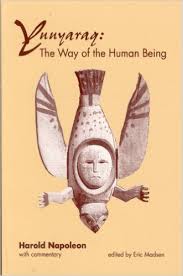
On The Way of the Human Being

Yesterday one of my very good students told me that he was driving through New York’s Finger Lakes region, not all that far from my campus.  He was enjoying a nice spring day, noticing the signs remaining from the heyday of the Anti-Indian group Upstate Citizens For Equality, and listening to one of the blowhards on right-wing radio.  Slim pickings, sometimes, in the Finger Lakes.  Whoever it was that he listened to argued that Native Americans need to move on and “Get Over It.” Stop whining and stop complaining. The injustices they suffered occurred a long time ago.

It is the end of the semester here at Geneseo.  All of us, I suspect, students and faculty alike, are limping into finals week.  The weather is turning nice, the flowers are blooming. It is difficult sometimes for students to focus on schoolwork. I get this.  The last reading I give to the students in my American Indian Law and Public Policy course is Harold Napoleon’s essay, Yuuyaraq: The Way of the Human Being.  It is, in places, a beautiful book, but a small number of my students were pretty hard on it. Disappointingly so.

Napoleon, a Yup’ik, wrote his essay in the late 1980s from a penitentiary in Alaska.  During a state of intoxication that he cannot remember, he killed his child. Napoleon wondered in Yuuyaraq not only how his story ended in prison–college-educated and capable, he had served his community by holding a number of leadership positions–but the larger story of what had happened to his people.

Yuuyaraq was, for Napoleon, a beautiful way of living. Indeed, his essay directly inspired the historian Calvin Luther Martin‘s beautiful but flawed meditation on the experience of native peoples in a book he wrote, also entitled The Way of the Human Being.    The human beings lived in a world in which they interacted with a range of spiritual forces, malevolent and otherwise, and a host of human and other-than-human beings. Ritual allowed this world to work.  Hunters made requests; hunters treated the animals they pursued with courtesy and so long as the animals were accorded the proper respect, no misfortune could befall the people. (Gregory Evans Dowd twenty-some years ago did a wonderful job of showing how these beliefs informed native peoples’ conduct and understanding of the cosmos in the first chapter of A Spirited Resistance, a book I sill assign in my classes).

Look at the primary sources.  Look at the extant accounts.  You cannot miss it. Napoleon discusses the primary sources. Following upon his work and that of a host of scholars and writers, Native American and non-native, I attempted to present this world of ritual and spiritual power in the opening chapter of Native America.  It is a world where native peoples paid close attention to ritual in order to deflect the wrath of malevolent forces whose ire could spell ruin for indigenous farmers, hunters, and warriors.

You also cannot miss when you look at these accounts how fragile all of this was.  Epidemic diseases tore gaping, jagged holes in the fabric of native community life.  For Napoleon’s people, the experience was a relatively recent one.  He writes of what his elders called the “Great Death,” which struck Alaska Native communities at the very beginning of the twentieth century.  60% of the people, the real human beings, died.

Wreckage. That is what Napoleon describes, and it is a painful read.  Other native peoples, whether recorded in white sources or in their own writings, have described the resulting chaos and pain in similar terms.  I think here of David Silverman’s searing portrait of Christian Indians in central New York who, when their white neighbors celebrated their independence from Great Britain and acted on their voracious appetites for Indian land, became convinced that they were a people cursed by God to suffer for all of eternity.  Or spelatch, the term Skokomish artist Bruce-subiyay Miller used to describe the world of change that came to his people after the arrival of Europeans.  The Skokomish “fell into disarray,” Miller wrote, his ancestors’ experience akin to that of “a shipwreck where everyone was trying to find something to cling to, to save their lives.”  As with Napoleon’s people, many turned to alcohol.  Some tried to assimilate, or turned to Christianity.  All of them struggled, for they found that “the things that they venerated, that gave them their vital life force and their strength for survival, suddenly were condemned as evil.”

A small number of my students, four out of the thirty in the class, thought that Napoleon was blaming the victims, but they badly misread his work.  The epidemic produced wreckage that most of us, mercifully, can only struggle to imagine.  The epidemics destroyed Yuuyaraq.  The survivors, Napoleon said, with their traditions , their customs, their networks of kin, and their very way of comprehending the cosmos destroyed, began to listen to missionaries who described their culture as sinful and demonic, their ways of living wicked.  Napoleon clearly did not blame the converts.  They were trying to get by, to make sense of a horrifying new world.  He described his people as victims of something very much like Post-Traumatic Stress Disorder, as victims of “cultural genocide” and a historical process that he described as “evil.”

When I teach Napoleon, I think often of the long poem that runs through Leslie Marmon Silko’s masterful novel Ceremony, which in its manner conveys something very powerful about the historical processes described in Yuuyaraq.  If you have not read it, you must. Though a work of fiction, Ceremony can work well in a history class. If you are a student, you can learn much from Silko about the horrifying new world the arrival of Europeans created for native peoples.

In the novel, Silko’s witches begin to duel, and conjure a horrifying vision.


Long time ago

in the beginning

there were no white people in the world

there was nothing European.

And this world might have gone on like that

except for one thing:

Witchery.

Silko’s witches told the story of the arrival of white people on American shores.  It was a horror story, for these newcomers

grow away from the earth.

Then they grow away from the sun

then they grow away from the plants and animals.

They see no life.

When they look

they see only objects.

The world is a dead things for them,

the trees and rivers are not alive.

The deer and bear are objects

They see no life.

They fear

They fear the world

They destroy what they fear

The fear themselves.

The white people would bring a New World to native peoples. The newcomers, Silko’s witches warned,

will kill the things they fear

all the animals

the people will starve…

They will fear what they find

They will fear the people

They will kill what they fear

Entire villages will be wiped out

They will slaughter whole tribes.

There were survivors, but they struggled with the horrifying consequences of this witchery.  Napoleon told his story, after all, from a prison full of Alaska Native who suffered from what one recent report labeled “Intergenerational Trauma.”  Martin, who taught at a penitentiary during a portion of the time he spent in Alaska, met men and women who found themselves incarcerated after committing horrible acts they could not remember.  They were struggling to carry the burden imposed by a legacy of unresolved grief.

Napoleon proposed solutions. He was not an expert, he claimed, nor a wise man.  But he had seen a lot and experienced a lot.  Talking circles, to open up, to restore shattered bonds, to heal.  It is hard to disagree with what he suggests. He was a humble man, and he has continued to struggle to meet the challenges communities like his face since he was granted parole.

Still, the problems remain.  In Canada, too, as the enduring epidemic of suicide in Nunavut attests.

Trauma.  An absence of well-being. Communities still struggle.  Get over it, they are told.  These are the words of white critics who are racist and stupid, and they can be dismissed as such.  But what to do?  In the United States, much of the talk about Native American communities focuses on economic development, sovereignty, self-determination.  Like justice, democracy and pizza, everyone is for these things, but what, really, do they mean?  And with the measure of self-determination and sovereignty determined by the governing structures of the settler state, or decided, as Roger Echo-Hawk put it in his too-long book of several years ago, in “The Courts of the Conqueror”?  How much can the governments of settler states do? What are they willing to do?  How much can their experts achieve?

Napoleon argued that communities needed to solve their own problems, to forcefully advocate for themselves to pursue changes in government policy but also to deal with the grief and heal.  In Wasase, Taiaiake Alfred, (who my students read as well) laments the limitations imposed by leaders who all-too-often act just like white politicians, administering the programs and policies put in place by the settler state.

Alfred, Napoleon, Martin–they are describing communities in the midst of complicated problems, and if we do not force our students to confront them we do a disservice to them as historians. Grief is a force in Native American history.  Read a bit, and you will find it hard to miss.

I know my students sometimes are asked why they are studying this or that field in the liberal arts.  What good is that? I’m willing to bet that if you are a student, you have heard it, too.  Maybe on our post-truth, alternative-fact world, history is not worth much to many of our leaders, but if we keep our eyes and our hearts open, and read with discipline, energy and compassion, we can arrive across the distance of time and geographic space at something close to understanding.  And that is no small thing.


Yeah, About that Issue of What is Fair and What is Unfair

A number of disgruntled readers of my piece on Donald Trump have reached out to me with angry emails.  My essay appeared in the Syracuse newspapers a week or so ago.

One reader raised an argument with which may of us who teach Native American history are familiar, and with which we must contend.  Referring to the Oneidas of New York, who operate a lucrative casino and resort complex a short distance from Syracuse and just off the New York State Thruway, this reader asserted that “the ‘sovereign nation’ concept is obsolete and unfair to taxpaying citizens.”

“Last time I checked,” he continued, “most Oneida Indians live within the borders of the US, the County of Madison and the town of Vernon, They drive their cars on public highways, are protected by our military, so on and so on, just like me.”

Oneidas did everything this writer did, he argued, “except pay taxes.”  Asserting that Indians have unfair advantages, he declared that “it’s time to level the playing field.”

If you teach Native American history, you have likely encountered these sentiments before.  If you are a student in a Native American history class, it is a safe bet that some of your classmates share these views.  They are not uncommon.  I heard them when I lived in Montana.  They were for many years the lifeblood of the anti-Indian sovereignty group Upstate Citizens for Equality, which opposed Indian gaming and other commercial operations in New York state and Indian land claims.  Some of their signs still dot the roads coursing through New York’s Finger Lakes region.

We could, I suppose, dismiss these views as anti-Indian racism.  That, in my view, would be a mistake.  We need to engage.  We need to educate, and tackle views such as these head on. Our students, after all, learn nothing about concepts like tribal sovereignty and the place of native peoples in the American constitutional system and, at best, little about Native American history. At times, views like these are expressed with such vehemence that we might feel as if we are casting our pearls before swine, but I believe that these are teachable moments. And I would argue that we let these opportunities pass us by at considerable cost.

When I face views such as these, I try to concede a few points. In other words, if one sets aside the entire historical experience of the native community in question–which historians are always reluctant to do–it might seem that native peoples have certain “advantages.”  But these so-called advantages are often misunderstood, or based upon fallacies, or a lack of information about the constitution and American Indian history.

Sometimes I find this stuff difficult to explain.  Sometimes I think the people who write to me really do not want to hear a history lesson, or an explanation for how things came to be.

So I begin with the fact that native peoples belong to polities that predate the United States.  Under American constitutionalism, native nations retain by virtue of their inherent sovereignty the right to govern most of their own affairs, on their own lands, so long as they have not explicitly lost those rights by virtue of an act of Congress or a treaty, or implicitly because the practice in question is somehow inconsistent with their status as domestic dependent nations.  I will point out that to a great extent they have lost criminal and civil jurisdiction over non-native peoples who own land on their reservations, but that they retain considerable power still.  I point out that over the course of the last forty years the Supreme Court has weakened significantly the powers of tribal governments.

So much for the Constitution.  I also point out that the notion that “Indians pay no taxes” is an oversimplification.  Native Americans pay federal taxes, even when that income is earned entirely on a reservation. States and localities do not have the constitutional right to tax economic activity by native peoples on Indian land.  (The most useful discussion of this issue appears in Chapter 10 of Stephen L. Pevar’s The Rights of Indians and Tribes, (4th ed., 2012)).  I am willing to concede that this might pose a competitive disadvantage to non-native businesses located in the vicinity of Indian reservations, but that this is not simply a product of “special treatment” or an “uneven playing field,” but because of the language of the Constitution which places Indian affairs under the control of the federal government.  I point out that in a number of instances, Congress has allowed states to exercise its authority in Indian country.  This is the case in New York State.

I have been at this a long time. Racism towards Native Americans is a real thing.  The inequalities experienced by native communities are significant.  The statistics do not lie.  New York became the Empire State, as Laurence Hauptman has so ably shown, through a systematic program of Iroquois dispossession. You could not have one without the other.

The transactions through which New York acquired Iroquois land happened a long time ago, but these were transactions that violated federal laws the United States lacked the power and perhaps the willingness to enforce.  The Supreme Court has held that these transactions occurred so long ago that nothing can be done to right these wrongs, but that does not mean that the rights retained by native peoples should be ignored.

New York’s native peoples have seen, through a long history, their homelands invaded.  They experienced waves of epidemic disease.  They faced dispossession, and then the effort to “remove” them to new homes in Arkansas, or Wisconsin, or the Indian Territory, and then to re-educate their children, and disable their governments.  Disease, warfare, dispossession, diaspora: the injuries occurred a long time ago, but their legacies remain.  And now, when a community like the Oneidas manage to bring a measure of prosperity to their homelands, after the withering trauma of history, there are those non-Indians who cry out, “Wait! This isn’t fair!”

Give me a break.  Look at the ground underneath your feet.  If you believe that laws matter, that the Constitution matters, that the pledges in a treaty that guarantees to the Six Nations the right to “the free use and employment of their lands” matters, then drop the whining about what is or is not unfair. Please.  I was writing about something else, a president’s name-calling that I considered racist.  Stop sniveling about fairness.  It is not a good look.  It makes you sound racist.


The Winters Doctrine and Dakota Access

After class a couple of weeks ago, one of my students asked me why the Winters decision had not played a larger role in the Water Protectors’ efforts to defeat the Dakota Access Pipeline. The students had read Winters v. US (1908) and they had been following closely developments at Standing Rock in their current events reading.

I have been teaching college history for a long time, but I am still reminded quite often how much there is that I do not know. My very best students frequently drive me back to the piles of books in my office, or to the library, or to the wonderful world of resources available online.  Sometimes their questions force me to ask my friends—historians, anthropologists, and, in this instance, lawyers—for guidance.  I learn a lot through teaching.  It is why I am so happy and feel myself so fortunate to be at Geneseo.

Winters, as Charles Carvell noted in an extremely useful article that appeared in the North Dakota Law Review, is quite simply a phenomenal ruling. “It occurred at a time,” Carvell writes, “when Indians wars were not distant memories and when federal Indian policy was      not to promote or even protect Indian interests but to break apart tribal communities and assimilate Indians into white society.” This was, Carvell continues, the era of Allotment, and of boarding schools—a full court press against native peoples and their cultures.   “The decision occurred at a time when the disappearance of ‘the Indian’ and Indian tribes was thought to be at hand.  It was issued a few years after Lone Wolf v. Hitchcock,” the 1903 decision that recognized the plenary power of Congress over Indian affairs and the ability of Congress, unilaterally and regardless of context, to abrogate an Indian treaty.  Winters was litigated as settlers crossed the Plains in droves. Still, “despite the milieu in which it was litigated, the Winters decision protected tribal interests.”

How did it do that? The Court held that when Congress established an Indian reservation, it established as well a right to the water necessary for that reservation to achieve its purposes.  Since one of the stated goals of the reservation policy involved leading native peoples towards what the federal government and many reformers considered a civilized way of life—and in this instance the native peoples in question were the Gros Ventre and Assiniboine communities residing near the Milk River on the Fort Belknap Reservation—that meant guaranteeing them the water they needed to undertake stock-raising and agriculture.  Thus the Winters Doctrine. Settlers upriver had diverted waters from the Milk River and this, the Court held, was unlawful.

So at the very time that Congress was seeking to dispossess native peoples and eradicate their culture, the Court, in this quirky case, recognized that these reservations had a claim to water superior to that of the settlers who coveted this vital resource.

Water is essential on the plains.  As the Water Protectors have asserted, “water is life,” and in their view, the Dakota Access Pipeline jeopardized waters flowing through the reservation.  As early as 1976, according to Carvell, the Standing Rock Sioux Tribe asserted that it controlled water and other natural resources on its reservation. The Standing Rock Sioux that year began demanding that all users of water obtain the approval of the tribal government.

And the Standing Rock Sioux have not only stated that they have control over their waters, but they have acted on their words. “They have developed on-reservation water resources, and reject any notion that in doing so they are subject to state regulatory authority. They have developed,” Carvell continues, “irrigation projects and water for domestic, municipal, and government purposes.”

Standing Rock, in other words, has asserted that its reservation was established as a permanent homeland and, as a result, that it “is entitled to use all water necessary to make itself economically self-sufficient, and because what is necessary to ensure self-sufficiency is never stated the tribe’s water right is ‘inherently unquantifiable.’” The scope of their claim is immense, extending to “the full spectrum of uses necessary to the ‘arts of civilization.’”

It is not difficult to imagine that an oil spill or a pipeline break upriver would threaten these water resources. Pipelines break. They leak. Oil spills.  It has happened in the vicinity of the Dakota Access in recent months. It is obvious that these accidents would threaten tribal water resources.  But North Dakota is unique in terms of western water law. The amount of water to which tribes in North Dakota are entitled has never been quantified, and as a result, one might argue that the Winters doctrine has, strictly speaking, never been applied to Standing Rock and other reservations in the state.

The efforts of the Water Protectors and their lawyers to obtain restraining orders to prevent the completion of the Dakota Access pipeline did not address these issues.  Nor have treaty guarantees and other matters received a full airing in court.  Needless to say, if the Dakota Access Pipeline is completed, and it is beginning to look like that is what is going to happen, many of the most pressing historical and legal question will not have received a full hearing.  And that, along with President Trump’s determination to undermine the Environmental Impact review, makes this episode even more disappointing and unfortunate than it otherwise might have been.

The Case for Civic Engagement

I published an opinion piece in the Rochester Democrat and Chronicle today, “The Case for Civic Education.”  I argued that one possible explanation as to why so many of Donald Trump’s supporters have accepted his trampling upon the Constitution is because too many Americans are unfamiliar with the country’s basic institutions, its history, and what the Constitution says.

I believe strongly that historians, and other academics, should engage the public.  We should write in defense of our disciplines.  We should advocate for our disciplines.  We should preach from the highest hills that history education, and education in the liberal arts and humanities generally, is vital to the functioning of a democratic republic because it equips citizens to participate in a mature, reasoned, and constructive manner.

The essay has drawn a bit of fire, but not nearly as much as I would have liked. I want to argue about these issues, and I want to have a debate.  So I will write.  It is the best way I know to engage with a broader public, to at least provoke some thought.

Alas, the D&C wants its opinion pieces short, 450 words, so there is not a lot of room to elaborate.  And for inexplicable reasons, the editorial staff decided to cut out the opening paragraph to the essay, despite the fact that I submitted a piece that came in below their word limit.  Maybe that opening was a bit inflammatory, but I do not think so.  The actual essay reads as follows:


A large minority of the voters who cast ballots last November chose Donald Trump to be their president, a choice endorsed and approved by the Electoral College, that antidemocratic anachronism designed to ensure that slaveholders controlled the national government.

            You have read in these pages many explanations for Trump’s unexpected victory. I would like to add another.  A significant number of voters cast their ballots for a bullying narcissist with little knowledge and less respect for American constitutionalism because they simply do not know enough about the Constitution, America’s political institutions, and the nation’s long struggle, in the Founders’ words, to “form a more perfect union.”  They can excuse Trump trampling over the Constitution because they do not know what the Constitution says.

            Let’s face it: despite a nationwide commitment to standardized testing, the social sciences, humanities, and liberal arts have been under attack.  We need “more plumbers and less philosophers,” said Marco Rubio during his brief quixotic run for the presidency.  The Lieutenant-Governor of Kentucky urged students not to study history but, instead, to focus upon something useful. Even Governor Cuomo, in his otherwise laudable proposal to provide tuition-free access to SUNY schools, promoted the program as a way for the state to produce more skilled workers, not informed citizens equipped to participate in American democracy in a meaningful and constructive manner.

            Education in history and the liberal arts, however, produces citizens capable of asking the tough questions and looking for answers in all their complexity.  They do not settle for simple solutions and pat answers. They know how to question assumptions, and demand evidence.  Civic education leads to responsible and mature civic engagement. Little wonder, then, that these fields of study are devalued and dismissed.

            Less than a third of Americans last year could identify all three branches of the federal government.  Another third could not name a single branch.  Many times more Americans can identify all five members of the Simpsons family than the five freedoms protected by the First Amendment. 

            The Founding Fathers argued that a flourishing republic needs citizens capable of displaying the virtue to set aside their narrow self-interest and petty fears and jealousies in order to pursue the common good.  They argued that citizens must be independent, informed, and active. An ignorant and quiescent populace, they feared, made fit tools for a tyrant.

            I cannot predict what will happen over the next several months and years. But I have watched the protests. We must do more, I believe, to engage the public, explain how our institutions are supposed to work, and protect them from a presidential administration that threatens the country’s fundamental aspiration of liberty and justice for all.


The evidence to support my assertions is not hard to find, and we should consider this evidence closely.  We have our work cut out for us.  Rick Shenkman, for one example, summarized some of the findings of his Just How Stupid Are We at Alternet.  The Annenberg Center for Public Policy in 2014 released a study in 2014 warning about Americans’ lack of basic civic knowledge.  Jason Brennan’s analysis from 2016 in Foreign Policy raises some points worth considering.  And the American Council of Trustees and Alumni found that American college graduates are “alarmingly ignorant of America’s history and heritage.”

This should disturb us all, regardless of the political party which claims our allegiance, regardless of who we voted for in the primaries or the general elections.  These results are a call to action. The challenge will be mustering the courage to answer that call.

I like to write opinion pieces. It is important for us all to bring our expertise to bear on public debates, and to make our voices heard.  Doing so requires a willingness to take some heat, some criticism that can be really, really vicious at times.  In my view, it comes with the territory. I could fume to my friends on Facebook.  I could bitch and whine or yell at the television set.  Better it seems to me is the effort to engage with as large a public as possible, to challenge assumptions, to offer explanations, and to provoke discussions.


Letter to that Lame Provost in Montana–Some thoughts on History and the Liberal Arts

Dear Provost,

I’ve been thinking a lot about a piece Timothy Egan wrote that appeared in the New York Times back in August. Egan lamented “our Dumbed-Down Democracy,” and saw in the rise of Donald Trump evidence of a failure in, among other things, American civic education.  If Americans knew their constitutionalism, Egan argued, they would be less likely to support a candidate who showed no concern for the American constitutional tradition.  “The current presidential election,” Egan wrote, “may prove that an even bigger part of the American citizenry [Bigger than the thirty million adults who, Egan asserted, cannot read] is politically illiterate—and functional.  Which is to say, they will vote despite being unable to accept basic facts needed to process this American life.”

There has been no shortage of opinion pieces and analyses like Egan’s in recent months.  As a college professor, as a teacher of history and the humanities at a school where, fortunately, these subjects are still valued, I wonder about whether any of the current state of affairs can be laid out our steps.  Are we doing enough to produce critical and informed citizens? Should we do more?

A long time ago when I taught at your college in Billings, Montana, you emphasized that we should be doing “applied research.”  We should strive to be relevant.  I was untenured, and in a deeply dysfunctional department.  You were no help on that front, either. I understood that to survive as a professor I needed to toe the company line. But what on earth did “applied research” mean? I was a historian with training in early American and Native American history.  How, I asked, would I cast these interests in a project that you would consider “applied” and relevant?

You did not expect the question, and I never got a meaningful answer, but I could see plenty of problems on campus. As you might remember, Native American students were the largest minority on campus, and many of them traveled a long way from the Crow Reservation to attend their classes.  There were those on campus who did much to make the college a welcoming environment—staff and faculty.  They did good work.  Students could use Crow to fulfill the college’s foreign language requirement, for instance, and the Intertribal Indian Club was a valuable and effective resource.  Its annual powwow, a beautiful and inspiring event held off campus, was the college’s largest student-sponsored event.  I do not think you knew that.  In the four years I was in Billings, neither you nor the President ever attended because, in the President’s words, it was a thing “for Indians.”

There were a lot of problems on campus. Financial aid was limited.  Some faculty embraced stereotypical and, in places, racist views of Native Americans that could create an incredibly hostile environment on campus.  Many faculty, acting on an assumption that Native American students would not speak up in class, never bothered to reach out.  I heard faculty say, about a student who did well in a class, that “she did really well for an Indian.” I told you about this.  You said something along the lines of, “Yeah, sometimes the Crows will really surprise you when they do well.”  Again, untenured.  I did not tell you how screwed up I thought that was.

But I watched this environment.  Coming from southern California, this was all new to me.  There was an event that caught my attention. I thought it would fit your description of an “applied research” project.  Down in Hardin, a town that borders the Crow Reservation, a series of ugly racial incidents took place.  I do not remember all the details, and I am sure you don’t either. There had been some sort of cultural awareness day at the high school. A significant number of white kids, with their parents’ support, stayed home.  Took a walk.   The Crow kids made some noise about this and, the next morning, distributed on driveways in Hardin was some racist, Christian Identity literature, and texts like “The White Man’s Bible”—really vile stuff.

That’s what I heard.  I heard a lot of stuff. I went down to Hardin.  Tried to talk to some locals.  I couldn’t blend, really. A friend of a friend put me in touch with a local minister, and I talked to her for a while.  She confirmed that there was some ugly and really open racism in Hardin, but also that there were good people trying to make things better. To investigate this problem, would require getting into the community, spending a lot of time, watching and listening and talking.  Producing a piece of “applied” research, then, would be difficult.  I lived sixty miles from Hardin.  I was a single parent, at the time, and I taught seven courses a year.  Time was short.  I could not get into the community enough to understand what these white people were thinking.

I could talk to my Crow students who had attended Hardin High, however. I persuaded a number of them to allow me to record interviews with them. I still have the microcassettes in my desk at Geneseo, even though I no longer have anything upon which to play them.  They spoke of the white ranchers’ kids who drove to school in their big, new trucks, paid for from the proceeds of ranching operations on land that had once belonged to the Crows. They spoke of intimidation.  Of gym teachers who told kids to take a leak before they went out for PE, “because they need something to drink down at Crow.”

When I was a student at Cal State Long Beach, one of my professors in American Indian Studies told me that interest in Native American studies among white people decreases in direct proportion as you get closer to Indian country.  And that seemed to be the case in Billings.  A lot of the people in my classes did not want to hear about racism at Crow, and the statistics that testified to the continuing impacts of colonialism and discrimination.  You and the President proved the truth of that statement, too.

I never did anything with those tapes.  Never did an “applied research” project that accorded with your hazy standards.  But I did keep plugging away at my own research in Early America, and Native America, and I continued to try to improve myself as a classroom teacher.   And I left Billings, and found a job at a wonderful college in the Finger Lakes region of western New York.

I do not like to enter into the debate over what a degree in history is worth in monetary terms, because it brings us value in other ways.  I have drawn upon the advice of so many people, and that advice informs how I teach.  I tell my students that we are the ones who question everything.  I tell them that  I love the questions—the search for answers, the complexity and the absolute lack of definitive answers sometimes, and the stories—the stories are at the heart of all that we historians do as teachers and writers.

In history, these stories can be tough to handle sometimes.  Particularly in my field, I read about horrifying acts of violence, greed, viciousness, and hatred, all the ways in which war is a violent teacher.  It can get you down sometimes, and history can be a brutal business.  But, once in a while, there are these amazing stories: of selflessness, of grace–and of courage.  And I tell them, that to the utmost of their ability, they should try to be intellectually fearless, and to have the courage to not shy away from those things that seem extremely difficult.  To be honest, curious, inquisitive, and relentless to be sure, but most of all, in terms of the questions they ask, the evidence they consider, the ideas they engage with, and the theses they advance, to be as fearless as they can be.  Now, on this campus, in this country, in this global community, more than ever.  This is History, Applied.

My students now live in a world where too many people confuse their feelings and their fears for facts, where being smart and engaged and critical and willing to ask questions can make one an object of scorn.  They live in a world as well where complexity is so often dismissed, where big and difficult answers to the big questions are avoided, that asking these sorts of questions can take a certain amount of courage.  They live in a world where, when we stand up in the face of these problems and ask, “Why?” and when we insist on a reasoned and relevant response to that simple question—it is like an act of subversion, and subversive acts, even small ones, require a degree of courage and fearlessness.

I tell my students this, and that their studies can help them makes sense of this world.   Looking at the spectacle of public life that my generation is in the process of bequeathing to their generation, I tell them, it might be easy to slide into a deep cynicism, but cynicism is an intellectually lazy position, a sort of cop out.  It can take courage to trust and to respect and to appreciate, as well as to care and to love, and to accept the validity of ideas presented by those with whom we would be predisposed to think we might disagree.  To never underestimate others, to take people seriously, whoever that person happens to be, to accept the possibility that those with whom we disagree might have a point and, indeed, to admit that we might be wrong.  To appear vulnerable in the face of those who despise us.  That is not an easy thing to do. That takes courage, and a willingness—a commitment—to approaching everything and everyone with a readiness to see goodness and to be surprised.

It is easy to feel like the challenges we face are too big and it is possible, I think, that we all feel at times like we are not enough to make a difference—that we need to be wealthier or have more expertise or access or whatever.  But what if we used our skills and our thoughts and our reason and acted as if we were exactly what was needed? How would we live or have lived if we were exactly what is needed to solve those things we see as problems? If we knew we could close the gap between the way things are and the way things ought to be, even a little bit, would we have the courage to act?

I am not sure what you would say to these questions.  I do not know that you would agree that the power of history, whatever the subfield, is that it allows us to share in the experiences of people far removed from us in space and time, to take part in our broader, shared, humanity.  That was never something you valued.  You wanted the standards low, the seats full.   I know that.  So I thought of you when I read Egan’s piece. You never realized the merits of the liberal arts, the power of ideas, the feeling of connection one can achieve when they study the past.   You left Billings, and became the president of a small college in a similarly red state, I think, but I did not pay any attention.  But I do know this: history and the liberal arts empower our students to be curious, kind, and fearless in an informed way that makes our world a better place.  That is something that transcends price and simplistic ways to measure learning outcomes.