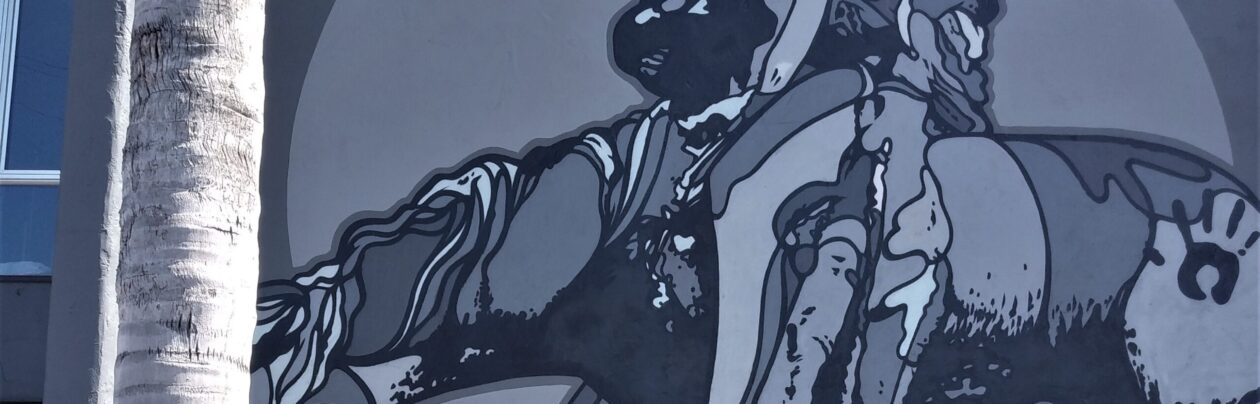
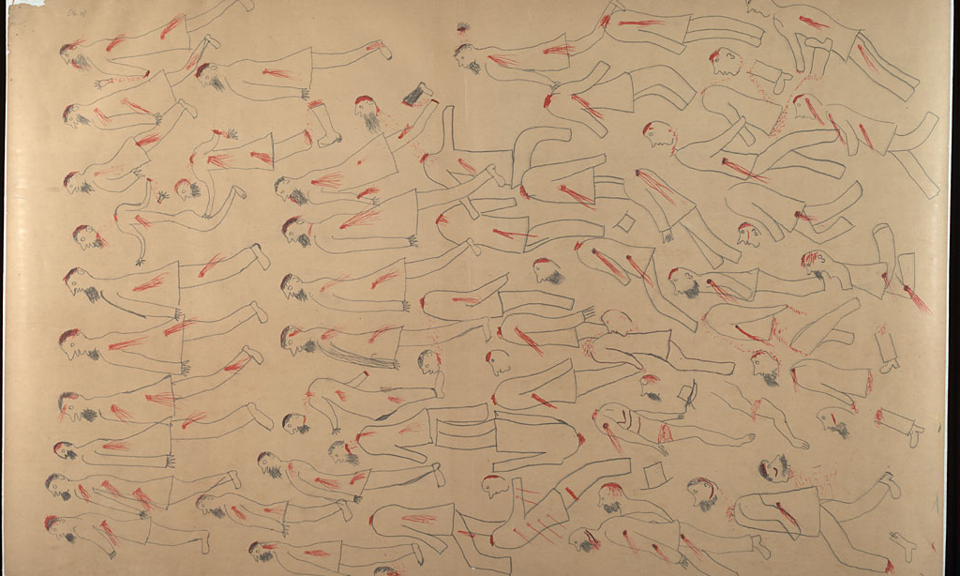
Whatever you call him, George Armstrong Custer was an American military leader who had no ethical problem with bringing the “horrors of war” to unarmed and innocent women and children. As we reach in this year of commemoration the 150th anniversary of his death at the Battle of the Greasy Grass on June 25th, 1876, it is worth keeping that in mind.
Long ago, when I lived in Billings, a friend and I drove out to a ranch on the Crow Reservation in Montana. A promoter had scheduled a reenactment of “Custer’s Last Stand.” We took our seats in the bleachers. Crow actors played the Sioux and Cheyenne warriors who wiped out the American forces. A traditional Crow healer blessed the actor playing Custer before the show began. And, then, the actor playing Crazy Horse galloped into our view. He stared down the audience, let out a war whoop, and then galloped off at full speed. It was a striking and startling opening. Immediately afterwards, the father of a white family seated in front of us turned to one of his tow-headed children and said, “There you go, Courtney. You’ve seen your first real Indian.” He could not see that the audience that surrounded him was made up overwhelmingly of Indigenous people from the Crow and neighboring Northern Cheyenne Reservation. They were decked out in t-shirts and jeans, baseball hats and cowboy hats and boots and sneakers. They were invisible to him.
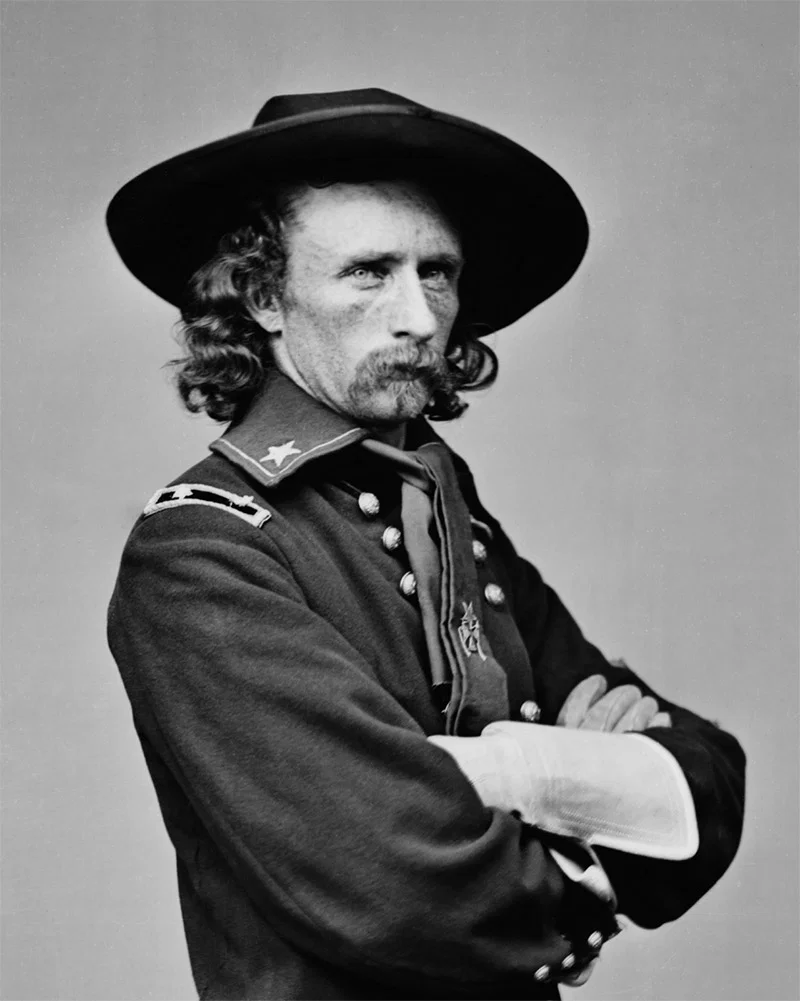
Custer saw little worth saving in Indigenous peoples. He wanted them, and their way of life, to disappear. Custer was not alone. The poet Walt Whitman wrote a “Death Sonnet for Custer,” asserting that his resounding defeat
Continues yet the old, old legend of our race!
The loftiest of life upheld by death!
The ancient banner perfectly maintained!
(O lesson opportune—O how I welcome thee!)
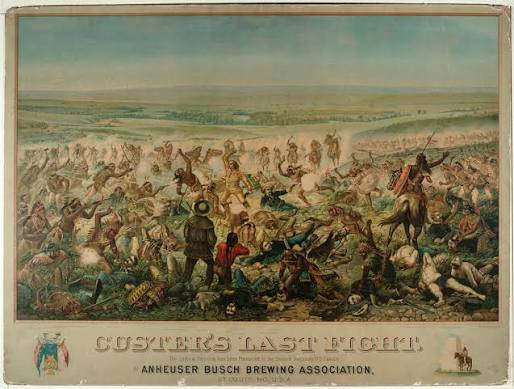
Custer died for us, Whitman asserted, paying the necessary price for civilization to conquer barbarism. It’s an image of Custer that enjoyed a long life. Look at depictions of Custer in art: There he is, standing in his bright buckskin, long locks flowing, in the midst of a sea of savages. Custer fell, yes, but the Indians who killed him would fade away as well. Custer marched with orders to push them on to reservations; others would cart Indigenous children off to boarding schools, attack their religions, and coerce culture change. Except it did not happen quite that way. Custer was no martyr. He was a violent fool. And with difficulty the people he attacked persisted.
I like much better the image of Custer portrayed by Richard Mulligan in Arthur Penn’s film “Little Big Man.” It’s the story of Jack Crabb, the oldest and only survivor of the Battle of Little Bighorn. Played by Dustin Hoffman, Crabb had lived among the Indians, and he had been along the Washita River in 1868 when Custer’s forces launched their infamous attack. On the 1876 campaign, Hoffman’s Crabb served as a scout for Custer, who asked him about the Sioux village along the Little Bighorn.
Crabb: General, you go down there.
Custer: You’re advising me to go into the Coulee?
Crabb: Yes, sir.
Custer: There are no Indians there, I suppose.
Crabb: I didn’t say that. There are thousands of Indians down there. And when they get done with you, there won’t be nothing left but a greasey spot. This ain’t the Washita River, General, and them ain’t helpless women and children waiting for you. They’re Cheyenne braves and Sioux. You go down there, General, if you’ve got the nerve.
Custer: Still trying to outsmart me, aren’t you, mule-skinner? You want me to think that you don’t want me to go down there, but the subtle truth is, you really don’t want me to go down there!”
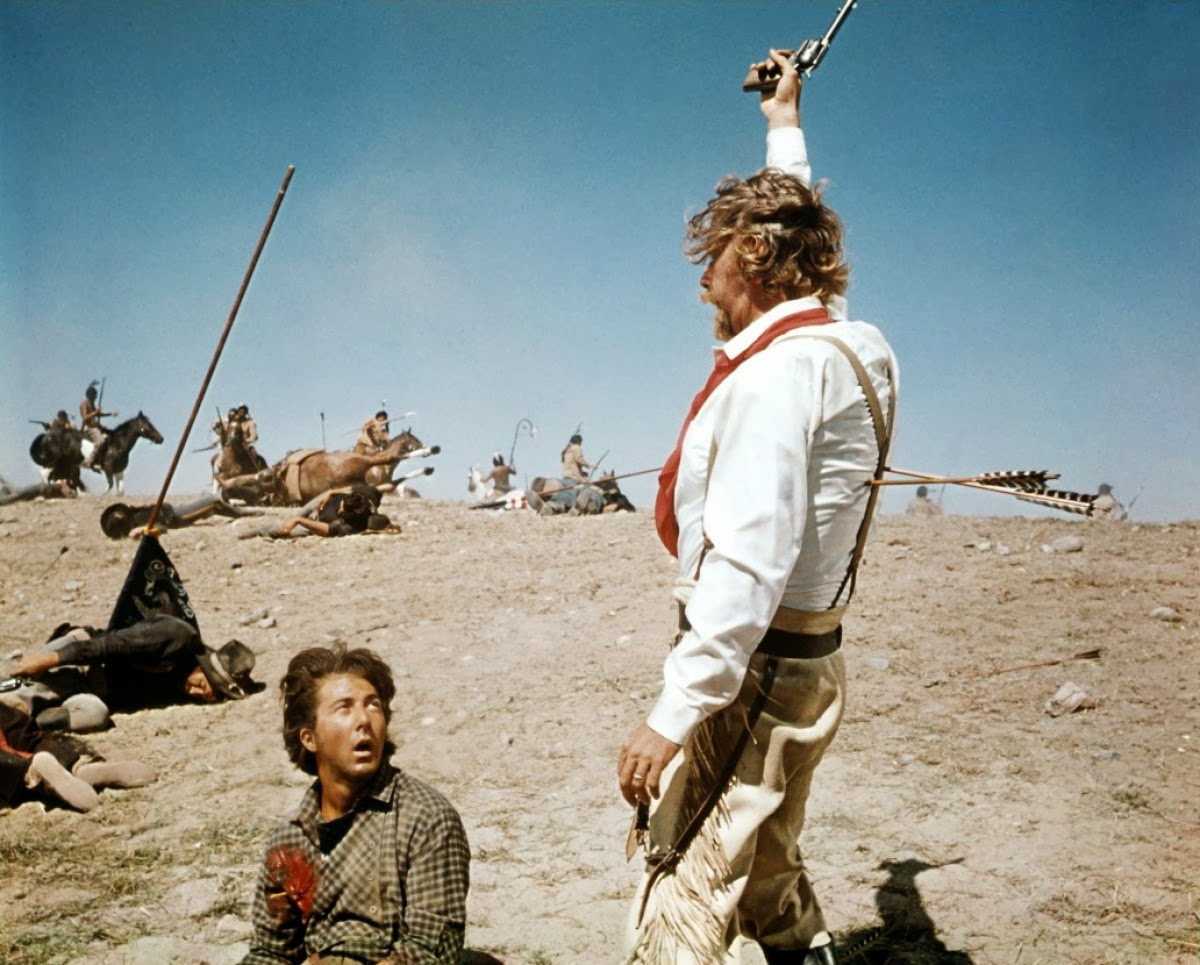
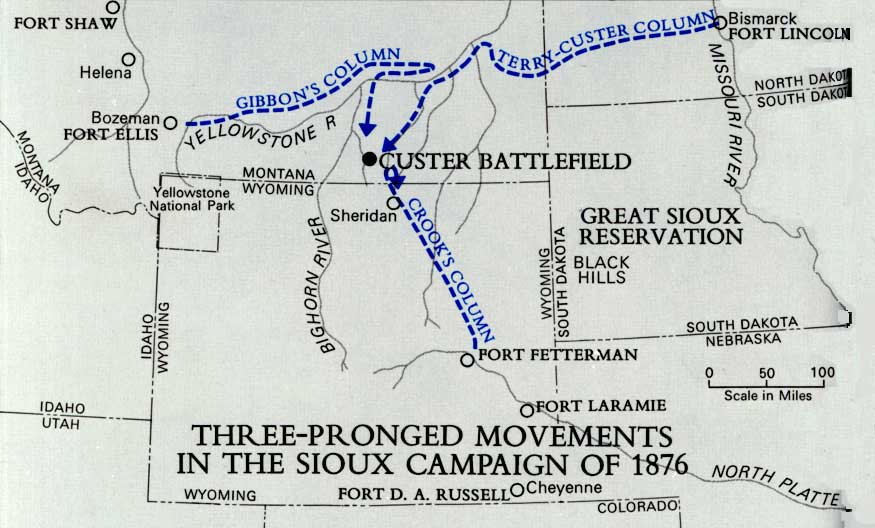
Reassured, Custer launches his attack. Two thousand warriors camped there out of his sight. They determined to defend themselves and their families. Depicted so often in American myth as a famous “Last Stand,” Custer’s defeat was a rout. The Sioux and their Cheyenne allies mowed them down as they fled from a village so much larger than they had anticipated. The Sioux wiped out Custer’s command in the time, one Sioux observer later noted, that it took a hungry man to eat his dinner. Only Custer’s Crow and Arikara scouts, who recognized the power of the Sioux, survived the assault.
The Lakotas won the battle, but they lost the war. That’s how the story is told. Once again, as in 1868, winter campaigns drove the Sioux and their allies back to the reservation. By the spring of 1877, most had returned. Crazy Horse surrendered at the Red Cloud Agency in May. He died four months later, stabbed to death during a guardhouse scuffle. Sitting Bull, who had fled across the border into Canada, held out until 1881, before he returned. He was gunned down late in 1890, just days before the massacre at Wounded Knee.
The campaign of 1876, and those that followed, taught the slow-learners in charge of the Bureau of Indian Affairs to reconsider their approach. They recognized the extent to which they relied upon violence, coercion, and conquest to place Indigenous peoples upon reservations and to keep them there. Reservations had once seemed an attractive solution to what these men deemed the “Indian Problem.” By concentrating and isolating Indigenous peoples from the vices of the surrounding white population, the reservation, its advocates hoped, bought them time to become civilized and Americanized. But neighboring whites seldom respected reservation boundaries, and corrupt government agents undermined the paternalistic concern of the federal government to care for its Indian wards. Congress failed to provide reservation Indians with the supplies they needed to undertake the great transition their White Father envisioned. Indigenous peoples found themselves under siege. They no longer could live their accustomed way of life in their homelands. Neither could they live well on the reservation. Whether they moved to the reservations voluntarily or as the result of military conquest, they suffered. But they did not disappear. Despite the efforts of federal agents, missionaries, and teachers to eliminate their culture, and despite their own decisions to make use of some of what the Americans offered them, these communities survived.
This year is the 350th anniversary of the attempt to eradicate Virginia’s Indigenous people during a genocidal uprising known as Bacon’s Rebellion. It is, of course, the 250th anniversary of the Declaration of Independence which unified rebellious colonists around their hatred of “merciless Indian savages.” It is the bicentennial of the 1826 treaty at Buffalo Creek, an agreement through which a business operation known as the Ogden Land Company and their friends in high places stole a third of the Senecas’ remaining lands in New York State in violation of the federal Indian Trade and Intercourse Act. And, today, the we commemorate the defeat of a foolish proponent of genocide and the men who followed him.
I am not sure what sort of commemorations will take place in Montana. Custer seems like the kind of guy Trump would want celebrated. I remember the plaque erected at the Little Bighorn National Monument by a group of activists led by Russel Means in June of 1988. It read: “In honor of our Indian patriots who fought and defeated the U. S. Cavalry in order to save our women and children from mass murder. In doing so, preserving our rights to our homelands, treaties, and sovereignty.”
That plaque was on display when I first visited Little Bighorn in the fall of 1994. I was told at the time that the first Native American director of the National Monument was spit on by white visitors who grew angry when they saw the plaque in the small museum at the Visitor’s Center. I am not sure if it is still there, and its been thirty years since I last visited. But I remember well that the Trump administration, just four months ago, ordered the removal of “signage describing broken promises to Native American tribes and references to the loss of Indigenous culture and language under boarding school systems.” The white supremacists nourished by the MAGA movement share the views of Custer. On this commemoration, let’s call them by their true names.