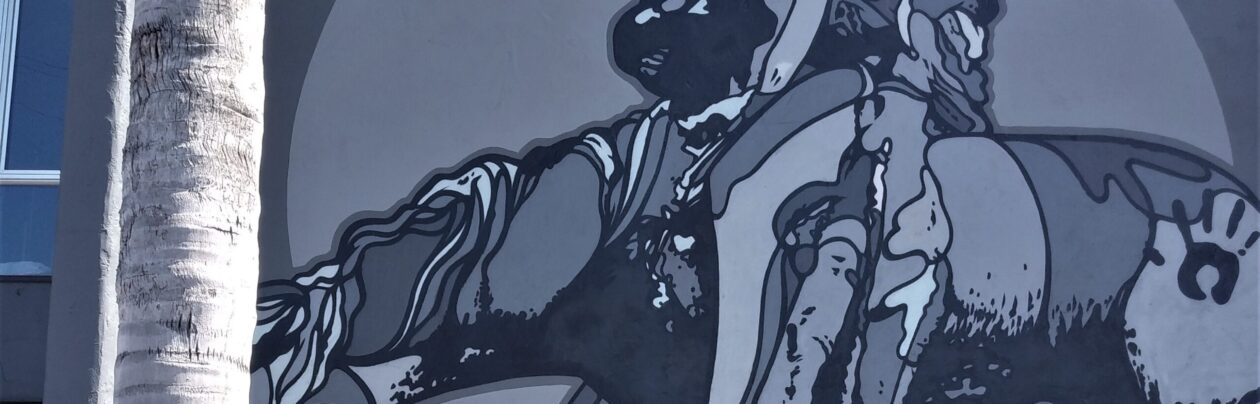
It is important to remind my students that when we discuss the crisis of missing and murdered Indigenous women and girls quite often we are talking about people younger than they are. Like Kaysera Stops Pretty in Places. She was eighteen, played basketball and ran cross-country. She performed in school plays at Hardin High School near the Crow
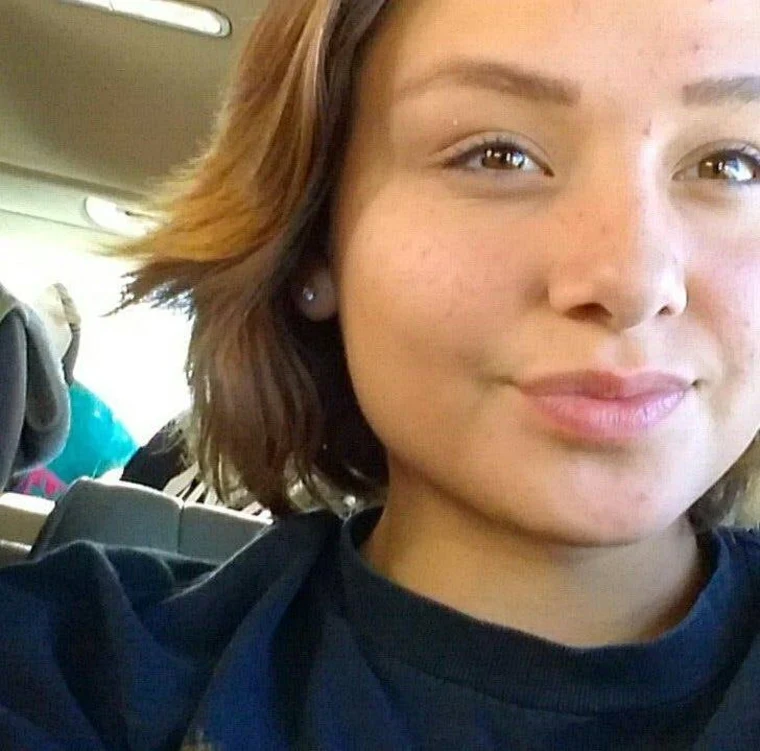
Reservation in Montana and wanted to act. She had been at a house party, but disappeared. She was found several days later, by a passerby, who discovered her body behind a woodpile in the backyard of a different house. I do not know how she got there, and her cause of death is “undetermined.” In March of 2025, Natosi Summers pleaded no contest to felony criminal endangerment. He was sentenced to three years’ probation but no jail time. It is unclear from the media reports what role Summers played specifically in Kaysera’s death. Whatever Summers did, we have a dead child in a reservation border town. The United States Bureau of Indian Affairs says that there are approximately 4200 unsolved cases of missing and murdered Indigenous women in the United States, with many experts believing that this number is a significant under count. There are thousands more in Canada.
Do you remember a time when your parents did not know where you were? Maybe you were out with friends, partying, having a good time. When you finally came home, your parents let you have it. It may have seemed to you that they were angry but I can tell you from experience that they were scared. There is nothing that frightens us more than the possibility that something bad might happen to you. Nobody can hurt us more than the person who hurts you.
So imagine what your house looks like, sounds like, and feels like, if you do not come home. Your parents stand and watch and wait and slowly come to the realization that they will never see you again. What would it do to your family to lose you?
This heart-breaking experience happens in thousands of Indigenous homes across the United States and Canada. Only because of the pressure placed by Indigenous women have settler governments begun to act. In the United States, a critical part of the story involved a young Indigenous woman in North Dakota. Brooke Crews, a white woman, butchered Savanna Greywind. Crews wanted a baby, and her young neighbor was eight months pregnant. On the night of 17 August of 2017, Crews lured Greywind into her home. She knocked her unconscious. While Savanna was still alive, and passing in and out of consciousness, she cut the child from her womb. When Crews’ boyfriend arrived, she presented him with the baby. “This is our baby,” she reportedly said. “This is our family.” Together, they cleaned up the blood. Together they disposed of Savanna’s clothing. And, together, they wrapped her body in plastic sheeting and dumped her in the Red River, where kayakers found her body sometime later.
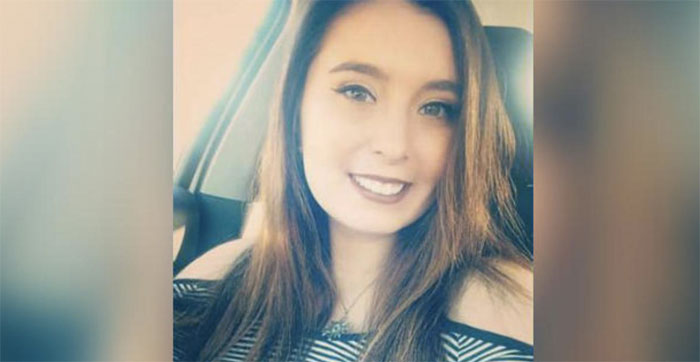
It was a horrifying crime. In response to Greywind’s murder, North Dakota Senator Heidi Heitkamp introduced “Savanna’s Law,” to “help address crisis of missing and murdered Native American women.” Specifically, the act was designed to:
- Improve tribal access to certain federal crime information databases. The bill would update the data fields to be more relevant to Native Americans, and mandate that the Attorney General consult with Tribes on how to further improve these databases and their access to them. The Attorney General would then submit a report to Congress on how the U.S. Department of Justice plans to implement the suggestions and resolve the outstanding barriers Tribes face in acquiring full access to these databases.
- Require the Attorney General, the Department of the Interior, and the Department of Health and Human Services to solicit recommendations from Tribes on improved access to local, regional, state, and federal crime information databases and criminal justice information systems during the annual consultations mandated under the Violence Against Women Act.
- Create standardized protocols for responding to cases of missing and murdered Native Americans. These protocols would take place in consultation with Tribes, which would include guidance on inter-jurisdictional cooperation among tribal, federal, state, and local law enforcement.
- Require an annual report to Congress with data. The report would include statistics on missing and murdered Native women, since there is little data on this problem and there isn’t a central location for keeping that information. The report would also include recommendations on how to improve data collection.
It was an important first step, but Heitkamp was defeated in her reelection campaign in 2018. She was not in the Senate when President Trump signed Savanah’s Law in 2020.
SIX YEARS AGO TODAY, President Trump proclaimed May 5th “Missing and Murdered American Indians and Alaska Natives Awareness Day.” He appointed a task force, dubbed “Operation Lady Justice,” to investigate the problem of MMIW and MMIWG. Trump was the first American President to place it on the national agenda.
Yet little came of the effort. COVID, of course, limited the work that Operation Lady Justice could undertake. But the pandemic cannot excuse the ideological and political barriers that the Trump Administration would not cross, and its real commitment to the issue was shallow and so limited as to be effectively meaningless. As Native Americans who attended the various listening sessions held by the task force pointed out, the President’s approval of pipe lines and other projects brings large numbers of non-native “man camps” into areas close to Native American communities. Many observers have asserted that a relationship exists between such projects and reports of missing and murdered Native American women and girls. Indeed, Kristin Welch, a community organizer for Menikanaehkem, a Wisconsin group, asserted that cases of violence against Native American women are increased 70% by the presence of these man camps.
Task Force members repeatedly ignored these challenges. When asked about the 1978 Oliphant decision, which held that non-Indians could not be held criminally liable for their actions on Indian land by tribal authorities, Task Force Member Marcia Good said that “Oliphant is currently beyond the scope of [Operation Lady Justice] at this time.” Indeed, the Trump Administration during his first term called for cuts in funding that adversely affected policing on reservations, and limited the ability of tribal governments to combat domestic violence and substance abuse. He did nothing to reauthorize the Violence Against Women Act, which permitted tribes a sliver of protection by allowing them to prosecute non-Indians for misdemeanor intimate partner violence committed on reservations.
Without restoring power to Native nations to allow them to prosecute the crimes non-Indians commit against Native American women on reservation land, the Trump Administration removed from the table what all experts assert was a vital part of any solution to this heart-wrenching problem. President Trump, in other words, supported policies that threatened to exacerbate the problem of missing and murdered Indigenous women while permitting no discussion of a critical part of the solution. The Trump Administration seemed interested only in the appearance of action, except when it chose to behave in a destructive manner.
And that destructive behavior has continued during the first sixteen months of Trump’s second presidency. Late in April of 2025, he posted on his Truth Social website that he supported residents of Massapequa, on Long Island, in their efforts to keep the local high school’s “Chiefs” logo. He tagged his Secretary of Education to help out, and she announced that her department “will not stand by as the state of New York attempts to rewrite history and deny the town of Massapequa the right to celebrate its heritage in its schools.” She criticized the state government’s phased prohibition of racist school mascots, by accusing New York of “erasing Native Americans.” It was a cynical and nasty reversal of charges. Massapequa’s logo showed an Indigenous male with a Plains-style headdress. Students wearing “Chiefs” logos appear prominently on the school’s website. It is an image out of place and out of time. And, as I have pointed out on this blog, when Indigenous peoples are cast as part of the past, as part of a white community’s heritage, it becomes much more difficult for those white people to take seriously the legitimate concerns of Indigenous people today. Every homeowner in Massapequa is the beneficiary of a systematic program of Indigenous dispossession.
It is worth pointing out, of course, that across America Native American mascots are being phased out. A consensus has emerged that holds them to be, at best, in poor taste. Even the Washington football and Cleveland baseball teams, historically two of the worst offenders, have changed their team names. The Trump administration fought on behalf of Massapequa for no principle, other than their mistaken belief that white people have it tough, and that they are being made to sacrifice their very identity because of an onslaught of “DEI.” It is racism and an attempt to stir up white resentments that does nothing to make this country a better place.
Indeed, Trump has taken steps to silence critical discussions of the Native American past. He has proscribed any sort of teaching that denigrates American heroes or makes white students feel guilt. Just last week, the President announced that he would discontinue the practice, begun under his predecessor, of commemorating Indigenous Peoples’ Day. Instead, even though it had never gone away, Trump said he will bring Columbus Day “back from the ashes.” He has placed a Columbus statue outside of the Executive Office Building. Democrats, Trump said, “did everything possible to destroy Christopher Columbus, his reputation, and all of the Italians that love him so much.” Again, the President is stoking white resentment, and raising the specter of DEI fanatics tearing down historic American heroes.
Trump’s rash and widespread budget cuts have endangered efforts to recover the history of Indian Boarding Schools. The Biden Administration lent its support to these efforts, and President Biden apologized, just before the election, for the Nation’s cruelties committed upon Indigenous children. Trump administration officials, apparently, feel no such remorse. As CNN pointed out, “at least $1.6 million in federal funds for projects meant to capture and digitize stories of the systemic abuse of generations of Indigenous children in boarding schools at the hands of the U.S. government have been slashed due to federal funding cuts under President Donald Trump’s administration.” Trump wants us to believe that white people are victims, and any discussion of injustices suffered by peoples of color threatens that tawdry proposition.
Trump’s budget cuts, moreover, has left “Native American Healthcare in Turmoil,” as Native News Online reported. Trump’s secretary of Health and Human Services Bobby Kennedy, Jr., had pledged prior to his confirmation hearings to support Indigenous health. Both his father and uncle, he said, had supported healthy Indigenous communities.
While Kennedy did stave off threatened DOGE cuts to the Indian Health Service, cuts to the National Institutes of Health could do massive damage in Indigenous communities, which already have the lowest life expectancy of any demographic group in the United States. The budget proposal Trump released in 2025 cut $617 million from the Bureau of Indian Affairs, more than $100 million from tribal law enforcement programs (a 20% cut), and $187 million from the Bureau of Indian Education. According to Tribal Business News, “overall, the Trump budget proposal slashes nearly $911 million, or 24%, from core tribal programs that fulfill the federal government’s trust and treaty responsibilities to tribal nations, including road maintenance, housing, and programs for children and families.” This year’s budget promises more cuts to social programs intended to benefit Indigenous people.
One of Trump’s first actions when he came into office in 2017 was to sign an executive order authorizing the completion of the Dakota Access Pipeline, cutting underneath burial grounds and lands sacred to the Oceti Sakowim at the Standing Rock Reservation . President Trump ignored the legitimate arguments raised in the stunning protest movement mounted by Water Protectors against DAPL, and did nothing to stop corporate thugs and state and local law enforcement officials from targeting them with extraordinary violence. (In all fairness, the Obama Administration did too little, too late, to stop DAPL, and Hillary Clinton was hardly an outspoken opponent).
This time around, Trump announced that his administration would support the transfer of Oak Flat, a site in Arizona sacred to the Western Apache, to a multinational mining conglomerate. Nobody disputes that mining will destroy the site, thus prohibiting the free exercise of an Indigenous religion. An Indigenous group called Apache Stronghold continues to fight against the mining corporations in federal court, but the Trump Administration feels no obligation to wait for the courts to rule.
Wendsler Nosie, Sr., the former chairperson of the San Carlos Apache tribe and leader of Apache Stronghold, said in a statement last year:
The U.S. government is rushing to give away our spiritual home before the courts can even rule–just like it’s rushed to erase Native people for generations…This is the same violent pattern we have seen for centuries. We urge the Supreme Court to protect our spiritual lifeblood and give our sacred site the same protection given to the holiest churches, mosques, and synagogues throughout this country.
No one who has watched either of the Trump Administrations can be surprised by this. Project 2025 called for the exploitation of the mineral wealth that could be found under lands occupied by, and sacred to, Indigenous peoples. The Trump Administration is coming for the American Nation’s public lands. After all, Project 2025 reads, 61% of the mineral wealth in the continental United States occurs on federal land, but less than a quarter of the nation’s oil and 12% of its natural gas come from those lands. The Biden Administration, the authors assert, waged a war against “domestically available fossil fuels.” And by discouraging Indigenous nations from mining, fracking, and drilling, the Project 2025 plotters cynically argued that the Biden administration unconstitutionally breached its trust responsibility to native nations (536).
So Project 2025 called for the federal government to work toward the following two goals:
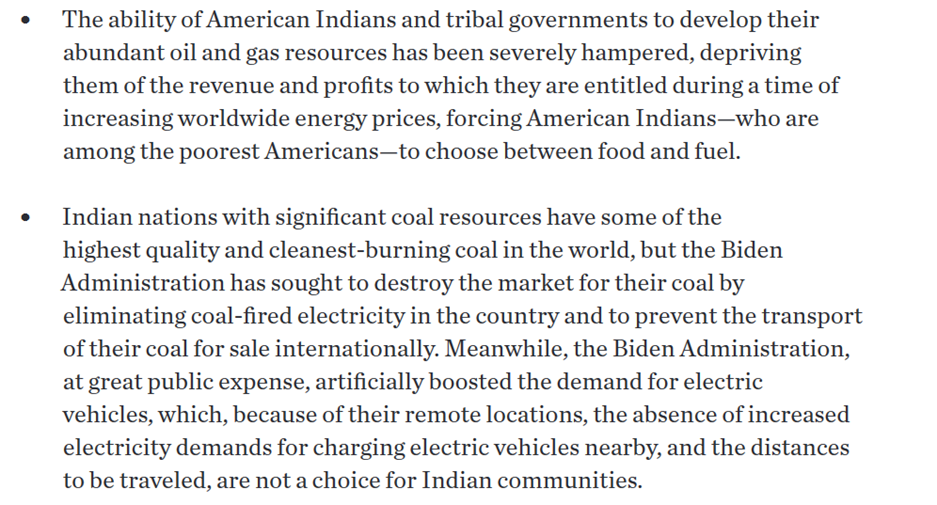
For Project 2025, it was simple: “A significant percentage of critical minerals need by the United States is on Indian lands, but the Biden Administration has actively discouraged development of critical mineral projects on Indian lands rather than assisting in their advancement”(536-537).
Drill, baby, drill.
There are Indigenous nations that have aggressively exploited their mineral wealth. The Crows are an example of a Native Nation that has seen in mining its rich coal fields a path out of poverty, and they have placed mining over the health and environmental consequences of mining. Project 2025 would have the Republican Party “end the war on fossil fuels and domestically available minerals and facilitate their development on lands owned by Indians and Indian Nations.” The federal government should no longer require Indigenous Nations to adhere to federal environmental policies. The government should open tribal lands for corporate exploitation, and Project 2025 respected tribal sovereignty so far as it made it easier to extract the mineral wealth in Indian Country.
In February of 2025, the Trump Administration removed from the Department of Justice the “Not One More” Report, which contained recommendations from the Not Invisible Act Commission to the federal government on how best to address the growing numbers of MMIWG. It was removed after federal agencies eliminated public documents that contained words or phrases that the new regime found objectionable, like “Native American” and “Indigenous community.” We must not talk about difficult topics, the Administration implied, and we will no longer consider the suffering of communities of color as a matter of public importance.
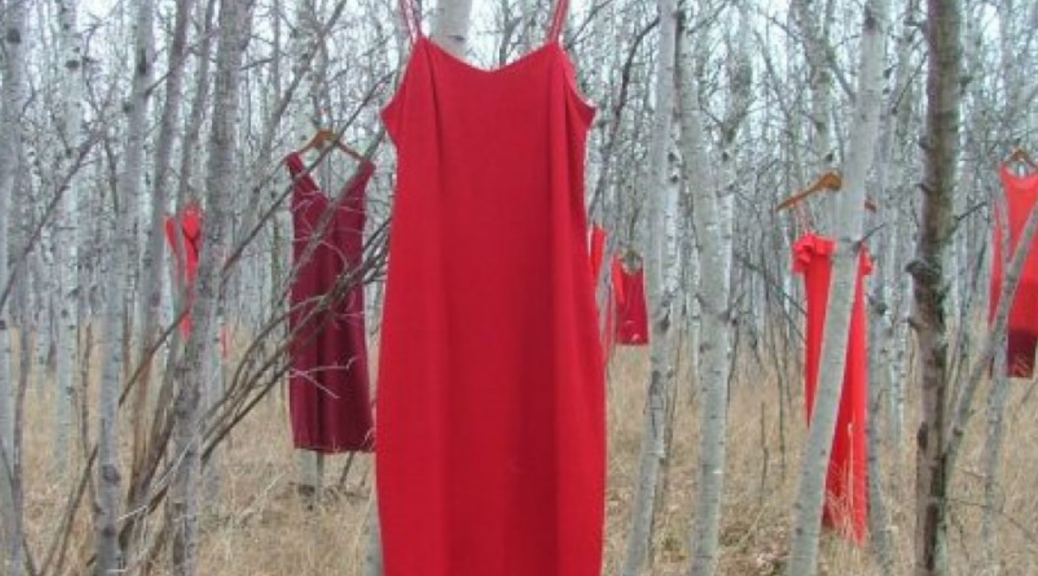
I write these words on May 5th. It is Red Dress Day, for awareness of missing and murdered Indigenous women and girls. The President has not revisited his proclamation. Trump has retreated, or forgotten about, his own very limited commitment to this very important issue.
Several years ago the Indigenous journalist Connie Walker, whose reporting has done significant work to bring the crisis of MMIW to audiences across North America, pointed out in an interview on NPR that “this issue of violence against Indigenous women and girls isn’t a new issue. This is something that has been going on for decades . . .centuries, even.” What has changed in the recent past, Walker continued, is “there’s a growing awareness of this crisis, and there’s a growing awareness about the impacts of that violence on the lives of Indigenous women and girls.”
Yet I worry that this crisis will not hold the attention of the American people for long, even more so without national leadership. Solving this project is one that demands empathy and historical understanding. Both have been in remarkably short supply of late. There are no easy solutions, and it is difficult to truly discern the true scope of the problem. It has been going on for so long.
It was there at inception. It was present when Christopher Columbus sailed into the Caribbean, his eyes scanning for those things that he hoped would make him a wealthy man. He found no gold, no silver, but he did see a young girl, swimming in the sea. “They should be good and intelligent servants, for I see that they say very quickly everything that is said to them; and I believe that they would become Christians very easily, for it seemed to me that they had no religion.” In 1495, Columbus enslaved over 1600 Indians, and sent home to Spain “the best males and females.”
Columbus saw a girl,
Splashing in the waves.
He couldn’t find gold.
So he started taking slaves.
It never stops. It rings in your ears as you read this history. The Queen of Paspahegh, captured with her children by the English after they burned her town and wiped out the Algonquian soldiers who defended it. The English officer in charge allowed his men to throw the children into the James River, and to amuse themselves by blowing out their brains in the water. The Queen of Paspahegh, traumatized land grieving her murdered children like so many Indigenous women, was led away from the English fort and stabbed to death in the woods by an executioner too weary to burn her. Algonquian women who surrendered during King Philip’s War in New England, trafficked and sent to death in West Indian Slavery, or torn limb from limb by English dogs of war. The mutilation of Indigenous women’s bodies at Sand Creek and at other sites of genocidal violence. The story has not stopped. Indigenous women go missing, and they die.
It is difficult to criticize a man who believes in nothing for abandoning principles he never clearly held. Trump strikes me as an empty shell, and for him the measure of justice is not how well the weakest and most vulnerable members of a community are treated, but whatever benefits him the most. And as the Epstein scandal has seemingly made quite clear, cruelty against young women and girls has never slowed Trump down. The Epstein victims. Missing and murdered Indigenous women. In each instance, Trump walked away. Nobody who has followed his political career can be surprised by this.