
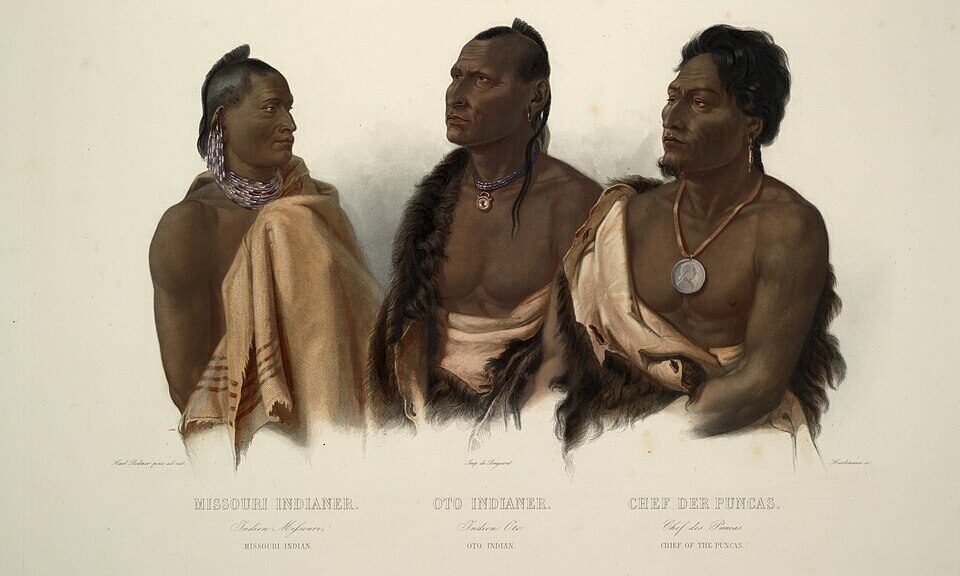
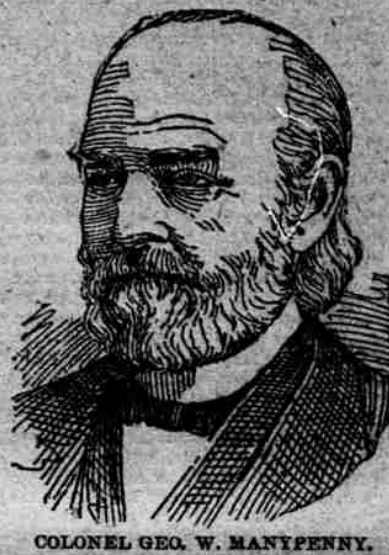
It was news to me that George W. Manypenny, who served as Commissioner of Indian Affairs under President Franklin Pierce, had published a memoir twenty-five years after he left the Bureau. During his tenure, he oversaw and, in some ways, first implemented the policy that many historians call “concentration,” an attempt to place the Indigenous peoples of the trans-Mississippi West on reservations on the northern and southern plains, in effect creating a thoroughfare across the continent for the hordes of settlers moving westward.
Manypenny oversaw the negotiation of more than fifty treaties during his four years in office, an unprecedented number, he boasted. Every year, I have my students read one of these treaties, the 1854 accord he negotiated with the Oto and Missouris. Like the other “concentration” treaties, this agreement involved a cession “to the United States [of] all their country west of the Missouri River, excepting a strip of land on the waters of the Big Blue River.” The Otos and Missouris would within one year “vacate the ceded country and remove to the lands” the treaty set aside as their reservation.
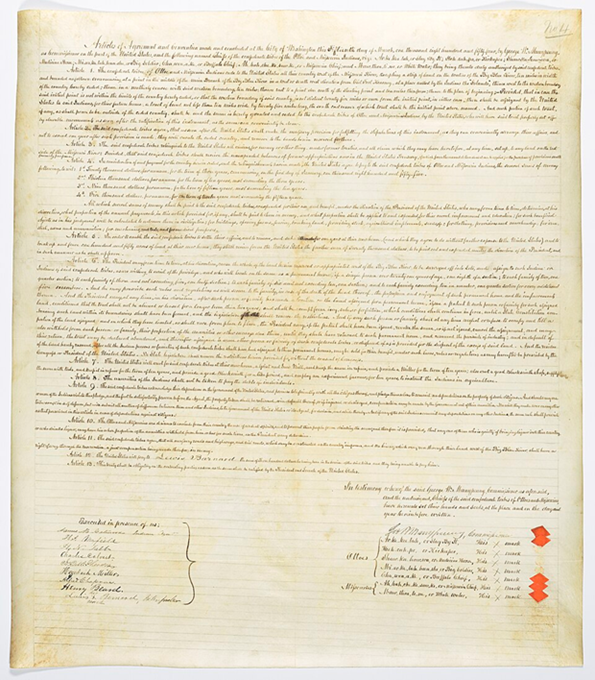
Manypenny, nonetheless, saw reservations as a temporary expedient. He already looked forward to the policy of allotment. The 1854 treaty, for instance, authorized the President, “at his discretion” to “cause the whole of the land herein reserved or appropriated west of the Big Blue river, to be surveyed off into lots, and assigned to such Indian or Indians of said confederate tribes, as are willing to avail of the privilege, and who will locate on the same as a permanent home.” In time, and again at his discretion, the President might “issue a patent to such person or family for such assigned land, conditioned that the tract shall not be aliened or leased for a longer term than two years; and shall be exempt from levy, sale, or forfeiture, which conditions shall continue in force, until a State constitution embracing such land within its boundaries shall have been formed, and the legislature of the State shall remove the restrictions.”
Turn Indians into farmers. Let them hold their land like their growing numbers of white neighbors. Of course, strings were attached, and Manypenny felt that Indigenous peoples must have the coercive assistance of the government to stay on task. If the recipient of this grant of land “shall at any time neglect or refuse to occupy and till a portion of the land assigned, and on which they have located, or shall rove from place to place, the President may, if the patent shall have been issued, revoke the same, or, if not issued, cancel the assignment.”
Manypenny, like many commissioners, felt he had the Indians’ interests at heart. He knew better than they their needs for development, improvement, and survival. I have not seen any evidence that he spent much time asking Indigenous people their thoughts. He might have denied it, but the approach was coercive, colonial. In his final annual report, he explained why. Several months before James Buchanan became president, Manypenny boasted of his accomplishments. “In no former equal period of our history,” he wrote, “have so many treaties been made, or such vast accessions of land been obtained.” Still, he believed that the reservation system already had flaws. “The existing laws for the protection of the person and properties of the Indian wards of the Government are sadly defective.” Manypenny complained of “lawless” white men, Americans, driven by “the rage for speculation” and “the wonderful desire to obtain choice lands.” He lacked the power to do anything about it. “Trespasses and depredations of every conceivable kind have been committed upon the Indians,” he wrote. “They have been personally maltreated, their property stolen, their timber destroyed, their possessions encroached upon, and diverse other wrongs and injuries done them.”
Manypenny did not believe it was possible to move the Indians out of the way of the advancing and land-hungry white settlers. No, he said. Referring to the Indigenous people living in Kansas, he wrote that “they must meet their fate upon their present reservation in that Territory, and there be made a civilized people, or crushed and blotted out.” And because the government, in his view, could neither move the concentrated nations once again nor control its own settlers, Indigenous peoples would have to change. They would give up their culture, relinquish their own rich religious traditions and, where they had not done so already, become Christians. They would come to hold their land in fee simple title, like their white neighbors, protected by a code of laws that extended to them the same rights of citizenship.
I do not doubt that Manypenny held his beliefs deeply and sincerely. He was not alone. But not only does it seem naïve, but oblivious to context as well, for there was ample evidence even in the 1850s that too many white people would never respect Indigenous property rights. The evidence was right in front of him.
If there were a think tank for Indigenous affairs in the middle of the nineteenth century, Manypenny likely would have worked there. He kept his hand in Indian affairs after his term as commissioner expired. Ulysses Grant sent him in 1876 to negotiate peace with the Sioux. Manypenny served both Democrats and Republicans. Need an expert on Indigenous concerns? Manypenny might be your guy.
So I was curious when I learned that in 1880 he published Our Indian Wards, written during a period where American policy-makers had reached the conclusion that concentration was inadequate, and that additional steps must be taken to solve the nation’s “Indian problem.” In his introduction, Manypenny claimed that he wanted his book “to render service in the amelioration of the condition of our Indian population.” The American Nation’s treatment of its “wards,” he wrote, “is a sickening detail of outrage, robbery, and murder.” Land lay at the heart of the matter. Indians had it, and white people wanted to take it from them. All the “border wars,” he wrote, stemmed from white land hunger. Beginning at Jamestown in 1607, “it was no fault of the natives that relations of peace and good will were not successfully cultivated.”
Successive governments broke treaty after treaty. Beneficial policies, when put in place, failed because government agents “have frequently proved faithless, and soldiers sent to protect the tribes not only have been cruel and vindictive, but often have introduced demoralization and carried disease among them.” It was a very old tune, Manypenny suggested, and “in fact (though it may seem paradoxical), it is true, that the white man’s conduct and example, instead of aiding, has been the chief obstacle in the way of civilization of the Indian.”
It was time for a change. “Is it not time that the government and people of the United States should resolve that justice and fair dealing shall be substituted for that coldness, sordid selfishness, and cruelty which the native race has endured in all the years of the past?” Manypenny thought so. “The Indian is not only entitled to justice at our hands, but we should extend to the race our earnest sympathy and aid. Our wards,” he said, “should have our best efforts for the amelioration of their condition.”
So what did Manypenny propose? “A fixed and settled home” for Indigenous peoples, he said, was imperative. Like many of his contemporaries, he had accepted allotment as vital, but he urged some small amount of caution. “To each head of a family there should, within the reservation, be assigned a homestead.” It should contain a “not excessive” number of acres. And the Indigenous assignee “should be taught that he is the proprietor, with the right to exercise jurisdiction over his farm, and be secured in the enjoyment of all he produces upon it.” He had to have known that this had been tried before, and that it had not worked in the way its advocates hoped. Nonetheless, he felt it was important to push forward, “though the title to the land should remain in the tribe, since the Indians are generally not prepared for fee-simple titles.” Private property could work magic, American policy-makers believed, but it could only be entrusted to proper hands. “When the tribe is permanently located on the reservation, and the integrity of the same is placed beyond question, and when those disposed to intrude upon the possessions of the red man understand, that if done, it is at their peril, and that certain and swift punishment will follow, the work of the agent may be successfully prosecuted.” And these agencies “should be confided to none but men of the highest character for integrity, or good executive ability, and industrious habits.”
Manypenny offered a host of other suggestions. All of them had been tried before. Not a new idea in sight. Indigenous women, he said, “must cease to do the outdoor work, and confine themselves to domestic duties and the cares of the house and the family.” Each agency must have a Christian missionary of good character, and a “brief and simple code of regulations” prepared by the Bureau of Indian Affairs and enforced by Indigenous officers could help keep order. After all, “the present laws for the protection of the Indians from intrusion, trespass, and personal injury by lawless whites, are wholly inadequate. The attention of Congress has been repeatedly called to this fact.” Maybe this time if we try all those things we have tried before it will work out differently.
Manypenny wanted his work to matter, his book to be one of consequence. He wanted to be heard and listened to. If his book had “any agency in arousing the public mind, and quickening the consciences of the people, to the end that our Indian wards may, in some degree, have that attention which is demanded by every sentiment of justice and every impulse of humanity, so that oppression and cruelty shall give place to just and fair treatment, and thus their path of life be made not only bearable, but strewn with such aid, instruction, and sympathy as will win them from their wild life, and induce them to accept the comforts of civilization and a settled home, the writer will be abundantly repaid for his labor.” Manypenny wished that a “better and brighter day may speedily come to the despised Indian.” But even as his book made its way towards publication, the Otos and Missouris were being driven from the Big Blue reservation they received in 1854.
I find the feckless crusader a frustrating historical character. Manypenny published his book just a year before Helen Hunt Jackson’s A Century of Dishonor appeared. Like her, he wrote a history of promises broken, treaties ignored, avarice enshrined as policy, massacres repeated and unpunished. Like her, he had little to offer by way of a solution other than we should do what we have done before but this time get the right people. An expert with no answers is not much of an expert at all.

Manypenny hoped that Americans might be better than what history showed them to be. Men like Manypenny had been expressing the hope that white settlers would follow the laws and the rules designed to protect or keep the peace with Indigenous peoples for over three centuries in North America by the time he wrote. Manypenny could either not see, nor admit, that dispossession of Indigenous peoples was as central to this country’s identity as life and liberty, and that many, many Americans saw the taking of lands from Indians as the best way to pursue happiness.
People like Manypenny make writing Native American history exhausting. The problem was obvious: too many Americans were Indian-hating racists who would stop at nothing to get their hands on Indigenous land. To solve that problem—in essence to keep Americans from being American—would have required a forceful assertion of the importance of respecting Indigenous rights. That this was a political impossibility is an indictment as much as it is an explanation. In a country founded and reliant for its shape on Indigenous dispossession, a crime in which nearly every person living on this continent is either implicated, a beneficiary, or both, it is so tiring to try to find one American leader who acted with competence, principle, and courage. When everyone in a country is guilty of a crime, after all, it is easy to dismiss the charge, to cast the crime as natural, inevitable, or part of God’s manifest design. That is the truth that Manypenny failed to confront. He was not alone.
