
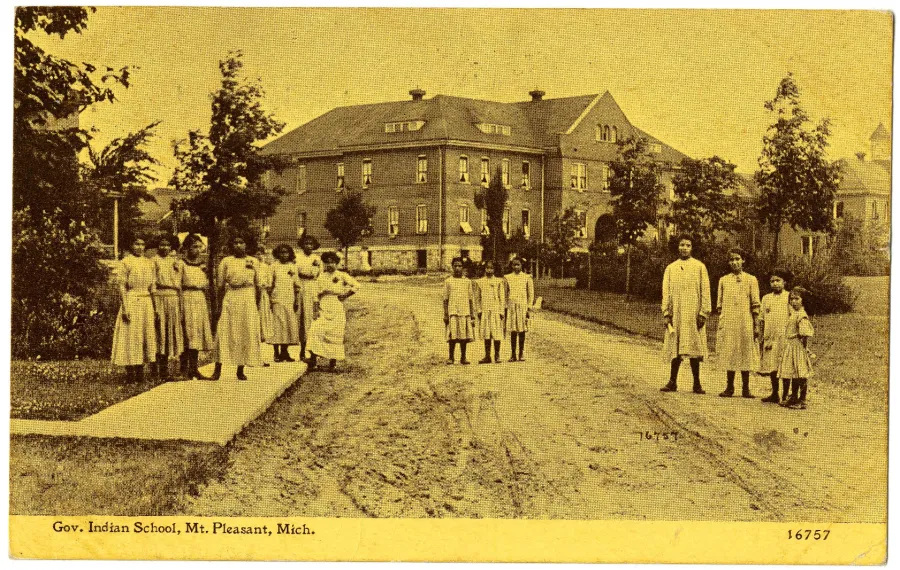
There is something fishy going on with a state-sponsored investigation of Indigenous boarding schools in Michigan. As one headline put it, “Michigan Spent $1.1M Probing Tribal Boarding Schools Then Buried the Results.”
Governor Gretchen Whitmer had called for an investigation in 2022, but the state’s Department of Civil Rights refused to release the resulting 283-page report. No representatives from the Department of Civil Rights or the State Attorney General’s office attended a hearing held recently by the state legislature to explain why this was the case. Some sources have suggested that the report was “shoddy.” Others have suggested that the report bore little resemblance to the original assignment. Others still have suggested that releasing the Report could retraumatize survivors.
In order to try to sort this out, I decided to read the report, which an independent and non-profit news outlet called Bridge Michigan made public. Produced by an Indigenous-owned firm from Washington State called Kauffman and Associates, the document it produced is titled Native American Boarding Schools in Michigan: Final Report.
It’s far from perfect. The research is admittedly preliminary, despite the report’s title. The primary sources necessary to tell the story of Michigan’s boarding schools are extremely difficult to access, owing to the resistance of Catholic authorities. Marquette University has recently digitized the Bureau of Catholic Indian Missions Correspondence Files, but this is only a very first step. Kauffman and Associates had to produce a detailed report in a limited amount of time. There is a lot of material they were not able to examine, and I cannot imagine a historian, who wanted to write a book on boarding schools in Michigan, finishing a thorough and satisfying work in so few years. There is so much material that the Report’s authors did not have time to assess. This is not the authors’ fault.
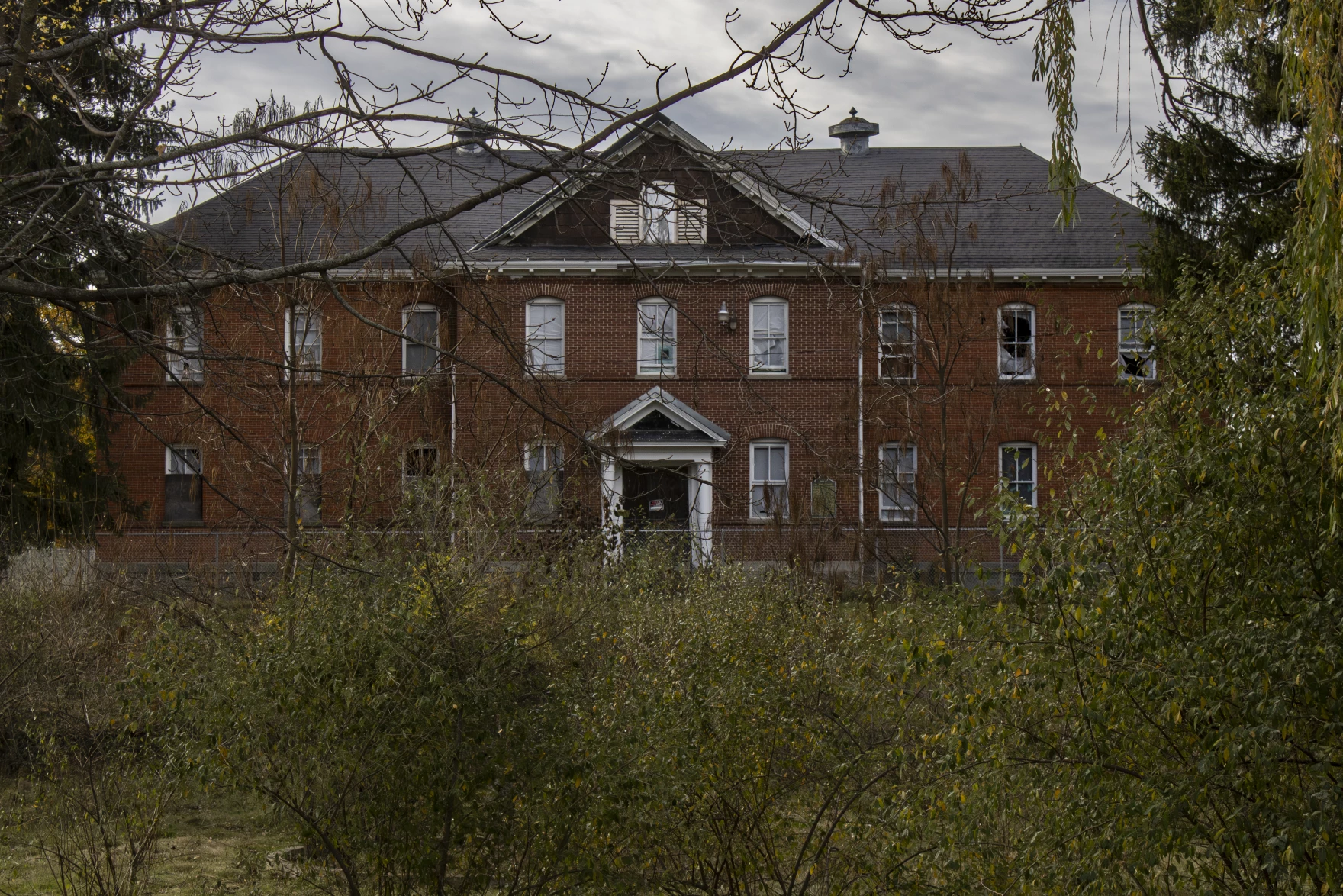
The bulk of the report relies on survey responses by thirty Michigan boarding school survivors, and 165 “Descendants, who shared what they knew, experienced, remembered or had heard about the state’s boarding schools. Identifying and interviewing the dwindling number of aged survivors must be a priority if the State is interested in bringing about healing, reconciliation and justice. There are more voices out there, and this report’s sample is small. It is unclear the relationship between “survivors” and “descendants.” Descendants tended to be much more harsh in their assessment of boarding schools than did survivors. For anyone who has read Brenda Child’s important essay, “The Boarding School as Metaphor,” this is not surprising at all.
Survivors and descendants both recognized the schools’ genocidal intention to erase Indigenous identity. Teachers routinely used derogatory language to describe their students. 78% of survivors and 90% of descendants said that children were not permitted to practice their culture. Many survivors said that they learned to feel shame about being Indigenous. Some former students adopted a range of “dysfunctional coping” methods, and some students committed suicide. Some of the students suffered from malnutrition. Survivors and descendants agreed about this. They also reported sadistic punishments, long hours of work in a system reliant on the exploitation of their labor, and separation from the many tender ties of family. Some survivors passed on the destructive tendencies they learned to their descendants, producing intergenerational trauma. They faced coercive attempts to persuade them to accept Christianity, seldom saw a doctor if they fell ill, and faced abuse and neglect.
There is nothing in the Michigan report that will surprise those who are familiar with the long history of Native American boarding schools in the United States. For that reason, the apparent decision to shelve the report is puzzling. There is not much that is new here. There was, however, in the report a list of recommendations that Kauffman and Associates felt the governor and state legislature should enact, and these may have raised the hackles of racists who objected to the breadth of the commitment they envisioned. Thinking in terms of the Four Directions, the Kauffman report said that the East is represented by “yellow, spring, childhood, and spirituality,” which corresponded to the early stage of reparations and the work towards healing. By following these “East Recommendations,” Michigan would “contribute to the spiritual healing within Native communities by recognizing harm, empowering families to reclaim their lost histories and identities, and be a step toward restoring balance.”
It is not hard to imagine that a state bureaucrat might conclude that these recommendations come at too high a price. For Michigan to “acknowledge that it has an inherent and ongoing obligation to provide for the educational interests of Indian nations” in the state, and that the state “has also knowingly neglected this obligation, contributing to the harm experienced under its oversight,” is a heavy lift in Trump’s America, where the white people of the past could do no wrong. To “acknowledge that its actions and inactions associated with Native American boarding schools, have caused significant damage to the education, health, and well-being of Tribes and their citizens,” might be seen as a heavy burden indeed.
Does Michigan want to make things better? Then the state “must embrace the broadest, most inclusive approach in its efforts to address” the problems boarding schools created, and the governor must issue “an executive order as an official apology that recognizes its deliberate participation in the national policy if Native American boarding schools.” Find the evidence. Force the Catholic Church, using the subpoena power of the state legislature, to turn over its documents, and fully fund the mammoth task of documenting the causes and consequences of Michigan’s boarding school era.
Words and apologies are not enough. And it cannot be a top-down solution. Within six months to a year of the report’s publication, as the first of its “south recommendations” that “can contribute to the emotional healing within Native communities by fostering justice and accountability, honoring lived experiences, respecting Tribal knowledge, restoring familial bonds, and creating spaces for cultivating genuine healing,” the report recommended that the state “consult with the Tribes on all state activities surrounding Native American boarding schools. Michigan should, as well, “provide financial support for ongoing research regarding its role in the development and perpetuation of Native American boarding schools as well as the aftermath.” In addition to providing financial support for research and to remedy the damage done, Michigan would as well “support individual and community tribal healing by providing resources, programs, and funding committed to addressing the trauma caused by Native American boarding schools.” The state must fix what it broke, repair what it damaged, and provide a full record of its actions to be taught to children in all of Michigan’s schools, and “eliminate the statute of limitations for sexual and physical abuse charges involving minors in Michigan.”
The West recommendations would “contribute to physical healing with Native communities by restoring resources necessary for healing and well-being and fostering reconnections to traditional knowledge and cultural practices that promote wellness.” When a state tries to eradicate a culture, there are going to be costly consequences, so the state must investigate the misuse of federal trust funds by state authorities and support financially language revitalization programs. When much is broken, much must be repaired.
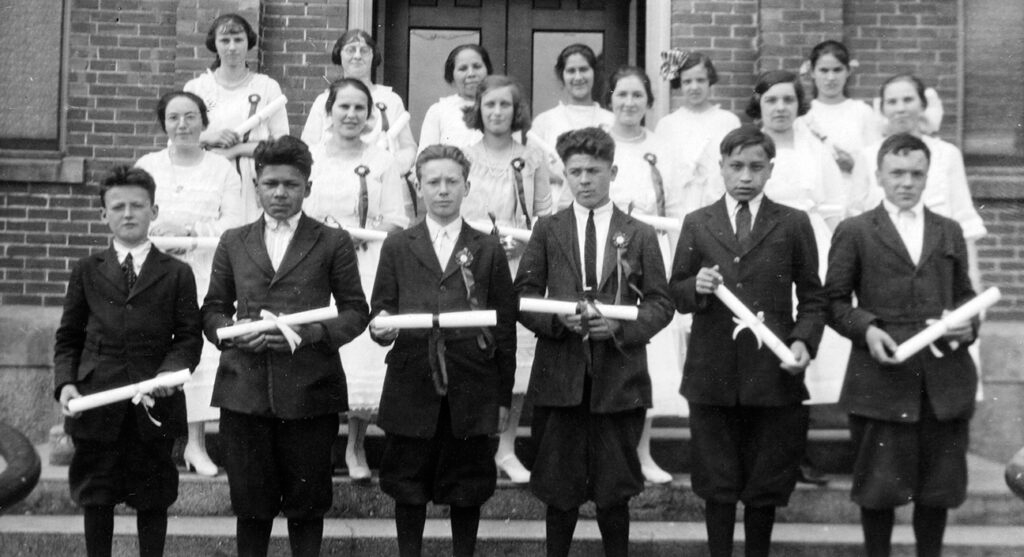
EVERY STEP OF THE WAY, “transitional justice should be used as the frameworks for all recommendations.” In a world where Donald Trump’s executive orders banish discussions of the Nation’s past that focus on enslavement and dispossession, and in which DOGE cutsmic funds from proposals with worlds like “tribal” contained therein, I find it easy to imagine how concepts like transitional justice would alienate racist Republicans and timorous Democrats. It is an approach, after all, “designed to transform societies into rights-respecting democracies while addressing past human rights violations.” It embraces things the Trump administration has rejected explicitly, and that Democrats approach with extreme caution and a noticeable lack of enthusiasm: “criminal prosecutions, truth commissions, reparations programs, institutional reforms, memorials, apologies and art.”
There is much more to learn about boarding schools in Michigan, the report’s authors suggest. This work must be undertaken carefully and critically. But even with the evidence collected thus far and included in the report, the remaining questions are simple. How serious is Michigan about setting things right? Was this undertaking more than a performative gesture? Are the recommendations the report made too big a request for a settler state to address honestly and seriously? Now that we know what we know about Michigan’s boarding schools, what is the state government willing to do about it? I hope I am wrong, but the apparent decision to shelve the report suggests to me that the answer will be, distressingly, “not very much at all.”
